Consumer Behavior: Organic Food, Marketing, and Valley Campaign
VerifiedAdded on 2023/01/19
|14
|2843
|45
Case Study
AI Summary
This case study analyzes consumer behavior towards organic food, exploring perceptions, attitudes, and motivations of consumers in Australia and globally. The study highlights the increasing demand for organic products, driven by health and environmental concerns, while also addressing challenges like high costs and consumer skepticism. It examines the influence of demographic factors and consumer values on purchasing decisions. The case study further investigates marketing strategies employed to promote organic foods, including influencer marketing and digital channels, and evaluates the Organic Valley campaign, focusing on its innovative approach and communication strategies. The analysis covers the campaign's effectiveness in building brand awareness and consumer loyalty, alongside its marketing tactics, and provides an evaluation of the company's strategies and recommendations.
Consumer behaviour1
CONSUMER BEHAVIOUR
Name:
School:
Department:
Date:
CONSUMER BEHAVIOUR
Name:
School:
Department:
Date:

Paraphrase This Document
Need a fresh take? Get an instant paraphrase of this document with our AI Paraphraser
Consumer behaviour 2
Abstract
The organic food quest has been quickly increasing globally, due to an improvement in the
awareness of ecological and health problems. Even though the demand is growing, natural food
popularity is not extensive, and the perceptions of organic foodstuff differ in the broad
community. This paper demonstrates that in Australia and other nations; there has been a
difference in individual’s awareness of organic food and agriculture, variations in users’
attitudes, behavior and motivations within the consumer class. Users’ perceptions have probably
varied over time. A large portion has been identified as knowing organic food. Health benefits
were the main motive for buying organic produce while the high rate was the key restrictive
factor to buying organic merchandise. There have been numerous findings connected to the link
between the natural food user and subjective components such as income, age, gender, a home
with kids, family size and education. Even though most users showed optimistic outlooks
towards organic goods and articulated their buy plans, their degree of their confidence in organic
goods level and certification are crucial elements swaying the buyer's decision of purchasing
organic foodstuffs.
Abstract
The organic food quest has been quickly increasing globally, due to an improvement in the
awareness of ecological and health problems. Even though the demand is growing, natural food
popularity is not extensive, and the perceptions of organic foodstuff differ in the broad
community. This paper demonstrates that in Australia and other nations; there has been a
difference in individual’s awareness of organic food and agriculture, variations in users’
attitudes, behavior and motivations within the consumer class. Users’ perceptions have probably
varied over time. A large portion has been identified as knowing organic food. Health benefits
were the main motive for buying organic produce while the high rate was the key restrictive
factor to buying organic merchandise. There have been numerous findings connected to the link
between the natural food user and subjective components such as income, age, gender, a home
with kids, family size and education. Even though most users showed optimistic outlooks
towards organic goods and articulated their buy plans, their degree of their confidence in organic
goods level and certification are crucial elements swaying the buyer's decision of purchasing
organic foodstuffs.
Consumer behaviour 3
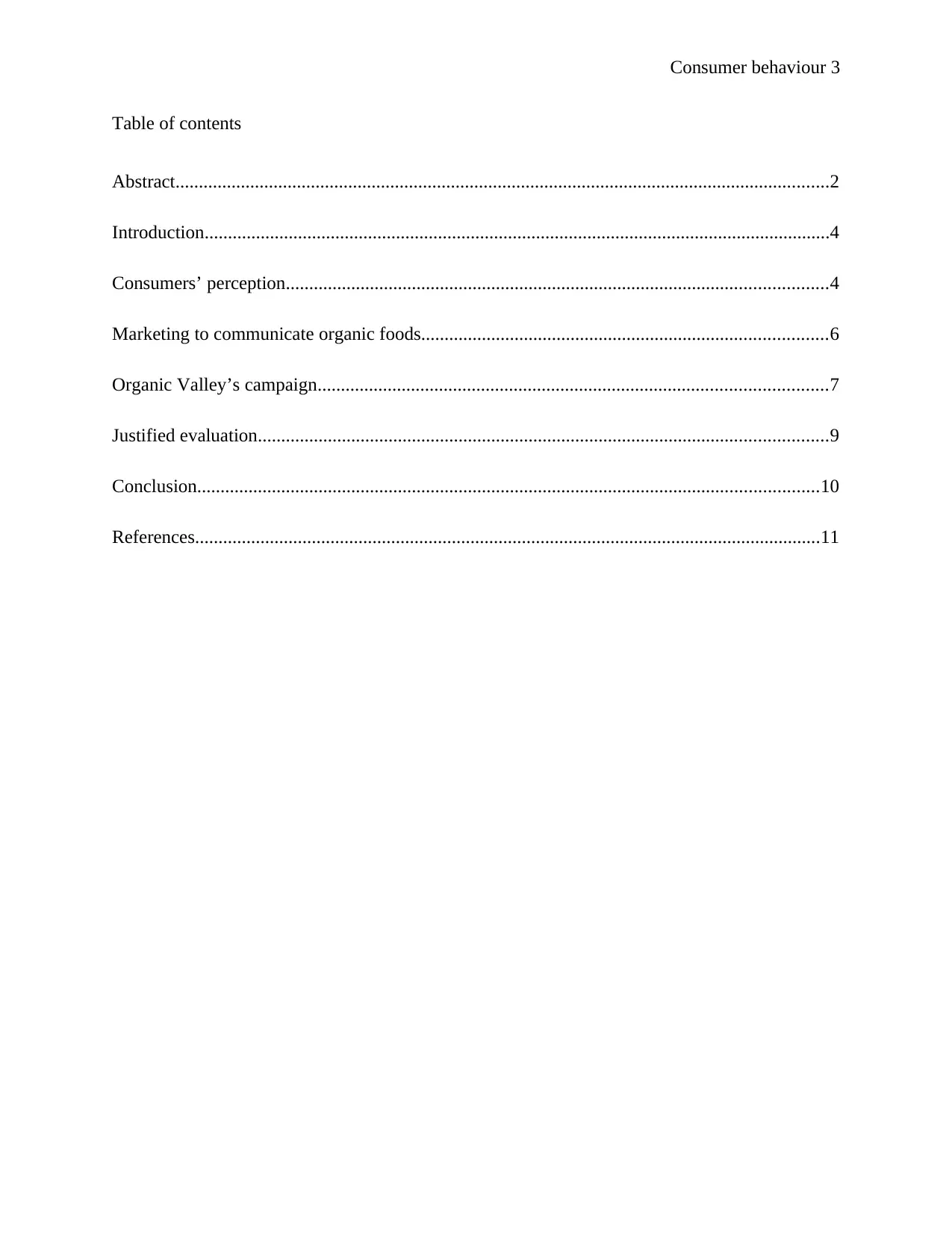
Table of contents
Abstract............................................................................................................................................2
Introduction......................................................................................................................................4
Consumers’ perception....................................................................................................................4
Marketing to communicate organic foods.......................................................................................6
Organic Valley’s campaign.............................................................................................................7
Justified evaluation..........................................................................................................................9
Conclusion.....................................................................................................................................10
References......................................................................................................................................11
Table of contents
Abstract............................................................................................................................................2
Introduction......................................................................................................................................4
Consumers’ perception....................................................................................................................4
Marketing to communicate organic foods.......................................................................................6
Organic Valley’s campaign.............................................................................................................7
Justified evaluation..........................................................................................................................9
Conclusion.....................................................................................................................................10
References......................................................................................................................................11
⊘ This is a preview!⊘
Do you want full access?
Subscribe today to unlock all pages.

Trusted by 1+ million students worldwide
Consumer behaviour 4
Introduction
The demand for organic foodstuffs has been progressing rapidly globally. Australia and New
Zealand are the main exporters of organic produce with key export goods being natural wool,
beef, Kiwi fruit, pear, and apple. Organic farming is a production scheme that safeguards the
health of top soil, individuals, and environment (Willer, Lernoud and Kemper 2018). The
technique depends on ecological routine, cycles and biodiversity adapted to native states, rather
than the application of inputs with severe impacts. Organic farming blends the innovation,
convention, and technology to benefits the shared ecology and promotes right coalition and
improved value of life (Stolz, Jahrl, Baumgart and Schneider 2010).
Consumers’ perception
According to the research findings, Australian users had positive viewpoints towards organic
foodstuffs and conveyed their views in the environmental and health paybacks of organic foods
(Rosen 2010). The benefits of consumer's opinions concerning this sort of diet were deliberated
in their procurement focus. Moreover, positive natural views were established to be connected to
self-transcendence principles. Mainly, individual values connected to environment, nature, and
parity were established to confidently project pro-organic foodstuff opinions rather than values
that rotate around the honesty, loyalty, devoutness, helpfulness and social justice
(Sangkumchaliang and Huang 2012). Organic food users were eager to buy finest for secure and
ecologically friendly foodstuffs and were also prepared to use more organic foodstuffs if they
were accessible. Consumers who had a positive attitude towards organic goods were women
particularly less than 40 years old (Voon, Ngui and Agrawal 2011).
Generally, the intent to buy organic produce reduces with limitations of awareness and
knowledge towards those foodstuffs, with numerous aspects influencing user's views and
Introduction
The demand for organic foodstuffs has been progressing rapidly globally. Australia and New
Zealand are the main exporters of organic produce with key export goods being natural wool,
beef, Kiwi fruit, pear, and apple. Organic farming is a production scheme that safeguards the
health of top soil, individuals, and environment (Willer, Lernoud and Kemper 2018). The
technique depends on ecological routine, cycles and biodiversity adapted to native states, rather
than the application of inputs with severe impacts. Organic farming blends the innovation,
convention, and technology to benefits the shared ecology and promotes right coalition and
improved value of life (Stolz, Jahrl, Baumgart and Schneider 2010).
Consumers’ perception
According to the research findings, Australian users had positive viewpoints towards organic
foodstuffs and conveyed their views in the environmental and health paybacks of organic foods
(Rosen 2010). The benefits of consumer's opinions concerning this sort of diet were deliberated
in their procurement focus. Moreover, positive natural views were established to be connected to
self-transcendence principles. Mainly, individual values connected to environment, nature, and
parity were established to confidently project pro-organic foodstuff opinions rather than values
that rotate around the honesty, loyalty, devoutness, helpfulness and social justice
(Sangkumchaliang and Huang 2012). Organic food users were eager to buy finest for secure and
ecologically friendly foodstuffs and were also prepared to use more organic foodstuffs if they
were accessible. Consumers who had a positive attitude towards organic goods were women
particularly less than 40 years old (Voon, Ngui and Agrawal 2011).
Generally, the intent to buy organic produce reduces with limitations of awareness and
knowledge towards those foodstuffs, with numerous aspects influencing user's views and
Paraphrase This Document
Need a fresh take? Get an instant paraphrase of this document with our AI Paraphraser
Consumer behaviour 5
outlooks (Sweeney 2018). In customer behavior model, users create their personal choices
centered on a person's plan to act a behavior, which is swayed by beliefs. Users choose whether
to purchase or not grounded on three core features: purpose, knowledge, and attitudes (Willer,
Lernoud and Kemper 2018). User's experience is a build that influences how and what users
decide to purchase. People's experience is affected by the quality and type of info made
accessible to users. Processing, promotion, cognizance of certification and tags, all take an
essential part in knowledge enrichment. Therefore, awareness and knowledge are necessary for
the user's behavior (Sweeney 2018).
Moreover, demographic traits are also crucial elements for buying deeds, which can describe the
buying of organic goods (Ahmad and Juhdi, 2010). Distinct socio-demographic comprise
economic characteristics such as household and personal income and are frequently
encompassed as a determinant of choice. If someone cannot keenly distinguish between
conventional and organic products, a rate premium on organic food can puzzle and impact the
individuals' buying choice. User's age, marital status, household dimension, a kid in the family,
along with goods’ traits, affects their preferences and attitudes to purchasing the goods (Ahmad
and Juhdi, 2010).
Even though Australia is main importer of organic producers, not much is well-known about the
country users' projection of upcoming organic foods, because a little study on this matter has
been done and printed (Worsley, Wang and Ridley 2015). Additionally, limited studies are
concentrating on user’s anticipation of organic produce in the future in other nations. Earlier
researches have stated the user's call for info about the manufacture, handling, and accreditation
of organic foodstuffs. Willer, Lernoud and Kemper (2018) suggest that individuals have an
aspiration to experience an authentic and natural organic produces, but users are very cynical that
outlooks (Sweeney 2018). In customer behavior model, users create their personal choices
centered on a person's plan to act a behavior, which is swayed by beliefs. Users choose whether
to purchase or not grounded on three core features: purpose, knowledge, and attitudes (Willer,
Lernoud and Kemper 2018). User's experience is a build that influences how and what users
decide to purchase. People's experience is affected by the quality and type of info made
accessible to users. Processing, promotion, cognizance of certification and tags, all take an
essential part in knowledge enrichment. Therefore, awareness and knowledge are necessary for
the user's behavior (Sweeney 2018).
Moreover, demographic traits are also crucial elements for buying deeds, which can describe the
buying of organic goods (Ahmad and Juhdi, 2010). Distinct socio-demographic comprise
economic characteristics such as household and personal income and are frequently
encompassed as a determinant of choice. If someone cannot keenly distinguish between
conventional and organic products, a rate premium on organic food can puzzle and impact the
individuals' buying choice. User's age, marital status, household dimension, a kid in the family,
along with goods’ traits, affects their preferences and attitudes to purchasing the goods (Ahmad
and Juhdi, 2010).
Even though Australia is main importer of organic producers, not much is well-known about the
country users' projection of upcoming organic foods, because a little study on this matter has
been done and printed (Worsley, Wang and Ridley 2015). Additionally, limited studies are
concentrating on user’s anticipation of organic produce in the future in other nations. Earlier
researches have stated the user's call for info about the manufacture, handling, and accreditation
of organic foodstuffs. Willer, Lernoud and Kemper (2018) suggest that individuals have an
aspiration to experience an authentic and natural organic produces, but users are very cynical that
Consumer behaviour 6
such info is offered as an advertising tool. Organic users believe that usage of natural
components contributes not merely private health and safety but also to broad societal and
ecological objectives, which the public benefits entirely (Van Loo, Diem, Pieniak and Verbeke
2013).
Marketing to communicate organic foods
Challenge faced by organic food manufacturer is lack of marketing abilities. It leads to the
manufacturers facing tests from having to contest with superstore outlets. Most of the organic
dealers are smaller as matched to the orthodox foodstuff sellers. It leads to cessation of those
natural foodstuffs that are slow-moving, therefore upsetting the already emerging fashion.
Furthermore, most of the nations have not advanced labeling rules. Customers will have extra
self-assurance when buying branded merchandises. It is fundamental for reassurance of quality
bearing in mind there are several self-proclaimed “organic foodstuffs” in the marketplace.
Several marketers are investing more in influencer marketing as these content builders can assist
engage users in authentic ways. Many marketers plan to increase their influencer marketing
budgets in 2019 and take a sophisticated approach. Additionally, the marketing can use other
digital marketing channels such as the use of Facebook, Instagram, LinkedIn, Google plus and
Twitter. The above channel can use the metrics such as referrals, likes, and recommendations to
gauge the competition level posed by non-organic foodstuffs. The social media metrics allow the
marketer to engage the customer and also respond in case of negative company’s reviews.
Organic Valley’s campaign
According to the company, it will create a change in today's biosphere if it is going to think in a
different way. The company’s values and choices are founded on the health and well-being of
such info is offered as an advertising tool. Organic users believe that usage of natural
components contributes not merely private health and safety but also to broad societal and
ecological objectives, which the public benefits entirely (Van Loo, Diem, Pieniak and Verbeke
2013).
Marketing to communicate organic foods
Challenge faced by organic food manufacturer is lack of marketing abilities. It leads to the
manufacturers facing tests from having to contest with superstore outlets. Most of the organic
dealers are smaller as matched to the orthodox foodstuff sellers. It leads to cessation of those
natural foodstuffs that are slow-moving, therefore upsetting the already emerging fashion.
Furthermore, most of the nations have not advanced labeling rules. Customers will have extra
self-assurance when buying branded merchandises. It is fundamental for reassurance of quality
bearing in mind there are several self-proclaimed “organic foodstuffs” in the marketplace.
Several marketers are investing more in influencer marketing as these content builders can assist
engage users in authentic ways. Many marketers plan to increase their influencer marketing
budgets in 2019 and take a sophisticated approach. Additionally, the marketing can use other
digital marketing channels such as the use of Facebook, Instagram, LinkedIn, Google plus and
Twitter. The above channel can use the metrics such as referrals, likes, and recommendations to
gauge the competition level posed by non-organic foodstuffs. The social media metrics allow the
marketer to engage the customer and also respond in case of negative company’s reviews.
Organic Valley’s campaign
According to the company, it will create a change in today's biosphere if it is going to think in a
different way. The company’s values and choices are founded on the health and well-being of
⊘ This is a preview!⊘
Do you want full access?
Subscribe today to unlock all pages.
Trusted by 1+ million students worldwide
Consumer behaviour 7
persons, wildlife, and the soil. It is a mission-focused cooperative, possessed by family
agriculturalists, and has managers in organic farming from the very establishment. Once
innovators of organic agriculture, they have proven leader. The firm is motivated by a mission to
support regional farmstead range and economic stability using organic agrarian approaches and
the transaction of certified natural merchandises.
The company’s new campaign slogan is "Call us crazy, but its working" drive (Organic Valley
2017). An above statement is an unusual approach, and innovative ideas and the implementation
of the concept is nearly flawless. The company mantra does not communicate about financial
success and everything to do with trying. Analyzing the above approach, it shows they
understand the confusion of buyers in the marketer about the organic and non-organics
foodstuffs. Even though the user wants organic, they doubt they're authentic. Therefore, the
company leaves the users with the perceptions that they make authentic products. The first Chief
Financial Officer would be a wild-eyed, white-haired eccentric sitting on a chair out in a field.
The shows that company is confidence what they offer to the market as they have been in the
area for so long.
The main competitor of this organic campaign is non-organic food companies. They obsessed
with price over the quality of the products, damage to the soil and cruelty to animals. The
Organic Valley in its adverts address the non-organic realities
Additionally, another film in the company’s campaign takes a direct and painful shot to their
rivals’ marketing. The above videos are very enticing communication approach. The Organic
Valley can create brand awareness and loyalty as their customer believes in its mission of saving
persons, wildlife, and the soil. It is a mission-focused cooperative, possessed by family
agriculturalists, and has managers in organic farming from the very establishment. Once
innovators of organic agriculture, they have proven leader. The firm is motivated by a mission to
support regional farmstead range and economic stability using organic agrarian approaches and
the transaction of certified natural merchandises.
The company’s new campaign slogan is "Call us crazy, but its working" drive (Organic Valley
2017). An above statement is an unusual approach, and innovative ideas and the implementation
of the concept is nearly flawless. The company mantra does not communicate about financial
success and everything to do with trying. Analyzing the above approach, it shows they
understand the confusion of buyers in the marketer about the organic and non-organics
foodstuffs. Even though the user wants organic, they doubt they're authentic. Therefore, the
company leaves the users with the perceptions that they make authentic products. The first Chief
Financial Officer would be a wild-eyed, white-haired eccentric sitting on a chair out in a field.
The shows that company is confidence what they offer to the market as they have been in the
area for so long.
The main competitor of this organic campaign is non-organic food companies. They obsessed
with price over the quality of the products, damage to the soil and cruelty to animals. The
Organic Valley in its adverts address the non-organic realities
Additionally, another film in the company’s campaign takes a direct and painful shot to their
rivals’ marketing. The above videos are very enticing communication approach. The Organic
Valley can create brand awareness and loyalty as their customer believes in its mission of saving
Paraphrase This Document
Need a fresh take? Get an instant paraphrase of this document with our AI Paraphraser
Consumer behaviour 8
family farms and promoting agriculture. The adverts show that the company is trying to assure
their customer on their quality control in healthily consuming organic foodstuffs.
It is quite fascinating as one could think that the advertisement campaign regarding the organic
farmers would have a male voiceover. The ad campaign of a woman had great reflection,
humble and understated, and also the time was perfect (Burns 2017). However, the enterprise is
concentrated on making the advert voice for commercial. Therefore, they choose a female with a
little attitude to do the advert. That also means the firm put into consideration that consumers
who had a positive attitude towards organic food were women especially aged less than 40 years
as earlier mentioned (Burns 2017).
Moreover, food marketer organic valley is promoting its ghee product with “Ghee-lish Any
Dish” campaign featuring Food Network chef Katie Lee and numerous “censored” video clips
created by YouTube cooking stars. Every time one of the influencers mentions butter or oil in a
video, the word is signaled out and substituted with a high-pitched a ghee sound. The Organic
Valley has established unique methods to tap into the interest in influencer marketing by
repurposing existing content as it appears to raise the knowledge of its ghee foodstuffs among
the user's interest in food videos. Ghee has been embraced by sure food lover for its distinctive
ability and favor to be utilized in high-heat cooking; however broad awareness of its application
beyond Indian cooking limited.
“Censoring” existing video clips and tapping into the professional of cooking influencers is
assisting the product takes a humorous tactic to show how the ghee product can be employed in
daily recipes. The promotion, which features educational and how-to content could resonate with
millennial who regularly reflect themselves to be gourmets.
family farms and promoting agriculture. The adverts show that the company is trying to assure
their customer on their quality control in healthily consuming organic foodstuffs.
It is quite fascinating as one could think that the advertisement campaign regarding the organic
farmers would have a male voiceover. The ad campaign of a woman had great reflection,
humble and understated, and also the time was perfect (Burns 2017). However, the enterprise is
concentrated on making the advert voice for commercial. Therefore, they choose a female with a
little attitude to do the advert. That also means the firm put into consideration that consumers
who had a positive attitude towards organic food were women especially aged less than 40 years
as earlier mentioned (Burns 2017).
Moreover, food marketer organic valley is promoting its ghee product with “Ghee-lish Any
Dish” campaign featuring Food Network chef Katie Lee and numerous “censored” video clips
created by YouTube cooking stars. Every time one of the influencers mentions butter or oil in a
video, the word is signaled out and substituted with a high-pitched a ghee sound. The Organic
Valley has established unique methods to tap into the interest in influencer marketing by
repurposing existing content as it appears to raise the knowledge of its ghee foodstuffs among
the user's interest in food videos. Ghee has been embraced by sure food lover for its distinctive
ability and favor to be utilized in high-heat cooking; however broad awareness of its application
beyond Indian cooking limited.
“Censoring” existing video clips and tapping into the professional of cooking influencers is
assisting the product takes a humorous tactic to show how the ghee product can be employed in
daily recipes. The promotion, which features educational and how-to content could resonate with
millennial who regularly reflect themselves to be gourmets.
Consumer behaviour 9
Justified evaluation
The Organic Valley marketing strategy is multi-faceted and straightforward. Everything that
company does is from a digital standpoint. The company has learned much through the mixture
of digital and traditional marketing approach. The company pride itself for having 80%
conversion rate of individuals watching over two minutes (Baron 2018).
Organic Valley is following several brands in experimenting with several lengths and
distribution channels for their video campaigns, using a variety of video lengths across platforms
which will assist the brand in extending the campaign reach. The info customers need is those
that signpost organic worth and organic handling methods. Thus, sensory promotion facts are
expected to be very valuable, and additional attention requires to be paid to this space to
encompass buyers and to magnify their familiarities (Stolz et al. 2010). Creating confidence is a
vital theme for organic manufacturers and venders. Nevertheless, apart from safeguarding the
advertising tool, it is essential to deliberate other probable implements such as symbols and
imageries to accomplish the wants of diverse opportunities and preferences.
Conclusion
The above studies have concentrated on demographic physiognomies such as the user's profile,
opinion, and motives of market dynamics. The researches show that a user's perception of
organic foods has transformed over time and vary in countries and groups within a state. Even
though the most user has a positive attitude towards organic produce, however, that are willing
or capable of but at a premium price. It can be seen that purchasing certified organic foods is
one path for users to get info about the non-observable foodstuff value aspects.
Justified evaluation
The Organic Valley marketing strategy is multi-faceted and straightforward. Everything that
company does is from a digital standpoint. The company has learned much through the mixture
of digital and traditional marketing approach. The company pride itself for having 80%
conversion rate of individuals watching over two minutes (Baron 2018).
Organic Valley is following several brands in experimenting with several lengths and
distribution channels for their video campaigns, using a variety of video lengths across platforms
which will assist the brand in extending the campaign reach. The info customers need is those
that signpost organic worth and organic handling methods. Thus, sensory promotion facts are
expected to be very valuable, and additional attention requires to be paid to this space to
encompass buyers and to magnify their familiarities (Stolz et al. 2010). Creating confidence is a
vital theme for organic manufacturers and venders. Nevertheless, apart from safeguarding the
advertising tool, it is essential to deliberate other probable implements such as symbols and
imageries to accomplish the wants of diverse opportunities and preferences.
Conclusion
The above studies have concentrated on demographic physiognomies such as the user's profile,
opinion, and motives of market dynamics. The researches show that a user's perception of
organic foods has transformed over time and vary in countries and groups within a state. Even
though the most user has a positive attitude towards organic produce, however, that are willing
or capable of but at a premium price. It can be seen that purchasing certified organic foods is
one path for users to get info about the non-observable foodstuff value aspects.
⊘ This is a preview!⊘
Do you want full access?
Subscribe today to unlock all pages.
Trusted by 1+ million students worldwide
Consumer behaviour 10
Australia users are still concerned about organic certification and recognition; however, they
purchase organic goods with the label and certification they comprehend. The users are
confused about the accreditation and labeling.
Australia users are still concerned about organic certification and recognition; however, they
purchase organic goods with the label and certification they comprehend. The users are
confused about the accreditation and labeling.
Paraphrase This Document
Need a fresh take? Get an instant paraphrase of this document with our AI Paraphraser
Consumer behaviour 11
References
Ahmad, S.N.B. and Juhdi, N. (2010). Organic food: A study on demographic characteristics and
factors influencing purchase intentions among consumers in Klang Valley, Malaysia.
International journal of business and management, 5(2), p.105. [Online]. Retrieved 13 April,
2019 from http://irep.iium.edu.my/id/document/5363
Baron.M.,(September 2018). The Future Of Organic Valley Marketing And Advertising. Farmer
news. [Online]. Retrieved 13 April, 2019 from: https://gourmetnutsanddriedfruit.com/organic-
valley-marketing/
Burns. W. (2017). Organic Valley's New Ad Campaign Is As Wonderfully Organic As The Foods
They Produce. Forbes. [Online]. Retrieved 13 April, 2019 from:
https://www.forbes.com/sites/willburns/2017/09/20/organic-valleys-new-ad-campaign-is-as-
wonderfully-organic-as-the-foods-they-produce/#3925902c46cb
Organic Valley, (Sep 2017). Organic Valley: Call Us Crazy, But It's Working by Humanaut.
[Online]. Retrieved 13 April, 2019 from:
https://www.thedrum.com/creative-works/project/humanaut-organic-valley-call-us-crazy-its-
working
Rosen, J.D. (2010). A review of the nutrition claims made by proponents of organic
food. Comprehensive Reviews in Food Science and Food Safety, 9(3), pp.270-277. [Online].
Retrieved 13 April, 2019 from: https://onlinelibrary.wiley.com/doi/abs/10.1111/j.1541-
4337.2010.00108.x
Sangkumchaliang, P. and Huang, W.C., 2012. Consumers’ perceptions and attitudes of organic
food products in Northern Thailand. International Food and Agribusiness Management
References
Ahmad, S.N.B. and Juhdi, N. (2010). Organic food: A study on demographic characteristics and
factors influencing purchase intentions among consumers in Klang Valley, Malaysia.
International journal of business and management, 5(2), p.105. [Online]. Retrieved 13 April,
2019 from http://irep.iium.edu.my/id/document/5363
Baron.M.,(September 2018). The Future Of Organic Valley Marketing And Advertising. Farmer
news. [Online]. Retrieved 13 April, 2019 from: https://gourmetnutsanddriedfruit.com/organic-
valley-marketing/
Burns. W. (2017). Organic Valley's New Ad Campaign Is As Wonderfully Organic As The Foods
They Produce. Forbes. [Online]. Retrieved 13 April, 2019 from:
https://www.forbes.com/sites/willburns/2017/09/20/organic-valleys-new-ad-campaign-is-as-
wonderfully-organic-as-the-foods-they-produce/#3925902c46cb
Organic Valley, (Sep 2017). Organic Valley: Call Us Crazy, But It's Working by Humanaut.
[Online]. Retrieved 13 April, 2019 from:
https://www.thedrum.com/creative-works/project/humanaut-organic-valley-call-us-crazy-its-
working
Rosen, J.D. (2010). A review of the nutrition claims made by proponents of organic
food. Comprehensive Reviews in Food Science and Food Safety, 9(3), pp.270-277. [Online].
Retrieved 13 April, 2019 from: https://onlinelibrary.wiley.com/doi/abs/10.1111/j.1541-
4337.2010.00108.x
Sangkumchaliang, P. and Huang, W.C., 2012. Consumers’ perceptions and attitudes of organic
food products in Northern Thailand. International Food and Agribusiness Management
Consumer behaviour 12
Review, 15(1030-2016-82915), p.87. [Online]. Retrieved 13 April, 2019
fromhttps://ageconsearch.umn.edu/record/120860/
Stolz, H., Jahrl, I., Baumgart, L. and Schneider, F. (2010). Sensory experiences and expectations
of organic food. Results of focus group discussions. Ecropolis. [Online]. Retrieved 13 April,
2019 from: http://orgprints.org/20233/
Sweeney. E. (July 2018). Organic Valley repurposes influencers' videos to promote ghee.
[Online]. Retrieved 13 April, 2019 from: https://www.marketingdive.com/news/organic-valley-
repurposes-influencers-videos-to-promote-ghee/527292/
Van Loo, E.J., Diem, M.N.H., Pieniak, Z. and Verbeke, W. (2013). Consumer attitudes,
knowledge, and consumption of organic yogurt. Journal of dairy science, 96(4), pp.2118-2129.
[Online]. Retrieved 13 April, 2019
from:https://www.sciencedirect.com/science/article/pii/S0022030213001264
Voon, J.P., Ngui, K.S. and Agrawal, A. (2011). Determinants of willingness to purchase organic
food: An exploratory study using structural equation modeling. [Online]. Retrieved 13 April,
2019 from https://papers.ssrn.com/sol3/papers.cfm?abstract_id=1875186
Willer, H., Lernoud, J. and Kemper, L. (2018). The world of organic agriculture 2018: Summary.
In The World of Organic Agriculture. Statistics and Emerging Trends 2018 (pp. 22-31).
Research Institute of Organic Agriculture FiBL and IFOAM-Organics International. [Online].
Retrieved 13 April, 2019 from: http://orgprints.org/34674/1/willer-etal-2018-world-of-organic-
summary.pdf
Review, 15(1030-2016-82915), p.87. [Online]. Retrieved 13 April, 2019
fromhttps://ageconsearch.umn.edu/record/120860/
Stolz, H., Jahrl, I., Baumgart, L. and Schneider, F. (2010). Sensory experiences and expectations
of organic food. Results of focus group discussions. Ecropolis. [Online]. Retrieved 13 April,
2019 from: http://orgprints.org/20233/
Sweeney. E. (July 2018). Organic Valley repurposes influencers' videos to promote ghee.
[Online]. Retrieved 13 April, 2019 from: https://www.marketingdive.com/news/organic-valley-
repurposes-influencers-videos-to-promote-ghee/527292/
Van Loo, E.J., Diem, M.N.H., Pieniak, Z. and Verbeke, W. (2013). Consumer attitudes,
knowledge, and consumption of organic yogurt. Journal of dairy science, 96(4), pp.2118-2129.
[Online]. Retrieved 13 April, 2019
from:https://www.sciencedirect.com/science/article/pii/S0022030213001264
Voon, J.P., Ngui, K.S. and Agrawal, A. (2011). Determinants of willingness to purchase organic
food: An exploratory study using structural equation modeling. [Online]. Retrieved 13 April,
2019 from https://papers.ssrn.com/sol3/papers.cfm?abstract_id=1875186
Willer, H., Lernoud, J. and Kemper, L. (2018). The world of organic agriculture 2018: Summary.
In The World of Organic Agriculture. Statistics and Emerging Trends 2018 (pp. 22-31).
Research Institute of Organic Agriculture FiBL and IFOAM-Organics International. [Online].
Retrieved 13 April, 2019 from: http://orgprints.org/34674/1/willer-etal-2018-world-of-organic-
summary.pdf
⊘ This is a preview!⊘
Do you want full access?
Subscribe today to unlock all pages.
Trusted by 1+ million students worldwide

1 out of 14


Related Documents


Your All-in-One AI-Powered Toolkit for Academic Success.
+13062052269
info@desklib.com
Available 24*7 on WhatsApp / Email
![[object Object]](/_next/static/media/star-bottom.7253800d.svg)
Unlock your academic potential
Copyright © 2020–2026 A2Z Services. All Rights Reserved. Developed and managed by ZUCOL.