Consumer Behaviour and Decision Making Process Analysis Report
VerifiedAdded on 2020/11/23
|20
|4365
|343
Report
AI Summary
This report analyzes consumer behavior and decision-making processes, focusing on the case of Unicorn Grocery in Manchester, UK. It explores various consumer decision-making models, including economic, passive, cognitive, and emotional models, and applies them to the grocery store's context. The report outlines the consumer decision-making process, from need recognition to post-purchase evaluation, and emphasizes the importance of understanding this process for influencing consumer purchases. It also examines the levels of consumer decision-making (extensive, limited, and routine) and factors affecting consumer behavior, such as personal, purchasing power, and cultural influences. The second part of the report compares and contrasts B2C and B2B decision-making, discusses market research differences, and explores the impact of personality, self-perception, and learning approaches on consumer behavior, including cultural factors. Finally, it evaluates the use of digital audience research to understand and influence consumer behavior in both B2C and B2B contexts.
Consumer Behaviour
and Insight
and Insight

Paraphrase This Document
Need a fresh take? Get an instant paraphrase of this document with our AI Paraphraser

⊘ This is a preview!⊘
Do you want full access?
Subscribe today to unlock all pages.

Trusted by 1+ million students worldwide
INTRODUCTION
Consumer Behaviour and understanding can be defined as the interpretation of the trends
that occurs in the human behaviour with the objective of increasing quality of the products and
services for the customers. It can be stated as doubtful understanding of the customers behaviour
which if enforce will definitely change their behaviour for the mutual benefit. The study of report
is based on small organisation and the chosen one is Unicorn Grocery which is located in
Manchester, UK and works as a grocery store. The organisation runs their business operations
with the help of horizontal organisational structure. The factors which influences consumer
decision making process will be taken into consideration like processes, levels and models.
Further, in this report the decision making process will executed in relation with the company's
services and the importance of determining such process will be explained.
Consumer decision making
The decision making of consumer can be defined as process that is used by the
consumers at the time of selecting the most suitable product or services for them in the market.
Decision making process varies from customers to customers depending on their needs and
requirements. This process is also stated as the procedure in which a consumer is indulged at the
time of buying a product or service (Calder, Isaac and Malthouse, 2016). These processes of
decision making also changes according to the opinions of the other people about a particular
product or services.
Consumer's decision making models
It consists of models that are defined under as follows:
Economic Model: The economic model in decision making is based on the assumption
that a customer is logical individual and will take rational decisions. It is assumed
because the consumer has habit of evaluating and analysing the products and services
before constructing a purchase decision. This model is however considered as unrealistic
as the peoples are limited with the abilities, existing values, and conceptualisation and are
not always rational at the time of decision making (Fulgoni, 2014).
Passive Model: This model defines that process of decision making is based on
promotional activities of organisation and the consumers are meant to respond on the
appeals made to them with the help of advertisement and the promotional tools by the
Consumer Behaviour and understanding can be defined as the interpretation of the trends
that occurs in the human behaviour with the objective of increasing quality of the products and
services for the customers. It can be stated as doubtful understanding of the customers behaviour
which if enforce will definitely change their behaviour for the mutual benefit. The study of report
is based on small organisation and the chosen one is Unicorn Grocery which is located in
Manchester, UK and works as a grocery store. The organisation runs their business operations
with the help of horizontal organisational structure. The factors which influences consumer
decision making process will be taken into consideration like processes, levels and models.
Further, in this report the decision making process will executed in relation with the company's
services and the importance of determining such process will be explained.
Consumer decision making
The decision making of consumer can be defined as process that is used by the
consumers at the time of selecting the most suitable product or services for them in the market.
Decision making process varies from customers to customers depending on their needs and
requirements. This process is also stated as the procedure in which a consumer is indulged at the
time of buying a product or service (Calder, Isaac and Malthouse, 2016). These processes of
decision making also changes according to the opinions of the other people about a particular
product or services.
Consumer's decision making models
It consists of models that are defined under as follows:
Economic Model: The economic model in decision making is based on the assumption
that a customer is logical individual and will take rational decisions. It is assumed
because the consumer has habit of evaluating and analysing the products and services
before constructing a purchase decision. This model is however considered as unrealistic
as the peoples are limited with the abilities, existing values, and conceptualisation and are
not always rational at the time of decision making (Fulgoni, 2014).
Passive Model: This model defines that process of decision making is based on
promotional activities of organisation and the consumers are meant to respond on the
appeals made to them with the help of advertisement and the promotional tools by the
Paraphrase This Document
Need a fresh take? Get an instant paraphrase of this document with our AI Paraphraser
marketers. This model is also considered to be impractical as the consumers evaluate the
information collected in regard of the products and services and then forms a purchase
decision.
Cognitive Model: This model is examined to be the best out of the other models as it
states that the consumers purchasing decisions is based on their own needs and demands
and not on the basis of the rational needs or the promotional efforts in the market.
Emotional Model: The emotional model brings out results that the decision making by
the consumers are based on the emotional aspects of their behaviour. It states that
consumers forms decisions in more impulsive manner when they relate themselves with
the products and services available in the market. This impulsive behaviour gives them
less time to grab the usefulness of the product or service for them and results in creating
favourable and unfavourable impact of product on them and they are continued in the
future on the basis of positive impacts.
Decision-making process for a particular product or service
The decision making process is the processes of making choices to purchase a product or
a service from the market with the help of gathering information, determining decisions and
evaluating the substitution present in the market. The behaviour of the costumers can be
identified with the help of economic and emotional factors. The decision making process is very
complicated in nature as it begins from the level of identifying the need and requirement to after
sales satisfaction evaluation (Gensler and et. al., 2015). As, the unicorn grocery is small company
in UK which carry out its business in grocery related products. The consumer decision-making
process includes series of steps which are depicted below:
Need/ Problem recognition: The decision making process starts with occurrence of
need, problem or motive in mind of the customer. The behaviour and judgement of
consumers according to market trend drives them to believe that they are lacking of
something and encourages them to buy something to fulfil their needs. For instance, if
consumer is in need of grocery items for daily households use.
Information search: The decision also depends on the research done by the consumer in
regard of a product and services. For this information search consumers chooses personal
as well as economical sources to form a relevant decision. In this step the consumer will
search the cost, quality and specifications of grocery products of the Unicorn Grocery
information collected in regard of the products and services and then forms a purchase
decision.
Cognitive Model: This model is examined to be the best out of the other models as it
states that the consumers purchasing decisions is based on their own needs and demands
and not on the basis of the rational needs or the promotional efforts in the market.
Emotional Model: The emotional model brings out results that the decision making by
the consumers are based on the emotional aspects of their behaviour. It states that
consumers forms decisions in more impulsive manner when they relate themselves with
the products and services available in the market. This impulsive behaviour gives them
less time to grab the usefulness of the product or service for them and results in creating
favourable and unfavourable impact of product on them and they are continued in the
future on the basis of positive impacts.
Decision-making process for a particular product or service
The decision making process is the processes of making choices to purchase a product or
a service from the market with the help of gathering information, determining decisions and
evaluating the substitution present in the market. The behaviour of the costumers can be
identified with the help of economic and emotional factors. The decision making process is very
complicated in nature as it begins from the level of identifying the need and requirement to after
sales satisfaction evaluation (Gensler and et. al., 2015). As, the unicorn grocery is small company
in UK which carry out its business in grocery related products. The consumer decision-making
process includes series of steps which are depicted below:
Need/ Problem recognition: The decision making process starts with occurrence of
need, problem or motive in mind of the customer. The behaviour and judgement of
consumers according to market trend drives them to believe that they are lacking of
something and encourages them to buy something to fulfil their needs. For instance, if
consumer is in need of grocery items for daily households use.
Information search: The decision also depends on the research done by the consumer in
regard of a product and services. For this information search consumers chooses personal
as well as economical sources to form a relevant decision. In this step the consumer will
search the cost, quality and specifications of grocery products of the Unicorn Grocery
with the help of their relatives, friends or neighbour who already buy products from store
or their buying behaviour is influence by commercial adds that company use for
marketing.
Evaluating substitutions: After collecting required information consumer starts
evaluating alternates of the product in the market and compare them to formulate
effective decision. This step will make the consumers to evaluate the grocery item of
other stores and their relative prices with items of Unicorn Grocery (Gillingham and
Palmer, 2014).
Selection and trial: After evaluating all the required actions now time comes to select
product for the trail basis. In this the consumer can buy the products form the unicorn
grocery in less quantity or can use product for a short period of time to form an decision
regarding the future use of respective product.
Purchase decision: This is the step when a consumer forms a decision for product that it
will satisfy the needs and wants in effective manner. This process of decision making
involves choosing the product, brand, dealer and quantity for purchase. In this the
consumer will purchase the items form the unicorn grocery store after examining the
price, quality, reliability and usage of the products.
Post-purchase evaluation: The final and most important stage in the decision making
process, customer retention, building relationship is the evaluation of the product and
services after the post purchase stage. This stage is considered to be the most important
aspect in the consumer decision making as it affects the future decision of the consumer.
If the items of unicorn grocery store will satisfy the needs of consumer then the customer
base will be enhanced and it will increase the company's reliability in the market.
Importance of understanding consumer decision-making and establishing path to influence
purchase
The roadmap to purchase consists of the conveys that the consumer go through at the
time of purchasing process for product or service. It can be defined as the proceeding map of
consumer and this journey goes through process that is research before forming decision making.
For an instance:
The consumer will construct a map to make purchases of the required grocery items and
the map will include the research of needs of the products, information about the organisation,
or their buying behaviour is influence by commercial adds that company use for
marketing.
Evaluating substitutions: After collecting required information consumer starts
evaluating alternates of the product in the market and compare them to formulate
effective decision. This step will make the consumers to evaluate the grocery item of
other stores and their relative prices with items of Unicorn Grocery (Gillingham and
Palmer, 2014).
Selection and trial: After evaluating all the required actions now time comes to select
product for the trail basis. In this the consumer can buy the products form the unicorn
grocery in less quantity or can use product for a short period of time to form an decision
regarding the future use of respective product.
Purchase decision: This is the step when a consumer forms a decision for product that it
will satisfy the needs and wants in effective manner. This process of decision making
involves choosing the product, brand, dealer and quantity for purchase. In this the
consumer will purchase the items form the unicorn grocery store after examining the
price, quality, reliability and usage of the products.
Post-purchase evaluation: The final and most important stage in the decision making
process, customer retention, building relationship is the evaluation of the product and
services after the post purchase stage. This stage is considered to be the most important
aspect in the consumer decision making as it affects the future decision of the consumer.
If the items of unicorn grocery store will satisfy the needs of consumer then the customer
base will be enhanced and it will increase the company's reliability in the market.
Importance of understanding consumer decision-making and establishing path to influence
purchase
The roadmap to purchase consists of the conveys that the consumer go through at the
time of purchasing process for product or service. It can be defined as the proceeding map of
consumer and this journey goes through process that is research before forming decision making.
For an instance:
The consumer will construct a map to make purchases of the required grocery items and
the map will include the research of needs of the products, information about the organisation,
⊘ This is a preview!⊘
Do you want full access?
Subscribe today to unlock all pages.
Trusted by 1+ million students worldwide
evaluating the alternate products and then following the final decision making action of
purchasing (Hofacker, Malthouse and Sultan, 2016). There are some important steps involved in
building map by consumer to make purchase is mentioned under:
It helps the consumer in constructing tailored experience in the decision making process.
It also helps in determining the critical points of particular products to customers.
The path of purchasing assist consumers in giving direction towards making purchase
decision process effective in buying particular product.
Consumer decision making can be described as process by which consumer goes through at the
period of making a purchase of the products or services. It is required by the Unicorn Grocery to
understand the requirements of the consumers in effective manner to attract their respective
decision making in direction of company's offering. Some important elements that will assist in
understanding decision-making process of consumer are described as follows:
The proper understanding of the decision making of the consumers will help the unicorn
grocery in enhancing their sales and market share in the potential market.
By understanding the expectations of the consumers from their respective products will
help in promoting the products with help of mouth publicity as advertising tool for
Unicorn Grocery in target market.
Levels of consumer decision-making
The consumer decision making is a process which helps customer in buying product with
the help of determining the needs and all the required evaluation in the market. The levels are as
follows:
Extensive Problem Solving: In this level the consumer develops a criteria to search the
reliability of the product or service that it will be able to fulfil need of consumer effectively or
not. This helps the consumer to decide the products or services they will buy as they take
decision after evaluating the alternate products in the market.
Limited Problem Solving: On this level the consumer executes general search for
specific product or service which will satisfy required commodity criteria from selected group of
output in the market. In this, time acts as biggest constraints to search for alternatives or
substitute of respective product or may be consumer will use it just once in long run.
purchasing (Hofacker, Malthouse and Sultan, 2016). There are some important steps involved in
building map by consumer to make purchase is mentioned under:
It helps the consumer in constructing tailored experience in the decision making process.
It also helps in determining the critical points of particular products to customers.
The path of purchasing assist consumers in giving direction towards making purchase
decision process effective in buying particular product.
Consumer decision making can be described as process by which consumer goes through at the
period of making a purchase of the products or services. It is required by the Unicorn Grocery to
understand the requirements of the consumers in effective manner to attract their respective
decision making in direction of company's offering. Some important elements that will assist in
understanding decision-making process of consumer are described as follows:
The proper understanding of the decision making of the consumers will help the unicorn
grocery in enhancing their sales and market share in the potential market.
By understanding the expectations of the consumers from their respective products will
help in promoting the products with help of mouth publicity as advertising tool for
Unicorn Grocery in target market.
Levels of consumer decision-making
The consumer decision making is a process which helps customer in buying product with
the help of determining the needs and all the required evaluation in the market. The levels are as
follows:
Extensive Problem Solving: In this level the consumer develops a criteria to search the
reliability of the product or service that it will be able to fulfil need of consumer effectively or
not. This helps the consumer to decide the products or services they will buy as they take
decision after evaluating the alternate products in the market.
Limited Problem Solving: On this level the consumer executes general search for
specific product or service which will satisfy required commodity criteria from selected group of
output in the market. In this, time acts as biggest constraints to search for alternatives or
substitute of respective product or may be consumer will use it just once in long run.
Paraphrase This Document
Need a fresh take? Get an instant paraphrase of this document with our AI Paraphraser
Routine Response Behaviour: The consumer on this level holds very low involvement
in the product and consumer choose any product that satisfies required needs of customer at time
of making purchasing decision.
Factors affecting decision-making
The behaviour of the consumer can be defined as the trends in the market that effects and
influences a consumer's purchasing behaviour. Factors affecting decision making is described as
follows:
Personal factors: The personal factors are those factors which takes into consideration
gender, age, statistics, etc. of the consumers. This factor influences decision making of the
consumer with the changing direction in the market which will affect the particular factors of an
individual directly (Nagengast and et. al., 2014). As, personal factors influences needs and wants
of customer by changing it time to time.
Purchasing power: This type of factor has very essential aspect in influencing decision
making of consumers. The consumer evaluates their buying capacity before constructing
decision making of purchase of the specific product or services. According to purchasing power,
prices of products are evaluated and many substitute are also examined which are available in
market at lower price.
Cultural factors: These factors influences much the power on decision making process
of consumers. These factors are related to elements related to culture, social and environmental
components. Customer gets affected by ingredients like religion, traditions, rituals, values and
ethics while framing decision of purchase.
CONCLUSION
It can be summarised from the beyond report that consumers constructs proper decision
making procedure before buying product or service in the targeted market, that will satisfy their
needs and requirement effectively. The organisation is required to develop the products after
understanding the needs of the consumers for proper functioning in the market. There report has
explanations about the various models related to decision of consumer purchasing and the factors
which dominates their selection of buying particular product.
in the product and consumer choose any product that satisfies required needs of customer at time
of making purchasing decision.
Factors affecting decision-making
The behaviour of the consumer can be defined as the trends in the market that effects and
influences a consumer's purchasing behaviour. Factors affecting decision making is described as
follows:
Personal factors: The personal factors are those factors which takes into consideration
gender, age, statistics, etc. of the consumers. This factor influences decision making of the
consumer with the changing direction in the market which will affect the particular factors of an
individual directly (Nagengast and et. al., 2014). As, personal factors influences needs and wants
of customer by changing it time to time.
Purchasing power: This type of factor has very essential aspect in influencing decision
making of consumers. The consumer evaluates their buying capacity before constructing
decision making of purchase of the specific product or services. According to purchasing power,
prices of products are evaluated and many substitute are also examined which are available in
market at lower price.
Cultural factors: These factors influences much the power on decision making process
of consumers. These factors are related to elements related to culture, social and environmental
components. Customer gets affected by ingredients like religion, traditions, rituals, values and
ethics while framing decision of purchase.
CONCLUSION
It can be summarised from the beyond report that consumers constructs proper decision
making procedure before buying product or service in the targeted market, that will satisfy their
needs and requirement effectively. The organisation is required to develop the products after
understanding the needs of the consumers for proper functioning in the market. There report has
explanations about the various models related to decision of consumer purchasing and the factors
which dominates their selection of buying particular product.
REFERENCES
Books & Journals
Books & Journals
⊘ This is a preview!⊘
Do you want full access?
Subscribe today to unlock all pages.
Trusted by 1+ million students worldwide
Consumer Behaviour
and Insight
(Part-2)
and Insight
(Part-2)
Paraphrase This Document
Need a fresh take? Get an instant paraphrase of this document with our AI Paraphraser
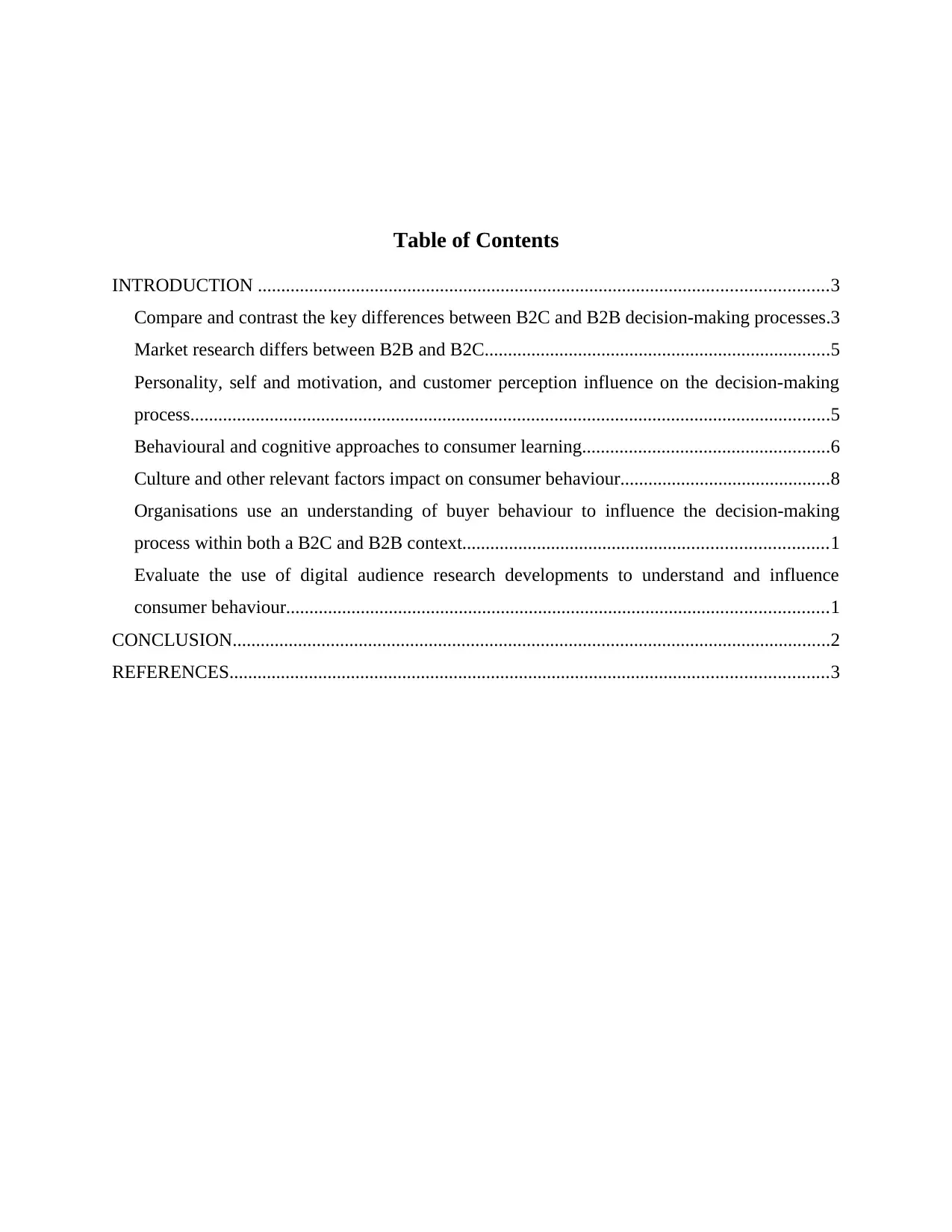
Table of Contents
INTRODUCTION ..........................................................................................................................3
Compare and contrast the key differences between B2C and B2B decision-making processes.3
Market research differs between B2B and B2C..........................................................................5
Personality, self and motivation, and customer perception influence on the decision-making
process.........................................................................................................................................5
Behavioural and cognitive approaches to consumer learning.....................................................6
Culture and other relevant factors impact on consumer behaviour.............................................8
Organisations use an understanding of buyer behaviour to influence the decision-making
process within both a B2C and B2B context..............................................................................1
Evaluate the use of digital audience research developments to understand and influence
consumer behaviour....................................................................................................................1
CONCLUSION................................................................................................................................2
REFERENCES................................................................................................................................3
INTRODUCTION ..........................................................................................................................3
Compare and contrast the key differences between B2C and B2B decision-making processes.3
Market research differs between B2B and B2C..........................................................................5
Personality, self and motivation, and customer perception influence on the decision-making
process.........................................................................................................................................5
Behavioural and cognitive approaches to consumer learning.....................................................6
Culture and other relevant factors impact on consumer behaviour.............................................8
Organisations use an understanding of buyer behaviour to influence the decision-making
process within both a B2C and B2B context..............................................................................1
Evaluate the use of digital audience research developments to understand and influence
consumer behaviour....................................................................................................................1
CONCLUSION................................................................................................................................2
REFERENCES................................................................................................................................3
INTRODUCTION
Consumer and customer behaviour refers to study of how individual customers, groups or
organisations uses goods and services for satisfying their needs. It is essential for company to
aware about their purchaser behaviour. So that they can design products and services
accordingly. Unicorn grocery is a small size grocery store offering products such as Organic
vegetables, household goods and affordable wholesome food items. This report will study about
the forces which influence formulation of assembly decisions such as consumer perception &
personality. It will also en-lighten the use of digital user research improvement for influencing
consumer behaviour.
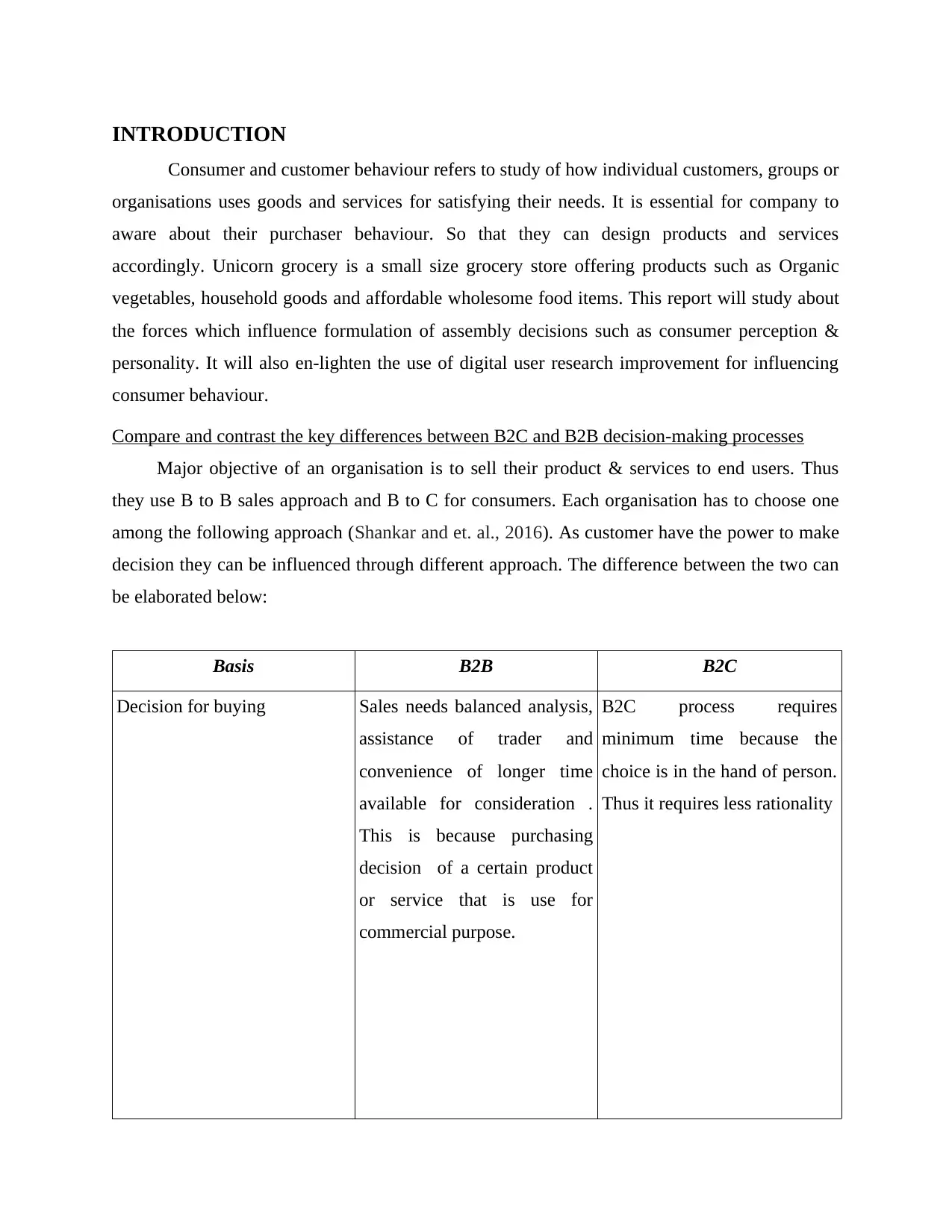
Compare and contrast the key differences between B2C and B2B decision-making processes
Major objective of an organisation is to sell their product & services to end users. Thus
they use B to B sales approach and B to C for consumers. Each organisation has to choose one
among the following approach (Shankar and et. al., 2016). As customer have the power to make
decision they can be influenced through different approach. The difference between the two can
be elaborated below:
Basis B2B B2C
Decision for buying Sales needs balanced analysis,
assistance of trader and
convenience of longer time
available for consideration .
This is because purchasing
decision of a certain product
or service that is use for
commercial purpose.
B2C process requires
minimum time because the
choice is in the hand of person.
Thus it requires less rationality
Consumer and customer behaviour refers to study of how individual customers, groups or
organisations uses goods and services for satisfying their needs. It is essential for company to
aware about their purchaser behaviour. So that they can design products and services
accordingly. Unicorn grocery is a small size grocery store offering products such as Organic
vegetables, household goods and affordable wholesome food items. This report will study about
the forces which influence formulation of assembly decisions such as consumer perception &
personality. It will also en-lighten the use of digital user research improvement for influencing
consumer behaviour.
Compare and contrast the key differences between B2C and B2B decision-making processes
Major objective of an organisation is to sell their product & services to end users. Thus
they use B to B sales approach and B to C for consumers. Each organisation has to choose one
among the following approach (Shankar and et. al., 2016). As customer have the power to make
decision they can be influenced through different approach. The difference between the two can
be elaborated below:
Basis B2B B2C
Decision for buying Sales needs balanced analysis,
assistance of trader and
convenience of longer time
available for consideration .
This is because purchasing
decision of a certain product
or service that is use for
commercial purpose.
B2C process requires
minimum time because the
choice is in the hand of person.
Thus it requires less rationality
⊘ This is a preview!⊘
Do you want full access?
Subscribe today to unlock all pages.
Trusted by 1+ million students worldwide

1 out of 20


Related Documents


Your All-in-One AI-Powered Toolkit for Academic Success.
+13062052269
info@desklib.com
Available 24*7 on WhatsApp / Email
![[object Object]](/_next/static/media/star-bottom.7253800d.svg)
Unlock your academic potential
Copyright © 2020–2026 A2Z Services. All Rights Reserved. Developed and managed by ZUCOL.