Group Research Report on Buyer Behaviour (MKTG1050 Final Report)
VerifiedAdded on 2022/10/17
|12
|4927
|3
Report
AI Summary
This document presents a final group research report for the MKTG1050 Buyer Behaviour course. The assignment requires a deep dive into consumer behavior, focusing on constructing, assessing, and devising marketing strategies based on theories of buyer behavior in consumer markets. The report examines the role of the consumer as a communicator, purchaser, user, and disposer to understand consumer decision-making processes. The group project allows students to choose between two options: a consumer research project or an in-depth interview. This specific report analyzes the topic of de-consumption, exploring its definition, global responses, and implications for the fashion industry. The report includes an overview of background, method and analysis, findings, implications, and cohesiveness. The rubric assesses various aspects, including topic focus, method and analysis, findings, implications, depth, cohesiveness, spelling, grammar, punctuation, referencing, citations, and visual presentation.
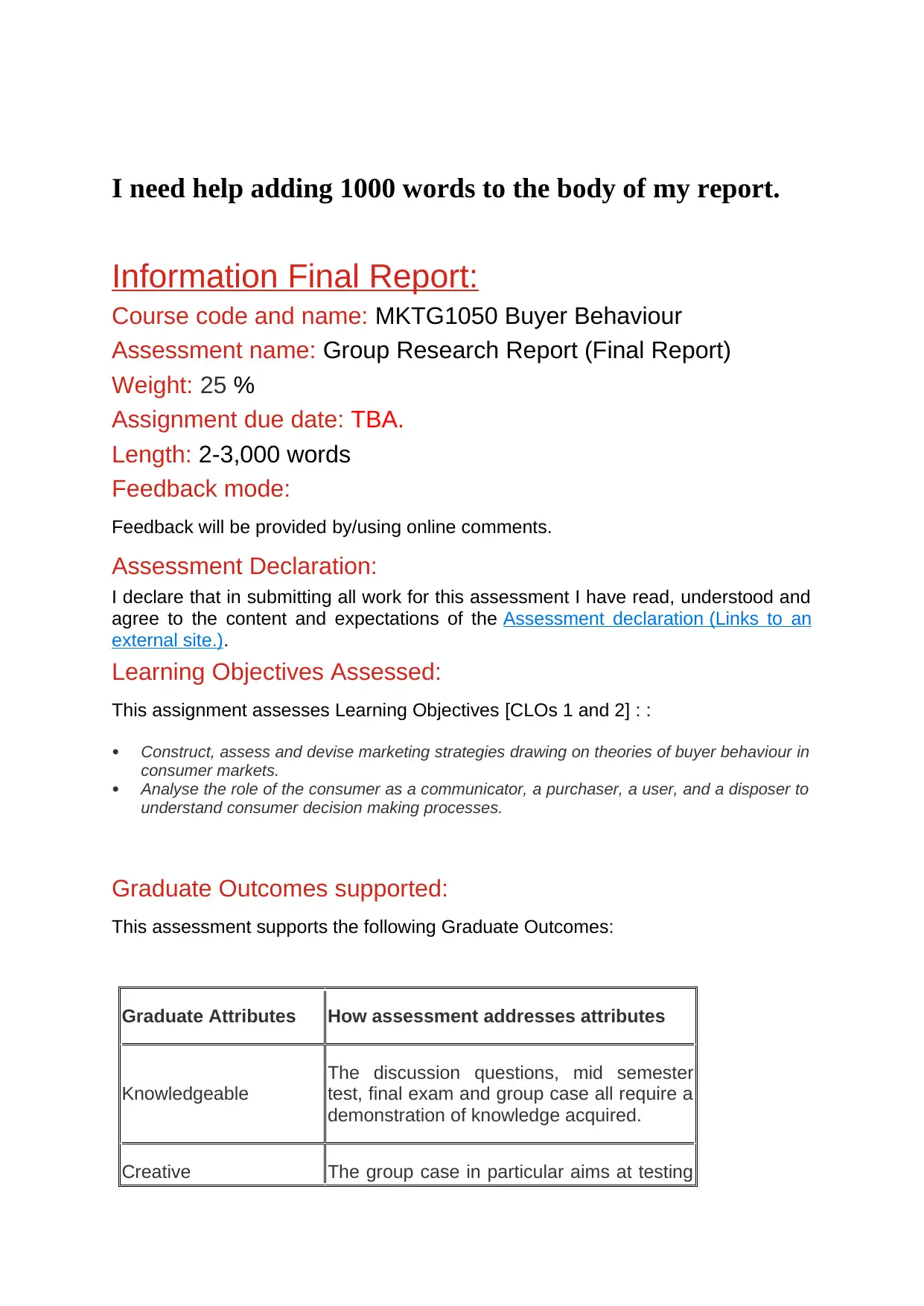
I need help adding 1000 words to the body of my report.
Information Final Report:
Course code and name: MKTG1050 Buyer Behaviour
Assessment name: Group Research Report (Final Report)
Weight: 25 %
Assignment due date: TBA.
Length: 2-3,000 words
Feedback mode:
Feedback will be provided by/using online comments.
Assessment Declaration:
I declare that in submitting all work for this assessment I have read, understood and
agree to the content and expectations of the Assessment declaration (Links to an
external site.).
Learning Objectives Assessed:
This assignment assesses Learning Objectives [CLOs 1 and 2] : :
Construct, assess and devise marketing strategies drawing on theories of buyer behaviour in
consumer markets.
Analyse the role of the consumer as a communicator, a purchaser, a user, and a disposer to
understand consumer decision making processes.
Graduate Outcomes supported:
This assessment supports the following Graduate Outcomes:
Graduate Attributes How assessment addresses attributes
Knowledgeable
The discussion questions, mid semester
test, final exam and group case all require a
demonstration of knowledge acquired.
Creative The group case in particular aims at testing
Information Final Report:
Course code and name: MKTG1050 Buyer Behaviour
Assessment name: Group Research Report (Final Report)
Weight: 25 %
Assignment due date: TBA.
Length: 2-3,000 words
Feedback mode:
Feedback will be provided by/using online comments.
Assessment Declaration:
I declare that in submitting all work for this assessment I have read, understood and
agree to the content and expectations of the Assessment declaration (Links to an
external site.).
Learning Objectives Assessed:
This assignment assesses Learning Objectives [CLOs 1 and 2] : :
Construct, assess and devise marketing strategies drawing on theories of buyer behaviour in
consumer markets.
Analyse the role of the consumer as a communicator, a purchaser, a user, and a disposer to
understand consumer decision making processes.
Graduate Outcomes supported:
This assessment supports the following Graduate Outcomes:
Graduate Attributes How assessment addresses attributes
Knowledgeable
The discussion questions, mid semester
test, final exam and group case all require a
demonstration of knowledge acquired.
Creative The group case in particular aims at testing

Paraphrase This Document
Need a fresh take? Get an instant paraphrase of this document with our AI Paraphraser
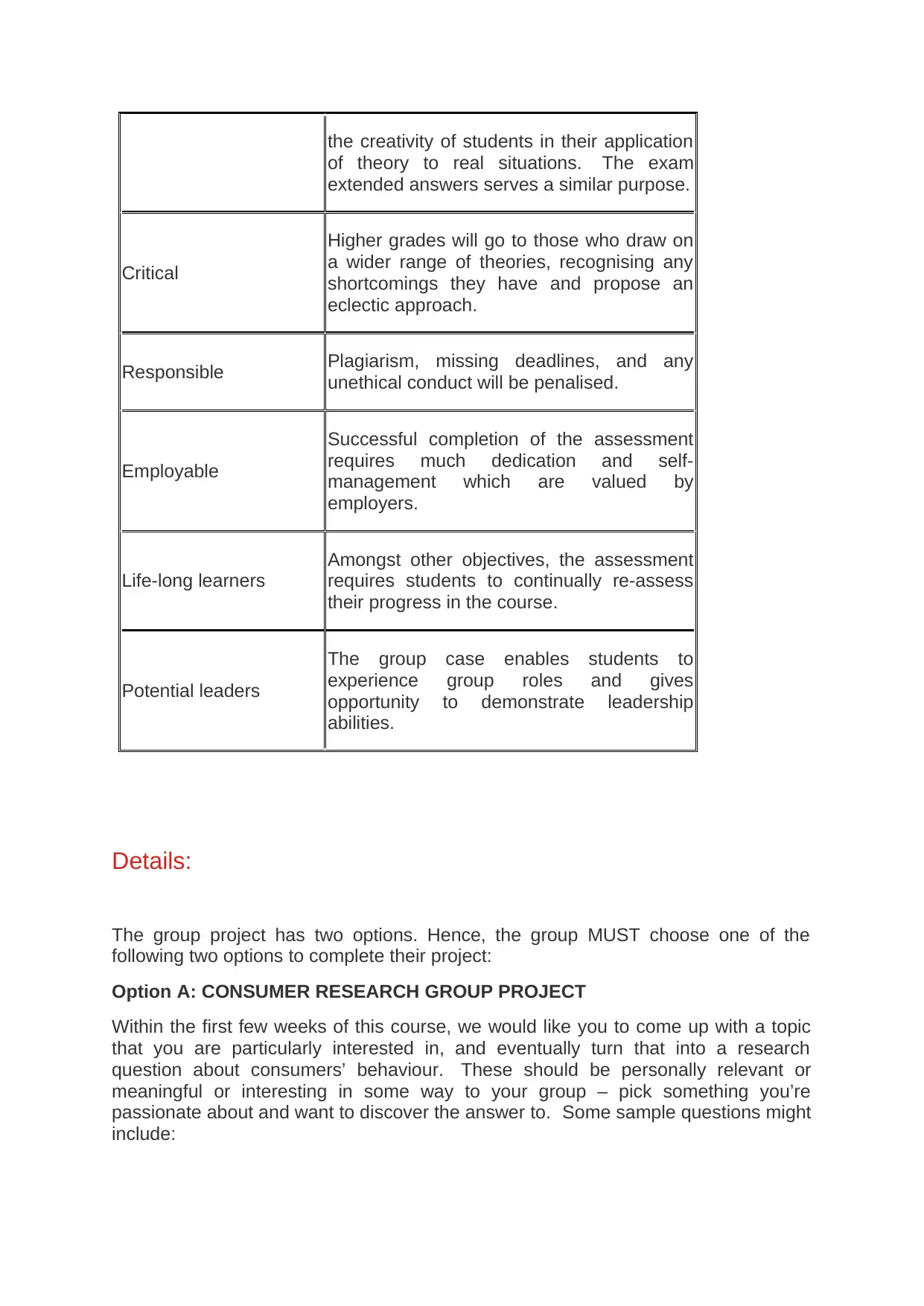
the creativity of students in their application
of theory to real situations. The exam
extended answers serves a similar purpose.
Critical
Higher grades will go to those who draw on
a wider range of theories, recognising any
shortcomings they have and propose an
eclectic approach.
Responsible Plagiarism, missing deadlines, and any
unethical conduct will be penalised.
Employable
Successful completion of the assessment
requires much dedication and self-
management which are valued by
employers.
Life-long learners
Amongst other objectives, the assessment
requires students to continually re-assess
their progress in the course.
Potential leaders
The group case enables students to
experience group roles and gives
opportunity to demonstrate leadership
abilities.
Details:
The group project has two options. Hence, the group MUST choose one of the
following two options to complete their project:
Option A: CONSUMER RESEARCH GROUP PROJECT
Within the first few weeks of this course, we would like you to come up with a topic
that you are particularly interested in, and eventually turn that into a research
question about consumers’ behaviour. These should be personally relevant or
meaningful or interesting in some way to your group – pick something you’re
passionate about and want to discover the answer to. Some sample questions might
include:
of theory to real situations. The exam
extended answers serves a similar purpose.
Critical
Higher grades will go to those who draw on
a wider range of theories, recognising any
shortcomings they have and propose an
eclectic approach.
Responsible Plagiarism, missing deadlines, and any
unethical conduct will be penalised.
Employable
Successful completion of the assessment
requires much dedication and self-
management which are valued by
employers.
Life-long learners
Amongst other objectives, the assessment
requires students to continually re-assess
their progress in the course.
Potential leaders
The group case enables students to
experience group roles and gives
opportunity to demonstrate leadership
abilities.
Details:
The group project has two options. Hence, the group MUST choose one of the
following two options to complete their project:
Option A: CONSUMER RESEARCH GROUP PROJECT
Within the first few weeks of this course, we would like you to come up with a topic
that you are particularly interested in, and eventually turn that into a research
question about consumers’ behaviour. These should be personally relevant or
meaningful or interesting in some way to your group – pick something you’re
passionate about and want to discover the answer to. Some sample questions might
include:
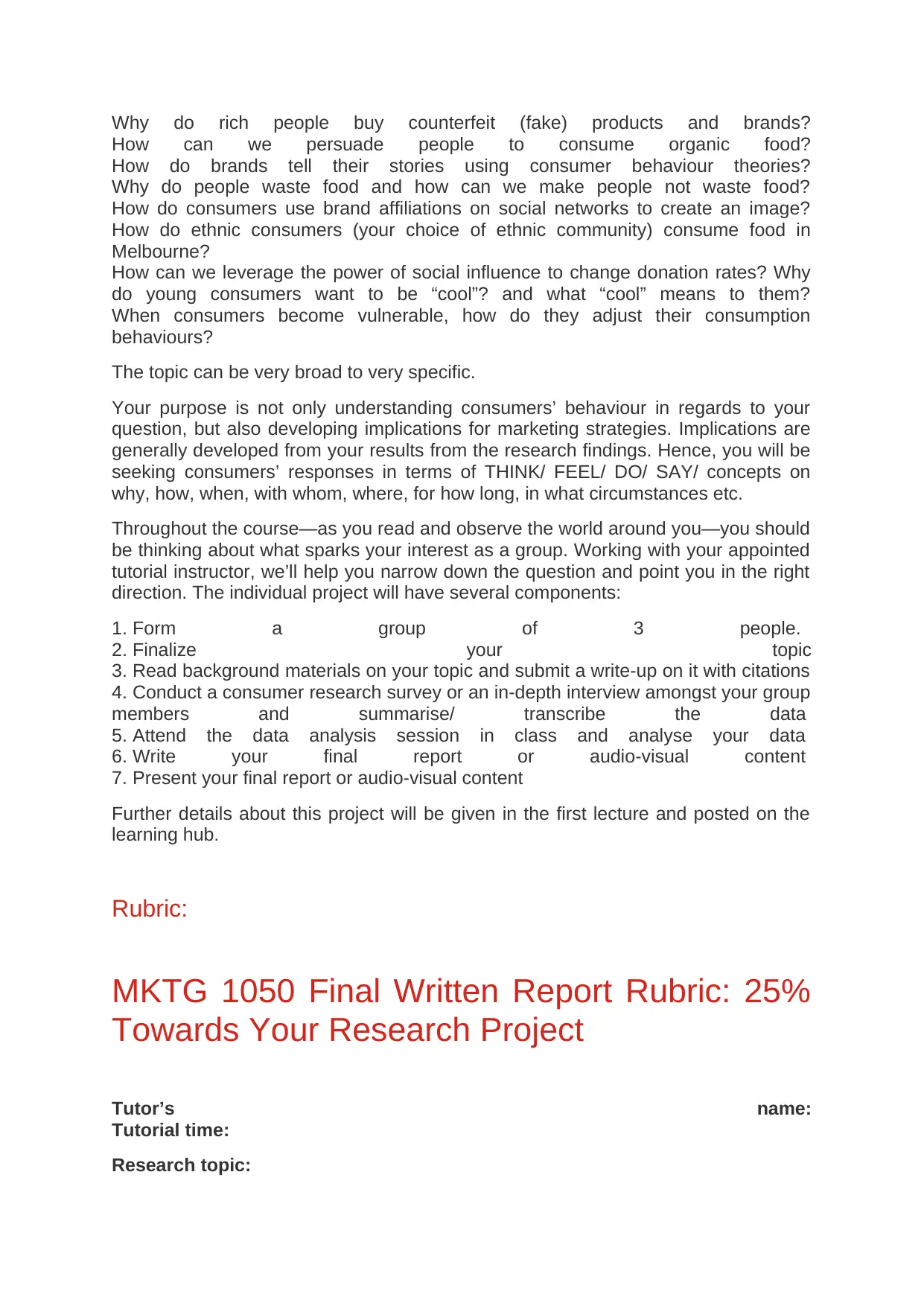
Why do rich people buy counterfeit (fake) products and brands?
How can we persuade people to consume organic food?
How do brands tell their stories using consumer behaviour theories?
Why do people waste food and how can we make people not waste food?
How do consumers use brand affiliations on social networks to create an image?
How do ethnic consumers (your choice of ethnic community) consume food in
Melbourne?
How can we leverage the power of social influence to change donation rates? Why
do young consumers want to be “cool”? and what “cool” means to them?
When consumers become vulnerable, how do they adjust their consumption
behaviours?
The topic can be very broad to very specific.
Your purpose is not only understanding consumers’ behaviour in regards to your
question, but also developing implications for marketing strategies. Implications are
generally developed from your results from the research findings. Hence, you will be
seeking consumers’ responses in terms of THINK/ FEEL/ DO/ SAY/ concepts on
why, how, when, with whom, where, for how long, in what circumstances etc.
Throughout the course—as you read and observe the world around you—you should
be thinking about what sparks your interest as a group. Working with your appointed
tutorial instructor, we’ll help you narrow down the question and point you in the right
direction. The individual project will have several components:
1. Form a group of 3 people.
2. Finalize your topic
3. Read background materials on your topic and submit a write-up on it with citations
4. Conduct a consumer research survey or an in-depth interview amongst your group
members and summarise/ transcribe the data
5. Attend the data analysis session in class and analyse your data
6. Write your final report or audio-visual content
7. Present your final report or audio-visual content
Further details about this project will be given in the first lecture and posted on the
learning hub.
Rubric:
MKTG 1050 Final Written Report Rubric: 25%
Towards Your Research Project
Tutor’s name:
Tutorial time:
Research topic:
How can we persuade people to consume organic food?
How do brands tell their stories using consumer behaviour theories?
Why do people waste food and how can we make people not waste food?
How do consumers use brand affiliations on social networks to create an image?
How do ethnic consumers (your choice of ethnic community) consume food in
Melbourne?
How can we leverage the power of social influence to change donation rates? Why
do young consumers want to be “cool”? and what “cool” means to them?
When consumers become vulnerable, how do they adjust their consumption
behaviours?
The topic can be very broad to very specific.
Your purpose is not only understanding consumers’ behaviour in regards to your
question, but also developing implications for marketing strategies. Implications are
generally developed from your results from the research findings. Hence, you will be
seeking consumers’ responses in terms of THINK/ FEEL/ DO/ SAY/ concepts on
why, how, when, with whom, where, for how long, in what circumstances etc.
Throughout the course—as you read and observe the world around you—you should
be thinking about what sparks your interest as a group. Working with your appointed
tutorial instructor, we’ll help you narrow down the question and point you in the right
direction. The individual project will have several components:
1. Form a group of 3 people.
2. Finalize your topic
3. Read background materials on your topic and submit a write-up on it with citations
4. Conduct a consumer research survey or an in-depth interview amongst your group
members and summarise/ transcribe the data
5. Attend the data analysis session in class and analyse your data
6. Write your final report or audio-visual content
7. Present your final report or audio-visual content
Further details about this project will be given in the first lecture and posted on the
learning hub.
Rubric:
MKTG 1050 Final Written Report Rubric: 25%
Towards Your Research Project
Tutor’s name:
Tutorial time:
Research topic:
⊘ This is a preview!⊘
Do you want full access?
Subscribe today to unlock all pages.

Trusted by 1+ million students worldwide
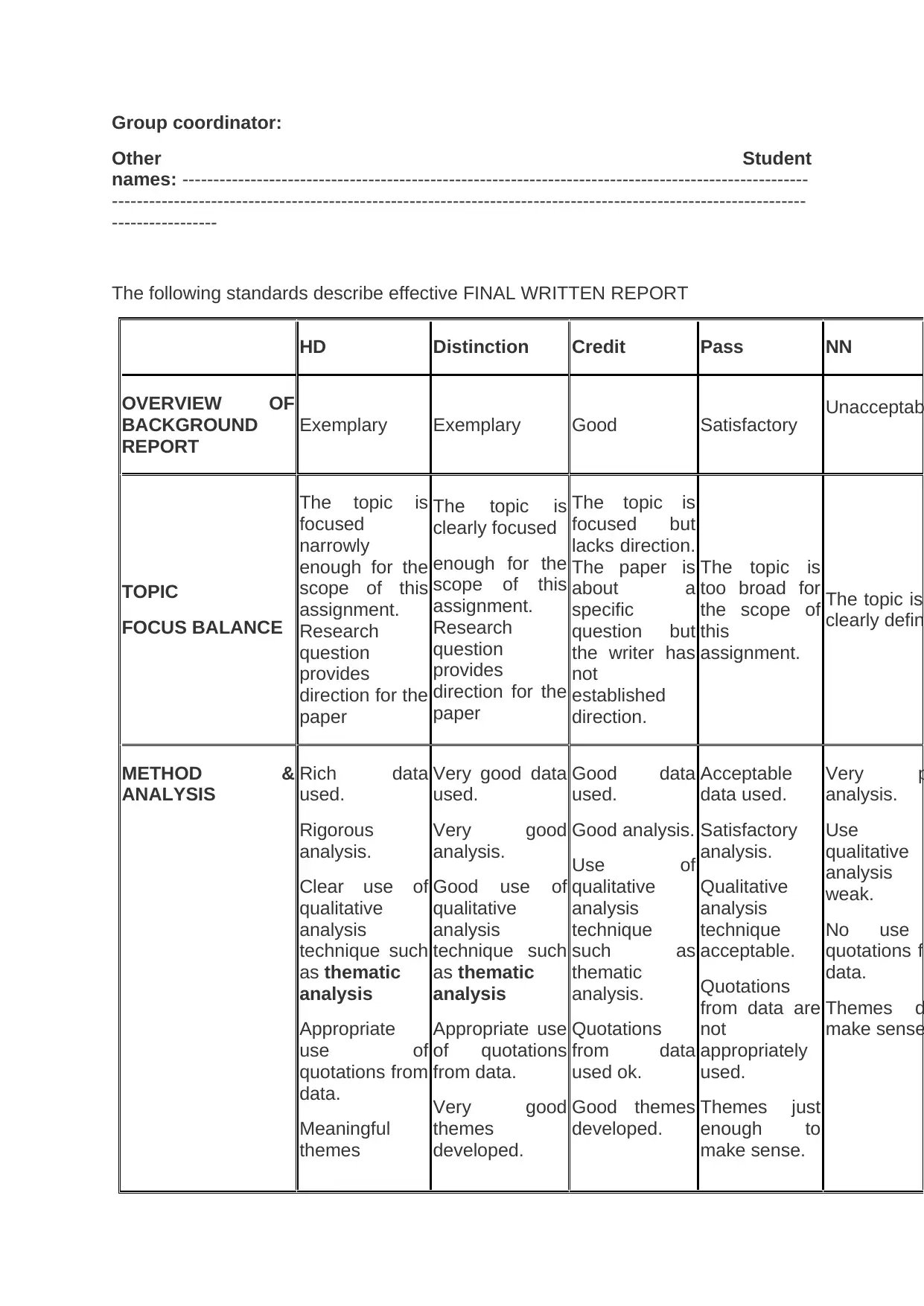
Group coordinator:
Other Student
names: -----------------------------------------------------------------------------------------------------
----------------------------------------------------------------------------------------------------------------
-----------------
The following standards describe effective FINAL WRITTEN REPORT
HD Distinction Credit Pass NN
OVERVIEW OF
BACKGROUND
REPORT
Exemplary Exemplary Good Satisfactory Unacceptab
TOPIC
FOCUS BALANCE
The topic is
focused
narrowly
enough for the
scope of this
assignment.
Research
question
provides
direction for the
paper
The topic is
clearly focused
enough for the
scope of this
assignment.
Research
question
provides
direction for the
paper
The topic is
focused but
lacks direction.
The paper is
about a
specific
question but
the writer has
not
established
direction.
The topic is
too broad for
the scope of
this
assignment.
The topic is
clearly defin
METHOD &
ANALYSIS
Rich data
used.
Rigorous
analysis.
Clear use of
qualitative
analysis
technique such
as thematic
analysis
Appropriate
use of
quotations from
data.
Meaningful
themes
Very good data
used.
Very good
analysis.
Good use of
qualitative
analysis
technique such
as thematic
analysis
Appropriate use
of quotations
from data.
Very good
themes
developed.
Good data
used.
Good analysis.
Use of
qualitative
analysis
technique
such as
thematic
analysis.
Quotations
from data
used ok.
Good themes
developed.
Acceptable
data used.
Satisfactory
analysis.
Qualitative
analysis
technique
acceptable.
Quotations
from data are
not
appropriately
used.
Themes just
enough to
make sense.
Very p
analysis.
Use
qualitative
analysis
weak.
No use
quotations fr
data.
Themes d
make sense
Other Student
names: -----------------------------------------------------------------------------------------------------
----------------------------------------------------------------------------------------------------------------
-----------------
The following standards describe effective FINAL WRITTEN REPORT
HD Distinction Credit Pass NN
OVERVIEW OF
BACKGROUND
REPORT
Exemplary Exemplary Good Satisfactory Unacceptab
TOPIC
FOCUS BALANCE
The topic is
focused
narrowly
enough for the
scope of this
assignment.
Research
question
provides
direction for the
paper
The topic is
clearly focused
enough for the
scope of this
assignment.
Research
question
provides
direction for the
paper
The topic is
focused but
lacks direction.
The paper is
about a
specific
question but
the writer has
not
established
direction.
The topic is
too broad for
the scope of
this
assignment.
The topic is
clearly defin
METHOD &
ANALYSIS
Rich data
used.
Rigorous
analysis.
Clear use of
qualitative
analysis
technique such
as thematic
analysis
Appropriate
use of
quotations from
data.
Meaningful
themes
Very good data
used.
Very good
analysis.
Good use of
qualitative
analysis
technique such
as thematic
analysis
Appropriate use
of quotations
from data.
Very good
themes
developed.
Good data
used.
Good analysis.
Use of
qualitative
analysis
technique
such as
thematic
analysis.
Quotations
from data
used ok.
Good themes
developed.
Acceptable
data used.
Satisfactory
analysis.
Qualitative
analysis
technique
acceptable.
Quotations
from data are
not
appropriately
used.
Themes just
enough to
make sense.
Very p
analysis.
Use
qualitative
analysis
weak.
No use
quotations fr
data.
Themes d
make sense
Paraphrase This Document
Need a fresh take? Get an instant paraphrase of this document with our AI Paraphraser
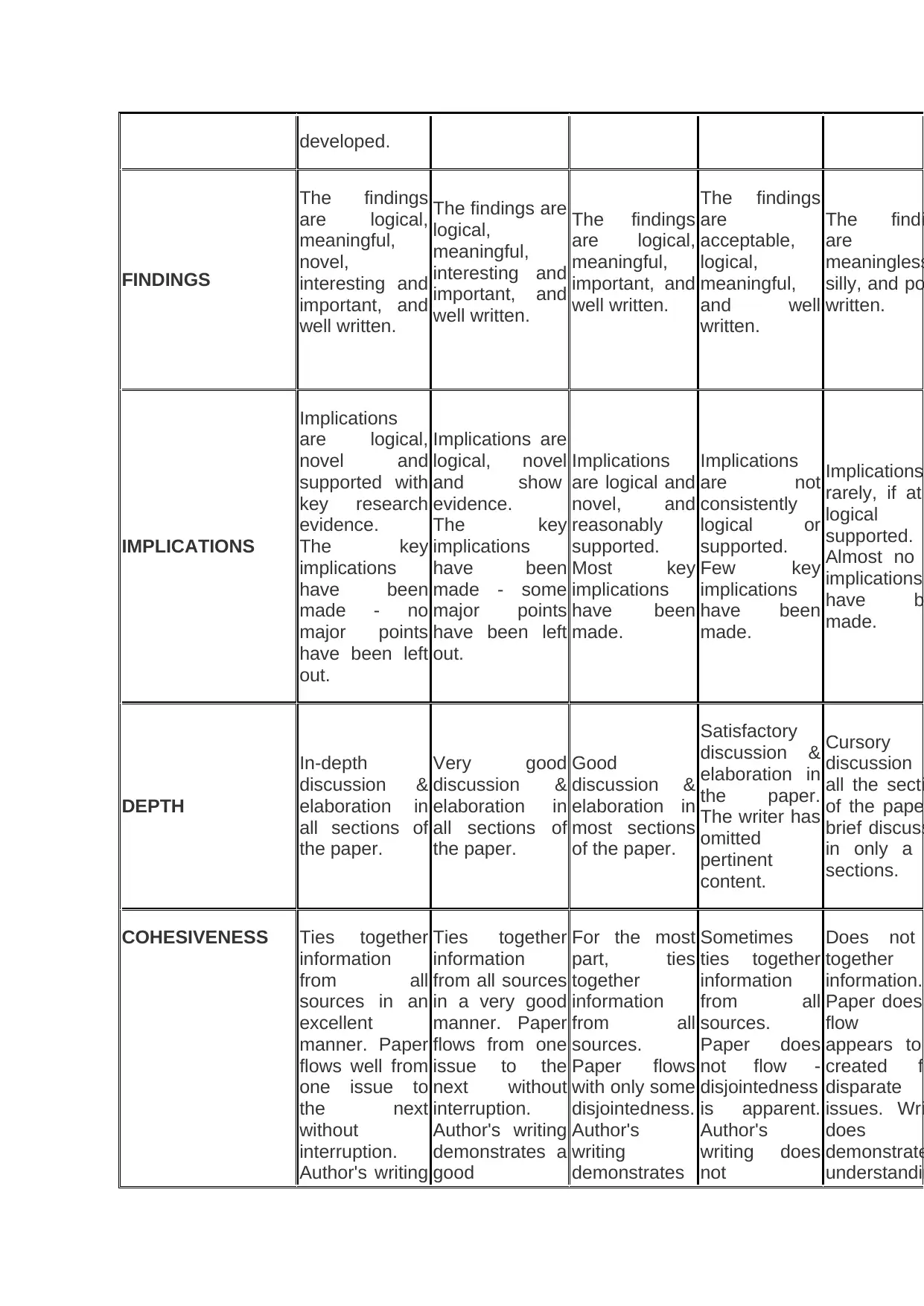
developed.
FINDINGS
The findings
are logical,
meaningful,
novel,
interesting and
important, and
well written.
The findings are
logical,
meaningful,
interesting and
important, and
well written.
The findings
are logical,
meaningful,
important, and
well written.
The findings
are
acceptable,
logical,
meaningful,
and well
written.
The findi
are
meaningless
silly, and po
written.
IMPLICATIONS
Implications
are logical,
novel and
supported with
key research
evidence.
The key
implications
have been
made - no
major points
have been left
out.
Implications are
logical, novel
and show
evidence.
The key
implications
have been
made - some
major points
have been left
out.
Implications
are logical and
novel, and
reasonably
supported.
Most key
implications
have been
made.
Implications
are not
consistently
logical or
supported.
Few key
implications
have been
made.
Implications
rarely, if at
logical
supported.
Almost no
implications
have b
made.
DEPTH
In-depth
discussion &
elaboration in
all sections of
the paper.
Very good
discussion &
elaboration in
all sections of
the paper.
Good
discussion &
elaboration in
most sections
of the paper.
Satisfactory
discussion &
elaboration in
the paper.
The writer has
omitted
pertinent
content.
Cursory
discussion
all the secti
of the pape
brief discuss
in only a
sections.
COHESIVENESS Ties together
information
from all
sources in an
excellent
manner. Paper
flows well from
one issue to
the next
without
interruption.
Author's writing
Ties together
information
from all sources
in a very good
manner. Paper
flows from one
issue to the
next without
interruption.
Author's writing
demonstrates a
good
For the most
part, ties
together
information
from all
sources.
Paper flows
with only some
disjointedness.
Author's
writing
demonstrates
Sometimes
ties together
information
from all
sources.
Paper does
not flow -
disjointedness
is apparent.
Author's
writing does
not
Does not
together
information.
Paper does
flow
appears to
created fr
disparate
issues. Wri
does
demonstrate
understandin
FINDINGS
The findings
are logical,
meaningful,
novel,
interesting and
important, and
well written.
The findings are
logical,
meaningful,
interesting and
important, and
well written.
The findings
are logical,
meaningful,
important, and
well written.
The findings
are
acceptable,
logical,
meaningful,
and well
written.
The findi
are
meaningless
silly, and po
written.
IMPLICATIONS
Implications
are logical,
novel and
supported with
key research
evidence.
The key
implications
have been
made - no
major points
have been left
out.
Implications are
logical, novel
and show
evidence.
The key
implications
have been
made - some
major points
have been left
out.
Implications
are logical and
novel, and
reasonably
supported.
Most key
implications
have been
made.
Implications
are not
consistently
logical or
supported.
Few key
implications
have been
made.
Implications
rarely, if at
logical
supported.
Almost no
implications
have b
made.
DEPTH
In-depth
discussion &
elaboration in
all sections of
the paper.
Very good
discussion &
elaboration in
all sections of
the paper.
Good
discussion &
elaboration in
most sections
of the paper.
Satisfactory
discussion &
elaboration in
the paper.
The writer has
omitted
pertinent
content.
Cursory
discussion
all the secti
of the pape
brief discuss
in only a
sections.
COHESIVENESS Ties together
information
from all
sources in an
excellent
manner. Paper
flows well from
one issue to
the next
without
interruption.
Author's writing
Ties together
information
from all sources
in a very good
manner. Paper
flows from one
issue to the
next without
interruption.
Author's writing
demonstrates a
good
For the most
part, ties
together
information
from all
sources.
Paper flows
with only some
disjointedness.
Author's
writing
demonstrates
Sometimes
ties together
information
from all
sources.
Paper does
not flow -
disjointedness
is apparent.
Author's
writing does
not
Does not
together
information.
Paper does
flow
appears to
created fr
disparate
issues. Wri
does
demonstrate
understandin
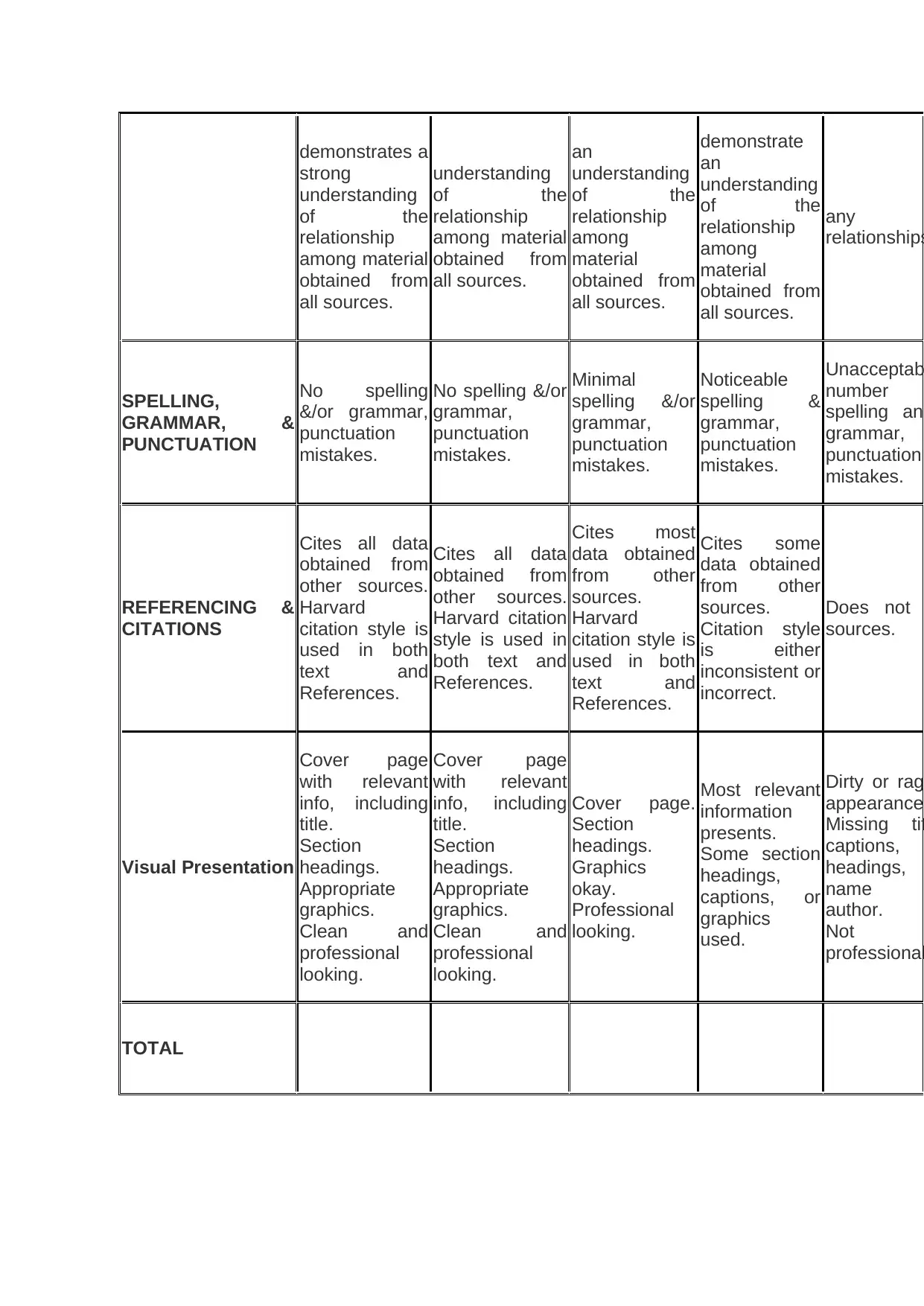
demonstrates a
strong
understanding
of the
relationship
among material
obtained from
all sources.
understanding
of the
relationship
among material
obtained from
all sources.
an
understanding
of the
relationship
among
material
obtained from
all sources.
demonstrate
an
understanding
of the
relationship
among
material
obtained from
all sources.
any
relationships
SPELLING,
GRAMMAR, &
PUNCTUATION
No spelling
&/or grammar,
punctuation
mistakes.
No spelling &/or
grammar,
punctuation
mistakes.
Minimal
spelling &/or
grammar,
punctuation
mistakes.
Noticeable
spelling &
grammar,
punctuation
mistakes.
Unacceptab
number
spelling and
grammar,
punctuation
mistakes.
REFERENCING &
CITATIONS
Cites all data
obtained from
other sources.
Harvard
citation style is
used in both
text and
References.
Cites all data
obtained from
other sources.
Harvard citation
style is used in
both text and
References.
Cites most
data obtained
from other
sources.
Harvard
citation style is
used in both
text and
References.
Cites some
data obtained
from other
sources.
Citation style
is either
inconsistent or
incorrect.
Does not
sources.
Visual Presentation
Cover page
with relevant
info, including
title.
Section
headings.
Appropriate
graphics.
Clean and
professional
looking.
Cover page
with relevant
info, including
title.
Section
headings.
Appropriate
graphics.
Clean and
professional
looking.
Cover page.
Section
headings.
Graphics
okay.
Professional
looking.
Most relevant
information
presents.
Some section
headings,
captions, or
graphics
used.
Dirty or rag
appearance
Missing tit
captions,
headings,
name
author.
Not
professional
TOTAL
strong
understanding
of the
relationship
among material
obtained from
all sources.
understanding
of the
relationship
among material
obtained from
all sources.
an
understanding
of the
relationship
among
material
obtained from
all sources.
demonstrate
an
understanding
of the
relationship
among
material
obtained from
all sources.
any
relationships
SPELLING,
GRAMMAR, &
PUNCTUATION
No spelling
&/or grammar,
punctuation
mistakes.
No spelling &/or
grammar,
punctuation
mistakes.
Minimal
spelling &/or
grammar,
punctuation
mistakes.
Noticeable
spelling &
grammar,
punctuation
mistakes.
Unacceptab
number
spelling and
grammar,
punctuation
mistakes.
REFERENCING &
CITATIONS
Cites all data
obtained from
other sources.
Harvard
citation style is
used in both
text and
References.
Cites all data
obtained from
other sources.
Harvard citation
style is used in
both text and
References.
Cites most
data obtained
from other
sources.
Harvard
citation style is
used in both
text and
References.
Cites some
data obtained
from other
sources.
Citation style
is either
inconsistent or
incorrect.
Does not
sources.
Visual Presentation
Cover page
with relevant
info, including
title.
Section
headings.
Appropriate
graphics.
Clean and
professional
looking.
Cover page
with relevant
info, including
title.
Section
headings.
Appropriate
graphics.
Clean and
professional
looking.
Cover page.
Section
headings.
Graphics
okay.
Professional
looking.
Most relevant
information
presents.
Some section
headings,
captions, or
graphics
used.
Dirty or rag
appearance
Missing tit
captions,
headings,
name
author.
Not
professional
TOTAL
⊘ This is a preview!⊘
Do you want full access?
Subscribe today to unlock all pages.
Trusted by 1+ million students worldwide
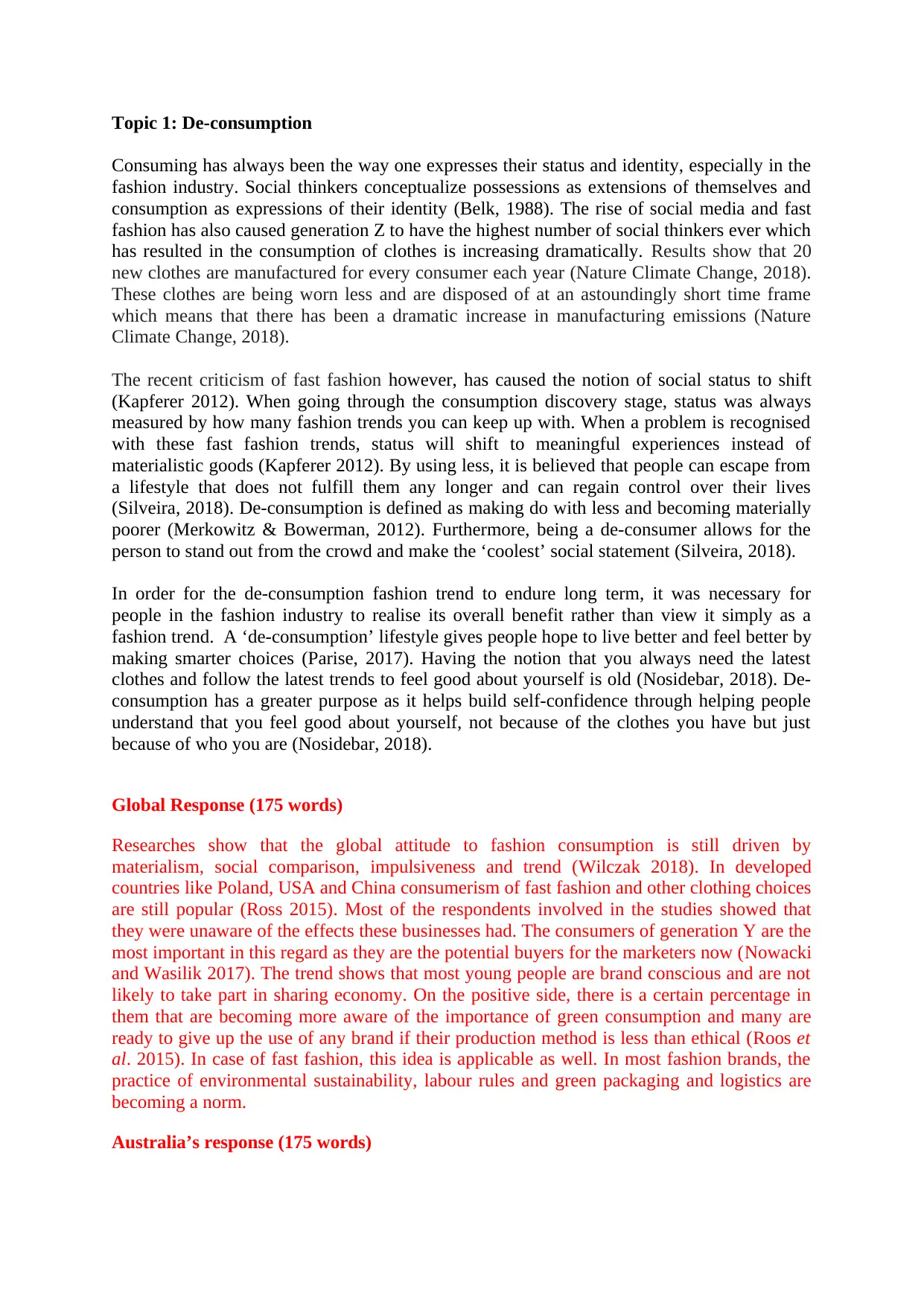
Topic 1: De-consumption
Consuming has always been the way one expresses their status and identity, especially in the
fashion industry. Social thinkers conceptualize possessions as extensions of themselves and
consumption as expressions of their identity (Belk, 1988). The rise of social media and fast
fashion has also caused generation Z to have the highest number of social thinkers ever which
has resulted in the consumption of clothes is increasing dramatically. Results show that 20
new clothes are manufactured for every consumer each year (Nature Climate Change, 2018).
These clothes are being worn less and are disposed of at an astoundingly short time frame
which means that there has been a dramatic increase in manufacturing emissions (Nature
Climate Change, 2018).
The recent criticism of fast fashion however, has caused the notion of social status to shift
(Kapferer 2012). When going through the consumption discovery stage, status was always
measured by how many fashion trends you can keep up with. When a problem is recognised
with these fast fashion trends, status will shift to meaningful experiences instead of
materialistic goods (Kapferer 2012). By using less, it is believed that people can escape from
a lifestyle that does not fulfill them any longer and can regain control over their lives
(Silveira, 2018). De-consumption is defined as making do with less and becoming materially
poorer (Merkowitz & Bowerman, 2012). Furthermore, being a de-consumer allows for the
person to stand out from the crowd and make the ‘coolest’ social statement (Silveira, 2018).
In order for the de-consumption fashion trend to endure long term, it was necessary for
people in the fashion industry to realise its overall benefit rather than view it simply as a
fashion trend. A ‘de-consumption’ lifestyle gives people hope to live better and feel better by
making smarter choices (Parise, 2017). Having the notion that you always need the latest
clothes and follow the latest trends to feel good about yourself is old (Nosidebar, 2018). De-
consumption has a greater purpose as it helps build self-confidence through helping people
understand that you feel good about yourself, not because of the clothes you have but just
because of who you are (Nosidebar, 2018).
Global Response (175 words)
Researches show that the global attitude to fashion consumption is still driven by
materialism, social comparison, impulsiveness and trend (Wilczak 2018). In developed
countries like Poland, USA and China consumerism of fast fashion and other clothing choices
are still popular (Ross 2015). Most of the respondents involved in the studies showed that
they were unaware of the effects these businesses had. The consumers of generation Y are the
most important in this regard as they are the potential buyers for the marketers now (Nowacki
and Wasilik 2017). The trend shows that most young people are brand conscious and are not
likely to take part in sharing economy. On the positive side, there is a certain percentage in
them that are becoming more aware of the importance of green consumption and many are
ready to give up the use of any brand if their production method is less than ethical (Roos et
al. 2015). In case of fast fashion, this idea is applicable as well. In most fashion brands, the
practice of environmental sustainability, labour rules and green packaging and logistics are
becoming a norm.
Australia’s response (175 words)
Consuming has always been the way one expresses their status and identity, especially in the
fashion industry. Social thinkers conceptualize possessions as extensions of themselves and
consumption as expressions of their identity (Belk, 1988). The rise of social media and fast
fashion has also caused generation Z to have the highest number of social thinkers ever which
has resulted in the consumption of clothes is increasing dramatically. Results show that 20
new clothes are manufactured for every consumer each year (Nature Climate Change, 2018).
These clothes are being worn less and are disposed of at an astoundingly short time frame
which means that there has been a dramatic increase in manufacturing emissions (Nature
Climate Change, 2018).
The recent criticism of fast fashion however, has caused the notion of social status to shift
(Kapferer 2012). When going through the consumption discovery stage, status was always
measured by how many fashion trends you can keep up with. When a problem is recognised
with these fast fashion trends, status will shift to meaningful experiences instead of
materialistic goods (Kapferer 2012). By using less, it is believed that people can escape from
a lifestyle that does not fulfill them any longer and can regain control over their lives
(Silveira, 2018). De-consumption is defined as making do with less and becoming materially
poorer (Merkowitz & Bowerman, 2012). Furthermore, being a de-consumer allows for the
person to stand out from the crowd and make the ‘coolest’ social statement (Silveira, 2018).
In order for the de-consumption fashion trend to endure long term, it was necessary for
people in the fashion industry to realise its overall benefit rather than view it simply as a
fashion trend. A ‘de-consumption’ lifestyle gives people hope to live better and feel better by
making smarter choices (Parise, 2017). Having the notion that you always need the latest
clothes and follow the latest trends to feel good about yourself is old (Nosidebar, 2018). De-
consumption has a greater purpose as it helps build self-confidence through helping people
understand that you feel good about yourself, not because of the clothes you have but just
because of who you are (Nosidebar, 2018).
Global Response (175 words)
Researches show that the global attitude to fashion consumption is still driven by
materialism, social comparison, impulsiveness and trend (Wilczak 2018). In developed
countries like Poland, USA and China consumerism of fast fashion and other clothing choices
are still popular (Ross 2015). Most of the respondents involved in the studies showed that
they were unaware of the effects these businesses had. The consumers of generation Y are the
most important in this regard as they are the potential buyers for the marketers now (Nowacki
and Wasilik 2017). The trend shows that most young people are brand conscious and are not
likely to take part in sharing economy. On the positive side, there is a certain percentage in
them that are becoming more aware of the importance of green consumption and many are
ready to give up the use of any brand if their production method is less than ethical (Roos et
al. 2015). In case of fast fashion, this idea is applicable as well. In most fashion brands, the
practice of environmental sustainability, labour rules and green packaging and logistics are
becoming a norm.
Australia’s response (175 words)
Paraphrase This Document
Need a fresh take? Get an instant paraphrase of this document with our AI Paraphraser
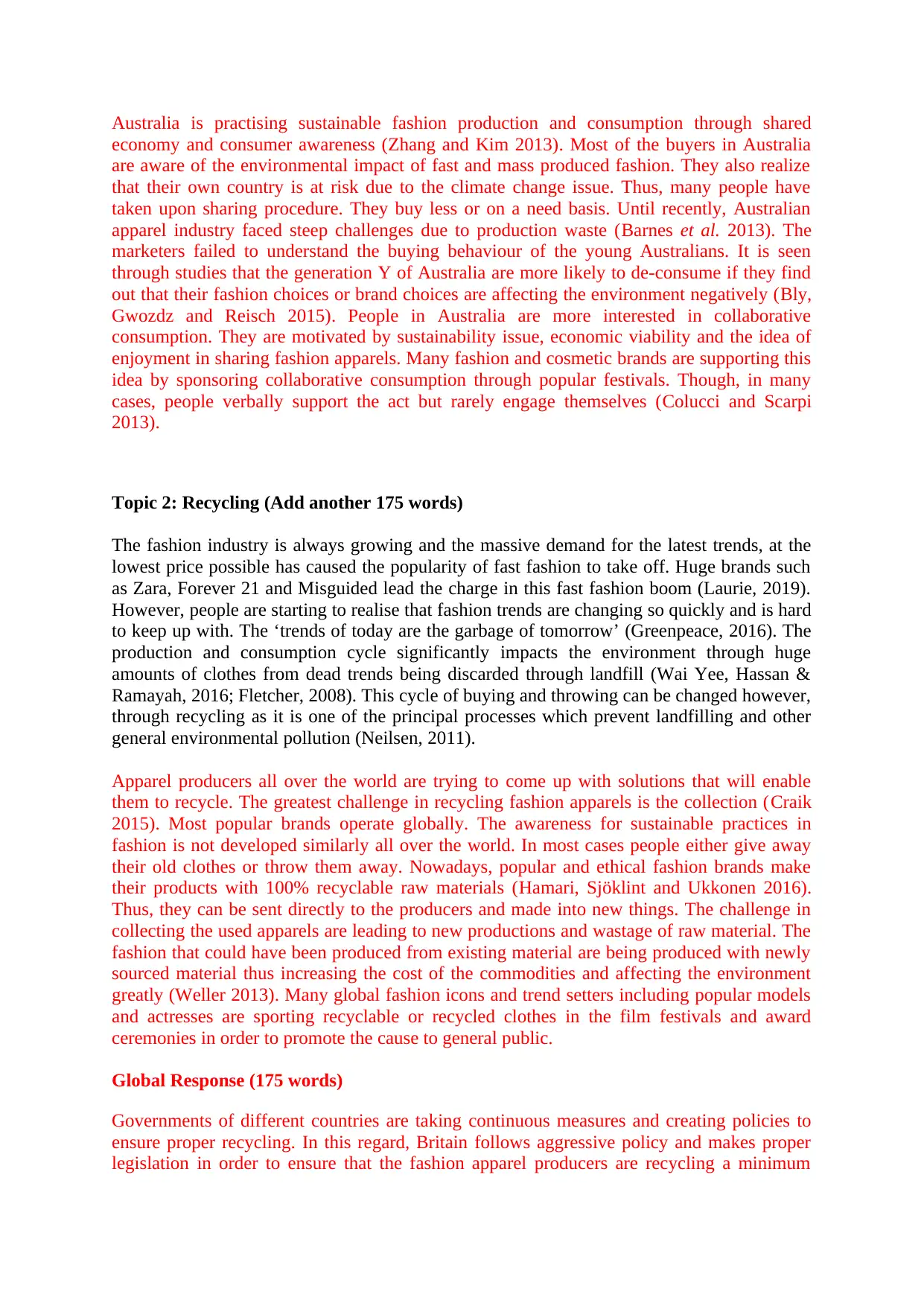
Australia is practising sustainable fashion production and consumption through shared
economy and consumer awareness (Zhang and Kim 2013). Most of the buyers in Australia
are aware of the environmental impact of fast and mass produced fashion. They also realize
that their own country is at risk due to the climate change issue. Thus, many people have
taken upon sharing procedure. They buy less or on a need basis. Until recently, Australian
apparel industry faced steep challenges due to production waste (Barnes et al. 2013). The
marketers failed to understand the buying behaviour of the young Australians. It is seen
through studies that the generation Y of Australia are more likely to de-consume if they find
out that their fashion choices or brand choices are affecting the environment negatively (Bly,
Gwozdz and Reisch 2015). People in Australia are more interested in collaborative
consumption. They are motivated by sustainability issue, economic viability and the idea of
enjoyment in sharing fashion apparels. Many fashion and cosmetic brands are supporting this
idea by sponsoring collaborative consumption through popular festivals. Though, in many
cases, people verbally support the act but rarely engage themselves (Colucci and Scarpi
2013).
Topic 2: Recycling (Add another 175 words)
The fashion industry is always growing and the massive demand for the latest trends, at the
lowest price possible has caused the popularity of fast fashion to take off. Huge brands such
as Zara, Forever 21 and Misguided lead the charge in this fast fashion boom (Laurie, 2019).
However, people are starting to realise that fashion trends are changing so quickly and is hard
to keep up with. The ‘trends of today are the garbage of tomorrow’ (Greenpeace, 2016). The
production and consumption cycle significantly impacts the environment through huge
amounts of clothes from dead trends being discarded through landfill (Wai Yee, Hassan &
Ramayah, 2016; Fletcher, 2008). This cycle of buying and throwing can be changed however,
through recycling as it is one of the principal processes which prevent landfilling and other
general environmental pollution (Neilsen, 2011).
Apparel producers all over the world are trying to come up with solutions that will enable
them to recycle. The greatest challenge in recycling fashion apparels is the collection (Craik
2015). Most popular brands operate globally. The awareness for sustainable practices in
fashion is not developed similarly all over the world. In most cases people either give away
their old clothes or throw them away. Nowadays, popular and ethical fashion brands make
their products with 100% recyclable raw materials (Hamari, Sjöklint and Ukkonen 2016).
Thus, they can be sent directly to the producers and made into new things. The challenge in
collecting the used apparels are leading to new productions and wastage of raw material. The
fashion that could have been produced from existing material are being produced with newly
sourced material thus increasing the cost of the commodities and affecting the environment
greatly (Weller 2013). Many global fashion icons and trend setters including popular models
and actresses are sporting recyclable or recycled clothes in the film festivals and award
ceremonies in order to promote the cause to general public.
Global Response (175 words)
Governments of different countries are taking continuous measures and creating policies to
ensure proper recycling. In this regard, Britain follows aggressive policy and makes proper
legislation in order to ensure that the fashion apparel producers are recycling a minimum
economy and consumer awareness (Zhang and Kim 2013). Most of the buyers in Australia
are aware of the environmental impact of fast and mass produced fashion. They also realize
that their own country is at risk due to the climate change issue. Thus, many people have
taken upon sharing procedure. They buy less or on a need basis. Until recently, Australian
apparel industry faced steep challenges due to production waste (Barnes et al. 2013). The
marketers failed to understand the buying behaviour of the young Australians. It is seen
through studies that the generation Y of Australia are more likely to de-consume if they find
out that their fashion choices or brand choices are affecting the environment negatively (Bly,
Gwozdz and Reisch 2015). People in Australia are more interested in collaborative
consumption. They are motivated by sustainability issue, economic viability and the idea of
enjoyment in sharing fashion apparels. Many fashion and cosmetic brands are supporting this
idea by sponsoring collaborative consumption through popular festivals. Though, in many
cases, people verbally support the act but rarely engage themselves (Colucci and Scarpi
2013).
Topic 2: Recycling (Add another 175 words)
The fashion industry is always growing and the massive demand for the latest trends, at the
lowest price possible has caused the popularity of fast fashion to take off. Huge brands such
as Zara, Forever 21 and Misguided lead the charge in this fast fashion boom (Laurie, 2019).
However, people are starting to realise that fashion trends are changing so quickly and is hard
to keep up with. The ‘trends of today are the garbage of tomorrow’ (Greenpeace, 2016). The
production and consumption cycle significantly impacts the environment through huge
amounts of clothes from dead trends being discarded through landfill (Wai Yee, Hassan &
Ramayah, 2016; Fletcher, 2008). This cycle of buying and throwing can be changed however,
through recycling as it is one of the principal processes which prevent landfilling and other
general environmental pollution (Neilsen, 2011).
Apparel producers all over the world are trying to come up with solutions that will enable
them to recycle. The greatest challenge in recycling fashion apparels is the collection (Craik
2015). Most popular brands operate globally. The awareness for sustainable practices in
fashion is not developed similarly all over the world. In most cases people either give away
their old clothes or throw them away. Nowadays, popular and ethical fashion brands make
their products with 100% recyclable raw materials (Hamari, Sjöklint and Ukkonen 2016).
Thus, they can be sent directly to the producers and made into new things. The challenge in
collecting the used apparels are leading to new productions and wastage of raw material. The
fashion that could have been produced from existing material are being produced with newly
sourced material thus increasing the cost of the commodities and affecting the environment
greatly (Weller 2013). Many global fashion icons and trend setters including popular models
and actresses are sporting recyclable or recycled clothes in the film festivals and award
ceremonies in order to promote the cause to general public.
Global Response (175 words)
Governments of different countries are taking continuous measures and creating policies to
ensure proper recycling. In this regard, Britain follows aggressive policy and makes proper
legislation in order to ensure that the fashion apparel producers are recycling a minimum
percentage of their fashion produce (Wang et al. 2014). In china, the government provide
subsidy options for the apparel producers to sell their products. The have the option to sell to
the customers directly or through government subsidy manufacturers so that waste can be
reduced. The developing countries like China have relatively low awareness and tendency to
use recycled or remanufactured products. This affects the consumer behaviour positively. The
government subsidy helps the remanufacturers to compete against the manufacturers
(Kaikobad et al. 2015). The government policies and legislations along with social campaigns
are also necessary to increase their awareness. In Korea too, the generation of fashion related
waste is high and the mitigation processes have proved to be insufficient (Kim and Kim
2016). Due to the emergence of fast fashion, countries all over the world are facing the
effects of throwaway culture which needs further planning by governments.
Australia’s response
Customer satisfaction affects customer behaviour; according to Reicheld (1996), customer
satisfaction is an antecedent of both customer loyalty and customer behaviour. The media
have attempted to influence consumer behaviour by educating people on the benefits of
recycling their clothes and purchasing recycled clothes. This is evident in Melbourne culture
as popular thrift stores such as Savers and Salvation Army stores are becoming integral
clothing stores in our communities with devoted followers. The results of a survey also
administered to a sample of female consumers in Australia identify antecedents of three
forms of clothing disposal methods: selling through eBay or second-hand shops, giving away
to family or friends or donating to charities (Bianchi & Birtwistle, 2010).
Additionally, the Victorian Government has also introduced its Recycling industry Strategic
Plan, backed by $37 million to provide an efficient, resilient and safe system in Victoria
(Victoria State Government Environment Planning, 2018). Many councils in Australia also
conduct clothing collection ‘banks’ at recycling centres or super market or other car parks, or
charity collection bags are often posted through your door (Thomas, 2015).
Topic 3: Sustainable Fashion Brands
Checking what Brands are sustainable and supporting only theses brands, Influencers
People buy sustainable clothing brands due to the values that come with the brands. Values
such as putting less strain on our planet’s resources and the reduction of toxic wastes come
with the notion of ‘eco-friendly clothing’ which influences buyer behaviour (Montgomery,
2012). Studies from the last 5 years show that 65% of consumers under 35 are aware of the
sustainability of our planet and choose brands with ethical practices (Russell, 2018). This is
due to social media taking off and making it easy for consumers to become knowledgeable of
the industry and brands efforts to work towards an ethical and sustainable future (Russell,
2018).
Brands are starting to adopt an ethical branding strategy that would make their vision,
mission and values to help society (Marion, 2018). This is due to them becoming aware of
consumers choosing to support ethical brands and have started their own campaigns to move
towards a sustainable future. Patagonia is an example, diverting its resources from landfill
since it started in 1993 and launched their radically resourceful clothing line which is 100%
recycled down, wool and polyester in 2016 (Patagonia, 2016). Over the years, Patagonia has
subsidy options for the apparel producers to sell their products. The have the option to sell to
the customers directly or through government subsidy manufacturers so that waste can be
reduced. The developing countries like China have relatively low awareness and tendency to
use recycled or remanufactured products. This affects the consumer behaviour positively. The
government subsidy helps the remanufacturers to compete against the manufacturers
(Kaikobad et al. 2015). The government policies and legislations along with social campaigns
are also necessary to increase their awareness. In Korea too, the generation of fashion related
waste is high and the mitigation processes have proved to be insufficient (Kim and Kim
2016). Due to the emergence of fast fashion, countries all over the world are facing the
effects of throwaway culture which needs further planning by governments.
Australia’s response
Customer satisfaction affects customer behaviour; according to Reicheld (1996), customer
satisfaction is an antecedent of both customer loyalty and customer behaviour. The media
have attempted to influence consumer behaviour by educating people on the benefits of
recycling their clothes and purchasing recycled clothes. This is evident in Melbourne culture
as popular thrift stores such as Savers and Salvation Army stores are becoming integral
clothing stores in our communities with devoted followers. The results of a survey also
administered to a sample of female consumers in Australia identify antecedents of three
forms of clothing disposal methods: selling through eBay or second-hand shops, giving away
to family or friends or donating to charities (Bianchi & Birtwistle, 2010).
Additionally, the Victorian Government has also introduced its Recycling industry Strategic
Plan, backed by $37 million to provide an efficient, resilient and safe system in Victoria
(Victoria State Government Environment Planning, 2018). Many councils in Australia also
conduct clothing collection ‘banks’ at recycling centres or super market or other car parks, or
charity collection bags are often posted through your door (Thomas, 2015).
Topic 3: Sustainable Fashion Brands
Checking what Brands are sustainable and supporting only theses brands, Influencers
People buy sustainable clothing brands due to the values that come with the brands. Values
such as putting less strain on our planet’s resources and the reduction of toxic wastes come
with the notion of ‘eco-friendly clothing’ which influences buyer behaviour (Montgomery,
2012). Studies from the last 5 years show that 65% of consumers under 35 are aware of the
sustainability of our planet and choose brands with ethical practices (Russell, 2018). This is
due to social media taking off and making it easy for consumers to become knowledgeable of
the industry and brands efforts to work towards an ethical and sustainable future (Russell,
2018).
Brands are starting to adopt an ethical branding strategy that would make their vision,
mission and values to help society (Marion, 2018). This is due to them becoming aware of
consumers choosing to support ethical brands and have started their own campaigns to move
towards a sustainable future. Patagonia is an example, diverting its resources from landfill
since it started in 1993 and launched their radically resourceful clothing line which is 100%
recycled down, wool and polyester in 2016 (Patagonia, 2016). Over the years, Patagonia has
⊘ This is a preview!⊘
Do you want full access?
Subscribe today to unlock all pages.
Trusted by 1+ million students worldwide
proven to its consumers that quality and performance does not have to be sacrificed and have
become a key example of how our world can become more sustainable (Fashioninsta, 2018).
Global Response (175 words)
Buying behaviour of the world is still influenced by fast fashion and popular trends (Payne
and Binotto 2017). Popular brand such as H&M and ZARA are also introducing recycled
fashion. H&M produces high fashion apparels in a comparatively lower price (Shen 2014).
They have adopted many methods of doing so. The sourcing managers take special
precaution while choosing their suppliers. They ensure that their supply chain system and
logistics are environmentally sustainable. Their packaging system is recyclable. Many other
brands are also following suits. Research shows that the world still has limited awareness and
adoption of sustainable fashion brands. Alternatively, it can be said that people all over the
world are equally likely to choose a sustainable brand and a non-sustainable brand if that
fulfils their needs. Clothing is not an altruistic choice and the idea of sustainable clothing is
too complex to understand properly (Joshi and Rahman 2015). People also have difference in
ethical consideration when it comes to sustainable clothing. In most cases, the green products
cost more than popular fashion, which is another reason why buying behaviour of consumers
are against this.
Australia’s response (175 words)
In Australia, the creation and use of sustainable clothing has become latest philosophy of the
local apparel brands. Companies like Saroka, Ginger & Smart, The Social Outfit and KITX
practice sustainable clothing extensively. From their sourcing, manufacture, logistics and
packaging, everything complies with environmental issues (Harris, Roby and Dibb 2016).
The Australian government too, has extensive procurement guidelines and policies to ensure
that the businesses are complying with their legislation. Many global fashion brands have
also adopted sustainability in their process. They also source products only from suppliers
that follow ethical standards in producing their raw material and follow labour and human
rights (Kaikobad et al. 2015). Big brands like ZARA and H&M source only sustainable
products and collect used products to recycle them. The Australian consumers are more
aware of sustainability issue of apparel industry than the rest of the world. Majority of the
buyers are likely to reject a brand that have no sustainability protocol. This trend increases
with upper age groups rather than the teenage fashion buying behaviour (Payne 2014).
become a key example of how our world can become more sustainable (Fashioninsta, 2018).
Global Response (175 words)
Buying behaviour of the world is still influenced by fast fashion and popular trends (Payne
and Binotto 2017). Popular brand such as H&M and ZARA are also introducing recycled
fashion. H&M produces high fashion apparels in a comparatively lower price (Shen 2014).
They have adopted many methods of doing so. The sourcing managers take special
precaution while choosing their suppliers. They ensure that their supply chain system and
logistics are environmentally sustainable. Their packaging system is recyclable. Many other
brands are also following suits. Research shows that the world still has limited awareness and
adoption of sustainable fashion brands. Alternatively, it can be said that people all over the
world are equally likely to choose a sustainable brand and a non-sustainable brand if that
fulfils their needs. Clothing is not an altruistic choice and the idea of sustainable clothing is
too complex to understand properly (Joshi and Rahman 2015). People also have difference in
ethical consideration when it comes to sustainable clothing. In most cases, the green products
cost more than popular fashion, which is another reason why buying behaviour of consumers
are against this.
Australia’s response (175 words)
In Australia, the creation and use of sustainable clothing has become latest philosophy of the
local apparel brands. Companies like Saroka, Ginger & Smart, The Social Outfit and KITX
practice sustainable clothing extensively. From their sourcing, manufacture, logistics and
packaging, everything complies with environmental issues (Harris, Roby and Dibb 2016).
The Australian government too, has extensive procurement guidelines and policies to ensure
that the businesses are complying with their legislation. Many global fashion brands have
also adopted sustainability in their process. They also source products only from suppliers
that follow ethical standards in producing their raw material and follow labour and human
rights (Kaikobad et al. 2015). Big brands like ZARA and H&M source only sustainable
products and collect used products to recycle them. The Australian consumers are more
aware of sustainability issue of apparel industry than the rest of the world. Majority of the
buyers are likely to reject a brand that have no sustainability protocol. This trend increases
with upper age groups rather than the teenage fashion buying behaviour (Payne 2014).
Paraphrase This Document
Need a fresh take? Get an instant paraphrase of this document with our AI Paraphraser
References
Barnes, L., Lea‐Greenwood, G., Gabrielli, V., Baghi, I. and Codeluppi, V., 2013.
Consumption practices of fast fashion products: a consumer‐based approach. Journal of
Fashion Marketing and Management: An International Journal.
Bly, S., Gwozdz, W. and Reisch, L.A., 2015. Exit from the high street: an exploratory study
of sustainable fashion consumption pioneers. International Journal of Consumer
Studies, 39(2), pp.125-135.
Colucci, M. and Scarpi, D., 2013. Generation Y: Evidences from the fast-fashion market and
implications for targeting. Journal of business theory and practice, 1(1), pp.1-7.
Craik, J., 2015. Challenges for Australian fashion. Journal of Fashion Marketing and
Management, 19(1), pp.56-68.
Hamari, J., Sjöklint, M. and Ukkonen, A., 2016. The sharing economy: Why people
participate in collaborative consumption. Journal of the association for information science
and technology, 67(9), pp.2047-2059.
Harris, F., Roby, H. and Dibb, S., 2016. Sustainable clothing: challenges, barriers and
interventions for encouraging more sustainable consumer behaviour. International Journal of
Consumer Studies, 40(3), pp.309-318.
Joshi, Y. and Rahman, Z., 2015. Factors affecting green purchase behaviour and future
research directions. International Strategic management review, 3(1-2), pp.128-143.
Kaikobad, N.K., Bhuiyan, M.Z.A., Sultana, F. and Rahman, M., 2015. Fast fashion:
marketing, recycling and environmental issues. International Journal of Humanities and
Social Science Invention, 4(7), pp.2319-7714.
Kaikobad, N.K., Bhuiyan, M.Z.A., Zobaida, H.N. and Daizy, A.H., 2015. Sustainable and
ethical fashion: the environmental and morality issues. IOSR-JHSS, 20, pp.17-22.
Kim, C.S. and Kim, K.R., 2016. A case study comparing textile recycling systems of Korea
and the UK to promote sustainability. Journal of Textile and Apparel, Technology and
Management, 10(1).
Nowacki, R. and Wasilik, K., 2017. Towards Responsible Consumption–Attitudes of Young
Consumers to the Idea of Corporate Social Responsibility. Handel Wewnętrzny, (2 (367)),
pp.280-293.
Payne, A. and Binotto, C., 2017. Towards a typology of waste in fashion practice: An
Australian perspective. PLATE: Product Lifetimes And The Environment, 9, pp.340-346.
Payne, A., 2014. Spinning a sustainable yarn: Environmental sustainability and brand story in
the Australian fashion industry. International Journal of Fashion Studies, 1(2), pp.185-208.
Roos, S., Sandin, G., Zamani, B. and Peters, G., 2015. Environmental assessment of Swedish
fashion consumption. Five garments–sustainable futures.
Ross, S.M., 2015. Whither simplicity? An exploratory study of the antecedents of voluntary
simplicity. In Marketing Dynamism & Sustainability: Things Change, Things Stay the
Same… (pp. 20-29). Springer, Cham.
Barnes, L., Lea‐Greenwood, G., Gabrielli, V., Baghi, I. and Codeluppi, V., 2013.
Consumption practices of fast fashion products: a consumer‐based approach. Journal of
Fashion Marketing and Management: An International Journal.
Bly, S., Gwozdz, W. and Reisch, L.A., 2015. Exit from the high street: an exploratory study
of sustainable fashion consumption pioneers. International Journal of Consumer
Studies, 39(2), pp.125-135.
Colucci, M. and Scarpi, D., 2013. Generation Y: Evidences from the fast-fashion market and
implications for targeting. Journal of business theory and practice, 1(1), pp.1-7.
Craik, J., 2015. Challenges for Australian fashion. Journal of Fashion Marketing and
Management, 19(1), pp.56-68.
Hamari, J., Sjöklint, M. and Ukkonen, A., 2016. The sharing economy: Why people
participate in collaborative consumption. Journal of the association for information science
and technology, 67(9), pp.2047-2059.
Harris, F., Roby, H. and Dibb, S., 2016. Sustainable clothing: challenges, barriers and
interventions for encouraging more sustainable consumer behaviour. International Journal of
Consumer Studies, 40(3), pp.309-318.
Joshi, Y. and Rahman, Z., 2015. Factors affecting green purchase behaviour and future
research directions. International Strategic management review, 3(1-2), pp.128-143.
Kaikobad, N.K., Bhuiyan, M.Z.A., Sultana, F. and Rahman, M., 2015. Fast fashion:
marketing, recycling and environmental issues. International Journal of Humanities and
Social Science Invention, 4(7), pp.2319-7714.
Kaikobad, N.K., Bhuiyan, M.Z.A., Zobaida, H.N. and Daizy, A.H., 2015. Sustainable and
ethical fashion: the environmental and morality issues. IOSR-JHSS, 20, pp.17-22.
Kim, C.S. and Kim, K.R., 2016. A case study comparing textile recycling systems of Korea
and the UK to promote sustainability. Journal of Textile and Apparel, Technology and
Management, 10(1).
Nowacki, R. and Wasilik, K., 2017. Towards Responsible Consumption–Attitudes of Young
Consumers to the Idea of Corporate Social Responsibility. Handel Wewnętrzny, (2 (367)),
pp.280-293.
Payne, A. and Binotto, C., 2017. Towards a typology of waste in fashion practice: An
Australian perspective. PLATE: Product Lifetimes And The Environment, 9, pp.340-346.
Payne, A., 2014. Spinning a sustainable yarn: Environmental sustainability and brand story in
the Australian fashion industry. International Journal of Fashion Studies, 1(2), pp.185-208.
Roos, S., Sandin, G., Zamani, B. and Peters, G., 2015. Environmental assessment of Swedish
fashion consumption. Five garments–sustainable futures.
Ross, S.M., 2015. Whither simplicity? An exploratory study of the antecedents of voluntary
simplicity. In Marketing Dynamism & Sustainability: Things Change, Things Stay the
Same… (pp. 20-29). Springer, Cham.
Shen, B., 2014. Sustainable fashion supply chain: Lessons from H&M. Sustainability, 6(9),
pp.6236-6249.
Wang, K., Zhao, Y., Cheng, Y. and Choi, T.M., 2014. Cooperation or competition? Channel
choice for a remanufacturing fashion supply chain with government
subsidy. Sustainability, 6(10), pp.7292-7310.
Weller, S., 2013. Consuming the city: Public fashion festivals and the participatory
economies of urban spaces in Melbourne, Australia. Urban Studies, 50(14), pp.2853-2868.
Wilczak, A., 2018. BETWEEN CONSUMERISM AND DECONSUMPTION-ATTITUDES
OF YOUNG POLES AS A CHALLENGE FOR MARKETERS. Economic and Social
Development: Book of Proceedings, pp.297-305.
Zhang, B. and Kim, J.H., 2013. Luxury fashion consumption in China: Factors affecting
attitude and purchase intent. Journal of Retailing and Consumer Services, 20(1), pp.68-79.
pp.6236-6249.
Wang, K., Zhao, Y., Cheng, Y. and Choi, T.M., 2014. Cooperation or competition? Channel
choice for a remanufacturing fashion supply chain with government
subsidy. Sustainability, 6(10), pp.7292-7310.
Weller, S., 2013. Consuming the city: Public fashion festivals and the participatory
economies of urban spaces in Melbourne, Australia. Urban Studies, 50(14), pp.2853-2868.
Wilczak, A., 2018. BETWEEN CONSUMERISM AND DECONSUMPTION-ATTITUDES
OF YOUNG POLES AS A CHALLENGE FOR MARKETERS. Economic and Social
Development: Book of Proceedings, pp.297-305.
Zhang, B. and Kim, J.H., 2013. Luxury fashion consumption in China: Factors affecting
attitude and purchase intent. Journal of Retailing and Consumer Services, 20(1), pp.68-79.
⊘ This is a preview!⊘
Do you want full access?
Subscribe today to unlock all pages.
Trusted by 1+ million students worldwide

1 out of 12


Your All-in-One AI-Powered Toolkit for Academic Success.
+13062052269
info@desklib.com
Available 24*7 on WhatsApp / Email
![[object Object]](/_next/static/media/star-bottom.7253800d.svg)
Unlock your academic potential
Copyright © 2020–2026 A2Z Services. All Rights Reserved. Developed and managed by ZUCOL.