Hospitality Consumer Behavior Analysis: Decision-Making Process Report
VerifiedAdded on 2022/08/29
|12
|3908
|34
Report
AI Summary
This report provides a comprehensive analysis of consumer behavior within the hospitality industry, focusing on the consumer decision-making process and the factors that influence it. The report begins with an introduction to consumer behavior and its significance in the hospitality sector, emphasizing the impact of Information and Communication Technology (ICT). It then presents a model of hospitality consumer decision-making, detailing the stages involved. The study explores various factors influencing consumer decisions, including environmental, organizational, interpersonal, and individual factors. It also discusses the different stages of the decision-making process, from need recognition to post-purchase evaluation. Furthermore, the report examines the influence of marketing strategies and approaches to consumer learning, including behavioral and cognitive perspectives. The report concludes with a summary of the key findings and their implications for the hospitality industry.
Running head: CONSUMER BEHAVIOUR
Consumer Behaviour
Name of the Student:
Name of the University:
Author note:
Consumer Behaviour
Name of the Student:
Name of the University:
Author note:

Paraphrase This Document
Need a fresh take? Get an instant paraphrase of this document with our AI Paraphraser
Table of Contents
1. Introduction............................................................................................................................2
2. Impact of Information and Communication Technology in Hospitality Industry.................2
2.1. Model of hospitality consumer decision-making............................................................3
2.2. “Factors that influence the decision making of hospitality customers”.............................4
2.3. Different stages of decision making process...................................................................6
2.4. Influences on the process of decision making.................................................................7
2.5. “The differences between Business to Consumer (B2C) and Business-to-business
(B2B) decision-making processes”..........................................................................................8
2.7. Market research differ between B2B and B2C...............................................................8
2.7. Approaches to the consumer learning (Behavioural and Cognitive)..............................8
Conclusion..................................................................................................................................9
References:...............................................................................................................................10
1
1. Introduction............................................................................................................................2
2. Impact of Information and Communication Technology in Hospitality Industry.................2
2.1. Model of hospitality consumer decision-making............................................................3
2.2. “Factors that influence the decision making of hospitality customers”.............................4
2.3. Different stages of decision making process...................................................................6
2.4. Influences on the process of decision making.................................................................7
2.5. “The differences between Business to Consumer (B2C) and Business-to-business
(B2B) decision-making processes”..........................................................................................8
2.7. Market research differ between B2B and B2C...............................................................8
2.7. Approaches to the consumer learning (Behavioural and Cognitive)..............................8
Conclusion..................................................................................................................................9
References:...............................................................................................................................10
1
1. Introduction
Business industry in the contemporary days has recorded significant growth and
development. Both in the local and global scenario, businesses have expanded with many
investors that are being attracted towards certain common line of operations. However, in
order to make the business successful in this world of advanced technology, understanding
customers and their behaviour is the key. It is to mention that consumer behaviour refers to
the study of groups, individuals and organisations as well as the various different processes
that they use for selecting, securing, using and disposing the products, experiences, ideas and
services for satisfying the needs of the customers. Kumar et al. (2016) have defined this as
“the process of studying economic, social, psychology, sociology and cultural anthropology
for endeavouring to understand the lifestyle and purchasing style of the customers”. Hotel or
hospitality industry is a unique industry that provides many products and services right from
accommodation, food, comfort etc. Consumer behaviour is considered to be the key to the
underpinning of all the marketing related activities that are carried out for developing,
promoting and selling the tourism products (Han et al. 2015). This is due to the reason that
behaviour of customers towards hotel industry is predominantly complicated. With the
development of social media and technology, consumer behaviour is changing in
considerable manner in this industry.
This report aims to demonstrate the ability of mapping a path of purchasing of customers
in hospitality context, taking in context the process of decision making. It shall present a
model of hospitality consumer decision-making, highlight the elements that affecr the
decision making of hospitality customers, discuss on the different stages of decision making
process and various influences on the decision making process. Finally, the approaches to the
consumer learning shall be discussed.
2. Impact of Information and Communication Technology in
Hospitality Industry
There has been a rapid development in the field of science and technology today and
this development has resulted in the deployment of internet and social media. The modern
customers are highly influenced by social media and their behaviour too has been changing
significantly in the tourism and hospitality industry (Kandampully, Zhang and Bilgihan
2015). These changes have brought in high rise of demands from the part of some
2
Business industry in the contemporary days has recorded significant growth and
development. Both in the local and global scenario, businesses have expanded with many
investors that are being attracted towards certain common line of operations. However, in
order to make the business successful in this world of advanced technology, understanding
customers and their behaviour is the key. It is to mention that consumer behaviour refers to
the study of groups, individuals and organisations as well as the various different processes
that they use for selecting, securing, using and disposing the products, experiences, ideas and
services for satisfying the needs of the customers. Kumar et al. (2016) have defined this as
“the process of studying economic, social, psychology, sociology and cultural anthropology
for endeavouring to understand the lifestyle and purchasing style of the customers”. Hotel or
hospitality industry is a unique industry that provides many products and services right from
accommodation, food, comfort etc. Consumer behaviour is considered to be the key to the
underpinning of all the marketing related activities that are carried out for developing,
promoting and selling the tourism products (Han et al. 2015). This is due to the reason that
behaviour of customers towards hotel industry is predominantly complicated. With the
development of social media and technology, consumer behaviour is changing in
considerable manner in this industry.
This report aims to demonstrate the ability of mapping a path of purchasing of customers
in hospitality context, taking in context the process of decision making. It shall present a
model of hospitality consumer decision-making, highlight the elements that affecr the
decision making of hospitality customers, discuss on the different stages of decision making
process and various influences on the decision making process. Finally, the approaches to the
consumer learning shall be discussed.
2. Impact of Information and Communication Technology in
Hospitality Industry
There has been a rapid development in the field of science and technology today and
this development has resulted in the deployment of internet and social media. The modern
customers are highly influenced by social media and their behaviour too has been changing
significantly in the tourism and hospitality industry (Kandampully, Zhang and Bilgihan
2015). These changes have brought in high rise of demands from the part of some
2
⊘ This is a preview!⊘
Do you want full access?
Subscribe today to unlock all pages.

Trusted by 1+ million students worldwide
sophisticated customer and this has been combined with the increasing need for improving
customer satisfaction and service efficiency. All these have made the hospitality managers to
be become more conscious and reliant on the ICT (Information and Communications
Technology) in order to help in completing the task. It has helped the suppliers by means of
assisting in the development, management and distribution of their products in no time and
without any geographical constraints (Buhalis and Law 2008). The modern travellers use
search engines for planning and experiencing their trips as these search engines’ carrying
capacity and speed is incomparable. It has helped both the customers and the suppliers.
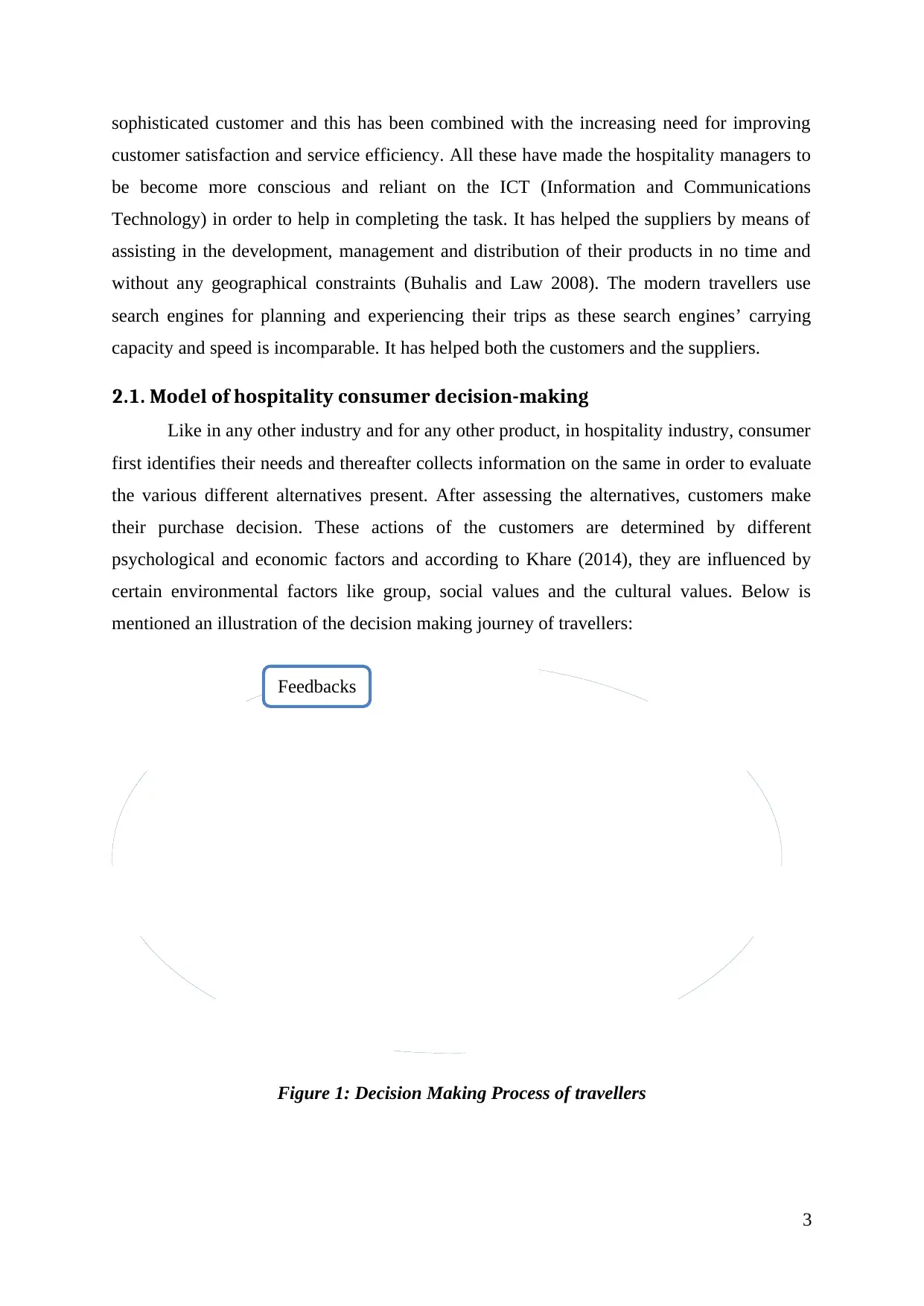
2.1. Model of hospitality consumer decision-making
Like in any other industry and for any other product, in hospitality industry, consumer
first identifies their needs and thereafter collects information on the same in order to evaluate
the various different alternatives present. After assessing the alternatives, customers make
their purchase decision. These actions of the customers are determined by different
psychological and economic factors and according to Khare (2014), they are influenced by
certain environmental factors like group, social values and the cultural values. Below is
mentioned an illustration of the decision making journey of travellers:
Figure 1: Decision Making Process of travellers
3
Needarousal(fortravelling)Needrecognition(totravel)LevelofinvolvementinthetripIdentifythetravelalternativesPurchasetravelMakedecisionontravellingPost-purchasebehaviourthatimpactstheirfuturedecisions
Feedbacks
customer satisfaction and service efficiency. All these have made the hospitality managers to
be become more conscious and reliant on the ICT (Information and Communications
Technology) in order to help in completing the task. It has helped the suppliers by means of
assisting in the development, management and distribution of their products in no time and
without any geographical constraints (Buhalis and Law 2008). The modern travellers use
search engines for planning and experiencing their trips as these search engines’ carrying
capacity and speed is incomparable. It has helped both the customers and the suppliers.
2.1. Model of hospitality consumer decision-making
Like in any other industry and for any other product, in hospitality industry, consumer
first identifies their needs and thereafter collects information on the same in order to evaluate
the various different alternatives present. After assessing the alternatives, customers make
their purchase decision. These actions of the customers are determined by different
psychological and economic factors and according to Khare (2014), they are influenced by
certain environmental factors like group, social values and the cultural values. Below is
mentioned an illustration of the decision making journey of travellers:
Figure 1: Decision Making Process of travellers
3
Needarousal(fortravelling)Needrecognition(totravel)LevelofinvolvementinthetripIdentifythetravelalternativesPurchasetravelMakedecisionontravellingPost-purchasebehaviourthatimpactstheirfuturedecisions
Feedbacks
Paraphrase This Document
Need a fresh take? Get an instant paraphrase of this document with our AI Paraphraser
2.2. “Factors that influence the decision making of hospitality customers”
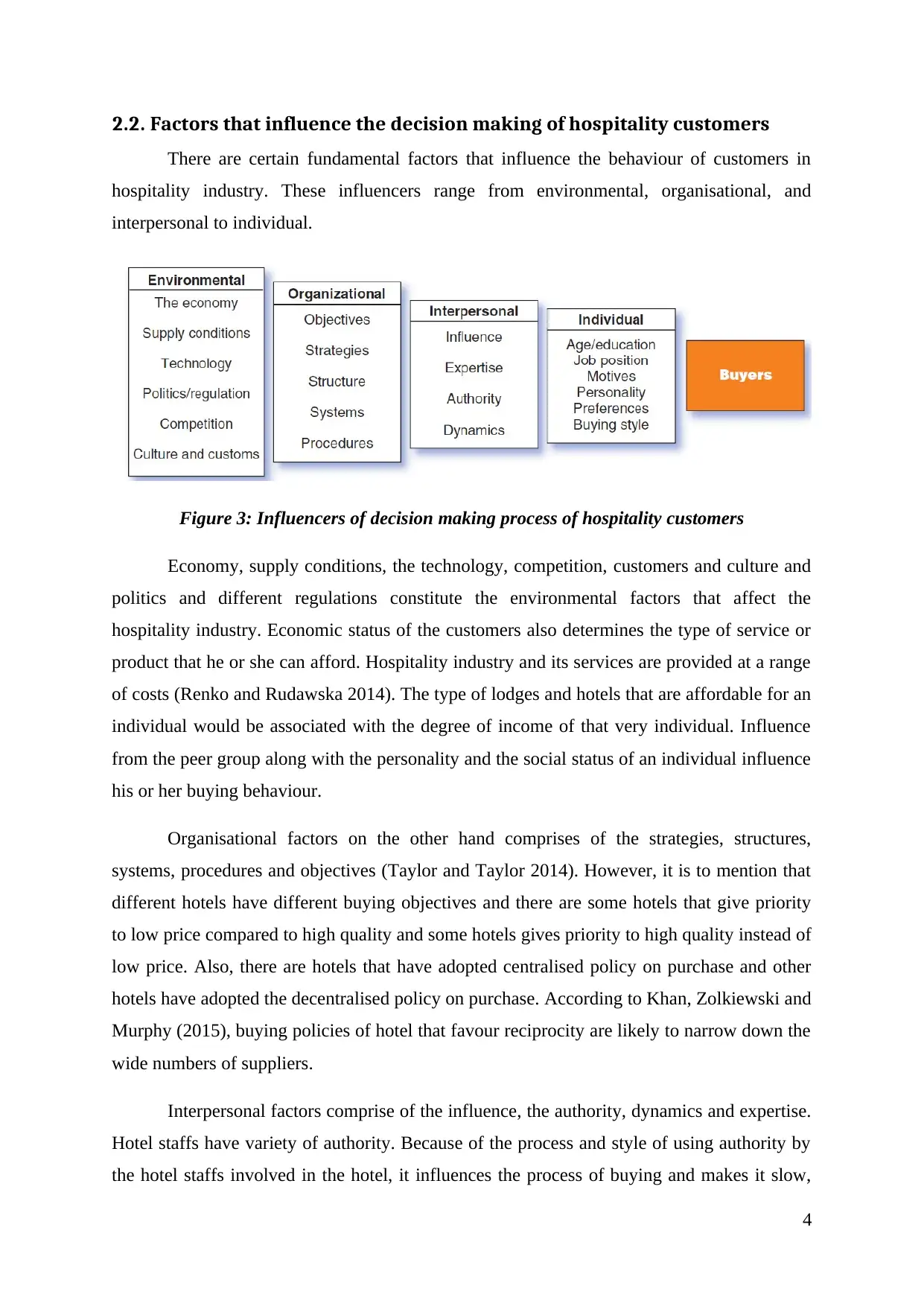
There are certain fundamental factors that influence the behaviour of customers in
hospitality industry. These influencers range from environmental, organisational, and
interpersonal to individual.
Figure 3: Influencers of decision making process of hospitality customers
Economy, supply conditions, the technology, competition, customers and culture and
politics and different regulations constitute the environmental factors that affect the
hospitality industry. Economic status of the customers also determines the type of service or
product that he or she can afford. Hospitality industry and its services are provided at a range
of costs (Renko and Rudawska 2014). The type of lodges and hotels that are affordable for an
individual would be associated with the degree of income of that very individual. Influence
from the peer group along with the personality and the social status of an individual influence
his or her buying behaviour.
Organisational factors on the other hand comprises of the strategies, structures,
systems, procedures and objectives (Taylor and Taylor 2014). However, it is to mention that
different hotels have different buying objectives and there are some hotels that give priority
to low price compared to high quality and some hotels gives priority to high quality instead of
low price. Also, there are hotels that have adopted centralised policy on purchase and other
hotels have adopted the decentralised policy on purchase. According to Khan, Zolkiewski and
Murphy (2015), buying policies of hotel that favour reciprocity are likely to narrow down the
wide numbers of suppliers.
Interpersonal factors comprise of the influence, the authority, dynamics and expertise.
Hotel staffs have variety of authority. Because of the process and style of using authority by
the hotel staffs involved in the hotel, it influences the process of buying and makes it slow,
4
There are certain fundamental factors that influence the behaviour of customers in
hospitality industry. These influencers range from environmental, organisational, and
interpersonal to individual.
Figure 3: Influencers of decision making process of hospitality customers
Economy, supply conditions, the technology, competition, customers and culture and
politics and different regulations constitute the environmental factors that affect the
hospitality industry. Economic status of the customers also determines the type of service or
product that he or she can afford. Hospitality industry and its services are provided at a range
of costs (Renko and Rudawska 2014). The type of lodges and hotels that are affordable for an
individual would be associated with the degree of income of that very individual. Influence
from the peer group along with the personality and the social status of an individual influence
his or her buying behaviour.
Organisational factors on the other hand comprises of the strategies, structures,
systems, procedures and objectives (Taylor and Taylor 2014). However, it is to mention that
different hotels have different buying objectives and there are some hotels that give priority
to low price compared to high quality and some hotels gives priority to high quality instead of
low price. Also, there are hotels that have adopted centralised policy on purchase and other
hotels have adopted the decentralised policy on purchase. According to Khan, Zolkiewski and
Murphy (2015), buying policies of hotel that favour reciprocity are likely to narrow down the
wide numbers of suppliers.
Interpersonal factors comprise of the influence, the authority, dynamics and expertise.
Hotel staffs have variety of authority. Because of the process and style of using authority by
the hotel staffs involved in the hotel, it influences the process of buying and makes it slow,
4
quick, easy and complicated. Also, there are differences in between the people’s interest
involved in the buying process of the organisation. Hotel manager might be interested in
consistency and quality of the supply of production input while the finance manager might be
interested in lowering of price. The customers might be represented by personnel working at
diverse levels of organisational hierarchy. The individual that give order and the ones who
purchase goods might not be same in the company. Because of this reason, section of services
and goods might get affected.
Lastly, individual factors comprise of the age, education, job position, buying style,
personality, culture and preferences of the customers. These factors are specific to the
customers such as their culture, religion, practices, beliefs etc., the economic status of the
customers, his age, experience with a particular product, sex and the peer group influence and
they often have a great influence on the choice that a customer make on a particular product
(Liat et al. 2017). Religion and culture also influence the types of foods and the hospitality
services that the customer would consume or use. His cultural beliefs and values would
determine his behaviour towards a particular context (Han 2015). It is to mention that culture
is an influential for the companies in hospitality industry, particularly the ones that have
expanded their operations to the global market. There are certain cultures that forbid intake of
some kind of foods and also there are some types of religious beliefs and teachings that
influence the same. All these are likely to dictate the lifestyle a traveller or a customer would
adopt and in this way, it would influence the operations of the hotels. Travel motivators are
considered to be an important aspect related to the decision making process of consumers.
Motivation-need theory of consumer behaviour can be implemented in order to motivate the
travellers so that they can fulfil their needs and gain huge levels of experience as well (Taylor
and Taylor 2014).
Apart from these, it is also to mention that “need to feel important and to be treated
with utmost respect may lead a potential guest to search for an upscale hotel with concierge
floor when making a reservation” (Lu et al. 2015). Status and personality of an individual in
the society determine him and the ones he is associated with. With the same, his opinion
regarding a service and the knowledge he possess too impact his buying of the product.
Customers might develop negative opinion towards some products right from their initial
encounter with them. This is likely to influence their future use of the same product or
service.
5
involved in the buying process of the organisation. Hotel manager might be interested in
consistency and quality of the supply of production input while the finance manager might be
interested in lowering of price. The customers might be represented by personnel working at
diverse levels of organisational hierarchy. The individual that give order and the ones who
purchase goods might not be same in the company. Because of this reason, section of services
and goods might get affected.
Lastly, individual factors comprise of the age, education, job position, buying style,
personality, culture and preferences of the customers. These factors are specific to the
customers such as their culture, religion, practices, beliefs etc., the economic status of the
customers, his age, experience with a particular product, sex and the peer group influence and
they often have a great influence on the choice that a customer make on a particular product
(Liat et al. 2017). Religion and culture also influence the types of foods and the hospitality
services that the customer would consume or use. His cultural beliefs and values would
determine his behaviour towards a particular context (Han 2015). It is to mention that culture
is an influential for the companies in hospitality industry, particularly the ones that have
expanded their operations to the global market. There are certain cultures that forbid intake of
some kind of foods and also there are some types of religious beliefs and teachings that
influence the same. All these are likely to dictate the lifestyle a traveller or a customer would
adopt and in this way, it would influence the operations of the hotels. Travel motivators are
considered to be an important aspect related to the decision making process of consumers.
Motivation-need theory of consumer behaviour can be implemented in order to motivate the
travellers so that they can fulfil their needs and gain huge levels of experience as well (Taylor
and Taylor 2014).
Apart from these, it is also to mention that “need to feel important and to be treated
with utmost respect may lead a potential guest to search for an upscale hotel with concierge
floor when making a reservation” (Lu et al. 2015). Status and personality of an individual in
the society determine him and the ones he is associated with. With the same, his opinion
regarding a service and the knowledge he possess too impact his buying of the product.
Customers might develop negative opinion towards some products right from their initial
encounter with them. This is likely to influence their future use of the same product or
service.
5
⊘ This is a preview!⊘
Do you want full access?
Subscribe today to unlock all pages.
Trusted by 1+ million students worldwide
2.3. Different stages of decision making process
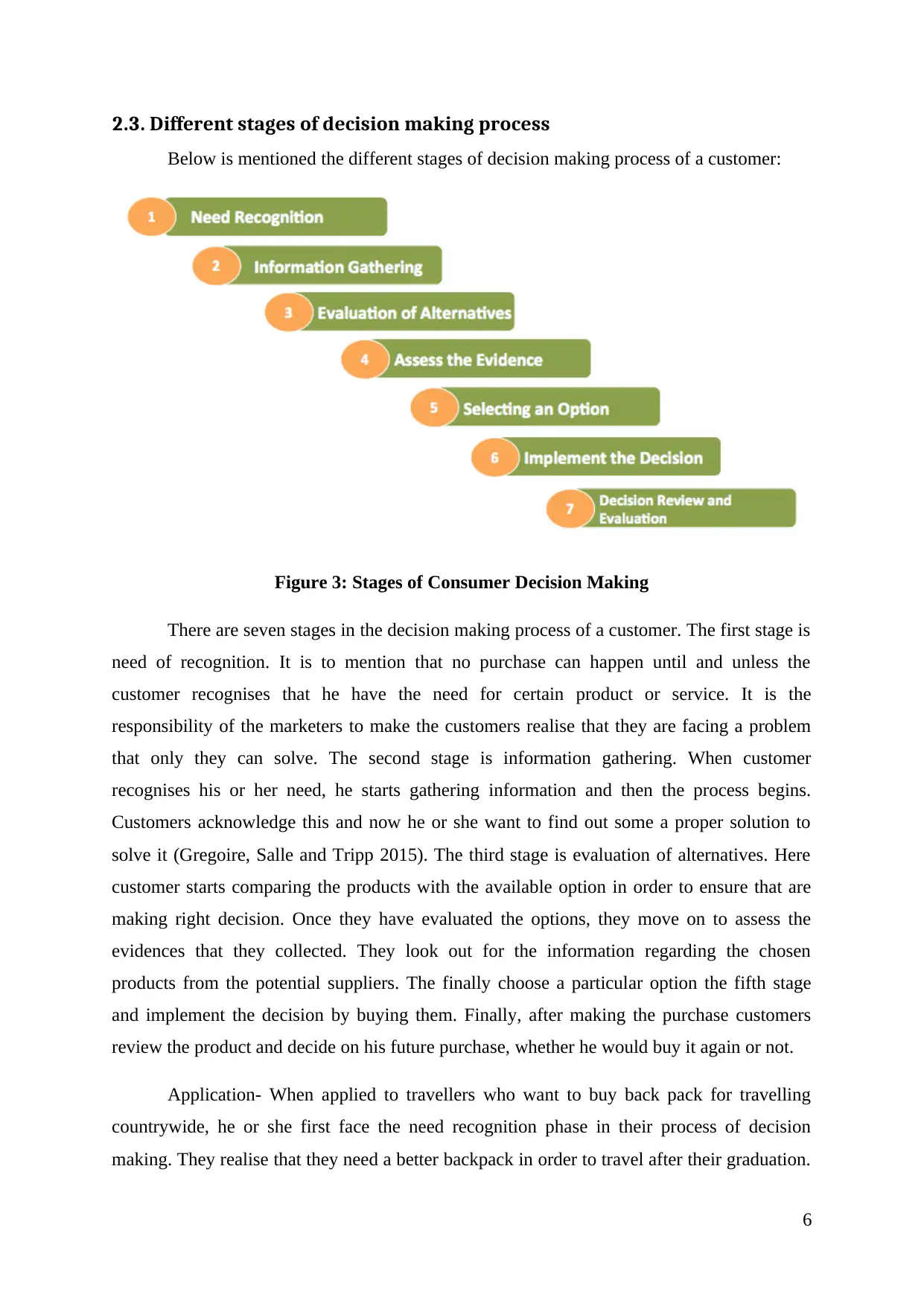
Below is mentioned the different stages of decision making process of a customer:
Figure 3: Stages of Consumer Decision Making
There are seven stages in the decision making process of a customer. The first stage is
need of recognition. It is to mention that no purchase can happen until and unless the
customer recognises that he have the need for certain product or service. It is the
responsibility of the marketers to make the customers realise that they are facing a problem
that only they can solve. The second stage is information gathering. When customer
recognises his or her need, he starts gathering information and then the process begins.
Customers acknowledge this and now he or she want to find out some a proper solution to
solve it (Gregoire, Salle and Tripp 2015). The third stage is evaluation of alternatives. Here
customer starts comparing the products with the available option in order to ensure that are
making right decision. Once they have evaluated the options, they move on to assess the
evidences that they collected. They look out for the information regarding the chosen
products from the potential suppliers. The finally choose a particular option the fifth stage
and implement the decision by buying them. Finally, after making the purchase customers
review the product and decide on his future purchase, whether he would buy it again or not.
Application- When applied to travellers who want to buy back pack for travelling
countrywide, he or she first face the need recognition phase in their process of decision
making. They realise that they need a better backpack in order to travel after their graduation.
6
Below is mentioned the different stages of decision making process of a customer:
Figure 3: Stages of Consumer Decision Making
There are seven stages in the decision making process of a customer. The first stage is
need of recognition. It is to mention that no purchase can happen until and unless the
customer recognises that he have the need for certain product or service. It is the
responsibility of the marketers to make the customers realise that they are facing a problem
that only they can solve. The second stage is information gathering. When customer
recognises his or her need, he starts gathering information and then the process begins.
Customers acknowledge this and now he or she want to find out some a proper solution to
solve it (Gregoire, Salle and Tripp 2015). The third stage is evaluation of alternatives. Here
customer starts comparing the products with the available option in order to ensure that are
making right decision. Once they have evaluated the options, they move on to assess the
evidences that they collected. They look out for the information regarding the chosen
products from the potential suppliers. The finally choose a particular option the fifth stage
and implement the decision by buying them. Finally, after making the purchase customers
review the product and decide on his future purchase, whether he would buy it again or not.
Application- When applied to travellers who want to buy back pack for travelling
countrywide, he or she first face the need recognition phase in their process of decision
making. They realise that they need a better backpack in order to travel after their graduation.
6
Paraphrase This Document
Need a fresh take? Get an instant paraphrase of this document with our AI Paraphraser
The phase is of “search for product information”. They begins to look at available options of
backpack on the website and different online shopping apps and take suggestions from their
friends and family members. They also often visit stores in order to have a look on the
available options (Buhalis and Law 2008).
The phase of recognition and recall is able to play a major role in recognising the
needs related to travel. The realisation that the travellers have related to recognition of their
need to acquire a better backpack for travelling after graduation is a major part of recognition
and recall phase. The next phase is of “product evaluation”. In this stage, travellers decide on
the price that he want to pay and set a budget and set criteria. They buy the bag pack
accordingly. On the basis of the evaluation and by deciding what would suit him or her best,
they make the purchase. After buying the product they decide whether the back pack is the
same that he or she thought of to be and is it meeting the needs or not. The last stage if the
disposal. If the customer likes the bag pack, he decides to buy the same or buy an upgrade
version of the same. Or if he or she dislikes it, then it is either given to a friend or sell it
(Gregoire, Salle and Tripp 2015).
2.4. Influences on the process of decision making
Marketers are often seen to be influencing the decision making process of the
hospitality customers. There are four components in the marketing mix and they are- product,
pricing, place of distribution and promotion and these components have direct and indirect
influence on the process of buying of the customers (Chan 2014). The kind of advertisement
that a marketer make or is carried out by a business on a particular product or service is likely
to influence the buying behaviour of the customer. The type of image used in advertising is
important to consider. Decisions are made to make a holiday plan and then the choices need
to be made about time, type and destination. This is when the image plays its role.
The purchase linked with high degrees of perceive risk and involvement is called
extensive problem solving, In the information of tourism, searching and evaluating plays a
notable role in the process of buying decision. With the same, brand loyalty is a notable
element in the process of decision making. Often customers want to visit or take the
hospitality of the same hotel that they used before. In such cases, customers barely choose to
evaluate or search for other alternatives (Murray and Kline 2015).
7
backpack on the website and different online shopping apps and take suggestions from their
friends and family members. They also often visit stores in order to have a look on the
available options (Buhalis and Law 2008).
The phase of recognition and recall is able to play a major role in recognising the
needs related to travel. The realisation that the travellers have related to recognition of their
need to acquire a better backpack for travelling after graduation is a major part of recognition
and recall phase. The next phase is of “product evaluation”. In this stage, travellers decide on
the price that he want to pay and set a budget and set criteria. They buy the bag pack
accordingly. On the basis of the evaluation and by deciding what would suit him or her best,
they make the purchase. After buying the product they decide whether the back pack is the
same that he or she thought of to be and is it meeting the needs or not. The last stage if the
disposal. If the customer likes the bag pack, he decides to buy the same or buy an upgrade
version of the same. Or if he or she dislikes it, then it is either given to a friend or sell it
(Gregoire, Salle and Tripp 2015).
2.4. Influences on the process of decision making
Marketers are often seen to be influencing the decision making process of the
hospitality customers. There are four components in the marketing mix and they are- product,
pricing, place of distribution and promotion and these components have direct and indirect
influence on the process of buying of the customers (Chan 2014). The kind of advertisement
that a marketer make or is carried out by a business on a particular product or service is likely
to influence the buying behaviour of the customer. The type of image used in advertising is
important to consider. Decisions are made to make a holiday plan and then the choices need
to be made about time, type and destination. This is when the image plays its role.
The purchase linked with high degrees of perceive risk and involvement is called
extensive problem solving, In the information of tourism, searching and evaluating plays a
notable role in the process of buying decision. With the same, brand loyalty is a notable
element in the process of decision making. Often customers want to visit or take the
hospitality of the same hotel that they used before. In such cases, customers barely choose to
evaluate or search for other alternatives (Murray and Kline 2015).
7
2.5. “The differences between Business to Consumer (B2C) and Business-to-
business (B2B) decision-making processes”
The business operations in B2C businesses are different from the B2B businesses and
so is their marketing and decision making processes. The main purpose of consumption for
B2B marketing is that these companies buy for producing products and services for the
customers and the other businesses. Here, marketers recognise that the companies buy these
products or services for running their own businesses. On the other hand, the purpose of
consumption for B2C marketing is that here customers buy products for their personal
gratification. Here marketer recognises that the customers buys services and products for
their personal use. In terms of buying produces, in B2B businesses, their buying habit tends
to involve more than one individual whereas, in B2C businesses, their buying habit tends to
involve a household unit or a single person (Murray and Kline 2015).
2.7. Market research differ between B2B and B2C
It is to mention that market research in B2B market needs diverse skillset at all the
level of responsibility, right from the research director for telephonic interviewer. The
telephonic interviewers face many challenges while working on B2B research projects as it
includes finite number of sample lists (Coenen and Kok 2014). Also, in most of the cases,
sample sizes are smaller for the B2B research and they are often restricted to the present
samples. B2c on the other hand are larger. Due to this reason, it is also very less likely to
weight a dataset in order to ensure that it is representative to overall sample. Telephone is a
significant tool of the business and therefore, tele-depth interviews work better as compared
to face-to-face interviews in B2B businesses and this can be quite costly. These interviews
are more focused those face to face interviews in the aspects of data that are collected in
allotted time. Pareto principle is something that factors into the B2B research more than the
B2C research while conducting the customer research (Lilien 2015). While sampling for a
piece of customer research that we need to be aware that in majority of the cases small
number of customers makes up larger number of revenue.
2.7. Approaches to the consumer learning (Behavioural and Cognitive)
It is to mention that the consumer behaviour models that explain the behaviour of the
customers are developed from different theoretical approaches, which have been used in the
subject of consumer behaviour. These approaches comprise of the “Economic Man,
8
business (B2B) decision-making processes”
The business operations in B2C businesses are different from the B2B businesses and
so is their marketing and decision making processes. The main purpose of consumption for
B2B marketing is that these companies buy for producing products and services for the
customers and the other businesses. Here, marketers recognise that the companies buy these
products or services for running their own businesses. On the other hand, the purpose of
consumption for B2C marketing is that here customers buy products for their personal
gratification. Here marketer recognises that the customers buys services and products for
their personal use. In terms of buying produces, in B2B businesses, their buying habit tends
to involve more than one individual whereas, in B2C businesses, their buying habit tends to
involve a household unit or a single person (Murray and Kline 2015).
2.7. Market research differ between B2B and B2C
It is to mention that market research in B2B market needs diverse skillset at all the
level of responsibility, right from the research director for telephonic interviewer. The
telephonic interviewers face many challenges while working on B2B research projects as it
includes finite number of sample lists (Coenen and Kok 2014). Also, in most of the cases,
sample sizes are smaller for the B2B research and they are often restricted to the present
samples. B2c on the other hand are larger. Due to this reason, it is also very less likely to
weight a dataset in order to ensure that it is representative to overall sample. Telephone is a
significant tool of the business and therefore, tele-depth interviews work better as compared
to face-to-face interviews in B2B businesses and this can be quite costly. These interviews
are more focused those face to face interviews in the aspects of data that are collected in
allotted time. Pareto principle is something that factors into the B2B research more than the
B2C research while conducting the customer research (Lilien 2015). While sampling for a
piece of customer research that we need to be aware that in majority of the cases small
number of customers makes up larger number of revenue.
2.7. Approaches to the consumer learning (Behavioural and Cognitive)
It is to mention that the consumer behaviour models that explain the behaviour of the
customers are developed from different theoretical approaches, which have been used in the
subject of consumer behaviour. These approaches comprise of the “Economic Man,
8
⊘ This is a preview!⊘
Do you want full access?
Subscribe today to unlock all pages.
Trusted by 1+ million students worldwide
Psychodynamic Approach, Cognitive Approach, Behaviourist Approach and the Humanistic
Approach”.
It is to mention that in cognitive approach to consumer learning, the consumer
behaviour is attributed to their internal cognitive related abilities and these abilities include
the ability of perceiving and processing different information. It is attached to the subject of
Cognitive Psychology. This approach claims that the external factors such as the environment
from which an individual belong is a stimuli, which generate the information for the internal
process of decision making. As opined by Shepherd and Rudd (2014), the process of decision
making of customers are influenced by two main factors- cognitive ability and environmental
influences. Cognitive ability is related to the individuals’ experience.
Behavioural approach to consumer learning is related to the response and stimulus. It
is related to the response that a person gives or reacts in a particular situation. This approach
depends on the stimulus and the response (Hutchinson and Eisenstein 2018). This approach
also generates the relation across different situations, having same kind of response. The
behaviourist theorist are concentrated over the process of learning.
Conclusion
From the above analysis it is to conclude that there are different elements that affect
the decision making process of customers in hospitality industry. Some factor emanates from
the customers, and the others stem from business organisations. Religion, culture, practices,
beliefs, economic status, age etc. are specific to the customers and the others like experience,
product, advertisement etc. are specific to the business. All these influence the customer
behaviour and gaining a good understanding of the customer behaviour is very important for
the enhancement of the operations of a business organisations.
9
Approach”.
It is to mention that in cognitive approach to consumer learning, the consumer
behaviour is attributed to their internal cognitive related abilities and these abilities include
the ability of perceiving and processing different information. It is attached to the subject of
Cognitive Psychology. This approach claims that the external factors such as the environment
from which an individual belong is a stimuli, which generate the information for the internal
process of decision making. As opined by Shepherd and Rudd (2014), the process of decision
making of customers are influenced by two main factors- cognitive ability and environmental
influences. Cognitive ability is related to the individuals’ experience.
Behavioural approach to consumer learning is related to the response and stimulus. It
is related to the response that a person gives or reacts in a particular situation. This approach
depends on the stimulus and the response (Hutchinson and Eisenstein 2018). This approach
also generates the relation across different situations, having same kind of response. The
behaviourist theorist are concentrated over the process of learning.
Conclusion
From the above analysis it is to conclude that there are different elements that affect
the decision making process of customers in hospitality industry. Some factor emanates from
the customers, and the others stem from business organisations. Religion, culture, practices,
beliefs, economic status, age etc. are specific to the customers and the others like experience,
product, advertisement etc. are specific to the business. All these influence the customer
behaviour and gaining a good understanding of the customer behaviour is very important for
the enhancement of the operations of a business organisations.
9
Paraphrase This Document
Need a fresh take? Get an instant paraphrase of this document with our AI Paraphraser
References:
Buhalis, D. and Law, R. (2008), “Progress in information technology and tourism
management: 20 years on and 10 years after the internet – the state of etourism research”,
Tourism Management, Vol. 29 No. 4, pp. 609-23.
Chan, E.S.W., 2014. Green marketing: Hotel customers’ perspective. Journal of Travel &
Tourism Marketing, 31(8), pp.915-936.
Coenen, M. and Kok, R.A., 2014. Workplace flexibility and new product development
performance: The role of telework and flexible work schedules. European Management
Journal, 32(4), pp.564-576.
Grégoire, Y., Salle, A. and Tripp, T.M., 2015. Managing social media crises with your
customers: The good, the bad, and the ugly. Business Horizons, 58(2), pp.173-182.
Han, H., 2015. Travelers' pro-environmental behavior in a green lodging context: Converging
value-belief-norm theory and the theory of planned behavior. Tourism Management, 47,
pp.164-177.
Han, J., Ding, H., Qian, C., Xi, W., Wang, Z., Jiang, Z., Shangguan, L. and Zhao, J., 2015.
Cbid: A customer behavior identification system using passive tags. IEEE/ACM Transactions
on Networking, 24(5), pp.2885-2898.
Hutchinson, J.W. and Eisenstein, E.M., 2018. Consumer learning and expertise. In Handbook
of consumer psychology (pp. 117-145). Routledge.
Kandampully, J., Zhang, T. and Bilgihan, A., 2015. Customer loyalty: a review and future
directions with a special focus on the hospitality industry. International Journal of
Contemporary Hospitality Management, 27(3), pp.379-414.
Khan, A., Zolkiewski, J. and Murphy, J., 2015. Favour and opportunity: renqing in Chinese
business relationships. Journal of Business & Industrial Marketing, 31(2), pp.183-192.
Khare, A., 2014. Consumers’ susceptibility to interpersonal influence as a determining factor
of ecologically conscious behaviour. Marketing Intelligence & Planning, 32(1), pp.2-20.
Kumar, A., Bezawada, R., Rishika, R., Janakiraman, R. and Kannan, P.K., 2016. From social
to sale: The effects of firm-generated content in social media on customer behavior. Journal
of Marketing, 80(1), pp.7-25.
10
Buhalis, D. and Law, R. (2008), “Progress in information technology and tourism
management: 20 years on and 10 years after the internet – the state of etourism research”,
Tourism Management, Vol. 29 No. 4, pp. 609-23.
Chan, E.S.W., 2014. Green marketing: Hotel customers’ perspective. Journal of Travel &
Tourism Marketing, 31(8), pp.915-936.
Coenen, M. and Kok, R.A., 2014. Workplace flexibility and new product development
performance: The role of telework and flexible work schedules. European Management
Journal, 32(4), pp.564-576.
Grégoire, Y., Salle, A. and Tripp, T.M., 2015. Managing social media crises with your
customers: The good, the bad, and the ugly. Business Horizons, 58(2), pp.173-182.
Han, H., 2015. Travelers' pro-environmental behavior in a green lodging context: Converging
value-belief-norm theory and the theory of planned behavior. Tourism Management, 47,
pp.164-177.
Han, J., Ding, H., Qian, C., Xi, W., Wang, Z., Jiang, Z., Shangguan, L. and Zhao, J., 2015.
Cbid: A customer behavior identification system using passive tags. IEEE/ACM Transactions
on Networking, 24(5), pp.2885-2898.
Hutchinson, J.W. and Eisenstein, E.M., 2018. Consumer learning and expertise. In Handbook
of consumer psychology (pp. 117-145). Routledge.
Kandampully, J., Zhang, T. and Bilgihan, A., 2015. Customer loyalty: a review and future
directions with a special focus on the hospitality industry. International Journal of
Contemporary Hospitality Management, 27(3), pp.379-414.
Khan, A., Zolkiewski, J. and Murphy, J., 2015. Favour and opportunity: renqing in Chinese
business relationships. Journal of Business & Industrial Marketing, 31(2), pp.183-192.
Khare, A., 2014. Consumers’ susceptibility to interpersonal influence as a determining factor
of ecologically conscious behaviour. Marketing Intelligence & Planning, 32(1), pp.2-20.
Kumar, A., Bezawada, R., Rishika, R., Janakiraman, R. and Kannan, P.K., 2016. From social
to sale: The effects of firm-generated content in social media on customer behavior. Journal
of Marketing, 80(1), pp.7-25.
10
Liat, C.B., Mansori, S., Chuan, G.C. and Imrie, B.C., 2017. Hotel service recovery and
service quality: Influences of corporate image and generational differences in the relationship
between customer satisfaction and loyalty. Journal of Global Marketing, 30(1), pp.42-51.
Lilien, G.L., 2015. The B2B knowledge gap. International Journal of Research in
Marketing, 33(3), pp.543-556.
Lu, C., Berchoux, C., Marek, M.W. and Chen, B., 2015. Service quality and customer
satisfaction: qualitative research implications for luxury hotels. International Journal of
Culture, Tourism and Hospitality Research, 9(2), pp.168-182.
Murray, A. and Kline, C., 2015. Rural tourism and the craft beer experience: Factors
influencing brand loyalty in rural North Carolina, USA. Journal of Sustainable
Tourism, 23(8-9), pp.1198-1216.
Renko, S. and Rudawska, E.D., 2014. Customer loyalty towards traditional products–Polish
market experience. British Food Journal.
Shepherd, N.G. and Rudd, J.M., 2014. The influence of context on the strategic decision‐
making process: A review of the literature. International Journal of Management
Reviews, 16(3), pp.340-364.
Taylor, A. and Taylor, M., 2014. Factors influencing effective implementation of
performance measurement systems in small and medium-sized enterprises and large firms: a
perspective from Contingency Theory. International Journal of Production Research, 52(3),
pp.847-866.
11
service quality: Influences of corporate image and generational differences in the relationship
between customer satisfaction and loyalty. Journal of Global Marketing, 30(1), pp.42-51.
Lilien, G.L., 2015. The B2B knowledge gap. International Journal of Research in
Marketing, 33(3), pp.543-556.
Lu, C., Berchoux, C., Marek, M.W. and Chen, B., 2015. Service quality and customer
satisfaction: qualitative research implications for luxury hotels. International Journal of
Culture, Tourism and Hospitality Research, 9(2), pp.168-182.
Murray, A. and Kline, C., 2015. Rural tourism and the craft beer experience: Factors
influencing brand loyalty in rural North Carolina, USA. Journal of Sustainable
Tourism, 23(8-9), pp.1198-1216.
Renko, S. and Rudawska, E.D., 2014. Customer loyalty towards traditional products–Polish
market experience. British Food Journal.
Shepherd, N.G. and Rudd, J.M., 2014. The influence of context on the strategic decision‐
making process: A review of the literature. International Journal of Management
Reviews, 16(3), pp.340-364.
Taylor, A. and Taylor, M., 2014. Factors influencing effective implementation of
performance measurement systems in small and medium-sized enterprises and large firms: a
perspective from Contingency Theory. International Journal of Production Research, 52(3),
pp.847-866.
11
⊘ This is a preview!⊘
Do you want full access?
Subscribe today to unlock all pages.
Trusted by 1+ million students worldwide

1 out of 12


Related Documents


Your All-in-One AI-Powered Toolkit for Academic Success.
+13062052269
info@desklib.com
Available 24*7 on WhatsApp / Email
![[object Object]](/_next/static/media/star-bottom.7253800d.svg)
Unlock your academic potential
Copyright © 2020–2026 A2Z Services. All Rights Reserved. Developed and managed by ZUCOL.