Science of Consumer Behavior: Research, Findings, and Recommendations

Verified

Added on  2021/06/17

|5
|1092
|28
Report
AI Summary
This report analyzes the science of consumer behavior, focusing on a research paper that explores how the desire for control influences product acquisition. The study investigates the impact of control deprivation on consumer choices between utilitarian and hedonic products. The research, conducted through four studies, reveals that consumers with low perceived control tend to favor utilitarian products. Based on these findings, the report offers recommendations for Wesfarmers Limited, an Australian conglomerate, suggesting strategies to enhance sales and consumer loyalty. These recommendations include importing more utilitarian products, framing hedonic products as problem-solving items, and creating utility marketing campaigns tailored to consumer needs. The report emphasizes the importance of understanding consumer preferences and staying true to brand messages to improve marketing effectiveness.
Document Page
Running head: SCIENCE OF CONSUMER BEHAVIOR
Science of Consumer Behavior
Name of the student
Name of the University
Author note
tabler-icon-diamond-filled.svg

Paraphrase This Document

Need a fresh take? Get an instant paraphrase of this document with our AI Paraphraser
Document Page
1SCIENCE OF CONSUMER BEHAVIOR
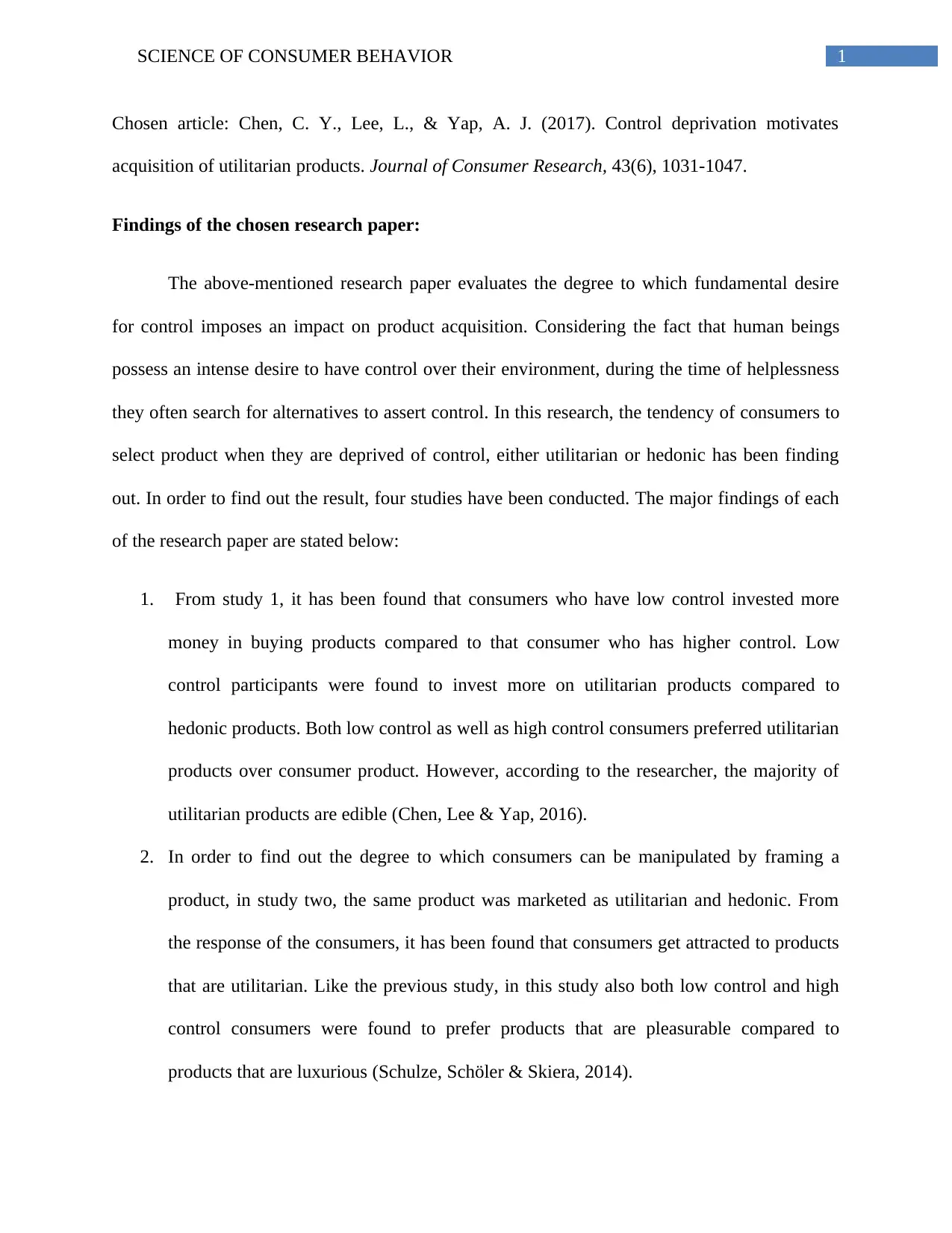
Chosen article: Chen, C. Y., Lee, L., & Yap, A. J. (2017). Control deprivation motivates
acquisition of utilitarian products. Journal of Consumer Research, 43(6), 1031-1047.
Findings of the chosen research paper:
The above-mentioned research paper evaluates the degree to which fundamental desire
for control imposes an impact on product acquisition. Considering the fact that human beings
possess an intense desire to have control over their environment, during the time of helplessness
they often search for alternatives to assert control. In this research, the tendency of consumers to
select product when they are deprived of control, either utilitarian or hedonic has been finding
out. In order to find out the result, four studies have been conducted. The major findings of each
of the research paper are stated below:
1. From study 1, it has been found that consumers who have low control invested more
money in buying products compared to that consumer who has higher control. Low
control participants were found to invest more on utilitarian products compared to
hedonic products. Both low control as well as high control consumers preferred utilitarian
products over consumer product. However, according to the researcher, the majority of
utilitarian products are edible (Chen, Lee & Yap, 2016).
2. In order to find out the degree to which consumers can be manipulated by framing a
product, in study two, the same product was marketed as utilitarian and hedonic. From
the response of the consumers, it has been found that consumers get attracted to products
that are utilitarian. Like the previous study, in this study also both low control and high
control consumers were found to prefer products that are pleasurable compared to
products that are luxurious (Schulze, Schöler & Skiera, 2014).
Document Page
2SCIENCE OF CONSUMER BEHAVIOR
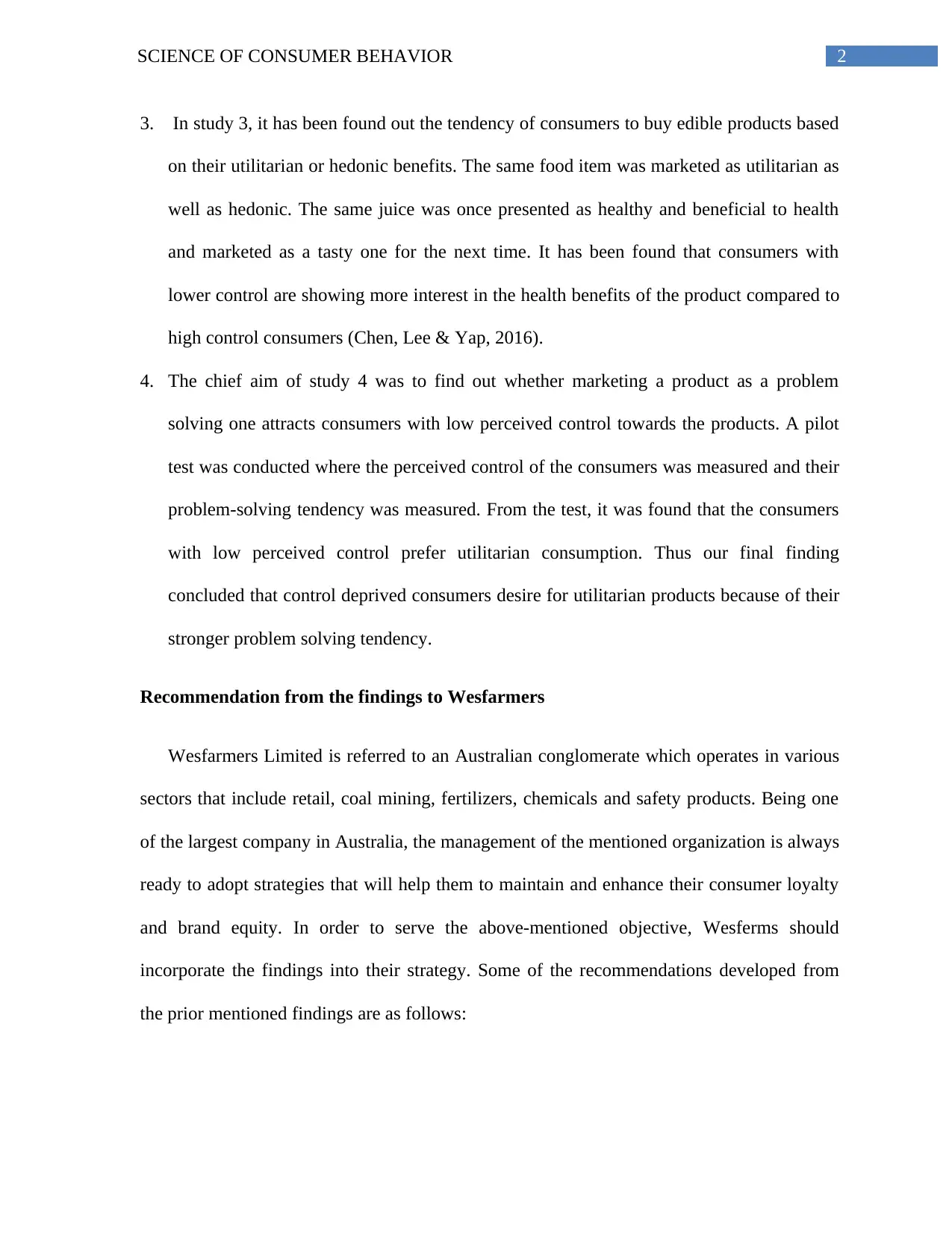
3. In study 3, it has been found out the tendency of consumers to buy edible products based
on their utilitarian or hedonic benefits. The same food item was marketed as utilitarian as
well as hedonic. The same juice was once presented as healthy and beneficial to health
and marketed as a tasty one for the next time. It has been found that consumers with
lower control are showing more interest in the health benefits of the product compared to
high control consumers (Chen, Lee & Yap, 2016).
4. The chief aim of study 4 was to find out whether marketing a product as a problem
solving one attracts consumers with low perceived control towards the products. A pilot
test was conducted where the perceived control of the consumers was measured and their
problem-solving tendency was measured. From the test, it was found that the consumers
with low perceived control prefer utilitarian consumption. Thus our final finding
concluded that control deprived consumers desire for utilitarian products because of their
stronger problem solving tendency.
Recommendation from the findings to Wesfarmers
Wesfarmers Limited is referred to an Australian conglomerate which operates in various
sectors that include retail, coal mining, fertilizers, chemicals and safety products. Being one
of the largest company in Australia, the management of the mentioned organization is always
ready to adopt strategies that will help them to maintain and enhance their consumer loyalty
and brand equity. In order to serve the above-mentioned objective, Wesferms should
incorporate the findings into their strategy. Some of the recommendations developed from
the prior mentioned findings are as follows:
Document Page
3SCIENCE OF CONSUMER BEHAVIOR
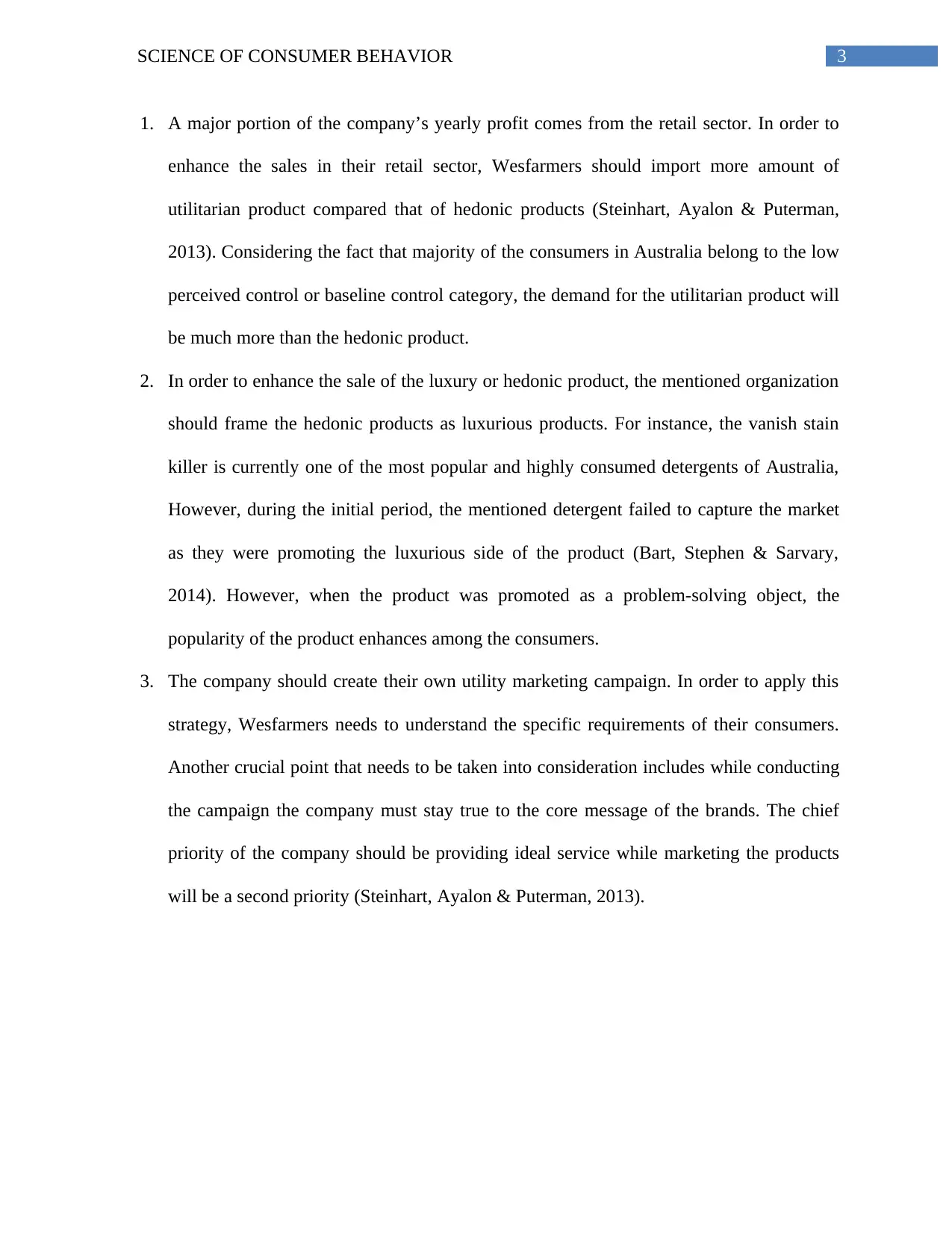
1. A major portion of the company’s yearly profit comes from the retail sector. In order to
enhance the sales in their retail sector, Wesfarmers should import more amount of
utilitarian product compared that of hedonic products (Steinhart, Ayalon & Puterman,
2013). Considering the fact that majority of the consumers in Australia belong to the low
perceived control or baseline control category, the demand for the utilitarian product will
be much more than the hedonic product.
2. In order to enhance the sale of the luxury or hedonic product, the mentioned organization
should frame the hedonic products as luxurious products. For instance, the vanish stain
killer is currently one of the most popular and highly consumed detergents of Australia,
However, during the initial period, the mentioned detergent failed to capture the market
as they were promoting the luxurious side of the product (Bart, Stephen & Sarvary,
2014). However, when the product was promoted as a problem-solving object, the
popularity of the product enhances among the consumers.
3. The company should create their own utility marketing campaign. In order to apply this
strategy, Wesfarmers needs to understand the specific requirements of their consumers.
Another crucial point that needs to be taken into consideration includes while conducting
the campaign the company must stay true to the core message of the brands. The chief
priority of the company should be providing ideal service while marketing the products
will be a second priority (Steinhart, Ayalon & Puterman, 2013).
tabler-icon-diamond-filled.svg

Paraphrase This Document

Need a fresh take? Get an instant paraphrase of this document with our AI Paraphraser
Document Page
4SCIENCE OF CONSUMER BEHAVIOR
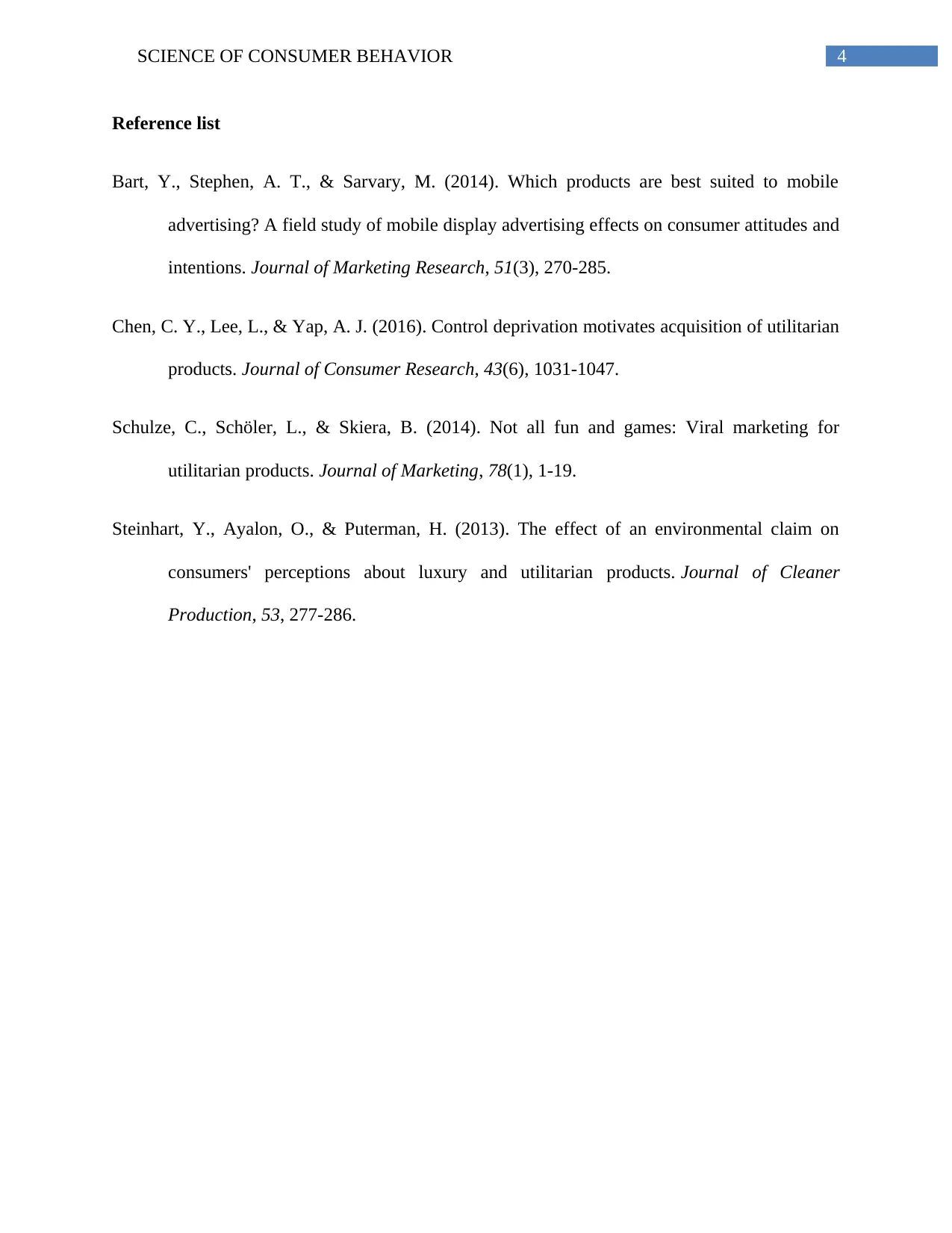
Reference list
Bart, Y., Stephen, A. T., & Sarvary, M. (2014). Which products are best suited to mobile
advertising? A field study of mobile display advertising effects on consumer attitudes and
intentions. Journal of Marketing Research, 51(3), 270-285.
Chen, C. Y., Lee, L., & Yap, A. J. (2016). Control deprivation motivates acquisition of utilitarian
products. Journal of Consumer Research, 43(6), 1031-1047.
Schulze, C., Schöler, L., & Skiera, B. (2014). Not all fun and games: Viral marketing for
utilitarian products. Journal of Marketing, 78(1), 1-19.
Steinhart, Y., Ayalon, O., & Puterman, H. (2013). The effect of an environmental claim on
consumers' perceptions about luxury and utilitarian products. Journal of Cleaner
Production, 53, 277-286.
chevron_up_icon
1 out of 5
circle_padding
hide_on_mobile
zoom_out_icon
[object Object]