Evaluating Consumer Protection and Negligence in Australian Law
VerifiedAdded on 2020/04/01
|10
|2527
|60
AI Summary
Negligent misstatement, a significant aspect of tort law, involves providing false information without due care. In Australia, landmark cases like Hedley Byrne v Heller established duty of care principles applicable to negligent statements. This essay delves into how such duties are recognized within Australian jurisdiction, notably in Barnett v Chelsea & Kensington Hospital and Oyston v St Patrick’s College. It highlights the criteria for establishing a duty of care and examines scenarios where businesses failed in their obligations, leading to consumer harm. The analysis extends to preventive measures under the Australian Consumer Law (ACL), emphasizing business compliance with information disclosure and safety guarantees. By examining cases like Joystick's misleading advertisements and Uber's legal disputes over misrepresentation, this essay underscores the critical importance of accurate communication in maintaining trust and mitigating risks in commercial transactions.
Running head: BUSINESS LAW
Business law
Name of the Student
Name of the University
Author Note
Business law
Name of the Student
Name of the University
Author Note

Paraphrase This Document
Need a fresh take? Get an instant paraphrase of this document with our AI Paraphraser
1BUSINESS LAW
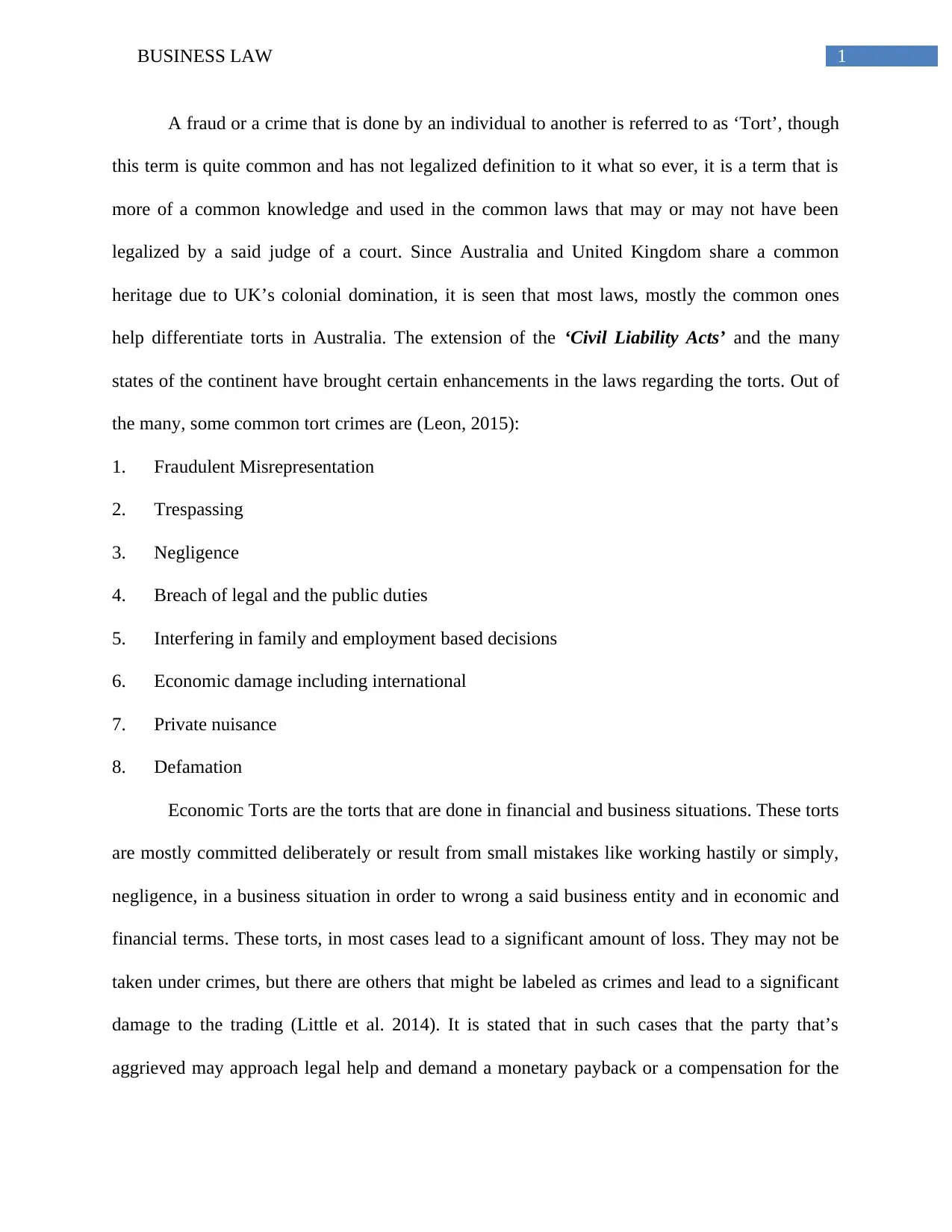
A fraud or a crime that is done by an individual to another is referred to as ‘Tort’, though
this term is quite common and has not legalized definition to it what so ever, it is a term that is
more of a common knowledge and used in the common laws that may or may not have been
legalized by a said judge of a court. Since Australia and United Kingdom share a common
heritage due to UK’s colonial domination, it is seen that most laws, mostly the common ones
help differentiate torts in Australia. The extension of the ‘Civil Liability Acts’ and the many
states of the continent have brought certain enhancements in the laws regarding the torts. Out of
the many, some common tort crimes are (Leon, 2015):
1. Fraudulent Misrepresentation
2. Trespassing
3. Negligence
4. Breach of legal and the public duties
5. Interfering in family and employment based decisions
6. Economic damage including international
7. Private nuisance
8. Defamation
Economic Torts are the torts that are done in financial and business situations. These torts
are mostly committed deliberately or result from small mistakes like working hastily or simply,
negligence, in a business situation in order to wrong a said business entity and in economic and
financial terms. These torts, in most cases lead to a significant amount of loss. They may not be
taken under crimes, but there are others that might be labeled as crimes and lead to a significant
damage to the trading (Little et al. 2014). It is stated that in such cases that the party that’s
aggrieved may approach legal help and demand a monetary payback or a compensation for the
A fraud or a crime that is done by an individual to another is referred to as ‘Tort’, though
this term is quite common and has not legalized definition to it what so ever, it is a term that is
more of a common knowledge and used in the common laws that may or may not have been
legalized by a said judge of a court. Since Australia and United Kingdom share a common
heritage due to UK’s colonial domination, it is seen that most laws, mostly the common ones
help differentiate torts in Australia. The extension of the ‘Civil Liability Acts’ and the many
states of the continent have brought certain enhancements in the laws regarding the torts. Out of
the many, some common tort crimes are (Leon, 2015):
1. Fraudulent Misrepresentation
2. Trespassing
3. Negligence
4. Breach of legal and the public duties
5. Interfering in family and employment based decisions
6. Economic damage including international
7. Private nuisance
8. Defamation
Economic Torts are the torts that are done in financial and business situations. These torts
are mostly committed deliberately or result from small mistakes like working hastily or simply,
negligence, in a business situation in order to wrong a said business entity and in economic and
financial terms. These torts, in most cases lead to a significant amount of loss. They may not be
taken under crimes, but there are others that might be labeled as crimes and lead to a significant
damage to the trading (Little et al. 2014). It is stated that in such cases that the party that’s
aggrieved may approach legal help and demand a monetary payback or a compensation for the
2BUSINESS LAW
damage and may request the seizure of any more of those activities if a financial damage is
faced.
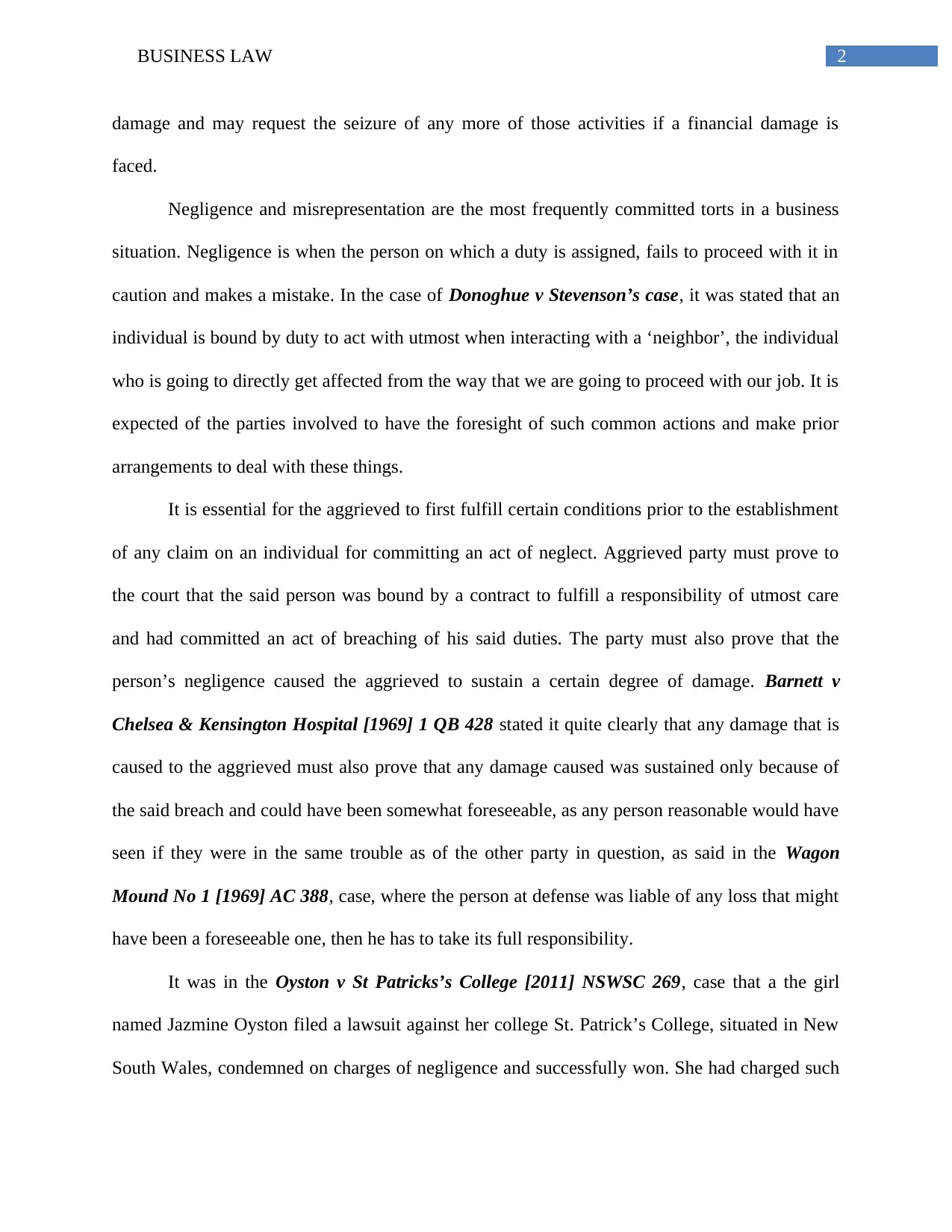
Negligence and misrepresentation are the most frequently committed torts in a business
situation. Negligence is when the person on which a duty is assigned, fails to proceed with it in
caution and makes a mistake. In the case of Donoghue v Stevenson’s case, it was stated that an
individual is bound by duty to act with utmost when interacting with a ‘neighbor’, the individual
who is going to directly get affected from the way that we are going to proceed with our job. It is
expected of the parties involved to have the foresight of such common actions and make prior
arrangements to deal with these things.
It is essential for the aggrieved to first fulfill certain conditions prior to the establishment
of any claim on an individual for committing an act of neglect. Aggrieved party must prove to
the court that the said person was bound by a contract to fulfill a responsibility of utmost care
and had committed an act of breaching of his said duties. The party must also prove that the
person’s negligence caused the aggrieved to sustain a certain degree of damage. Barnett v
Chelsea & Kensington Hospital [1969] 1 QB 428 stated it quite clearly that any damage that is
caused to the aggrieved must also prove that any damage caused was sustained only because of
the said breach and could have been somewhat foreseeable, as any person reasonable would have
seen if they were in the same trouble as of the other party in question, as said in the Wagon
Mound No 1 [1969] AC 388, case, where the person at defense was liable of any loss that might
have been a foreseeable one, then he has to take its full responsibility.
It was in the Oyston v St Patricks’s College [2011] NSWSC 269, case that a the girl
named Jazmine Oyston filed a lawsuit against her college St. Patrick’s College, situated in New
South Wales, condemned on charges of negligence and successfully won. She had charged such
damage and may request the seizure of any more of those activities if a financial damage is
faced.
Negligence and misrepresentation are the most frequently committed torts in a business
situation. Negligence is when the person on which a duty is assigned, fails to proceed with it in
caution and makes a mistake. In the case of Donoghue v Stevenson’s case, it was stated that an
individual is bound by duty to act with utmost when interacting with a ‘neighbor’, the individual
who is going to directly get affected from the way that we are going to proceed with our job. It is
expected of the parties involved to have the foresight of such common actions and make prior
arrangements to deal with these things.
It is essential for the aggrieved to first fulfill certain conditions prior to the establishment
of any claim on an individual for committing an act of neglect. Aggrieved party must prove to
the court that the said person was bound by a contract to fulfill a responsibility of utmost care
and had committed an act of breaching of his said duties. The party must also prove that the
person’s negligence caused the aggrieved to sustain a certain degree of damage. Barnett v
Chelsea & Kensington Hospital [1969] 1 QB 428 stated it quite clearly that any damage that is
caused to the aggrieved must also prove that any damage caused was sustained only because of
the said breach and could have been somewhat foreseeable, as any person reasonable would have
seen if they were in the same trouble as of the other party in question, as said in the Wagon
Mound No 1 [1969] AC 388, case, where the person at defense was liable of any loss that might
have been a foreseeable one, then he has to take its full responsibility.
It was in the Oyston v St Patricks’s College [2011] NSWSC 269, case that a the girl
named Jazmine Oyston filed a lawsuit against her college St. Patrick’s College, situated in New
South Wales, condemned on charges of negligence and successfully won. She had charged such
⊘ This is a preview!⊘
Do you want full access?
Subscribe today to unlock all pages.

Trusted by 1+ million students worldwide
3BUSINESS LAW
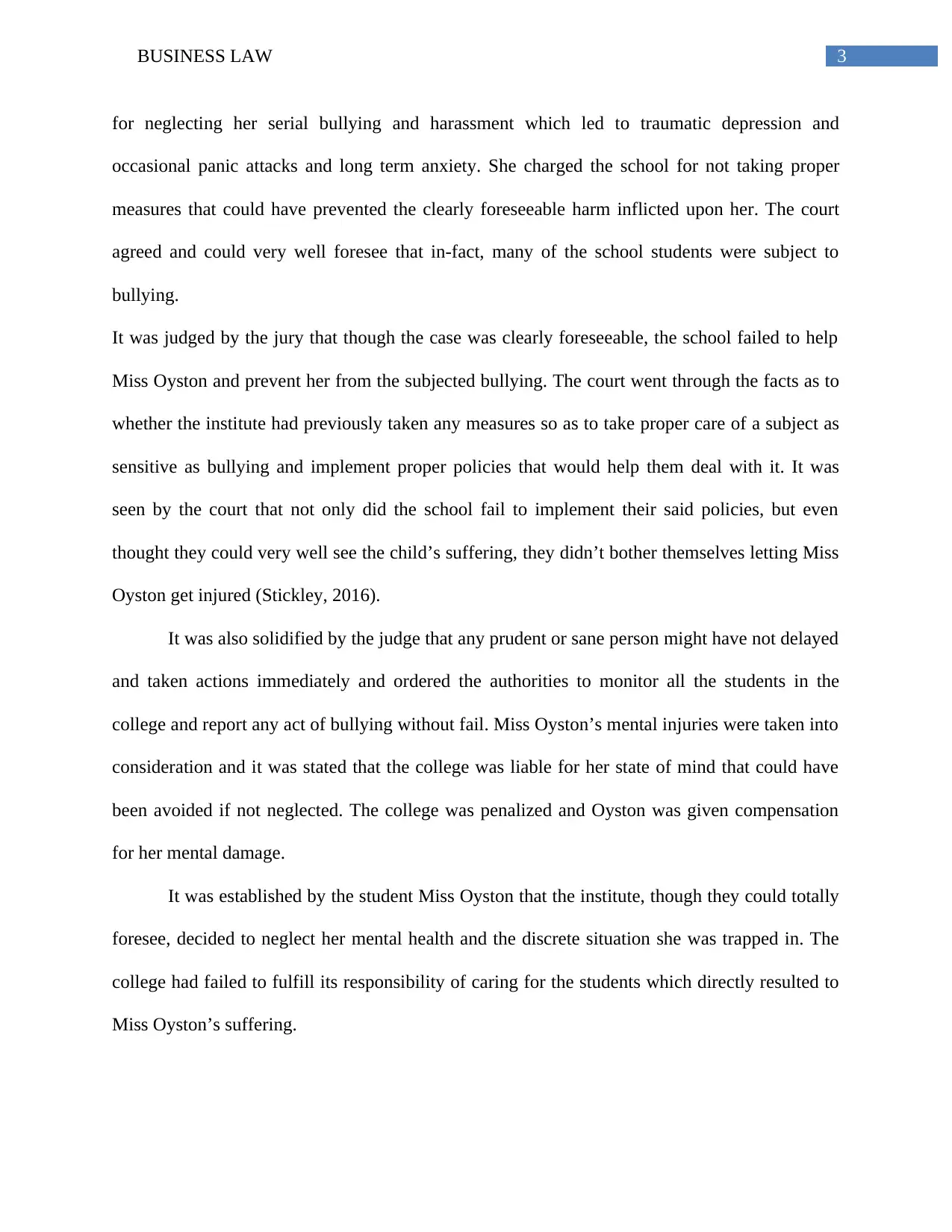
for neglecting her serial bullying and harassment which led to traumatic depression and
occasional panic attacks and long term anxiety. She charged the school for not taking proper
measures that could have prevented the clearly foreseeable harm inflicted upon her. The court
agreed and could very well foresee that in-fact, many of the school students were subject to
bullying.
It was judged by the jury that though the case was clearly foreseeable, the school failed to help
Miss Oyston and prevent her from the subjected bullying. The court went through the facts as to
whether the institute had previously taken any measures so as to take proper care of a subject as
sensitive as bullying and implement proper policies that would help them deal with it. It was
seen by the court that not only did the school fail to implement their said policies, but even
thought they could very well see the child’s suffering, they didn’t bother themselves letting Miss
Oyston get injured (Stickley, 2016).
It was also solidified by the judge that any prudent or sane person might have not delayed
and taken actions immediately and ordered the authorities to monitor all the students in the
college and report any act of bullying without fail. Miss Oyston’s mental injuries were taken into
consideration and it was stated that the college was liable for her state of mind that could have
been avoided if not neglected. The college was penalized and Oyston was given compensation
for her mental damage.
It was established by the student Miss Oyston that the institute, though they could totally
foresee, decided to neglect her mental health and the discrete situation she was trapped in. The
college had failed to fulfill its responsibility of caring for the students which directly resulted to
Miss Oyston’s suffering.
for neglecting her serial bullying and harassment which led to traumatic depression and
occasional panic attacks and long term anxiety. She charged the school for not taking proper
measures that could have prevented the clearly foreseeable harm inflicted upon her. The court
agreed and could very well foresee that in-fact, many of the school students were subject to
bullying.
It was judged by the jury that though the case was clearly foreseeable, the school failed to help
Miss Oyston and prevent her from the subjected bullying. The court went through the facts as to
whether the institute had previously taken any measures so as to take proper care of a subject as
sensitive as bullying and implement proper policies that would help them deal with it. It was
seen by the court that not only did the school fail to implement their said policies, but even
thought they could very well see the child’s suffering, they didn’t bother themselves letting Miss
Oyston get injured (Stickley, 2016).
It was also solidified by the judge that any prudent or sane person might have not delayed
and taken actions immediately and ordered the authorities to monitor all the students in the
college and report any act of bullying without fail. Miss Oyston’s mental injuries were taken into
consideration and it was stated that the college was liable for her state of mind that could have
been avoided if not neglected. The college was penalized and Oyston was given compensation
for her mental damage.
It was established by the student Miss Oyston that the institute, though they could totally
foresee, decided to neglect her mental health and the discrete situation she was trapped in. The
college had failed to fulfill its responsibility of caring for the students which directly resulted to
Miss Oyston’s suffering.
Paraphrase This Document
Need a fresh take? Get an instant paraphrase of this document with our AI Paraphraser
4BUSINESS LAW
Misrepresentation is the tort where a party makes certain false exaggerations to another
party in relation to a contract or a product in order to induce them into signing on to the
contractual agreement. Hence, a false statement made while negotiating over something is an act
of misrepresentation. If a contractual term comes as misrepresented, then the other party has the
right to put the contract aside and sign itself out (Sandeen, 2015). In order for a party to file a
case of misrepresentation, it has to fulfill certain criteria in order to confirm the
misrepresentation done to them. The most common one would be an incorrect statement based
on any common law or estimates for future, this was regarded as essential in the Esso Petroleum
v Mardon [1976] QB 801 case. It is also stated if the party had knowledge of the said fact, then
they have committed an act of misrepresentation, they will be liable to the damage caused as in
Smith v Land & House Property Corp [1884] 28 Ch D 7 case.
The other element, which is on the aggrieved party’s point of view is that whether they
trusted and believed what was said to them or misrepresented to them and agreed to enter the
contract or not. If, the party managed to not get induced by the exaggerated claims of the other
party and was not in any way induced, then the claim can be called a legitimate one (North and
Flitcroft, 2016). Hence, it further seen that misrepresentations are of three categories, Fraudulent,
Innocent and Negligent Misrepresentation.
The case of Joystick Company Pty Ltd can be held in the recent instances of
misrepresentation where it was seen that the Australian Competition and Consumer
Commission (ACCC) had filed a legal proceeding against the organisation inside the Federal
Court that the said company was involved in the act of misrepresentation. It was claimed that the
company lied to the buyers that their products were free from any formaldehyde or other toxins.
When tested, their product was in-fact intoxicated and may result to sickness. The director was
Misrepresentation is the tort where a party makes certain false exaggerations to another
party in relation to a contract or a product in order to induce them into signing on to the
contractual agreement. Hence, a false statement made while negotiating over something is an act
of misrepresentation. If a contractual term comes as misrepresented, then the other party has the
right to put the contract aside and sign itself out (Sandeen, 2015). In order for a party to file a
case of misrepresentation, it has to fulfill certain criteria in order to confirm the
misrepresentation done to them. The most common one would be an incorrect statement based
on any common law or estimates for future, this was regarded as essential in the Esso Petroleum
v Mardon [1976] QB 801 case. It is also stated if the party had knowledge of the said fact, then
they have committed an act of misrepresentation, they will be liable to the damage caused as in
Smith v Land & House Property Corp [1884] 28 Ch D 7 case.
The other element, which is on the aggrieved party’s point of view is that whether they
trusted and believed what was said to them or misrepresented to them and agreed to enter the
contract or not. If, the party managed to not get induced by the exaggerated claims of the other
party and was not in any way induced, then the claim can be called a legitimate one (North and
Flitcroft, 2016). Hence, it further seen that misrepresentations are of three categories, Fraudulent,
Innocent and Negligent Misrepresentation.
The case of Joystick Company Pty Ltd can be held in the recent instances of
misrepresentation where it was seen that the Australian Competition and Consumer
Commission (ACCC) had filed a legal proceeding against the organisation inside the Federal
Court that the said company was involved in the act of misrepresentation. It was claimed that the
company lied to the buyers that their products were free from any formaldehyde or other toxins.
When tested, their product was in-fact intoxicated and may result to sickness. The director was
5BUSINESS LAW
held responsible for knowing the ill effects of his products full well and was condemned
(Corones, 2014).
Competition and Consumer Act 2010 was established in Australia in order to maintain the
stringent responsibilities of the business towards the consumers and also to safeguard trading and
commercial activities in the country at all cost. The said statute that prohibits all business
organizations from engaging in fraudulent actions in the famed Section 18 of schedule 2 of the
Act of the Australian Consumer Law which stops any company from committing malpractices
that involve Antisocial Conduct, Use of Unfair means, misleading, misrepresentation, selling
goods In referral way, baiting with false advertisements, an act to mislead public and etc.
Schedule 2 of the Competition and Consumer Act 2010 makes consumer guarantees very clear
and a must follow for all the companies at all cost such that the safety and welfare of both the
organization and the consumers are met in every way possible in the business. These include the
rights of the consumer to get products that are of good quality and are sold to them at a fair price
and also how the stock is delivered and provided to all the customers engaged in business with
the said company.
It is clear in the country of Australia that misrepresentation in all its categories is
considered illegal and if a company were to exaggerate false facts to a company knowing full
well that the facts are false but believing in them anyway just to induce the consumer into
purchasing it in the first place, then they are to be punished by law. This falls under the statutory
interests of the economy (Howells and Weatheril, 2017).
The said torts of both misrepresentation and negligence are most common of them all in
the business world. It falls in the company's hands to not make any exaggerations or false
representations in order to attract the customers or hurt their consumer rights. Businesses and all
held responsible for knowing the ill effects of his products full well and was condemned
(Corones, 2014).
Competition and Consumer Act 2010 was established in Australia in order to maintain the
stringent responsibilities of the business towards the consumers and also to safeguard trading and
commercial activities in the country at all cost. The said statute that prohibits all business
organizations from engaging in fraudulent actions in the famed Section 18 of schedule 2 of the
Act of the Australian Consumer Law which stops any company from committing malpractices
that involve Antisocial Conduct, Use of Unfair means, misleading, misrepresentation, selling
goods In referral way, baiting with false advertisements, an act to mislead public and etc.
Schedule 2 of the Competition and Consumer Act 2010 makes consumer guarantees very clear
and a must follow for all the companies at all cost such that the safety and welfare of both the
organization and the consumers are met in every way possible in the business. These include the
rights of the consumer to get products that are of good quality and are sold to them at a fair price
and also how the stock is delivered and provided to all the customers engaged in business with
the said company.
It is clear in the country of Australia that misrepresentation in all its categories is
considered illegal and if a company were to exaggerate false facts to a company knowing full
well that the facts are false but believing in them anyway just to induce the consumer into
purchasing it in the first place, then they are to be punished by law. This falls under the statutory
interests of the economy (Howells and Weatheril, 2017).
The said torts of both misrepresentation and negligence are most common of them all in
the business world. It falls in the company's hands to not make any exaggerations or false
representations in order to attract the customers or hurt their consumer rights. Businesses and all
⊘ This is a preview!⊘
Do you want full access?
Subscribe today to unlock all pages.
Trusted by 1+ million students worldwide
6BUSINESS LAW
retailers must make sure that they are not engaging in any act of unfair practice (Latimer, 2016).
This includes price, value and quality and the basic nature of stock provided such that any claim
that may arise in regard to misrepresentation is avoided at all cost.
Hence to avoid such situations, safety goods must be used that would not harm a
consumer in any way. If a risk that in all possible circumstances my eventually arise or is
foreseen then measures are to be taken in order to avoid the risk completely such that any
damage caused to the company or customer are avoided in all ways. As per the laws of
Australian Consumer Law, the business must comply with guarantees of the consumer if
supposedly a client happens to make any claims against the working of the said company
(Pearson, 2017).The business should make sure that disclosure of necessary information about
the product in question is made such that safety is maintained for all consumers in question.
Another such incident like the company Joysticks was with Uber when it filed a suit
against phone media company Fetch Media for engaging into acts of misrepresentation by not
controlling and complying with false advertisements that were making Uber responsible for
committing the misrepresentation. It is evident from this case that torts that arise from the
company are liable to make the reputation and goodwill of it to go down which will further
include considerable financial loss of the company in the economic criteria.
The authorities like the Australian Consumer laws ensure saturation and stop companies
from making such acts of frauds that would harm the consumers and themselves which includes
creating a significant disruption in the terms and proceeding of the said contract that could lead
to dissatisfied consumers and parties (Brody and Temple, 2016). In such cases, if the aggrieved
has suffered any said losses or damages, it falls on the shoulder of condemned to handle all the
repairs and provide all the goods necessary to compensate for the losses faced by the said party.
retailers must make sure that they are not engaging in any act of unfair practice (Latimer, 2016).
This includes price, value and quality and the basic nature of stock provided such that any claim
that may arise in regard to misrepresentation is avoided at all cost.
Hence to avoid such situations, safety goods must be used that would not harm a
consumer in any way. If a risk that in all possible circumstances my eventually arise or is
foreseen then measures are to be taken in order to avoid the risk completely such that any
damage caused to the company or customer are avoided in all ways. As per the laws of
Australian Consumer Law, the business must comply with guarantees of the consumer if
supposedly a client happens to make any claims against the working of the said company
(Pearson, 2017).The business should make sure that disclosure of necessary information about
the product in question is made such that safety is maintained for all consumers in question.
Another such incident like the company Joysticks was with Uber when it filed a suit
against phone media company Fetch Media for engaging into acts of misrepresentation by not
controlling and complying with false advertisements that were making Uber responsible for
committing the misrepresentation. It is evident from this case that torts that arise from the
company are liable to make the reputation and goodwill of it to go down which will further
include considerable financial loss of the company in the economic criteria.
The authorities like the Australian Consumer laws ensure saturation and stop companies
from making such acts of frauds that would harm the consumers and themselves which includes
creating a significant disruption in the terms and proceeding of the said contract that could lead
to dissatisfied consumers and parties (Brody and Temple, 2016). In such cases, if the aggrieved
has suffered any said losses or damages, it falls on the shoulder of condemned to handle all the
repairs and provide all the goods necessary to compensate for the losses faced by the said party.
Paraphrase This Document
Need a fresh take? Get an instant paraphrase of this document with our AI Paraphraser
7BUSINESS LAW
Hence, it is now clear that any entity or individual that owes any significant form of duty to
another entity or individual has to make sure to carry it out properly without making errors or
committing fraud actions, especially when the risk concerned is clearly foreseen.
Hence, it is now clear that any entity or individual that owes any significant form of duty to
another entity or individual has to make sure to carry it out properly without making errors or
committing fraud actions, especially when the risk concerned is clearly foreseen.
8BUSINESS LAW
Reference List
Barnett v Chelsea & Kensington Hospital [1969] 1 QB 428.
Brody, G. and Temple, K., 2016. Unfair but not illegal: Are Australia's consumer protection laws
allowing predatory businesses to flourish?. Alternative Law Journal, 41(3), pp.169-173.
Competition and Consumer Act 2010 schedule 2
Corones, S.G., 2014. Competition law in Australia. Thomson Reuters Australia, Limited.
Esso Petroleum v Mardon [1976] QB 801.
Howells, G. and Weatherill, S., 2017. Consumer protection law. Routledge.
Latimer, P., 2016. Protecting Consumers from Unfair Contract Terms: Australian Comparisons.
Leon, J.J., 2015. Negligence-Torts-Negligent Misrepresentation-Downfall of Privity-Hanberry v.
Hearst Corp., 81 Cal. Rptr. 519 (1969). DePaul Law Review, 19(4), p.803.
Little, J.W., Lidsky, L.B., O'Connell, S.C. and Lande, R.H., 2014. Torts: Theory and Practice.
LexisNexis.
North, J. and Flitcroft, R., 2016. Businesses beware When does the Australian Consumer Law
apply?. Governance Directions, 68(5), p.306.
Oyston v St Patricks’s College [2011] NSWSC 269,
Pearson, G., 2017. Current Issues for Consumer Protection Law in Australia. In Consumer Law
and Socioeconomic Development (pp. 199-208). Springer, Cham.
Sandeen, S., 2015. LAW9151-W. Torts: The Common Law Process. F15. Sandeen, Sharon.
Smith v Land & House Property Corp [1884] 28 Ch D 7.
Stickley, A.P., 2016. Australian Torts Law. LexisNexis Butterworths.
Wagon Mound No 1 [1969] AC 388,
Reference List
Barnett v Chelsea & Kensington Hospital [1969] 1 QB 428.
Brody, G. and Temple, K., 2016. Unfair but not illegal: Are Australia's consumer protection laws
allowing predatory businesses to flourish?. Alternative Law Journal, 41(3), pp.169-173.
Competition and Consumer Act 2010 schedule 2
Corones, S.G., 2014. Competition law in Australia. Thomson Reuters Australia, Limited.
Esso Petroleum v Mardon [1976] QB 801.
Howells, G. and Weatherill, S., 2017. Consumer protection law. Routledge.
Latimer, P., 2016. Protecting Consumers from Unfair Contract Terms: Australian Comparisons.
Leon, J.J., 2015. Negligence-Torts-Negligent Misrepresentation-Downfall of Privity-Hanberry v.
Hearst Corp., 81 Cal. Rptr. 519 (1969). DePaul Law Review, 19(4), p.803.
Little, J.W., Lidsky, L.B., O'Connell, S.C. and Lande, R.H., 2014. Torts: Theory and Practice.
LexisNexis.
North, J. and Flitcroft, R., 2016. Businesses beware When does the Australian Consumer Law
apply?. Governance Directions, 68(5), p.306.
Oyston v St Patricks’s College [2011] NSWSC 269,
Pearson, G., 2017. Current Issues for Consumer Protection Law in Australia. In Consumer Law
and Socioeconomic Development (pp. 199-208). Springer, Cham.
Sandeen, S., 2015. LAW9151-W. Torts: The Common Law Process. F15. Sandeen, Sharon.
Smith v Land & House Property Corp [1884] 28 Ch D 7.
Stickley, A.P., 2016. Australian Torts Law. LexisNexis Butterworths.
Wagon Mound No 1 [1969] AC 388,
⊘ This is a preview!⊘
Do you want full access?
Subscribe today to unlock all pages.
Trusted by 1+ million students worldwide
9BUSINESS LAW

1 out of 10


Related Documents


Your All-in-One AI-Powered Toolkit for Academic Success.
+13062052269
info@desklib.com
Available 24*7 on WhatsApp / Email
![[object Object]](/_next/static/media/star-bottom.7253800d.svg)
Unlock your academic potential
Copyright © 2020–2026 A2Z Services. All Rights Reserved. Developed and managed by ZUCOL.