Business Law Case Study: Consumer Rights under Australian Consumer Law

Verified

Added on  2023/06/11

|5
|757
|349
Case Study
AI Summary
This case study examines a scenario where a consumer, Elton, purchases a painting portrait from Magda and later discovers discrepancies in its quality and edition compared to the advertised description. The analysis focuses on the Australian Consumer Law (ACL), specifically sections related to consumer guarantees, misleading conduct, and the requirement for goods to match their description. By referencing relevant sections of the Competition and Consumer Act 2010 and a precedent case, the study concludes that Elton is entitled to consumer guarantee rights and may claim a refund, repair, or replacement due to the breach of these rights by Magda. Desklib provides access to similar solved assignments and past papers for students.
Document Page
Running head: BUSINESS LAW
Business Law
Name of the Student
Name of the University
Author Note
tabler-icon-diamond-filled.svg

Paraphrase This Document

Need a fresh take? Get an instant paraphrase of this document with our AI Paraphraser
Document Page
1
BUSINESS LAW
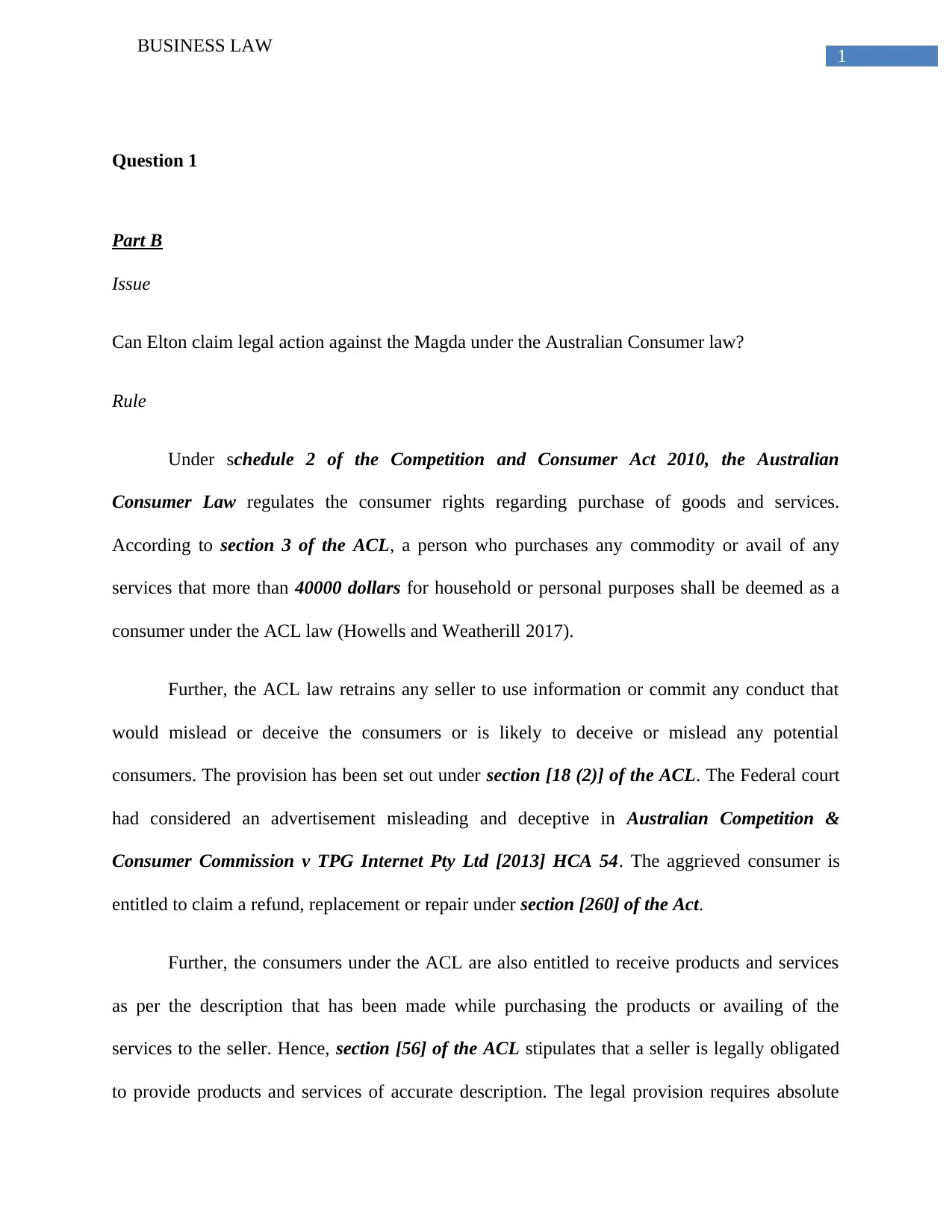
Question 1
Part B
Issue
Can Elton claim legal action against the Magda under the Australian Consumer law?
Rule
Under schedule 2 of the Competition and Consumer Act 2010, the Australian
Consumer Law regulates the consumer rights regarding purchase of goods and services.
According to section 3 of the ACL, a person who purchases any commodity or avail of any
services that more than 40000 dollars for household or personal purposes shall be deemed as a
consumer under the ACL law (Howells and Weatherill 2017).
Further, the ACL law retrains any seller to use information or commit any conduct that
would mislead or deceive the consumers or is likely to deceive or mislead any potential
consumers. The provision has been set out under section [18 (2)] of the ACL. The Federal court
had considered an advertisement misleading and deceptive in Australian Competition &
Consumer Commission v TPG Internet Pty Ltd [2013] HCA 54. The aggrieved consumer is
entitled to claim a refund, replacement or repair under section [260] of the Act.
Further, the consumers under the ACL are also entitled to receive products and services
as per the description that has been made while purchasing the products or availing of the
services to the seller. Hence, section [56] of the ACL stipulates that a seller is legally obligated
to provide products and services of accurate description. The legal provision requires absolute
Document Page
2
BUSINESS LAW
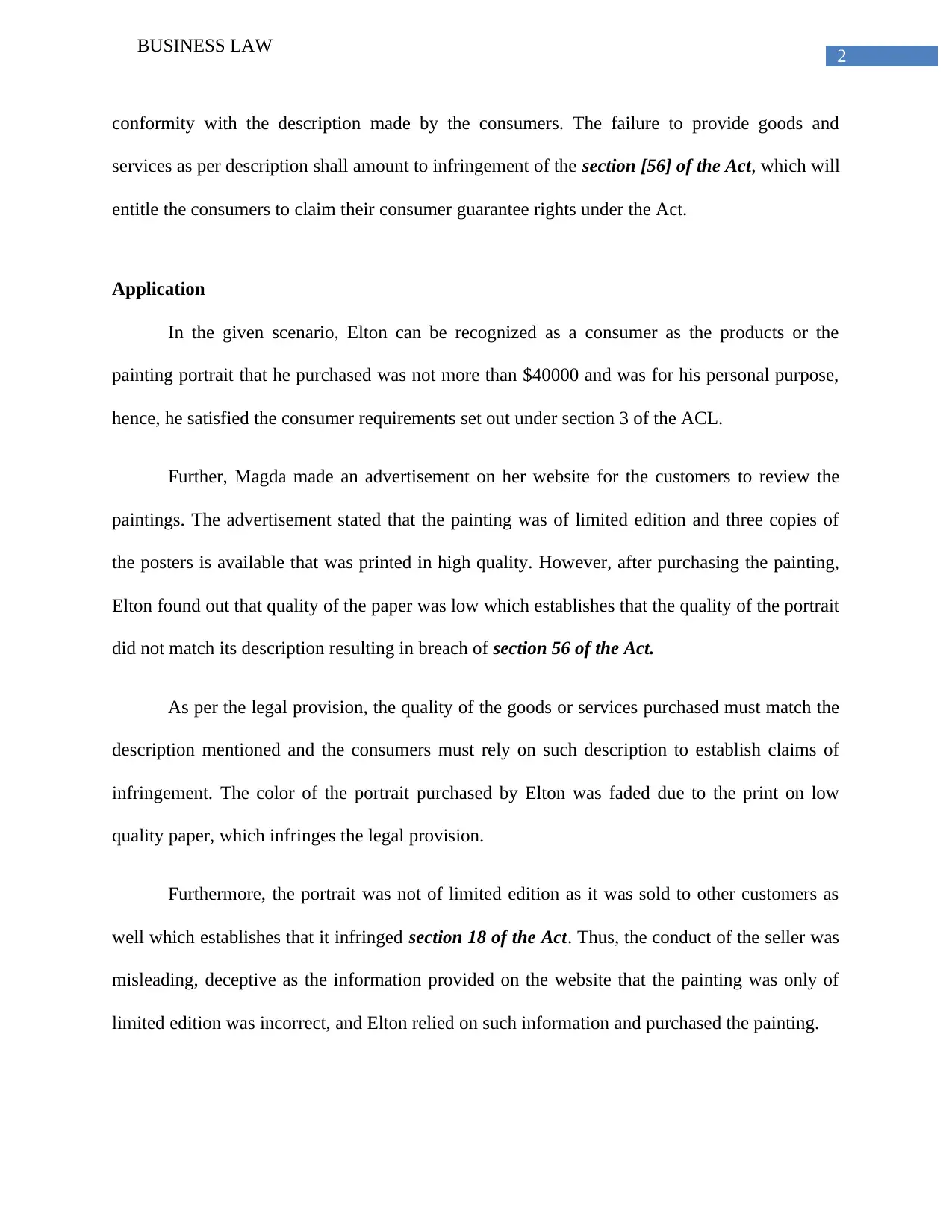
conformity with the description made by the consumers. The failure to provide goods and
services as per description shall amount to infringement of the section [56] of the Act, which will
entitle the consumers to claim their consumer guarantee rights under the Act.
Application
In the given scenario, Elton can be recognized as a consumer as the products or the
painting portrait that he purchased was not more than $40000 and was for his personal purpose,
hence, he satisfied the consumer requirements set out under section 3 of the ACL.
Further, Magda made an advertisement on her website for the customers to review the
paintings. The advertisement stated that the painting was of limited edition and three copies of
the posters is available that was printed in high quality. However, after purchasing the painting,
Elton found out that quality of the paper was low which establishes that the quality of the portrait
did not match its description resulting in breach of section 56 of the Act.
As per the legal provision, the quality of the goods or services purchased must match the
description mentioned and the consumers must rely on such description to establish claims of
infringement. The color of the portrait purchased by Elton was faded due to the print on low
quality paper, which infringes the legal provision.
Furthermore, the portrait was not of limited edition as it was sold to other customers as
well which establishes that it infringed section 18 of the Act. Thus, the conduct of the seller was
misleading, deceptive as the information provided on the website that the painting was only of
limited edition was incorrect, and Elton relied on such information and purchased the painting.
Document Page
3
BUSINESS LAW
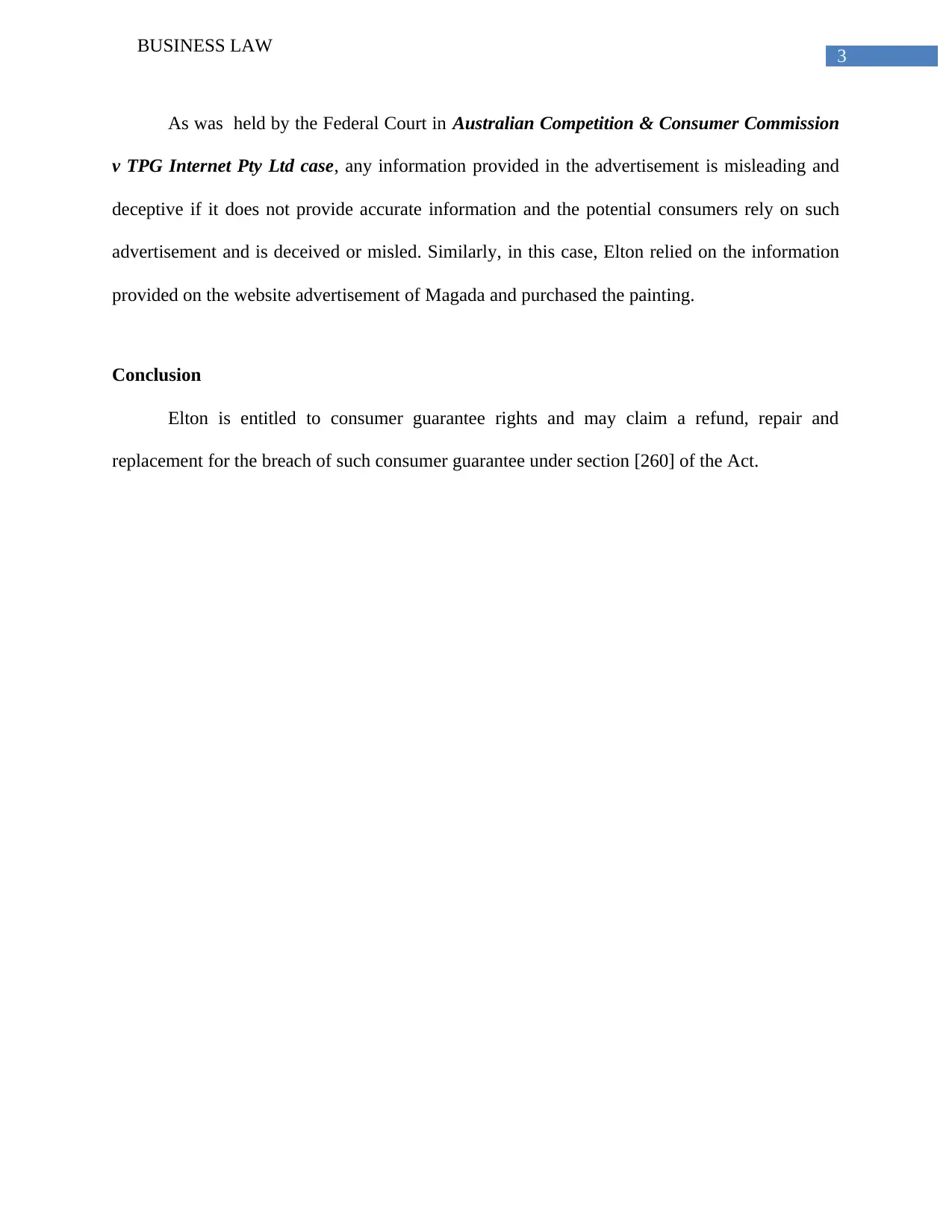
As was held by the Federal Court in Australian Competition & Consumer Commission
v TPG Internet Pty Ltd case, any information provided in the advertisement is misleading and
deceptive if it does not provide accurate information and the potential consumers rely on such
advertisement and is deceived or misled. Similarly, in this case, Elton relied on the information
provided on the website advertisement of Magada and purchased the painting.
Conclusion
Elton is entitled to consumer guarantee rights and may claim a refund, repair and
replacement for the breach of such consumer guarantee under section [260] of the Act.
tabler-icon-diamond-filled.svg

Paraphrase This Document

Need a fresh take? Get an instant paraphrase of this document with our AI Paraphraser
Document Page
4
BUSINESS LAW
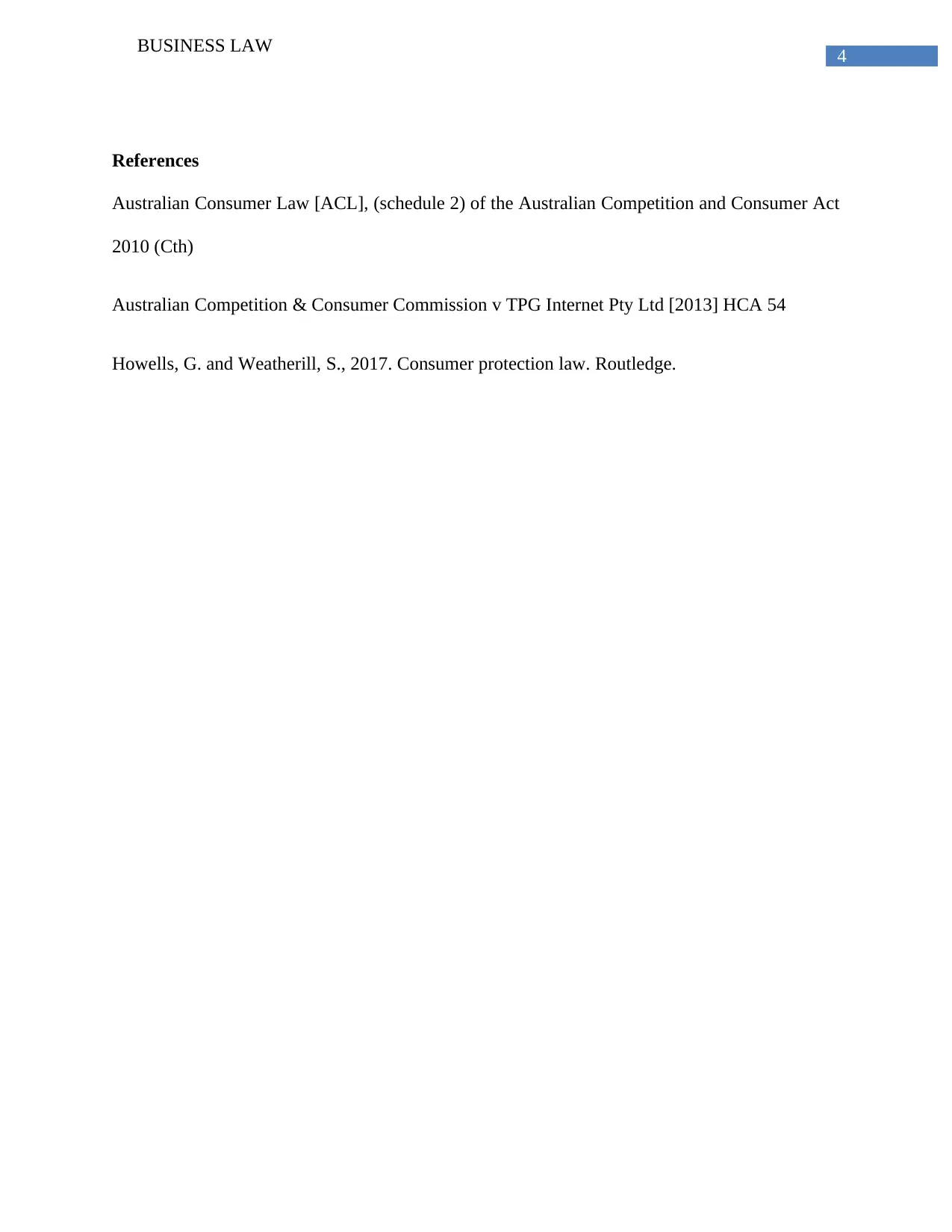
References
Australian Consumer Law [ACL], (schedule 2) of the Australian Competition and Consumer Act
2010 (Cth)
Australian Competition & Consumer Commission v TPG Internet Pty Ltd [2013] HCA 54
Howells, G. and Weatherill, S., 2017. Consumer protection law. Routledge.
chevron_up_icon
1 out of 5
circle_padding
hide_on_mobile
zoom_out_icon
[object Object]