PUN210 Contemporary Health Management Assignment Solution - Brisbane
VerifiedAdded on 2022/11/10
|8
|2136
|2
Homework Assignment
AI Summary
This assignment solution addresses key aspects of contemporary health management, starting with financial planning for a physiotherapy clinic in Brisbane, including budgeting steps, account types, and financial reports. It then explores resource funding approaches in healthcare, highlighting the popularity of activity-based funding. The solution delves into strategic workforce planning, outlining review processes, challenges, and future considerations. Finally, it examines organizational health policies, covering review processes, human resource planning, and strategic management strategies. The document incorporates references to support the analysis and provides a holistic view of the topics covered in the assignment.
Running head: CONTEMPORARY HEALTH MANAGEMENT
CONTEMPORARY HEALTH MANAGEMENT
Name of the Student
Name of the University
Author Note
CONTEMPORARY HEALTH MANAGEMENT
Name of the Student
Name of the University
Author Note

Paraphrase This Document
Need a fresh take? Get an instant paraphrase of this document with our AI Paraphraser
1
CONTEMPORARY HEALTH MANAGEMENT
Q1. The financial planning of the physiotherapy clinic would be comprised of the several steps
of the budgeting process. The steps include planning, goal setting, and determining income,
controlling and recording and realistic.
Financial planning
The budgeting of the physiotherapy clinic would require the assessment of the asset and
the workforce. Other than these the influential factors of the expenditure and income including
salary and wages of employees, award based allowances, payroll tax, government taxation
process, hour based wage for the employees, equipment cost, medical officer or supervisor cost
and other essential costs as well should be considered (Van Den Besselaar, Heyman &
Sandström, 2017). The factor of the budgeting would be developed based on the health
workforce wages regulation set by Australian Department of Health. Thus it can be stated that
the realistic prediction of the budget that is the income and the expenditure ratio calculation
should be considered for the financial planning of the physiotherapy clinic development (Grossi,
Reichard & Ruggiero, 2016).Theft risk assessment would be incorporated in the budgeting
process as well as the insurance planning as it is an important factor that refers to the aspect of
the continuous change in the health financing sector. For example possible cost for the
equipment would be higher than 5000 AUD and per day health care staff cost would be 200
AUD and the possible income can be 30,000 to 50,000 AUD per month.
Types of accounts
Here the accounting type would be used for the record of the financial information include
asset, liability, owner’s equity, revenues and expenses.
Asset: It refers to the financial and other resources owned by the business that is the property of
the owner. This resource can be used for producing a positive economy.
Liability: It refers to the legal and financial debts if the organisation for the business operation
and also producing positive economy.
CONTEMPORARY HEALTH MANAGEMENT
Q1. The financial planning of the physiotherapy clinic would be comprised of the several steps
of the budgeting process. The steps include planning, goal setting, and determining income,
controlling and recording and realistic.
Financial planning
The budgeting of the physiotherapy clinic would require the assessment of the asset and
the workforce. Other than these the influential factors of the expenditure and income including
salary and wages of employees, award based allowances, payroll tax, government taxation
process, hour based wage for the employees, equipment cost, medical officer or supervisor cost
and other essential costs as well should be considered (Van Den Besselaar, Heyman &
Sandström, 2017). The factor of the budgeting would be developed based on the health
workforce wages regulation set by Australian Department of Health. Thus it can be stated that
the realistic prediction of the budget that is the income and the expenditure ratio calculation
should be considered for the financial planning of the physiotherapy clinic development (Grossi,
Reichard & Ruggiero, 2016).Theft risk assessment would be incorporated in the budgeting
process as well as the insurance planning as it is an important factor that refers to the aspect of
the continuous change in the health financing sector. For example possible cost for the
equipment would be higher than 5000 AUD and per day health care staff cost would be 200
AUD and the possible income can be 30,000 to 50,000 AUD per month.
Types of accounts
Here the accounting type would be used for the record of the financial information include
asset, liability, owner’s equity, revenues and expenses.
Asset: It refers to the financial and other resources owned by the business that is the property of
the owner. This resource can be used for producing a positive economy.
Liability: It refers to the legal and financial debts if the organisation for the business operation
and also producing positive economy.
2
CONTEMPORARY HEALTH MANAGEMENT
Owner’s equity: It refers to the subtracted value of the asset and the liability of the owner of the
organisation.
Revenue: It refers to the income produced by the service providence by an organisation.
Expenses: It refers to the payments of the organisation to the employees, suppliers, leases and
others as well.
The financial information would be recorded to all these accounting types, and the
accounting process would be recorded by the ledger maintenance (Zhao & Huang, 2016).
Q2. There is a different kind of approaches for resource funding for the health system in
Australia. However, activity-based funding and block funding is the most popular one in the
system. The process of funding for the system of health care in Australia is governed by the
National Health Funding Body and National Health Funding Pool
(Publichospitalfunding.gov.au., 2019).
Resource funding in healthcare
Block funding: It refers to a grant provided by the government to the specific process or project
with specific guidelines for the use of the granted money. It is also used for different scenarios,
such as the payment of the suppliers and other aspects as well. Based on the comprising of
various elements in the health care system that require the factor of both types of the funding
process, however, the activity-based funding is more effective in this process (Van Den
Besselaar, Heyman & Sandström, 2017).
Activity-based funding: It refers to the funding process, which dependent on the mixed number
of patients a hospital is treating. Thus it can be seen that the operation of the funding in the
health care system of Australia is dependent on the activity-based funding as the case-mix
procedure for the evaluation of the cases of the patients (Toloo et al., 2018).
Causes of popularity of the activity-based funding process:
CONTEMPORARY HEALTH MANAGEMENT
Owner’s equity: It refers to the subtracted value of the asset and the liability of the owner of the
organisation.
Revenue: It refers to the income produced by the service providence by an organisation.
Expenses: It refers to the payments of the organisation to the employees, suppliers, leases and
others as well.
The financial information would be recorded to all these accounting types, and the
accounting process would be recorded by the ledger maintenance (Zhao & Huang, 2016).
Q2. There is a different kind of approaches for resource funding for the health system in
Australia. However, activity-based funding and block funding is the most popular one in the
system. The process of funding for the system of health care in Australia is governed by the
National Health Funding Body and National Health Funding Pool
(Publichospitalfunding.gov.au., 2019).
Resource funding in healthcare
Block funding: It refers to a grant provided by the government to the specific process or project
with specific guidelines for the use of the granted money. It is also used for different scenarios,
such as the payment of the suppliers and other aspects as well. Based on the comprising of
various elements in the health care system that require the factor of both types of the funding
process, however, the activity-based funding is more effective in this process (Van Den
Besselaar, Heyman & Sandström, 2017).
Activity-based funding: It refers to the funding process, which dependent on the mixed number
of patients a hospital is treating. Thus it can be seen that the operation of the funding in the
health care system of Australia is dependent on the activity-based funding as the case-mix
procedure for the evaluation of the cases of the patients (Toloo et al., 2018).
Causes of popularity of the activity-based funding process:
⊘ This is a preview!⊘
Do you want full access?
Subscribe today to unlock all pages.

Trusted by 1+ million students worldwide
3
CONTEMPORARY HEALTH MANAGEMENT
As the State and Commonwealth Governments became interested in the case-mix system;
thus, the productivity and service providence can be evaluated based on the outcome.
State government became interested in output and outcome-based funding.
To deliver to high quality care to the public and also sustaining against the increasing
amount of health care cost (Laviana et al., 2016).
Q3. Review process
To review the workforce of the health care system, an investigator should consider the
clinical audit process and also the workforce planning assessment. Internal management and also
the workforce design is one of the essential aspects of the review of the workforce. The
occupational health and safety, equity, cultural safety, performance management are the factors
included in workforce management. The human resource cost and the quality of care should also
be considered in terms of the workforce review process (Hewko et al., 2015).
Challenges of Health workforce planning and design in future
It can be seen based on the workforce review process that the cost of the workforce in the
health care system is 50 per cent of the total cost. It can also be reaching up to 70 per cent as well
(Roche et al., 2015). Hence, it can be stated that the increasing cost of workforce management is
high. This can be highlighted as a primary issue which will progress in a way that will affect the
workforce in future as well. On the other hand, the knowledge and the quality of the staffs and
the increasing workload of in the health care system would also be highlighted as the challenges
of the workforce planning design (Sellers et al., 2015). Other than these the factor of different
policies and rules of government regarding health care procedures and proper knowledge of
staffs should be considered as challenge for workforce financing. The challenges in the future
health workforce is the huge workload and the ratio of the staff and patients.It has been seen that
in present condition 766,800 employed in Australian health care sector and the statistical
CONTEMPORARY HEALTH MANAGEMENT
As the State and Commonwealth Governments became interested in the case-mix system;
thus, the productivity and service providence can be evaluated based on the outcome.
State government became interested in output and outcome-based funding.
To deliver to high quality care to the public and also sustaining against the increasing
amount of health care cost (Laviana et al., 2016).
Q3. Review process
To review the workforce of the health care system, an investigator should consider the
clinical audit process and also the workforce planning assessment. Internal management and also
the workforce design is one of the essential aspects of the review of the workforce. The
occupational health and safety, equity, cultural safety, performance management are the factors
included in workforce management. The human resource cost and the quality of care should also
be considered in terms of the workforce review process (Hewko et al., 2015).
Challenges of Health workforce planning and design in future
It can be seen based on the workforce review process that the cost of the workforce in the
health care system is 50 per cent of the total cost. It can also be reaching up to 70 per cent as well
(Roche et al., 2015). Hence, it can be stated that the increasing cost of workforce management is
high. This can be highlighted as a primary issue which will progress in a way that will affect the
workforce in future as well. On the other hand, the knowledge and the quality of the staffs and
the increasing workload of in the health care system would also be highlighted as the challenges
of the workforce planning design (Sellers et al., 2015). Other than these the factor of different
policies and rules of government regarding health care procedures and proper knowledge of
staffs should be considered as challenge for workforce financing. The challenges in the future
health workforce is the huge workload and the ratio of the staff and patients.It has been seen that
in present condition 766,800 employed in Australian health care sector and the statistical
Paraphrase This Document
Need a fresh take? Get an instant paraphrase of this document with our AI Paraphraser
4
CONTEMPORARY HEALTH MANAGEMENT
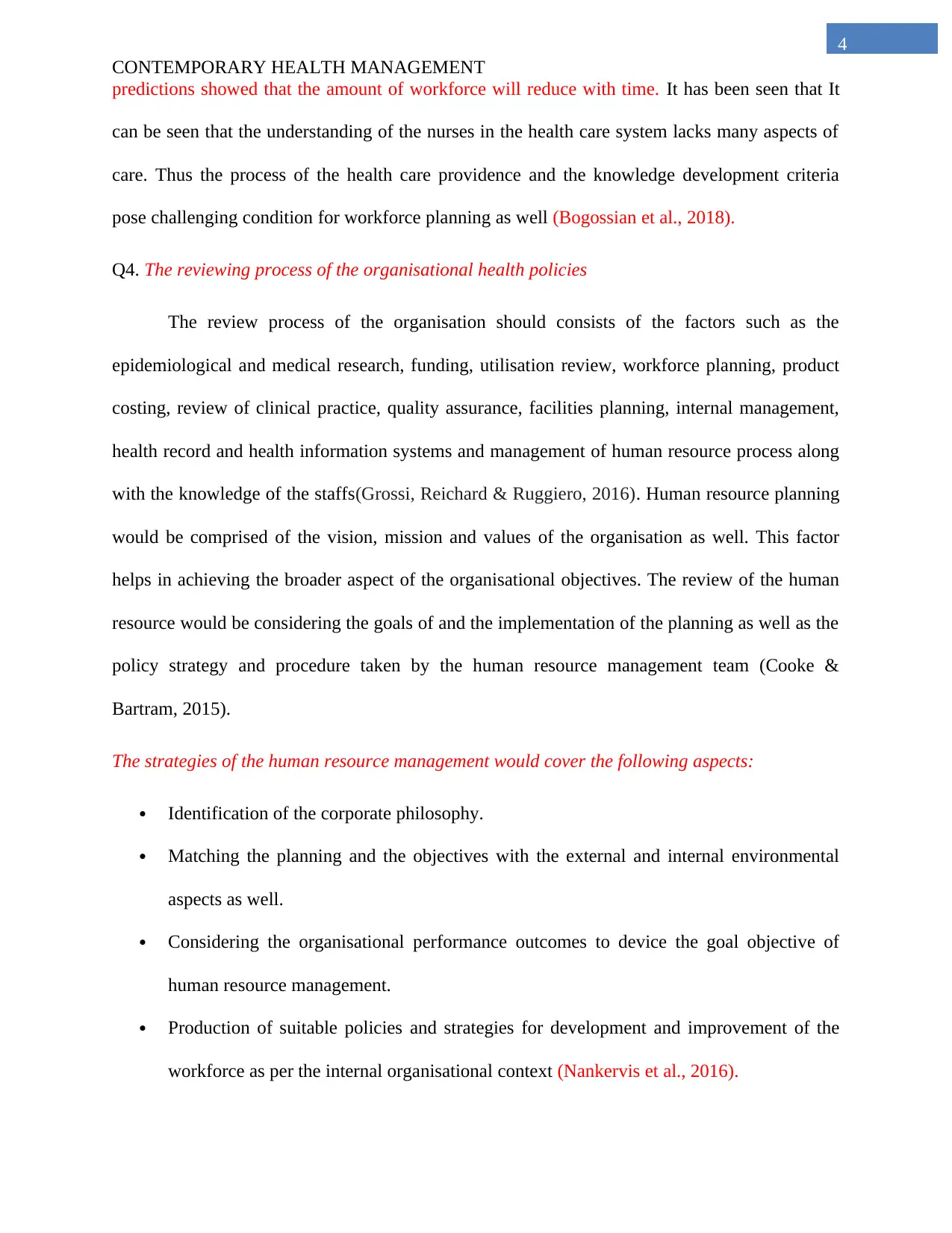
predictions showed that the amount of workforce will reduce with time. It has been seen that It
can be seen that the understanding of the nurses in the health care system lacks many aspects of
care. Thus the process of the health care providence and the knowledge development criteria
pose challenging condition for workforce planning as well (Bogossian et al., 2018).
Q4. The reviewing process of the organisational health policies
The review process of the organisation should consists of the factors such as the
epidemiological and medical research, funding, utilisation review, workforce planning, product
costing, review of clinical practice, quality assurance, facilities planning, internal management,
health record and health information systems and management of human resource process along
with the knowledge of the staffs(Grossi, Reichard & Ruggiero, 2016). Human resource planning
would be comprised of the vision, mission and values of the organisation as well. This factor
helps in achieving the broader aspect of the organisational objectives. The review of the human
resource would be considering the goals of and the implementation of the planning as well as the
policy strategy and procedure taken by the human resource management team (Cooke &
Bartram, 2015).
The strategies of the human resource management would cover the following aspects:
Identification of the corporate philosophy.
Matching the planning and the objectives with the external and internal environmental
aspects as well.
Considering the organisational performance outcomes to device the goal objective of
human resource management.
Production of suitable policies and strategies for development and improvement of the
workforce as per the internal organisational context (Nankervis et al., 2016).
CONTEMPORARY HEALTH MANAGEMENT
predictions showed that the amount of workforce will reduce with time. It has been seen that It
can be seen that the understanding of the nurses in the health care system lacks many aspects of
care. Thus the process of the health care providence and the knowledge development criteria
pose challenging condition for workforce planning as well (Bogossian et al., 2018).
Q4. The reviewing process of the organisational health policies
The review process of the organisation should consists of the factors such as the
epidemiological and medical research, funding, utilisation review, workforce planning, product
costing, review of clinical practice, quality assurance, facilities planning, internal management,
health record and health information systems and management of human resource process along
with the knowledge of the staffs(Grossi, Reichard & Ruggiero, 2016). Human resource planning
would be comprised of the vision, mission and values of the organisation as well. This factor
helps in achieving the broader aspect of the organisational objectives. The review of the human
resource would be considering the goals of and the implementation of the planning as well as the
policy strategy and procedure taken by the human resource management team (Cooke &
Bartram, 2015).
The strategies of the human resource management would cover the following aspects:
Identification of the corporate philosophy.
Matching the planning and the objectives with the external and internal environmental
aspects as well.
Considering the organisational performance outcomes to device the goal objective of
human resource management.
Production of suitable policies and strategies for development and improvement of the
workforce as per the internal organisational context (Nankervis et al., 2016).
5
CONTEMPORARY HEALTH MANAGEMENT
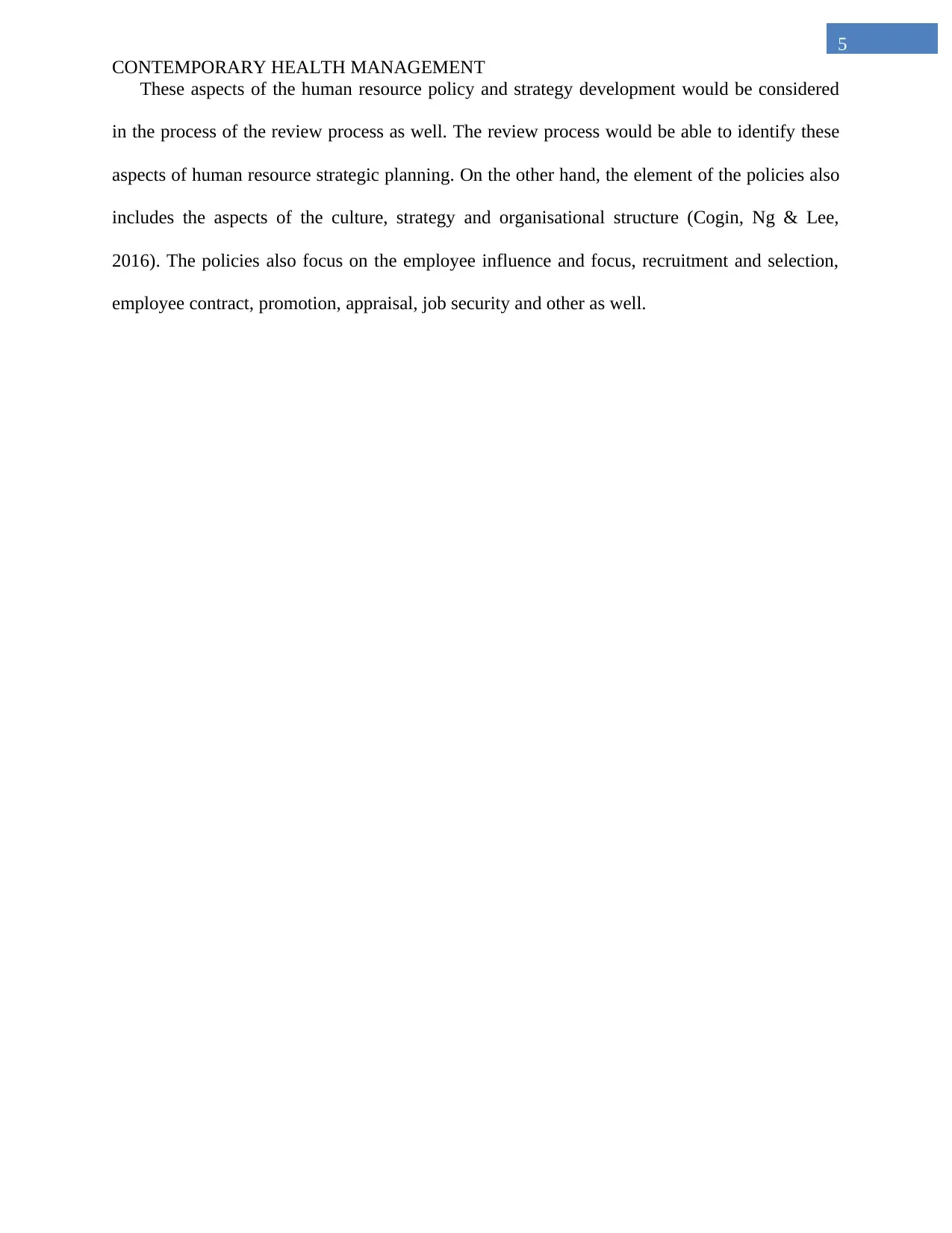
These aspects of the human resource policy and strategy development would be considered
in the process of the review process as well. The review process would be able to identify these
aspects of human resource strategic planning. On the other hand, the element of the policies also
includes the aspects of the culture, strategy and organisational structure (Cogin, Ng & Lee,
2016). The policies also focus on the employee influence and focus, recruitment and selection,
employee contract, promotion, appraisal, job security and other as well.
CONTEMPORARY HEALTH MANAGEMENT
These aspects of the human resource policy and strategy development would be considered
in the process of the review process as well. The review process would be able to identify these
aspects of human resource strategic planning. On the other hand, the element of the policies also
includes the aspects of the culture, strategy and organisational structure (Cogin, Ng & Lee,
2016). The policies also focus on the employee influence and focus, recruitment and selection,
employee contract, promotion, appraisal, job security and other as well.
⊘ This is a preview!⊘
Do you want full access?
Subscribe today to unlock all pages.
Trusted by 1+ million students worldwide
6
CONTEMPORARY HEALTH MANAGEMENT
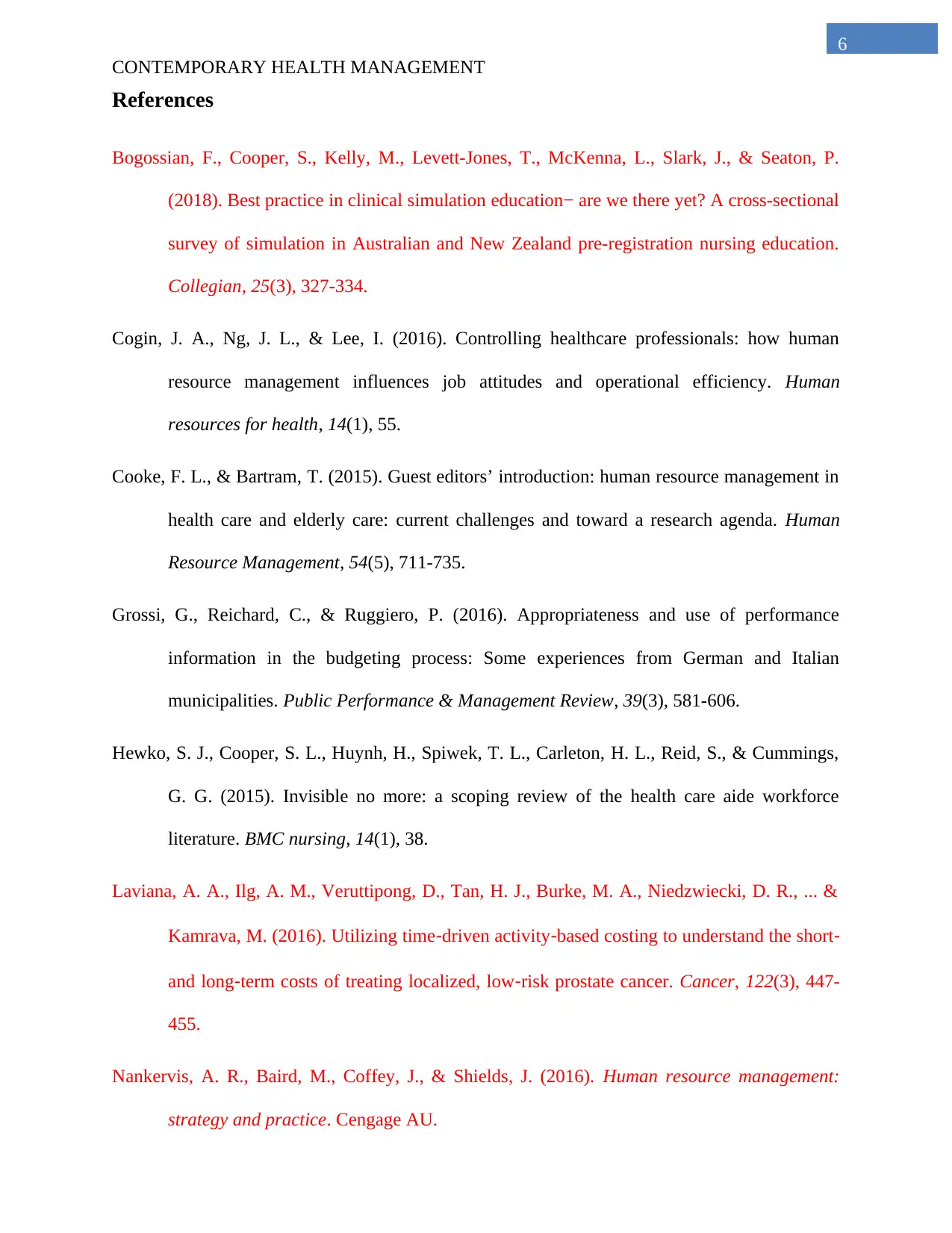
References
Bogossian, F., Cooper, S., Kelly, M., Levett-Jones, T., McKenna, L., Slark, J., & Seaton, P.
(2018). Best practice in clinical simulation education− are we there yet? A cross-sectional
survey of simulation in Australian and New Zealand pre-registration nursing education.
Collegian, 25(3), 327-334.
Cogin, J. A., Ng, J. L., & Lee, I. (2016). Controlling healthcare professionals: how human
resource management influences job attitudes and operational efficiency. Human
resources for health, 14(1), 55.
Cooke, F. L., & Bartram, T. (2015). Guest editors’ introduction: human resource management in
health care and elderly care: current challenges and toward a research agenda. Human
Resource Management, 54(5), 711-735.
Grossi, G., Reichard, C., & Ruggiero, P. (2016). Appropriateness and use of performance
information in the budgeting process: Some experiences from German and Italian
municipalities. Public Performance & Management Review, 39(3), 581-606.
Hewko, S. J., Cooper, S. L., Huynh, H., Spiwek, T. L., Carleton, H. L., Reid, S., & Cummings,
G. G. (2015). Invisible no more: a scoping review of the health care aide workforce
literature. BMC nursing, 14(1), 38.
Laviana, A. A., Ilg, A. M., Veruttipong, D., Tan, H. J., Burke, M. A., Niedzwiecki, D. R., ... &
Kamrava, M. (2016). Utilizing time‐driven activity‐based costing to understand the short‐
and long‐term costs of treating localized, low‐risk prostate cancer. Cancer, 122(3), 447-
455.
Nankervis, A. R., Baird, M., Coffey, J., & Shields, J. (2016). Human resource management:
strategy and practice. Cengage AU.
CONTEMPORARY HEALTH MANAGEMENT
References
Bogossian, F., Cooper, S., Kelly, M., Levett-Jones, T., McKenna, L., Slark, J., & Seaton, P.
(2018). Best practice in clinical simulation education− are we there yet? A cross-sectional
survey of simulation in Australian and New Zealand pre-registration nursing education.
Collegian, 25(3), 327-334.
Cogin, J. A., Ng, J. L., & Lee, I. (2016). Controlling healthcare professionals: how human
resource management influences job attitudes and operational efficiency. Human
resources for health, 14(1), 55.
Cooke, F. L., & Bartram, T. (2015). Guest editors’ introduction: human resource management in
health care and elderly care: current challenges and toward a research agenda. Human
Resource Management, 54(5), 711-735.
Grossi, G., Reichard, C., & Ruggiero, P. (2016). Appropriateness and use of performance
information in the budgeting process: Some experiences from German and Italian
municipalities. Public Performance & Management Review, 39(3), 581-606.
Hewko, S. J., Cooper, S. L., Huynh, H., Spiwek, T. L., Carleton, H. L., Reid, S., & Cummings,
G. G. (2015). Invisible no more: a scoping review of the health care aide workforce
literature. BMC nursing, 14(1), 38.
Laviana, A. A., Ilg, A. M., Veruttipong, D., Tan, H. J., Burke, M. A., Niedzwiecki, D. R., ... &
Kamrava, M. (2016). Utilizing time‐driven activity‐based costing to understand the short‐
and long‐term costs of treating localized, low‐risk prostate cancer. Cancer, 122(3), 447-
455.
Nankervis, A. R., Baird, M., Coffey, J., & Shields, J. (2016). Human resource management:
strategy and practice. Cengage AU.
Paraphrase This Document
Need a fresh take? Get an instant paraphrase of this document with our AI Paraphraser
7
CONTEMPORARY HEALTH MANAGEMENT
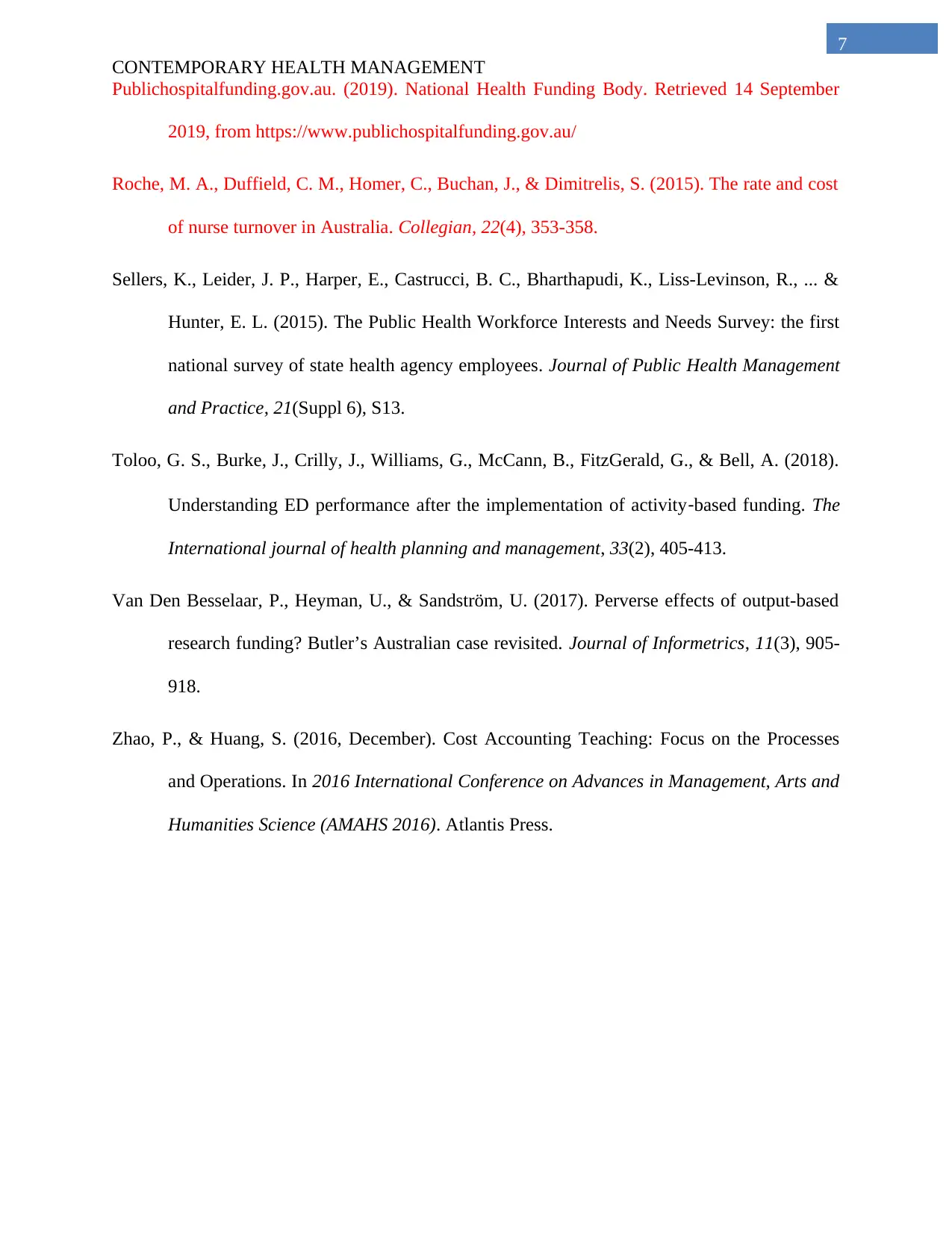
Publichospitalfunding.gov.au. (2019). National Health Funding Body. Retrieved 14 September
2019, from https://www.publichospitalfunding.gov.au/
Roche, M. A., Duffield, C. M., Homer, C., Buchan, J., & Dimitrelis, S. (2015). The rate and cost
of nurse turnover in Australia. Collegian, 22(4), 353-358.
Sellers, K., Leider, J. P., Harper, E., Castrucci, B. C., Bharthapudi, K., Liss-Levinson, R., ... &
Hunter, E. L. (2015). The Public Health Workforce Interests and Needs Survey: the first
national survey of state health agency employees. Journal of Public Health Management
and Practice, 21(Suppl 6), S13.
Toloo, G. S., Burke, J., Crilly, J., Williams, G., McCann, B., FitzGerald, G., & Bell, A. (2018).
Understanding ED performance after the implementation of activity‐based funding. The
International journal of health planning and management, 33(2), 405-413.
Van Den Besselaar, P., Heyman, U., & Sandström, U. (2017). Perverse effects of output-based
research funding? Butler’s Australian case revisited. Journal of Informetrics, 11(3), 905-
918.
Zhao, P., & Huang, S. (2016, December). Cost Accounting Teaching: Focus on the Processes
and Operations. In 2016 International Conference on Advances in Management, Arts and
Humanities Science (AMAHS 2016). Atlantis Press.
CONTEMPORARY HEALTH MANAGEMENT
Publichospitalfunding.gov.au. (2019). National Health Funding Body. Retrieved 14 September
2019, from https://www.publichospitalfunding.gov.au/
Roche, M. A., Duffield, C. M., Homer, C., Buchan, J., & Dimitrelis, S. (2015). The rate and cost
of nurse turnover in Australia. Collegian, 22(4), 353-358.
Sellers, K., Leider, J. P., Harper, E., Castrucci, B. C., Bharthapudi, K., Liss-Levinson, R., ... &
Hunter, E. L. (2015). The Public Health Workforce Interests and Needs Survey: the first
national survey of state health agency employees. Journal of Public Health Management
and Practice, 21(Suppl 6), S13.
Toloo, G. S., Burke, J., Crilly, J., Williams, G., McCann, B., FitzGerald, G., & Bell, A. (2018).
Understanding ED performance after the implementation of activity‐based funding. The
International journal of health planning and management, 33(2), 405-413.
Van Den Besselaar, P., Heyman, U., & Sandström, U. (2017). Perverse effects of output-based
research funding? Butler’s Australian case revisited. Journal of Informetrics, 11(3), 905-
918.
Zhao, P., & Huang, S. (2016, December). Cost Accounting Teaching: Focus on the Processes
and Operations. In 2016 International Conference on Advances in Management, Arts and
Humanities Science (AMAHS 2016). Atlantis Press.

1 out of 8


Related Documents


Your All-in-One AI-Powered Toolkit for Academic Success.
+13062052269
info@desklib.com
Available 24*7 on WhatsApp / Email
![[object Object]](/_next/static/media/star-bottom.7253800d.svg)
Unlock your academic potential
Copyright © 2020–2026 A2Z Services. All Rights Reserved. Developed and managed by ZUCOL.