Evaluating the Contemporary Hospitality Industry: Trends and Issues
VerifiedAdded on 2024/06/03
|18
|2101
|58
Report
AI Summary
This report provides a comprehensive analysis of the contemporary hospitality industry, evaluating its scope, size, diversity, and organizational structures. It examines the roles of various hospitality organizations and professional bodies, along with the types of staff employed, their responsibilities, and qualifications. The report discusses the current image of the industry, addressing safety and security concerns, and explores potential future trends, such as eco-friendly lodgings and the integration of advanced technology. It further analyzes the impact of these trends on operational, managerial, and legislative aspects of the hospitality sector, concluding with insights into areas for future development and growth. Desklib provides this and many more solved assignments for students.
Contemporary Hospitality Industry
1
1

Paraphrase This Document
Need a fresh take? Get an instant paraphrase of this document with our AI Paraphraser
Table of Contents
Introduction......................................................................................................................................3
Task 1: (LO1: AC 1.1, 1.2, 1.3).......................................................................................................4
Task 2 (LO2: AC 2.1,2.2)................................................................................................................6
Task 3: (LO3: AC 3.2).....................................................................................................................8
Task 4: (LO3:AC3.1,LO4:AC4.1,4.2).............................................................................................9
Conclusion.....................................................................................................................................17
2
Introduction......................................................................................................................................3
Task 1: (LO1: AC 1.1, 1.2, 1.3).......................................................................................................4
Task 2 (LO2: AC 2.1,2.2)................................................................................................................6
Task 3: (LO3: AC 3.2).....................................................................................................................8
Task 4: (LO3:AC3.1,LO4:AC4.1,4.2).............................................................................................9
Conclusion.....................................................................................................................................17
2
Introduction
As the hospitality industry is expanding with the help of technology and better human resource
availability, there are certain issues that are faced by the organisations belonging to this industry.
This assignment is conceived with the purpose of enabling the reader to further develop their
knowledge and understanding regarding the hospitality management industry and the
management of contemporary issues associated to this industry. This report has been constructed
in order to analyse and evaluate the new developments in the field. The aim is to create a
comprehensive and conclusive analysis, essentially helping to deduce the nuances and the
attributes associated with the hospitality sector.
3
As the hospitality industry is expanding with the help of technology and better human resource
availability, there are certain issues that are faced by the organisations belonging to this industry.
This assignment is conceived with the purpose of enabling the reader to further develop their
knowledge and understanding regarding the hospitality management industry and the
management of contemporary issues associated to this industry. This report has been constructed
in order to analyse and evaluate the new developments in the field. The aim is to create a
comprehensive and conclusive analysis, essentially helping to deduce the nuances and the
attributes associated with the hospitality sector.
3
⊘ This is a preview!⊘
Do you want full access?
Subscribe today to unlock all pages.

Trusted by 1+ million students worldwide
Task 1: (LO1: AC 1.1, 1.2, 1.3)
Analysis of current scope, size and diversity of the hospitality industry
The advent of a global market has provided a major impetus to the hotel industry, effectively
enhancing the scope and the size of the business, which has resulted in the rise of a market
narrative, which facilitates the capital transaction with greater ease than before. The recent de-
centralisation of the trade practices has led to a revolutionary growth in the sector, bringing
unprecedented economic growth and employment opportunities.
The hospitality industry has categorised varied other services under one umbrella, the service
ranging from Catering, Bars and Lounges, Events and Management, Hotels and Night Clubs etc.
This has created a plethora of jobs pertaining to the hospitality industry; the diversity of the
industry has successfully propelled the sector to a position of economic demand (Jones et al.,
2016).
Organisational structure of different hospitality organisations and comparison between
them
The different organisations associate with the hospitality sector has different organisational
structures, conceived in order to facilitate the organisational process and enhance the business
acumen. The TUI group employs a matrix organisational structure; Basically the employees
within the organisation are grouped according to their functions along with their assignments
they are currently working on.
The Hilton Worldwide on the other hand employs the hierarchal organisational structure,
essentially specifying that each employee of the organisation is responsible for the decision
making process and are directed to report directly to the supervisors who are positioned higher.
Every entity functioning in the organisation is positioned as a subordinated to a single entity. The
arrangement facilitates the communication in between the immediate successors and the
subordinates.
4
Analysis of current scope, size and diversity of the hospitality industry
The advent of a global market has provided a major impetus to the hotel industry, effectively
enhancing the scope and the size of the business, which has resulted in the rise of a market
narrative, which facilitates the capital transaction with greater ease than before. The recent de-
centralisation of the trade practices has led to a revolutionary growth in the sector, bringing
unprecedented economic growth and employment opportunities.
The hospitality industry has categorised varied other services under one umbrella, the service
ranging from Catering, Bars and Lounges, Events and Management, Hotels and Night Clubs etc.
This has created a plethora of jobs pertaining to the hospitality industry; the diversity of the
industry has successfully propelled the sector to a position of economic demand (Jones et al.,
2016).
Organisational structure of different hospitality organisations and comparison between
them
The different organisations associate with the hospitality sector has different organisational
structures, conceived in order to facilitate the organisational process and enhance the business
acumen. The TUI group employs a matrix organisational structure; Basically the employees
within the organisation are grouped according to their functions along with their assignments
they are currently working on.
The Hilton Worldwide on the other hand employs the hierarchal organisational structure,
essentially specifying that each employee of the organisation is responsible for the decision
making process and are directed to report directly to the supervisors who are positioned higher.
Every entity functioning in the organisation is positioned as a subordinated to a single entity. The
arrangement facilitates the communication in between the immediate successors and the
subordinates.
4
Paraphrase This Document
Need a fresh take? Get an instant paraphrase of this document with our AI Paraphraser
Roles of various hospitality related organisations and the professional bodies such as BHA
and IOH
The various hospitality related professional bodies are responsible ensuring that the function of
the sector is conducted with keeping in consideration the dynamics of the market at large. The
BHA or the British Hospitality Association acts as a forum for the leading businesses in the
hospitality sector of UK. The primary role of BHA is to promote the interest of the operators and
the owners across the multitude of services being provided. They are responsible for shaping the
course of the action and drives for international opportunities and economic growth, ensuring
that British hospitality is the numero uno in the hospitality industry. The IOH or the Institute of
Hospitality was created with the primary purpose of promoting the highest possible professional
standards of education and management in the global hospitality industry (Manhas and
Tukamushaba, 2015).
5
and IOH
The various hospitality related professional bodies are responsible ensuring that the function of
the sector is conducted with keeping in consideration the dynamics of the market at large. The
BHA or the British Hospitality Association acts as a forum for the leading businesses in the
hospitality sector of UK. The primary role of BHA is to promote the interest of the operators and
the owners across the multitude of services being provided. They are responsible for shaping the
course of the action and drives for international opportunities and economic growth, ensuring
that British hospitality is the numero uno in the hospitality industry. The IOH or the Institute of
Hospitality was created with the primary purpose of promoting the highest possible professional
standards of education and management in the global hospitality industry (Manhas and
Tukamushaba, 2015).
5
Task 2 (LO2: AC 2.1,2.2)
Types of Staff employed in the business, responsibilities and qualifications.
The staffs employed by the two hospitality organisations in question operate with similar
approaches with different methods employed. The recruitment process differs on the basis of
skills set, roles, qualifications and responsibilities of the concerned potential candidate.
Types of Staff
The two organisations in consideration is the TUI group, which belongs to the tour and travel
sector and the Hilton Worldwide Holdings Inc., which belongs to the hotel and resorts services.
The staffs employed in the two organisations differ on certain attributes. TUI Group employs
workers with moderate skill set, since the job involved does not requires the need for efficient
work resources. The employees employed by the Hilton Worldwide Holdings Inc. Require the
inclusion of high skill set since the need to address the different aspects are of utmost
importance. The employees in the Hotel services are usually recruited in terms of full-time
workers with shift workers, outworkers and fixed term workers for particular peak seasons,
which the TUI group does not involves with. The employees of the Hilton Worldwide Holdings
Inc. differ from the TUI group based on employment is more diverse in the Hotel services,
varying periodically (Kim et al., 2015).
Roles and the Responsibilities
The roles and the responsibilities associated with the two sectors differ based on the work
conducted and the employment criterion. The roles of the Hotel sector has been considered in
lieu of the services which must be provided to the consumer base, such as ensuring that the room
being accorded is compatible with the guest preferences, the food and the lodging facilities and
ensure that all the nuances are properly addressed. The Tour and the Travel services on the other
hand have different role and responsibilities accorded to the employees, such as that the tour
experience of the customers is optimum and the customer satisfaction is effectively ensured
(Ariza-Montes et al., 2017).
Qualifications
6
Types of Staff employed in the business, responsibilities and qualifications.
The staffs employed by the two hospitality organisations in question operate with similar
approaches with different methods employed. The recruitment process differs on the basis of
skills set, roles, qualifications and responsibilities of the concerned potential candidate.
Types of Staff
The two organisations in consideration is the TUI group, which belongs to the tour and travel
sector and the Hilton Worldwide Holdings Inc., which belongs to the hotel and resorts services.
The staffs employed in the two organisations differ on certain attributes. TUI Group employs
workers with moderate skill set, since the job involved does not requires the need for efficient
work resources. The employees employed by the Hilton Worldwide Holdings Inc. Require the
inclusion of high skill set since the need to address the different aspects are of utmost
importance. The employees in the Hotel services are usually recruited in terms of full-time
workers with shift workers, outworkers and fixed term workers for particular peak seasons,
which the TUI group does not involves with. The employees of the Hilton Worldwide Holdings
Inc. differ from the TUI group based on employment is more diverse in the Hotel services,
varying periodically (Kim et al., 2015).
Roles and the Responsibilities
The roles and the responsibilities associated with the two sectors differ based on the work
conducted and the employment criterion. The roles of the Hotel sector has been considered in
lieu of the services which must be provided to the consumer base, such as ensuring that the room
being accorded is compatible with the guest preferences, the food and the lodging facilities and
ensure that all the nuances are properly addressed. The Tour and the Travel services on the other
hand have different role and responsibilities accorded to the employees, such as that the tour
experience of the customers is optimum and the customer satisfaction is effectively ensured
(Ariza-Montes et al., 2017).
Qualifications
6
⊘ This is a preview!⊘
Do you want full access?
Subscribe today to unlock all pages.
Trusted by 1+ million students worldwide
The qualification of the staff associated with the hotel services is much higher considering the
need for skill based job opportunities. The inclusion of degree-based employers, such as the
chefs and the staff is of utmost significance. On the other hand the qualification of the employees
associated with the TUI group is of comparatively low in accordance to the job requirement
which requires less expertise.
7
need for skill based job opportunities. The inclusion of degree-based employers, such as the
chefs and the staff is of utmost significance. On the other hand the qualification of the employees
associated with the TUI group is of comparatively low in accordance to the job requirement
which requires less expertise.
7
Paraphrase This Document
Need a fresh take? Get an instant paraphrase of this document with our AI Paraphraser
Task 3: (LO3: AC 3.2)
Discussion about the current image of the industry
The hospitality industry is essentially an integral part of the Tourism and Travel industry. The
Hospitality industry is globalized with regards to the market space. With the market p[ace
previously restrained, the opportunities of expansion were limited. The globalized market space
has facilitated the growth of the Hospitality sector in an unprecedented manner with the market
space has growing at a rapid pace. The hospitality industry can be considered as one of the most
diverse sectors in the economy. Efficient incorporation of different cultural attributes has
contributed to the overall incremental growth in the hospitality sector. The contemporary
hospitality industry functions on the efficient inclusion of different cultural aspect, which has
helped the business to expand and grow at an exponential pace. The hospitality sector has been
marred with the recent rising concerns in the safety and security issues. The recent terrorist
attack has raise concerns with the customer base. The current business plan of the sector aims at
minimising the effect of the issues plaguing the sector with objectives of ensuring that the
consequence of the disasters does not have detrimental repercussions in the business progress of
the organisation (Rathore, 2017).
8
Discussion about the current image of the industry
The hospitality industry is essentially an integral part of the Tourism and Travel industry. The
Hospitality industry is globalized with regards to the market space. With the market p[ace
previously restrained, the opportunities of expansion were limited. The globalized market space
has facilitated the growth of the Hospitality sector in an unprecedented manner with the market
space has growing at a rapid pace. The hospitality industry can be considered as one of the most
diverse sectors in the economy. Efficient incorporation of different cultural attributes has
contributed to the overall incremental growth in the hospitality sector. The contemporary
hospitality industry functions on the efficient inclusion of different cultural aspect, which has
helped the business to expand and grow at an exponential pace. The hospitality sector has been
marred with the recent rising concerns in the safety and security issues. The recent terrorist
attack has raise concerns with the customer base. The current business plan of the sector aims at
minimising the effect of the issues plaguing the sector with objectives of ensuring that the
consequence of the disasters does not have detrimental repercussions in the business progress of
the organisation (Rathore, 2017).
8
Task 4: (LO3:AC3.1,LO4:AC4.1,4.2)
Potential trends in the future of the hospitality industry
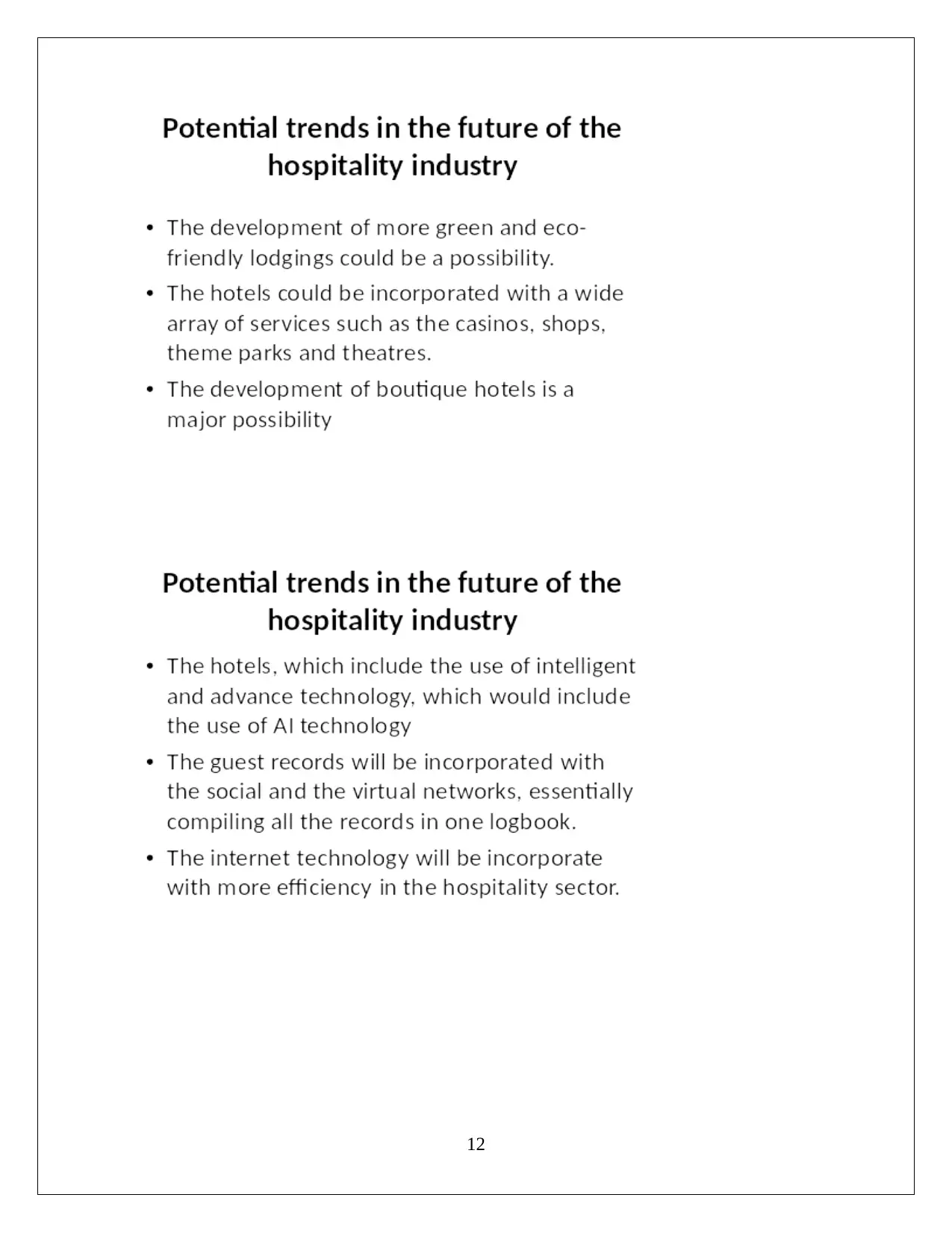
The future trends, which are possible in the hospitality sector, are as follows:
The development of more green and eco-friendly lodgings could be a possibility.
The hotels could be incorporated with a wide array of services such as the casinos, shops,
theme parks and theatres.
The development of boutique hotels is a major possibility.
The hotels, which include the use of intelligent and advance technology, which would
include the use of AI technology
The guest records will be incorporated with the social and the virtual networks,
essentially compiling all the records in one logbook.
The internet technology will be incorporate with more efficiency in the hospitality sector.
Analysis of the impact of the trends and the developments in the hospitality industry.
The future trends of the hospitality industry are conceived with keeping in consideration the
market trends and the possible outcomes of a global market space, which would facilitate the
business process.
The development of eco-friendly hotel would enable the hotel to ensure that the hotel retains a
appealing image in the market. The eco-friendly stamp would ensure that the hotel industry has a
relatively smaller carbon footprint, the environment conscious consumer base would find the
development appealing and would be more eager to use the services. The operational aspect of
the hospitality industry will eventually envelop a wide array of services such as casinos, bars and
nightclubs, shops and amusement parks; essentially contributing to more recruitment and
employment opportunities. The operational scope of the hospitality sector will be massively
augmented with the incorporation of the different services, contributing to massive investment
and revenue generation (Walker and Walker, 2016).
The managerial aspect of the hospitality industry will be conducted with more ease with the
efficient incorporation of the social and the virtual network, which essentially would compile the
9
Potential trends in the future of the hospitality industry
The future trends, which are possible in the hospitality sector, are as follows:
The development of more green and eco-friendly lodgings could be a possibility.
The hotels could be incorporated with a wide array of services such as the casinos, shops,
theme parks and theatres.
The development of boutique hotels is a major possibility.
The hotels, which include the use of intelligent and advance technology, which would
include the use of AI technology
The guest records will be incorporated with the social and the virtual networks,
essentially compiling all the records in one logbook.
The internet technology will be incorporate with more efficiency in the hospitality sector.
Analysis of the impact of the trends and the developments in the hospitality industry.
The future trends of the hospitality industry are conceived with keeping in consideration the
market trends and the possible outcomes of a global market space, which would facilitate the
business process.
The development of eco-friendly hotel would enable the hotel to ensure that the hotel retains a
appealing image in the market. The eco-friendly stamp would ensure that the hotel industry has a
relatively smaller carbon footprint, the environment conscious consumer base would find the
development appealing and would be more eager to use the services. The operational aspect of
the hospitality industry will eventually envelop a wide array of services such as casinos, bars and
nightclubs, shops and amusement parks; essentially contributing to more recruitment and
employment opportunities. The operational scope of the hospitality sector will be massively
augmented with the incorporation of the different services, contributing to massive investment
and revenue generation (Walker and Walker, 2016).
The managerial aspect of the hospitality industry will be conducted with more ease with the
efficient incorporation of the social and the virtual network, which essentially would compile the
9
⊘ This is a preview!⊘
Do you want full access?
Subscribe today to unlock all pages.
Trusted by 1+ million students worldwide
entire records maintained in single database, thus ensuring that the operational process is
conducted with an enhanced efficacy. The legislative aspects could be handled with more ease
following the efficient implementation of internet technology and the smart interfaces. This will
enable the executive positioned at higher power to conduct the legislative aspect of operation
with a thorough understanding of the market dynamics, essentially contributing to a
comprehensive network of competent management. The gaffes and blunders could be addressed
with more ease and thus will be incremental to the operations and will enhance the business
acumen (Rathore, 2017).
10
conducted with an enhanced efficacy. The legislative aspects could be handled with more ease
following the efficient implementation of internet technology and the smart interfaces. This will
enable the executive positioned at higher power to conduct the legislative aspect of operation
with a thorough understanding of the market dynamics, essentially contributing to a
comprehensive network of competent management. The gaffes and blunders could be addressed
with more ease and thus will be incremental to the operations and will enhance the business
acumen (Rathore, 2017).
10
Paraphrase This Document
Need a fresh take? Get an instant paraphrase of this document with our AI Paraphraser
11
12
⊘ This is a preview!⊘
Do you want full access?
Subscribe today to unlock all pages.
Trusted by 1+ million students worldwide

1 out of 18


Related Documents


Your All-in-One AI-Powered Toolkit for Academic Success.
+13062052269
info@desklib.com
Available 24*7 on WhatsApp / Email
![[object Object]](/_next/static/media/star-bottom.7253800d.svg)
Unlock your academic potential
Copyright © 2020–2026 A2Z Services. All Rights Reserved. Developed and managed by ZUCOL.