EDU10004 Assignment 2: An Exploration of Learning Theories Essay
VerifiedAdded on 2023/05/27
|7
|2854
|301
Essay
AI Summary
This essay, submitted as part of the EDU10004 Theories of Teaching and Learning assignment, provides an in-depth analysis of contemporary learning theories. It begins with a Venn diagram comparing and contrasting constructivism and sociocultural theory, highlighting their similarities in social context application and student-focused approaches. The essay then delves into these theories, examining constructivism's emphasis on knowledge construction through experience and sociocultural theory's focus on social interaction as a driver of learning. It discusses perspectives of learning, including the role of language and the zone of proximal development. The essay explores the benefits and limitations of each theory, providing examples and critiques. The conclusion emphasizes the importance of integrating diverse teaching and learning approaches, considering both teacher and learner perspectives for effective learning outcomes.

Running Head: ESSAY 1
EDU10004 Theories of Teaching and Learning
Assignment 2
500 word Venn Diagram and 1500 word Essay
Student Name
Student Number
Group Number
eLA Name
Date Submitted
EDU10004 Theories of Teaching and Learning
Assignment 2
500 word Venn Diagram and 1500 word Essay
Student Name
Student Number
Group Number
eLA Name
Date Submitted

Paraphrase This Document
Need a fresh take? Get an instant paraphrase of this document with our AI Paraphraser
Running Head: ESSAY 2
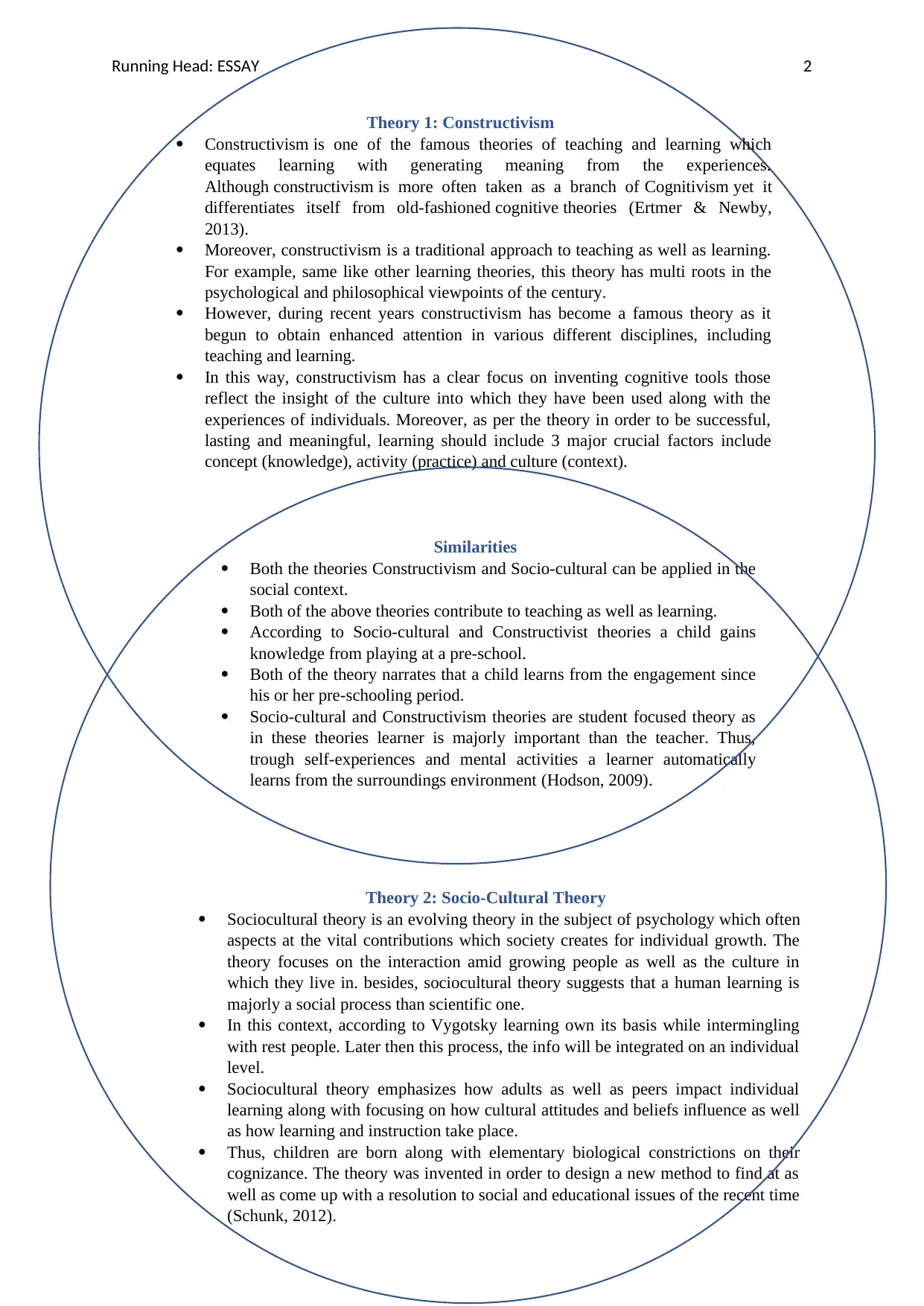
Theory 2: Socio-Cultural Theory
Sociocultural theory is an evolving theory in the subject of psychology which often
aspects at the vital contributions which society creates for individual growth. The
theory focuses on the interaction amid growing people as well as the culture in
which they live in. besides, sociocultural theory suggests that a human learning is
majorly a social process than scientific one.
In this context, according to Vygotsky learning own its basis while intermingling
with rest people. Later then this process, the info will be integrated on an individual
level.
Sociocultural theory emphasizes how adults as well as peers impact individual
learning along with focusing on how cultural attitudes and beliefs influence as well
as how learning and instruction take place.
Thus, children are born along with elementary biological constrictions on their
cognizance. The theory was invented in order to design a new method to find at as
well as come up with a resolution to social and educational issues of the recent time
(Schunk, 2012).
Similarities
Both the theories Constructivism and Socio-cultural can be applied in the
social context.
Both of the above theories contribute to teaching as well as learning.
According to Socio-cultural and Constructivist theories a child gains
knowledge from playing at a pre-school.
Both of the theory narrates that a child learns from the engagement since
his or her pre-schooling period.
Socio-cultural and Constructivism theories are student focused theory as
in these theories learner is majorly important than the teacher. Thus,
trough self-experiences and mental activities a learner automatically
learns from the surroundings environment (Hodson, 2009).
Part 1: Venn diagram
5 Theory 1: Constructivism
Constructivism is one of the famous theories of teaching and learning which
equates learning with generating meaning from the experiences.
Although constructivism is more often taken as a branch of Cognitivism yet it
differentiates itself from old-fashioned cognitive theories (Ertmer & Newby,
2013).
Moreover, constructivism is a traditional approach to teaching as well as learning.
For example, same like other learning theories, this theory has multi roots in the
psychological and philosophical viewpoints of the century.
However, during recent years constructivism has become a famous theory as it
begun to obtain enhanced attention in various different disciplines, including
teaching and learning.
In this way, constructivism has a clear focus on inventing cognitive tools those
reflect the insight of the culture into which they have been used along with the
experiences of individuals. Moreover, as per the theory in order to be successful,
lasting and meaningful, learning should include 3 major crucial factors include
concept (knowledge), activity (practice) and culture (context).
Theory 2: Socio-Cultural Theory
Sociocultural theory is an evolving theory in the subject of psychology which often
aspects at the vital contributions which society creates for individual growth. The
theory focuses on the interaction amid growing people as well as the culture in
which they live in. besides, sociocultural theory suggests that a human learning is
majorly a social process than scientific one.
In this context, according to Vygotsky learning own its basis while intermingling
with rest people. Later then this process, the info will be integrated on an individual
level.
Sociocultural theory emphasizes how adults as well as peers impact individual
learning along with focusing on how cultural attitudes and beliefs influence as well
as how learning and instruction take place.
Thus, children are born along with elementary biological constrictions on their
cognizance. The theory was invented in order to design a new method to find at as
well as come up with a resolution to social and educational issues of the recent time
(Schunk, 2012).
Similarities
Both the theories Constructivism and Socio-cultural can be applied in the
social context.
Both of the above theories contribute to teaching as well as learning.
According to Socio-cultural and Constructivist theories a child gains
knowledge from playing at a pre-school.
Both of the theory narrates that a child learns from the engagement since
his or her pre-schooling period.
Socio-cultural and Constructivism theories are student focused theory as
in these theories learner is majorly important than the teacher. Thus,
trough self-experiences and mental activities a learner automatically
learns from the surroundings environment (Hodson, 2009).
Part 1: Venn diagram
5 Theory 1: Constructivism
Constructivism is one of the famous theories of teaching and learning which
equates learning with generating meaning from the experiences.
Although constructivism is more often taken as a branch of Cognitivism yet it
differentiates itself from old-fashioned cognitive theories (Ertmer & Newby,
2013).
Moreover, constructivism is a traditional approach to teaching as well as learning.
For example, same like other learning theories, this theory has multi roots in the
psychological and philosophical viewpoints of the century.
However, during recent years constructivism has become a famous theory as it
begun to obtain enhanced attention in various different disciplines, including
teaching and learning.
In this way, constructivism has a clear focus on inventing cognitive tools those
reflect the insight of the culture into which they have been used along with the
experiences of individuals. Moreover, as per the theory in order to be successful,
lasting and meaningful, learning should include 3 major crucial factors include
concept (knowledge), activity (practice) and culture (context).
Running Head: ESSAY 3
Part 2: Teaching and Learning
This essay is based on teaching as well as learning theories as we all know that learning is a
process which results in a moderately stable change in a person. Learning can also be taken as
dynamic process where the students’ skills and knowledge are different, while they get compared
prior and after learning. Moreover, teaching is the advertising mechanism of learning; hence our
knowledge about learning as well as the parallel theories through how we can learn should be
demonstrating from our teaching. Additionally, learning theories are those conceptual frameworks
that serve in order to explain how human learn (Schunk, 2012). By utilising teaching and learning
theories, understanding about how knowledge is established is developed. Furthermore, understanding
about knowledge enables teachers to form the methodological delivery of the subject contents for
matching the theoretical frameworks as well a supporting how knowledge is established. Moreover,
adopting the way students learn effectively can be utilised to nurture effective teaching practice,
which further enable teachers to enhance the productivity of their practice, hence ultimately improve
the quality of the learner’s experience (Teach Make a Difference, 2018).
Perspectives of learning in theory 1: Constructivism
The constructivist theory was invented by Piaget’s and Vygotsky, who saw learning being the
result of mental construction, where the learners united their prevailing knowledge with novel info, in
order to construct meaning. In this way, constructivist theory suggests that learning is a dynamic,
contextual procedure, a social activity, focused on constructing meaning as well as views of the
learner being a responsible agent (Schunk, 2012). Moreover, during constructivist learning, people
use world-base experiences being the ways to help them identify as well as establish understanding of
the surroundings. As constructivism theory enables learners for interacting with their instant learning
environment, the learning through this theory has been measured to be condition-specific as well as a
context-bound movement. Additionally, social constructivism focuses the role of language in the
progress of expressive understanding. In this context, Vygotsky claimed that dialogues could be
utilised for allowing individuals to contemplate, deliberate, reflect, contribute, impart and share
beliefs as well as understanding of the concepts.
In the context of critique of the theory 1, it has been suggested that this constructivist theory
might imply that memorizing is insignificant, as well as the constructivist model is entirely focused on
understanding notions. However, the theory proposes that being capable to memorize knowledge is an
important criterion of an effective learning. Additionally, many educational researchers have reported
that teaching approaches of constructivist theory do not steadily assure teaching effectiveness
(Schölkopf, 2015).
Part 2: Teaching and Learning
This essay is based on teaching as well as learning theories as we all know that learning is a
process which results in a moderately stable change in a person. Learning can also be taken as
dynamic process where the students’ skills and knowledge are different, while they get compared
prior and after learning. Moreover, teaching is the advertising mechanism of learning; hence our
knowledge about learning as well as the parallel theories through how we can learn should be
demonstrating from our teaching. Additionally, learning theories are those conceptual frameworks
that serve in order to explain how human learn (Schunk, 2012). By utilising teaching and learning
theories, understanding about how knowledge is established is developed. Furthermore, understanding
about knowledge enables teachers to form the methodological delivery of the subject contents for
matching the theoretical frameworks as well a supporting how knowledge is established. Moreover,
adopting the way students learn effectively can be utilised to nurture effective teaching practice,
which further enable teachers to enhance the productivity of their practice, hence ultimately improve
the quality of the learner’s experience (Teach Make a Difference, 2018).
Perspectives of learning in theory 1: Constructivism
The constructivist theory was invented by Piaget’s and Vygotsky, who saw learning being the
result of mental construction, where the learners united their prevailing knowledge with novel info, in
order to construct meaning. In this way, constructivist theory suggests that learning is a dynamic,
contextual procedure, a social activity, focused on constructing meaning as well as views of the
learner being a responsible agent (Schunk, 2012). Moreover, during constructivist learning, people
use world-base experiences being the ways to help them identify as well as establish understanding of
the surroundings. As constructivism theory enables learners for interacting with their instant learning
environment, the learning through this theory has been measured to be condition-specific as well as a
context-bound movement. Additionally, social constructivism focuses the role of language in the
progress of expressive understanding. In this context, Vygotsky claimed that dialogues could be
utilised for allowing individuals to contemplate, deliberate, reflect, contribute, impart and share
beliefs as well as understanding of the concepts.
In the context of critique of the theory 1, it has been suggested that this constructivist theory
might imply that memorizing is insignificant, as well as the constructivist model is entirely focused on
understanding notions. However, the theory proposes that being capable to memorize knowledge is an
important criterion of an effective learning. Additionally, many educational researchers have reported
that teaching approaches of constructivist theory do not steadily assure teaching effectiveness
(Schölkopf, 2015).
⊘ This is a preview!⊘
Do you want full access?
Subscribe today to unlock all pages.

Trusted by 1+ million students worldwide
Running Head: ESSAY 4
Moreover, constructivism theory neglects the starring role of mechanical learning as well as
memorisation techniques into learning. Additionally, according to this theory teachers must identify
as well as consider that memorization learning is not a method for developing students’
understanding. The constructivist theory implies that learning differences shoot from peoples’
knowledge processes. However, constructivism theory rebates the role of motivational, innate, talent
as well as genetic factors into knowledge construction that have been demonstrated in order to play a
role in cognitive learning and development (Slezackova, 2017).
For an example, teachers go into the classrooms with their own construction as well as
conceptions of the subject content, and it can be taken as a benefit or limitation according to this
theory (Spelt, Biemans, Tobi, Luning, & Mulder, 2009). Thus, a teacher’s understanding about the
subject can paint the students’ understanding. However, the limitation lies within the above example
is that some teachers shaped the students’ mental construction about a concept in order to align them
with their individual concept interpretations (Kizel, 2016).
Another limitation of the constructivism theory is that this undertakes students’ energetically
search for as well as utilise experiences and resources, and hence their understanding is secured by
their previous experiences and pro-active utilisation for establishing understanding (Kereluik, Mishra,
Fahnoe, & Terry, 2013). Thus, the theory 1 of learning and teaching experiences relies on students’
encountering experiences as well as application of their prior knowledge in order to develop an
effective understanding. However, these experiences and world-base interactions might not be
available to learners because of their daily lifestyle circumstances. Subsequently, if the constructivism
approach to learning and teaching is adopted, teachers require being aware that meaning and
understanding might be inadequate to the students’ personal experiences (Honig, 2008). However, the
constructivism theory is capable to explain the inconsistencies amid scholars’ conceptions as well as
meaning.
Perspectives of learning in theory 2: Socio-cultural
In socio-culture theory, Mr Vygotsky emphasized on the social environment as an originator
of learning and development. Main perspectives of learning through socio-cultural theory are as
follows:
■ Social interactions are critically important; learning and knowledge is constructed amid two or more
people or group.
■ Self-regulation is established by internalization of mental operations and actions which occur
through social interactions (Beetham & Sharpe, 2013).
■ Human development happens by the cultural conduction of tools such as language and symbols.
Moreover, constructivism theory neglects the starring role of mechanical learning as well as
memorisation techniques into learning. Additionally, according to this theory teachers must identify
as well as consider that memorization learning is not a method for developing students’
understanding. The constructivist theory implies that learning differences shoot from peoples’
knowledge processes. However, constructivism theory rebates the role of motivational, innate, talent
as well as genetic factors into knowledge construction that have been demonstrated in order to play a
role in cognitive learning and development (Slezackova, 2017).
For an example, teachers go into the classrooms with their own construction as well as
conceptions of the subject content, and it can be taken as a benefit or limitation according to this
theory (Spelt, Biemans, Tobi, Luning, & Mulder, 2009). Thus, a teacher’s understanding about the
subject can paint the students’ understanding. However, the limitation lies within the above example
is that some teachers shaped the students’ mental construction about a concept in order to align them
with their individual concept interpretations (Kizel, 2016).
Another limitation of the constructivism theory is that this undertakes students’ energetically
search for as well as utilise experiences and resources, and hence their understanding is secured by
their previous experiences and pro-active utilisation for establishing understanding (Kereluik, Mishra,
Fahnoe, & Terry, 2013). Thus, the theory 1 of learning and teaching experiences relies on students’
encountering experiences as well as application of their prior knowledge in order to develop an
effective understanding. However, these experiences and world-base interactions might not be
available to learners because of their daily lifestyle circumstances. Subsequently, if the constructivism
approach to learning and teaching is adopted, teachers require being aware that meaning and
understanding might be inadequate to the students’ personal experiences (Honig, 2008). However, the
constructivism theory is capable to explain the inconsistencies amid scholars’ conceptions as well as
meaning.
Perspectives of learning in theory 2: Socio-cultural
In socio-culture theory, Mr Vygotsky emphasized on the social environment as an originator
of learning and development. Main perspectives of learning through socio-cultural theory are as
follows:
■ Social interactions are critically important; learning and knowledge is constructed amid two or more
people or group.
■ Self-regulation is established by internalization of mental operations and actions which occur
through social interactions (Beetham & Sharpe, 2013).
■ Human development happens by the cultural conduction of tools such as language and symbols.
Paraphrase This Document
Need a fresh take? Get an instant paraphrase of this document with our AI Paraphraser
Running Head: ESSAY 5
■ during learning, language is a critical tool as Language cultivates from social speech, in order to
private speech as well as covert speech (Benade, 2012).
■ According to the socio-cultural theory, zone of proximal development (referred as ZPD) is the
variance amid what children can do with help from others and what they can do on with their own.
Hence, interaction among adults and peers in the ZPD promotes cognitive development, teaching and
effective learning (Spelt, Biemans, Tobi, Luning, & Mulder, 2009).
Vygotsky’s theory of socio-culture suggests that someone’s interaction with the immediate
environment assists learning in magnificent way. Besides, the experiences an individual carries to a
learning scenario can hugely impact the outcome of the same (Henriett & Máté, 2013). For an
example, ice skating coaches might coach the innovative students who have well-educated in ice
skating and they will teach how they can use their flexible bodies for performing on the ice. In this
context, students come with their concepts of speed, balance, movement as well as body control on
the basis of their experiences about skating. Hence, ice-skating coaches use the strengths as well as
weaknesses of those students and assist them learning various movements in order to improve their
performances in skating.
For an instance, a great skater who is facing trouble in completing a triple axel toe loop and
the speed and height is needed to finish the jump, yet the coach observed and taught that she should
turn her toe at an angle while spinning which altered the smooth end of the triple axel toe loop in
skating even with the same height of that student. In this way, due to teaching of the coach the skater
learnt to alter that movement, and hence she is now capable to successfully finish the jump in the
same circumstances (Banks, 2009).
Likewise, another example of veterinary learners who have grown up on farms can
demonstrate the positive side of the socio-cultural theory. These students have experienced illnesses;
births and care of various kinds of animals provide valuable knowledge for their future training. In
this context, veterinary instructors can utilise these past experiences in order to enhance their students’
learning (Concordia University, 2013). For an instance, while teaching students how to handle an
injured hoof of a horse or cow, the tutor or instructor may call some of the experienced students for
discussing what they have perceived about the same. Thus, on the basis of that knowledge an
instructor can explain the latest as well as most effective method of treatment through integrating
students’ experiences with his or her own knowledge (Ertmer & Newby, 2013).
In order to report limitations of socio-cultural theory, there are major limitations as follows:
Theory 2 has vagueness of ZPD and it did not explain the procedure of learning development
as well as how exactly progress occurs.
■ during learning, language is a critical tool as Language cultivates from social speech, in order to
private speech as well as covert speech (Benade, 2012).
■ According to the socio-cultural theory, zone of proximal development (referred as ZPD) is the
variance amid what children can do with help from others and what they can do on with their own.
Hence, interaction among adults and peers in the ZPD promotes cognitive development, teaching and
effective learning (Spelt, Biemans, Tobi, Luning, & Mulder, 2009).
Vygotsky’s theory of socio-culture suggests that someone’s interaction with the immediate
environment assists learning in magnificent way. Besides, the experiences an individual carries to a
learning scenario can hugely impact the outcome of the same (Henriett & Máté, 2013). For an
example, ice skating coaches might coach the innovative students who have well-educated in ice
skating and they will teach how they can use their flexible bodies for performing on the ice. In this
context, students come with their concepts of speed, balance, movement as well as body control on
the basis of their experiences about skating. Hence, ice-skating coaches use the strengths as well as
weaknesses of those students and assist them learning various movements in order to improve their
performances in skating.
For an instance, a great skater who is facing trouble in completing a triple axel toe loop and
the speed and height is needed to finish the jump, yet the coach observed and taught that she should
turn her toe at an angle while spinning which altered the smooth end of the triple axel toe loop in
skating even with the same height of that student. In this way, due to teaching of the coach the skater
learnt to alter that movement, and hence she is now capable to successfully finish the jump in the
same circumstances (Banks, 2009).
Likewise, another example of veterinary learners who have grown up on farms can
demonstrate the positive side of the socio-cultural theory. These students have experienced illnesses;
births and care of various kinds of animals provide valuable knowledge for their future training. In
this context, veterinary instructors can utilise these past experiences in order to enhance their students’
learning (Concordia University, 2013). For an instance, while teaching students how to handle an
injured hoof of a horse or cow, the tutor or instructor may call some of the experienced students for
discussing what they have perceived about the same. Thus, on the basis of that knowledge an
instructor can explain the latest as well as most effective method of treatment through integrating
students’ experiences with his or her own knowledge (Ertmer & Newby, 2013).
In order to report limitations of socio-cultural theory, there are major limitations as follows:
Theory 2 has vagueness of ZPD and it did not explain the procedure of learning development
as well as how exactly progress occurs.
Running Head: ESSAY 6
Perspective of socio-cultural theory carries inadequate attention to developmental problems.
Besides, a more attention requires to be paid to children’s physical as well as cognitive
developmental levels.
Socio-cultural theory ignored the main role of the individual as it emphasized on the
collective or social perspective more (Pritchard, 2013).
In conclusion, adopting and integrating different facets of diverse theories of teaching and
learning into their classroom environment by the teachers is an important factor of learning. In this
context, different capabilities and needs of children will demand to utilise distinct approaches into
teaching and learning practices. Therefore, it can be concluded that the shape of understanding
mesmerized onto students is hugely reliant on the teachers’ personal interpretation about the subjects’
content. Likewise, students carry their personal conceptions before being taught, that definitely
influence their forthcoming learning. Thus, although constructivist theory undertakes that construction
of an understanding is solely the product of the learners’ interpretation, yet this theory does not
account for the interaction amid teachers’ as well as learners’ comprehension. Therefore, we might
not suggest that the teaching and learning theories will definitely improve learning in a given scenario
unless both of the sides include teacher and learner are being considered. Thus, in order to perceive
the best out of these learning theories as well as allow them improving the learning effectiveness in
the classrooms, teachers are suggested to use the learning theories simultaneously as well as should
focus on the benefits more than limitations of each theory.
References
Banks, S. (2009). From professional ethics to ethics in professional life: implications for learning,
teaching and study. Ethics and Social Welfare, 3(1), 55-63.
Beetham, H., & Sharpe, R. (2013). Rethinking pedagogy for a digital age: Designing for 21st century
learning (2nd ed. ed.). New York: Routledge.
Benade, L. (2012). From technicians to teachers: Ethical teaching in the context of globalized
education reform. New York: Continuum International.
Concordia University. (2013, 10 23). 7 Invaluable Qualities Teachers Can Learn and Earn. Retrieved
from Concordia University: https://online.csp.edu/blog/education/7-invaluable-qualities-
teachers-can-learn-and-earn
Ertmer, P., & Newby, T. (2013). Behaviorism, cognitivism, constructivism: Comparing critical
features from an instructional design perspective. Performance Improvement Quarterly,
26(2), 43-71.
Perspective of socio-cultural theory carries inadequate attention to developmental problems.
Besides, a more attention requires to be paid to children’s physical as well as cognitive
developmental levels.
Socio-cultural theory ignored the main role of the individual as it emphasized on the
collective or social perspective more (Pritchard, 2013).
In conclusion, adopting and integrating different facets of diverse theories of teaching and
learning into their classroom environment by the teachers is an important factor of learning. In this
context, different capabilities and needs of children will demand to utilise distinct approaches into
teaching and learning practices. Therefore, it can be concluded that the shape of understanding
mesmerized onto students is hugely reliant on the teachers’ personal interpretation about the subjects’
content. Likewise, students carry their personal conceptions before being taught, that definitely
influence their forthcoming learning. Thus, although constructivist theory undertakes that construction
of an understanding is solely the product of the learners’ interpretation, yet this theory does not
account for the interaction amid teachers’ as well as learners’ comprehension. Therefore, we might
not suggest that the teaching and learning theories will definitely improve learning in a given scenario
unless both of the sides include teacher and learner are being considered. Thus, in order to perceive
the best out of these learning theories as well as allow them improving the learning effectiveness in
the classrooms, teachers are suggested to use the learning theories simultaneously as well as should
focus on the benefits more than limitations of each theory.
References
Banks, S. (2009). From professional ethics to ethics in professional life: implications for learning,
teaching and study. Ethics and Social Welfare, 3(1), 55-63.
Beetham, H., & Sharpe, R. (2013). Rethinking pedagogy for a digital age: Designing for 21st century
learning (2nd ed. ed.). New York: Routledge.
Benade, L. (2012). From technicians to teachers: Ethical teaching in the context of globalized
education reform. New York: Continuum International.
Concordia University. (2013, 10 23). 7 Invaluable Qualities Teachers Can Learn and Earn. Retrieved
from Concordia University: https://online.csp.edu/blog/education/7-invaluable-qualities-
teachers-can-learn-and-earn
Ertmer, P., & Newby, T. (2013). Behaviorism, cognitivism, constructivism: Comparing critical
features from an instructional design perspective. Performance Improvement Quarterly,
26(2), 43-71.
⊘ This is a preview!⊘
Do you want full access?
Subscribe today to unlock all pages.
Trusted by 1+ million students worldwide
Running Head: ESSAY 7
Henriett, N., & Máté, G. (2013). BASIC CONCEPTS IN POSITIVE PSYCHOLOGY. Retrieved from
pszichologia:
http://pszichologia.elte.hu/eltetamop412A1/eppdm/basic_concepts_in_positive_psychology.p
df
Hodson, D. (2009). Teaching and learning about science: Language, theories, methods, history,
traditions and values. England: Brill SEnse.
Honig, M. (2008). District central offices as learning organizations: How sociocultural and
organizational learning theories elaborate district central office administrators' participation in
teaching and learning improvement efforts. American Journal of Education, 114(4), 627-664.
Kereluik, K., Mishra, P., Fahnoe, C., & Terry, L. (2013). What knowledge is of most worth: Teacher
knowledge for 21st century learning. Journal of Digital Learning in Teacher Education,
29(4), 127-140.
Kizel, A. (2016). Philosophy with Children as an educational platform for self-determined learning.
Cogent Education, 3(1), 1244026.
Pritchard, A. (2013). Ways of learning: Learning theories and learning styles in the classroom.
London: Routledge.
Schölkopf, B. (2015). Learning to see and act. Nature, 518(7540), 486-487.
Schunk, D. (2012). Learning theories an educational perspective sixth edition. London: Pearson.
Slezackova, A. (2017, 01 15). Hope and Well-being: Psychosocial Correlates and Benefits. Retrieved
from The University of Malta:
https://www.um.edu.mt/__data/assets/pdf_file/0019/330391/HopeandWell-
beingMonograph.pdf
Spelt, E., Biemans, H., Tobi, H., Luning, P., & Mulder, M. (2009). Teaching and learning in
interdisciplinary higher education: A systematic review. Educational Psychology, 21(4), 365.
Teach Make a Difference. (2018). Early Childhood Education. Retrieved from Teach Make a
Difference: https://teach.com/become/where-can-i-teach/grade-levels/early-childhood/
Henriett, N., & Máté, G. (2013). BASIC CONCEPTS IN POSITIVE PSYCHOLOGY. Retrieved from
pszichologia:
http://pszichologia.elte.hu/eltetamop412A1/eppdm/basic_concepts_in_positive_psychology.p
df
Hodson, D. (2009). Teaching and learning about science: Language, theories, methods, history,
traditions and values. England: Brill SEnse.
Honig, M. (2008). District central offices as learning organizations: How sociocultural and
organizational learning theories elaborate district central office administrators' participation in
teaching and learning improvement efforts. American Journal of Education, 114(4), 627-664.
Kereluik, K., Mishra, P., Fahnoe, C., & Terry, L. (2013). What knowledge is of most worth: Teacher
knowledge for 21st century learning. Journal of Digital Learning in Teacher Education,
29(4), 127-140.
Kizel, A. (2016). Philosophy with Children as an educational platform for self-determined learning.
Cogent Education, 3(1), 1244026.
Pritchard, A. (2013). Ways of learning: Learning theories and learning styles in the classroom.
London: Routledge.
Schölkopf, B. (2015). Learning to see and act. Nature, 518(7540), 486-487.
Schunk, D. (2012). Learning theories an educational perspective sixth edition. London: Pearson.
Slezackova, A. (2017, 01 15). Hope and Well-being: Psychosocial Correlates and Benefits. Retrieved
from The University of Malta:
https://www.um.edu.mt/__data/assets/pdf_file/0019/330391/HopeandWell-
beingMonograph.pdf
Spelt, E., Biemans, H., Tobi, H., Luning, P., & Mulder, M. (2009). Teaching and learning in
interdisciplinary higher education: A systematic review. Educational Psychology, 21(4), 365.
Teach Make a Difference. (2018). Early Childhood Education. Retrieved from Teach Make a
Difference: https://teach.com/become/where-can-i-teach/grade-levels/early-childhood/

1 out of 7


Related Documents


Your All-in-One AI-Powered Toolkit for Academic Success.
+13062052269
info@desklib.com
Available 24*7 on WhatsApp / Email
![[object Object]](/_next/static/media/star-bottom.7253800d.svg)
Unlock your academic potential
Copyright © 2020–2026 A2Z Services. All Rights Reserved. Developed and managed by ZUCOL.