Analyzing Contemporary Tourism: Economic, Social & Environmental

Verified

Added on  2023/06/13

|8
|2223
|418
Essay
AI Summary
This essay explores the development of contemporary tourism, highlighting its evolution and the various factors contributing to its growth, such as climate, historical and cultural influences, and religious and spiritual sites. It delves into the positive and negative economic impacts, including investment attraction, job creation, and increased regional income, alongside concerns about seasonal employment and price inflation for tourists. Furthermore, the essay examines the environmental impacts, noting both the benefits of foreign currency influx for resource management and the detrimental effects of natural resource depletion and pollution. Finally, it discusses the socio-cultural impacts, emphasizing the importance of cross-cultural interaction and national pride while also addressing the potential loss of cultural identity due to tourist influence. The essay concludes that tourism plays a crucial role in national development but requires careful management to mitigate negative consequences and promote sustainability. Desklib offers a range of similar academic resources for students.
Document Page
Understanding the
World of Tourism
tabler-icon-diamond-filled.svg

Paraphrase This Document

Need a fresh take? Get an instant paraphrase of this document with our AI Paraphraser
Document Page
Table of Contents
INTRODUCTION ..........................................................................................................................3
TASK ..............................................................................................................................................3
CONCLUSION ...............................................................................................................................6
Document Page
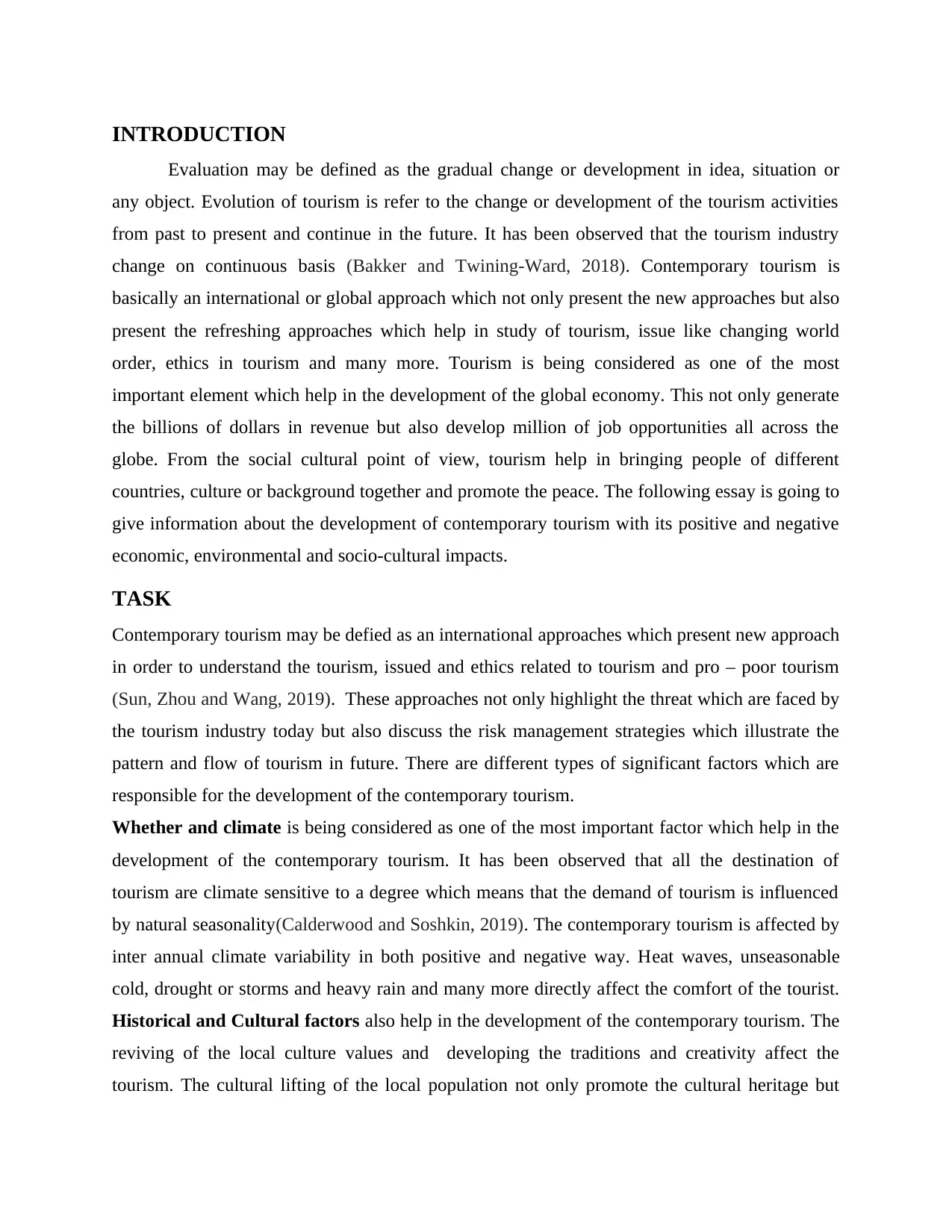
INTRODUCTION
Evaluation may be defined as the gradual change or development in idea, situation or
any object. Evolution of tourism is refer to the change or development of the tourism activities
from past to present and continue in the future. It has been observed that the tourism industry
change on continuous basis (Bakker and Twining-Ward, 2018). Contemporary tourism is
basically an international or global approach which not only present the new approaches but also
present the refreshing approaches which help in study of tourism, issue like changing world
order, ethics in tourism and many more. Tourism is being considered as one of the most
important element which help in the development of the global economy. This not only generate
the billions of dollars in revenue but also develop million of job opportunities all across the
globe. From the social cultural point of view, tourism help in bringing people of different
countries, culture or background together and promote the peace. The following essay is going to
give information about the development of contemporary tourism with its positive and negative
economic, environmental and socio-cultural impacts.
TASK
Contemporary tourism may be defied as an international approaches which present new approach
in order to understand the tourism, issued and ethics related to tourism and pro – poor tourism
(Sun, Zhou and Wang, 2019). These approaches not only highlight the threat which are faced by
the tourism industry today but also discuss the risk management strategies which illustrate the
pattern and flow of tourism in future. There are different types of significant factors which are
responsible for the development of the contemporary tourism.
Whether and climate is being considered as one of the most important factor which help in the
development of the contemporary tourism. It has been observed that all the destination of
tourism are climate sensitive to a degree which means that the demand of tourism is influenced
by natural seasonality(Calderwood and Soshkin, 2019). The contemporary tourism is affected by
inter annual climate variability in both positive and negative way. Heat waves, unseasonable
cold, drought or storms and heavy rain and many more directly affect the comfort of the tourist.
Historical and Cultural factors also help in the development of the contemporary tourism. The
reviving of the local culture values and developing the traditions and creativity affect the
tourism. The cultural lifting of the local population not only promote the cultural heritage but
Document Page
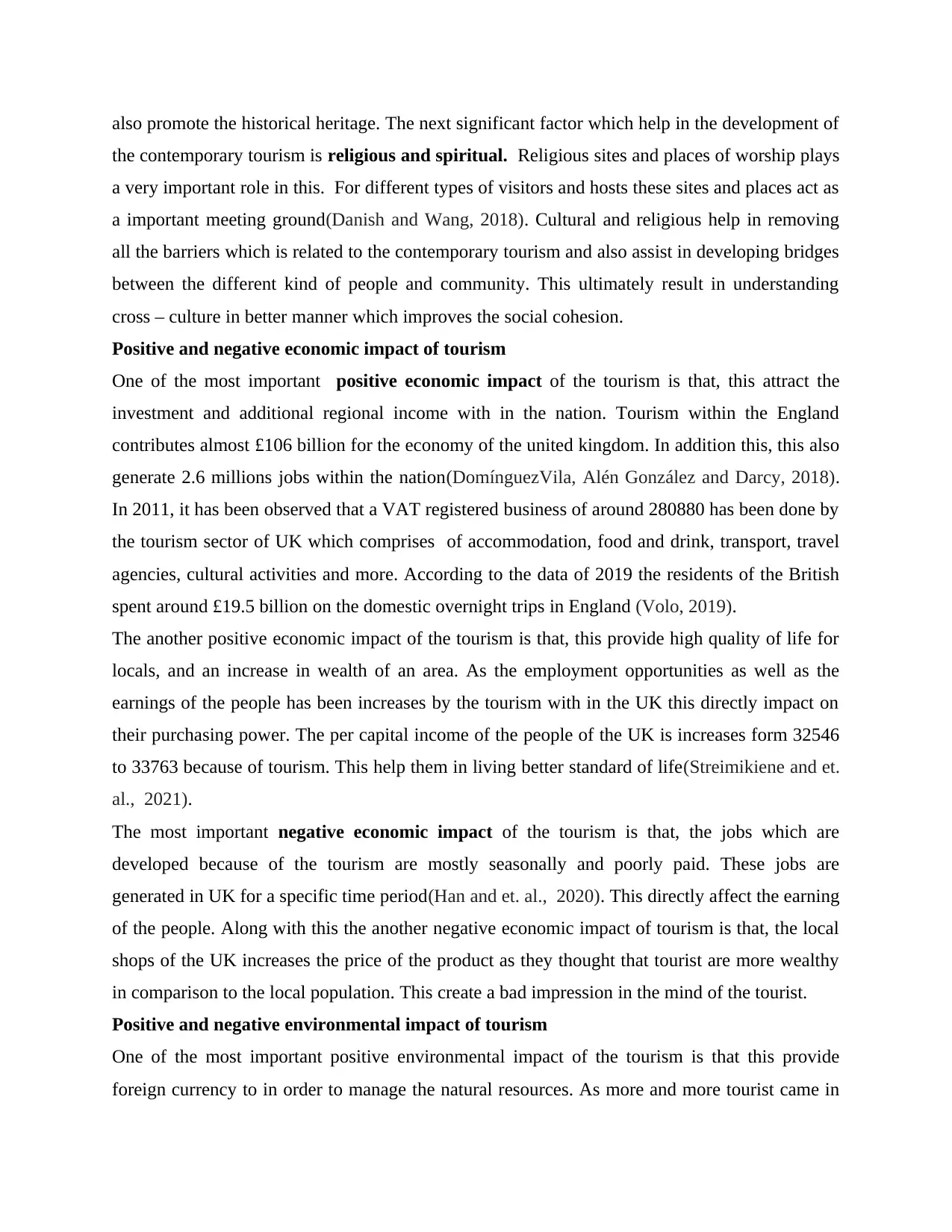
also promote the historical heritage. The next significant factor which help in the development of
the contemporary tourism is religious and spiritual. Religious sites and places of worship plays
a very important role in this. For different types of visitors and hosts these sites and places act as
a important meeting ground(Danish and Wang, 2018). Cultural and religious help in removing
all the barriers which is related to the contemporary tourism and also assist in developing bridges
between the different kind of people and community. This ultimately result in understanding
cross – culture in better manner which improves the social cohesion.
Positive and negative economic impact of tourism
One of the most important positive economic impact of the tourism is that, this attract the
investment and additional regional income with in the nation. Tourism within the England
contributes almost £106 billion for the economy of the united kingdom. In addition this, this also
generate 2.6 millions jobs within the nation(DomínguezVila, Alén González and Darcy, 2018).
In 2011, it has been observed that a VAT registered business of around 280880 has been done by
the tourism sector of UK which comprises of accommodation, food and drink, transport, travel
agencies, cultural activities and more. According to the data of 2019 the residents of the British
spent around £19.5 billion on the domestic overnight trips in England (Volo, 2019).
The another positive economic impact of the tourism is that, this provide high quality of life for
locals, and an increase in wealth of an area. As the employment opportunities as well as the
earnings of the people has been increases by the tourism with in the UK this directly impact on
their purchasing power. The per capital income of the people of the UK is increases form 32546
to 33763 because of tourism. This help them in living better standard of life(Streimikiene and et.
al., 2021).
The most important negative economic impact of the tourism is that, the jobs which are
developed because of the tourism are mostly seasonally and poorly paid. These jobs are
generated in UK for a specific time period(Han and et. al., 2020). This directly affect the earning
of the people. Along with this the another negative economic impact of tourism is that, the local
shops of the UK increases the price of the product as they thought that tourist are more wealthy
in comparison to the local population. This create a bad impression in the mind of the tourist.
Positive and negative environmental impact of tourism
One of the most important positive environmental impact of the tourism is that this provide
foreign currency to in order to manage the natural resources. As more and more tourist came in
tabler-icon-diamond-filled.svg

Paraphrase This Document

Need a fresh take? Get an instant paraphrase of this document with our AI Paraphraser
Document Page
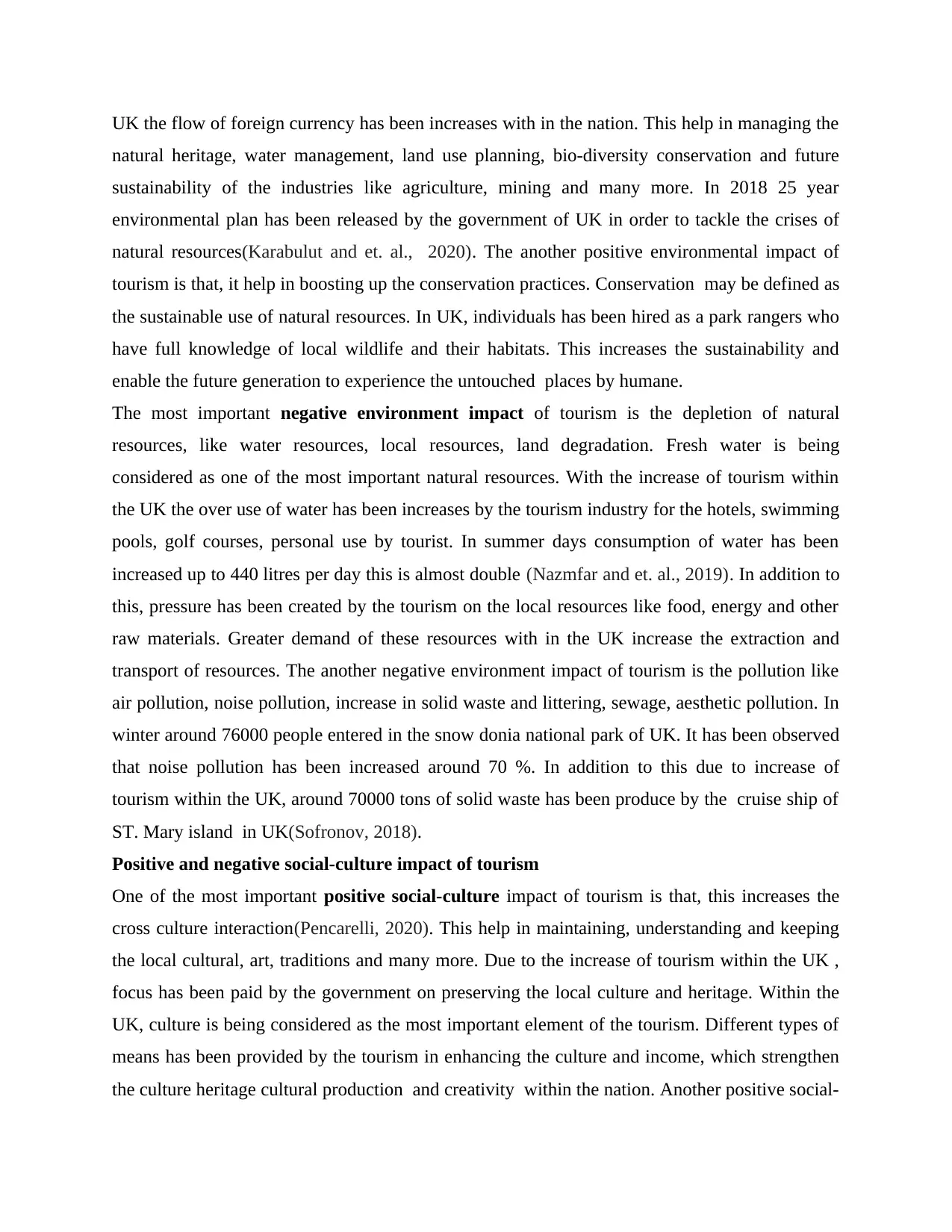
UK the flow of foreign currency has been increases with in the nation. This help in managing the
natural heritage, water management, land use planning, bio-diversity conservation and future
sustainability of the industries like agriculture, mining and many more. In 2018 25 year
environmental plan has been released by the government of UK in order to tackle the crises of
natural resources(Karabulut and et. al., 2020). The another positive environmental impact of
tourism is that, it help in boosting up the conservation practices. Conservation may be defined as
the sustainable use of natural resources. In UK, individuals has been hired as a park rangers who
have full knowledge of local wildlife and their habitats. This increases the sustainability and
enable the future generation to experience the untouched places by humane.
The most important negative environment impact of tourism is the depletion of natural
resources, like water resources, local resources, land degradation. Fresh water is being
considered as one of the most important natural resources. With the increase of tourism within
the UK the over use of water has been increases by the tourism industry for the hotels, swimming
pools, golf courses, personal use by tourist. In summer days consumption of water has been
increased up to 440 litres per day this is almost double (Nazmfar and et. al., 2019). In addition to
this, pressure has been created by the tourism on the local resources like food, energy and other
raw materials. Greater demand of these resources with in the UK increase the extraction and
transport of resources. The another negative environment impact of tourism is the pollution like
air pollution, noise pollution, increase in solid waste and littering, sewage, aesthetic pollution. In
winter around 76000 people entered in the snow donia national park of UK. It has been observed
that noise pollution has been increased around 70 %. In addition to this due to increase of
tourism within the UK, around 70000 tons of solid waste has been produce by the cruise ship of
ST. Mary island in UK(Sofronov, 2018).
Positive and negative social-culture impact of tourism
One of the most important positive social-culture impact of tourism is that, this increases the
cross culture interaction(Pencarelli, 2020). This help in maintaining, understanding and keeping
the local cultural, art, traditions and many more. Due to the increase of tourism within the UK ,
focus has been paid by the government on preserving the local culture and heritage. Within the
UK, culture is being considered as the most important element of the tourism. Different types of
means has been provided by the tourism in enhancing the culture and income, which strengthen
the culture heritage cultural production and creativity within the nation. Another positive social-
Document Page
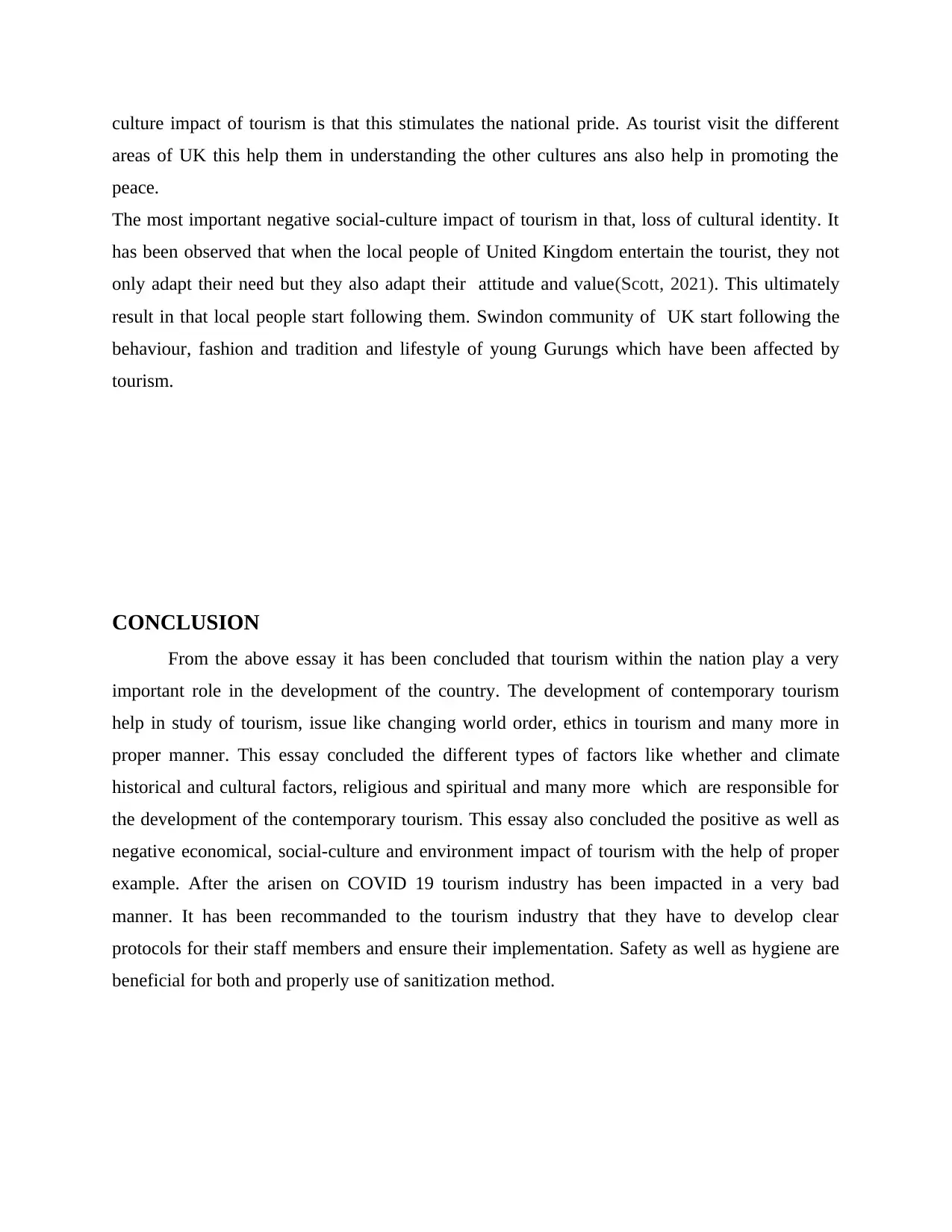
culture impact of tourism is that this stimulates the national pride. As tourist visit the different
areas of UK this help them in understanding the other cultures ans also help in promoting the
peace.
The most important negative social-culture impact of tourism in that, loss of cultural identity. It
has been observed that when the local people of United Kingdom entertain the tourist, they not
only adapt their need but they also adapt their attitude and value(Scott, 2021). This ultimately
result in that local people start following them. Swindon community of UK start following the
behaviour, fashion and tradition and lifestyle of young Gurungs which have been affected by
tourism.
CONCLUSION
From the above essay it has been concluded that tourism within the nation play a very
important role in the development of the country. The development of contemporary tourism
help in study of tourism, issue like changing world order, ethics in tourism and many more in
proper manner. This essay concluded the different types of factors like whether and climate
historical and cultural factors, religious and spiritual and many more which are responsible for
the development of the contemporary tourism. This essay also concluded the positive as well as
negative economical, social-culture and environment impact of tourism with the help of proper
example. After the arisen on COVID 19 tourism industry has been impacted in a very bad
manner. It has been recommanded to the tourism industry that they have to develop clear
protocols for their staff members and ensure their implementation. Safety as well as hygiene are
beneficial for both and properly use of sanitization method.
Document Page
REFERENCES
Books and journals
Bakker, M. and Twining-Ward, L., 2018. Tourism and the Sharing Economy.
Brouder, P., 2020. Reset redux: Possible evolutionary pathways towards the transformation of
tourism in a COVID-19 world. Tourism Geographies, 22(3), pp.484-490.
Calderwood, L.U. and Soshkin, M., 2019, September. The travel and tourism competitiveness
report 2019. World Economic Forum.
Danish and Wang, Z., 2018. Dynamic relationship between tourism, economic growth, and
environmental quality. Journal of Sustainable Tourism, 26(11), pp.1928-1943.
Domínguez Vila, T., Alén González, E. and Darcy, S., 2018. Website accessibility in the tourism
industry: an analysis of official national tourism organization websites around the
world. Disability and rehabilitation, 40(24), pp.2895-2906.
Han, H and et. al., 2020. The post-coronavirus world in the international tourism industry:
Application of the theory of planned behavior to safer destination choices in the case of
US outbound tourism. International journal of environmental research and public
health, 17(18), p.6485.
Karabulut, G and et. al., 2020. How pandemics affect tourism: International evidence. Annals of
Tourism Research, 84, p.102991.
Nazmfar, H and et. al., 2019. Analysis of travel and tourism competitiveness index in middle-
east countries. Asia Pacific Journal of Tourism Research, 24(6), pp.501-513.
Pencarelli, T., 2020. The digital revolution in the travel and tourism industry. Information
Technology & Tourism, 22(3), pp.455-476.
Scott, D., 2021. Sustainable tourism and the grand challenge of climate
change. Sustainability, 13(4), p.1966.
Sofronov, B., 2018. The development of the travel and tourism industry in the world. Annals of
Spiru Haret University. Economic Series, 18(4), pp.123-137.
Streimikiene, D and et. al., 2021. Sustainable tourism development and competitiveness: The
systematic literature review. Sustainable development, 29(1), pp.259-271.
Sun, J., Zhou, Y. and Wang, X., 2019. Place construction in the context of world heritage
tourism: the case of ‘Kaiping Diaolou and Villages’. Journal of Tourism and Cultural
Change, 17(2), pp.115-131.
Volo, S., 2019. Tourism statistics, indicators and big data: a perspective article. Tourism Review.
tabler-icon-diamond-filled.svg

Paraphrase This Document

Need a fresh take? Get an instant paraphrase of this document with our AI Paraphraser
Document Page
chevron_up_icon
1 out of 8
circle_padding
hide_on_mobile
zoom_out_icon
[object Object]