An Examination of the Role of Continuous Disclosure Framework
VerifiedAdded on 2019/10/30
|9
|2174
|166
Essay
AI Summary
This essay delves into the critical role of the continuous disclosure framework within the realm of finance, particularly focusing on the Australian context and the regulations set forth by the Corporations Act (2001), Accounting Standards, and ASX requirements. It elucidates the significance of disclosure obligations, emphasizing the need for companies to release comprehensive information to ensure fair investment propositions and foster investor trust. The essay explores market-sensitive information, providing guidelines for determining when disclosure is necessary, and highlights the importance of timely reporting. It underscores the necessity of a continuous reporting regime, including periodic reports, to aid stakeholders in making informed decisions and to promote transparency in the market. Furthermore, the essay references key academic research to support its arguments and emphasizes the benefits of continuous disclosure in improving capital markets and resource allocation.
Running head: THE ROLE OF THE CONTINUOUS DISCLOSURE FRAMEWORK
The Role of the Continuous Disclosure Framework
Student’s Name:
University Name:
Author Note
The Role of the Continuous Disclosure Framework
Student’s Name:
University Name:
Author Note

Paraphrase This Document
Need a fresh take? Get an instant paraphrase of this document with our AI Paraphraser
1THE ROLE OF THE CONTINUOUS DISCLOSURE FRAMEWORK
Table of Contents
Introduction................................................................................................................................2
Disclosure Obligations...............................................................................................................2
Market Sensitive Information....................................................................................................3
Necessities to have a continuous reporting regime for disclosure.............................................4
Conclusion..................................................................................................................................6
References..................................................................................................................................7
Table of Contents
Introduction................................................................................................................................2
Disclosure Obligations...............................................................................................................2
Market Sensitive Information....................................................................................................3
Necessities to have a continuous reporting regime for disclosure.............................................4
Conclusion..................................................................................................................................6
References..................................................................................................................................7
2THE ROLE OF THE CONTINUOUS DISCLOSURE FRAMEWORK
Introduction
The word Disclosure essentially refers to the act of releasing all linked information
that a company has generated in relation to an investment decision. In order to make the
investment proposition fair, companies should tend to release all kinds of information that is
both pros and cons regarding that particular investment proposition so that the investors come
to know about the investment in which he is planning to invest. In this study the necessity of
a continuous reporting regime has been discussed. Company policies regarding disclosure are
very common in Australian law. As mentioned in the question disclosing entities are
regulated by the Corporations Act (2001), Accounting Standards and ASX requirements. The
continuous disclosure requirements in ASX LR 3.1 require timely reporting to the ASX of
significant events and financial information that is likely to impact the price of the entity’s
securities. Disclosures not only help in improving the capital market but also assist in
optimum allocation of resources in the economy.
Disclosure Obligations
Most of the companies have come to know about the accounting concept of disclosure
because of the news headlines that sometimes come into view due to the large amounts of
fine that companies have to pay due to not disclosing or withholding information that
ultimately affected the investors (Admati and Pfleiderer 2000). The disclosure obligations are
mentioned in the Corporations Act in subsections 674(2) and 675(2). Some provisions that
require disclosures or do not require disclosures as the case may be are listed companies
conducting discussions to acquire business might not require disclosures. Even if the
company has not taken any decision regarding the acquirement of business, then also the no
disclosure will be required. A company which is listed and is still negotiating for acquiring
the business and there has been a newspaper article which clearly states that these discussions
Introduction
The word Disclosure essentially refers to the act of releasing all linked information
that a company has generated in relation to an investment decision. In order to make the
investment proposition fair, companies should tend to release all kinds of information that is
both pros and cons regarding that particular investment proposition so that the investors come
to know about the investment in which he is planning to invest. In this study the necessity of
a continuous reporting regime has been discussed. Company policies regarding disclosure are
very common in Australian law. As mentioned in the question disclosing entities are
regulated by the Corporations Act (2001), Accounting Standards and ASX requirements. The
continuous disclosure requirements in ASX LR 3.1 require timely reporting to the ASX of
significant events and financial information that is likely to impact the price of the entity’s
securities. Disclosures not only help in improving the capital market but also assist in
optimum allocation of resources in the economy.
Disclosure Obligations
Most of the companies have come to know about the accounting concept of disclosure
because of the news headlines that sometimes come into view due to the large amounts of
fine that companies have to pay due to not disclosing or withholding information that
ultimately affected the investors (Admati and Pfleiderer 2000). The disclosure obligations are
mentioned in the Corporations Act in subsections 674(2) and 675(2). Some provisions that
require disclosures or do not require disclosures as the case may be are listed companies
conducting discussions to acquire business might not require disclosures. Even if the
company has not taken any decision regarding the acquirement of business, then also the no
disclosure will be required. A company which is listed and is still negotiating for acquiring
the business and there has been a newspaper article which clearly states that these discussions
⊘ This is a preview!⊘
Do you want full access?
Subscribe today to unlock all pages.

Trusted by 1+ million students worldwide
3THE ROLE OF THE CONTINUOUS DISCLOSURE FRAMEWORK
are being conducted. In such a case disclosures are required (Matolcsy, Tyler and Wells
2012).
According to the ASX Listing Rule 3.1 the information that a listed company has to
disclose, so that a person with utmost reasonability will most probably understand or expect a
material effect on the value or price of the securities are, transactions that would result to an
important change in the scale of activities of the organization, information regarding disposal
or acquisition, entry or termination of an agreement which is material in nature, forwarding or
expecting a notice in order to create a takeover and much more such information (Hsu,
Lindsay and Tutticci 2012).
Market Sensitive Information
A disclosure or information may be market sensitive in nature. This is a very
important aspect of a disclosure because a listed company might avoid certain information,
giving the excuse that it was not able to analyze or it thought that the particular information
was not market sensitive that is it would not have any effect on the mindset of the investor
who tends to invest on a particular proposition. In such case, a higher authority or the
concerned authority of a listed company may have to take a decision as to whether to disclose
specific information or not might be ascertained with two important questions (Cumming and
Johan 2013). These questions are that, would the particular information be able to influence
the decision of buying or selling securities in the organization at the current market price and
the next question that the officer in charge needs to ask himself is that would he or she be
vulnerable to insider trading if an investor or a stakeholder was to buy or sell securities of the
organization at the current market price, when it is known that the information is not
disclosed. If the answer to any of the two above mentioned questions is yes then the officer in
charge very importantly has to reanalyze and think over the matter as it is a well cautioned
are being conducted. In such a case disclosures are required (Matolcsy, Tyler and Wells
2012).
According to the ASX Listing Rule 3.1 the information that a listed company has to
disclose, so that a person with utmost reasonability will most probably understand or expect a
material effect on the value or price of the securities are, transactions that would result to an
important change in the scale of activities of the organization, information regarding disposal
or acquisition, entry or termination of an agreement which is material in nature, forwarding or
expecting a notice in order to create a takeover and much more such information (Hsu,
Lindsay and Tutticci 2012).
Market Sensitive Information
A disclosure or information may be market sensitive in nature. This is a very
important aspect of a disclosure because a listed company might avoid certain information,
giving the excuse that it was not able to analyze or it thought that the particular information
was not market sensitive that is it would not have any effect on the mindset of the investor
who tends to invest on a particular proposition. In such case, a higher authority or the
concerned authority of a listed company may have to take a decision as to whether to disclose
specific information or not might be ascertained with two important questions (Cumming and
Johan 2013). These questions are that, would the particular information be able to influence
the decision of buying or selling securities in the organization at the current market price and
the next question that the officer in charge needs to ask himself is that would he or she be
vulnerable to insider trading if an investor or a stakeholder was to buy or sell securities of the
organization at the current market price, when it is known that the information is not
disclosed. If the answer to any of the two above mentioned questions is yes then the officer in
charge very importantly has to reanalyze and think over the matter as it is a well cautioned
Paraphrase This Document
Need a fresh take? Get an instant paraphrase of this document with our AI Paraphraser
4THE ROLE OF THE CONTINUOUS DISCLOSURE FRAMEWORK
indication that the particular information might as well be market sensitive had most probably
does not fall into the exceptions (Shi, Pukthuanthong and Walker 2013). ASX also lays down
the rules regarding the time period within which the information has to be disclosed. A time
period will most probably pass from the time when an organization at first falls under the
obligation to give information to ASX under Listing Rule 3.1 and when it in real is gives that
particular information to ASX via means of a market announcement. This delay in time might
not be due to reluctance to disclose information always. Some announcements might be
prepared very quickly and submitted to ASX more quickly, while other announcements might
take much longer to complete. The matter to be inspected and judged in these cases is, if the
organization is adhering to the rules and regulations of the guidelines laid down by ASX as
fast as possible without postponing it to later.
Necessities to have a continuous reporting regime for disclosure
Disclosure as a process is very important both on the part of the stakeholder or
investor and also on the part of the entity as it leads to goodwill of the firm in the market. A
proper disclosure also leads to proper investors. A continuous reporting regime for disclosure
is very important and needful because a continuous presentation of reports regarding
investment propositions in the company leads to better information on the part of the
investors so that they can evaluate and analyze the investment propositions and take proper
decisions. Disclosure that is listed for the secondary markets is equally significant after an
entity issuing securities has made its initial offering of securities (Clinton, White and
Woidtke 2014). Continuous reporting of high security or intrinsically private information to
the outside marketers on a regular basis is very important after listing of a particular security.
The disclosure of events material in nature on the basis of ad hoc alone is insufficient for
investors or stakeholders in order to make decisions regarding investment propositions (Kross
indication that the particular information might as well be market sensitive had most probably
does not fall into the exceptions (Shi, Pukthuanthong and Walker 2013). ASX also lays down
the rules regarding the time period within which the information has to be disclosed. A time
period will most probably pass from the time when an organization at first falls under the
obligation to give information to ASX under Listing Rule 3.1 and when it in real is gives that
particular information to ASX via means of a market announcement. This delay in time might
not be due to reluctance to disclose information always. Some announcements might be
prepared very quickly and submitted to ASX more quickly, while other announcements might
take much longer to complete. The matter to be inspected and judged in these cases is, if the
organization is adhering to the rules and regulations of the guidelines laid down by ASX as
fast as possible without postponing it to later.
Necessities to have a continuous reporting regime for disclosure
Disclosure as a process is very important both on the part of the stakeholder or
investor and also on the part of the entity as it leads to goodwill of the firm in the market. A
proper disclosure also leads to proper investors. A continuous reporting regime for disclosure
is very important and needful because a continuous presentation of reports regarding
investment propositions in the company leads to better information on the part of the
investors so that they can evaluate and analyze the investment propositions and take proper
decisions. Disclosure that is listed for the secondary markets is equally significant after an
entity issuing securities has made its initial offering of securities (Clinton, White and
Woidtke 2014). Continuous reporting of high security or intrinsically private information to
the outside marketers on a regular basis is very important after listing of a particular security.
The disclosure of events material in nature on the basis of ad hoc alone is insufficient for
investors or stakeholders in order to make decisions regarding investment propositions (Kross
5THE ROLE OF THE CONTINUOUS DISCLOSURE FRAMEWORK
and Suk 2012). Even though it is laid down by ASX that once the material events occur, it is
required to be disclosed to the public via means of public offering or announcements, some
disclosures may take much more time than expected (Cox, Hillman and Langevoort 2016).
This does not necessarily mean that the entity is purposely delaying the process of disclosure.
These disclosures are called ad hoc disclosures and investors are unable or under informed to
make proper investment decisions on these kinds of investment propositions related to the
disclosures alone (Gehlbach et al., 2012). Due to this reason, it is very important for entities
issuing securities to create certain periodical presentations, like annual reports and interim
reports, under which specifically claimed disclosures must be presented at continuous
intervals to the public. This continuous reporting process of disclosing crucial information
help stakeholders or investors in decision making and continuous check or monitoring of the
listed securities of the concerned company and also helps in comparison of the listed
securities of the other companies that are in competition with the same entity in the market
(Muniandy and Ali 2012).
In spite of the Principles for Ongoing Disclosure has laid down general guidelines for
continuous disclosure, specific guidelines for periodic disclosure also has utmost significance
in promoting continuously higher quality disclosure that are present in the reports of periodic
intervals of entities whose securities are being traded in the domestic, as well as international
markets.
The important components of disclosures that reflect the present status of an
organization are annual reports with financial statements, management’s discussions,
transactions in relation to material management, disclosure related t compensation, disclosure
related to corporate governance, market sensitive instruments disclosure, disclosure in
relation to disclosures, interim reports (Russell 2015).
and Suk 2012). Even though it is laid down by ASX that once the material events occur, it is
required to be disclosed to the public via means of public offering or announcements, some
disclosures may take much more time than expected (Cox, Hillman and Langevoort 2016).
This does not necessarily mean that the entity is purposely delaying the process of disclosure.
These disclosures are called ad hoc disclosures and investors are unable or under informed to
make proper investment decisions on these kinds of investment propositions related to the
disclosures alone (Gehlbach et al., 2012). Due to this reason, it is very important for entities
issuing securities to create certain periodical presentations, like annual reports and interim
reports, under which specifically claimed disclosures must be presented at continuous
intervals to the public. This continuous reporting process of disclosing crucial information
help stakeholders or investors in decision making and continuous check or monitoring of the
listed securities of the concerned company and also helps in comparison of the listed
securities of the other companies that are in competition with the same entity in the market
(Muniandy and Ali 2012).
In spite of the Principles for Ongoing Disclosure has laid down general guidelines for
continuous disclosure, specific guidelines for periodic disclosure also has utmost significance
in promoting continuously higher quality disclosure that are present in the reports of periodic
intervals of entities whose securities are being traded in the domestic, as well as international
markets.
The important components of disclosures that reflect the present status of an
organization are annual reports with financial statements, management’s discussions,
transactions in relation to material management, disclosure related t compensation, disclosure
related to corporate governance, market sensitive instruments disclosure, disclosure in
relation to disclosures, interim reports (Russell 2015).
⊘ This is a preview!⊘
Do you want full access?
Subscribe today to unlock all pages.
Trusted by 1+ million students worldwide
6THE ROLE OF THE CONTINUOUS DISCLOSURE FRAMEWORK
But the most important point to be kept in mind while analyzing the importance of
disclosures or continuous reporting is the criteria for reporting a disclosure which pertains to
the information disclosed in the reports. The information should reflect a true and fair view of
the company. The reports published by a company on its website should very importantly
match with the auditor’s report. This will definitely increase the management’s concern to
monitor and control the quality of the financial statements and this further explains the
importance of continuous reporting (Fasterling 2012).
Some authorities may be of the opinion that the disclosure of material information
results in unjustified skepticism among the public, it may reduce the confidence of the
stakeholders or investors in the fairness of the entity concerned. But in reality proper
disclosures help investors in avoiding the insider trading or abusive use of information by an
organization (Doshi, Dowell and Toffel 2013).
Conclusion
As it is understood from the above study continuous reporting of disclosures are very
important. It does not only help the investors in getting a true and fair view of the company
but also indirectly aid the company by helping it to avoid exorbitant fine or fees that investors
claim due to wrong or no information disclosed by the entity. Therefore companies should
very importantly adhere to the guidelines in the Corporation Act or the ASX so that they can
enjoy the benefits of continuous reporting.
But the most important point to be kept in mind while analyzing the importance of
disclosures or continuous reporting is the criteria for reporting a disclosure which pertains to
the information disclosed in the reports. The information should reflect a true and fair view of
the company. The reports published by a company on its website should very importantly
match with the auditor’s report. This will definitely increase the management’s concern to
monitor and control the quality of the financial statements and this further explains the
importance of continuous reporting (Fasterling 2012).
Some authorities may be of the opinion that the disclosure of material information
results in unjustified skepticism among the public, it may reduce the confidence of the
stakeholders or investors in the fairness of the entity concerned. But in reality proper
disclosures help investors in avoiding the insider trading or abusive use of information by an
organization (Doshi, Dowell and Toffel 2013).
Conclusion
As it is understood from the above study continuous reporting of disclosures are very
important. It does not only help the investors in getting a true and fair view of the company
but also indirectly aid the company by helping it to avoid exorbitant fine or fees that investors
claim due to wrong or no information disclosed by the entity. Therefore companies should
very importantly adhere to the guidelines in the Corporation Act or the ASX so that they can
enjoy the benefits of continuous reporting.
Paraphrase This Document
Need a fresh take? Get an instant paraphrase of this document with our AI Paraphraser
7THE ROLE OF THE CONTINUOUS DISCLOSURE FRAMEWORK
References
Admati, A.R. and Pfleiderer, P., 2000. Forcing firms to talk: Financial disclosure regulation
and externalities. The Review of financial studies, 13(3), pp.479-519.
Clinton, S.B., White, J.T. and Woidtke, T., 2014. Differences in the information environment
prior to seasoned equity offerings under relaxed disclosure regulation. Journal of Accounting
and Economics, 58(1), pp.59-78.
Cox, J.D., Hillman, R.W. and Langevoort, D.C., 2016. Securities regulation: cases and
materials. Wolters Kluwer Law & Business.
Cumming, D. and Johan, S., 2013. Demand-driven securities regulation: Evidence from
crowdfunding. Venture Capital, 15(4), pp.361-379.
Doshi, A.R., Dowell, G.W. and Toffel, M.W., 2013. How firms respond to mandatory
information disclosure. Strategic Management Journal, 34(10), pp.1209-1231.
Fasterling, B., 2012. Development of norms through compliance disclosure. Journal of
Business Ethics, 106(1), pp.73-87.
Gehlbach, B.K., Chapotot, F., Leproult, R., Whitmore, H., Poston, J., Pohlman, M., Miller,
A., Pohlman, A.S., Nedeltcheva, A., Jacobsen, J.H. and Hall, J.B., 2012. Temporal
disorganization of circadian rhythmicity and sleep-wake regulation in mechanically
ventilated patients receiving continuous intravenous sedation. Sleep, 35(8), pp.1105-1114.
Hsu, G.C.M., Lindsay, S. and Tutticci, I., 2012. Inter‐temporal changes in analysts’ forecast
properties under the Australian continuous disclosure regime. Accounting & Finance, 52(4),
pp.1101-1123.
References
Admati, A.R. and Pfleiderer, P., 2000. Forcing firms to talk: Financial disclosure regulation
and externalities. The Review of financial studies, 13(3), pp.479-519.
Clinton, S.B., White, J.T. and Woidtke, T., 2014. Differences in the information environment
prior to seasoned equity offerings under relaxed disclosure regulation. Journal of Accounting
and Economics, 58(1), pp.59-78.
Cox, J.D., Hillman, R.W. and Langevoort, D.C., 2016. Securities regulation: cases and
materials. Wolters Kluwer Law & Business.
Cumming, D. and Johan, S., 2013. Demand-driven securities regulation: Evidence from
crowdfunding. Venture Capital, 15(4), pp.361-379.
Doshi, A.R., Dowell, G.W. and Toffel, M.W., 2013. How firms respond to mandatory
information disclosure. Strategic Management Journal, 34(10), pp.1209-1231.
Fasterling, B., 2012. Development of norms through compliance disclosure. Journal of
Business Ethics, 106(1), pp.73-87.
Gehlbach, B.K., Chapotot, F., Leproult, R., Whitmore, H., Poston, J., Pohlman, M., Miller,
A., Pohlman, A.S., Nedeltcheva, A., Jacobsen, J.H. and Hall, J.B., 2012. Temporal
disorganization of circadian rhythmicity and sleep-wake regulation in mechanically
ventilated patients receiving continuous intravenous sedation. Sleep, 35(8), pp.1105-1114.
Hsu, G.C.M., Lindsay, S. and Tutticci, I., 2012. Inter‐temporal changes in analysts’ forecast
properties under the Australian continuous disclosure regime. Accounting & Finance, 52(4),
pp.1101-1123.
8THE ROLE OF THE CONTINUOUS DISCLOSURE FRAMEWORK
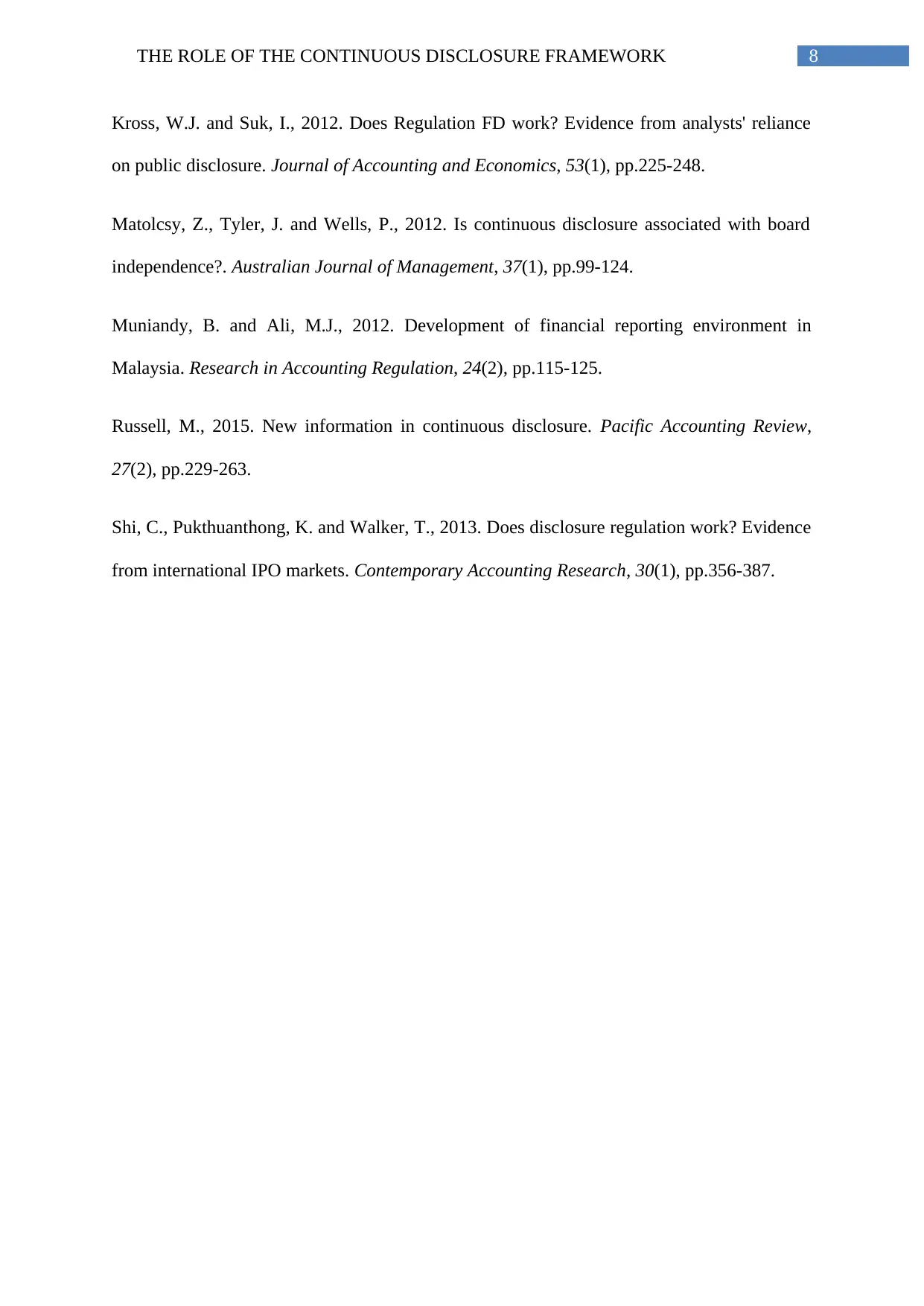
Kross, W.J. and Suk, I., 2012. Does Regulation FD work? Evidence from analysts' reliance
on public disclosure. Journal of Accounting and Economics, 53(1), pp.225-248.
Matolcsy, Z., Tyler, J. and Wells, P., 2012. Is continuous disclosure associated with board
independence?. Australian Journal of Management, 37(1), pp.99-124.
Muniandy, B. and Ali, M.J., 2012. Development of financial reporting environment in
Malaysia. Research in Accounting Regulation, 24(2), pp.115-125.
Russell, M., 2015. New information in continuous disclosure. Pacific Accounting Review,
27(2), pp.229-263.
Shi, C., Pukthuanthong, K. and Walker, T., 2013. Does disclosure regulation work? Evidence
from international IPO markets. Contemporary Accounting Research, 30(1), pp.356-387.
Kross, W.J. and Suk, I., 2012. Does Regulation FD work? Evidence from analysts' reliance
on public disclosure. Journal of Accounting and Economics, 53(1), pp.225-248.
Matolcsy, Z., Tyler, J. and Wells, P., 2012. Is continuous disclosure associated with board
independence?. Australian Journal of Management, 37(1), pp.99-124.
Muniandy, B. and Ali, M.J., 2012. Development of financial reporting environment in
Malaysia. Research in Accounting Regulation, 24(2), pp.115-125.
Russell, M., 2015. New information in continuous disclosure. Pacific Accounting Review,
27(2), pp.229-263.
Shi, C., Pukthuanthong, K. and Walker, T., 2013. Does disclosure regulation work? Evidence
from international IPO markets. Contemporary Accounting Research, 30(1), pp.356-387.
⊘ This is a preview!⊘
Do you want full access?
Subscribe today to unlock all pages.
Trusted by 1+ million students worldwide

1 out of 9


Related Documents


Your All-in-One AI-Powered Toolkit for Academic Success.
+13062052269
info@desklib.com
Available 24*7 on WhatsApp / Email
![[object Object]](/_next/static/media/star-bottom.7253800d.svg)
Unlock your academic potential
Copyright © 2020–2026 A2Z Services. All Rights Reserved. Developed and managed by ZUCOL.