Contract Law: Analysis of Australian Contractual Agreements
VerifiedAdded on 2020/10/22
|8
|1932
|408
Report
AI Summary
This report provides a comprehensive analysis of Australian contract law, addressing key legal principles and case studies. It begins with an introduction to contract law, defining its role in regulating agreements and outlining the legal framework within Australia. The main body of the report examines two specific scenarios. The first scenario explores the issue of whether a seller is legally obligated to sell goods to a potential buyer, analyzing the concept of consumer contracts, offers, and acceptance, referencing the Competition and Consumer Act 2010 and relevant case law like Pharmaceutical Society of Great Britain v Boots Cash Chemists Ltd. The second scenario delves into the formation, amendment, and potential breach of a contract, focusing on the communication of offer and acceptance, revocation of acceptance, and the impact of amendments on contractual obligations, also considering the scenario where the parties involved are cousins. The report provides legal solutions based on the given facts, and concludes by summarizing the key findings and principles of contract law, emphasizing the importance of offer, acceptance, and free consent in creating a valid and enforceable agreement. It also highlights the implications of contract completion and the rights of parties involved in contractual disputes.
Contract Law
Paraphrase This Document
Need a fresh take? Get an instant paraphrase of this document with our AI Paraphraser

Table of Contents
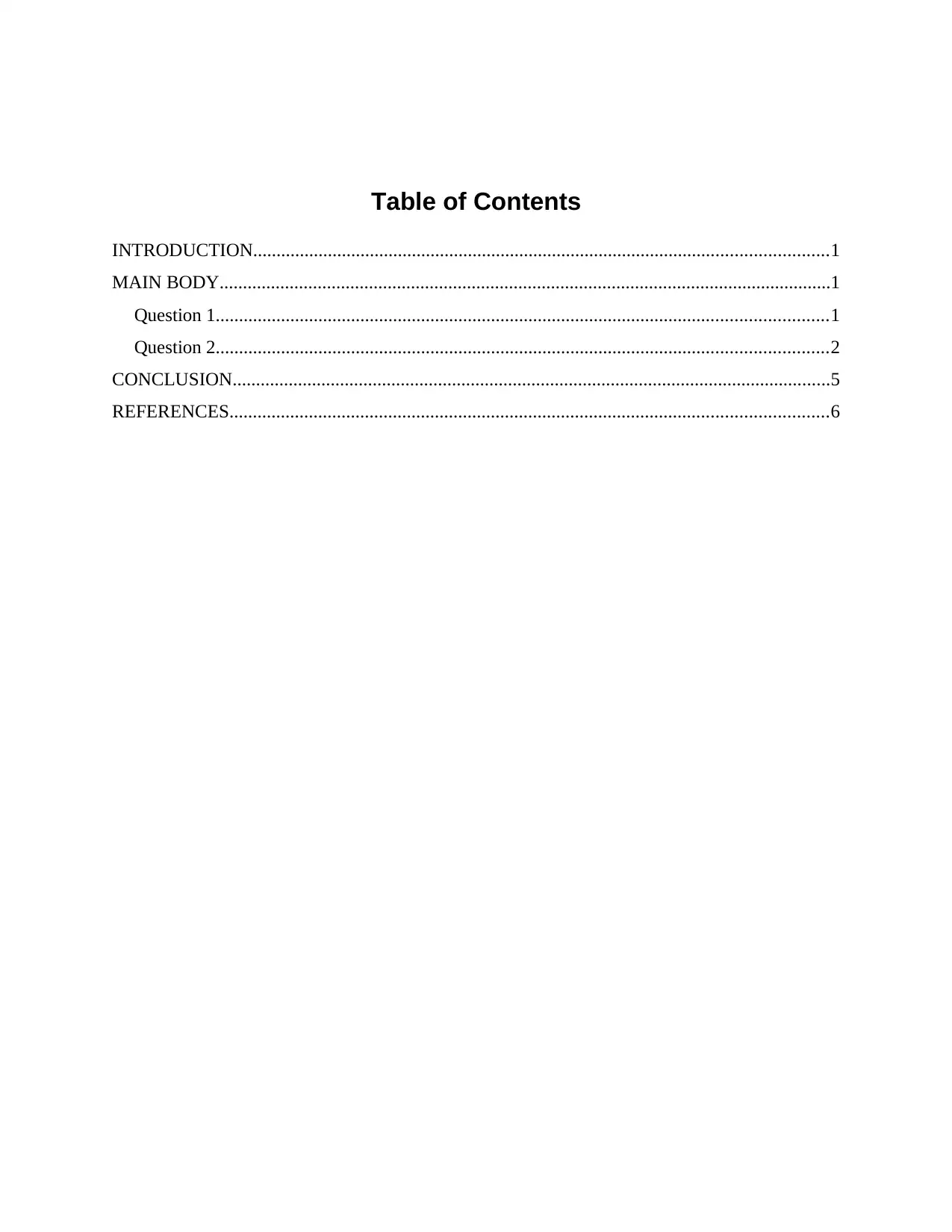
INTRODUCTION...........................................................................................................................1
MAIN BODY...................................................................................................................................1
Question 1...................................................................................................................................1
Question 2...................................................................................................................................2
CONCLUSION................................................................................................................................5
REFERENCES................................................................................................................................6
INTRODUCTION...........................................................................................................................1
MAIN BODY...................................................................................................................................1
Question 1...................................................................................................................................1
Question 2...................................................................................................................................2
CONCLUSION................................................................................................................................5
REFERENCES................................................................................................................................6

INTRODUCTION
Contract law can be defined as set of rules and regulations that concerns with preparation
of each contractual valid and legal. The contract law contains legislations required to be followed
by the business while developing a contract and perform their part performance as well. The
present study provides legal solutions of some contract relating to the contract laws of Australia.
The study provides legal solutions on the basis of contra laws and justice provided previously on
similar disputes among parties.
MAIN BODY
Question 1
Issue:
Whether Carla have a legal right to refuse to sell the books?
Rules:
Competition and Consumer Act 2010: It is an act provided by the parliament for the
purpose of having batter control over contractual activities within the country.
Contract: As per the Competition and Consumer Act 2010, A contract can be defined
as a legal agreement among parties that can be enforceable by law. For the purpose of
turning an agreement into a contract it needs to fulfill the following conditions:
▪ There must be a valid offer which has been accepted by the another party.
▪ There must be a mutual consent between both the parties.
▪ A valid consideration must be paid to both the parties (Currie and De Gruyter,
2016).
▪ Further, each term of the agreement is needed to be certain.
Consumer contract: As per the Australian contract law, a consumer contract is an
agreement which have a legal boundation upon sales person and the consumer that
concerns to sale of a specific good or services at a certain rate.
Valid consumer contract: A consumer contract can be termed as a valid contract
between consumer and seller of goods or services. Further, the consumer contract needs
to fulfill the following terms:
▪ An agreement can be made either verbally or through written agreements.
▪ In a consumer contract an offer is generally being given by the buyer of goods
which must be accepted by the seller.
1
Contract law can be defined as set of rules and regulations that concerns with preparation
of each contractual valid and legal. The contract law contains legislations required to be followed
by the business while developing a contract and perform their part performance as well. The
present study provides legal solutions of some contract relating to the contract laws of Australia.
The study provides legal solutions on the basis of contra laws and justice provided previously on
similar disputes among parties.
MAIN BODY
Question 1
Issue:
Whether Carla have a legal right to refuse to sell the books?
Rules:
Competition and Consumer Act 2010: It is an act provided by the parliament for the
purpose of having batter control over contractual activities within the country.
Contract: As per the Competition and Consumer Act 2010, A contract can be defined
as a legal agreement among parties that can be enforceable by law. For the purpose of
turning an agreement into a contract it needs to fulfill the following conditions:
▪ There must be a valid offer which has been accepted by the another party.
▪ There must be a mutual consent between both the parties.
▪ A valid consideration must be paid to both the parties (Currie and De Gruyter,
2016).
▪ Further, each term of the agreement is needed to be certain.
Consumer contract: As per the Australian contract law, a consumer contract is an
agreement which have a legal boundation upon sales person and the consumer that
concerns to sale of a specific good or services at a certain rate.
Valid consumer contract: A consumer contract can be termed as a valid contract
between consumer and seller of goods or services. Further, the consumer contract needs
to fulfill the following terms:
▪ An agreement can be made either verbally or through written agreements.
▪ In a consumer contract an offer is generally being given by the buyer of goods
which must be accepted by the seller.
1
⊘ This is a preview!⊘
Do you want full access?
Subscribe today to unlock all pages.

Trusted by 1+ million students worldwide

▪ Both the parties are needed to be give their concern to act as per the agreements.
▪ Sufficient amount of consideration must be provided to the each party to the
contract.
.
Application:
From the application of the above mentioned rules, laws on the present scenario, it can
be stated that it is related to the consumer contract. By applying rules of consumer contract, it
can be said that Mr. Brendan is a buyer who put an offer in front of Carla, the sales woman of
Clayton Books store. Further, the Carla didn't give the acceptance by refusing Brendan to sell
the book.
Case Laws:
In Pharmaceutical Society of Great Britain v Boots Cash Chemists Ltd [1953] 1 QB
401, Court of Appeal case, customer put some medicines into the basket as per his need and
went to the cash counter for purchasing it. Some selected medicines were put aside by the cashier
as they could not be sold by them without prescription of doctors. The customer filled a case on
the ground that the chemist has broken the term of contract.
The court held that by putting the medicines in front of cashier, an offer was being made.
As per the contract law, there must be free consent of both the parties (Networked Knowledge -
Contract Law Casenotes, 2018). Therefore, seller have right to either accept or reject the offer of
customers. In this regard, the court held that the chemist can not be held defaulter on this ground
Conclusion:
From the application of all the rules, laws and case studies relating to the issue of present
case scenario, it can be concluded that Brendan offered to sell the books at reasonable money.
Carla refused to sell the goods that can be considered as not accepting the offer. In this regard, as
the offer was not accepted, the agreement does not meet the basic requirements of a contract.
Therefore, it can be concluded that the Carla have legal right to weather accept the offer
or to refuse to sell the books and reject the offer of Brendan.
Question 2
A) Advising Whether there is an agreement between Edward and Greg?
2
▪ Sufficient amount of consideration must be provided to the each party to the
contract.
.
Application:
From the application of the above mentioned rules, laws on the present scenario, it can
be stated that it is related to the consumer contract. By applying rules of consumer contract, it
can be said that Mr. Brendan is a buyer who put an offer in front of Carla, the sales woman of
Clayton Books store. Further, the Carla didn't give the acceptance by refusing Brendan to sell
the book.
Case Laws:
In Pharmaceutical Society of Great Britain v Boots Cash Chemists Ltd [1953] 1 QB
401, Court of Appeal case, customer put some medicines into the basket as per his need and
went to the cash counter for purchasing it. Some selected medicines were put aside by the cashier
as they could not be sold by them without prescription of doctors. The customer filled a case on
the ground that the chemist has broken the term of contract.
The court held that by putting the medicines in front of cashier, an offer was being made.
As per the contract law, there must be free consent of both the parties (Networked Knowledge -
Contract Law Casenotes, 2018). Therefore, seller have right to either accept or reject the offer of
customers. In this regard, the court held that the chemist can not be held defaulter on this ground
Conclusion:
From the application of all the rules, laws and case studies relating to the issue of present
case scenario, it can be concluded that Brendan offered to sell the books at reasonable money.
Carla refused to sell the goods that can be considered as not accepting the offer. In this regard, as
the offer was not accepted, the agreement does not meet the basic requirements of a contract.
Therefore, it can be concluded that the Carla have legal right to weather accept the offer
or to refuse to sell the books and reject the offer of Brendan.
Question 2
A) Advising Whether there is an agreement between Edward and Greg?
2
Paraphrase This Document
Need a fresh take? Get an instant paraphrase of this document with our AI Paraphraser

Issue:
Rules
Acceptance of each terms of an agreement results in binding effect over both the parties. As per
the terms of Communication of offer and Acceptance rules of Competition and Consumer
Act 2010,:
An offer must be For the purpose of turning any agreement into a contract, it needs to
fulfil the following basic clauses made which is needed to be accepted by another party to
the contract.
The contract remains valid until it has been revoked with the mutual consent of both
parties.
There must be free consent of both the parties.
For the purpose of creating a contract, it is important to actual completion of
communication of offer and acceptance.
An offer can be revoked at any time before the acceptance is being made by the another
party.
Further, the acceptance can be revoked before reaching the acceptance latter to the person
offering the contract. The communication of revoked acceptance can be made through a
faster media way of communication than through which the acceptance was made.
Application
Moreover, as per the judgement held in Supreme Court of New South Wales [1974] 2 NSWLR
46 case, it is important to include offer and acceptance in the agreement (Bressan v Squires,
2018)
Conclusion
In the present scenario, Edward offered to sale some specific goods to Greg on 4th
February through latter. Mr. Greg accepted the offer and sent the acceptance letter on 7th which
was delivered to Edward on 11th. Greg decided to revoke the acceptance and sent a mail of
rejection to Greg on 9th February.
Here in this case, as there is an offer and acceptance which was revoked by the Greg
before delivery of the acceptance as it was made through a faster way of communication i.e. via
email.
3
Rules
Acceptance of each terms of an agreement results in binding effect over both the parties. As per
the terms of Communication of offer and Acceptance rules of Competition and Consumer
Act 2010,:
An offer must be For the purpose of turning any agreement into a contract, it needs to
fulfil the following basic clauses made which is needed to be accepted by another party to
the contract.
The contract remains valid until it has been revoked with the mutual consent of both
parties.
There must be free consent of both the parties.
For the purpose of creating a contract, it is important to actual completion of
communication of offer and acceptance.
An offer can be revoked at any time before the acceptance is being made by the another
party.
Further, the acceptance can be revoked before reaching the acceptance latter to the person
offering the contract. The communication of revoked acceptance can be made through a
faster media way of communication than through which the acceptance was made.
Application
Moreover, as per the judgement held in Supreme Court of New South Wales [1974] 2 NSWLR
46 case, it is important to include offer and acceptance in the agreement (Bressan v Squires,
2018)
Conclusion
In the present scenario, Edward offered to sale some specific goods to Greg on 4th
February through latter. Mr. Greg accepted the offer and sent the acceptance letter on 7th which
was delivered to Edward on 11th. Greg decided to revoke the acceptance and sent a mail of
rejection to Greg on 9th February.
Here in this case, as there is an offer and acceptance which was revoked by the Greg
before delivery of the acceptance as it was made through a faster way of communication i.e. via
email.
3

In this regard, it can be advised to Edward that as there is no presence of acceptance in
the agreement due to its revocation. Therefore, it can be advised to Greg that there is no
agreement
B) Whether Peter is still liable for the unpaid sum of $50?
Issue
Is peter still liable to pay $50?
Rules
According to the Amendment of contract rules of Competition and Consumer Act 2010, parties
have right to amend the contractual agreement at any time with the mutual consent of all the
parties to the contract. Parties do not remain bound to the contractual terms after completing their
part of performance. The contract is said to be a completed contract when:
when the parties complete their part of performance.
By creating a different agreement as to end up the contract.
When the situation arises due to which performance in the contract is no longer possible.
If due to any reason the contract becomes void as per the legal framework (Mansor and
Rashid, 2016).
Application
In the present case scenario, Edward and Peter entered into an agreement of selling some
specific goods at $450 on credit. Goods were delivered as per the agreement. After hearing the
news of bankruptcy Edward offered Peter to pay the debt immediately and get a discount of $50.
Peter agreed and paid the sum to Edward through cheque.
Conclusion
In this regard, it can be analysed that the contract was being amended with the mutual
consent. Further, it has been completed through completion of performance by both the parties.
Therefore, it can be advised to Peter that he both the parties are no longer bound to the
contractual terms any more as to pay the sum of $50.
C) If Edward and Peter were cousins, would there be still an existence of a contract to sell
the goods?
Issue
will the contract remain valid even if Endwad and Peter was cousins?
Rules
4
the agreement due to its revocation. Therefore, it can be advised to Greg that there is no
agreement
B) Whether Peter is still liable for the unpaid sum of $50?
Issue
Is peter still liable to pay $50?
Rules
According to the Amendment of contract rules of Competition and Consumer Act 2010, parties
have right to amend the contractual agreement at any time with the mutual consent of all the
parties to the contract. Parties do not remain bound to the contractual terms after completing their
part of performance. The contract is said to be a completed contract when:
when the parties complete their part of performance.
By creating a different agreement as to end up the contract.
When the situation arises due to which performance in the contract is no longer possible.
If due to any reason the contract becomes void as per the legal framework (Mansor and
Rashid, 2016).
Application
In the present case scenario, Edward and Peter entered into an agreement of selling some
specific goods at $450 on credit. Goods were delivered as per the agreement. After hearing the
news of bankruptcy Edward offered Peter to pay the debt immediately and get a discount of $50.
Peter agreed and paid the sum to Edward through cheque.
Conclusion
In this regard, it can be analysed that the contract was being amended with the mutual
consent. Further, it has been completed through completion of performance by both the parties.
Therefore, it can be advised to Peter that he both the parties are no longer bound to the
contractual terms any more as to pay the sum of $50.
C) If Edward and Peter were cousins, would there be still an existence of a contract to sell
the goods?
Issue
will the contract remain valid even if Endwad and Peter was cousins?
Rules
4
⊘ This is a preview!⊘
Do you want full access?
Subscribe today to unlock all pages.

Trusted by 1+ million students worldwide

As per the Australian contract law, a contract is needed to be made by those parties who
are competent to contract. For gaining competency an individual need to have following
capacities:
Individual must not be minor.
Individual should not have any mental disabilities (McLean, Stewart and Kerridge, 2015).
At the time of formation of contract, it is required to be in mental capability to understand
the terms of contract.
Contractual parties must not be enemy aliens.
A contract is needed to be fulfil the basic requirement as mentioned in the contract law of
Australia.
Application
By applying these rules in the present case, it can be analysed that there are no such rules
relating to the cousin ship in the contract law.
Conclusion
If the parties are not competent to the contract, they can not make a valid contract. In the
present case, both Edward and Peter are competent to contract. Further, no clause related to the
relation among the parties have been included in the law. Therefore, the contract will be still in
existence even if Edward and Peter would be cousins.
CONCLUSION
From the above study of cases based on the contractual agreement disputes, it can be
analysed that, for the purpose of creating a contract, there is required to be offer and acceptance
of the agreement. Further, due to the clause of free consent, both parties have right to refuse to
accept the contract. Further, the study has also concluded that the acceptance can be revoked
before communication of acceptance to the offerer. A contract is said to be completed after
completion of completing performance by both parties. After completion of contract, no party
remains bound to the contractual terms.
5
are competent to contract. For gaining competency an individual need to have following
capacities:
Individual must not be minor.
Individual should not have any mental disabilities (McLean, Stewart and Kerridge, 2015).
At the time of formation of contract, it is required to be in mental capability to understand
the terms of contract.
Contractual parties must not be enemy aliens.
A contract is needed to be fulfil the basic requirement as mentioned in the contract law of
Australia.
Application
By applying these rules in the present case, it can be analysed that there are no such rules
relating to the cousin ship in the contract law.
Conclusion
If the parties are not competent to the contract, they can not make a valid contract. In the
present case, both Edward and Peter are competent to contract. Further, no clause related to the
relation among the parties have been included in the law. Therefore, the contract will be still in
existence even if Edward and Peter would be cousins.
CONCLUSION
From the above study of cases based on the contractual agreement disputes, it can be
analysed that, for the purpose of creating a contract, there is required to be offer and acceptance
of the agreement. Further, due to the clause of free consent, both parties have right to refuse to
accept the contract. Further, the study has also concluded that the acceptance can be revoked
before communication of acceptance to the offerer. A contract is said to be completed after
completion of completing performance by both parties. After completion of contract, no party
remains bound to the contractual terms.
5
Paraphrase This Document
Need a fresh take? Get an instant paraphrase of this document with our AI Paraphraser

REFERENCES
Books and Journal
Currie, G. and De Gruyter, C., 2016. Exploring performance outcomes and regulatory contexts of
Light Rail in Australia and the US. Research in Transportation Economics, 59. pp.297-
303.
Mansor, N. S. and Rashid, K. A., 2016. Incomplete Contract in Private Finance Initiative (PFI)
contracts: causes, implications and strategies. Procedia-Social and Behavioral
Sciences. 222. pp.93-102.
McLean, A. K., Stewart, C. and Kerridge, I., 2015. Untested, unproven, and unethical: the
promotion and provision of autologous stem cell therapies in Australia. Stem cell
research & therapy. 6(1). pp.33.
Online
Networked Knowledge - Contract Law Casenotes. 2018. [ONLINE] Available through
<http://netk.net.au/Contract/Pharmaceutical.asp>
Bressan v Squires. 2018. [ONLINE] Available through
<https://www.australiancontractlaw.com/cases/bressan.html>
6
Books and Journal
Currie, G. and De Gruyter, C., 2016. Exploring performance outcomes and regulatory contexts of
Light Rail in Australia and the US. Research in Transportation Economics, 59. pp.297-
303.
Mansor, N. S. and Rashid, K. A., 2016. Incomplete Contract in Private Finance Initiative (PFI)
contracts: causes, implications and strategies. Procedia-Social and Behavioral
Sciences. 222. pp.93-102.
McLean, A. K., Stewart, C. and Kerridge, I., 2015. Untested, unproven, and unethical: the
promotion and provision of autologous stem cell therapies in Australia. Stem cell
research & therapy. 6(1). pp.33.
Online
Networked Knowledge - Contract Law Casenotes. 2018. [ONLINE] Available through
<http://netk.net.au/Contract/Pharmaceutical.asp>
Bressan v Squires. 2018. [ONLINE] Available through
<https://www.australiancontractlaw.com/cases/bressan.html>
6
1 out of 8
Related Documents
Your All-in-One AI-Powered Toolkit for Academic Success.
+13062052269
info@desklib.com
Available 24*7 on WhatsApp / Email
Unlock your academic potential
Copyright © 2020–2025 A2Z Services. All Rights Reserved. Developed and managed by ZUCOL.