Comprehensive Analysis of Contract Law: Elements, Types, and Terms
VerifiedAdded on 2019/12/28
|9
|2653
|90
Report
AI Summary
This report delves into the intricacies of contract law, commencing with an introduction to contracts and their legal enforceability. It meticulously examines the essential elements required for a valid contract, including offer, acceptance, intention to create legal relations, and consideration, providing detailed explanations and relevant case examples. The report then explores diverse types of contracts, such as verbal, written, online, and inferred contracts, highlighting their characteristics and implications. Furthermore, it distinguishes between conditions and warranties, the two primary terms within a contract, and outlines the remedies available in case of a breach. Through case studies and practical examples, the report aims to provide a comprehensive understanding of contract law principles and their application in real-world scenarios, including an analysis of exclusion clauses and their legal validity. The report concludes with advice for clients, emphasizing the importance of understanding contract terms and potential remedies.
ACNB

Paraphrase This Document
Need a fresh take? Get an instant paraphrase of this document with our AI Paraphraser
Table of Contents
INTRODUCTION...........................................................................................................................4
LETTER 1........................................................................................................................................4
LETTER 2........................................................................................................................................5
LETTER 3........................................................................................................................................7
CONCLUSION................................................................................................................................8
REFERENCES................................................................................................................................9
2
INTRODUCTION...........................................................................................................................4
LETTER 1........................................................................................................................................4
LETTER 2........................................................................................................................................5
LETTER 3........................................................................................................................................7
CONCLUSION................................................................................................................................8
REFERENCES................................................................................................................................9
2
INTRODUCTION
An agreement which is enforceable by law is termed as contract. In other words, an
agreement which is voluntary, deliberately and legally bound among two or more parties are also
called as contract (Bennett, 2011). This report is basically focused on the different aspects of
contract in order to enhance knowledge about the contract and its elements. Moreover,
discussion has been made on the essential element of a valid contract and also the terms included
in the contract. Along with that, different types of contracts are discussed and also its impacts
will be described.
TASK 1
LETTER 1
To,
Sam and Bob
Subject: Explanation about the essential elements of a valid contract
There are basically four types of essential elements which are required by the parties to
follow in order to make a contract valid. Description of these elements as per the case are as
follows:
Offer
Firstly, the most important element is the offer. As per the case, Bob has made an offer to
another party so Bob is known as offerer (Joo, 2009). Offer should be valid and should be made
within a reasonable time.
(Invitation to treat basically is a different concept and it is distinguished from an offer. Offer
basically leads to a binding contract on acceptance whereas an invitation to treat cannot be
accepted as it is an invitation for the offer to be created. Thus, as per the case of (Fisher v Bell
[1961] 1 QB 394) it can be inferred that goods displayed on the shop is not an offer and it is an
invitation to treat. It is up to the seller to accept it or not (Kantarelis, 2008). So, Sam has invited
their customers to give them an offer. In this case, Bob has offered Sam for the sale of book but
it is in the hands of Sam whether to accept the offer or reject it. Hence, there was no contract
made between them).
Acceptance
3
An agreement which is enforceable by law is termed as contract. In other words, an
agreement which is voluntary, deliberately and legally bound among two or more parties are also
called as contract (Bennett, 2011). This report is basically focused on the different aspects of
contract in order to enhance knowledge about the contract and its elements. Moreover,
discussion has been made on the essential element of a valid contract and also the terms included
in the contract. Along with that, different types of contracts are discussed and also its impacts
will be described.
TASK 1
LETTER 1
To,
Sam and Bob
Subject: Explanation about the essential elements of a valid contract
There are basically four types of essential elements which are required by the parties to
follow in order to make a contract valid. Description of these elements as per the case are as
follows:
Offer
Firstly, the most important element is the offer. As per the case, Bob has made an offer to
another party so Bob is known as offerer (Joo, 2009). Offer should be valid and should be made
within a reasonable time.
(Invitation to treat basically is a different concept and it is distinguished from an offer. Offer
basically leads to a binding contract on acceptance whereas an invitation to treat cannot be
accepted as it is an invitation for the offer to be created. Thus, as per the case of (Fisher v Bell
[1961] 1 QB 394) it can be inferred that goods displayed on the shop is not an offer and it is an
invitation to treat. It is up to the seller to accept it or not (Kantarelis, 2008). So, Sam has invited
their customers to give them an offer. In this case, Bob has offered Sam for the sale of book but
it is in the hands of Sam whether to accept the offer or reject it. Hence, there was no contract
made between them).
Acceptance
3
⊘ This is a preview!⊘
Do you want full access?
Subscribe today to unlock all pages.

Trusted by 1+ million students worldwide
Moreover, second element is the acceptance. In order to create a contract, another party
has to accept the offer. If, offer is not accepted then no contract can be made. However, in this
case, Sam did not accept the offer given by Bob; hence no contract was formed between them.
Intention to create a legal relationship
Third element is the intention to create legal relationship. In this, a party must have an
intention to get indulge in the contract. None of the party can force the other one to get involve
in the contract (Olander and Norrman, 2012.). As per the given case, Bob could not make a
force on Sam to sell him the book. If, he forcefully gets into the contract then contract could
not be held as a valid contract.
Consideration
It is concerned with the bargain of contract. Every contract is based on the exchange of
promises that is each party in the contract must receive a benefit out of the contract as well as
suffer a detriment. Benefits can be in the form of money or in a kind or in a form of services.
This benefit or cost is termed as a consideration (Klass, 2010). According to the case, if Bob
and Sam entered into the contract than Bob would get a book and he has to pay the price for that
book that is in the form of money which will be received by the Sam. Therefore, both the party
would have got the benefit out of it.
Advice to the Client
An advice can be given to Bob that Sam was not given an offer and he was only invited
to treat an offer. Further, he is fully entitled to refuse the offer and reject it on hand. Further, an
advice can be given to Sam that he has to take care about the same in future so that customers
will not get misguided. Moreover, they both should take care that all the essential elements
should get fulfilled at the time of entering into a contract.
LETTER 2
To,
Client
Subject: Description about the various types of contract
There are four types of contract which can be formed by the parties through different means
4
has to accept the offer. If, offer is not accepted then no contract can be made. However, in this
case, Sam did not accept the offer given by Bob; hence no contract was formed between them.
Intention to create a legal relationship
Third element is the intention to create legal relationship. In this, a party must have an
intention to get indulge in the contract. None of the party can force the other one to get involve
in the contract (Olander and Norrman, 2012.). As per the given case, Bob could not make a
force on Sam to sell him the book. If, he forcefully gets into the contract then contract could
not be held as a valid contract.
Consideration
It is concerned with the bargain of contract. Every contract is based on the exchange of
promises that is each party in the contract must receive a benefit out of the contract as well as
suffer a detriment. Benefits can be in the form of money or in a kind or in a form of services.
This benefit or cost is termed as a consideration (Klass, 2010). According to the case, if Bob
and Sam entered into the contract than Bob would get a book and he has to pay the price for that
book that is in the form of money which will be received by the Sam. Therefore, both the party
would have got the benefit out of it.
Advice to the Client
An advice can be given to Bob that Sam was not given an offer and he was only invited
to treat an offer. Further, he is fully entitled to refuse the offer and reject it on hand. Further, an
advice can be given to Sam that he has to take care about the same in future so that customers
will not get misguided. Moreover, they both should take care that all the essential elements
should get fulfilled at the time of entering into a contract.
LETTER 2
To,
Client
Subject: Description about the various types of contract
There are four types of contract which can be formed by the parties through different means
4
Paraphrase This Document
Need a fresh take? Get an instant paraphrase of this document with our AI Paraphraser
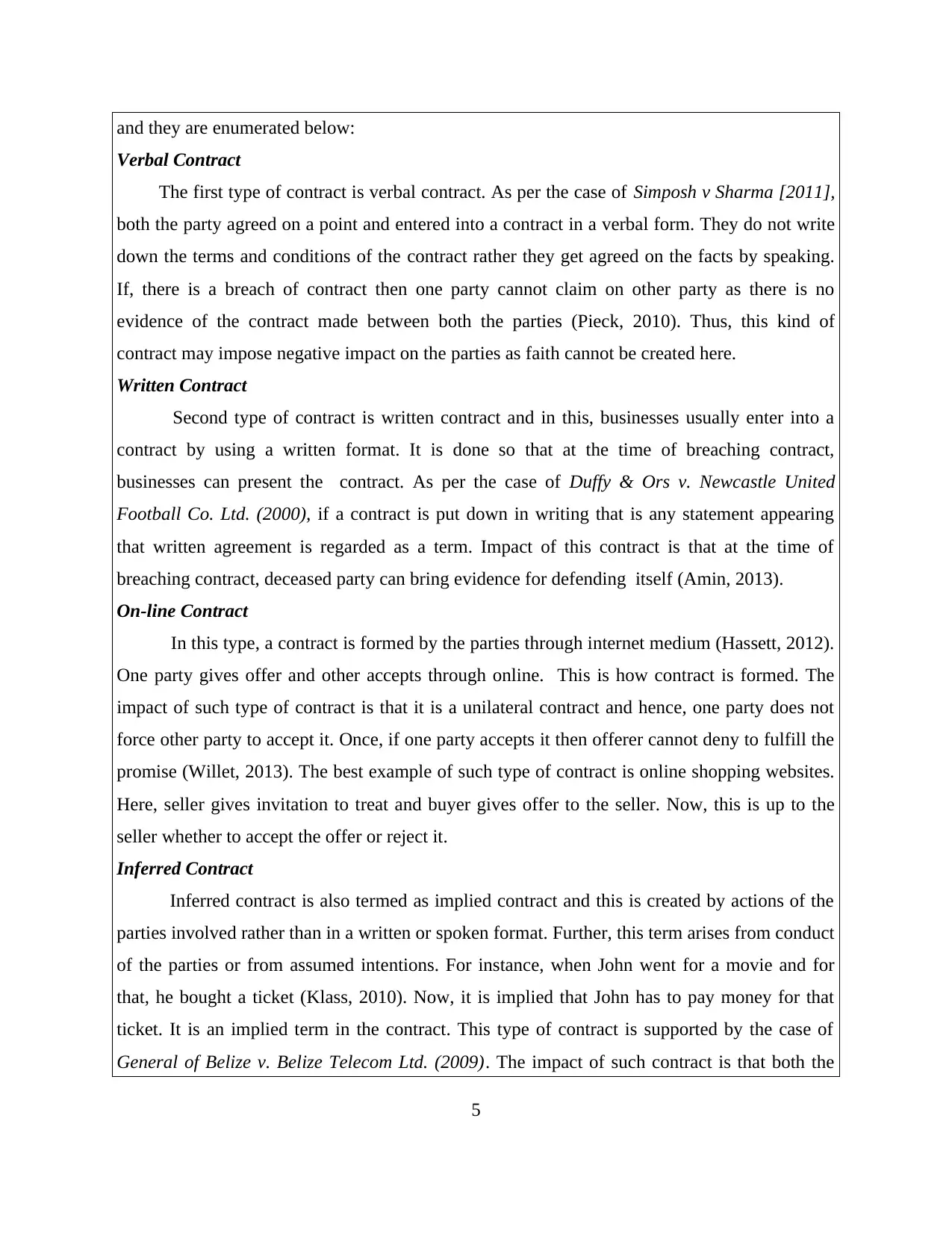
and they are enumerated below:
Verbal Contract
The first type of contract is verbal contract. As per the case of Simposh v Sharma [2011],
both the party agreed on a point and entered into a contract in a verbal form. They do not write
down the terms and conditions of the contract rather they get agreed on the facts by speaking.
If, there is a breach of contract then one party cannot claim on other party as there is no
evidence of the contract made between both the parties (Pieck, 2010). Thus, this kind of
contract may impose negative impact on the parties as faith cannot be created here.
Written Contract
Second type of contract is written contract and in this, businesses usually enter into a
contract by using a written format. It is done so that at the time of breaching contract,
businesses can present the contract. As per the case of Duffy & Ors v. Newcastle United
Football Co. Ltd. (2000), if a contract is put down in writing that is any statement appearing
that written agreement is regarded as a term. Impact of this contract is that at the time of
breaching contract, deceased party can bring evidence for defending itself (Amin, 2013).
On-line Contract
In this type, a contract is formed by the parties through internet medium (Hassett, 2012).
One party gives offer and other accepts through online. This is how contract is formed. The
impact of such type of contract is that it is a unilateral contract and hence, one party does not
force other party to accept it. Once, if one party accepts it then offerer cannot deny to fulfill the
promise (Willet, 2013). The best example of such type of contract is online shopping websites.
Here, seller gives invitation to treat and buyer gives offer to the seller. Now, this is up to the
seller whether to accept the offer or reject it.
Inferred Contract
Inferred contract is also termed as implied contract and this is created by actions of the
parties involved rather than in a written or spoken format. Further, this term arises from conduct
of the parties or from assumed intentions. For instance, when John went for a movie and for
that, he bought a ticket (Klass, 2010). Now, it is implied that John has to pay money for that
ticket. It is an implied term in the contract. This type of contract is supported by the case of
General of Belize v. Belize Telecom Ltd. (2009). The impact of such contract is that both the
5
Verbal Contract
The first type of contract is verbal contract. As per the case of Simposh v Sharma [2011],
both the party agreed on a point and entered into a contract in a verbal form. They do not write
down the terms and conditions of the contract rather they get agreed on the facts by speaking.
If, there is a breach of contract then one party cannot claim on other party as there is no
evidence of the contract made between both the parties (Pieck, 2010). Thus, this kind of
contract may impose negative impact on the parties as faith cannot be created here.
Written Contract
Second type of contract is written contract and in this, businesses usually enter into a
contract by using a written format. It is done so that at the time of breaching contract,
businesses can present the contract. As per the case of Duffy & Ors v. Newcastle United
Football Co. Ltd. (2000), if a contract is put down in writing that is any statement appearing
that written agreement is regarded as a term. Impact of this contract is that at the time of
breaching contract, deceased party can bring evidence for defending itself (Amin, 2013).
On-line Contract
In this type, a contract is formed by the parties through internet medium (Hassett, 2012).
One party gives offer and other accepts through online. This is how contract is formed. The
impact of such type of contract is that it is a unilateral contract and hence, one party does not
force other party to accept it. Once, if one party accepts it then offerer cannot deny to fulfill the
promise (Willet, 2013). The best example of such type of contract is online shopping websites.
Here, seller gives invitation to treat and buyer gives offer to the seller. Now, this is up to the
seller whether to accept the offer or reject it.
Inferred Contract
Inferred contract is also termed as implied contract and this is created by actions of the
parties involved rather than in a written or spoken format. Further, this term arises from conduct
of the parties or from assumed intentions. For instance, when John went for a movie and for
that, he bought a ticket (Klass, 2010). Now, it is implied that John has to pay money for that
ticket. It is an implied term in the contract. This type of contract is supported by the case of
General of Belize v. Belize Telecom Ltd. (2009). The impact of such contract is that both the
5
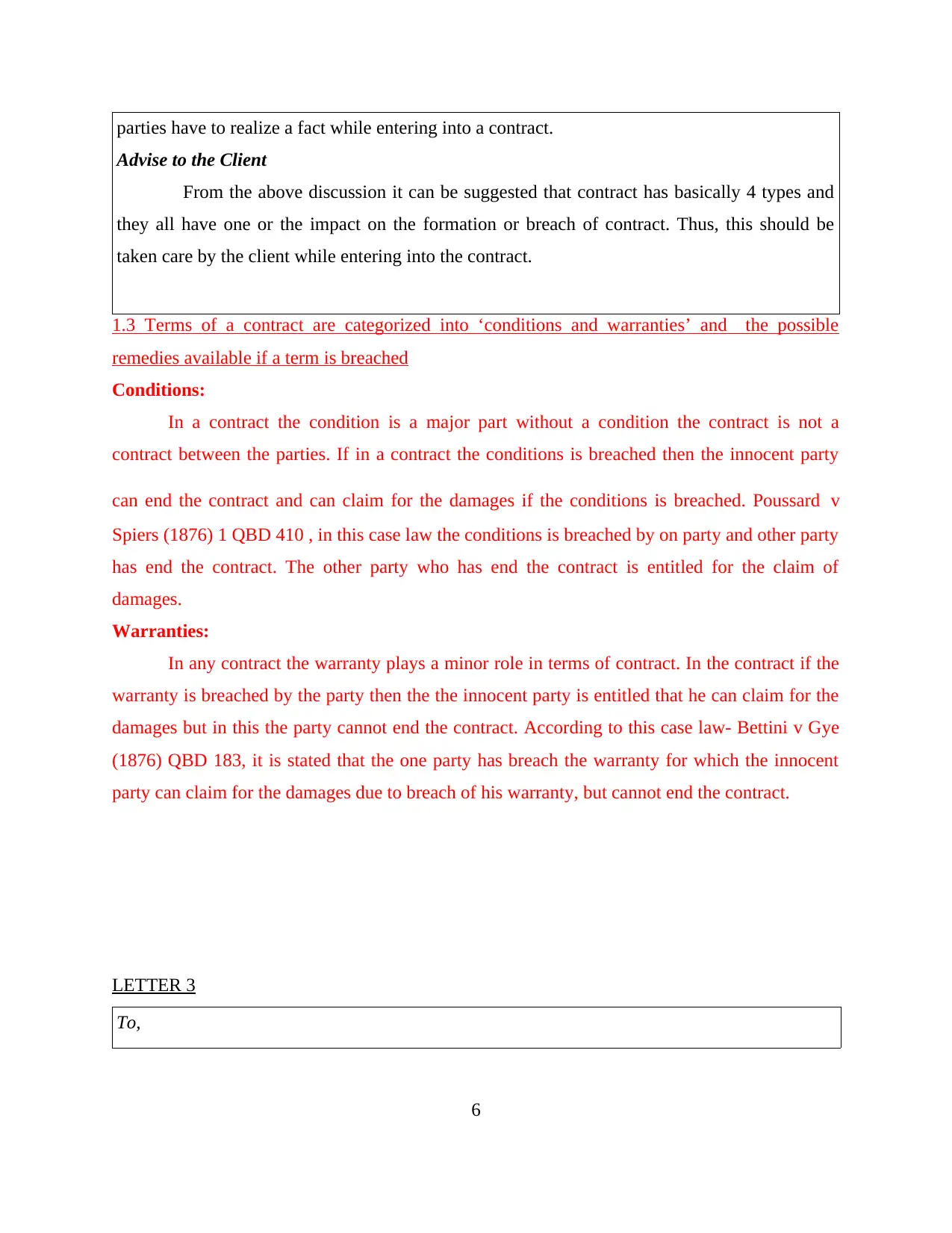
parties have to realize a fact while entering into a contract.
Advise to the Client
From the above discussion it can be suggested that contract has basically 4 types and
they all have one or the impact on the formation or breach of contract. Thus, this should be
taken care by the client while entering into the contract.
1.3 Terms of a contract are categorized into ‘conditions and warranties’ and the possible
remedies available if a term is breached
Conditions:
In a contract the condition is a major part without a condition the contract is not a
contract between the parties. If in a contract the conditions is breached then the innocent party
can end the contract and can claim for the damages if the conditions is breached. Poussard v
Spiers (1876) 1 QBD 410 , in this case law the conditions is breached by on party and other party
has end the contract. The other party who has end the contract is entitled for the claim of
damages.
Warranties:
In any contract the warranty plays a minor role in terms of contract. In the contract if the
warranty is breached by the party then the the innocent party is entitled that he can claim for the
damages but in this the party cannot end the contract. According to this case law- Bettini v Gye
(1876) QBD 183, it is stated that the one party has breach the warranty for which the innocent
party can claim for the damages due to breach of his warranty, but cannot end the contract.
LETTER 3
To,
6
Advise to the Client
From the above discussion it can be suggested that contract has basically 4 types and
they all have one or the impact on the formation or breach of contract. Thus, this should be
taken care by the client while entering into the contract.
1.3 Terms of a contract are categorized into ‘conditions and warranties’ and the possible
remedies available if a term is breached
Conditions:
In a contract the condition is a major part without a condition the contract is not a
contract between the parties. If in a contract the conditions is breached then the innocent party
can end the contract and can claim for the damages if the conditions is breached. Poussard v
Spiers (1876) 1 QBD 410 , in this case law the conditions is breached by on party and other party
has end the contract. The other party who has end the contract is entitled for the claim of
damages.
Warranties:
In any contract the warranty plays a minor role in terms of contract. In the contract if the
warranty is breached by the party then the the innocent party is entitled that he can claim for the
damages but in this the party cannot end the contract. According to this case law- Bettini v Gye
(1876) QBD 183, it is stated that the one party has breach the warranty for which the innocent
party can claim for the damages due to breach of his warranty, but cannot end the contract.
LETTER 3
To,
6
⊘ This is a preview!⊘
Do you want full access?
Subscribe today to unlock all pages.
Trusted by 1+ million students worldwide
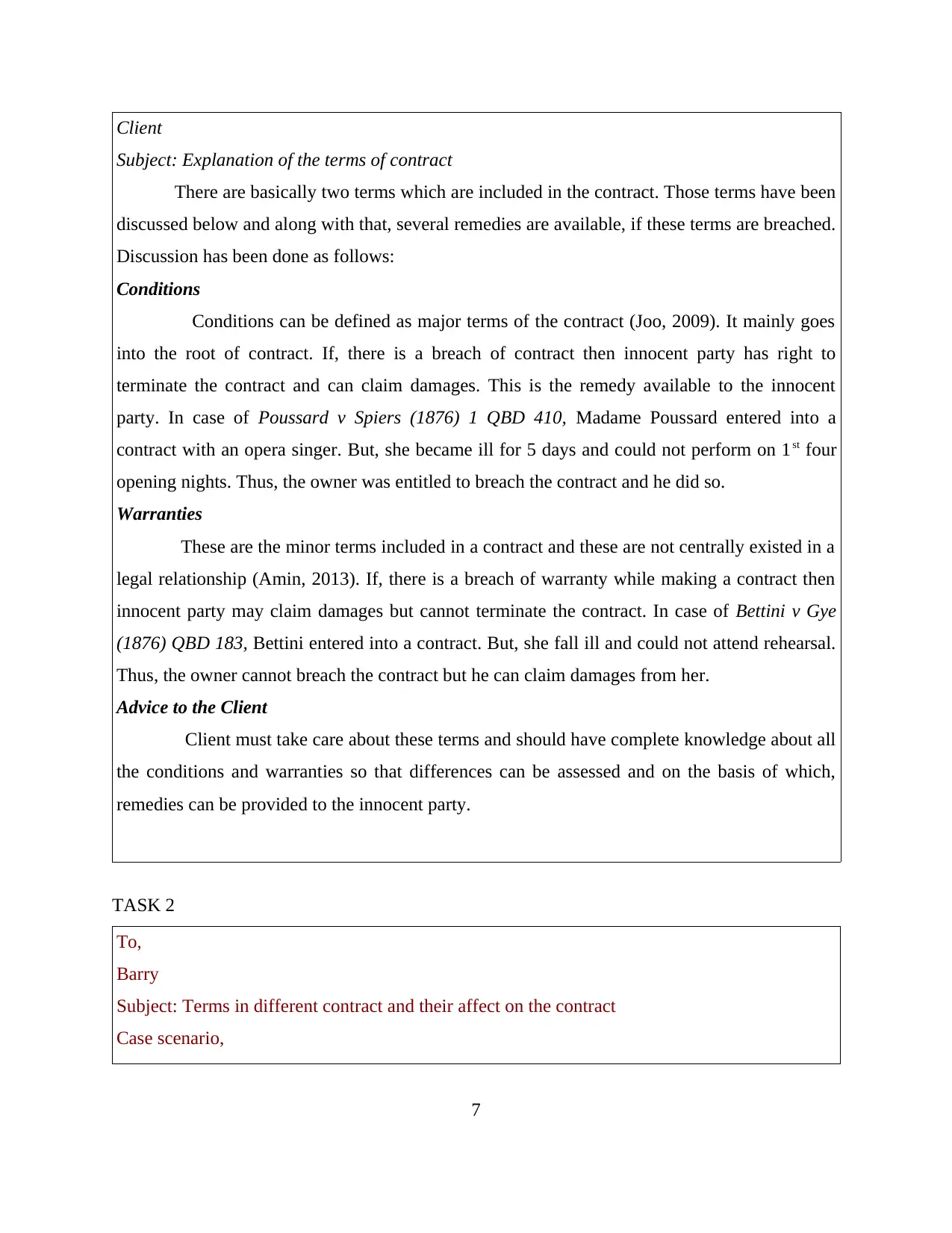
Client
Subject: Explanation of the terms of contract
There are basically two terms which are included in the contract. Those terms have been
discussed below and along with that, several remedies are available, if these terms are breached.
Discussion has been done as follows:
Conditions
Conditions can be defined as major terms of the contract (Joo, 2009). It mainly goes
into the root of contract. If, there is a breach of contract then innocent party has right to
terminate the contract and can claim damages. This is the remedy available to the innocent
party. In case of Poussard v Spiers (1876) 1 QBD 410, Madame Poussard entered into a
contract with an opera singer. But, she became ill for 5 days and could not perform on 1st four
opening nights. Thus, the owner was entitled to breach the contract and he did so.
Warranties
These are the minor terms included in a contract and these are not centrally existed in a
legal relationship (Amin, 2013). If, there is a breach of warranty while making a contract then
innocent party may claim damages but cannot terminate the contract. In case of Bettini v Gye
(1876) QBD 183, Bettini entered into a contract. But, she fall ill and could not attend rehearsal.
Thus, the owner cannot breach the contract but he can claim damages from her.
Advice to the Client
Client must take care about these terms and should have complete knowledge about all
the conditions and warranties so that differences can be assessed and on the basis of which,
remedies can be provided to the innocent party.
TASK 2
To,
Barry
Subject: Terms in different contract and their affect on the contract
Case scenario,
7
Subject: Explanation of the terms of contract
There are basically two terms which are included in the contract. Those terms have been
discussed below and along with that, several remedies are available, if these terms are breached.
Discussion has been done as follows:
Conditions
Conditions can be defined as major terms of the contract (Joo, 2009). It mainly goes
into the root of contract. If, there is a breach of contract then innocent party has right to
terminate the contract and can claim damages. This is the remedy available to the innocent
party. In case of Poussard v Spiers (1876) 1 QBD 410, Madame Poussard entered into a
contract with an opera singer. But, she became ill for 5 days and could not perform on 1st four
opening nights. Thus, the owner was entitled to breach the contract and he did so.
Warranties
These are the minor terms included in a contract and these are not centrally existed in a
legal relationship (Amin, 2013). If, there is a breach of warranty while making a contract then
innocent party may claim damages but cannot terminate the contract. In case of Bettini v Gye
(1876) QBD 183, Bettini entered into a contract. But, she fall ill and could not attend rehearsal.
Thus, the owner cannot breach the contract but he can claim damages from her.
Advice to the Client
Client must take care about these terms and should have complete knowledge about all
the conditions and warranties so that differences can be assessed and on the basis of which,
remedies can be provided to the innocent party.
TASK 2
To,
Barry
Subject: Terms in different contract and their affect on the contract
Case scenario,
7
Paraphrase This Document
Need a fresh take? Get an instant paraphrase of this document with our AI Paraphraser
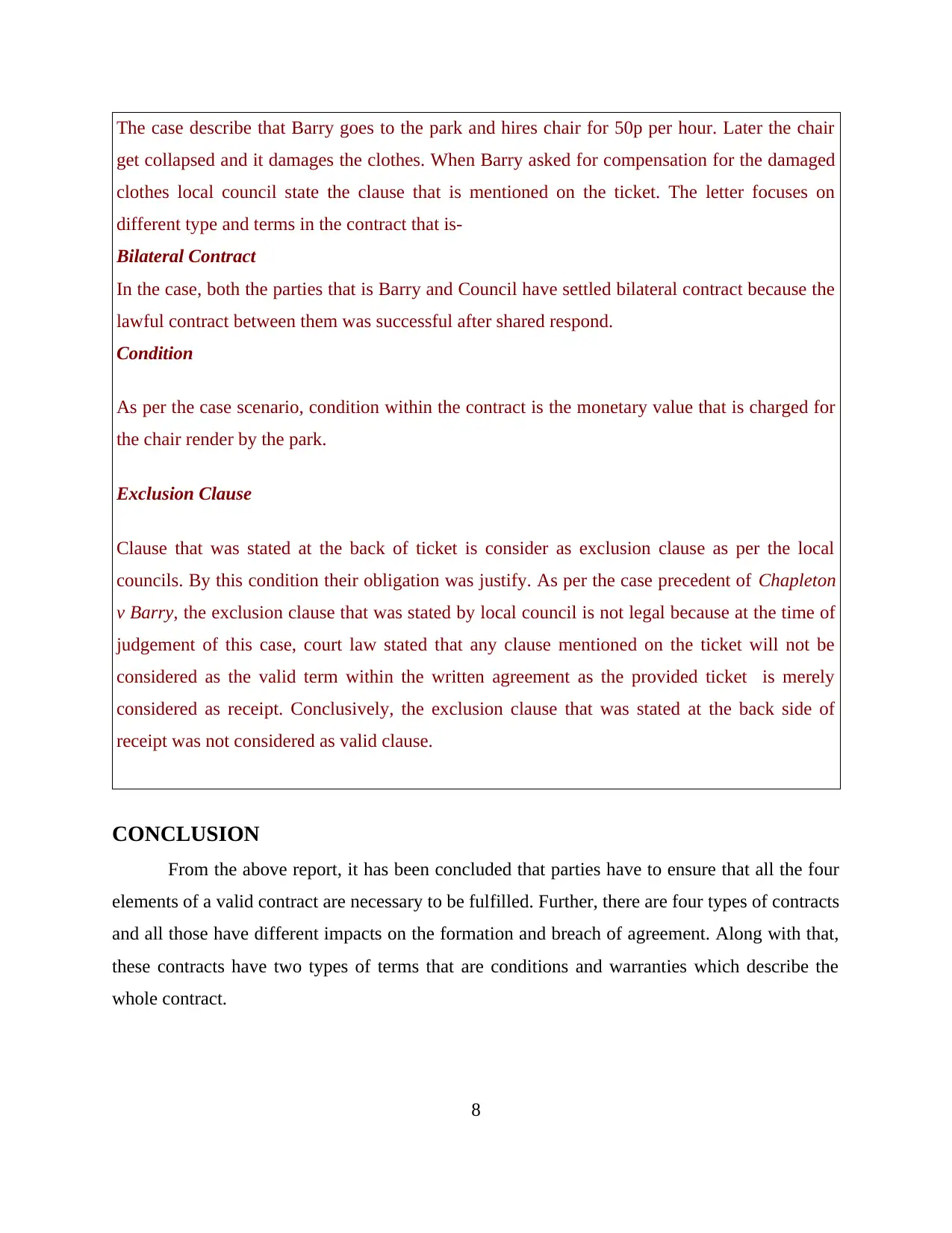
The case describe that Barry goes to the park and hires chair for 50p per hour. Later the chair
get collapsed and it damages the clothes. When Barry asked for compensation for the damaged
clothes local council state the clause that is mentioned on the ticket. The letter focuses on
different type and terms in the contract that is-
Bilateral Contract
In the case, both the parties that is Barry and Council have settled bilateral contract because the
lawful contract between them was successful after shared respond.
Condition
As per the case scenario, condition within the contract is the monetary value that is charged for
the chair render by the park.
Exclusion Clause
Clause that was stated at the back of ticket is consider as exclusion clause as per the local
councils. By this condition their obligation was justify. As per the case precedent of Chapleton
v Barry, the exclusion clause that was stated by local council is not legal because at the time of
judgement of this case, court law stated that any clause mentioned on the ticket will not be
considered as the valid term within the written agreement as the provided ticket is merely
considered as receipt. Conclusively, the exclusion clause that was stated at the back side of
receipt was not considered as valid clause.
CONCLUSION
From the above report, it has been concluded that parties have to ensure that all the four
elements of a valid contract are necessary to be fulfilled. Further, there are four types of contracts
and all those have different impacts on the formation and breach of agreement. Along with that,
these contracts have two types of terms that are conditions and warranties which describe the
whole contract.
8
get collapsed and it damages the clothes. When Barry asked for compensation for the damaged
clothes local council state the clause that is mentioned on the ticket. The letter focuses on
different type and terms in the contract that is-
Bilateral Contract
In the case, both the parties that is Barry and Council have settled bilateral contract because the
lawful contract between them was successful after shared respond.
Condition
As per the case scenario, condition within the contract is the monetary value that is charged for
the chair render by the park.
Exclusion Clause
Clause that was stated at the back of ticket is consider as exclusion clause as per the local
councils. By this condition their obligation was justify. As per the case precedent of Chapleton
v Barry, the exclusion clause that was stated by local council is not legal because at the time of
judgement of this case, court law stated that any clause mentioned on the ticket will not be
considered as the valid term within the written agreement as the provided ticket is merely
considered as receipt. Conclusively, the exclusion clause that was stated at the back side of
receipt was not considered as valid clause.
CONCLUSION
From the above report, it has been concluded that parties have to ensure that all the four
elements of a valid contract are necessary to be fulfilled. Further, there are four types of contracts
and all those have different impacts on the formation and breach of agreement. Along with that,
these contracts have two types of terms that are conditions and warranties which describe the
whole contract.
8
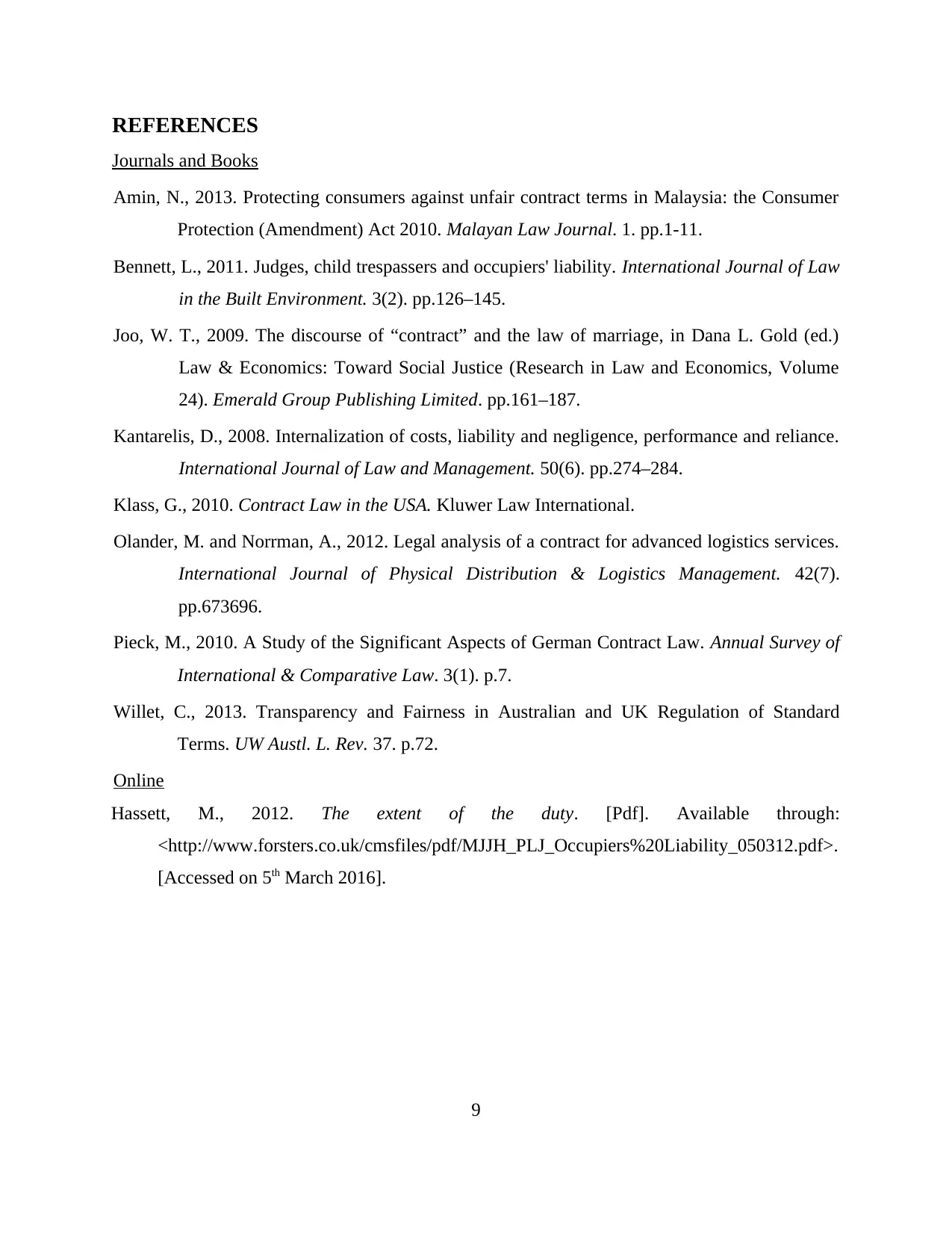
REFERENCES
Journals and Books
Amin, N., 2013. Protecting consumers against unfair contract terms in Malaysia: the Consumer
Protection (Amendment) Act 2010. Malayan Law Journal. 1. pp.1-11.
Bennett, L., 2011. Judges, child trespassers and occupiers' liability. International Journal of Law
in the Built Environment. 3(2). pp.126–145.
Joo, W. T., 2009. The discourse of “contract” and the law of marriage, in Dana L. Gold (ed.)
Law & Economics: Toward Social Justice (Research in Law and Economics, Volume
24). Emerald Group Publishing Limited. pp.161–187.
Kantarelis, D., 2008. Internalization of costs, liability and negligence, performance and reliance.
International Journal of Law and Management. 50(6). pp.274–284.
Klass, G., 2010. Contract Law in the USA. Kluwer Law International.
Olander, M. and Norrman, A., 2012. Legal analysis of a contract for advanced logistics services.
International Journal of Physical Distribution & Logistics Management. 42(7).
pp.673696.
Pieck, M., 2010. A Study of the Significant Aspects of German Contract Law. Annual Survey of
International & Comparative Law. 3(1). p.7.
Willet, C., 2013. Transparency and Fairness in Australian and UK Regulation of Standard
Terms. UW Austl. L. Rev. 37. p.72.
Online
Hassett, M., 2012. The extent of the duty. [Pdf]. Available through:
<http://www.forsters.co.uk/cmsfiles/pdf/MJJH_PLJ_Occupiers%20Liability_050312.pdf>.
[Accessed on 5th March 2016].
9
Journals and Books
Amin, N., 2013. Protecting consumers against unfair contract terms in Malaysia: the Consumer
Protection (Amendment) Act 2010. Malayan Law Journal. 1. pp.1-11.
Bennett, L., 2011. Judges, child trespassers and occupiers' liability. International Journal of Law
in the Built Environment. 3(2). pp.126–145.
Joo, W. T., 2009. The discourse of “contract” and the law of marriage, in Dana L. Gold (ed.)
Law & Economics: Toward Social Justice (Research in Law and Economics, Volume
24). Emerald Group Publishing Limited. pp.161–187.
Kantarelis, D., 2008. Internalization of costs, liability and negligence, performance and reliance.
International Journal of Law and Management. 50(6). pp.274–284.
Klass, G., 2010. Contract Law in the USA. Kluwer Law International.
Olander, M. and Norrman, A., 2012. Legal analysis of a contract for advanced logistics services.
International Journal of Physical Distribution & Logistics Management. 42(7).
pp.673696.
Pieck, M., 2010. A Study of the Significant Aspects of German Contract Law. Annual Survey of
International & Comparative Law. 3(1). p.7.
Willet, C., 2013. Transparency and Fairness in Australian and UK Regulation of Standard
Terms. UW Austl. L. Rev. 37. p.72.
Online
Hassett, M., 2012. The extent of the duty. [Pdf]. Available through:
<http://www.forsters.co.uk/cmsfiles/pdf/MJJH_PLJ_Occupiers%20Liability_050312.pdf>.
[Accessed on 5th March 2016].
9
⊘ This is a preview!⊘
Do you want full access?
Subscribe today to unlock all pages.
Trusted by 1+ million students worldwide

1 out of 9


Related Documents


Your All-in-One AI-Powered Toolkit for Academic Success.
+13062052269
info@desklib.com
Available 24*7 on WhatsApp / Email
![[object Object]](/_next/static/media/star-bottom.7253800d.svg)
Unlock your academic potential
Copyright © 2020–2026 A2Z Services. All Rights Reserved. Developed and managed by ZUCOL.