Business Law Individual Assignment: Contract Law and Case Analysis

Verified

Added on  2023/06/09

|8
|1721
|56
Report
AI Summary
This assignment delves into the core principles of business law, focusing on contract formation and analysis. It begins by defining a contract and outlining the essential elements required for its validity, such as offer, acceptance, free consent, intention to create legal relations, and consideration. The report then examines a case study involving Safe Bank Ltd (SB) and All Gifts Pte Ltd (AG), analyzing the communications between the parties to determine if a valid contract was formed, considering issues of offer, counter-offer, and acceptance. A second issue examines a contract between SB and Perfect Gifts Pte Ltd (PG), exploring the timing of acceptance and the applicability of postal rules. The report applies legal principles to the facts of each scenario, drawing upon relevant case law to reach conclusions on the existence and enforceability of the contracts.
Document Page
qwertyuiopasdfghjklzxcvbnmqwe
rtyuiopasdfghjklzxcvbnmqwertyu
iopasdfghjklzxcvbnmqwertyuiopa
sdfghjklzxcvbnmqwertyuiopasdfg
hjklzxcvbnmqwertyuiopasdfghjkl
zxcvbnmqwertyuiopasdfghjklzxcv
bnmqwertyuiopasdfghjklzxcvbnm
qwertyuiopasdfghjklzxcvbnmqwe
rtyuiopasdfghjklzxcvbnmqwertyu
iopasdfghjklzxcvbnmqwertyuiopa
sdfghjklzxcvbnmqwertyuiopasdfg
hjklzxcvbnmqwertyuiopasdfghjkl
zxcvbnmqwertyuiopasdfghjklzxcv
bnmqwertyuiopasdfghjklzxcvbnm
qwertyuiopasdfghjklzxcvbnmqwe
rtyuiopasdfghjklzxcvbnmrtyuiopa
Running Head: BUSINESS AND CORPORATION LAW 0
Business Law
7/15/2018
Student’s Name
tabler-icon-diamond-filled.svg

Paraphrase This Document

Need a fresh take? Get an instant paraphrase of this document with our AI Paraphraser
Document Page
Business Law
1
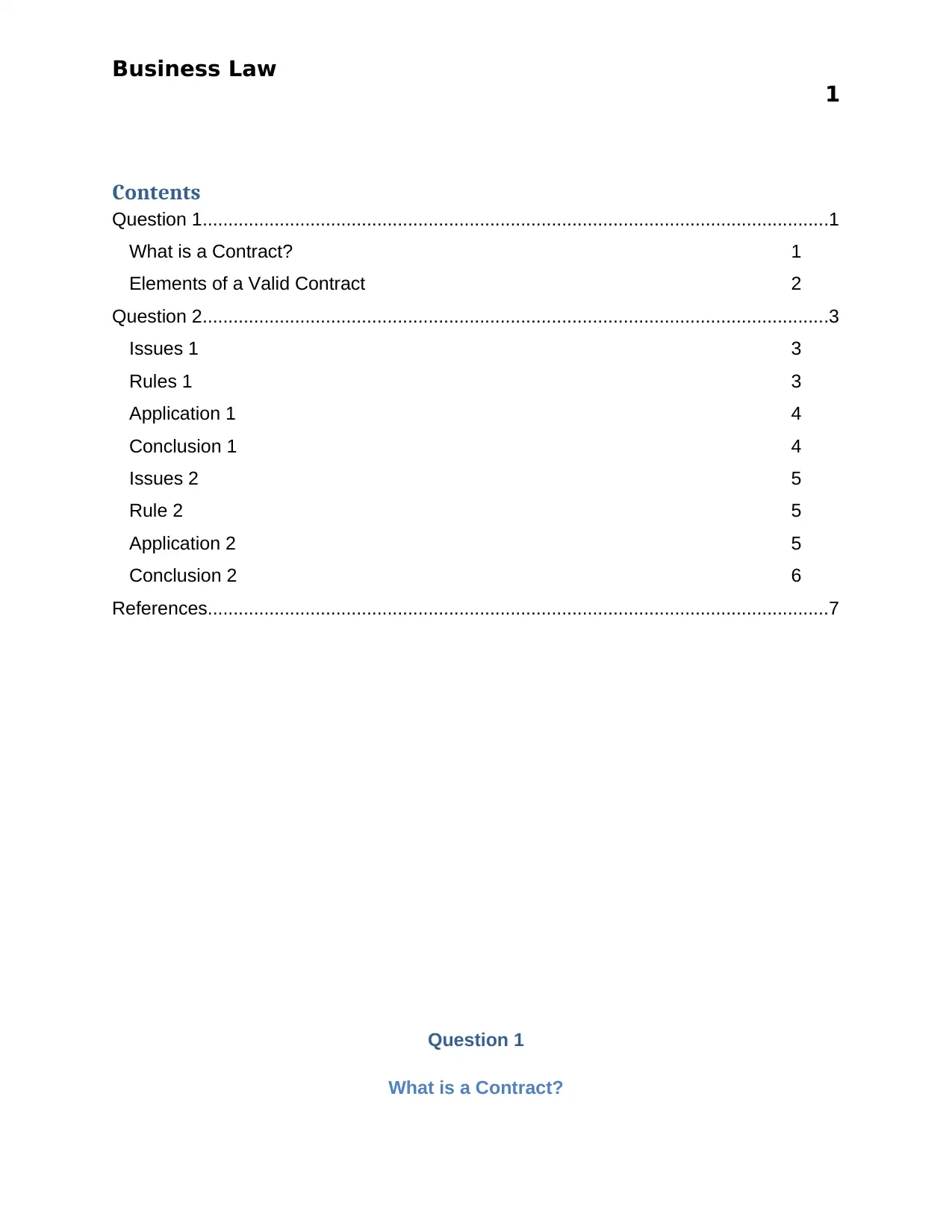
Contents
Question 1..........................................................................................................................1
What is a Contract? 1
Elements of a Valid Contract 2
Question 2..........................................................................................................................3
Issues 1 3
Rules 1 3
Application 1 4
Conclusion 1 4
Issues 2 5
Rule 2 5
Application 2 5
Conclusion 2 6
References.........................................................................................................................7
Question 1
What is a Contract?
Document Page
Business Law
2
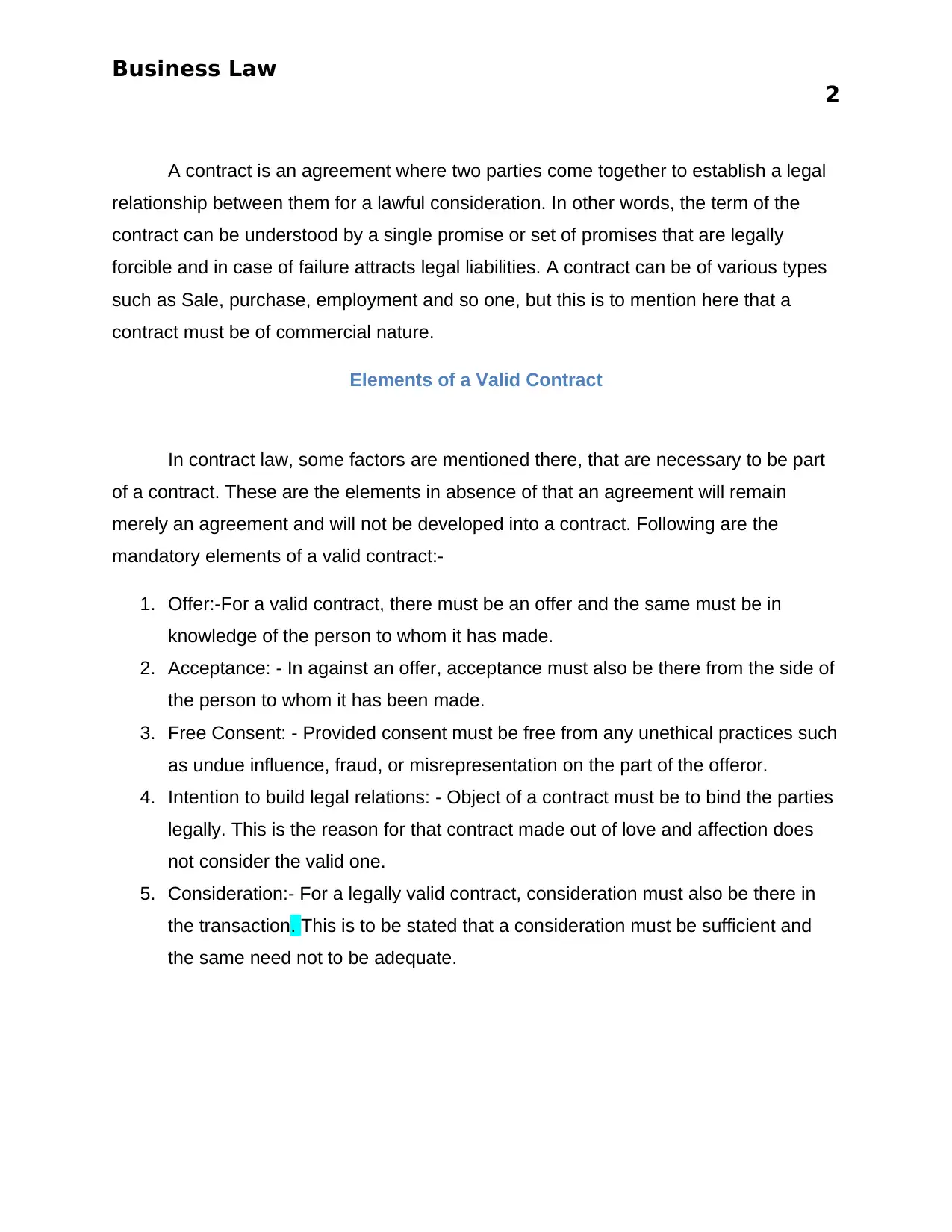
A contract is an agreement where two parties come together to establish a legal
relationship between them for a lawful consideration. In other words, the term of the
contract can be understood by a single promise or set of promises that are legally
forcible and in case of failure attracts legal liabilities. A contract can be of various types
such as Sale, purchase, employment and so one, but this is to mention here that a
contract must be of commercial nature.
Elements of a Valid Contract
In contract law, some factors are mentioned there, that are necessary to be part
of a contract. These are the elements in absence of that an agreement will remain
merely an agreement and will not be developed into a contract. Following are the
mandatory elements of a valid contract:-
1. Offer:-For a valid contract, there must be an offer and the same must be in
knowledge of the person to whom it has made.
2. Acceptance: - In against an offer, acceptance must also be there from the side of
the person to whom it has been made.
3. Free Consent: - Provided consent must be free from any unethical practices such
as undue influence, fraud, or misrepresentation on the part of the offeror.
4. Intention to build legal relations: - Object of a contract must be to bind the parties
legally. This is the reason for that contract made out of love and affection does
not consider the valid one.
5. Consideration:- For a legally valid contract, consideration must also be there in
the transaction. This is to be stated that a consideration must be sufficient and
the same need not to be adequate.
Document Page
Business Law
3
Question 2
Issues 1
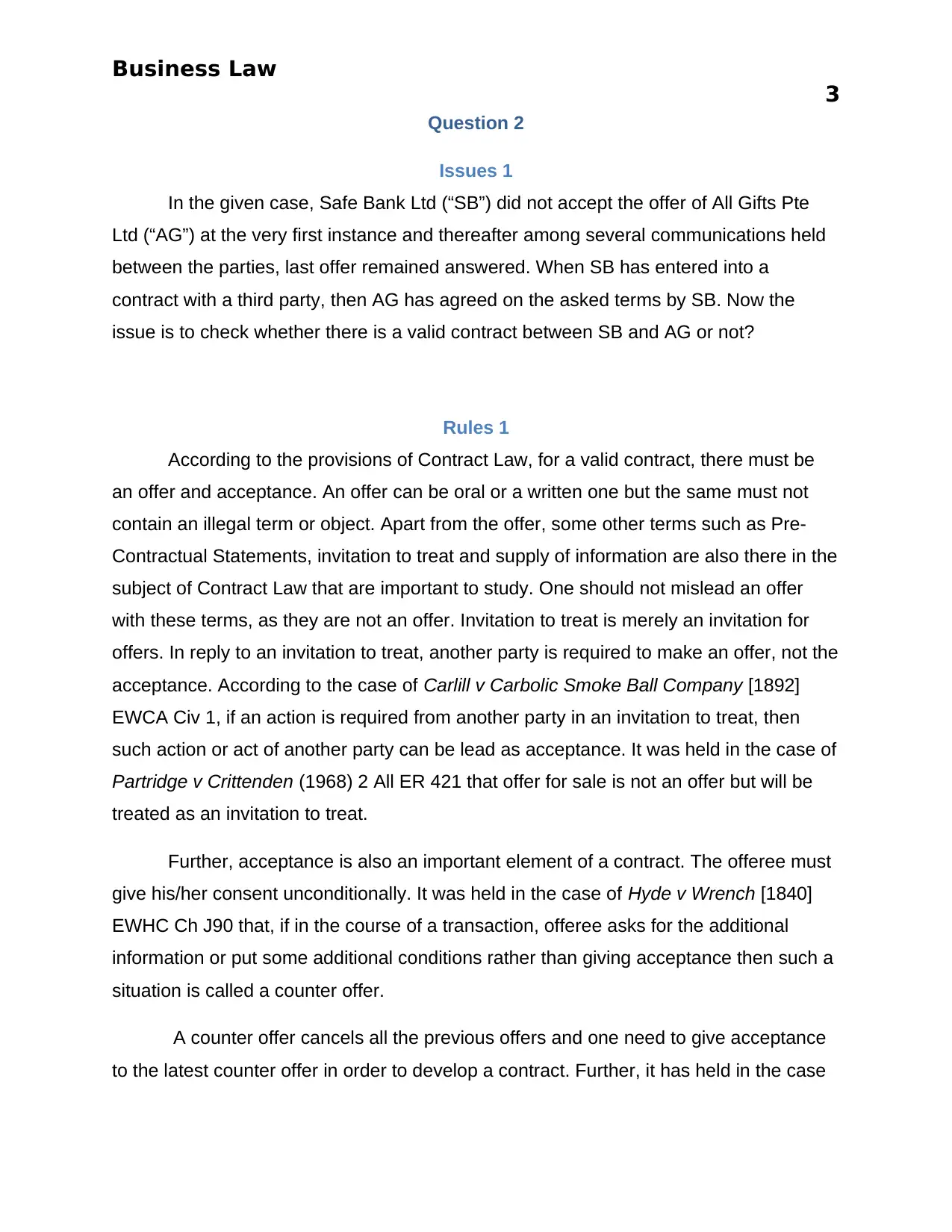
In the given case, Safe Bank Ltd (“SB”) did not accept the offer of All Gifts Pte
Ltd (“AG”) at the very first instance and thereafter among several communications held
between the parties, last offer remained answered. When SB has entered into a
contract with a third party, then AG has agreed on the asked terms by SB. Now the
issue is to check whether there is a valid contract between SB and AG or not?
Rules 1
According to the provisions of Contract Law, for a valid contract, there must be
an offer and acceptance. An offer can be oral or a written one but the same must not
contain an illegal term or object. Apart from the offer, some other terms such as Pre-
Contractual Statements, invitation to treat and supply of information are also there in the
subject of Contract Law that are important to study. One should not mislead an offer
with these terms, as they are not an offer. Invitation to treat is merely an invitation for
offers. In reply to an invitation to treat, another party is required to make an offer, not the
acceptance. According to the case of Carlill v Carbolic Smoke Ball Company [1892]
EWCA Civ 1, if an action is required from another party in an invitation to treat, then
such action or act of another party can be lead as acceptance. It was held in the case of
Partridge v Crittenden (1968) 2 All ER 421 that offer for sale is not an offer but will be
treated as an invitation to treat.
Further, acceptance is also an important element of a contract. The offeree must
give his/her consent unconditionally. It was held in the case of Hyde v Wrench [1840]
EWHC Ch J90 that, if in the course of a transaction, offeree asks for the additional
information or put some additional conditions rather than giving acceptance then such a
situation is called a counter offer.
A counter offer cancels all the previous offers and one need to give acceptance
to the latest counter offer in order to develop a contract. Further, it has held in the case
tabler-icon-diamond-filled.svg

Paraphrase This Document

Need a fresh take? Get an instant paraphrase of this document with our AI Paraphraser
Document Page
Business Law
4
of Felthouse v Bindley [1862] EWHC CP J35 that silence of another party cannot be
treated as acceptance.
Application 1
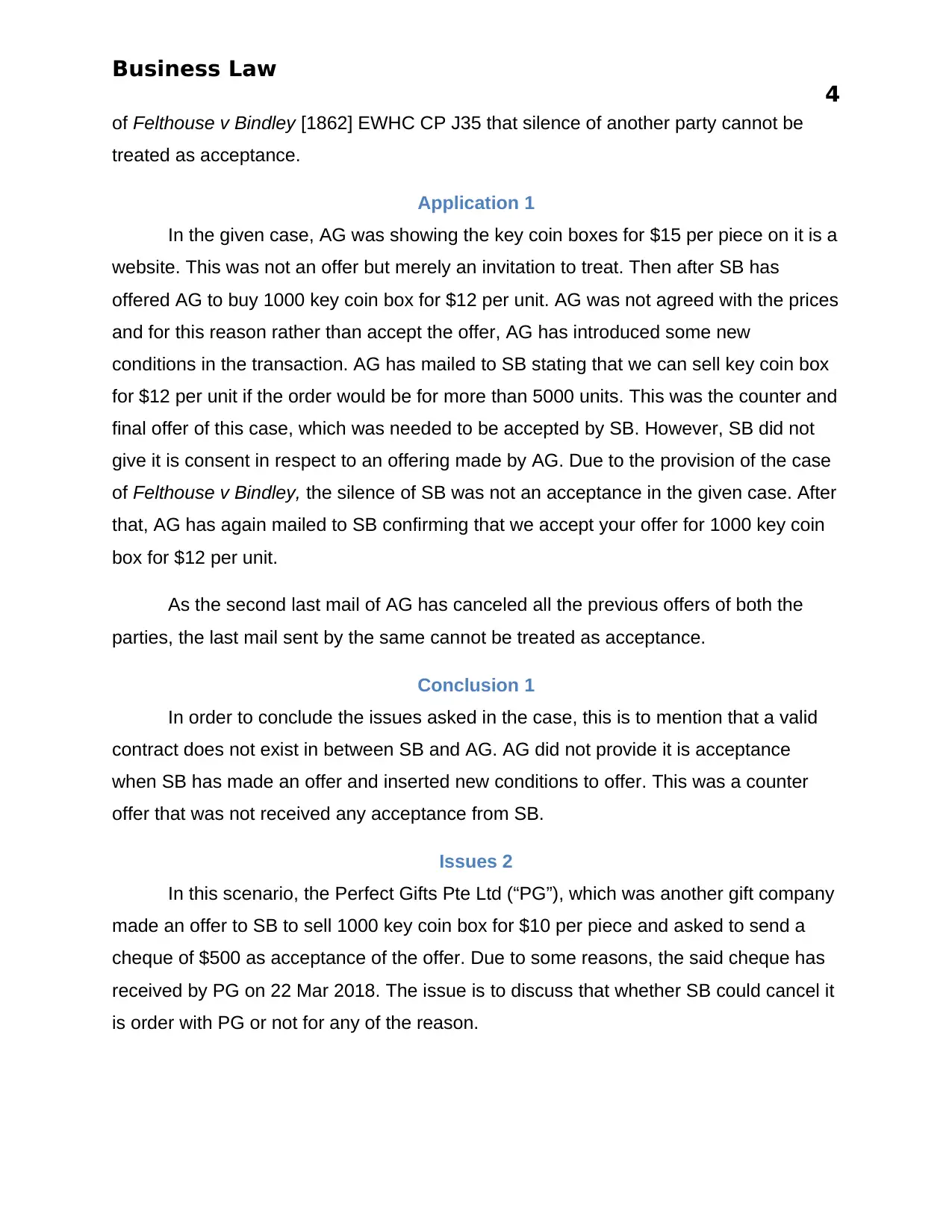
In the given case, AG was showing the key coin boxes for $15 per piece on it is a
website. This was not an offer but merely an invitation to treat. Then after SB has
offered AG to buy 1000 key coin box for $12 per unit. AG was not agreed with the prices
and for this reason rather than accept the offer, AG has introduced some new
conditions in the transaction. AG has mailed to SB stating that we can sell key coin box
for $12 per unit if the order would be for more than 5000 units. This was the counter and
final offer of this case, which was needed to be accepted by SB. However, SB did not
give it is consent in respect to an offering made by AG. Due to the provision of the case
of Felthouse v Bindley, the silence of SB was not an acceptance in the given case. After
that, AG has again mailed to SB confirming that we accept your offer for 1000 key coin
box for $12 per unit.
As the second last mail of AG has canceled all the previous offers of both the
parties, the last mail sent by the same cannot be treated as acceptance.
Conclusion 1
In order to conclude the issues asked in the case, this is to mention that a valid
contract does not exist in between SB and AG. AG did not provide it is acceptance
when SB has made an offer and inserted new conditions to offer. This was a counter
offer that was not received any acceptance from SB.
Issues 2
In this scenario, the Perfect Gifts Pte Ltd (“PG”), which was another gift company
made an offer to SB to sell 1000 key coin box for $10 per piece and asked to send a
cheque of $500 as acceptance of the offer. Due to some reasons, the said cheque has
received by PG on 22 Mar 2018. The issue is to discuss that whether SB could cancel it
is order with PG or not for any of the reason.
Document Page
Business Law
5
Rule 2
For a valid acceptance, it is necessary to understand that What is the time of
acceptance will depend on the mode of acceptance?. It was held in the case of Adams
v Lindsell (1818) 106 ER 250 that wherever postal rules are applicable, as soon as
offeree drops the acceptance letter to the mailbox, acceptance is deemed complete.
As earlier mentioned that according to the decision given in the case of Carlill v
Carbolic Smoke Ball Company, Parties to the case can decide that a particular conduct
of offeree will be treated as acceptance. Further, according to the provisions of Section
11 and 12 of Electronic Transactions Act 2010, offer and acceptance made by an
electronic mode will have their legal impacts.
It is also necessary to mention that acceptance must be provided within the
period prescribed by the offeror. In cases where no time has given by offeror,
acceptance must be submitted within the reasonable time.
Application 2
In the given case, parties to the transaction i.e. SB and PG have decided that if
SB is agree with the provided offer by PG then the same is required to send $500 as
acceptance. PG has made the said offer as on 06th March but SB could not send the
cheque till 07th March due to the absence of accounts executive. SB has sent the
cheque on 08th March. As no time was prescribed by PG, then it is to say that SB has
given consent within a reasonable time as the same was delayed by only 2 days from
the date of the offer.
Further, due to some issues, PG has received the cheque on 22nd March,
however, as per the case, Adams v Lindsell acceptance will be treated as complete on
the day when SB has introduced the cheque to the process of post i.e. 08th March. In
the given case, parties have not excluded the applicability of postal rules hence, there
was a valid contract between PG and SB.
Conclusion 2
Regardless of every other aspect, this is to conclude that there was a legal
contract between SB and PG. As earlier mentioned, that in case of breach of contract,
Document Page
Business Law
6
legal liabilities get attract, therefore SB could not cancel it is order with PG after the
posting of Cheque to the same.
tabler-icon-diamond-filled.svg

Paraphrase This Document

Need a fresh take? Get an instant paraphrase of this document with our AI Paraphraser
Document Page
Business Law
7
References
Adams v Lindsell (1818) 106 ER 250
Carlill v Carbolic Smoke Ball Company [1892] EWCA Civ 1
Electronic Transactions Act 2010
Felthouse v Bindley [1862] EWHC CP J35
Hyde v Wrench [1840] EWHC Ch J90
Partridge v Crittenden (1968) 2 All ER 421
chevron_up_icon
1 out of 8
circle_padding
hide_on_mobile
zoom_out_icon
[object Object]