ACTG2P40 Assignment 2: Contract Law, Mistake, and Breach Analysis
VerifiedAdded on 2022/08/19
|9
|2108
|28
Homework Assignment
AI Summary
This assignment delves into various aspects of contract law through case analysis. The first question examines a scenario involving undue influence and duress, determining whether a contract can be set aside due to these factors. The second question focuses on misrepresentation and mistake, exploring the remedies available to a party who has suffered losses due to these issues, particularly damages and rescission. The final question assesses a breach of contract, analyzing whether a party can litigate based on a violation of contractual terms, considering the elements needed to prove a breach and potential defenses like unforeseeable events. The assignment covers key concepts such as misrepresentation, mistake, breach of contract, and the remedies available under Canadian contract law, referencing relevant cases to support the analysis.
Running head: CASE ANALYSIS
CASE ANALYSIS
Name of the student
Name of the university
Author note
CASE ANALYSIS
Name of the student
Name of the university
Author note

Paraphrase This Document
Need a fresh take? Get an instant paraphrase of this document with our AI Paraphraser
1CASE ANALYSIS
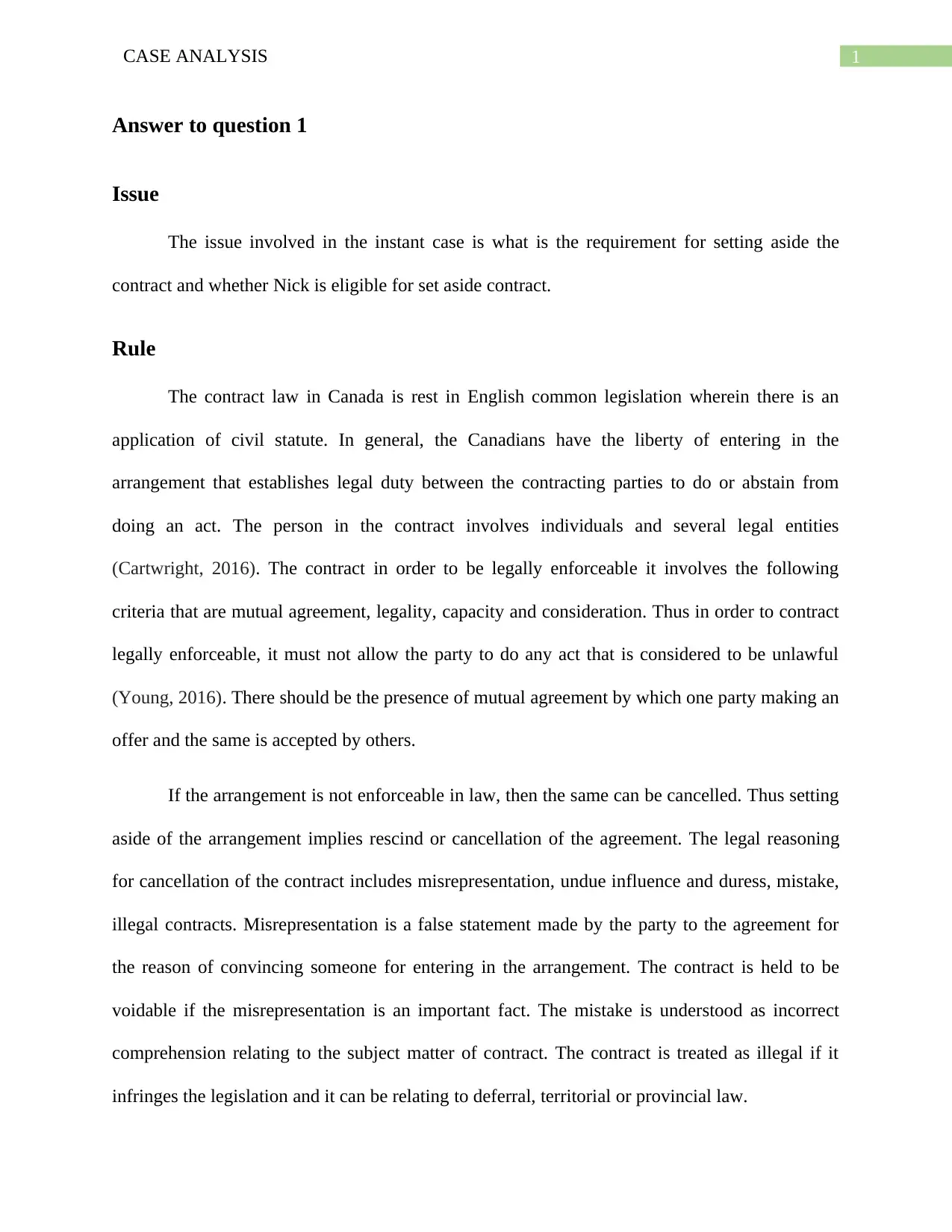
Answer to question 1
Issue
The issue involved in the instant case is what is the requirement for setting aside the
contract and whether Nick is eligible for set aside contract.
Rule
The contract law in Canada is rest in English common legislation wherein there is an
application of civil statute. In general, the Canadians have the liberty of entering in the
arrangement that establishes legal duty between the contracting parties to do or abstain from
doing an act. The person in the contract involves individuals and several legal entities
(Cartwright, 2016). The contract in order to be legally enforceable it involves the following
criteria that are mutual agreement, legality, capacity and consideration. Thus in order to contract
legally enforceable, it must not allow the party to do any act that is considered to be unlawful
(Young, 2016). There should be the presence of mutual agreement by which one party making an
offer and the same is accepted by others.
If the arrangement is not enforceable in law, then the same can be cancelled. Thus setting
aside of the arrangement implies rescind or cancellation of the agreement. The legal reasoning
for cancellation of the contract includes misrepresentation, undue influence and duress, mistake,
illegal contracts. Misrepresentation is a false statement made by the party to the agreement for
the reason of convincing someone for entering in the arrangement. The contract is held to be
voidable if the misrepresentation is an important fact. The mistake is understood as incorrect
comprehension relating to the subject matter of contract. The contract is treated as illegal if it
infringes the legislation and it can be relating to deferral, territorial or provincial law.
Answer to question 1
Issue
The issue involved in the instant case is what is the requirement for setting aside the
contract and whether Nick is eligible for set aside contract.
Rule
The contract law in Canada is rest in English common legislation wherein there is an
application of civil statute. In general, the Canadians have the liberty of entering in the
arrangement that establishes legal duty between the contracting parties to do or abstain from
doing an act. The person in the contract involves individuals and several legal entities
(Cartwright, 2016). The contract in order to be legally enforceable it involves the following
criteria that are mutual agreement, legality, capacity and consideration. Thus in order to contract
legally enforceable, it must not allow the party to do any act that is considered to be unlawful
(Young, 2016). There should be the presence of mutual agreement by which one party making an
offer and the same is accepted by others.
If the arrangement is not enforceable in law, then the same can be cancelled. Thus setting
aside of the arrangement implies rescind or cancellation of the agreement. The legal reasoning
for cancellation of the contract includes misrepresentation, undue influence and duress, mistake,
illegal contracts. Misrepresentation is a false statement made by the party to the agreement for
the reason of convincing someone for entering in the arrangement. The contract is held to be
voidable if the misrepresentation is an important fact. The mistake is understood as incorrect
comprehension relating to the subject matter of contract. The contract is treated as illegal if it
infringes the legislation and it can be relating to deferral, territorial or provincial law.
2CASE ANALYSIS
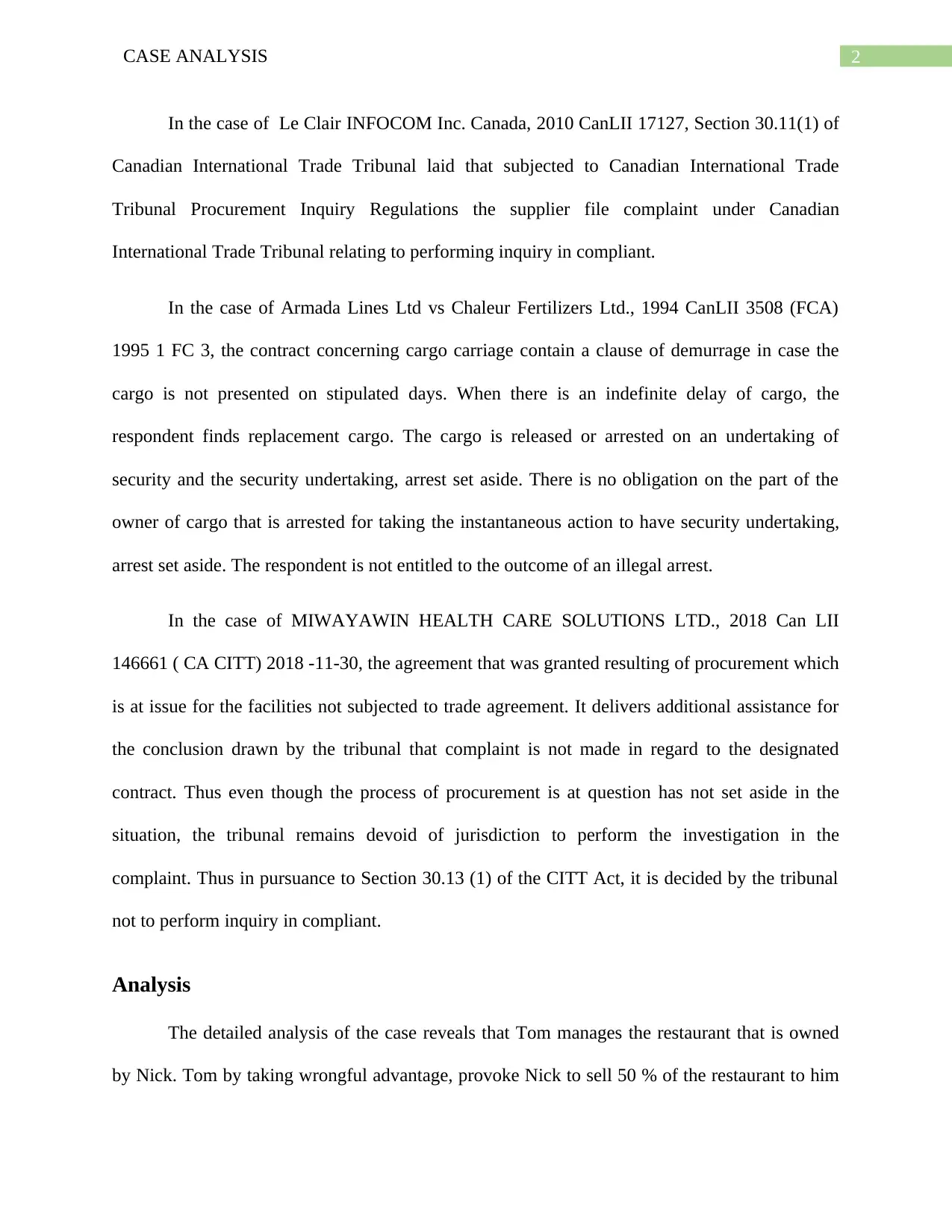
In the case of Le Clair INFOCOM Inc. Canada, 2010 CanLII 17127, Section 30.11(1) of
Canadian International Trade Tribunal laid that subjected to Canadian International Trade
Tribunal Procurement Inquiry Regulations the supplier file complaint under Canadian
International Trade Tribunal relating to performing inquiry in compliant.
In the case of Armada Lines Ltd vs Chaleur Fertilizers Ltd., 1994 CanLII 3508 (FCA)
1995 1 FC 3, the contract concerning cargo carriage contain a clause of demurrage in case the
cargo is not presented on stipulated days. When there is an indefinite delay of cargo, the
respondent finds replacement cargo. The cargo is released or arrested on an undertaking of
security and the security undertaking, arrest set aside. There is no obligation on the part of the
owner of cargo that is arrested for taking the instantaneous action to have security undertaking,
arrest set aside. The respondent is not entitled to the outcome of an illegal arrest.
In the case of MIWAYAWIN HEALTH CARE SOLUTIONS LTD., 2018 Can LII
146661 ( CA CITT) 2018 -11-30, the agreement that was granted resulting of procurement which
is at issue for the facilities not subjected to trade agreement. It delivers additional assistance for
the conclusion drawn by the tribunal that complaint is not made in regard to the designated
contract. Thus even though the process of procurement is at question has not set aside in the
situation, the tribunal remains devoid of jurisdiction to perform the investigation in the
complaint. Thus in pursuance to Section 30.13 (1) of the CITT Act, it is decided by the tribunal
not to perform inquiry in compliant.
Analysis
The detailed analysis of the case reveals that Tom manages the restaurant that is owned
by Nick. Tom by taking wrongful advantage, provoke Nick to sell 50 % of the restaurant to him
In the case of Le Clair INFOCOM Inc. Canada, 2010 CanLII 17127, Section 30.11(1) of
Canadian International Trade Tribunal laid that subjected to Canadian International Trade
Tribunal Procurement Inquiry Regulations the supplier file complaint under Canadian
International Trade Tribunal relating to performing inquiry in compliant.
In the case of Armada Lines Ltd vs Chaleur Fertilizers Ltd., 1994 CanLII 3508 (FCA)
1995 1 FC 3, the contract concerning cargo carriage contain a clause of demurrage in case the
cargo is not presented on stipulated days. When there is an indefinite delay of cargo, the
respondent finds replacement cargo. The cargo is released or arrested on an undertaking of
security and the security undertaking, arrest set aside. There is no obligation on the part of the
owner of cargo that is arrested for taking the instantaneous action to have security undertaking,
arrest set aside. The respondent is not entitled to the outcome of an illegal arrest.
In the case of MIWAYAWIN HEALTH CARE SOLUTIONS LTD., 2018 Can LII
146661 ( CA CITT) 2018 -11-30, the agreement that was granted resulting of procurement which
is at issue for the facilities not subjected to trade agreement. It delivers additional assistance for
the conclusion drawn by the tribunal that complaint is not made in regard to the designated
contract. Thus even though the process of procurement is at question has not set aside in the
situation, the tribunal remains devoid of jurisdiction to perform the investigation in the
complaint. Thus in pursuance to Section 30.13 (1) of the CITT Act, it is decided by the tribunal
not to perform inquiry in compliant.
Analysis
The detailed analysis of the case reveals that Tom manages the restaurant that is owned
by Nick. Tom by taking wrongful advantage, provoke Nick to sell 50 % of the restaurant to him
⊘ This is a preview!⊘
Do you want full access?
Subscribe today to unlock all pages.

Trusted by 1+ million students worldwide
3CASE ANALYSIS
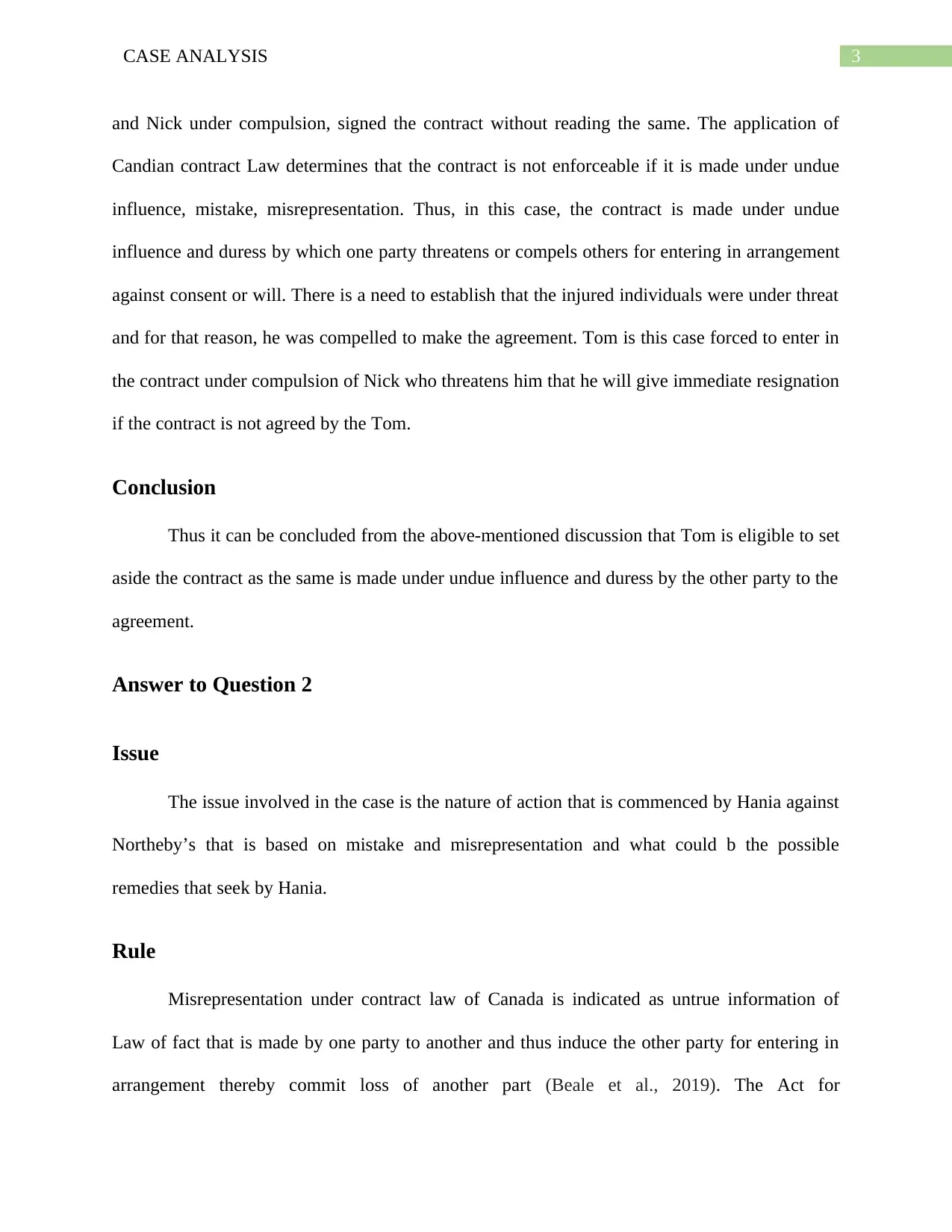
and Nick under compulsion, signed the contract without reading the same. The application of
Candian contract Law determines that the contract is not enforceable if it is made under undue
influence, mistake, misrepresentation. Thus, in this case, the contract is made under undue
influence and duress by which one party threatens or compels others for entering in arrangement
against consent or will. There is a need to establish that the injured individuals were under threat
and for that reason, he was compelled to make the agreement. Tom is this case forced to enter in
the contract under compulsion of Nick who threatens him that he will give immediate resignation
if the contract is not agreed by the Tom.
Conclusion
Thus it can be concluded from the above-mentioned discussion that Tom is eligible to set
aside the contract as the same is made under undue influence and duress by the other party to the
agreement.
Answer to Question 2
Issue
The issue involved in the case is the nature of action that is commenced by Hania against
Northeby’s that is based on mistake and misrepresentation and what could b the possible
remedies that seek by Hania.
Rule
Misrepresentation under contract law of Canada is indicated as untrue information of
Law of fact that is made by one party to another and thus induce the other party for entering in
arrangement thereby commit loss of another part (Beale et al., 2019). The Act for
and Nick under compulsion, signed the contract without reading the same. The application of
Candian contract Law determines that the contract is not enforceable if it is made under undue
influence, mistake, misrepresentation. Thus, in this case, the contract is made under undue
influence and duress by which one party threatens or compels others for entering in arrangement
against consent or will. There is a need to establish that the injured individuals were under threat
and for that reason, he was compelled to make the agreement. Tom is this case forced to enter in
the contract under compulsion of Nick who threatens him that he will give immediate resignation
if the contract is not agreed by the Tom.
Conclusion
Thus it can be concluded from the above-mentioned discussion that Tom is eligible to set
aside the contract as the same is made under undue influence and duress by the other party to the
agreement.
Answer to Question 2
Issue
The issue involved in the case is the nature of action that is commenced by Hania against
Northeby’s that is based on mistake and misrepresentation and what could b the possible
remedies that seek by Hania.
Rule
Misrepresentation under contract law of Canada is indicated as untrue information of
Law of fact that is made by one party to another and thus induce the other party for entering in
arrangement thereby commit loss of another part (Beale et al., 2019). The Act for
Paraphrase This Document
Need a fresh take? Get an instant paraphrase of this document with our AI Paraphraser
4CASE ANALYSIS
misrepresentation of contract can be initiate in regard to misrepresentation of Law or fact. The
misrepresentation can be categorized in fraudulent misrepresentation, negligent
misrepresentation. The remedies that can be claimed for the aggrieved party to the contract for
misrepresentation is damages or rescission (Hunt, 2015). For negligent misrepresentation and
fraudulent, the claimant might assert damages and rescission. The court in case of innocent
misrepresentation has discretionary power to order damages in exchange of rescission.
The mistake in contract law is designated as erroneous belief during the period of
entering the contract that particular facts are accurate. It may be raised and argued as defence and
may tend to make the agreement that is in issue to be held voidable or void ab initio, or equitable
remedy alternatively may be awarded by the court (Adriaanse, 2016). It is identified by the
common law in Canada that there are three types of mistake that is a unilateral, common and
bilateral mistake. The mistake can be further categorized into the mistake of law or fact .
In the case of Canada (Public Safety and Emergency Preparedness) v. Niaz, 2008 CanLII
46296 it was held that Ministry of Public Safety and Emergency Preparedness mentioned report
that is regarding Fakhar Niaz in Immigration Department for determining that in case he is
unacceptable on the ground of misrepresentation Immigration and Refugee Protection Act for
indirectly or directly withholding or misrepresenting material facts that are connected to
significant matter which provoke error in administration of Act.
In the case of Lin vs. Canada ( Citizenship and Immigration), 2019 FC 1284, it is held
that three-stage process for ascertaining misrepresentation under Section 40 (1)(a) of IRPA it is
said that the misrepresentation concerning the material fact that provokes error in the
administration of act.
misrepresentation of contract can be initiate in regard to misrepresentation of Law or fact. The
misrepresentation can be categorized in fraudulent misrepresentation, negligent
misrepresentation. The remedies that can be claimed for the aggrieved party to the contract for
misrepresentation is damages or rescission (Hunt, 2015). For negligent misrepresentation and
fraudulent, the claimant might assert damages and rescission. The court in case of innocent
misrepresentation has discretionary power to order damages in exchange of rescission.
The mistake in contract law is designated as erroneous belief during the period of
entering the contract that particular facts are accurate. It may be raised and argued as defence and
may tend to make the agreement that is in issue to be held voidable or void ab initio, or equitable
remedy alternatively may be awarded by the court (Adriaanse, 2016). It is identified by the
common law in Canada that there are three types of mistake that is a unilateral, common and
bilateral mistake. The mistake can be further categorized into the mistake of law or fact .
In the case of Canada (Public Safety and Emergency Preparedness) v. Niaz, 2008 CanLII
46296 it was held that Ministry of Public Safety and Emergency Preparedness mentioned report
that is regarding Fakhar Niaz in Immigration Department for determining that in case he is
unacceptable on the ground of misrepresentation Immigration and Refugee Protection Act for
indirectly or directly withholding or misrepresenting material facts that are connected to
significant matter which provoke error in administration of Act.
In the case of Lin vs. Canada ( Citizenship and Immigration), 2019 FC 1284, it is held
that three-stage process for ascertaining misrepresentation under Section 40 (1)(a) of IRPA it is
said that the misrepresentation concerning the material fact that provokes error in the
administration of act.
5CASE ANALYSIS
The principle that is implemented for ascertaining damages on the ground of misrepresentation
was under Misrepresentation Act, 1967 and it emphasize the method the assessment differ that is
rest on whether a misrepresentation is negligent, fraudulent or innocent.
Analysis
Thus by making detail analysis of the case, it is established that Hania is entitled to
receive compensation in terms of remedies for loss incurred by her on the basis of mistake or
misrepresentation. The remedy that is claimed involves damages or rescission which indicate
remedy that is afforded to the contractual party whose consensus has invalidated in case the party
enter in contract on the basis of a false statement or has mistaken in relation to contractual terms.
The outcome of rescinding contract is to restore or extinguish the party to the prior position that
they were before entering in the contract.
Conclusion
Thus it can be concluded that Hania is entitled to receive damages on the grounds of
misrepresentation in terms of rescission of the contract.
Answer to question 3
Issue
The issue involved in the particular case is whether Lucy is entitled to litigate Charles on the
ground of violation of contractual terms.
Rule
There is a breach of contract where the parties to the contract fail to comply with the
obligation as promised by the contract. The conditions required for breach of contract involve
The principle that is implemented for ascertaining damages on the ground of misrepresentation
was under Misrepresentation Act, 1967 and it emphasize the method the assessment differ that is
rest on whether a misrepresentation is negligent, fraudulent or innocent.
Analysis
Thus by making detail analysis of the case, it is established that Hania is entitled to
receive compensation in terms of remedies for loss incurred by her on the basis of mistake or
misrepresentation. The remedy that is claimed involves damages or rescission which indicate
remedy that is afforded to the contractual party whose consensus has invalidated in case the party
enter in contract on the basis of a false statement or has mistaken in relation to contractual terms.
The outcome of rescinding contract is to restore or extinguish the party to the prior position that
they were before entering in the contract.
Conclusion
Thus it can be concluded that Hania is entitled to receive damages on the grounds of
misrepresentation in terms of rescission of the contract.
Answer to question 3
Issue
The issue involved in the particular case is whether Lucy is entitled to litigate Charles on the
ground of violation of contractual terms.
Rule
There is a breach of contract where the parties to the contract fail to comply with the
obligation as promised by the contract. The conditions required for breach of contract involve
⊘ This is a preview!⊘
Do you want full access?
Subscribe today to unlock all pages.
Trusted by 1+ million students worldwide
6CASE ANALYSIS
denial to perform any obligation or do any act that is prohibited by contract or stop others from
conducting contractual obligations. The legislation distinguishes in between immaterial and
material infringement of contract (Pargendler, 2018). the material breach is irreparably broken
and furthermore it setback the determination of entering the contract. In case of a material
violation by the contractual party, then the aggrieved party is entitled to seek damages. The
damages can be assessed in terms of money that is sufficient for shielding financial loss
impacting from the breach (Andrews, 2015. The immaterial violation does not lead to contract
termination (Poole, 2016). Thus each party to the contract is liable to fulfil the terms and failure
on performing the same in contract leads to a breach in the Law of contract. The remedies for the
breach of contract include monetary damages, injunction and specific performance.
In the case of Berry v. Pulley, 2002 SCC 40, the issue raised is whether the union
member violates union constitution that incurs liability to another who suffer resulting from the
Act.
Analysis
In this case, lucy can claim damages for breach of contractual terms. In this case, Lucy
had required to establish that the defendant violate the arrangement deliberately or he may
require to prove an actual violation of terms of the contract. The remedy that is awarded by the
court is in the form of damages. As after initial acceptance of contract he cannot withdraw from
the same. Thus in ascertaining the damages the factors that taken in regard are causation,
remoteness and mitigation. The damage that is award by court is assessed on the basis of injury
that is incurred by Lucy for act of other party
denial to perform any obligation or do any act that is prohibited by contract or stop others from
conducting contractual obligations. The legislation distinguishes in between immaterial and
material infringement of contract (Pargendler, 2018). the material breach is irreparably broken
and furthermore it setback the determination of entering the contract. In case of a material
violation by the contractual party, then the aggrieved party is entitled to seek damages. The
damages can be assessed in terms of money that is sufficient for shielding financial loss
impacting from the breach (Andrews, 2015. The immaterial violation does not lead to contract
termination (Poole, 2016). Thus each party to the contract is liable to fulfil the terms and failure
on performing the same in contract leads to a breach in the Law of contract. The remedies for the
breach of contract include monetary damages, injunction and specific performance.
In the case of Berry v. Pulley, 2002 SCC 40, the issue raised is whether the union
member violates union constitution that incurs liability to another who suffer resulting from the
Act.
Analysis
In this case, lucy can claim damages for breach of contractual terms. In this case, Lucy
had required to establish that the defendant violate the arrangement deliberately or he may
require to prove an actual violation of terms of the contract. The remedy that is awarded by the
court is in the form of damages. As after initial acceptance of contract he cannot withdraw from
the same. Thus in ascertaining the damages the factors that taken in regard are causation,
remoteness and mitigation. The damage that is award by court is assessed on the basis of injury
that is incurred by Lucy for act of other party
Paraphrase This Document
Need a fresh take? Get an instant paraphrase of this document with our AI Paraphraser
7CASE ANALYSIS
If the scenario is that Charles litigates Lucy for loss that incurred by him as he has no
roes to sell. It is claimed that the storm is unforeseeable. Thus in case of unforeseeability of any
event which is out control of the parties, then the aggrieved party cannot sue the other for the
breach of contract. In this case, the obligation can be discharged under the rule of
impracticability. In this case, Lucy is not entitled to claim damages for the breach of contract on
the basis of an unforeseeable event.
If the scenario is that Charles litigates Lucy for loss that incurred by him as he has no
roes to sell. It is claimed that the storm is unforeseeable. Thus in case of unforeseeability of any
event which is out control of the parties, then the aggrieved party cannot sue the other for the
breach of contract. In this case, the obligation can be discharged under the rule of
impracticability. In this case, Lucy is not entitled to claim damages for the breach of contract on
the basis of an unforeseeable event.
8CASE ANALYSIS
References
Adriaanse, M. J. (2016). Construction contract law. Macmillan International Higher Education.
Andrews, N. (2015). Contract law. Cambridge University Press.
Beale, H., Fauvarque-Cosson, B., Rutgers, J., & Vogenauer, S. (2019). Cases, materials and text
on contract law. Bloomsbury Publishing.
Cartwright, J. (2016). Contract law: An introduction to the English law of contract for the civil
lawyer. Bloomsbury Publishing.
Hunt, C. D. (2015). Good Faith Performance in Canadian Contract Law. The Cambridge Law
Journal, 74(1), 4-7.
Pargendler, M. (2018). The role of the state in contract law: The common-civil law divide. Yale
J. Int'l L., 43, 143.
Poole, J. (2016). Textbook on contract law. Oxford University Press.
Young, J. (2016). Justice Beneath the Palms: Bhasin v. Hrynew and the Role of Good Faith in
Canadian Contract Law. Sask. L. Rev., 79, 79.
References
Adriaanse, M. J. (2016). Construction contract law. Macmillan International Higher Education.
Andrews, N. (2015). Contract law. Cambridge University Press.
Beale, H., Fauvarque-Cosson, B., Rutgers, J., & Vogenauer, S. (2019). Cases, materials and text
on contract law. Bloomsbury Publishing.
Cartwright, J. (2016). Contract law: An introduction to the English law of contract for the civil
lawyer. Bloomsbury Publishing.
Hunt, C. D. (2015). Good Faith Performance in Canadian Contract Law. The Cambridge Law
Journal, 74(1), 4-7.
Pargendler, M. (2018). The role of the state in contract law: The common-civil law divide. Yale
J. Int'l L., 43, 143.
Poole, J. (2016). Textbook on contract law. Oxford University Press.
Young, J. (2016). Justice Beneath the Palms: Bhasin v. Hrynew and the Role of Good Faith in
Canadian Contract Law. Sask. L. Rev., 79, 79.
⊘ This is a preview!⊘
Do you want full access?
Subscribe today to unlock all pages.
Trusted by 1+ million students worldwide

1 out of 9


Your All-in-One AI-Powered Toolkit for Academic Success.
+13062052269
info@desklib.com
Available 24*7 on WhatsApp / Email
![[object Object]](/_next/static/media/star-bottom.7253800d.svg)
Unlock your academic potential
Copyright © 2020–2026 A2Z Services. All Rights Reserved. Developed and managed by ZUCOL.