LAW20019 Law of Commerce: Report on Contractual Legal Issue Analysis
VerifiedAdded on  2023/03/31
|6
|1395
|183
Report
AI Summary
This report addresses a legal issue in a Law of Commerce scenario where Bob, a new business owner, entered into a lease agreement with Ken, the office owner. A verbal agreement was made prohibiting similar businesses in the same premises, but the written contract contained a clause invalidating verbal representations, which Bob didn't read. Ken later leased space to a competitor, causing Bob financial loss. The report identifies the breach of verbal representation as a major issue and the undisclosed clause as a minor one. It discusses promissory estoppel and the Australian Consumer Law (ACL) as potential legal remedies for Bob, referencing relevant case laws like Waltons Stores v Maher and Singtel Optus Pty Ltd v ACCC. The report concludes that Ken breached his promise and misrepresented the contract, and Bob can pursue legal action using promissory estoppel and the ACL. Desklib provides access to this and similar solved assignments.
LAW OF COMMERCE
Paraphrase This Document
Need a fresh take? Get an instant paraphrase of this document with our AI Paraphraser

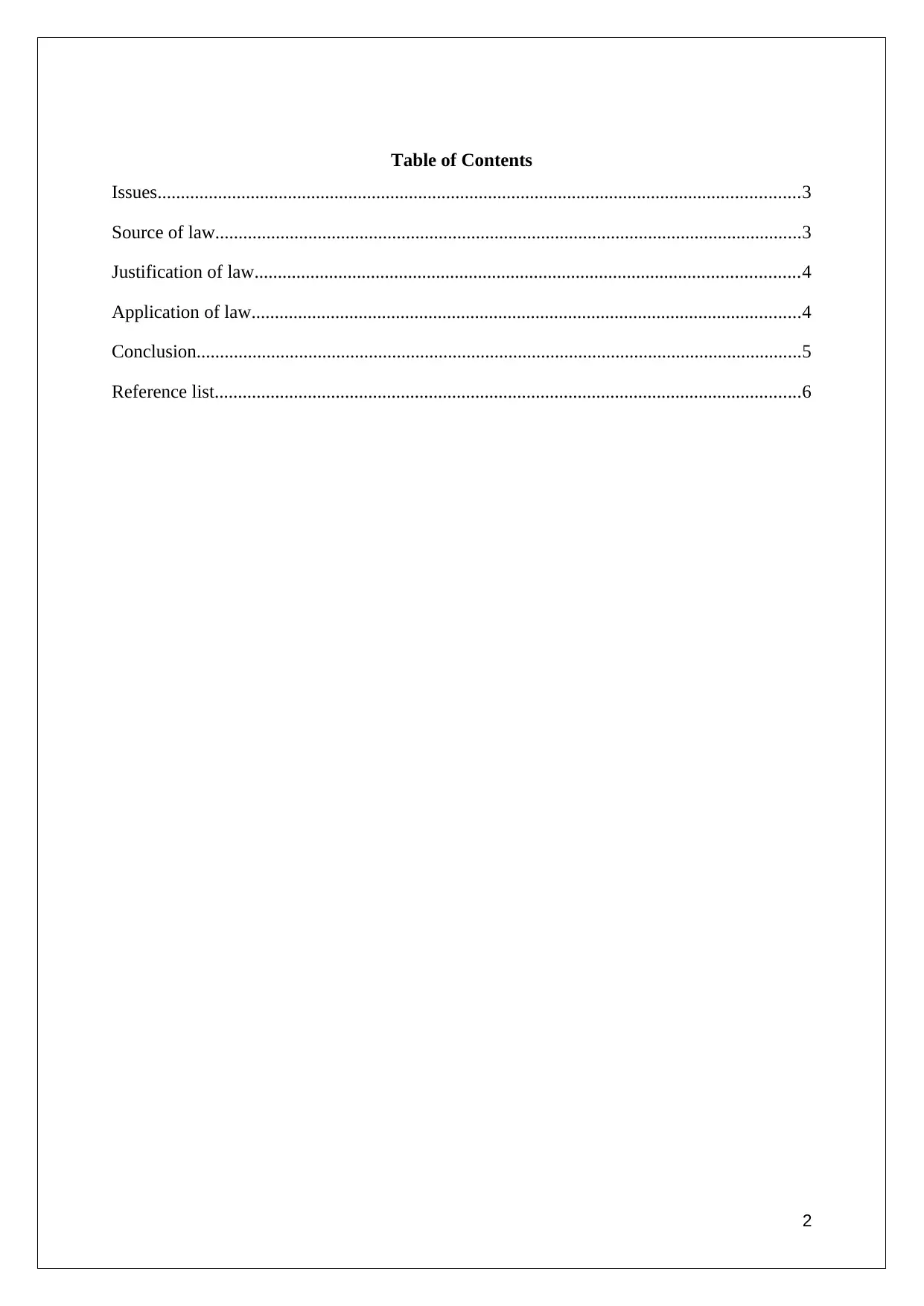
Table of Contents
Issues..........................................................................................................................................3
Source of law..............................................................................................................................3
Justification of law.....................................................................................................................4
Application of law......................................................................................................................4
Conclusion..................................................................................................................................5
Reference list..............................................................................................................................6
2
Issues..........................................................................................................................................3
Source of law..............................................................................................................................3
Justification of law.....................................................................................................................4
Application of law......................................................................................................................4
Conclusion..................................................................................................................................5
Reference list..............................................................................................................................6
2

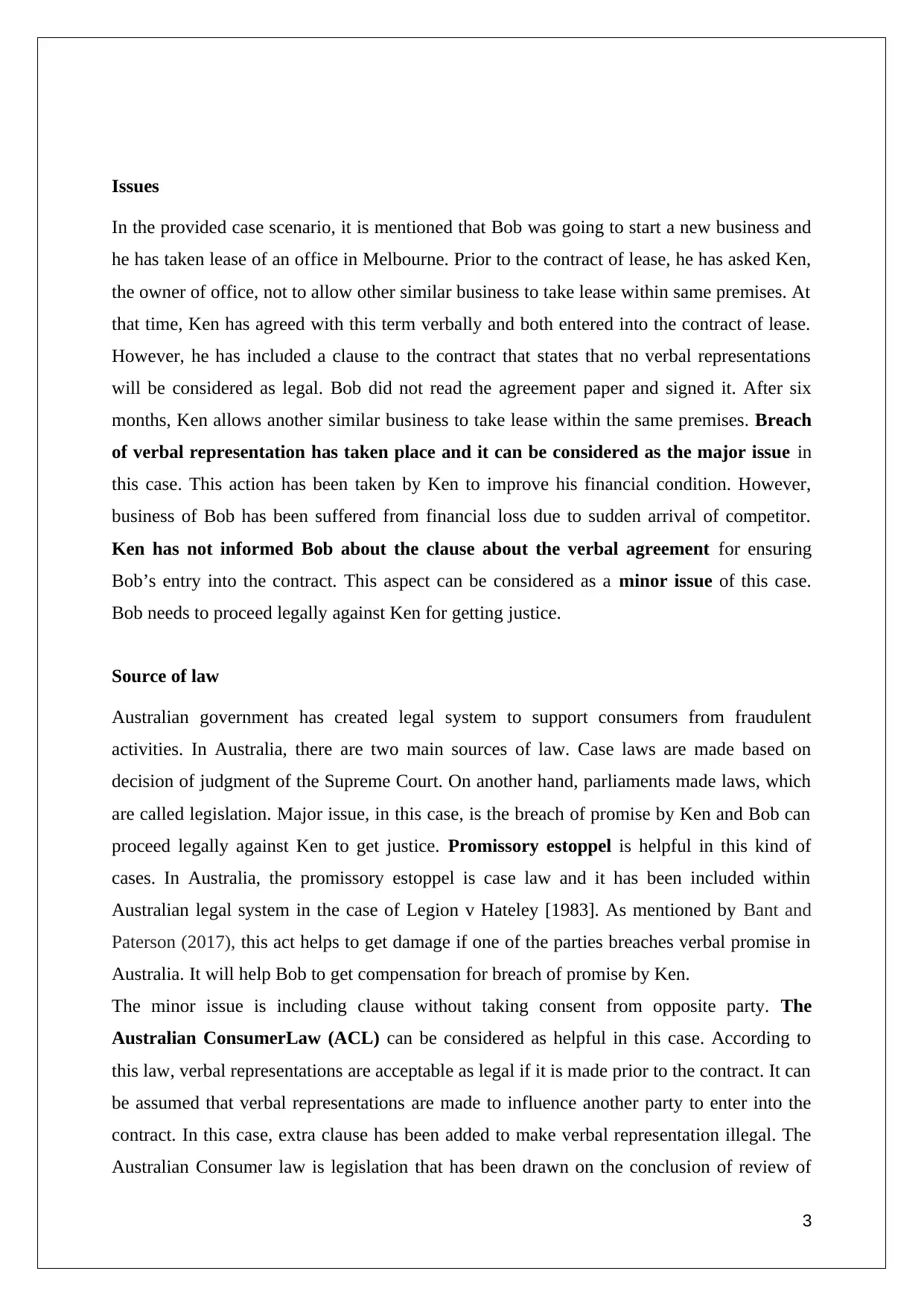
Issues
In the provided case scenario, it is mentioned that Bob was going to start a new business and
he has taken lease of an office in Melbourne. Prior to the contract of lease, he has asked Ken,
the owner of office, not to allow other similar business to take lease within same premises. At
that time, Ken has agreed with this term verbally and both entered into the contract of lease.
However, he has included a clause to the contract that states that no verbal representations
will be considered as legal. Bob did not read the agreement paper and signed it. After six
months, Ken allows another similar business to take lease within the same premises. Breach
of verbal representation has taken place and it can be considered as the major issue in
this case. This action has been taken by Ken to improve his financial condition. However,
business of Bob has been suffered from financial loss due to sudden arrival of competitor.
Ken has not informed Bob about the clause about the verbal agreement for ensuring
Bob’s entry into the contract. This aspect can be considered as a minor issue of this case.
Bob needs to proceed legally against Ken for getting justice.
Source of law
Australian government has created legal system to support consumers from fraudulent
activities. In Australia, there are two main sources of law. Case laws are made based on
decision of judgment of the Supreme Court. On another hand, parliaments made laws, which
are called legislation. Major issue, in this case, is the breach of promise by Ken and Bob can
proceed legally against Ken to get justice. Promissory estoppel is helpful in this kind of
cases. In Australia, the promissory estoppel is case law and it has been included within
Australian legal system in the case of Legion v Hateley [1983]. As mentioned by Bant and
Paterson (2017), this act helps to get damage if one of the parties breaches verbal promise in
Australia. It will help Bob to get compensation for breach of promise by Ken.
The minor issue is including clause without taking consent from opposite party. The
Australian ConsumerLaw (ACL) can be considered as helpful in this case. According to
this law, verbal representations are acceptable as legal if it is made prior to the contract. It can
be assumed that verbal representations are made to influence another party to enter into the
contract. In this case, extra clause has been added to make verbal representation illegal. The
Australian Consumer law is legislation that has been drawn on the conclusion of review of
3
In the provided case scenario, it is mentioned that Bob was going to start a new business and
he has taken lease of an office in Melbourne. Prior to the contract of lease, he has asked Ken,
the owner of office, not to allow other similar business to take lease within same premises. At
that time, Ken has agreed with this term verbally and both entered into the contract of lease.
However, he has included a clause to the contract that states that no verbal representations
will be considered as legal. Bob did not read the agreement paper and signed it. After six
months, Ken allows another similar business to take lease within the same premises. Breach
of verbal representation has taken place and it can be considered as the major issue in
this case. This action has been taken by Ken to improve his financial condition. However,
business of Bob has been suffered from financial loss due to sudden arrival of competitor.
Ken has not informed Bob about the clause about the verbal agreement for ensuring
Bob’s entry into the contract. This aspect can be considered as a minor issue of this case.
Bob needs to proceed legally against Ken for getting justice.
Source of law
Australian government has created legal system to support consumers from fraudulent
activities. In Australia, there are two main sources of law. Case laws are made based on
decision of judgment of the Supreme Court. On another hand, parliaments made laws, which
are called legislation. Major issue, in this case, is the breach of promise by Ken and Bob can
proceed legally against Ken to get justice. Promissory estoppel is helpful in this kind of
cases. In Australia, the promissory estoppel is case law and it has been included within
Australian legal system in the case of Legion v Hateley [1983]. As mentioned by Bant and
Paterson (2017), this act helps to get damage if one of the parties breaches verbal promise in
Australia. It will help Bob to get compensation for breach of promise by Ken.
The minor issue is including clause without taking consent from opposite party. The
Australian ConsumerLaw (ACL) can be considered as helpful in this case. According to
this law, verbal representations are acceptable as legal if it is made prior to the contract. It can
be assumed that verbal representations are made to influence another party to enter into the
contract. In this case, extra clause has been added to make verbal representation illegal. The
Australian Consumer law is legislation that has been drawn on the conclusion of review of
3
⊘ This is a preview!⊘
Do you want full access?
Subscribe today to unlock all pages.

Trusted by 1+ million students worldwide

Australia's Consumer Policy Framework. This legislation has been implemented by
Australian government in 2011. Use of this legislation may help Bob to obtain monetary
compensation from Ken for his misconduct.
Justification of law
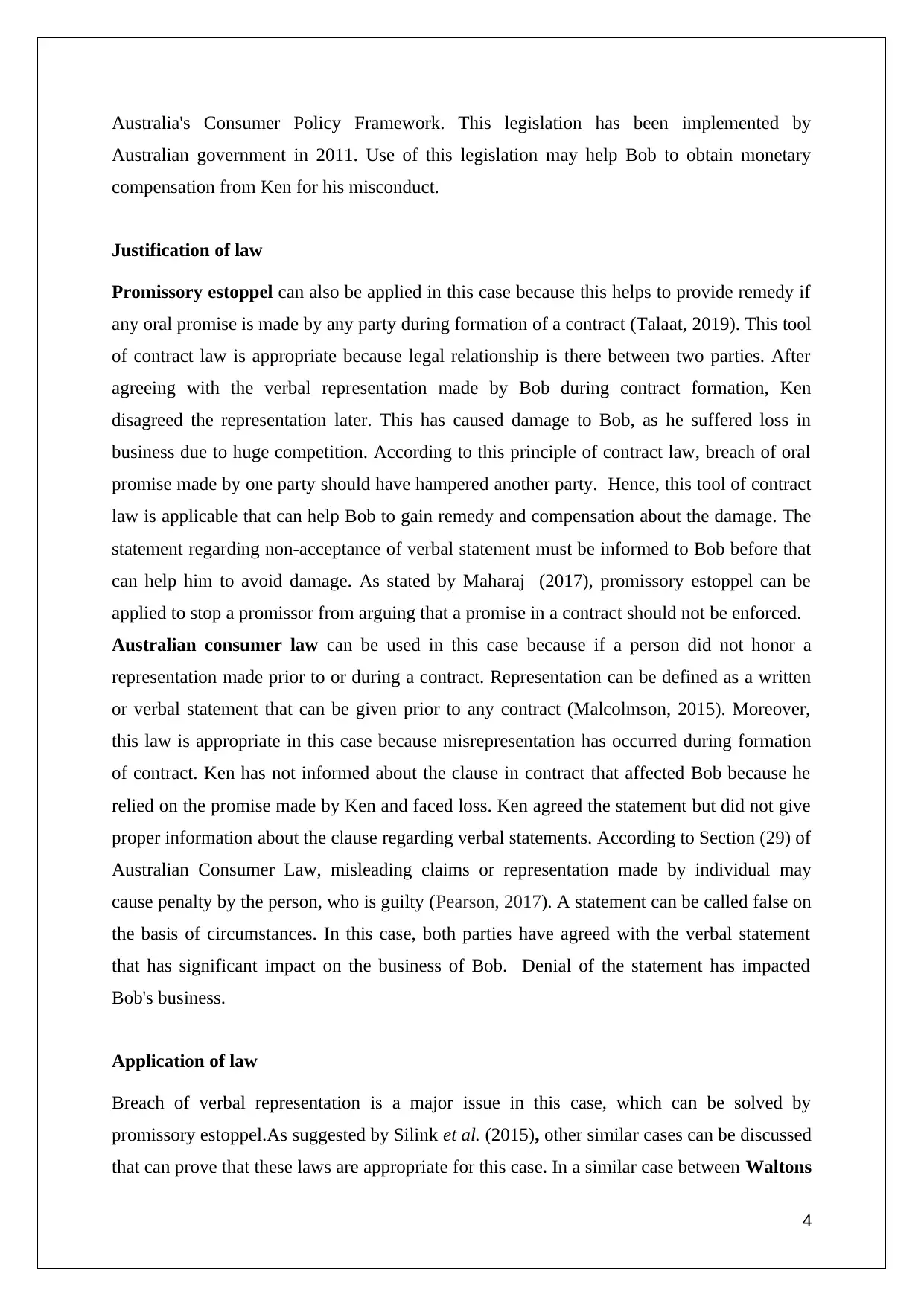
Promissory estoppel can also be applied in this case because this helps to provide remedy if
any oral promise is made by any party during formation of a contract (Talaat, 2019). This tool
of contract law is appropriate because legal relationship is there between two parties. After
agreeing with the verbal representation made by Bob during contract formation, Ken
disagreed the representation later. This has caused damage to Bob, as he suffered loss in
business due to huge competition. According to this principle of contract law, breach of oral
promise made by one party should have hampered another party. Hence, this tool of contract
law is applicable that can help Bob to gain remedy and compensation about the damage. The
statement regarding non-acceptance of verbal statement must be informed to Bob before that
can help him to avoid damage. As stated by Maharaj (2017), promissory estoppel can be
applied to stop a promissor from arguing that a promise in a contract should not be enforced.
Australian consumer law can be used in this case because if a person did not honor a
representation made prior to or during a contract. Representation can be defined as a written
or verbal statement that can be given prior to any contract (Malcolmson, 2015). Moreover,
this law is appropriate in this case because misrepresentation has occurred during formation
of contract. Ken has not informed about the clause in contract that affected Bob because he
relied on the promise made by Ken and faced loss. Ken agreed the statement but did not give
proper information about the clause regarding verbal statements. According to Section (29) of
Australian Consumer Law, misleading claims or representation made by individual may
cause penalty by the person, who is guilty (Pearson, 2017). A statement can be called false on
the basis of circumstances. In this case, both parties have agreed with the verbal statement
that has significant impact on the business of Bob. Denial of the statement has impacted
Bob's business.
Application of law
Breach of verbal representation is a major issue in this case, which can be solved by
promissory estoppel.As suggested by Silink et al. (2015), other similar cases can be discussed
that can prove that these laws are appropriate for this case. In a similar case between Waltons
4
Australian government in 2011. Use of this legislation may help Bob to obtain monetary
compensation from Ken for his misconduct.
Justification of law
Promissory estoppel can also be applied in this case because this helps to provide remedy if
any oral promise is made by any party during formation of a contract (Talaat, 2019). This tool
of contract law is appropriate because legal relationship is there between two parties. After
agreeing with the verbal representation made by Bob during contract formation, Ken
disagreed the representation later. This has caused damage to Bob, as he suffered loss in
business due to huge competition. According to this principle of contract law, breach of oral
promise made by one party should have hampered another party. Hence, this tool of contract
law is applicable that can help Bob to gain remedy and compensation about the damage. The
statement regarding non-acceptance of verbal statement must be informed to Bob before that
can help him to avoid damage. As stated by Maharaj (2017), promissory estoppel can be
applied to stop a promissor from arguing that a promise in a contract should not be enforced.
Australian consumer law can be used in this case because if a person did not honor a
representation made prior to or during a contract. Representation can be defined as a written
or verbal statement that can be given prior to any contract (Malcolmson, 2015). Moreover,
this law is appropriate in this case because misrepresentation has occurred during formation
of contract. Ken has not informed about the clause in contract that affected Bob because he
relied on the promise made by Ken and faced loss. Ken agreed the statement but did not give
proper information about the clause regarding verbal statements. According to Section (29) of
Australian Consumer Law, misleading claims or representation made by individual may
cause penalty by the person, who is guilty (Pearson, 2017). A statement can be called false on
the basis of circumstances. In this case, both parties have agreed with the verbal statement
that has significant impact on the business of Bob. Denial of the statement has impacted
Bob's business.
Application of law
Breach of verbal representation is a major issue in this case, which can be solved by
promissory estoppel.As suggested by Silink et al. (2015), other similar cases can be discussed
that can prove that these laws are appropriate for this case. In a similar case between Waltons
4
Paraphrase This Document
Need a fresh take? Get an instant paraphrase of this document with our AI Paraphraser

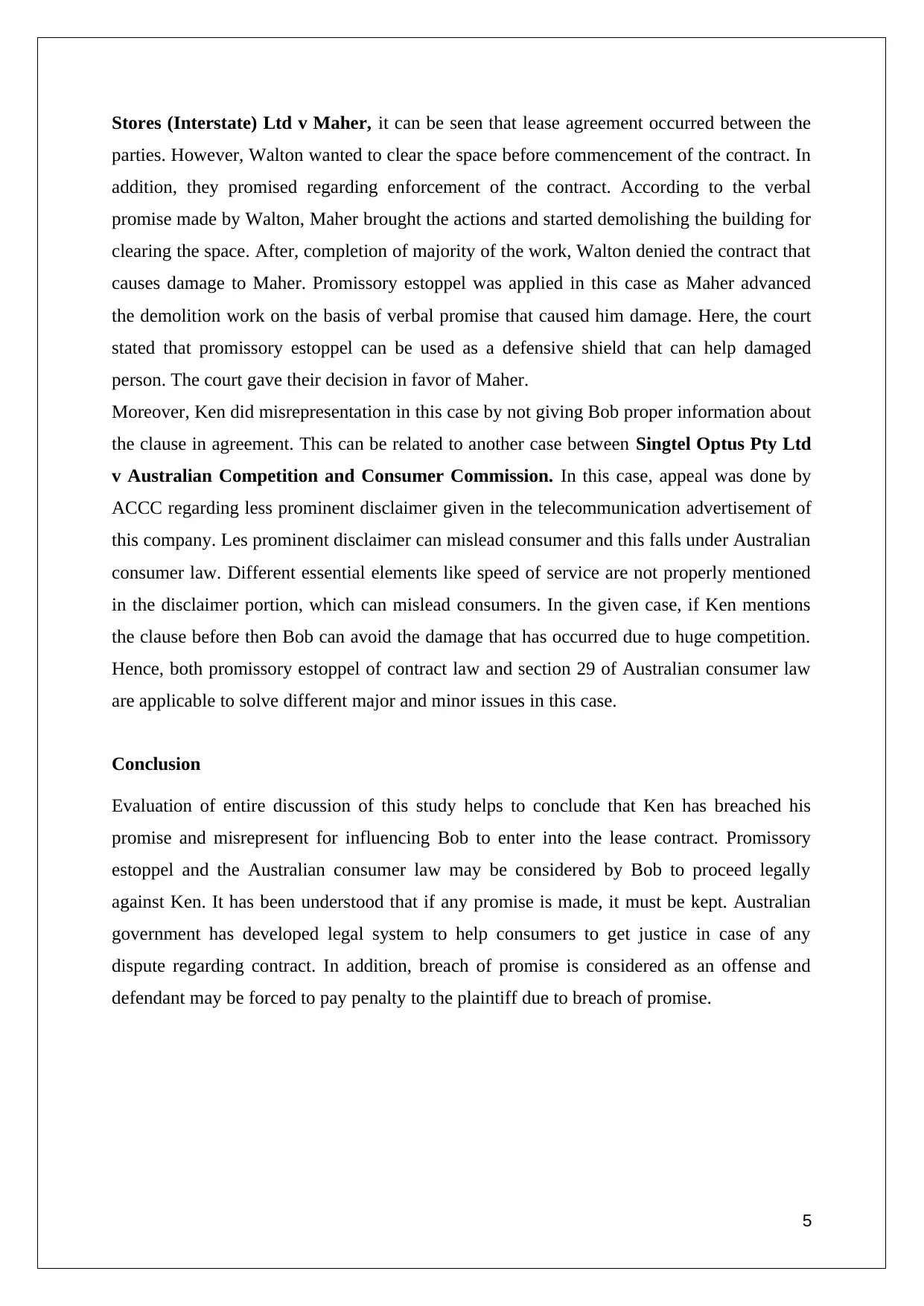
Stores (Interstate) Ltd v Maher, it can be seen that lease agreement occurred between the
parties. However, Walton wanted to clear the space before commencement of the contract. In
addition, they promised regarding enforcement of the contract. According to the verbal
promise made by Walton, Maher brought the actions and started demolishing the building for
clearing the space. After, completion of majority of the work, Walton denied the contract that
causes damage to Maher. Promissory estoppel was applied in this case as Maher advanced
the demolition work on the basis of verbal promise that caused him damage. Here, the court
stated that promissory estoppel can be used as a defensive shield that can help damaged
person. The court gave their decision in favor of Maher.
Moreover, Ken did misrepresentation in this case by not giving Bob proper information about
the clause in agreement. This can be related to another case between Singtel Optus Pty Ltd
v Australian Competition and Consumer Commission. In this case, appeal was done by
ACCC regarding less prominent disclaimer given in the telecommunication advertisement of
this company. Les prominent disclaimer can mislead consumer and this falls under Australian
consumer law. Different essential elements like speed of service are not properly mentioned
in the disclaimer portion, which can mislead consumers. In the given case, if Ken mentions
the clause before then Bob can avoid the damage that has occurred due to huge competition.
Hence, both promissory estoppel of contract law and section 29 of Australian consumer law
are applicable to solve different major and minor issues in this case.
Conclusion
Evaluation of entire discussion of this study helps to conclude that Ken has breached his
promise and misrepresent for influencing Bob to enter into the lease contract. Promissory
estoppel and the Australian consumer law may be considered by Bob to proceed legally
against Ken. It has been understood that if any promise is made, it must be kept. Australian
government has developed legal system to help consumers to get justice in case of any
dispute regarding contract. In addition, breach of promise is considered as an offense and
defendant may be forced to pay penalty to the plaintiff due to breach of promise.
5
parties. However, Walton wanted to clear the space before commencement of the contract. In
addition, they promised regarding enforcement of the contract. According to the verbal
promise made by Walton, Maher brought the actions and started demolishing the building for
clearing the space. After, completion of majority of the work, Walton denied the contract that
causes damage to Maher. Promissory estoppel was applied in this case as Maher advanced
the demolition work on the basis of verbal promise that caused him damage. Here, the court
stated that promissory estoppel can be used as a defensive shield that can help damaged
person. The court gave their decision in favor of Maher.
Moreover, Ken did misrepresentation in this case by not giving Bob proper information about
the clause in agreement. This can be related to another case between Singtel Optus Pty Ltd
v Australian Competition and Consumer Commission. In this case, appeal was done by
ACCC regarding less prominent disclaimer given in the telecommunication advertisement of
this company. Les prominent disclaimer can mislead consumer and this falls under Australian
consumer law. Different essential elements like speed of service are not properly mentioned
in the disclaimer portion, which can mislead consumers. In the given case, if Ken mentions
the clause before then Bob can avoid the damage that has occurred due to huge competition.
Hence, both promissory estoppel of contract law and section 29 of Australian consumer law
are applicable to solve different major and minor issues in this case.
Conclusion
Evaluation of entire discussion of this study helps to conclude that Ken has breached his
promise and misrepresent for influencing Bob to enter into the lease contract. Promissory
estoppel and the Australian consumer law may be considered by Bob to proceed legally
against Ken. It has been understood that if any promise is made, it must be kept. Australian
government has developed legal system to help consumers to get justice in case of any
dispute regarding contract. In addition, breach of promise is considered as an offense and
defendant may be forced to pay penalty to the plaintiff due to breach of promise.
5

Reference list
Bant, E. and Paterson, J.M., 2017. Consumer Redress Legislation: Simplifying or Subverting
the Law of Contract. The Modern Law Review, 80(5), pp.895-926.
Maharaj, K., 2017. An Action on the Equities: Re-Characterizing Bhasin as Equitable
Estoppel. Alta. L. Rev., 55, p.199.
Malcolmson, D., 2015. The Patient's Right to Know. Journal of Medical Regulation, 101(3),
pp.32-36.
Pearson, G., 2017. Further challenges for Australian consumer law. In Consumer Law and
Socioeconomic Development pp. 287-305
Silink, A., 2015. Can Promissory Estoppel Be an Independent Source of Rights. UW Austl. L.
Rev., 40, p.39.
Talaat, W.I.W., 2019. The Present Parameters of Promissory Estoppel and Its Changing Role
in the English, Australian and Malaysian Contract Law. Journal of Malaysian and
Comparative Law, 35, pp.39-88.
Laws
Australian Consumer Law (ACL)
Promissory estoppels
Case laws
Legion v Hateley [1983] 57 ALJR 152 CLR 406
Singtel Optus Pty Ltd v ACCC (2012) 287 ALR 249
Waltons Stores (Interstate) Ltd v Maher (1988) 164 CLR 387
6
Bant, E. and Paterson, J.M., 2017. Consumer Redress Legislation: Simplifying or Subverting
the Law of Contract. The Modern Law Review, 80(5), pp.895-926.
Maharaj, K., 2017. An Action on the Equities: Re-Characterizing Bhasin as Equitable
Estoppel. Alta. L. Rev., 55, p.199.
Malcolmson, D., 2015. The Patient's Right to Know. Journal of Medical Regulation, 101(3),
pp.32-36.
Pearson, G., 2017. Further challenges for Australian consumer law. In Consumer Law and
Socioeconomic Development pp. 287-305
Silink, A., 2015. Can Promissory Estoppel Be an Independent Source of Rights. UW Austl. L.
Rev., 40, p.39.
Talaat, W.I.W., 2019. The Present Parameters of Promissory Estoppel and Its Changing Role
in the English, Australian and Malaysian Contract Law. Journal of Malaysian and
Comparative Law, 35, pp.39-88.
Laws
Australian Consumer Law (ACL)
Promissory estoppels
Case laws
Legion v Hateley [1983] 57 ALJR 152 CLR 406
Singtel Optus Pty Ltd v ACCC (2012) 287 ALR 249
Waltons Stores (Interstate) Ltd v Maher (1988) 164 CLR 387
6
⊘ This is a preview!⊘
Do you want full access?
Subscribe today to unlock all pages.

Trusted by 1+ million students worldwide
1 out of 6
Related Documents
Your All-in-One AI-Powered Toolkit for Academic Success.
 +13062052269
info@desklib.com
Available 24*7 on WhatsApp / Email
Unlock your academic potential
Copyright © 2020–2025 A2Z Services. All Rights Reserved. Developed and managed by ZUCOL.