Detailed Analysis of Contract Law Principles and Essentials
VerifiedAdded on 2022/08/27
|7
|1793
|17
Homework Assignment
AI Summary
This document presents a comprehensive solution to a contract law assignment, addressing key concepts and principles. The assignment explores the essential elements of a valid contract, including offer, acceptance, and consideration, providing detailed explanations and examples to illustrate each concept. It analyzes scenarios involving offers for sale, distinguishing between invitations to offer and actual offers, and discusses the Sales of Goods Act. The solution also delves into the requirements for a valid offer, the importance of intention to create legal relations, and the consequences of lacking any of the essential elements. The document provides a clear understanding of contract law, including case examples like Harvey v. Facey, Gibson v. Manchester City Council, and Balfour v. Balfour, making it a valuable resource for students studying contract law.
Running head- CONTRACT LAW
Contract Law
Name of the Student
Name of the University
Author Note
Contract Law
Name of the Student
Name of the University
Author Note
Paraphrase This Document
Need a fresh take? Get an instant paraphrase of this document with our AI Paraphraser

1Contract Law
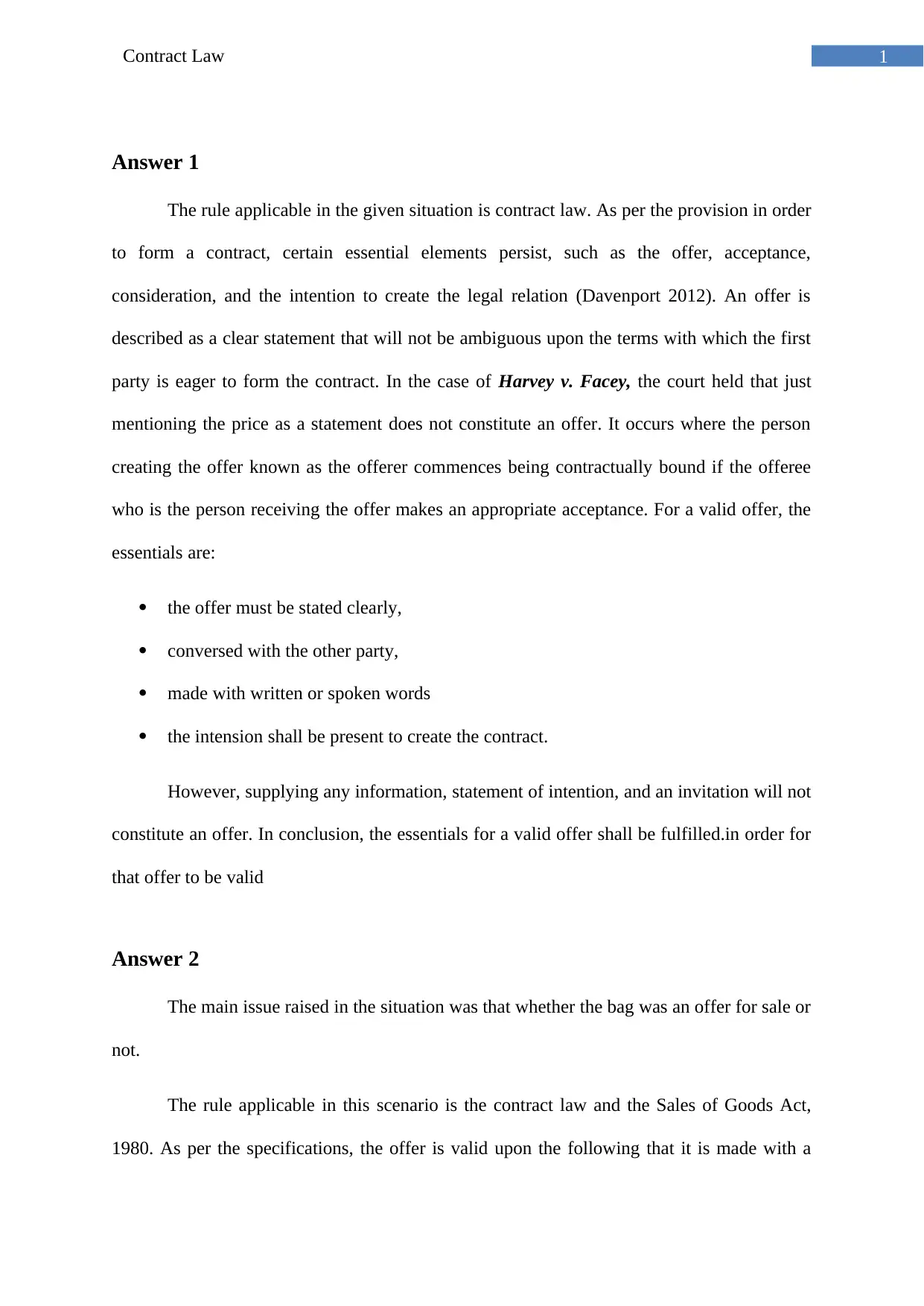
Answer 1
The rule applicable in the given situation is contract law. As per the provision in order
to form a contract, certain essential elements persist, such as the offer, acceptance,
consideration, and the intention to create the legal relation (Davenport 2012). An offer is
described as a clear statement that will not be ambiguous upon the terms with which the first
party is eager to form the contract. In the case of Harvey v. Facey, the court held that just
mentioning the price as a statement does not constitute an offer. It occurs where the person
creating the offer known as the offerer commences being contractually bound if the offeree
who is the person receiving the offer makes an appropriate acceptance. For a valid offer, the
essentials are:
the offer must be stated clearly,
conversed with the other party,
made with written or spoken words
the intension shall be present to create the contract.
However, supplying any information, statement of intention, and an invitation will not
constitute an offer. In conclusion, the essentials for a valid offer shall be fulfilled.in order for
that offer to be valid
Answer 2
The main issue raised in the situation was that whether the bag was an offer for sale or
not.
The rule applicable in this scenario is the contract law and the Sales of Goods Act,
1980. As per the specifications, the offer is valid upon the following that it is made with a
Answer 1
The rule applicable in the given situation is contract law. As per the provision in order
to form a contract, certain essential elements persist, such as the offer, acceptance,
consideration, and the intention to create the legal relation (Davenport 2012). An offer is
described as a clear statement that will not be ambiguous upon the terms with which the first
party is eager to form the contract. In the case of Harvey v. Facey, the court held that just
mentioning the price as a statement does not constitute an offer. It occurs where the person
creating the offer known as the offerer commences being contractually bound if the offeree
who is the person receiving the offer makes an appropriate acceptance. For a valid offer, the
essentials are:
the offer must be stated clearly,
conversed with the other party,
made with written or spoken words
the intension shall be present to create the contract.
However, supplying any information, statement of intention, and an invitation will not
constitute an offer. In conclusion, the essentials for a valid offer shall be fulfilled.in order for
that offer to be valid
Answer 2
The main issue raised in the situation was that whether the bag was an offer for sale or
not.
The rule applicable in this scenario is the contract law and the Sales of Goods Act,
1980. As per the specifications, the offer is valid upon the following that it is made with a

2Contract Law
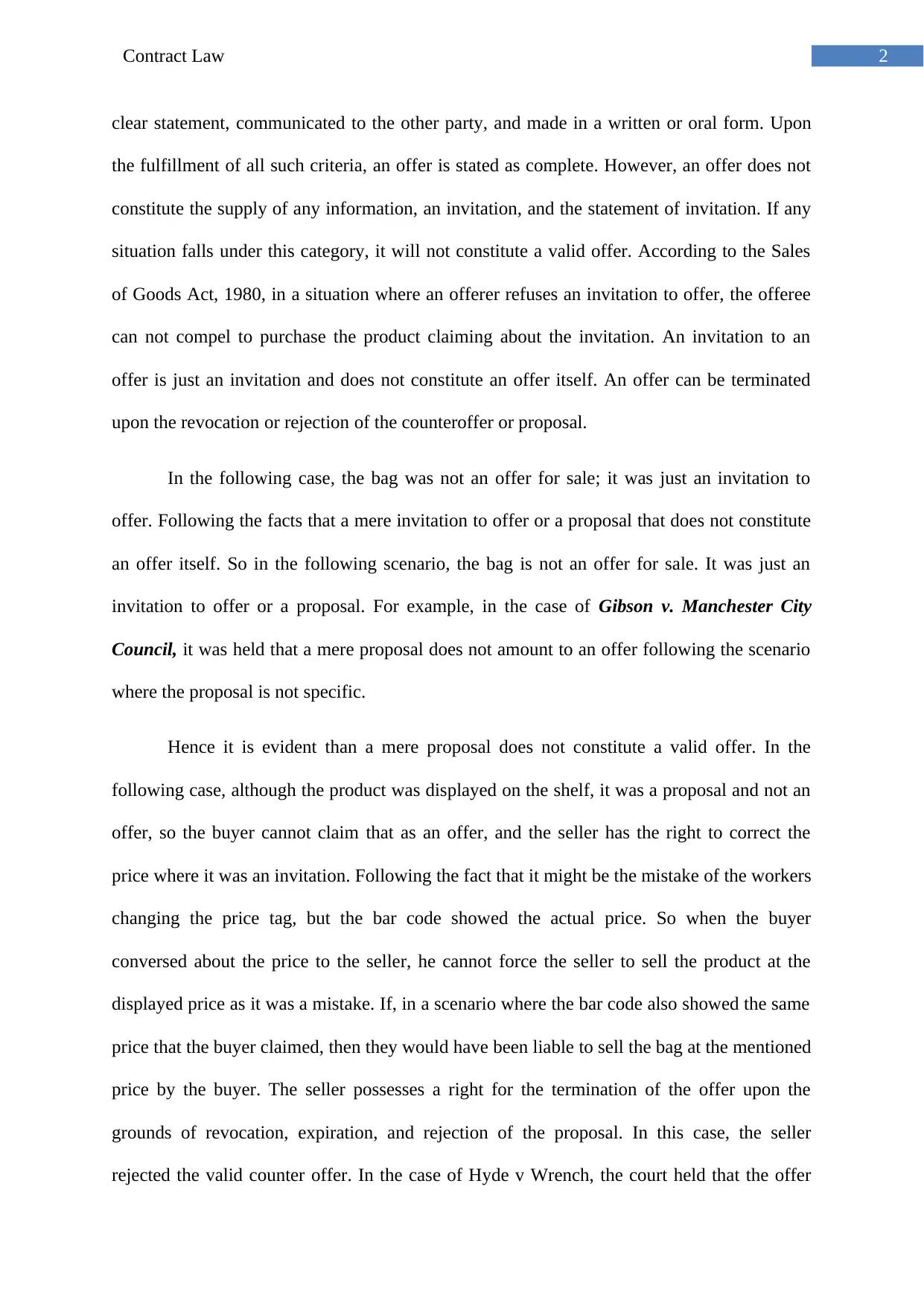
clear statement, communicated to the other party, and made in a written or oral form. Upon
the fulfillment of all such criteria, an offer is stated as complete. However, an offer does not
constitute the supply of any information, an invitation, and the statement of invitation. If any
situation falls under this category, it will not constitute a valid offer. According to the Sales
of Goods Act, 1980, in a situation where an offerer refuses an invitation to offer, the offeree
can not compel to purchase the product claiming about the invitation. An invitation to an
offer is just an invitation and does not constitute an offer itself. An offer can be terminated
upon the revocation or rejection of the counteroffer or proposal.
In the following case, the bag was not an offer for sale; it was just an invitation to
offer. Following the facts that a mere invitation to offer or a proposal that does not constitute
an offer itself. So in the following scenario, the bag is not an offer for sale. It was just an
invitation to offer or a proposal. For example, in the case of Gibson v. Manchester City
Council, it was held that a mere proposal does not amount to an offer following the scenario
where the proposal is not specific.
Hence it is evident than a mere proposal does not constitute a valid offer. In the
following case, although the product was displayed on the shelf, it was a proposal and not an
offer, so the buyer cannot claim that as an offer, and the seller has the right to correct the
price where it was an invitation. Following the fact that it might be the mistake of the workers
changing the price tag, but the bar code showed the actual price. So when the buyer
conversed about the price to the seller, he cannot force the seller to sell the product at the
displayed price as it was a mistake. If, in a scenario where the bar code also showed the same
price that the buyer claimed, then they would have been liable to sell the bag at the mentioned
price by the buyer. The seller possesses a right for the termination of the offer upon the
grounds of revocation, expiration, and rejection of the proposal. In this case, the seller
rejected the valid counter offer. In the case of Hyde v Wrench, the court held that the offer
clear statement, communicated to the other party, and made in a written or oral form. Upon
the fulfillment of all such criteria, an offer is stated as complete. However, an offer does not
constitute the supply of any information, an invitation, and the statement of invitation. If any
situation falls under this category, it will not constitute a valid offer. According to the Sales
of Goods Act, 1980, in a situation where an offerer refuses an invitation to offer, the offeree
can not compel to purchase the product claiming about the invitation. An invitation to an
offer is just an invitation and does not constitute an offer itself. An offer can be terminated
upon the revocation or rejection of the counteroffer or proposal.
In the following case, the bag was not an offer for sale; it was just an invitation to
offer. Following the facts that a mere invitation to offer or a proposal that does not constitute
an offer itself. So in the following scenario, the bag is not an offer for sale. It was just an
invitation to offer or a proposal. For example, in the case of Gibson v. Manchester City
Council, it was held that a mere proposal does not amount to an offer following the scenario
where the proposal is not specific.
Hence it is evident than a mere proposal does not constitute a valid offer. In the
following case, although the product was displayed on the shelf, it was a proposal and not an
offer, so the buyer cannot claim that as an offer, and the seller has the right to correct the
price where it was an invitation. Following the fact that it might be the mistake of the workers
changing the price tag, but the bar code showed the actual price. So when the buyer
conversed about the price to the seller, he cannot force the seller to sell the product at the
displayed price as it was a mistake. If, in a scenario where the bar code also showed the same
price that the buyer claimed, then they would have been liable to sell the bag at the mentioned
price by the buyer. The seller possesses a right for the termination of the offer upon the
grounds of revocation, expiration, and rejection of the proposal. In this case, the seller
rejected the valid counter offer. In the case of Hyde v Wrench, the court held that the offer
⊘ This is a preview!⊘
Do you want full access?
Subscribe today to unlock all pages.

Trusted by 1+ million students worldwide

3Contract Law
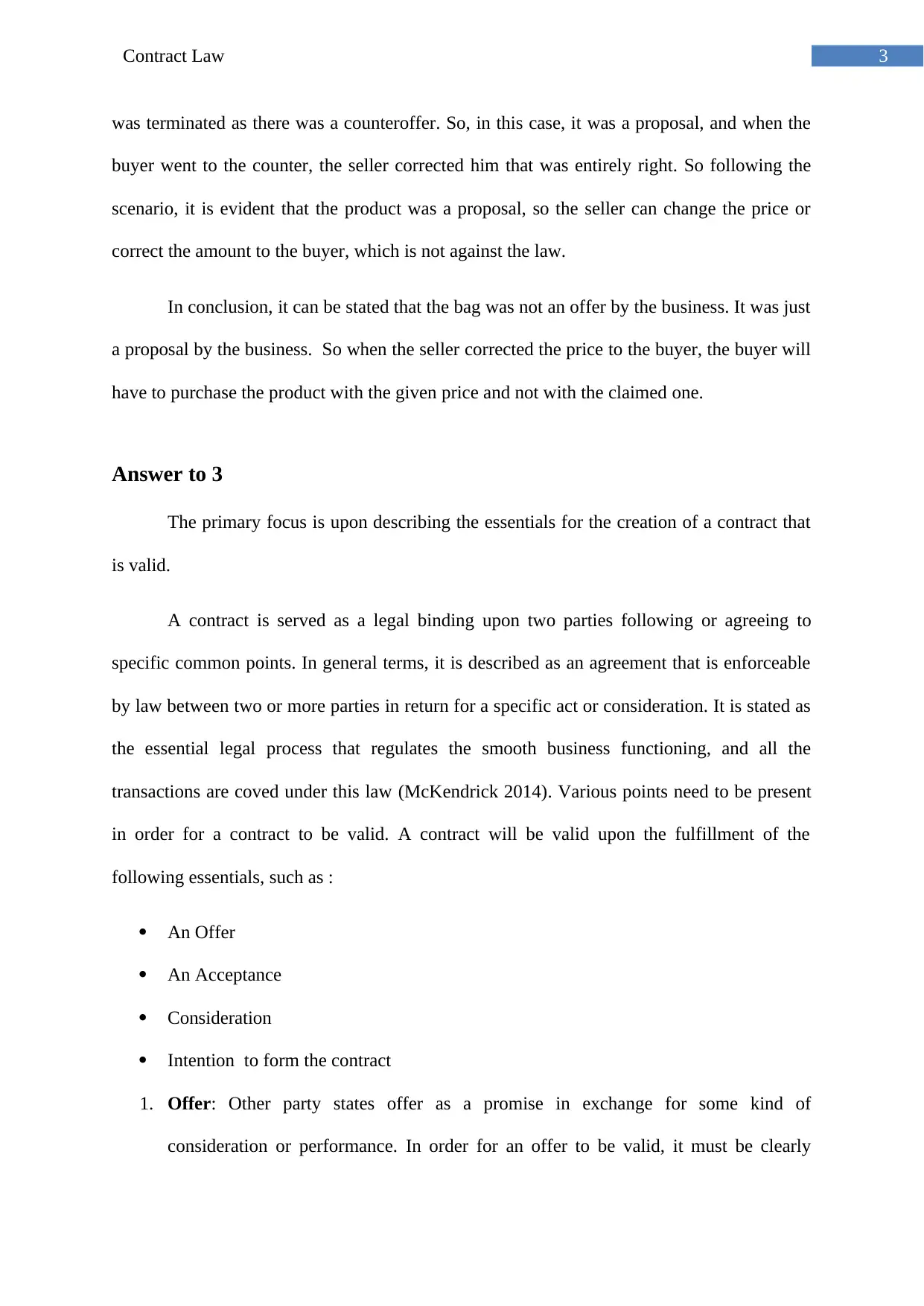
was terminated as there was a counteroffer. So, in this case, it was a proposal, and when the
buyer went to the counter, the seller corrected him that was entirely right. So following the
scenario, it is evident that the product was a proposal, so the seller can change the price or
correct the amount to the buyer, which is not against the law.
In conclusion, it can be stated that the bag was not an offer by the business. It was just
a proposal by the business. So when the seller corrected the price to the buyer, the buyer will
have to purchase the product with the given price and not with the claimed one.
Answer to 3
The primary focus is upon describing the essentials for the creation of a contract that
is valid.
A contract is served as a legal binding upon two parties following or agreeing to
specific common points. In general terms, it is described as an agreement that is enforceable
by law between two or more parties in return for a specific act or consideration. It is stated as
the essential legal process that regulates the smooth business functioning, and all the
transactions are coved under this law (McKendrick 2014). Various points need to be present
in order for a contract to be valid. A contract will be valid upon the fulfillment of the
following essentials, such as :
An Offer
An Acceptance
Consideration
Intention to form the contract
1. Offer: Other party states offer as a promise in exchange for some kind of
consideration or performance. In order for an offer to be valid, it must be clearly
was terminated as there was a counteroffer. So, in this case, it was a proposal, and when the
buyer went to the counter, the seller corrected him that was entirely right. So following the
scenario, it is evident that the product was a proposal, so the seller can change the price or
correct the amount to the buyer, which is not against the law.
In conclusion, it can be stated that the bag was not an offer by the business. It was just
a proposal by the business. So when the seller corrected the price to the buyer, the buyer will
have to purchase the product with the given price and not with the claimed one.
Answer to 3
The primary focus is upon describing the essentials for the creation of a contract that
is valid.
A contract is served as a legal binding upon two parties following or agreeing to
specific common points. In general terms, it is described as an agreement that is enforceable
by law between two or more parties in return for a specific act or consideration. It is stated as
the essential legal process that regulates the smooth business functioning, and all the
transactions are coved under this law (McKendrick 2014). Various points need to be present
in order for a contract to be valid. A contract will be valid upon the fulfillment of the
following essentials, such as :
An Offer
An Acceptance
Consideration
Intention to form the contract
1. Offer: Other party states offer as a promise in exchange for some kind of
consideration or performance. In order for an offer to be valid, it must be clearly
Paraphrase This Document
Need a fresh take? Get an instant paraphrase of this document with our AI Paraphraser

4Contract Law
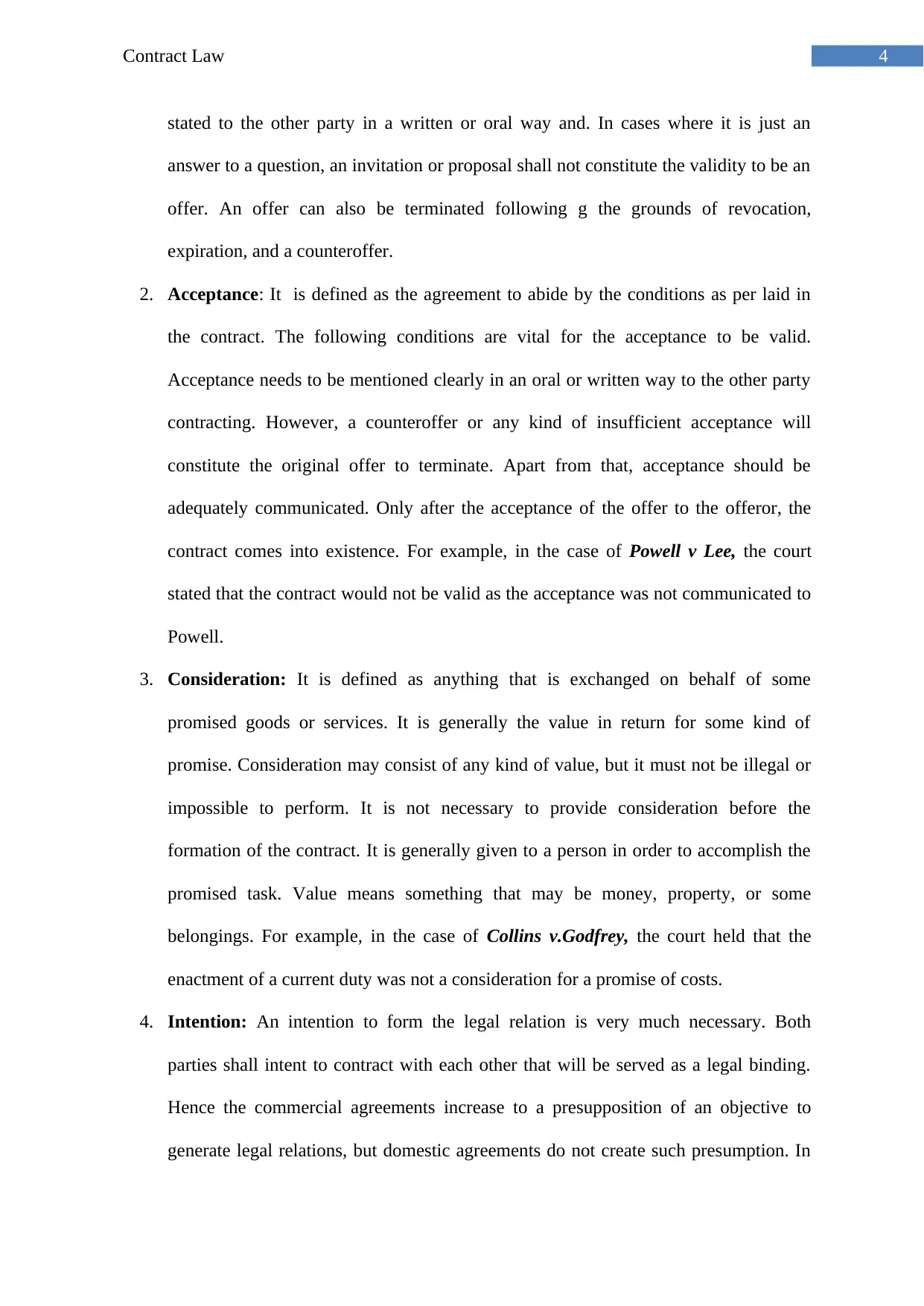
stated to the other party in a written or oral way and. In cases where it is just an
answer to a question, an invitation or proposal shall not constitute the validity to be an
offer. An offer can also be terminated following g the grounds of revocation,
expiration, and a counteroffer.
2. Acceptance: It is defined as the agreement to abide by the conditions as per laid in
the contract. The following conditions are vital for the acceptance to be valid.
Acceptance needs to be mentioned clearly in an oral or written way to the other party
contracting. However, a counteroffer or any kind of insufficient acceptance will
constitute the original offer to terminate. Apart from that, acceptance should be
adequately communicated. Only after the acceptance of the offer to the offeror, the
contract comes into existence. For example, in the case of Powell v Lee, the court
stated that the contract would not be valid as the acceptance was not communicated to
Powell.
3. Consideration: It is defined as anything that is exchanged on behalf of some
promised goods or services. It is generally the value in return for some kind of
promise. Consideration may consist of any kind of value, but it must not be illegal or
impossible to perform. It is not necessary to provide consideration before the
formation of the contract. It is generally given to a person in order to accomplish the
promised task. Value means something that may be money, property, or some
belongings. For example, in the case of Collins v.Godfrey, the court held that the
enactment of a current duty was not a consideration for a promise of costs.
4. Intention: An intention to form the legal relation is very much necessary. Both
parties shall intent to contract with each other that will be served as a legal binding.
Hence the commercial agreements increase to a presupposition of an objective to
generate legal relations, but domestic agreements do not create such presumption. In
stated to the other party in a written or oral way and. In cases where it is just an
answer to a question, an invitation or proposal shall not constitute the validity to be an
offer. An offer can also be terminated following g the grounds of revocation,
expiration, and a counteroffer.
2. Acceptance: It is defined as the agreement to abide by the conditions as per laid in
the contract. The following conditions are vital for the acceptance to be valid.
Acceptance needs to be mentioned clearly in an oral or written way to the other party
contracting. However, a counteroffer or any kind of insufficient acceptance will
constitute the original offer to terminate. Apart from that, acceptance should be
adequately communicated. Only after the acceptance of the offer to the offeror, the
contract comes into existence. For example, in the case of Powell v Lee, the court
stated that the contract would not be valid as the acceptance was not communicated to
Powell.
3. Consideration: It is defined as anything that is exchanged on behalf of some
promised goods or services. It is generally the value in return for some kind of
promise. Consideration may consist of any kind of value, but it must not be illegal or
impossible to perform. It is not necessary to provide consideration before the
formation of the contract. It is generally given to a person in order to accomplish the
promised task. Value means something that may be money, property, or some
belongings. For example, in the case of Collins v.Godfrey, the court held that the
enactment of a current duty was not a consideration for a promise of costs.
4. Intention: An intention to form the legal relation is very much necessary. Both
parties shall intent to contract with each other that will be served as a legal binding.
Hence the commercial agreements increase to a presupposition of an objective to
generate legal relations, but domestic agreements do not create such presumption. In

5Contract Law
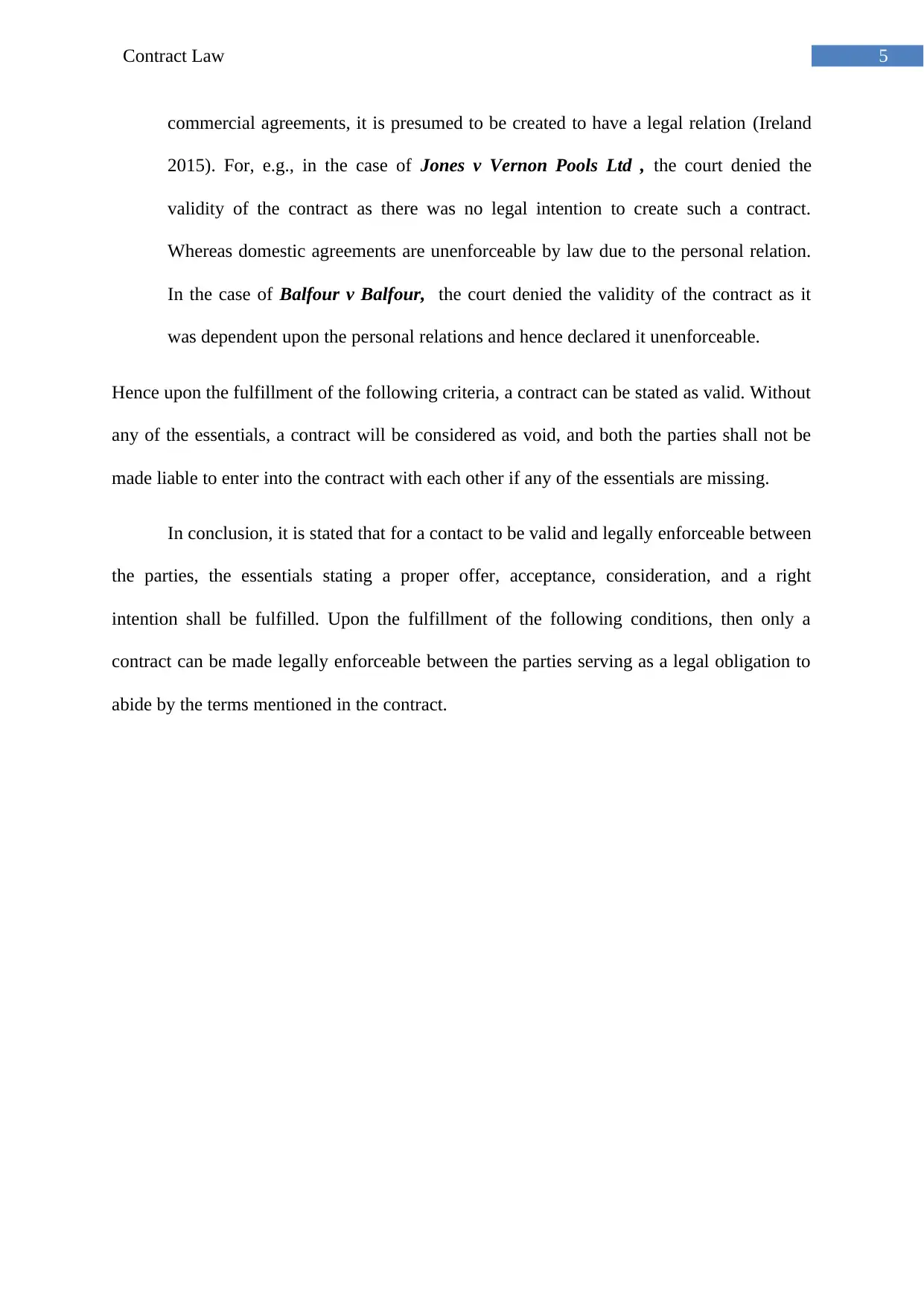
commercial agreements, it is presumed to be created to have a legal relation (Ireland
2015). For, e.g., in the case of Jones v Vernon Pools Ltd , the court denied the
validity of the contract as there was no legal intention to create such a contract.
Whereas domestic agreements are unenforceable by law due to the personal relation.
In the case of Balfour v Balfour, the court denied the validity of the contract as it
was dependent upon the personal relations and hence declared it unenforceable.
Hence upon the fulfillment of the following criteria, a contract can be stated as valid. Without
any of the essentials, a contract will be considered as void, and both the parties shall not be
made liable to enter into the contract with each other if any of the essentials are missing.
In conclusion, it is stated that for a contact to be valid and legally enforceable between
the parties, the essentials stating a proper offer, acceptance, consideration, and a right
intention shall be fulfilled. Upon the fulfillment of the following conditions, then only a
contract can be made legally enforceable between the parties serving as a legal obligation to
abide by the terms mentioned in the contract.
commercial agreements, it is presumed to be created to have a legal relation (Ireland
2015). For, e.g., in the case of Jones v Vernon Pools Ltd , the court denied the
validity of the contract as there was no legal intention to create such a contract.
Whereas domestic agreements are unenforceable by law due to the personal relation.
In the case of Balfour v Balfour, the court denied the validity of the contract as it
was dependent upon the personal relations and hence declared it unenforceable.
Hence upon the fulfillment of the following criteria, a contract can be stated as valid. Without
any of the essentials, a contract will be considered as void, and both the parties shall not be
made liable to enter into the contract with each other if any of the essentials are missing.
In conclusion, it is stated that for a contact to be valid and legally enforceable between
the parties, the essentials stating a proper offer, acceptance, consideration, and a right
intention shall be fulfilled. Upon the fulfillment of the following conditions, then only a
contract can be made legally enforceable between the parties serving as a legal obligation to
abide by the terms mentioned in the contract.
⊘ This is a preview!⊘
Do you want full access?
Subscribe today to unlock all pages.

Trusted by 1+ million students worldwide

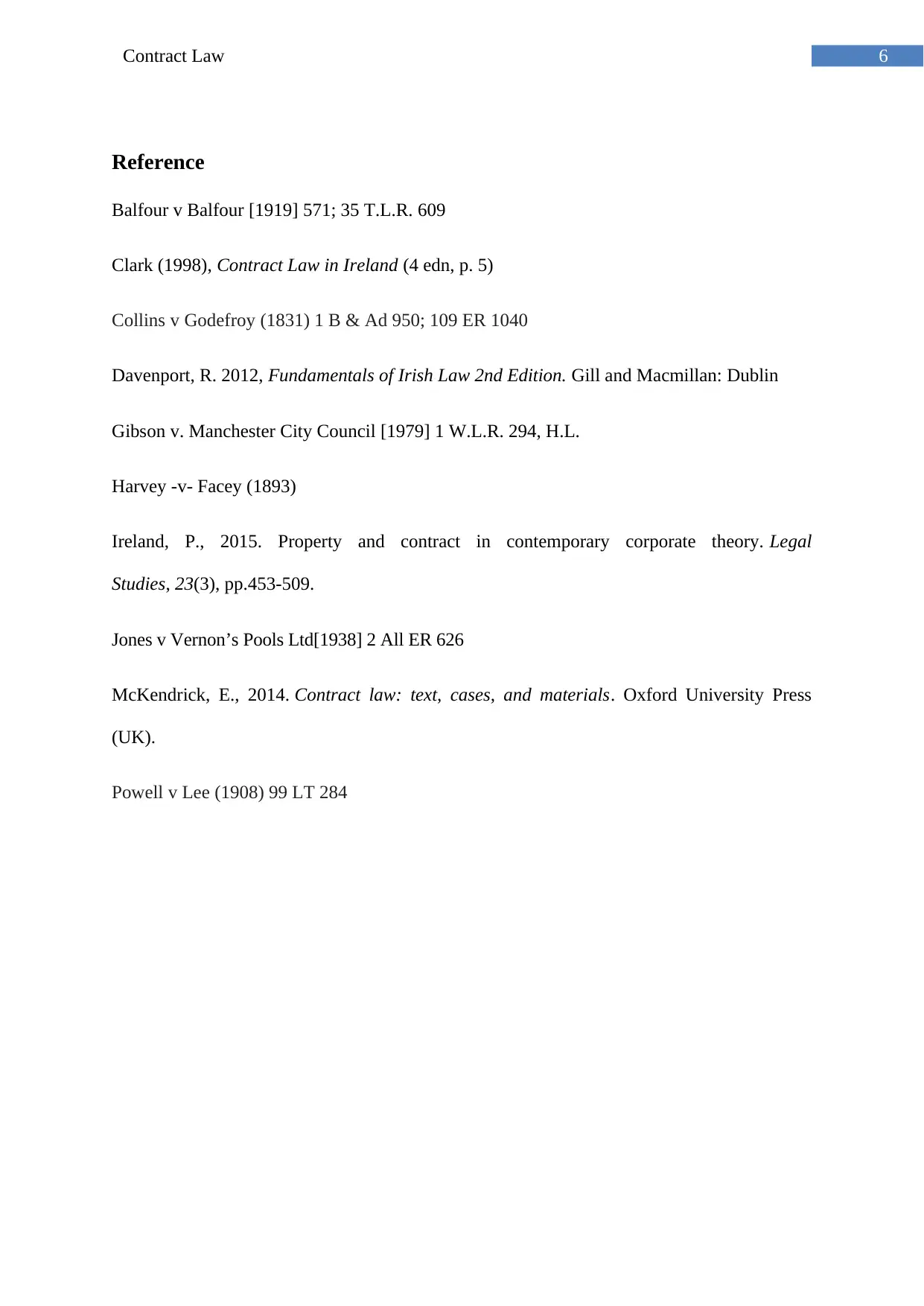
6Contract Law
Reference
Balfour v Balfour [1919] 571; 35 T.L.R. 609
Clark (1998), Contract Law in Ireland (4 edn, p. 5)
Collins v Godefroy (1831) 1 B & Ad 950; 109 ER 1040
Davenport, R. 2012, Fundamentals of Irish Law 2nd Edition. Gill and Macmillan: Dublin
Gibson v. Manchester City Council [1979] 1 W.L.R. 294, H.L.
Harvey -v- Facey (1893)
Ireland, P., 2015. Property and contract in contemporary corporate theory. Legal
Studies, 23(3), pp.453-509.
Jones v Vernon’s Pools Ltd[1938] 2 All ER 626
McKendrick, E., 2014. Contract law: text, cases, and materials. Oxford University Press
(UK).
Powell v Lee (1908) 99 LT 284
Reference
Balfour v Balfour [1919] 571; 35 T.L.R. 609
Clark (1998), Contract Law in Ireland (4 edn, p. 5)
Collins v Godefroy (1831) 1 B & Ad 950; 109 ER 1040
Davenport, R. 2012, Fundamentals of Irish Law 2nd Edition. Gill and Macmillan: Dublin
Gibson v. Manchester City Council [1979] 1 W.L.R. 294, H.L.
Harvey -v- Facey (1893)
Ireland, P., 2015. Property and contract in contemporary corporate theory. Legal
Studies, 23(3), pp.453-509.
Jones v Vernon’s Pools Ltd[1938] 2 All ER 626
McKendrick, E., 2014. Contract law: text, cases, and materials. Oxford University Press
(UK).
Powell v Lee (1908) 99 LT 284
1 out of 7
Related Documents
Your All-in-One AI-Powered Toolkit for Academic Success.
+13062052269
info@desklib.com
Available 24*7 on WhatsApp / Email
Unlock your academic potential
Copyright © 2020–2026 A2Z Services. All Rights Reserved. Developed and managed by ZUCOL.