Comprehensive Analysis of Contract Law: Elements, Liability, and Terms
VerifiedAdded on 2020/01/16
|9
|2476
|200
Report
AI Summary
This report provides a comprehensive analysis of contract law, delving into its fundamental aspects. It begins by defining contracts and outlining the essential elements required for their formation, such as offer, acceptance, and consideration, supported by relevant case laws. The report then categorizes different types of contracts, including written, face-to-face, and distance selling contracts, highlighting their distinguishing characteristics. Furthermore, it examines the various terms found within contracts, distinguishing between express, implied, and innominate terms, and elucidates their impact. The report continues by analyzing scenarios to illustrate the application of these legal concepts, including elements of contract formation and the effect of different terms. It concludes by exploring contract liability, differentiating between contractual liability and liability in tort, and analyzing negligence and vicarious liability through case studies. The report draws upon various sources to provide a well-rounded understanding of contract law principles and applications, making it a valuable resource for students and professionals alike.
ASPECTS OF CONTRACT

Paraphrase This Document
Need a fresh take? Get an instant paraphrase of this document with our AI Paraphraser
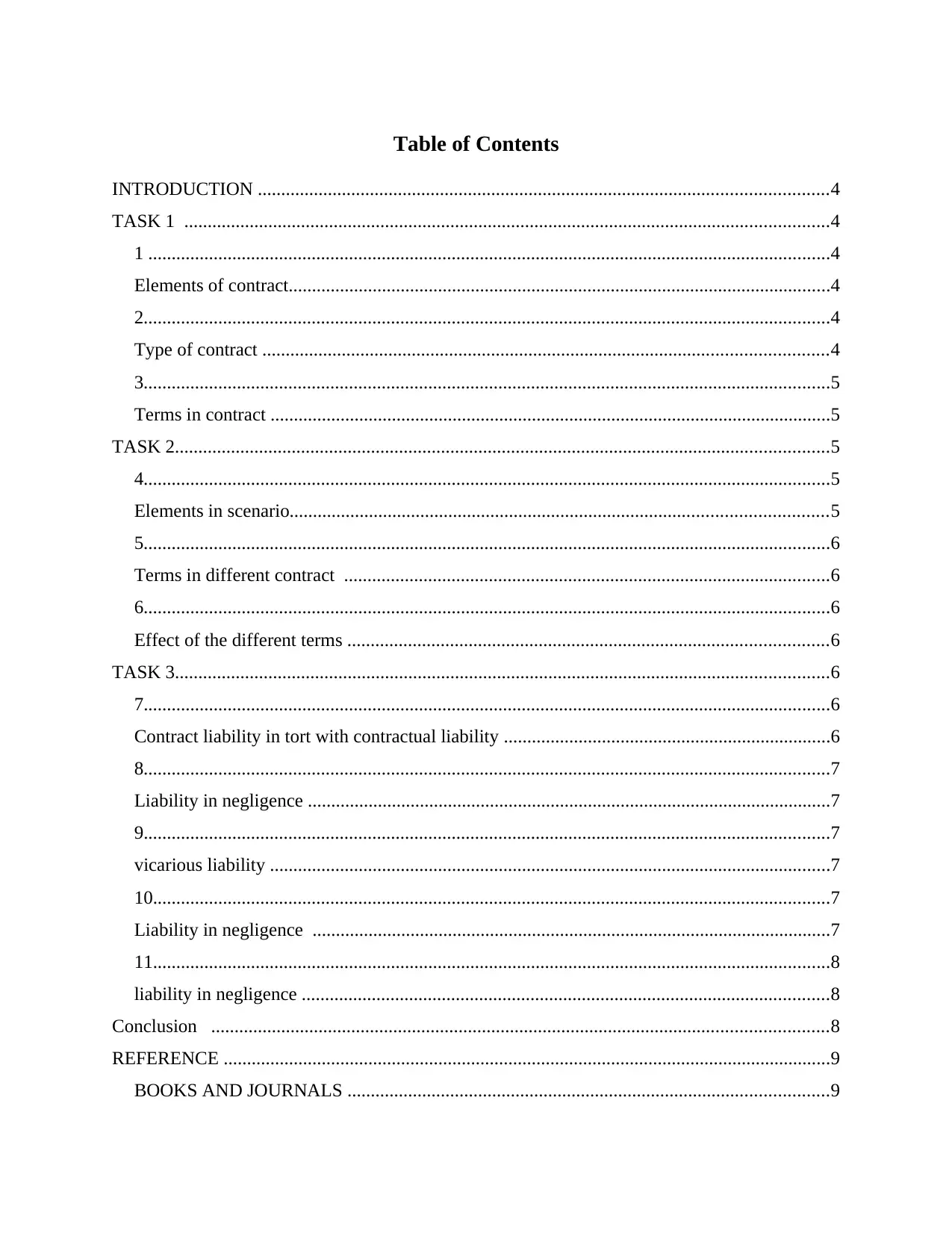
Table of Contents
INTRODUCTION ..........................................................................................................................4
TASK 1 ..........................................................................................................................................4
1 ..................................................................................................................................................4
Elements of contract....................................................................................................................4
2...................................................................................................................................................4
Type of contract .........................................................................................................................4
3...................................................................................................................................................5
Terms in contract ........................................................................................................................5
TASK 2............................................................................................................................................5
4...................................................................................................................................................5
Elements in scenario...................................................................................................................5
5...................................................................................................................................................6
Terms in different contract ........................................................................................................6
6...................................................................................................................................................6
Effect of the different terms .......................................................................................................6
TASK 3............................................................................................................................................6
7...................................................................................................................................................6
Contract liability in tort with contractual liability ......................................................................6
8...................................................................................................................................................7
Liability in negligence ................................................................................................................7
9...................................................................................................................................................7
vicarious liability ........................................................................................................................7
10.................................................................................................................................................7
Liability in negligence ...............................................................................................................7
11.................................................................................................................................................8
liability in negligence .................................................................................................................8
Conclusion ....................................................................................................................................8
REFERENCE ..................................................................................................................................9
BOOKS AND JOURNALS .......................................................................................................9
INTRODUCTION ..........................................................................................................................4
TASK 1 ..........................................................................................................................................4
1 ..................................................................................................................................................4
Elements of contract....................................................................................................................4
2...................................................................................................................................................4
Type of contract .........................................................................................................................4
3...................................................................................................................................................5
Terms in contract ........................................................................................................................5
TASK 2............................................................................................................................................5
4...................................................................................................................................................5
Elements in scenario...................................................................................................................5
5...................................................................................................................................................6
Terms in different contract ........................................................................................................6
6...................................................................................................................................................6
Effect of the different terms .......................................................................................................6
TASK 3............................................................................................................................................6
7...................................................................................................................................................6
Contract liability in tort with contractual liability ......................................................................6
8...................................................................................................................................................7
Liability in negligence ................................................................................................................7
9...................................................................................................................................................7
vicarious liability ........................................................................................................................7
10.................................................................................................................................................7
Liability in negligence ...............................................................................................................7
11.................................................................................................................................................8
liability in negligence .................................................................................................................8
Conclusion ....................................................................................................................................8
REFERENCE ..................................................................................................................................9
BOOKS AND JOURNALS .......................................................................................................9
INTRODUCTION
Law of the contract is the law governing people's agreement and obligations. Contract are
important to run a society smoothly an active operating system is necessary. A contract is
important because it can be used in the legal system to ensure that both parties of an agreement
are equally compensated for their work, goods or money. It gives a safeguard to rights of the
person in the business or the course of employment. In the following project discuss contract and
its various aspect (Argyres, Mayer, 2007). The project further describes the aspects of the
contract to make better understanding, and that create better knowledge for the same.
TASK 1
1
Elements of contract
A contract is an agreement between two or more parties upon some terms and condition and that
is enforceable by law. For the formation of a valid contract, all the elements are necessary these
are-
Offer An offer is an expression of willingness to contract on specified terms, made with the
intention that it is to be binding once accepted by the person to whom it is addressed. An offer
can be made for a specific person or group of persons or to the world at large (Appleman,
Appleman, Holmes, 2015).
Case law- Fisher v. Bell.
Acceptance- for the formation of the contract there should be acceptance of the offer from other
party or person. When a party accepts the offer with their free consent than only, it forms a valid
contract.
Case law- Adams v. Lindsell.
Consideration is the price paid for the promise of the other party. The price must be something
related to value, although it need not be money it may be some rights interest or benefit to
another party (Chadha, Kremer, Scedrov, 2006).
Case law- Chapple v. Nestle.
Law of the contract is the law governing people's agreement and obligations. Contract are
important to run a society smoothly an active operating system is necessary. A contract is
important because it can be used in the legal system to ensure that both parties of an agreement
are equally compensated for their work, goods or money. It gives a safeguard to rights of the
person in the business or the course of employment. In the following project discuss contract and
its various aspect (Argyres, Mayer, 2007). The project further describes the aspects of the
contract to make better understanding, and that create better knowledge for the same.
TASK 1
1
Elements of contract
A contract is an agreement between two or more parties upon some terms and condition and that
is enforceable by law. For the formation of a valid contract, all the elements are necessary these
are-
Offer An offer is an expression of willingness to contract on specified terms, made with the
intention that it is to be binding once accepted by the person to whom it is addressed. An offer
can be made for a specific person or group of persons or to the world at large (Appleman,
Appleman, Holmes, 2015).
Case law- Fisher v. Bell.
Acceptance- for the formation of the contract there should be acceptance of the offer from other
party or person. When a party accepts the offer with their free consent than only, it forms a valid
contract.
Case law- Adams v. Lindsell.
Consideration is the price paid for the promise of the other party. The price must be something
related to value, although it need not be money it may be some rights interest or benefit to
another party (Chadha, Kremer, Scedrov, 2006).
Case law- Chapple v. Nestle.
⊘ This is a preview!⊘
Do you want full access?
Subscribe today to unlock all pages.

Trusted by 1+ million students worldwide
2
Type of contract
A written contract is those contract which is in written form. The contract in which all the terms
and the condition written down are known as written contract. These contracts are mostly used in
business relation to looking back into terms and conditions which were written down at the time
of formation of the contract (Lyon, 2013).
Face to face contract these contracts are the most crystal clear contract than any other contract.
In these contract both the parties were present at the same place and the terms and condition
decide by both the parties and if they agree then they come into a contract (Zhao, Wayne,
Glibkowski, 2007). In these contract, there are very fewer chances of miscommunication or
confusion.
Distance selling contract Contract made between a trader and the consumer where they are not
together, which is negotiated and agree by one or more organised. These contracts are made
throw phone, email, website. By these contract, it is easy to buy a product from another country.
3
Terms in contract
There are three type of contract-
Express terms these terms are laid down by the parties themselves. Theses are the terms, and the
condition of the contract is based (Laredo, 2007).
Implied terms the terms in the contract put into by the courts by the nature of the agreement and
the parties. And that differ from the certain type of contract in each contract implied term will be
different.
Innominate terms This terms arise on breach of which may or may not go to the root of the
contract, and that depend upon the nature of the breach. Breach of innominate terms as with
other terms will arise to damage (Friedman, 2011).
Type of contract
A written contract is those contract which is in written form. The contract in which all the terms
and the condition written down are known as written contract. These contracts are mostly used in
business relation to looking back into terms and conditions which were written down at the time
of formation of the contract (Lyon, 2013).
Face to face contract these contracts are the most crystal clear contract than any other contract.
In these contract both the parties were present at the same place and the terms and condition
decide by both the parties and if they agree then they come into a contract (Zhao, Wayne,
Glibkowski, 2007). In these contract, there are very fewer chances of miscommunication or
confusion.
Distance selling contract Contract made between a trader and the consumer where they are not
together, which is negotiated and agree by one or more organised. These contracts are made
throw phone, email, website. By these contract, it is easy to buy a product from another country.
3
Terms in contract
There are three type of contract-
Express terms these terms are laid down by the parties themselves. Theses are the terms, and the
condition of the contract is based (Laredo, 2007).
Implied terms the terms in the contract put into by the courts by the nature of the agreement and
the parties. And that differ from the certain type of contract in each contract implied term will be
different.
Innominate terms This terms arise on breach of which may or may not go to the root of the
contract, and that depend upon the nature of the breach. Breach of innominate terms as with
other terms will arise to damage (Friedman, 2011).
Paraphrase This Document
Need a fresh take? Get an instant paraphrase of this document with our AI Paraphraser
TASK 2
4
Elements in scenario
As per the given scenario, in this case, Todor put his book on the display for 50 euro and
Ivan want to buy that book he takes that book on the counter to pay that money but today refuse
to sell that book he said that this book has already sold. In this today who put that book with the
mark of 50 euro that was the offer to the world to buy that book at the specific price. And in this
case the offer was accepted by the Ivan but in this today refuse to accept the offer because the
book was already old, so in this scenario, the a valid contract was not formed by them and in this
scenario only offer and acceptance two elements perform by the parties.
5
Terms in different contract
A condition is a term that, if breached, gives the aggrieved party the right either to
terminate the contract or affirm it (Qian, Strahan, 2007). Also, the aggrieved party can also claim
damages.
A warranty is a term that, if breached, does not give the aggrieved party the right to terminate
the contract; it gives rise only to a right to claim damages.
Innominate terms are neither a condition nor a warranty and are also referred to as intermediate
terms. A breach of any terms gives the other party the rights to sue for damage.
6
Effect of the different terms
The facts are in the scenario is John goes into the park which is managed by his local council. In
the park, there are chairs which can take to sit for 50p per hour (Tayur, 2012). John pays 50p and
get the chair to sit. Later because of chair John collapses by the chair and he was injured and
badly damaged his clothes, then he wants to complain and wants to claim the compensation from
the council, so they show the ticket of the chair where it was clearly stated that "no liability is
accepted for any damage or injury caused by the failure of any hired equipment". So as per the
scenario there was in this the innominate term mention in the contract and It was stated in the
contract and when John buy the ticket he must have to see the ticket after paying the money and
4
Elements in scenario
As per the given scenario, in this case, Todor put his book on the display for 50 euro and
Ivan want to buy that book he takes that book on the counter to pay that money but today refuse
to sell that book he said that this book has already sold. In this today who put that book with the
mark of 50 euro that was the offer to the world to buy that book at the specific price. And in this
case the offer was accepted by the Ivan but in this today refuse to accept the offer because the
book was already old, so in this scenario, the a valid contract was not formed by them and in this
scenario only offer and acceptance two elements perform by the parties.
5
Terms in different contract
A condition is a term that, if breached, gives the aggrieved party the right either to
terminate the contract or affirm it (Qian, Strahan, 2007). Also, the aggrieved party can also claim
damages.
A warranty is a term that, if breached, does not give the aggrieved party the right to terminate
the contract; it gives rise only to a right to claim damages.
Innominate terms are neither a condition nor a warranty and are also referred to as intermediate
terms. A breach of any terms gives the other party the rights to sue for damage.
6
Effect of the different terms
The facts are in the scenario is John goes into the park which is managed by his local council. In
the park, there are chairs which can take to sit for 50p per hour (Tayur, 2012). John pays 50p and
get the chair to sit. Later because of chair John collapses by the chair and he was injured and
badly damaged his clothes, then he wants to complain and wants to claim the compensation from
the council, so they show the ticket of the chair where it was clearly stated that "no liability is
accepted for any damage or injury caused by the failure of any hired equipment". So as per the
scenario there was in this the innominate term mention in the contract and It was stated in the
contract and when John buy the ticket he must have to see the ticket after paying the money and
if a person pay the money that considers as he accept all the terms and the condition so as per the
innominate term John will not get any compensation. He is liable for not reading the ticket
carefully.
TASK 3
7.
Contract liability in tort with contractual liability
The contractual liability that punishes a failure to fulfil contractual obligations and the
liability in tort applicable where the negligence is done by the parties. If the conditions for the
application of contractual liability are fulfilled, tort liability will not apply. Tort liability is
excluded by contractual liability under the principle of non-accumulation of contractual and tort
liabilities (Argyres, Bercovitz, Mayer, 2007). Strict liability is a legal doctrine that holds a person
responsible for the damages or loss caused by his or her acts or omissions. The contractual duty
may be owed to one person and the duty independent of that contract to another.
Case law- Austin v. G.W.Railway.
8
Liability in negligence
In negligence, the tortious liability arises on the person who commits the wrong the nature of the
liability will be strict in tortious liability. Liability in tort a defendant is found responsible for the
cause of plaintiff injury (Dittmann, Maug, 2007). Liability in tort law may be based on the fault,
or it may be strict. There is no liability arise without the fault. There are two main types of
liability first the liability may be due to an intention act, and the other one is liability mat also
due to a negligent act.
9.
vicarious liability
This refers to a situation where someone is held liable for the another person's action. Vicarious
liability in business context employer will be liable for the act of employees during employment.
Vicarious liability is a form of strict liability. In this doctrine of 'respondent superior', it means
that the responsibility of the superior for the acts of their subordinate (Brennan, Buchanan,
innominate term John will not get any compensation. He is liable for not reading the ticket
carefully.
TASK 3
7.
Contract liability in tort with contractual liability
The contractual liability that punishes a failure to fulfil contractual obligations and the
liability in tort applicable where the negligence is done by the parties. If the conditions for the
application of contractual liability are fulfilled, tort liability will not apply. Tort liability is
excluded by contractual liability under the principle of non-accumulation of contractual and tort
liabilities (Argyres, Bercovitz, Mayer, 2007). Strict liability is a legal doctrine that holds a person
responsible for the damages or loss caused by his or her acts or omissions. The contractual duty
may be owed to one person and the duty independent of that contract to another.
Case law- Austin v. G.W.Railway.
8
Liability in negligence
In negligence, the tortious liability arises on the person who commits the wrong the nature of the
liability will be strict in tortious liability. Liability in tort a defendant is found responsible for the
cause of plaintiff injury (Dittmann, Maug, 2007). Liability in tort law may be based on the fault,
or it may be strict. There is no liability arise without the fault. There are two main types of
liability first the liability may be due to an intention act, and the other one is liability mat also
due to a negligent act.
9.
vicarious liability
This refers to a situation where someone is held liable for the another person's action. Vicarious
liability in business context employer will be liable for the act of employees during employment.
Vicarious liability is a form of strict liability. In this doctrine of 'respondent superior', it means
that the responsibility of the superior for the acts of their subordinate (Brennan, Buchanan,
⊘ This is a preview!⊘
Do you want full access?
Subscribe today to unlock all pages.
Trusted by 1+ million students worldwide
2008). In this liability, the third party will vicariously liable for the act done by the other party.
In the business context in the employer will be liable for the employee's actions.
Case law- Lister v. Hesley.
10.
Liability in negligence
In this scenario, the facts are David was driving in the wrong street where in that street Children
were playing. There on the street nine-year-old kid was playing. David negligently hit a
telephone pole and because of that the kid was permanently injured. The telephone pole was
owned by the local phone company that hits by David, and that hit Kevin and that injured him
permanently (Gordon, Morel, 2012). So, in this case, tortious liability arise on David because he
was driving the car in the wrong lane and he also hit the car on a telephone pole and the nature of
the liability will be strict in this case. David need to take are about all the consequence and the
negligence is done on his part.
11.
liability in negligence
The facts of this scenario are Colin who was the head chef of the Regent hotel. He fed up with
Roger who was the worker in the same kitchen he works as a dishwasher and rogers fed up with
his attitude and by his anger (Bal, et.al., 2008). One day Colin knocks Roger unconsciously with
the frying pan. By the act of the Colin Roger severely injured. In this case, the vicarious liability
arises in this case. The nature of vicarious liability is strict in this the third person will be liable
for the act. In vicarious liability, if any wrong done by the employee than the employer will be
liable for his wrong if he is in the course of employment.
Conclusion
In this project discuss different aspect of the contract and why it is important for the business
and the for the society. And this project gives the clear knowledge about the contract and as well
as about the negligence in the business and it describes the different type of liability in the
contract. This project defines other laws as well the also give the basic knowledge on that topic.
In the business context in the employer will be liable for the employee's actions.
Case law- Lister v. Hesley.
10.
Liability in negligence
In this scenario, the facts are David was driving in the wrong street where in that street Children
were playing. There on the street nine-year-old kid was playing. David negligently hit a
telephone pole and because of that the kid was permanently injured. The telephone pole was
owned by the local phone company that hits by David, and that hit Kevin and that injured him
permanently (Gordon, Morel, 2012). So, in this case, tortious liability arise on David because he
was driving the car in the wrong lane and he also hit the car on a telephone pole and the nature of
the liability will be strict in this case. David need to take are about all the consequence and the
negligence is done on his part.
11.
liability in negligence
The facts of this scenario are Colin who was the head chef of the Regent hotel. He fed up with
Roger who was the worker in the same kitchen he works as a dishwasher and rogers fed up with
his attitude and by his anger (Bal, et.al., 2008). One day Colin knocks Roger unconsciously with
the frying pan. By the act of the Colin Roger severely injured. In this case, the vicarious liability
arises in this case. The nature of vicarious liability is strict in this the third person will be liable
for the act. In vicarious liability, if any wrong done by the employee than the employer will be
liable for his wrong if he is in the course of employment.
Conclusion
In this project discuss different aspect of the contract and why it is important for the business
and the for the society. And this project gives the clear knowledge about the contract and as well
as about the negligence in the business and it describes the different type of liability in the
contract. This project defines other laws as well the also give the basic knowledge on that topic.
Paraphrase This Document
Need a fresh take? Get an instant paraphrase of this document with our AI Paraphraser
REFERENCE
BOOKS AND JOURNALS
Argyres, N. and Mayer, K.J., 2007. Contract design as a firm capability: An integration of
learning and transaction cost perspectives. Academy of Management Review, 32(4), pp.1060-
1077.
Appleman, J.A., Appleman, J. and Holmes, E.M., 2015. Excuses for Nonpayment and Defenses
to Actions for Premiums (Vol. 5). Appleman on Insurance Law and Practice.
Chadha, R., Kremer, S. and Scedrov, A., 2006. Formal analysis of multiparty contract signing.
Journal of Automated Reasoning, 36(1-2), pp.39-83.
Zhao, H.A.O., Wayne, S.J., Glibkowski, B.C. and Bravo, J., 2007. The impact of psychological
contract breach on work‐related outcomes: a meta‐analysis. Personnel psychology, 60(3),
pp.647-680.
Laredo, P., 2007. Revisiting the third mission of universities: toward a renewed categorization of
university activities?. Higher education policy, 20(4), pp.441-456.
Friedman, L.M., 2011. Contract law in America: a social and economic case study. Quid Pro
Books.
Qian, J. and Strahan, P.E., 2007. How laws and institutions shape financial contracts: The case of
bank loans. The Journal of Finance, 62(6), pp.2803-2834.
Argyres, N.S., Bercovitz, J. and Mayer, K.J., 2007. Complementarity and evolution of
contractual provisions: An empirical study of IT services contracts. Organization Science, 18(1),
pp.3-19.
Dittmann, I. and Maug, E., 2007. Lower salaries and no options? On the optimal structure of
executive pay. The Journal of Finance, 62(1), pp.303-343.
Brennan, G. and Buchanan, J.M., 2008. The reason of rules. Cambridge Books.
Gordon, H.R. and Morel, A.Y., 2012. Remote assessment of ocean color for interpretation of
satellite visible imagery: A review (Vol. 4). Springer Science & Business Media.
BOOKS AND JOURNALS
Argyres, N. and Mayer, K.J., 2007. Contract design as a firm capability: An integration of
learning and transaction cost perspectives. Academy of Management Review, 32(4), pp.1060-
1077.
Appleman, J.A., Appleman, J. and Holmes, E.M., 2015. Excuses for Nonpayment and Defenses
to Actions for Premiums (Vol. 5). Appleman on Insurance Law and Practice.
Chadha, R., Kremer, S. and Scedrov, A., 2006. Formal analysis of multiparty contract signing.
Journal of Automated Reasoning, 36(1-2), pp.39-83.
Zhao, H.A.O., Wayne, S.J., Glibkowski, B.C. and Bravo, J., 2007. The impact of psychological
contract breach on work‐related outcomes: a meta‐analysis. Personnel psychology, 60(3),
pp.647-680.
Laredo, P., 2007. Revisiting the third mission of universities: toward a renewed categorization of
university activities?. Higher education policy, 20(4), pp.441-456.
Friedman, L.M., 2011. Contract law in America: a social and economic case study. Quid Pro
Books.
Qian, J. and Strahan, P.E., 2007. How laws and institutions shape financial contracts: The case of
bank loans. The Journal of Finance, 62(6), pp.2803-2834.
Argyres, N.S., Bercovitz, J. and Mayer, K.J., 2007. Complementarity and evolution of
contractual provisions: An empirical study of IT services contracts. Organization Science, 18(1),
pp.3-19.
Dittmann, I. and Maug, E., 2007. Lower salaries and no options? On the optimal structure of
executive pay. The Journal of Finance, 62(1), pp.303-343.
Brennan, G. and Buchanan, J.M., 2008. The reason of rules. Cambridge Books.
Gordon, H.R. and Morel, A.Y., 2012. Remote assessment of ocean color for interpretation of
satellite visible imagery: A review (Vol. 4). Springer Science & Business Media.
Bal, P.M., De Lange, A.H., Jansen, P.G. and Van Der Velde, M.E., 2008. Psychological contract
breach and job attitudes: A meta-analysis of age as a moderator. Journal of vocational behavior,
72(1), pp.143-158.
Tayur, S., Ganeshan, R. and Magazine, M. eds., 2012. Quantitative models for supply chain
management (Vol. 17). Springer Science & Business Media.
Lyon, D., 2013. The information society: Issues and illusions. John Wiley & Sons.
Online
Net Industries and its Licensors. 2016. [online]. Available
through<http://law.jrank.org/pages/5690/Contracts-Elements-Contract.html>. Accessed on 28th
December 2016.
breach and job attitudes: A meta-analysis of age as a moderator. Journal of vocational behavior,
72(1), pp.143-158.
Tayur, S., Ganeshan, R. and Magazine, M. eds., 2012. Quantitative models for supply chain
management (Vol. 17). Springer Science & Business Media.
Lyon, D., 2013. The information society: Issues and illusions. John Wiley & Sons.
Online
Net Industries and its Licensors. 2016. [online]. Available
through<http://law.jrank.org/pages/5690/Contracts-Elements-Contract.html>. Accessed on 28th
December 2016.
⊘ This is a preview!⊘
Do you want full access?
Subscribe today to unlock all pages.
Trusted by 1+ million students worldwide

1 out of 9


Related Documents


Your All-in-One AI-Powered Toolkit for Academic Success.
+13062052269
info@desklib.com
Available 24*7 on WhatsApp / Email
![[object Object]](/_next/static/media/star-bottom.7253800d.svg)
Unlock your academic potential
Copyright © 2020–2026 A2Z Services. All Rights Reserved. Developed and managed by ZUCOL.