Legal Frameworks: Contract, Tort, ADR, Equality, and Labour Law
VerifiedAdded on 2023/01/10
|9
|3373
|78
Homework Assignment
AI Summary
This assignment explores several key areas of law, beginning with contract law, which defines agreements between parties and their enforceability. It then delves into the law of tort, examining different types of torts and their implications for causing harm and seeking compensation. The assignment also addresses Alternate Dispute Resolution (ADR) methods, such as mediation and arbitration, explaining their role in resolving disputes outside of court. Furthermore, it covers the law of equality, emphasizing its function in protecting individual and employee rights within society and organizations. Finally, the assignment concludes with an overview of labour law and its significance in governing employment practices. The document provides detailed explanations of each topic, including the elements required for a valid contract, the different categories of torts, the mechanisms of ADR, and the principles of equality and labour law. The assignment is a valuable resource for students seeking to understand these fundamental legal concepts.
Law

Paraphrase This Document
Need a fresh take? Get an instant paraphrase of this document with our AI Paraphraser
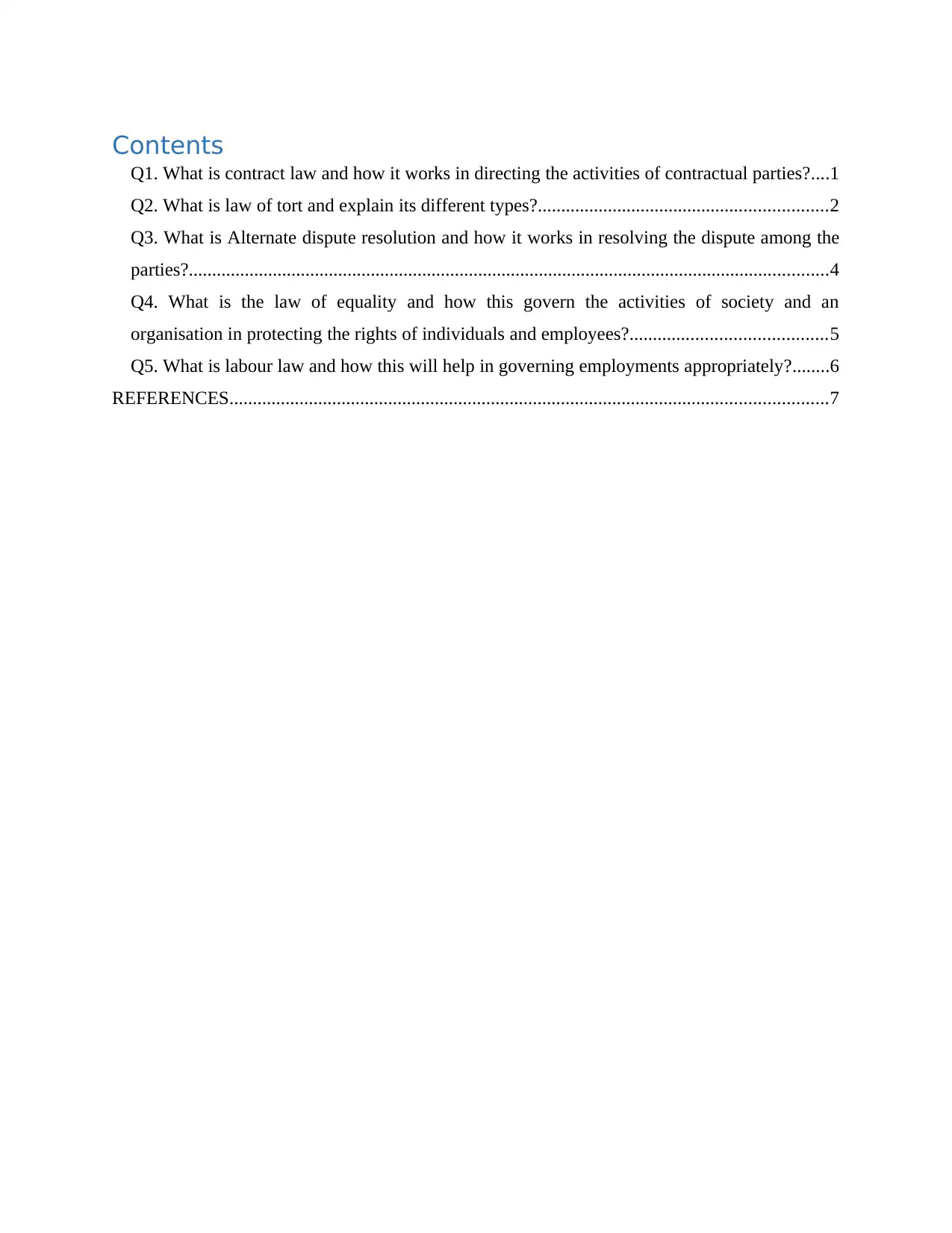
Contents
Q1. What is contract law and how it works in directing the activities of contractual parties?....1
Q2. What is law of tort and explain its different types?..............................................................2
Q3. What is Alternate dispute resolution and how it works in resolving the dispute among the
parties?.........................................................................................................................................4
Q4. What is the law of equality and how this govern the activities of society and an
organisation in protecting the rights of individuals and employees?..........................................5
Q5. What is labour law and how this will help in governing employments appropriately?........6
REFERENCES................................................................................................................................7
Q1. What is contract law and how it works in directing the activities of contractual parties?....1
Q2. What is law of tort and explain its different types?..............................................................2
Q3. What is Alternate dispute resolution and how it works in resolving the dispute among the
parties?.........................................................................................................................................4
Q4. What is the law of equality and how this govern the activities of society and an
organisation in protecting the rights of individuals and employees?..........................................5
Q5. What is labour law and how this will help in governing employments appropriately?........6
REFERENCES................................................................................................................................7
Q1. What is contract law and how it works in directing the activities of contractual parties?
A contract is understood as the agreement between two or more parties. This will be
legally binding upon the parties when entered voluntarily. This type of contract is enforceable in
law. This is the important part in the life of most persons who indulge in agreements for the
purpose of carrying business activities or performing some any other work. Contract law is falls
under the body of law that applies over the rights and obligations of all the contractual parties
under an agreement. This has the main purpose of regarding governance of relationship, validity
and interpretation of an agreement between two or more persons in respect to the any activity
like sale of goods, provision of service and exchange of interest or ownerships (Jouppi and et. al.,
2017).
English contract law is a collection of law managing contracts in England and Wales. With
its foundations in the lex mercatoria and the activism of the legal executive during the industrial
revolution, it imparts a legacy to nations over the Commonwealth, and to a lesser degree the
United States. Any agreement that is enforceable in court is a contract. Since an agreement is a
wilful commitment, rather than paying pay for a tort and compensation to switch vile
improvement, English law puts a high incentive on guaranteeing individuals have genuinely
assented to the arrangements that dilemma them in court.
In simple words, it is interpreted as collection of law that identifies with settling on and
implementing agreements. A contract is an agreement where party can go to a court to uphold.
Contract law is the territory of law that administers making contracts, doing them and designing
a reasonable cure when there's a penetrate. Any individual who conducts business utilizes
contract law. The two organizations and buyers use contracts when they purchase and sell
merchandise, when they permit items or exercises, for business understandings, for insurance
agreements and more. Contracts cause these exchanges to happen easily and with no errors. They
permit gatherings to lead their issues unquestionably. Contracts help to ensure that the parties to
an exchange are sure about its terms (Tanaka, 2019).
In process of the building valid contract, there is need of four aspects i.e. offer, acceptance,
consideration and mutual intent to enter into an agreement. The detailed description in respect to
these all is provided below:
Offer: It is necessary that one party must make an offer. While providing the offer, it is
must to present the all terms which have to be agreed by the other party. In case, party is satisfied
1
A contract is understood as the agreement between two or more parties. This will be
legally binding upon the parties when entered voluntarily. This type of contract is enforceable in
law. This is the important part in the life of most persons who indulge in agreements for the
purpose of carrying business activities or performing some any other work. Contract law is falls
under the body of law that applies over the rights and obligations of all the contractual parties
under an agreement. This has the main purpose of regarding governance of relationship, validity
and interpretation of an agreement between two or more persons in respect to the any activity
like sale of goods, provision of service and exchange of interest or ownerships (Jouppi and et. al.,
2017).
English contract law is a collection of law managing contracts in England and Wales. With
its foundations in the lex mercatoria and the activism of the legal executive during the industrial
revolution, it imparts a legacy to nations over the Commonwealth, and to a lesser degree the
United States. Any agreement that is enforceable in court is a contract. Since an agreement is a
wilful commitment, rather than paying pay for a tort and compensation to switch vile
improvement, English law puts a high incentive on guaranteeing individuals have genuinely
assented to the arrangements that dilemma them in court.
In simple words, it is interpreted as collection of law that identifies with settling on and
implementing agreements. A contract is an agreement where party can go to a court to uphold.
Contract law is the territory of law that administers making contracts, doing them and designing
a reasonable cure when there's a penetrate. Any individual who conducts business utilizes
contract law. The two organizations and buyers use contracts when they purchase and sell
merchandise, when they permit items or exercises, for business understandings, for insurance
agreements and more. Contracts cause these exchanges to happen easily and with no errors. They
permit gatherings to lead their issues unquestionably. Contracts help to ensure that the parties to
an exchange are sure about its terms (Tanaka, 2019).
In process of the building valid contract, there is need of four aspects i.e. offer, acceptance,
consideration and mutual intent to enter into an agreement. The detailed description in respect to
these all is provided below:
Offer: It is necessary that one party must make an offer. While providing the offer, it is
must to present the all terms which have to be agreed by the other party. In case, party is satisfied
1
⊘ This is a preview!⊘
Do you want full access?
Subscribe today to unlock all pages.

Trusted by 1+ million students worldwide
with all the mentioned conditions then accept the offer where ascertained the same as completion
of contract.
Acceptance: Acceptance of the one party offers by another makes the contract complete.
The party who accepts the contract must have needed to do on the same terms as presented in the
original offer. If second party proposes different terms, then it would not be a contract. This is
ascertained as counteroffer.
Consideration: For building valid contract, it is must that each party give something up.
Such process of giving up is further called as consideration (Kittay, 2019).
Mutual intent to enter into an agreement: To form a valid contract, it is must that both
parties bound by the contract. Only declaration as statement of intent is not considered as
contract because no party mutually agreed to enter into a contract. Informal agreements between
friends are often fall under this category.
Q2. What is law of tort and explain its different types?
A tort, in common law jurisdiction, is a common wrong that makes a petitioner endure
misfortune or damage, bringing about legitimate obligation for the individual who submits a
tortious demonstration. It can incorporate the purposeful punishment of emotional pain,
carelessness, money related misfortunes, wounds, intrusion of security, and numerous different
things (Cornford, 2016). Tort law, a suit where the motivation behind a lawful activity is to get a
private common cure, for example, harms, might be contrasted with criminal law, which
manages criminal wrongs that are deserving of the state. Tort law may likewise be appeared
differently in relation to contract law, which additionally gives a common cure after break of
obligation; yet while the legally binding commitment is one picked by the parties, the
commitment in both tort and wrongdoing is forced by the state. In both agreement and tort,
fruitful petitioners must show that they have endured predictable misfortune or damage as an
immediate consequence of the penetrate of an obligation.
In simple words, this is understood as set of laws that work in direction of providing
remedies to individuals who have suffered harm by the unreasonable acts of another. This based
upon the concept that people will be liable for their actions whether it would be intentional or
accidental, in case when they cause harm to another person or an entity. These are considered as
civil wrongs and falls under the category of civil lawsuits. This law further provides the
opportunity to persons about seeking of compensation for wrongs committed against them. The
2
of contract.
Acceptance: Acceptance of the one party offers by another makes the contract complete.
The party who accepts the contract must have needed to do on the same terms as presented in the
original offer. If second party proposes different terms, then it would not be a contract. This is
ascertained as counteroffer.
Consideration: For building valid contract, it is must that each party give something up.
Such process of giving up is further called as consideration (Kittay, 2019).
Mutual intent to enter into an agreement: To form a valid contract, it is must that both
parties bound by the contract. Only declaration as statement of intent is not considered as
contract because no party mutually agreed to enter into a contract. Informal agreements between
friends are often fall under this category.
Q2. What is law of tort and explain its different types?
A tort, in common law jurisdiction, is a common wrong that makes a petitioner endure
misfortune or damage, bringing about legitimate obligation for the individual who submits a
tortious demonstration. It can incorporate the purposeful punishment of emotional pain,
carelessness, money related misfortunes, wounds, intrusion of security, and numerous different
things (Cornford, 2016). Tort law, a suit where the motivation behind a lawful activity is to get a
private common cure, for example, harms, might be contrasted with criminal law, which
manages criminal wrongs that are deserving of the state. Tort law may likewise be appeared
differently in relation to contract law, which additionally gives a common cure after break of
obligation; yet while the legally binding commitment is one picked by the parties, the
commitment in both tort and wrongdoing is forced by the state. In both agreement and tort,
fruitful petitioners must show that they have endured predictable misfortune or damage as an
immediate consequence of the penetrate of an obligation.
In simple words, this is understood as set of laws that work in direction of providing
remedies to individuals who have suffered harm by the unreasonable acts of another. This based
upon the concept that people will be liable for their actions whether it would be intentional or
accidental, in case when they cause harm to another person or an entity. These are considered as
civil wrongs and falls under the category of civil lawsuits. This law further provides the
opportunity to persons about seeking of compensation for wrongs committed against them. The
2
Paraphrase This Document
Need a fresh take? Get an instant paraphrase of this document with our AI Paraphraser
scope of this law is wide where includes all different types of harm i.e. to property, reputation
and physical injury. In this case, person or an entity seek damages through the court. Damages
are considered as monetary reward which is ordered by the court for the payment to an injured
party, by the party at fault. These may be awarded for different aspects such as damage to
personal or real property, compensation for loss, injury and financial loss (Wright, 2017).
There are four elements upon which a successful tort case depends includes duty, breach of
duty, causation and injury. In respect to the tort claim, there must have been a breach of duty
made by the defendant against the plaintiff, which resulted in an injury.
There are many types of tort that leads as the basis for numerous civil lawsuits such as
negligence, assault, battery, trespass, products liability and intentional infliction of emotional
distress (Halvorssen, 2019). This law divides the most specific cases under three categories i.e.
intentional torts, negligent torts and strict liability torts. The detailed description in relation to all
these three is provided below:
Intentional torts: Intentional torts are acts dedicated with the aim to hurt another, or to
intentionally meddle with a person's privileges to substantial security, enthusiastic serenity,
protection, power over property, opportunity from double dealing, and opportunity from
imprisonment. Intentional torts normally incorporate such issues as ambush and additionally
battery, bogus detainment, attack of security, burglary, property harm, misrepresentation or other
trickiness, and intruding. Intent is a key issue in demonstrating a deliberate tort, as the harmed
party, called the Plaintiff, must demonstrate to the court that the other party, called the
Respondent or Defendant, acted intentionally, and realized that the activities could cause hurt. At
times, the Plaintiff need just demonstrate that the Defendant ought to have realized that the
activities could cause hurt. Numerous intentional torts may likewise be charged as criminal
offenses (Lee, 2016).
Negligent torts: The cases of damage or injury in negligent torts are not deliberate. There
are three explicit components that must be fulfilled in a case of negligence i.e. the respondent
must have an obligation or owe a support of the offended party or casualty, the respondent more
likely than not bombed that obligation, or abused a guarantee or commitment to the offended
party and the offended party more likely than not endured a real misfortune, injury, or harms that
were straightforwardly brought about by the offended party's activities, or inability to act
(Alhambra, Masanes, Oppenheim and Perry, 2016).
3
and physical injury. In this case, person or an entity seek damages through the court. Damages
are considered as monetary reward which is ordered by the court for the payment to an injured
party, by the party at fault. These may be awarded for different aspects such as damage to
personal or real property, compensation for loss, injury and financial loss (Wright, 2017).
There are four elements upon which a successful tort case depends includes duty, breach of
duty, causation and injury. In respect to the tort claim, there must have been a breach of duty
made by the defendant against the plaintiff, which resulted in an injury.
There are many types of tort that leads as the basis for numerous civil lawsuits such as
negligence, assault, battery, trespass, products liability and intentional infliction of emotional
distress (Halvorssen, 2019). This law divides the most specific cases under three categories i.e.
intentional torts, negligent torts and strict liability torts. The detailed description in relation to all
these three is provided below:
Intentional torts: Intentional torts are acts dedicated with the aim to hurt another, or to
intentionally meddle with a person's privileges to substantial security, enthusiastic serenity,
protection, power over property, opportunity from double dealing, and opportunity from
imprisonment. Intentional torts normally incorporate such issues as ambush and additionally
battery, bogus detainment, attack of security, burglary, property harm, misrepresentation or other
trickiness, and intruding. Intent is a key issue in demonstrating a deliberate tort, as the harmed
party, called the Plaintiff, must demonstrate to the court that the other party, called the
Respondent or Defendant, acted intentionally, and realized that the activities could cause hurt. At
times, the Plaintiff need just demonstrate that the Defendant ought to have realized that the
activities could cause hurt. Numerous intentional torts may likewise be charged as criminal
offenses (Lee, 2016).
Negligent torts: The cases of damage or injury in negligent torts are not deliberate. There
are three explicit components that must be fulfilled in a case of negligence i.e. the respondent
must have an obligation or owe a support of the offended party or casualty, the respondent more
likely than not bombed that obligation, or abused a guarantee or commitment to the offended
party and the offended party more likely than not endured a real misfortune, injury, or harms that
were straightforwardly brought about by the offended party's activities, or inability to act
(Alhambra, Masanes, Oppenheim and Perry, 2016).
3
Strict liability torts: This alludes to the idea of forcing risk on a respondent, generally a
producer, without demonstrating careless flaw, or expectation to cause hurt. The reason for
exacting obligation torts is to direct exercises that are recognized as being essential and valuable
to society, however which represent an unusually high danger of peril to people in general.
Q3. What is Alternate dispute resolution and how it works in resolving the dispute among the
parties?
Alternate Dispute Resolution (ADR) is the methodology for settling questions without suit,
for example, arbitration, mediation, or negotiation. ADR systems are generally not so much
exorbitant but rather more quick. They are progressively being used in questions that would
somehow or another outcome in prosecution, including prominent work debates, separate from
activities, and individual injury claims. One of the essential reasons parties may favour ADR
procedures is that, not at all like ill-disposed prosecution, ADR strategies are frequently
collective and permit the parties to see each other's positions. ADR additionally permits the
gatherings to think of increasingly innovative arrangements that a court may not be lawfully
permitted to force (Nonet, Selznick and Kagan, 2017).
In simple terms, this is understood as confidential and alternative method to tackling the
legal disputes which avoids going to court. This is the best method regarding resolution of
dispute without any kind of litigation along with expense of least cost. There is huge support of
this method is dispute resolution among the parties through the application of its different types.
The most common types of ADR’s include conciliation and mediation, arbitration and
adjudication. All these are defined below in detailed manner.
Conciliation and mediation: These include an independent middle man to encourage
correspondence between the two parties having the contest, with the point of accomplishing a
settlement or goals (Bishop and et. al., 2017). All in all, mediation alludes to the help of
correspondence though conciliation alludes to any evaluative strategies, for example, the creation
of proposals with regards to a result. Conciliation is commonly utilized for work circumstances
instead of business questions. Conciliation is an obligatory procedure before an individual wish
to carry a case to the Employment Tribunal.
Arbitration: This is more formal than mediation, and includes a procedure where the
question is settled by the choice of an arbitrator (Chi and et. al., 2016). The arbitration procedure
can be especially helpful in debates which require a comprehension of specialized information
4
producer, without demonstrating careless flaw, or expectation to cause hurt. The reason for
exacting obligation torts is to direct exercises that are recognized as being essential and valuable
to society, however which represent an unusually high danger of peril to people in general.
Q3. What is Alternate dispute resolution and how it works in resolving the dispute among the
parties?
Alternate Dispute Resolution (ADR) is the methodology for settling questions without suit,
for example, arbitration, mediation, or negotiation. ADR systems are generally not so much
exorbitant but rather more quick. They are progressively being used in questions that would
somehow or another outcome in prosecution, including prominent work debates, separate from
activities, and individual injury claims. One of the essential reasons parties may favour ADR
procedures is that, not at all like ill-disposed prosecution, ADR strategies are frequently
collective and permit the parties to see each other's positions. ADR additionally permits the
gatherings to think of increasingly innovative arrangements that a court may not be lawfully
permitted to force (Nonet, Selznick and Kagan, 2017).
In simple terms, this is understood as confidential and alternative method to tackling the
legal disputes which avoids going to court. This is the best method regarding resolution of
dispute without any kind of litigation along with expense of least cost. There is huge support of
this method is dispute resolution among the parties through the application of its different types.
The most common types of ADR’s include conciliation and mediation, arbitration and
adjudication. All these are defined below in detailed manner.
Conciliation and mediation: These include an independent middle man to encourage
correspondence between the two parties having the contest, with the point of accomplishing a
settlement or goals (Bishop and et. al., 2017). All in all, mediation alludes to the help of
correspondence though conciliation alludes to any evaluative strategies, for example, the creation
of proposals with regards to a result. Conciliation is commonly utilized for work circumstances
instead of business questions. Conciliation is an obligatory procedure before an individual wish
to carry a case to the Employment Tribunal.
Arbitration: This is more formal than mediation, and includes a procedure where the
question is settled by the choice of an arbitrator (Chi and et. al., 2016). The arbitration procedure
can be especially helpful in debates which require a comprehension of specialized information
4
⊘ This is a preview!⊘
Do you want full access?
Subscribe today to unlock all pages.
Trusted by 1+ million students worldwide
and where protection is significant or if there is a worldwide component. It runs as a court
procedure and choices are official. Numerous agreements will contain an assertion statement,
which expects intervention to be utilized on account of a question (Collins, Ewing and
McColgan, 2019).
Adjudication: This is basically used for resolving disputed arose out of construction
contracts. This includes formal process such as providing written notice including the details of
dispute, appoint of agreed adjudicator, serving of referral notice, response to the notice and final
decision within 28 days of referral notice.
Q4. What is the law of equality and how this govern the activities of society and an organisation
in protecting the rights of individuals and employees?
The UK government formulated the law named as Equality Act 2010. The main reason
behind the formulation of this law is promotion of equality in nation. This act governs the
activities of all individuals, institutions and organisation within the nation that they cannot
discriminate between the individuals and employees on the basis of the factors like age, sex,
gender, religion, colour and disability (Knapp, Crystal and Prince, 2019). If they do any kind of
partiality, then liable for the fine and negative consequences from the government side.
There is huge role of this act regarding protection of the individuals and employees right
within a society and an organisation. This brings an obligation over society and its officials that
never attempt the performance of aspects which will be discriminatory in nature and deprive the
one in fulfilment of their needs on the basis of factors like religion, colour, gender, sex and
disability. The same kind of obligation beings by this act over the organisational units and their
management that they never adopt the practice which is discriminatory in nature and impacts
negatively over rights of some another person. Here, within an organisation each and every one
has equal rights regarding attainment of equal pay and all other benefits without providing focus
over the determinants such as religion, colour, gender and gender (Savelyev, 2017).
Equality act 2010 is the new act and came into the force in 1 October, 2010. It unites
more than 116 separate bits of enactment into one single Act. The Act gives a legitimate
structure to secure the privileges of people and advance equity of chance for all. It furnishes
Britain with a separation law which shields people from uncalled for treatment and advances a
reasonable and increasingly equivalent society. The nine pieces of different laws are merged
under this act which includes the Equal Pay Act 1970, the Sex Discrimination Act 1975, the
5
procedure and choices are official. Numerous agreements will contain an assertion statement,
which expects intervention to be utilized on account of a question (Collins, Ewing and
McColgan, 2019).
Adjudication: This is basically used for resolving disputed arose out of construction
contracts. This includes formal process such as providing written notice including the details of
dispute, appoint of agreed adjudicator, serving of referral notice, response to the notice and final
decision within 28 days of referral notice.
Q4. What is the law of equality and how this govern the activities of society and an organisation
in protecting the rights of individuals and employees?
The UK government formulated the law named as Equality Act 2010. The main reason
behind the formulation of this law is promotion of equality in nation. This act governs the
activities of all individuals, institutions and organisation within the nation that they cannot
discriminate between the individuals and employees on the basis of the factors like age, sex,
gender, religion, colour and disability (Knapp, Crystal and Prince, 2019). If they do any kind of
partiality, then liable for the fine and negative consequences from the government side.
There is huge role of this act regarding protection of the individuals and employees right
within a society and an organisation. This brings an obligation over society and its officials that
never attempt the performance of aspects which will be discriminatory in nature and deprive the
one in fulfilment of their needs on the basis of factors like religion, colour, gender, sex and
disability. The same kind of obligation beings by this act over the organisational units and their
management that they never adopt the practice which is discriminatory in nature and impacts
negatively over rights of some another person. Here, within an organisation each and every one
has equal rights regarding attainment of equal pay and all other benefits without providing focus
over the determinants such as religion, colour, gender and gender (Savelyev, 2017).
Equality act 2010 is the new act and came into the force in 1 October, 2010. It unites
more than 116 separate bits of enactment into one single Act. The Act gives a legitimate
structure to secure the privileges of people and advance equity of chance for all. It furnishes
Britain with a separation law which shields people from uncalled for treatment and advances a
reasonable and increasingly equivalent society. The nine pieces of different laws are merged
under this act which includes the Equal Pay Act 1970, the Sex Discrimination Act 1975, the
5
Paraphrase This Document
Need a fresh take? Get an instant paraphrase of this document with our AI Paraphraser
Race Relations Act 1976, the Disability Discrimination Act 1995, the Employment Equality
(Religion or Belief) Regulations 2003, the Employment Equality (Sexual Orientation)
Regulations 2003, the Employment Equality (Age) Regulations 2006, the Equality Act 2006,
Part 2 and the Equality Act (Sexual Orientation) Regulations 2007.
Q5. What is labour law and how this will help in governing employments appropriately?
Labour law also known as employment law that is mediate the relationship between trade
union, workers, government and employing entities. Collective labour law is mainly relates to
the tripartite relationship between employer, employees and trade union. In addition, labour law
is mainly a social security mechanism that is design to give benefits and protection to workers.
Labour law primarily concerns the responsibilities and rights of unionized workers. Some groups
of worker’s analysis unions beneficial, since workers have a lot more rights and power when
they bargain as a group rather than independently. Unions can bargain for better pay, increased
workplace safety and more convenient hours. On the other hand, trade unions do not have
unlimited power. Leaders of an organization should treat their each and every union member
equally or fairly and refrain as of restricting union members’ rights and responsibilities to
speech, meeting, and voting powers (Zhang, 2019).
Labour law is effective and plays important role in governing employment. Labour laws for
example the National Labour Relations Act are essential for the reason that they provide peace of
mind to both union as well as non-union employees. Additionally, the Act requires labour unions
and employers to work with each other and collaboratively within negotiating group bargaining
agreements that get started the terms as well as conditions of employment. Labour law is more
effective and important in governing the employment as it will support an organization to make
strong relationship with their employers and employees. Along with this, Labour laws contain a
uniform purpose; they protect worker’s rights as well as set forth employers' responsibilities and
obligations. They also encompass multiple functions that are beneficial in governing of
employment effectively. The main functions of such law are to give equal pay and opportunity,
employees' mental and physical well-being and safety, as well as workplace diversity (Servais,
2017).
6
(Religion or Belief) Regulations 2003, the Employment Equality (Sexual Orientation)
Regulations 2003, the Employment Equality (Age) Regulations 2006, the Equality Act 2006,
Part 2 and the Equality Act (Sexual Orientation) Regulations 2007.
Q5. What is labour law and how this will help in governing employments appropriately?
Labour law also known as employment law that is mediate the relationship between trade
union, workers, government and employing entities. Collective labour law is mainly relates to
the tripartite relationship between employer, employees and trade union. In addition, labour law
is mainly a social security mechanism that is design to give benefits and protection to workers.
Labour law primarily concerns the responsibilities and rights of unionized workers. Some groups
of worker’s analysis unions beneficial, since workers have a lot more rights and power when
they bargain as a group rather than independently. Unions can bargain for better pay, increased
workplace safety and more convenient hours. On the other hand, trade unions do not have
unlimited power. Leaders of an organization should treat their each and every union member
equally or fairly and refrain as of restricting union members’ rights and responsibilities to
speech, meeting, and voting powers (Zhang, 2019).
Labour law is effective and plays important role in governing employment. Labour laws for
example the National Labour Relations Act are essential for the reason that they provide peace of
mind to both union as well as non-union employees. Additionally, the Act requires labour unions
and employers to work with each other and collaboratively within negotiating group bargaining
agreements that get started the terms as well as conditions of employment. Labour law is more
effective and important in governing the employment as it will support an organization to make
strong relationship with their employers and employees. Along with this, Labour laws contain a
uniform purpose; they protect worker’s rights as well as set forth employers' responsibilities and
obligations. They also encompass multiple functions that are beneficial in governing of
employment effectively. The main functions of such law are to give equal pay and opportunity,
employees' mental and physical well-being and safety, as well as workplace diversity (Servais,
2017).
6
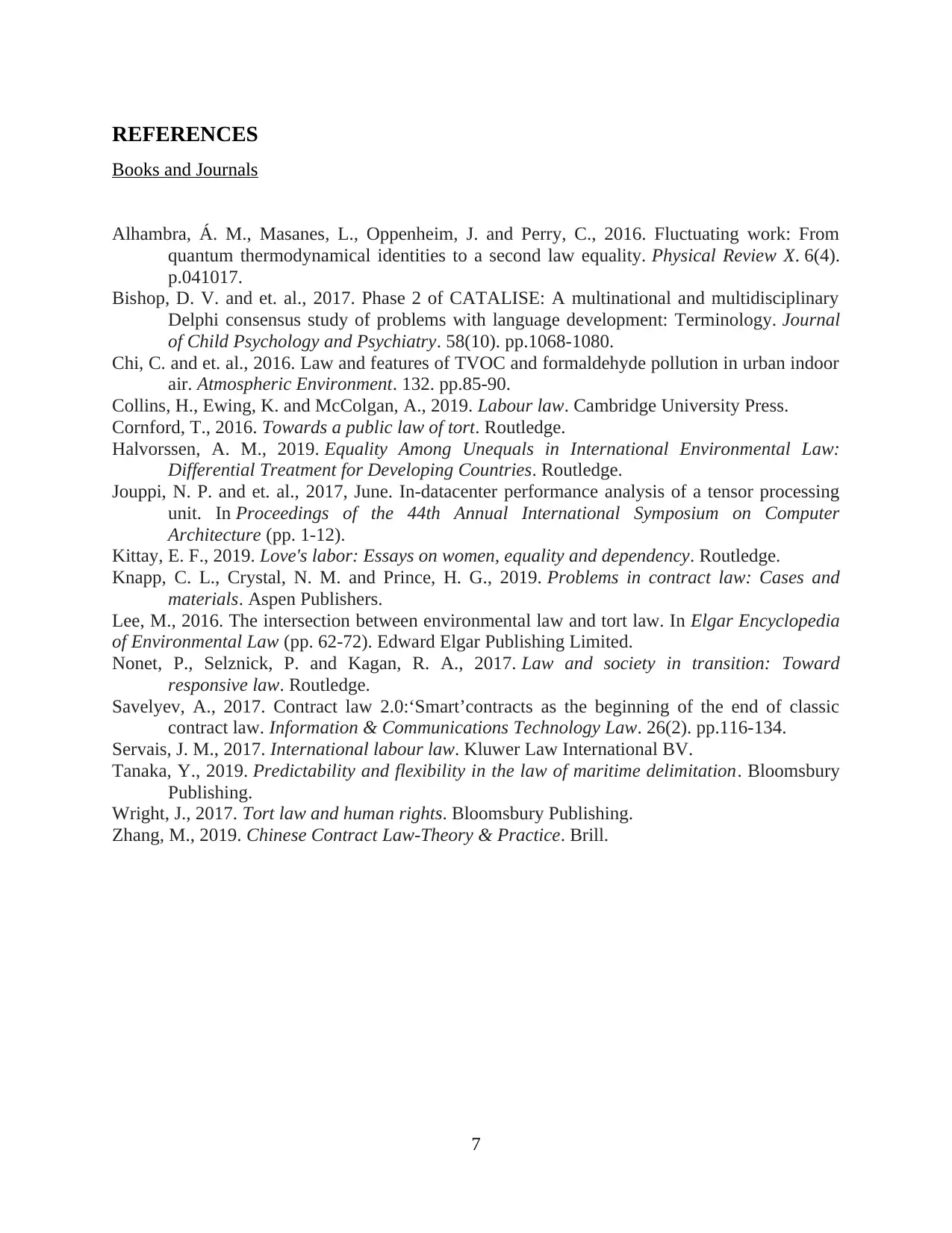
REFERENCES
Books and Journals
Alhambra, Á. M., Masanes, L., Oppenheim, J. and Perry, C., 2016. Fluctuating work: From
quantum thermodynamical identities to a second law equality. Physical Review X. 6(4).
p.041017.
Bishop, D. V. and et. al., 2017. Phase 2 of CATALISE: A multinational and multidisciplinary
Delphi consensus study of problems with language development: Terminology. Journal
of Child Psychology and Psychiatry. 58(10). pp.1068-1080.
Chi, C. and et. al., 2016. Law and features of TVOC and formaldehyde pollution in urban indoor
air. Atmospheric Environment. 132. pp.85-90.
Collins, H., Ewing, K. and McColgan, A., 2019. Labour law. Cambridge University Press.
Cornford, T., 2016. Towards a public law of tort. Routledge.
Halvorssen, A. M., 2019. Equality Among Unequals in International Environmental Law:
Differential Treatment for Developing Countries. Routledge.
Jouppi, N. P. and et. al., 2017, June. In-datacenter performance analysis of a tensor processing
unit. In Proceedings of the 44th Annual International Symposium on Computer
Architecture (pp. 1-12).
Kittay, E. F., 2019. Love's labor: Essays on women, equality and dependency. Routledge.
Knapp, C. L., Crystal, N. M. and Prince, H. G., 2019. Problems in contract law: Cases and
materials. Aspen Publishers.
Lee, M., 2016. The intersection between environmental law and tort law. In Elgar Encyclopedia
of Environmental Law (pp. 62-72). Edward Elgar Publishing Limited.
Nonet, P., Selznick, P. and Kagan, R. A., 2017. Law and society in transition: Toward
responsive law. Routledge.
Savelyev, A., 2017. Contract law 2.0:‘Smart’contracts as the beginning of the end of classic
contract law. Information & Communications Technology Law. 26(2). pp.116-134.
Servais, J. M., 2017. International labour law. Kluwer Law International BV.
Tanaka, Y., 2019. Predictability and flexibility in the law of maritime delimitation. Bloomsbury
Publishing.
Wright, J., 2017. Tort law and human rights. Bloomsbury Publishing.
Zhang, M., 2019. Chinese Contract Law-Theory & Practice. Brill.
7
Books and Journals
Alhambra, Á. M., Masanes, L., Oppenheim, J. and Perry, C., 2016. Fluctuating work: From
quantum thermodynamical identities to a second law equality. Physical Review X. 6(4).
p.041017.
Bishop, D. V. and et. al., 2017. Phase 2 of CATALISE: A multinational and multidisciplinary
Delphi consensus study of problems with language development: Terminology. Journal
of Child Psychology and Psychiatry. 58(10). pp.1068-1080.
Chi, C. and et. al., 2016. Law and features of TVOC and formaldehyde pollution in urban indoor
air. Atmospheric Environment. 132. pp.85-90.
Collins, H., Ewing, K. and McColgan, A., 2019. Labour law. Cambridge University Press.
Cornford, T., 2016. Towards a public law of tort. Routledge.
Halvorssen, A. M., 2019. Equality Among Unequals in International Environmental Law:
Differential Treatment for Developing Countries. Routledge.
Jouppi, N. P. and et. al., 2017, June. In-datacenter performance analysis of a tensor processing
unit. In Proceedings of the 44th Annual International Symposium on Computer
Architecture (pp. 1-12).
Kittay, E. F., 2019. Love's labor: Essays on women, equality and dependency. Routledge.
Knapp, C. L., Crystal, N. M. and Prince, H. G., 2019. Problems in contract law: Cases and
materials. Aspen Publishers.
Lee, M., 2016. The intersection between environmental law and tort law. In Elgar Encyclopedia
of Environmental Law (pp. 62-72). Edward Elgar Publishing Limited.
Nonet, P., Selznick, P. and Kagan, R. A., 2017. Law and society in transition: Toward
responsive law. Routledge.
Savelyev, A., 2017. Contract law 2.0:‘Smart’contracts as the beginning of the end of classic
contract law. Information & Communications Technology Law. 26(2). pp.116-134.
Servais, J. M., 2017. International labour law. Kluwer Law International BV.
Tanaka, Y., 2019. Predictability and flexibility in the law of maritime delimitation. Bloomsbury
Publishing.
Wright, J., 2017. Tort law and human rights. Bloomsbury Publishing.
Zhang, M., 2019. Chinese Contract Law-Theory & Practice. Brill.
7
⊘ This is a preview!⊘
Do you want full access?
Subscribe today to unlock all pages.
Trusted by 1+ million students worldwide

1 out of 9


Related Documents


Your All-in-One AI-Powered Toolkit for Academic Success.
+13062052269
info@desklib.com
Available 24*7 on WhatsApp / Email
![[object Object]](/_next/static/media/star-bottom.7253800d.svg)
Unlock your academic potential
Copyright © 2020–2026 A2Z Services. All Rights Reserved. Developed and managed by ZUCOL.