Business Law (HA2022) Assignment: Contract and Tort Analysis

Verified

Added on  2022/08/22

|12
|745
|12
Homework Assignment
AI Summary
This document presents a comprehensive analysis of two case problems from a Business Law assignment, focusing on contract law and the law of torts, specifically negligence. The first question examines the formation of a contract, discussing the essential elements such as offer, acceptance, and consideration, and applies these principles to a scenario involving an advertisement. The second question delves into the concept of negligence, exploring the establishment of duty of care, breach of duty, and causation, referencing the Caparo Industries PLC v Dickman case. It also addresses the issue of vicarious liability within an employer-employee context, highlighting the relationship between an employer and employee, and the potential for liability when an employee's actions cause harm to another. The analysis follows the IRAC method, providing a structured approach to legal problem-solving, and includes relevant case law and references to support the arguments presented.
Document Page
Question 1
Issue
Whether a contract existed between Greta and Sam?
Rules
For every valid contract, certain elements are
needed to exist. These elements are also known as
the essentials of the contract.
The very first essential is an offer, which is a
proposal from one party to another.
tabler-icon-diamond-filled.svg

Paraphrase This Document

Need a fresh take? Get an instant paraphrase of this document with our AI Paraphraser
Document Page
Rules
Another element is is acceptance. The first rule
states that acceptance must be appropriately
communicated to the offeror.
Further, the acceptance is required to be given for
similar terms as proposed under an offer.
Where offeree responds to an offer by creating
another offer on different terms, such
communication is known as a counteroffer.
Document Page
Rules
As given in the case of Chappell v Nestle [1960] AC
87, the adequacy of the consideration does not take
any matter as its sufficiency does (Burrows, 2018).
A further intention of the parties is another essential
of a valid contract according to which all the parties
of the contract must intend to bind each other legally.
Document Page
Application
In the case given hereby, Greta made
communication in the form of an advertisement
where she presented her will to sell the car.
This communication cannot be considered as a
valid offer as the same did not contain a certain
value of consideration and the terms of the offer in
the context of sale price were unclear.
tabler-icon-diamond-filled.svg

Paraphrase This Document

Need a fresh take? Get an instant paraphrase of this document with our AI Paraphraser
Document Page
Application cont…
Further, the consideration was also valid as the
same was sufficient and valuable in the opinion of
the law.
In addition to this, as the offer was presented in a
commercial context hence applying Esso
Petroleum v Commissioners of Customs & Excise,
the same also seems to bind Sam.
Document Page
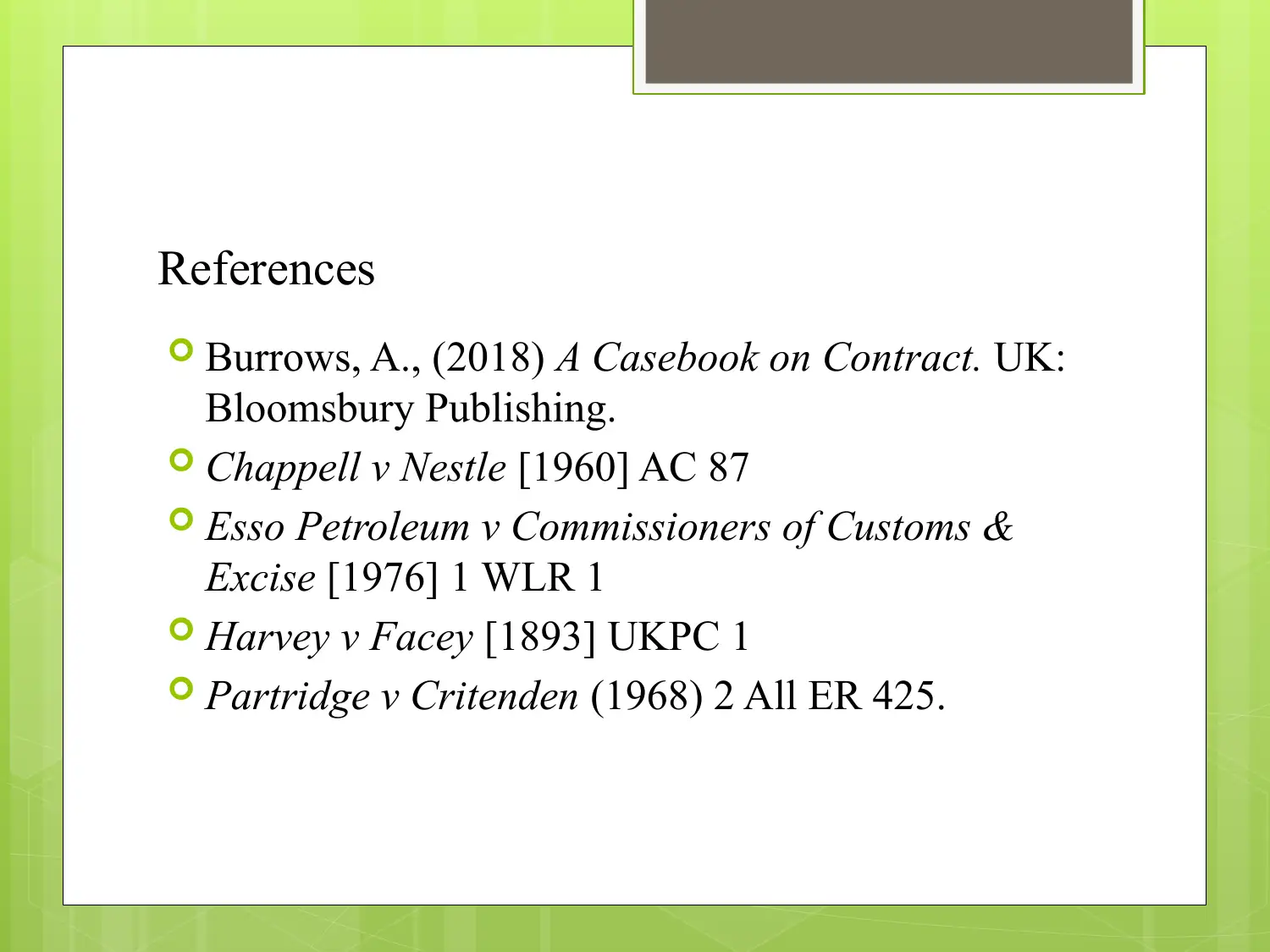
References
Burrows, A., (2018) A Casebook on Contract. UK:
Bloomsbury Publishing.
Chappell v Nestle [1960] AC 87
Esso Petroleum v Commissioners of Customs &
Excise [1976] 1 WLR 1
Harvey v Facey [1893] UKPC 1
Partridge v Critenden (1968) 2 All ER 425.
Document Page
Question 2
Issue
Whether Jonas may held liable for the negligence? Is
there any defense available to him?
Rules
In general, life, people do wrongs to each other
where some of them are intentional and some are
unintentional.
These wrongs are considered as Tort and are subject
to the provisions of Tort Law.
tabler-icon-diamond-filled.svg

Paraphrase This Document

Need a fresh take? Get an instant paraphrase of this document with our AI Paraphraser
Document Page
Rules cont.
One such case has given in the case of Caparo
Industries PLC v Dickman [1990] UKHL 2.
A three-step test was given in this case, following
that the presence or absence of duty of care can be
checked (Kelly, Hammer and Hendy, 2017).
According to first requirement the defendant must
share a proximate/neighborhood relationship with
the claimant.
Document Page
Rules Cont..
The other condition states that there must be a
breach of duty of care by the defendant that he/she
owed to the claimant.
Breach of duty refers to the failure of the
defendant to pursue the actions with the duty of
care while dealing with others (Daller, 2018).
According to the third requirement the claimant
must be suffer from some kind of loss due to the
actions of the defendant.
Document Page
Jonas was employed as a courier by Rapid
couriers. His father was also employed with the
same company.
Firstly, a duty of care existed between the parties
as applying the three-stage test given in the Caparo
case. As given in the rule section above, the
relationship between parents and child falls under
the category of proximate relation.
Application
tabler-icon-diamond-filled.svg

Paraphrase This Document

Need a fresh take? Get an instant paraphrase of this document with our AI Paraphraser
Document Page
Application cont.
To check the forth requirement this is to state that
a direct relationship between injury happened to
Jonas's father and negligence of Jonas was there.
In this manner, all the requirements of a successful
negligence claim are satisfied here.
Document Page
References
Caparo Industries PLC v Dickman [1990]
UKHL 2
Daller. (2018) Product Liability Desk
Reference: A Fifty-State Compendium, 2019
Edition (IL). USA: Wolters Kluwer Law &
Business.
Kelly, D., Hammer, R., and Hendy, J. (2017)
Business Law. New York: Taylor & Francis.
chevron_up_icon
1 out of 12
circle_padding
hide_on_mobile
zoom_out_icon
[object Object]