Analysis of Contractor Payments, Retention, and Tendering Processes
VerifiedAdded on 2020/05/28
|14
|3193
|70
Report
AI Summary
This report delves into various aspects of contractor finance and project management. It begins by examining the benefits of regular payments to contractors and the significance of retention amounts in ensuring quality work. The report then explores different methods of valuing work for payment, including the Value Of Work Done (VOWD) and Dayworks methods, and includes an example interim payment certificate. The report also addresses the process of obtaining quotes, commissioning suppliers, and payment procedures. Furthermore, it provides a detailed analysis of depreciation methods, specifically the straight-line and sum of year digits methods, using a JCB as an example. The report concludes by discussing the importance of Pre-qualification questionnaires (PQQ) and negotiated tendering, including their benefits and impact on contractor opportunities and tender prices, with a calculation of direct and indirect costs. The report provides a comprehensive overview of key financial and management aspects of construction projects.

Name:
Course:
Professor:
Course:
Professor:

Paraphrase This Document
Need a fresh take? Get an instant paraphrase of this document with our AI Paraphraser
Question 1
A
Benefits of contractor receiving regular payments
Finances are one of the major challenges which contractor faces during the
implementation period of the projects. Having regular payments ensure that the contractors are
off the handle of getting finances to support the different activities in the project. Availing the
regular payments to the contractor ensures that the project is able to continue well and do not
stop. According to statistics, many of projects are able to stall due to lack of finances. Availing
regular payment to the contractor ensures that the works are able to progress as scheduled in the
project documents (Choma 2008). The payments ensure that the contractors can keep working all
through according to the schedule. Therefore the payment ensures that the completion of the
projects is on time. In addition, regular payments ensure that the contractors concentrate on the
projects and deliver quality according to the contract document. Since the contractor has the
finances to run the works, the contractor will always have easy time in concentrating on their
works. This is able to enhance the success of the project implementation (Ross and Williams
2013). The regular payments therefore ensure works always continue all through as scheduled
without a hitch. Quality works are also achieved since the contractors do not spend much time
looking for finances to implement the project and only concentrate on the project
implementation.
B
Importance of retention amount
A
Benefits of contractor receiving regular payments
Finances are one of the major challenges which contractor faces during the
implementation period of the projects. Having regular payments ensure that the contractors are
off the handle of getting finances to support the different activities in the project. Availing the
regular payments to the contractor ensures that the project is able to continue well and do not
stop. According to statistics, many of projects are able to stall due to lack of finances. Availing
regular payment to the contractor ensures that the works are able to progress as scheduled in the
project documents (Choma 2008). The payments ensure that the contractors can keep working all
through according to the schedule. Therefore the payment ensures that the completion of the
projects is on time. In addition, regular payments ensure that the contractors concentrate on the
projects and deliver quality according to the contract document. Since the contractor has the
finances to run the works, the contractor will always have easy time in concentrating on their
works. This is able to enhance the success of the project implementation (Ross and Williams
2013). The regular payments therefore ensure works always continue all through as scheduled
without a hitch. Quality works are also achieved since the contractors do not spend much time
looking for finances to implement the project and only concentrate on the project
implementation.
B
Importance of retention amount
Retention is the amount which the employer is able to deduct in each payment certificate,
which is submitted by the contractor (Riley & Cotgrave 2011). The retention amount is paid in
fully after completion of works and successful handover is done. Retention ensures quality works
is usually done by the contractor. Failure to meet the specified quality, the retention amount is
used to compensate and rectify the works. Quality and performance are achieved through holding
of the retention amount. Since the contractor does not want to lose any amount, they are able to
work according to the specified contract documents. The retention amount acts as a guarantee to
the client that the contractor will be able to perform the contract to the satisfactory level
(Courtney, Hutchinson, O'Leary & Courtney 2012). Since the client has the right to liquidate part
of whole of the retention amount, the contractor works according to their capacity to meet the
specific parts of the contract. Therefore, retention is used by the client to ensure that the
contractor delivers quality work. It is simply the security which the employer uses until he or she
is satisfied (Klee 2015). This is because the client will pay the retention amount, which he or she
has been able to hold in the different payments. Therefore retention ensures contract details are
fulfilled up to the later.
C
Methods of valuing works for payment
Value Of Work Done (VOWD) method – this is a method of measuring and estimating
the cost of work which has already been done at any specific point. In order to determine
VOWD, percentage of physical progress is achieved through current committed value of costs of
items used. This method is able to provide accurate and comprehensive possible estimates of
costs of project. The physical progress is mostly used as a key deliverable to produce the costs.
which is submitted by the contractor (Riley & Cotgrave 2011). The retention amount is paid in
fully after completion of works and successful handover is done. Retention ensures quality works
is usually done by the contractor. Failure to meet the specified quality, the retention amount is
used to compensate and rectify the works. Quality and performance are achieved through holding
of the retention amount. Since the contractor does not want to lose any amount, they are able to
work according to the specified contract documents. The retention amount acts as a guarantee to
the client that the contractor will be able to perform the contract to the satisfactory level
(Courtney, Hutchinson, O'Leary & Courtney 2012). Since the client has the right to liquidate part
of whole of the retention amount, the contractor works according to their capacity to meet the
specific parts of the contract. Therefore, retention is used by the client to ensure that the
contractor delivers quality work. It is simply the security which the employer uses until he or she
is satisfied (Klee 2015). This is because the client will pay the retention amount, which he or she
has been able to hold in the different payments. Therefore retention ensures contract details are
fulfilled up to the later.
C
Methods of valuing works for payment
Value Of Work Done (VOWD) method – this is a method of measuring and estimating
the cost of work which has already been done at any specific point. In order to determine
VOWD, percentage of physical progress is achieved through current committed value of costs of
items used. This method is able to provide accurate and comprehensive possible estimates of
costs of project. The physical progress is mostly used as a key deliverable to produce the costs.
⊘ This is a preview!⊘
Do you want full access?
Subscribe today to unlock all pages.

Trusted by 1+ million students worldwide
In case of services, incurred hours are calculated and used for payment of the services. The
approved changes are included in the work done for estimated and valued together.
Dayworks method – this method is usually applied when the works cannot be priced in
the normal way. Under this method, the cost of labor, materials and plants mark up costs are
calculated on daily basis. The overhead costs and profits costs are calculated and added during
the payments. The method is defined as “...method of valuing work on basis of time spent by the
contractor’s work people, the materials used and the plants employed”. In the valuing of works,
this method involves who methods where one option involves a percentage addition of the
overhead costs, profits and incidental costs. The other option involves all inclusive rates, where
the tender in cooperates all the costs in contract documents.
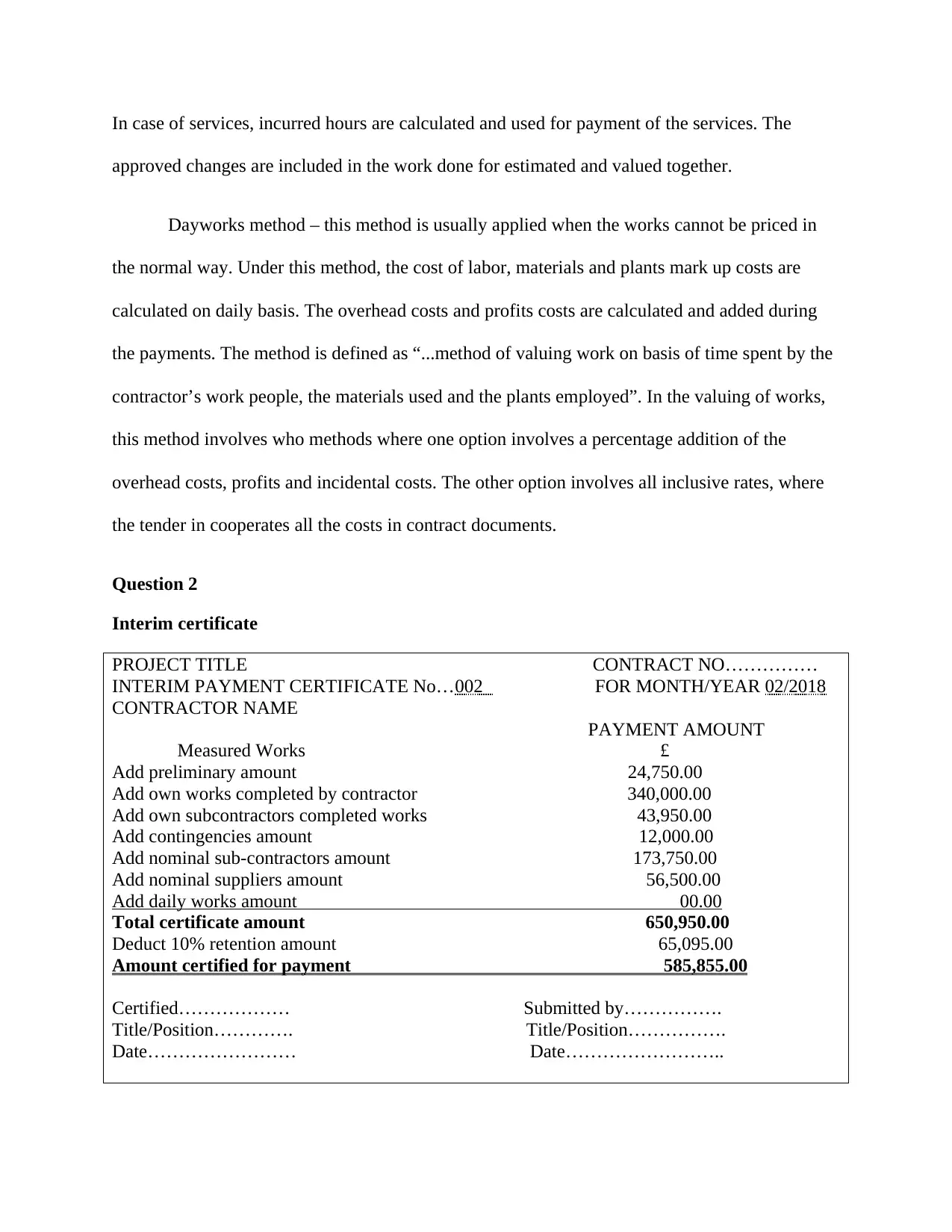
Question 2
Interim certificate
PROJECT TITLE CONTRACT NO……………
INTERIM PAYMENT CERTIFICATE No…002 FOR MONTH/YEAR 02/2018
CONTRACTOR NAME
PAYMENT AMOUNT
Measured Works £
Add preliminary amount 24,750.00
Add own works completed by contractor 340,000.00
Add own subcontractors completed works 43,950.00
Add contingencies amount 12,000.00
Add nominal sub-contractors amount 173,750.00
Add nominal suppliers amount 56,500.00
Add daily works amount 00.00
Total certificate amount 650,950.00
Deduct 10% retention amount 65,095.00
Amount certified for payment 585,855.00
Certified……………… Submitted by…………….
Title/Position…………. Title/Position…………….
Date…………………… Date……………………..
approved changes are included in the work done for estimated and valued together.
Dayworks method – this method is usually applied when the works cannot be priced in
the normal way. Under this method, the cost of labor, materials and plants mark up costs are
calculated on daily basis. The overhead costs and profits costs are calculated and added during
the payments. The method is defined as “...method of valuing work on basis of time spent by the
contractor’s work people, the materials used and the plants employed”. In the valuing of works,
this method involves who methods where one option involves a percentage addition of the
overhead costs, profits and incidental costs. The other option involves all inclusive rates, where
the tender in cooperates all the costs in contract documents.
Question 2
Interim certificate
PROJECT TITLE CONTRACT NO……………
INTERIM PAYMENT CERTIFICATE No…002 FOR MONTH/YEAR 02/2018
CONTRACTOR NAME
PAYMENT AMOUNT
Measured Works £
Add preliminary amount 24,750.00
Add own works completed by contractor 340,000.00
Add own subcontractors completed works 43,950.00
Add contingencies amount 12,000.00
Add nominal sub-contractors amount 173,750.00
Add nominal suppliers amount 56,500.00
Add daily works amount 00.00
Total certificate amount 650,950.00
Deduct 10% retention amount 65,095.00
Amount certified for payment 585,855.00
Certified……………… Submitted by…………….
Title/Position…………. Title/Position…………….
Date…………………… Date……………………..
Paraphrase This Document
Need a fresh take? Get an instant paraphrase of this document with our AI Paraphraser
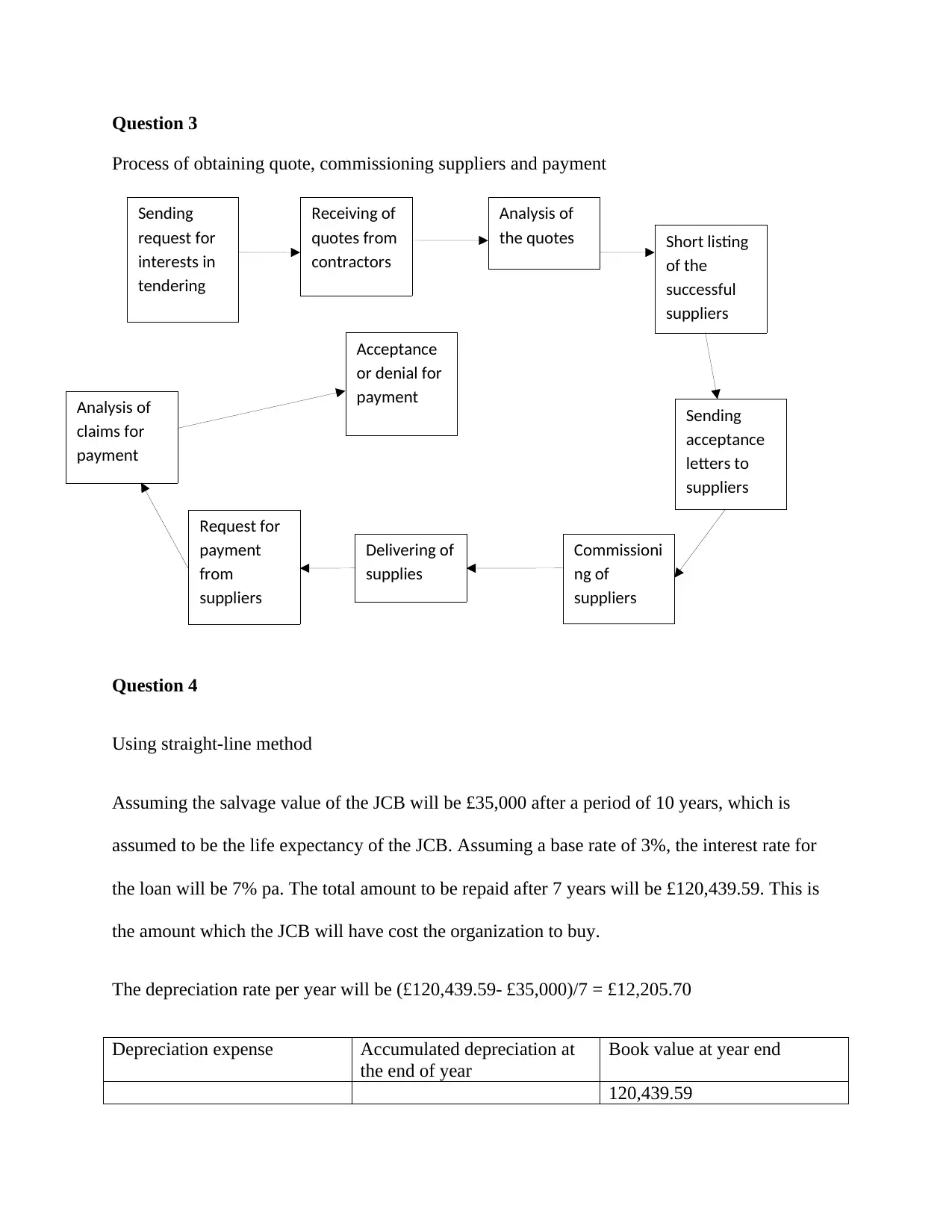
Question 3
Process of obtaining quote, commissioning suppliers and payment
Question 4
Using straight-line method
Assuming the salvage value of the JCB will be £35,000 after a period of 10 years, which is
assumed to be the life expectancy of the JCB. Assuming a base rate of 3%, the interest rate for
the loan will be 7% pa. The total amount to be repaid after 7 years will be £120,439.59. This is
the amount which the JCB will have cost the organization to buy.
The depreciation rate per year will be (£120,439.59- £35,000)/7 = £12,205.70
Depreciation expense Accumulated depreciation at
the end of year
Book value at year end
120,439.59
Sending
request for
interests in
tendering
Receiving of
quotes from
contractors
Request for
payment
from
suppliers
Sending
acceptance
letters to
suppliers
Analysis of
the quotes
Delivering of
supplies
Commissioni
ng of
suppliers
Short listing
of the
successful
suppliers
Analysis of
claims for
payment
Acceptance
or denial for
payment
Process of obtaining quote, commissioning suppliers and payment
Question 4
Using straight-line method
Assuming the salvage value of the JCB will be £35,000 after a period of 10 years, which is
assumed to be the life expectancy of the JCB. Assuming a base rate of 3%, the interest rate for
the loan will be 7% pa. The total amount to be repaid after 7 years will be £120,439.59. This is
the amount which the JCB will have cost the organization to buy.
The depreciation rate per year will be (£120,439.59- £35,000)/7 = £12,205.70
Depreciation expense Accumulated depreciation at
the end of year
Book value at year end
120,439.59
Sending
request for
interests in
tendering
Receiving of
quotes from
contractors
Request for
payment
from
suppliers
Sending
acceptance
letters to
suppliers
Analysis of
the quotes
Delivering of
supplies
Commissioni
ng of
suppliers
Short listing
of the
successful
suppliers
Analysis of
claims for
payment
Acceptance
or denial for
payment
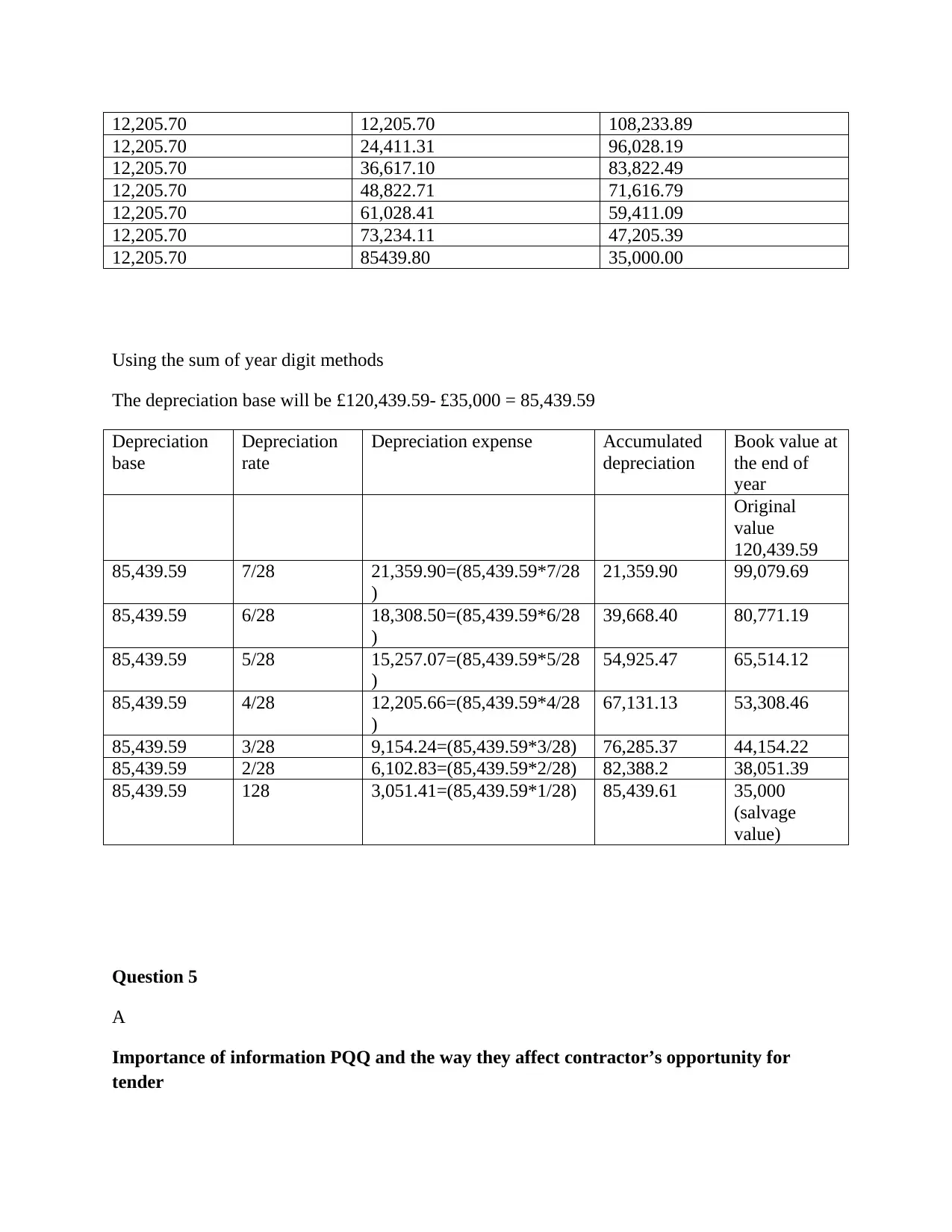
12,205.70 12,205.70 108,233.89
12,205.70 24,411.31 96,028.19
12,205.70 36,617.10 83,822.49
12,205.70 48,822.71 71,616.79
12,205.70 61,028.41 59,411.09
12,205.70 73,234.11 47,205.39
12,205.70 85439.80 35,000.00
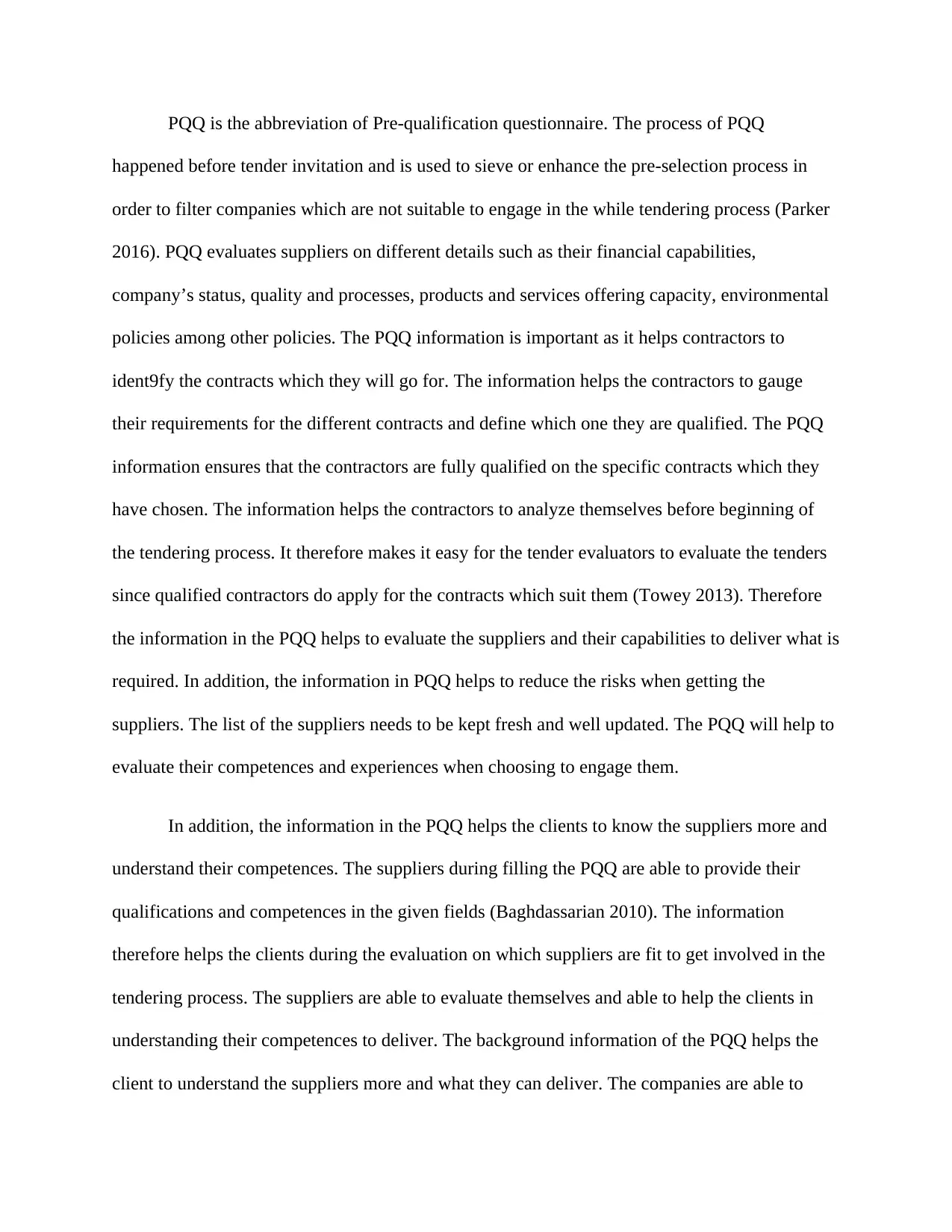
Using the sum of year digit methods
The depreciation base will be £120,439.59- £35,000 = 85,439.59
Depreciation
base
Depreciation
rate
Depreciation expense Accumulated
depreciation
Book value at
the end of
year
Original
value
120,439.59
85,439.59 7/28 21,359.90=(85,439.59*7/28
)
21,359.90 99,079.69
85,439.59 6/28 18,308.50=(85,439.59*6/28
)
39,668.40 80,771.19
85,439.59 5/28 15,257.07=(85,439.59*5/28
)
54,925.47 65,514.12
85,439.59 4/28 12,205.66=(85,439.59*4/28
)
67,131.13 53,308.46
85,439.59 3/28 9,154.24=(85,439.59*3/28) 76,285.37 44,154.22
85,439.59 2/28 6,102.83=(85,439.59*2/28) 82,388.2 38,051.39
85,439.59 128 3,051.41=(85,439.59*1/28) 85,439.61 35,000
(salvage
value)
Question 5
A
Importance of information PQQ and the way they affect contractor’s opportunity for
tender
12,205.70 24,411.31 96,028.19
12,205.70 36,617.10 83,822.49
12,205.70 48,822.71 71,616.79
12,205.70 61,028.41 59,411.09
12,205.70 73,234.11 47,205.39
12,205.70 85439.80 35,000.00
Using the sum of year digit methods
The depreciation base will be £120,439.59- £35,000 = 85,439.59
Depreciation
base
Depreciation
rate
Depreciation expense Accumulated
depreciation
Book value at
the end of
year
Original
value
120,439.59
85,439.59 7/28 21,359.90=(85,439.59*7/28
)
21,359.90 99,079.69
85,439.59 6/28 18,308.50=(85,439.59*6/28
)
39,668.40 80,771.19
85,439.59 5/28 15,257.07=(85,439.59*5/28
)
54,925.47 65,514.12
85,439.59 4/28 12,205.66=(85,439.59*4/28
)
67,131.13 53,308.46
85,439.59 3/28 9,154.24=(85,439.59*3/28) 76,285.37 44,154.22
85,439.59 2/28 6,102.83=(85,439.59*2/28) 82,388.2 38,051.39
85,439.59 128 3,051.41=(85,439.59*1/28) 85,439.61 35,000
(salvage
value)
Question 5
A
Importance of information PQQ and the way they affect contractor’s opportunity for
tender
⊘ This is a preview!⊘
Do you want full access?
Subscribe today to unlock all pages.
Trusted by 1+ million students worldwide
PQQ is the abbreviation of Pre-qualification questionnaire. The process of PQQ
happened before tender invitation and is used to sieve or enhance the pre-selection process in
order to filter companies which are not suitable to engage in the while tendering process (Parker
2016). PQQ evaluates suppliers on different details such as their financial capabilities,
company’s status, quality and processes, products and services offering capacity, environmental
policies among other policies. The PQQ information is important as it helps contractors to
ident9fy the contracts which they will go for. The information helps the contractors to gauge
their requirements for the different contracts and define which one they are qualified. The PQQ
information ensures that the contractors are fully qualified on the specific contracts which they
have chosen. The information helps the contractors to analyze themselves before beginning of
the tendering process. It therefore makes it easy for the tender evaluators to evaluate the tenders
since qualified contractors do apply for the contracts which suit them (Towey 2013). Therefore
the information in the PQQ helps to evaluate the suppliers and their capabilities to deliver what is
required. In addition, the information in PQQ helps to reduce the risks when getting the
suppliers. The list of the suppliers needs to be kept fresh and well updated. The PQQ will help to
evaluate their competences and experiences when choosing to engage them.
In addition, the information in the PQQ helps the clients to know the suppliers more and
understand their competences. The suppliers during filling the PQQ are able to provide their
qualifications and competences in the given fields (Baghdassarian 2010). The information
therefore helps the clients during the evaluation on which suppliers are fit to get involved in the
tendering process. The suppliers are able to evaluate themselves and able to help the clients in
understanding their competences to deliver. The background information of the PQQ helps the
client to understand the suppliers more and what they can deliver. The companies are able to
happened before tender invitation and is used to sieve or enhance the pre-selection process in
order to filter companies which are not suitable to engage in the while tendering process (Parker
2016). PQQ evaluates suppliers on different details such as their financial capabilities,
company’s status, quality and processes, products and services offering capacity, environmental
policies among other policies. The PQQ information is important as it helps contractors to
ident9fy the contracts which they will go for. The information helps the contractors to gauge
their requirements for the different contracts and define which one they are qualified. The PQQ
information ensures that the contractors are fully qualified on the specific contracts which they
have chosen. The information helps the contractors to analyze themselves before beginning of
the tendering process. It therefore makes it easy for the tender evaluators to evaluate the tenders
since qualified contractors do apply for the contracts which suit them (Towey 2013). Therefore
the information in the PQQ helps to evaluate the suppliers and their capabilities to deliver what is
required. In addition, the information in PQQ helps to reduce the risks when getting the
suppliers. The list of the suppliers needs to be kept fresh and well updated. The PQQ will help to
evaluate their competences and experiences when choosing to engage them.
In addition, the information in the PQQ helps the clients to know the suppliers more and
understand their competences. The suppliers during filling the PQQ are able to provide their
qualifications and competences in the given fields (Baghdassarian 2010). The information
therefore helps the clients during the evaluation on which suppliers are fit to get involved in the
tendering process. The suppliers are able to evaluate themselves and able to help the clients in
understanding their competences to deliver. The background information of the PQQ helps the
client to understand the suppliers more and what they can deliver. The companies are able to
Paraphrase This Document
Need a fresh take? Get an instant paraphrase of this document with our AI Paraphraser
provide the operational information and this helps the client when choosing the best suited
organization for the category they need to tender for. In addition, the financial details help the
client to make a decision on whether the companies can be able to supply what they need (Parker
2016). In addition, the PQQ details helps the client to analyze the way the companies have been
able to support policies and implement them. This helps to gauge their effectiveness when
awarded the tender.
The PQQ details are a chance given to the suppliers to convince the employers that they
have the best qualification to supply what they need. The PQQ makes the process of tendering
competitive since only the qualified suppliers are chosen for the tendering process. Therefore, it
can be concluded that the PQQ increase the opportunity of the suppliers to get the tenders when
they meet the specified requirements.
B
Benefits of negotiated tendering
One of the major benefits of the negotiated tendering is its ability to fluctuate. The needs
of the client are well addressed after choosing the contractor or supplier whom they negotiate
with. The flexibility ensures that the different specifications of the client are met (Fuller &
Nightingale 2017). Under this method, the client is able to use the prior record of the supplier to
negotiate the contract details. Therefore the client is sure of the capability of the supplier to
deliver following the previous experience. This means that the method has high delivery ration
since the chosen suppliers have been engaged on similar contracts and delivered. In addition,
another benefit of the negotiated tendering is that the contract details can be negotiated out until
organization for the category they need to tender for. In addition, the financial details help the
client to make a decision on whether the companies can be able to supply what they need (Parker
2016). In addition, the PQQ details helps the client to analyze the way the companies have been
able to support policies and implement them. This helps to gauge their effectiveness when
awarded the tender.
The PQQ details are a chance given to the suppliers to convince the employers that they
have the best qualification to supply what they need. The PQQ makes the process of tendering
competitive since only the qualified suppliers are chosen for the tendering process. Therefore, it
can be concluded that the PQQ increase the opportunity of the suppliers to get the tenders when
they meet the specified requirements.
B
Benefits of negotiated tendering
One of the major benefits of the negotiated tendering is its ability to fluctuate. The needs
of the client are well addressed after choosing the contractor or supplier whom they negotiate
with. The flexibility ensures that the different specifications of the client are met (Fuller &
Nightingale 2017). Under this method, the client is able to use the prior record of the supplier to
negotiate the contract details. Therefore the client is sure of the capability of the supplier to
deliver following the previous experience. This means that the method has high delivery ration
since the chosen suppliers have been engaged on similar contracts and delivered. In addition,
another benefit of the negotiated tendering is that the contract details can be negotiated out until
an agreement is reached. This means that both parties will be satisfied and their requirements are
met. Both suppliers and client have the opportunity to explain themselves through this tendering
process until they reach an agreement (Boyce 2002). This means that future discrepancies on the
tenders and agreements are unlikely to arise since the parties are able to present their points fully.
This ensures that the two parties are satisfied before agreeing to sign the contract documents and
award of the tender.
In addition, the negotiated tendering is able to save time. As compared to competitive
tendering, negotiated tendering is able to save a lot of time since the supplier is personally
identified through the previous experience and competence of available suppliers (Smith 2013).
This means that the client has only a single supplier whom they negotiate tender with. From
experience, the tendering process is able to take a lot of time until the client settles on the
suppliers whom will be involved in the works. Through negotiated tendering, analysis of
different suppliers and the whole process of tendering are shorted to picking of a single supplier
who is competent according to their previous delivery. In addition, to saving time, this process is
able to save a lot of financial resources when engaged (Lorne & Bryan 2015). The tendering
process involves engagement of different personnel’s and resources are usually required to
conduct the tendering process such as competitive tendering. Therefore through negotiated
tendering, these resources are saved as well as time of engagement. In addition, through this
tendering process, the works are able to commence early. This gives the opportunity to the
contractors to finish the projects within stipulated timeline. Early commencement is enhanced
since only a single contractor is involved in the tendering process and they only negotiate the
terms with the client.
C (i)
met. Both suppliers and client have the opportunity to explain themselves through this tendering
process until they reach an agreement (Boyce 2002). This means that future discrepancies on the
tenders and agreements are unlikely to arise since the parties are able to present their points fully.
This ensures that the two parties are satisfied before agreeing to sign the contract documents and
award of the tender.
In addition, the negotiated tendering is able to save time. As compared to competitive
tendering, negotiated tendering is able to save a lot of time since the supplier is personally
identified through the previous experience and competence of available suppliers (Smith 2013).
This means that the client has only a single supplier whom they negotiate tender with. From
experience, the tendering process is able to take a lot of time until the client settles on the
suppliers whom will be involved in the works. Through negotiated tendering, analysis of
different suppliers and the whole process of tendering are shorted to picking of a single supplier
who is competent according to their previous delivery. In addition, to saving time, this process is
able to save a lot of financial resources when engaged (Lorne & Bryan 2015). The tendering
process involves engagement of different personnel’s and resources are usually required to
conduct the tendering process such as competitive tendering. Therefore through negotiated
tendering, these resources are saved as well as time of engagement. In addition, through this
tendering process, the works are able to commence early. This gives the opportunity to the
contractors to finish the projects within stipulated timeline. Early commencement is enhanced
since only a single contractor is involved in the tendering process and they only negotiate the
terms with the client.
C (i)
⊘ This is a preview!⊘
Do you want full access?
Subscribe today to unlock all pages.
Trusted by 1+ million students worldwide
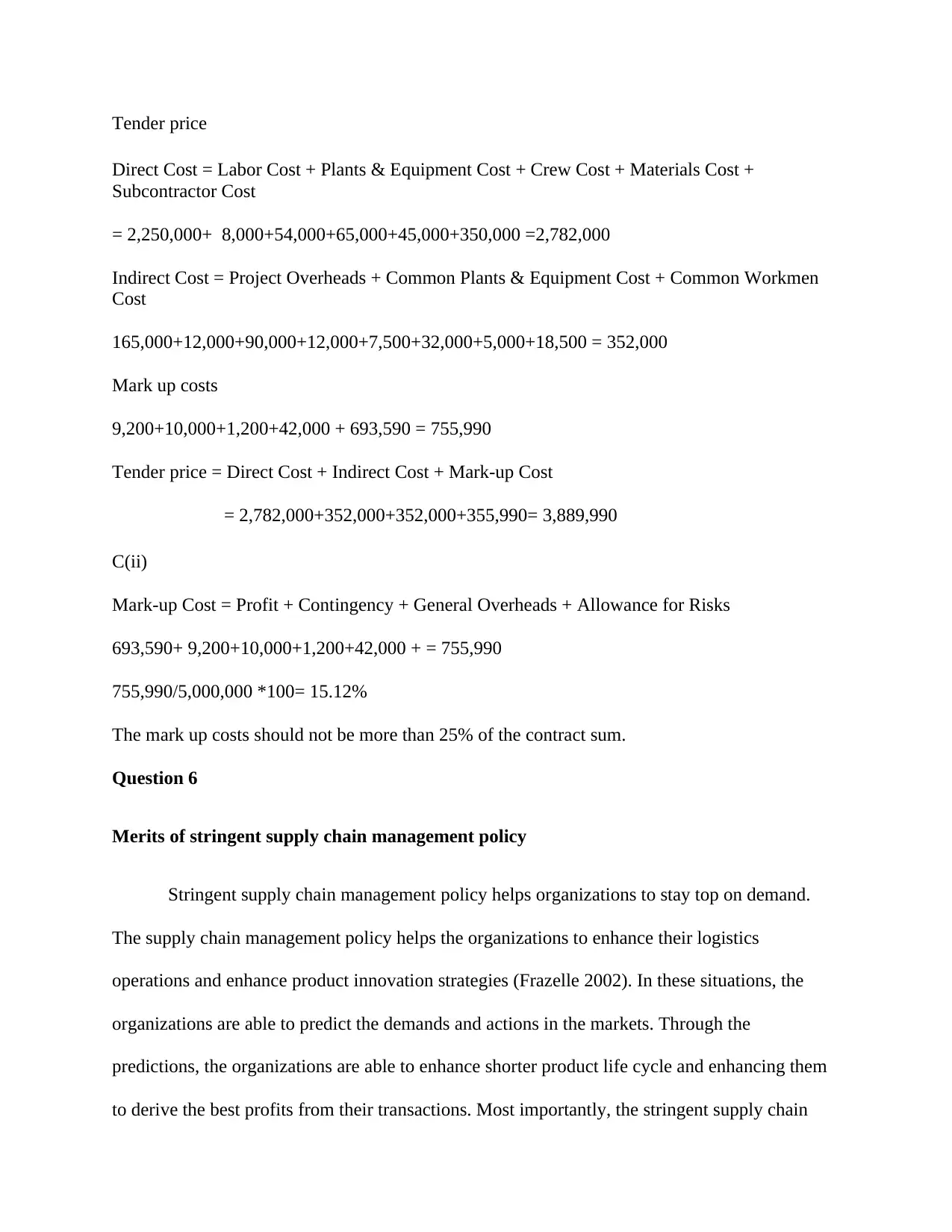
Tender price
Direct Cost = Labor Cost + Plants & Equipment Cost + Crew Cost + Materials Cost +
Subcontractor Cost
= 2,250,000+ 8,000+54,000+65,000+45,000+350,000 =2,782,000
Indirect Cost = Project Overheads + Common Plants & Equipment Cost + Common Workmen
Cost
165,000+12,000+90,000+12,000+7,500+32,000+5,000+18,500 = 352,000
Mark up costs
9,200+10,000+1,200+42,000 + 693,590 = 755,990
Tender price = Direct Cost + Indirect Cost + Mark-up Cost
= 2,782,000+352,000+352,000+355,990= 3,889,990
C(ii)
Mark-up Cost = Profit + Contingency + General Overheads + Allowance for Risks
693,590+ 9,200+10,000+1,200+42,000 + = 755,990
755,990/5,000,000 *100= 15.12%
The mark up costs should not be more than 25% of the contract sum.
Question 6
Merits of stringent supply chain management policy
Stringent supply chain management policy helps organizations to stay top on demand.
The supply chain management policy helps the organizations to enhance their logistics
operations and enhance product innovation strategies (Frazelle 2002). In these situations, the
organizations are able to predict the demands and actions in the markets. Through the
predictions, the organizations are able to enhance shorter product life cycle and enhancing them
to derive the best profits from their transactions. Most importantly, the stringent supply chain
Direct Cost = Labor Cost + Plants & Equipment Cost + Crew Cost + Materials Cost +
Subcontractor Cost
= 2,250,000+ 8,000+54,000+65,000+45,000+350,000 =2,782,000
Indirect Cost = Project Overheads + Common Plants & Equipment Cost + Common Workmen
Cost
165,000+12,000+90,000+12,000+7,500+32,000+5,000+18,500 = 352,000
Mark up costs
9,200+10,000+1,200+42,000 + 693,590 = 755,990
Tender price = Direct Cost + Indirect Cost + Mark-up Cost
= 2,782,000+352,000+352,000+355,990= 3,889,990
C(ii)
Mark-up Cost = Profit + Contingency + General Overheads + Allowance for Risks
693,590+ 9,200+10,000+1,200+42,000 + = 755,990
755,990/5,000,000 *100= 15.12%
The mark up costs should not be more than 25% of the contract sum.
Question 6
Merits of stringent supply chain management policy
Stringent supply chain management policy helps organizations to stay top on demand.
The supply chain management policy helps the organizations to enhance their logistics
operations and enhance product innovation strategies (Frazelle 2002). In these situations, the
organizations are able to predict the demands and actions in the markets. Through the
predictions, the organizations are able to enhance shorter product life cycle and enhancing them
to derive the best profits from their transactions. Most importantly, the stringent supply chain
Paraphrase This Document
Need a fresh take? Get an instant paraphrase of this document with our AI Paraphraser
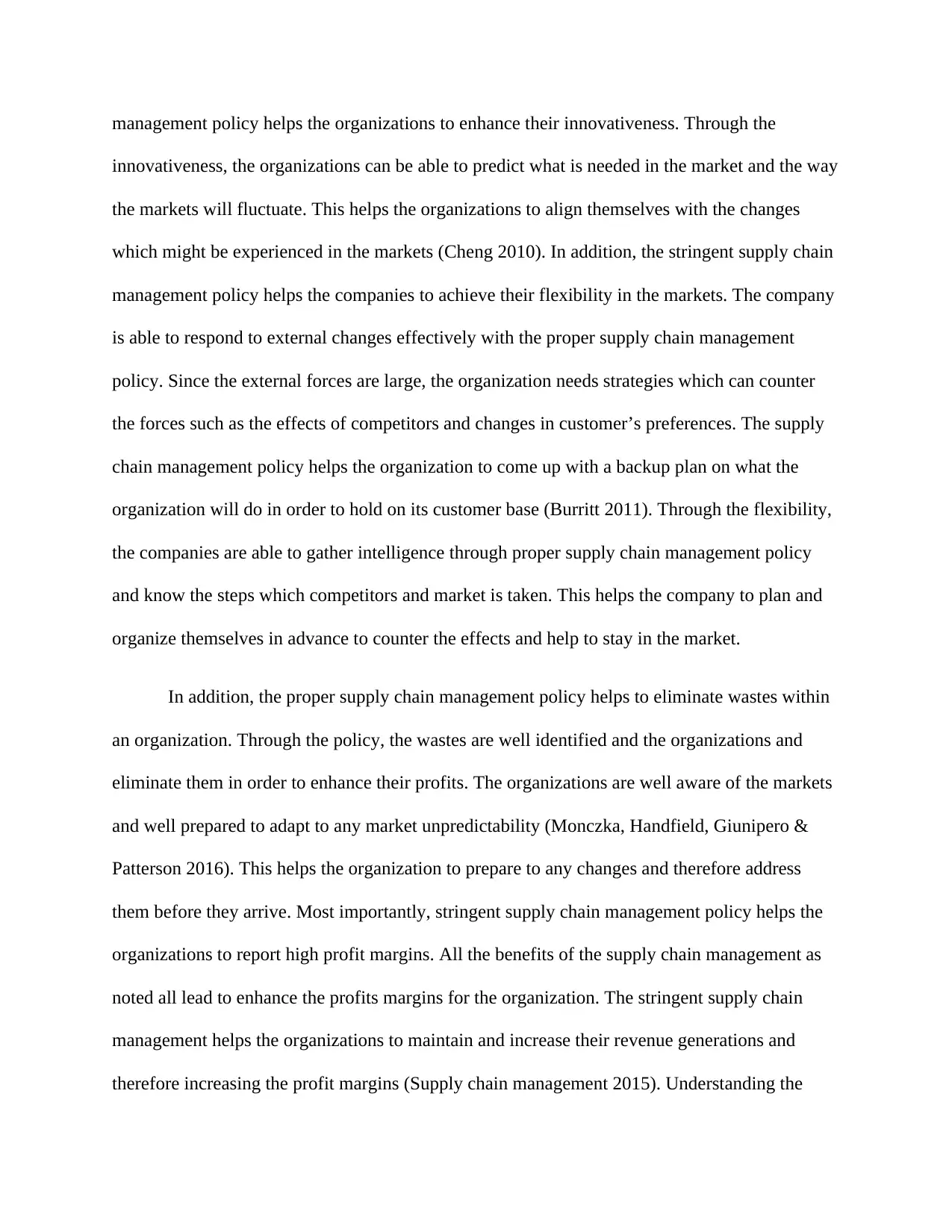
management policy helps the organizations to enhance their innovativeness. Through the
innovativeness, the organizations can be able to predict what is needed in the market and the way
the markets will fluctuate. This helps the organizations to align themselves with the changes
which might be experienced in the markets (Cheng 2010). In addition, the stringent supply chain
management policy helps the companies to achieve their flexibility in the markets. The company
is able to respond to external changes effectively with the proper supply chain management
policy. Since the external forces are large, the organization needs strategies which can counter
the forces such as the effects of competitors and changes in customer’s preferences. The supply
chain management policy helps the organization to come up with a backup plan on what the
organization will do in order to hold on its customer base (Burritt 2011). Through the flexibility,
the companies are able to gather intelligence through proper supply chain management policy
and know the steps which competitors and market is taken. This helps the company to plan and
organize themselves in advance to counter the effects and help to stay in the market.
In addition, the proper supply chain management policy helps to eliminate wastes within
an organization. Through the policy, the wastes are well identified and the organizations and
eliminate them in order to enhance their profits. The organizations are well aware of the markets
and well prepared to adapt to any market unpredictability (Monczka, Handfield, Giunipero &
Patterson 2016). This helps the organization to prepare to any changes and therefore address
them before they arrive. Most importantly, stringent supply chain management policy helps the
organizations to report high profit margins. All the benefits of the supply chain management as
noted all lead to enhance the profits margins for the organization. The stringent supply chain
management helps the organizations to maintain and increase their revenue generations and
therefore increasing the profit margins (Supply chain management 2015). Understanding the
innovativeness, the organizations can be able to predict what is needed in the market and the way
the markets will fluctuate. This helps the organizations to align themselves with the changes
which might be experienced in the markets (Cheng 2010). In addition, the stringent supply chain
management policy helps the companies to achieve their flexibility in the markets. The company
is able to respond to external changes effectively with the proper supply chain management
policy. Since the external forces are large, the organization needs strategies which can counter
the forces such as the effects of competitors and changes in customer’s preferences. The supply
chain management policy helps the organization to come up with a backup plan on what the
organization will do in order to hold on its customer base (Burritt 2011). Through the flexibility,
the companies are able to gather intelligence through proper supply chain management policy
and know the steps which competitors and market is taken. This helps the company to plan and
organize themselves in advance to counter the effects and help to stay in the market.
In addition, the proper supply chain management policy helps to eliminate wastes within
an organization. Through the policy, the wastes are well identified and the organizations and
eliminate them in order to enhance their profits. The organizations are well aware of the markets
and well prepared to adapt to any market unpredictability (Monczka, Handfield, Giunipero &
Patterson 2016). This helps the organization to prepare to any changes and therefore address
them before they arrive. Most importantly, stringent supply chain management policy helps the
organizations to report high profit margins. All the benefits of the supply chain management as
noted all lead to enhance the profits margins for the organization. The stringent supply chain
management helps the organizations to maintain and increase their revenue generations and
therefore increasing the profit margins (Supply chain management 2015). Understanding the
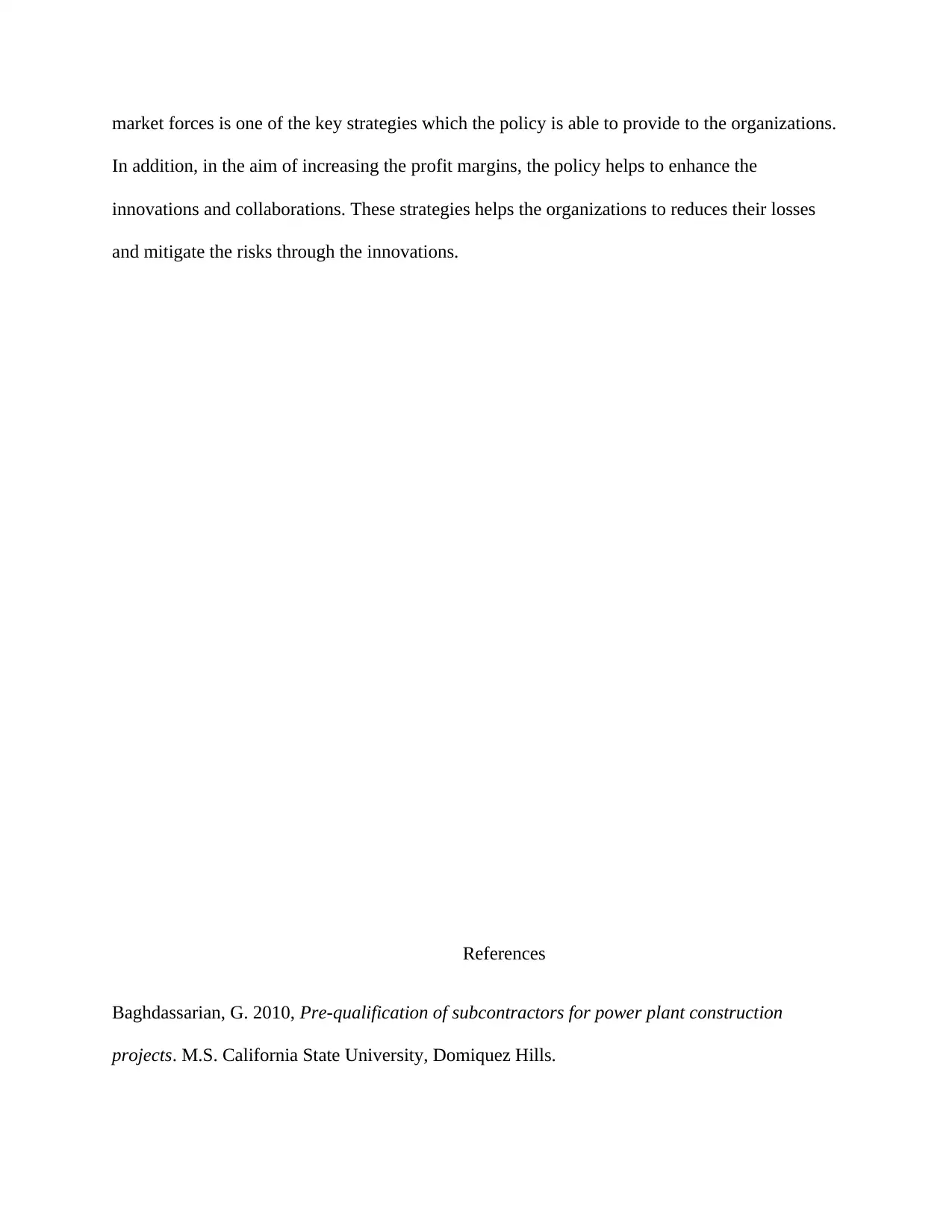
market forces is one of the key strategies which the policy is able to provide to the organizations.
In addition, in the aim of increasing the profit margins, the policy helps to enhance the
innovations and collaborations. These strategies helps the organizations to reduces their losses
and mitigate the risks through the innovations.
References
Baghdassarian, G. 2010, Pre-qualification of subcontractors for power plant construction
projects. M.S. California State University, Domiquez Hills.
In addition, in the aim of increasing the profit margins, the policy helps to enhance the
innovations and collaborations. These strategies helps the organizations to reduces their losses
and mitigate the risks through the innovations.
References
Baghdassarian, G. 2010, Pre-qualification of subcontractors for power plant construction
projects. M.S. California State University, Domiquez Hills.
⊘ This is a preview!⊘
Do you want full access?
Subscribe today to unlock all pages.
Trusted by 1+ million students worldwide

1 out of 14


Related Documents


Your All-in-One AI-Powered Toolkit for Academic Success.
+13062052269
info@desklib.com
Available 24*7 on WhatsApp / Email
![[object Object]](/_next/static/media/star-bottom.7253800d.svg)
Unlock your academic potential
Copyright © 2020–2026 A2Z Services. All Rights Reserved. Developed and managed by ZUCOL.