Business Law: Analysis of Contractual Obligations for Selena's Case
VerifiedAdded on 2020/05/08
|6
|1401
|157
Report
AI Summary
This report analyzes a business law scenario involving a photographer named Selena and two companies, Villette Pty Ltd and PerZaZZ, focusing on contract law principles. The report examines the formation of contracts, including offer and acceptance, and the implications of signed agreements. It discusses Selena's interactions with Tom (representing Villette) and Zach, exploring issues of agency and the binding nature of contract terms, even if unread. The analysis delves into the concept of occupiers' liability concerning damages to Selena's camera during an event and evaluates the companies' obligations regarding payment and compensation. The report references relevant case law, such as Dickinson v Dodds, L'Estrange v Graucob, and Wyong Shire Council v Shirt, to support its legal arguments, ultimately advising Selena on her contractual claims and potential liabilities. The report concludes by determining the extent of Selena's contractual claims against both companies, considering both express and implied terms within the contracts.
Running head: BUSINESS LAW
Business law
Name of the Student
Name of the University
Author Note
Business law
Name of the Student
Name of the University
Author Note
Paraphrase This Document
Need a fresh take? Get an instant paraphrase of this document with our AI Paraphraser

1BUSINESS LAW
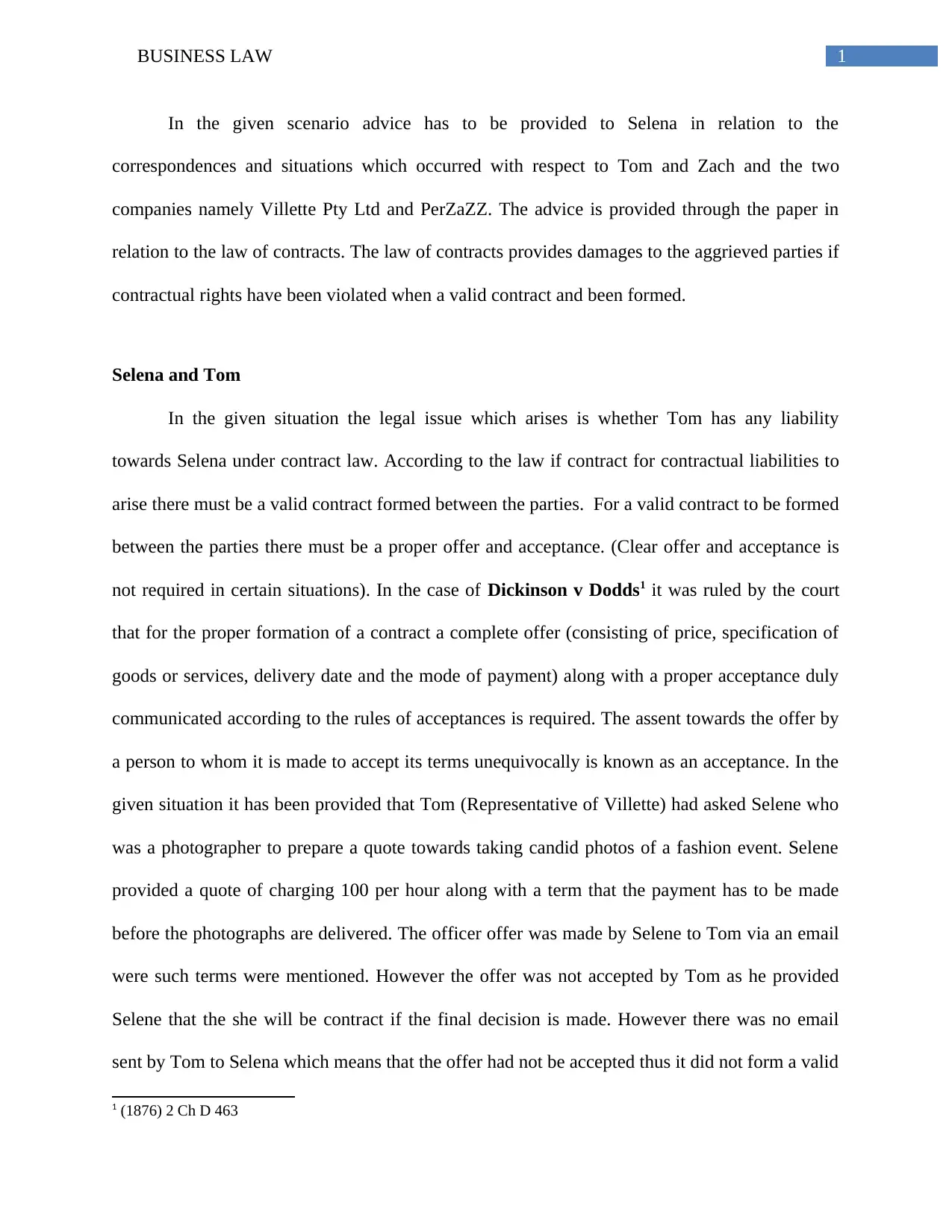
In the given scenario advice has to be provided to Selena in relation to the
correspondences and situations which occurred with respect to Tom and Zach and the two
companies namely Villette Pty Ltd and PerZaZZ. The advice is provided through the paper in
relation to the law of contracts. The law of contracts provides damages to the aggrieved parties if
contractual rights have been violated when a valid contract and been formed.
Selena and Tom
In the given situation the legal issue which arises is whether Tom has any liability
towards Selena under contract law. According to the law if contract for contractual liabilities to
arise there must be a valid contract formed between the parties. For a valid contract to be formed
between the parties there must be a proper offer and acceptance. (Clear offer and acceptance is
not required in certain situations). In the case of Dickinson v Dodds1 it was ruled by the court
that for the proper formation of a contract a complete offer (consisting of price, specification of
goods or services, delivery date and the mode of payment) along with a proper acceptance duly
communicated according to the rules of acceptances is required. The assent towards the offer by
a person to whom it is made to accept its terms unequivocally is known as an acceptance. In the
given situation it has been provided that Tom (Representative of Villette) had asked Selene who
was a photographer to prepare a quote towards taking candid photos of a fashion event. Selene
provided a quote of charging 100 per hour along with a term that the payment has to be made
before the photographs are delivered. The officer offer was made by Selene to Tom via an email
were such terms were mentioned. However the offer was not accepted by Tom as he provided
Selene that the she will be contract if the final decision is made. However there was no email
sent by Tom to Selena which means that the offer had not be accepted thus it did not form a valid
1 (1876) 2 Ch D 463
In the given scenario advice has to be provided to Selena in relation to the
correspondences and situations which occurred with respect to Tom and Zach and the two
companies namely Villette Pty Ltd and PerZaZZ. The advice is provided through the paper in
relation to the law of contracts. The law of contracts provides damages to the aggrieved parties if
contractual rights have been violated when a valid contract and been formed.
Selena and Tom
In the given situation the legal issue which arises is whether Tom has any liability
towards Selena under contract law. According to the law if contract for contractual liabilities to
arise there must be a valid contract formed between the parties. For a valid contract to be formed
between the parties there must be a proper offer and acceptance. (Clear offer and acceptance is
not required in certain situations). In the case of Dickinson v Dodds1 it was ruled by the court
that for the proper formation of a contract a complete offer (consisting of price, specification of
goods or services, delivery date and the mode of payment) along with a proper acceptance duly
communicated according to the rules of acceptances is required. The assent towards the offer by
a person to whom it is made to accept its terms unequivocally is known as an acceptance. In the
given situation it has been provided that Tom (Representative of Villette) had asked Selene who
was a photographer to prepare a quote towards taking candid photos of a fashion event. Selene
provided a quote of charging 100 per hour along with a term that the payment has to be made
before the photographs are delivered. The officer offer was made by Selene to Tom via an email
were such terms were mentioned. However the offer was not accepted by Tom as he provided
Selene that the she will be contract if the final decision is made. However there was no email
sent by Tom to Selena which means that the offer had not be accepted thus it did not form a valid
1 (1876) 2 Ch D 463

2BUSINESS LAW
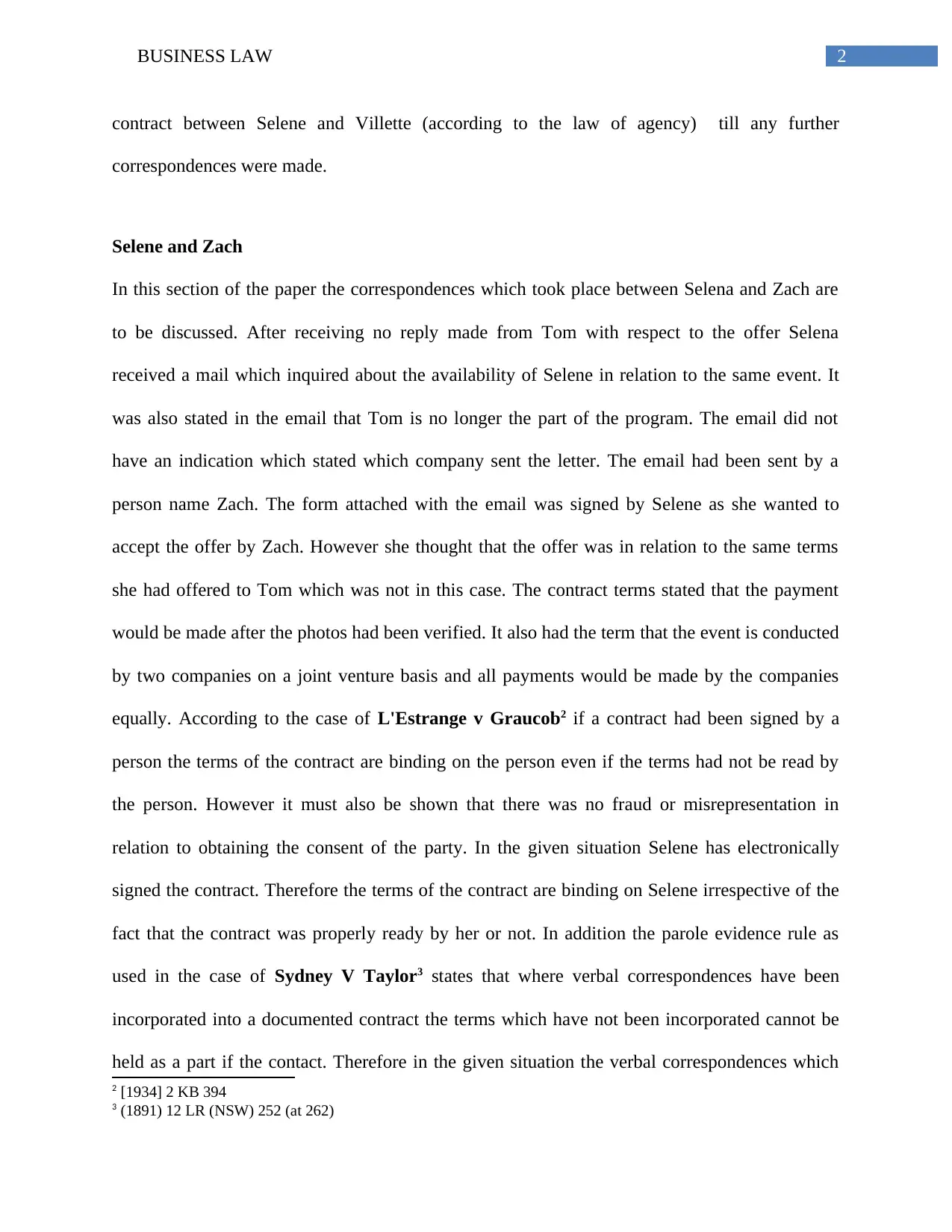
contract between Selene and Villette (according to the law of agency) till any further
correspondences were made.
Selene and Zach
In this section of the paper the correspondences which took place between Selena and Zach are
to be discussed. After receiving no reply made from Tom with respect to the offer Selena
received a mail which inquired about the availability of Selene in relation to the same event. It
was also stated in the email that Tom is no longer the part of the program. The email did not
have an indication which stated which company sent the letter. The email had been sent by a
person name Zach. The form attached with the email was signed by Selene as she wanted to
accept the offer by Zach. However she thought that the offer was in relation to the same terms
she had offered to Tom which was not in this case. The contract terms stated that the payment
would be made after the photos had been verified. It also had the term that the event is conducted
by two companies on a joint venture basis and all payments would be made by the companies
equally. According to the case of L'Estrange v Graucob2 if a contract had been signed by a
person the terms of the contract are binding on the person even if the terms had not be read by
the person. However it must also be shown that there was no fraud or misrepresentation in
relation to obtaining the consent of the party. In the given situation Selene has electronically
signed the contract. Therefore the terms of the contract are binding on Selene irrespective of the
fact that the contract was properly ready by her or not. In addition the parole evidence rule as
used in the case of Sydney V Taylor3 states that where verbal correspondences have been
incorporated into a documented contract the terms which have not been incorporated cannot be
held as a part if the contact. Therefore in the given situation the verbal correspondences which
2 [1934] 2 KB 394
3 (1891) 12 LR (NSW) 252 (at 262)
contract between Selene and Villette (according to the law of agency) till any further
correspondences were made.
Selene and Zach
In this section of the paper the correspondences which took place between Selena and Zach are
to be discussed. After receiving no reply made from Tom with respect to the offer Selena
received a mail which inquired about the availability of Selene in relation to the same event. It
was also stated in the email that Tom is no longer the part of the program. The email did not
have an indication which stated which company sent the letter. The email had been sent by a
person name Zach. The form attached with the email was signed by Selene as she wanted to
accept the offer by Zach. However she thought that the offer was in relation to the same terms
she had offered to Tom which was not in this case. The contract terms stated that the payment
would be made after the photos had been verified. It also had the term that the event is conducted
by two companies on a joint venture basis and all payments would be made by the companies
equally. According to the case of L'Estrange v Graucob2 if a contract had been signed by a
person the terms of the contract are binding on the person even if the terms had not be read by
the person. However it must also be shown that there was no fraud or misrepresentation in
relation to obtaining the consent of the party. In the given situation Selene has electronically
signed the contract. Therefore the terms of the contract are binding on Selene irrespective of the
fact that the contract was properly ready by her or not. In addition the parole evidence rule as
used in the case of Sydney V Taylor3 states that where verbal correspondences have been
incorporated into a documented contract the terms which have not been incorporated cannot be
held as a part if the contact. Therefore in the given situation the verbal correspondences which
2 [1934] 2 KB 394
3 (1891) 12 LR (NSW) 252 (at 262)
⊘ This is a preview!⊘
Do you want full access?
Subscribe today to unlock all pages.

Trusted by 1+ million students worldwide

3BUSINESS LAW
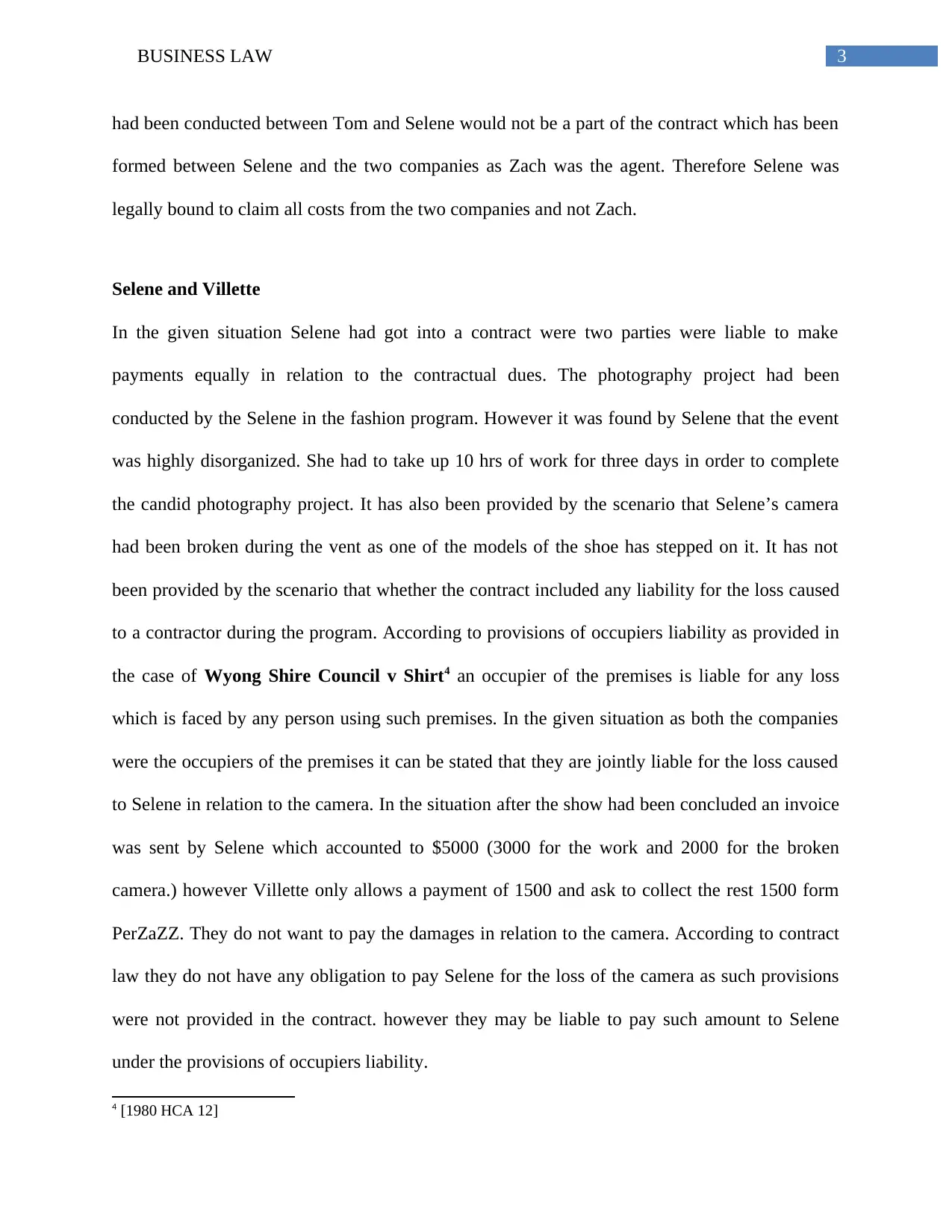
had been conducted between Tom and Selene would not be a part of the contract which has been
formed between Selene and the two companies as Zach was the agent. Therefore Selene was
legally bound to claim all costs from the two companies and not Zach.
Selene and Villette
In the given situation Selene had got into a contract were two parties were liable to make
payments equally in relation to the contractual dues. The photography project had been
conducted by the Selene in the fashion program. However it was found by Selene that the event
was highly disorganized. She had to take up 10 hrs of work for three days in order to complete
the candid photography project. It has also been provided by the scenario that Selene’s camera
had been broken during the vent as one of the models of the shoe has stepped on it. It has not
been provided by the scenario that whether the contract included any liability for the loss caused
to a contractor during the program. According to provisions of occupiers liability as provided in
the case of Wyong Shire Council v Shirt4 an occupier of the premises is liable for any loss
which is faced by any person using such premises. In the given situation as both the companies
were the occupiers of the premises it can be stated that they are jointly liable for the loss caused
to Selene in relation to the camera. In the situation after the show had been concluded an invoice
was sent by Selene which accounted to $5000 (3000 for the work and 2000 for the broken
camera.) however Villette only allows a payment of 1500 and ask to collect the rest 1500 form
PerZaZZ. They do not want to pay the damages in relation to the camera. According to contract
law they do not have any obligation to pay Selene for the loss of the camera as such provisions
were not provided in the contract. however they may be liable to pay such amount to Selene
under the provisions of occupiers liability.
4 [1980 HCA 12]
had been conducted between Tom and Selene would not be a part of the contract which has been
formed between Selene and the two companies as Zach was the agent. Therefore Selene was
legally bound to claim all costs from the two companies and not Zach.
Selene and Villette
In the given situation Selene had got into a contract were two parties were liable to make
payments equally in relation to the contractual dues. The photography project had been
conducted by the Selene in the fashion program. However it was found by Selene that the event
was highly disorganized. She had to take up 10 hrs of work for three days in order to complete
the candid photography project. It has also been provided by the scenario that Selene’s camera
had been broken during the vent as one of the models of the shoe has stepped on it. It has not
been provided by the scenario that whether the contract included any liability for the loss caused
to a contractor during the program. According to provisions of occupiers liability as provided in
the case of Wyong Shire Council v Shirt4 an occupier of the premises is liable for any loss
which is faced by any person using such premises. In the given situation as both the companies
were the occupiers of the premises it can be stated that they are jointly liable for the loss caused
to Selene in relation to the camera. In the situation after the show had been concluded an invoice
was sent by Selene which accounted to $5000 (3000 for the work and 2000 for the broken
camera.) however Villette only allows a payment of 1500 and ask to collect the rest 1500 form
PerZaZZ. They do not want to pay the damages in relation to the camera. According to contract
law they do not have any obligation to pay Selene for the loss of the camera as such provisions
were not provided in the contract. however they may be liable to pay such amount to Selene
under the provisions of occupiers liability.
4 [1980 HCA 12]
Paraphrase This Document
Need a fresh take? Get an instant paraphrase of this document with our AI Paraphraser

4BUSINESS LAW
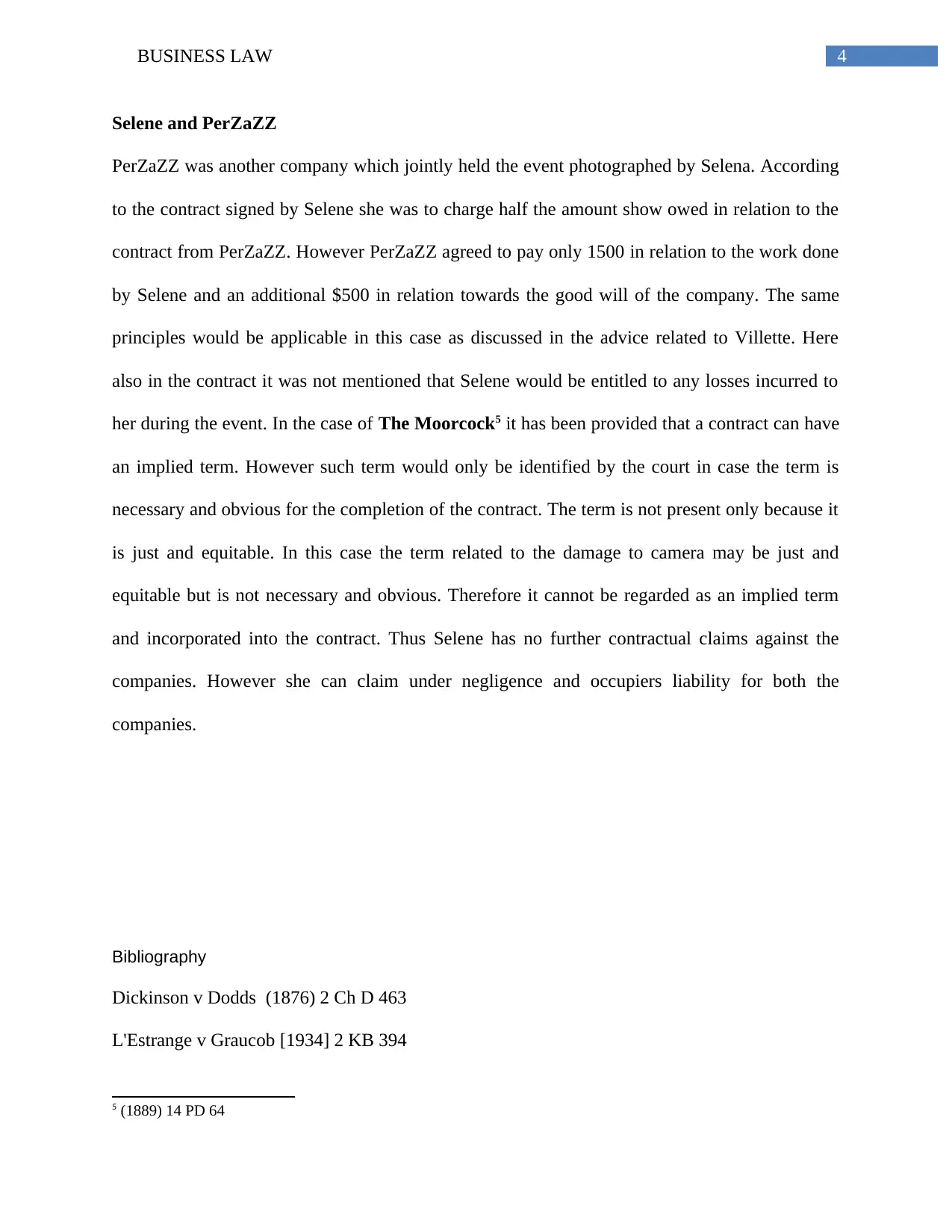
Selene and PerZaZZ
PerZaZZ was another company which jointly held the event photographed by Selena. According
to the contract signed by Selene she was to charge half the amount show owed in relation to the
contract from PerZaZZ. However PerZaZZ agreed to pay only 1500 in relation to the work done
by Selene and an additional $500 in relation towards the good will of the company. The same
principles would be applicable in this case as discussed in the advice related to Villette. Here
also in the contract it was not mentioned that Selene would be entitled to any losses incurred to
her during the event. In the case of The Moorcock5 it has been provided that a contract can have
an implied term. However such term would only be identified by the court in case the term is
necessary and obvious for the completion of the contract. The term is not present only because it
is just and equitable. In this case the term related to the damage to camera may be just and
equitable but is not necessary and obvious. Therefore it cannot be regarded as an implied term
and incorporated into the contract. Thus Selene has no further contractual claims against the
companies. However she can claim under negligence and occupiers liability for both the
companies.
Bibliography
Dickinson v Dodds (1876) 2 Ch D 463
L'Estrange v Graucob [1934] 2 KB 394
5 (1889) 14 PD 64
Selene and PerZaZZ
PerZaZZ was another company which jointly held the event photographed by Selena. According
to the contract signed by Selene she was to charge half the amount show owed in relation to the
contract from PerZaZZ. However PerZaZZ agreed to pay only 1500 in relation to the work done
by Selene and an additional $500 in relation towards the good will of the company. The same
principles would be applicable in this case as discussed in the advice related to Villette. Here
also in the contract it was not mentioned that Selene would be entitled to any losses incurred to
her during the event. In the case of The Moorcock5 it has been provided that a contract can have
an implied term. However such term would only be identified by the court in case the term is
necessary and obvious for the completion of the contract. The term is not present only because it
is just and equitable. In this case the term related to the damage to camera may be just and
equitable but is not necessary and obvious. Therefore it cannot be regarded as an implied term
and incorporated into the contract. Thus Selene has no further contractual claims against the
companies. However she can claim under negligence and occupiers liability for both the
companies.
Bibliography
Dickinson v Dodds (1876) 2 Ch D 463
L'Estrange v Graucob [1934] 2 KB 394
5 (1889) 14 PD 64

5BUSINESS LAW
Sydney V Taylor (1891) 12 LR (NSW) 252 (at 262)
The Moorcock (1889) 14 PD 64
Wyong Shire Council v Shirt [1980 HCA 12]
Sydney V Taylor (1891) 12 LR (NSW) 252 (at 262)
The Moorcock (1889) 14 PD 64
Wyong Shire Council v Shirt [1980 HCA 12]
⊘ This is a preview!⊘
Do you want full access?
Subscribe today to unlock all pages.

Trusted by 1+ million students worldwide
1 out of 6
Related Documents
Your All-in-One AI-Powered Toolkit for Academic Success.
+13062052269
info@desklib.com
Available 24*7 on WhatsApp / Email
Unlock your academic potential
Copyright © 2020–2026 A2Z Services. All Rights Reserved. Developed and managed by ZUCOL.


![Management Law 2 Assignment - [University Name] - Semester 2](/_next/image/?url=https%3A%2F%2Fdesklib.com%2Fmedia%2Fimages%2Foc%2F38e706355e0d4bf19ce1377653715513.jpg&w=256&q=75)