Language and Racism: Demonstrating Control Over Words and Their Impact

Verified

Added on  2023/01/18

|6
|1463
|92
Essay
AI Summary
This essay delves into the intricate relationship between language and racism, emphasizing how the conscious control of words can significantly impact societal attitudes and behaviors. It highlights the ways in which language, often unconsciously, perpetuates negative stereotypes and discriminations based on ethnicity, citing examples of how seemingly innocuous terms can carry deep-seated racist connotations. The essay argues that by understanding the history, origin, and potential consequences of the words we use, we can begin to dismantle the linguistic structures that support racism. It advocates for a shift towards more constructive language, replacing derogatory terms with alternatives that promote equality and respect for cultural diversity. Ultimately, the essay underscores the power of language not only as a tool for communication but also as a catalyst for social change, urging individuals to cultivate a mindful approach to word choice in order to foster a more inclusive and equitable society. Desklib provides access to similar essays and resources for students.
Document Page
Running head: Demonstration of control over language and words concerning Racism
Demonstration of control over language and words concerning
Racism
tabler-icon-diamond-filled.svg

Paraphrase This Document

Need a fresh take? Get an instant paraphrase of this document with our AI Paraphraser
Document Page
Demonstration of control over language and words concerning Racism
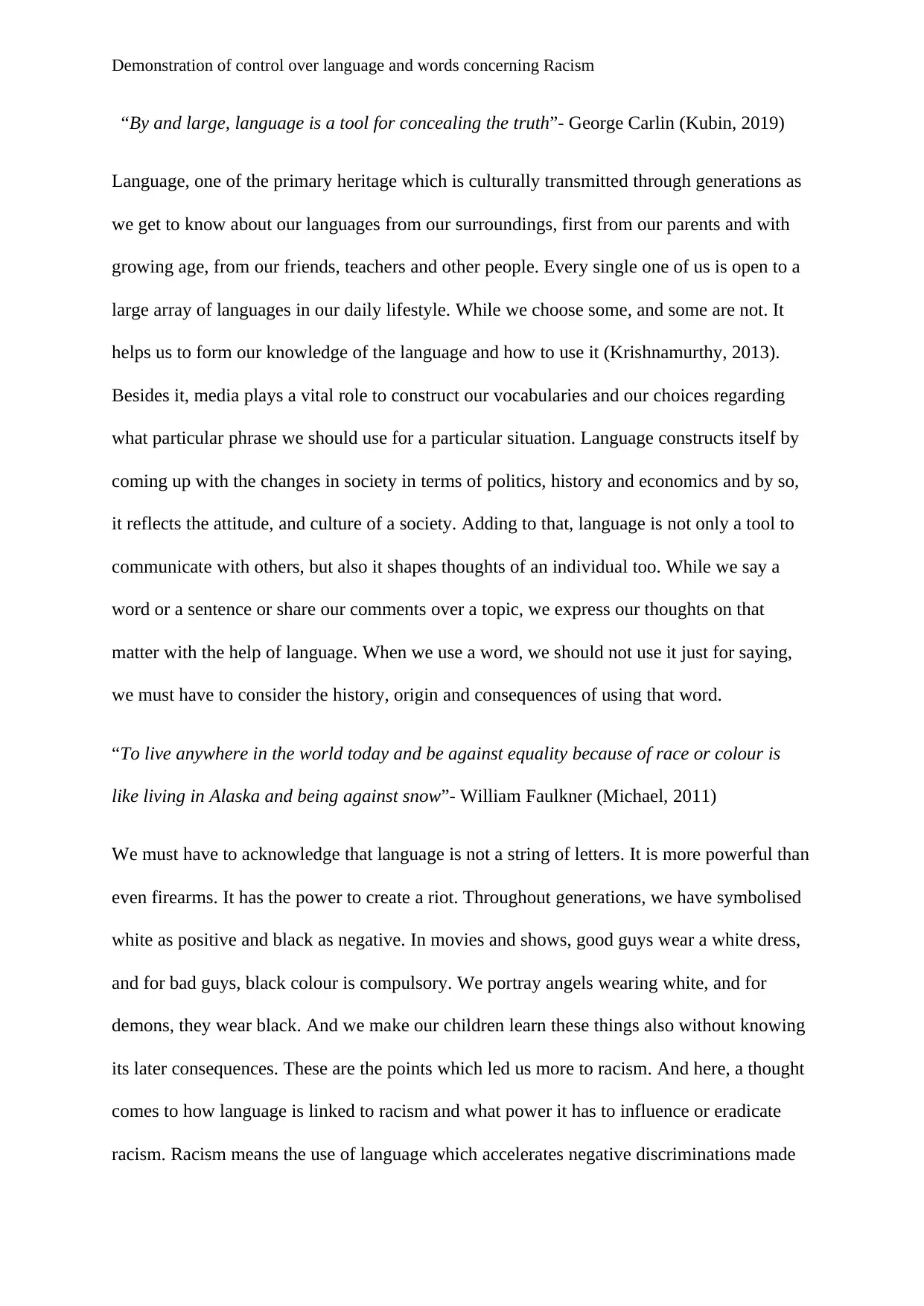
By and large, language is a tool for concealing the truth”- George Carlin (Kubin, 2019)
Language, one of the primary heritage which is culturally transmitted through generations as
we get to know about our languages from our surroundings, first from our parents and with
growing age, from our friends, teachers and other people. Every single one of us is open to a
large array of languages in our daily lifestyle. While we choose some, and some are not. It
helps us to form our knowledge of the language and how to use it (Krishnamurthy, 2013).
Besides it, media plays a vital role to construct our vocabularies and our choices regarding
what particular phrase we should use for a particular situation. Language constructs itself by
coming up with the changes in society in terms of politics, history and economics and by so,
it reflects the attitude, and culture of a society. Adding to that, language is not only a tool to
communicate with others, but also it shapes thoughts of an individual too. While we say a
word or a sentence or share our comments over a topic, we express our thoughts on that
matter with the help of language. When we use a word, we should not use it just for saying,
we must have to consider the history, origin and consequences of using that word.
To live anywhere in the world today and be against equality because of race or colour is
like living in Alaska and being against snow”- William Faulkner (Michael, 2011)
We must have to acknowledge that language is not a string of letters. It is more powerful than
even firearms. It has the power to create a riot. Throughout generations, we have symbolised
white as positive and black as negative. In movies and shows, good guys wear a white dress,
and for bad guys, black colour is compulsory. We portray angels wearing white, and for
demons, they wear black. And we make our children learn these things also without knowing
its later consequences. These are the points which led us more to racism. And here, a thought
comes to how language is linked to racism and what power it has to influence or eradicate
racism. Racism means the use of language which accelerates negative discriminations made
Document Page
Demonstration of control over language and words concerning Racism
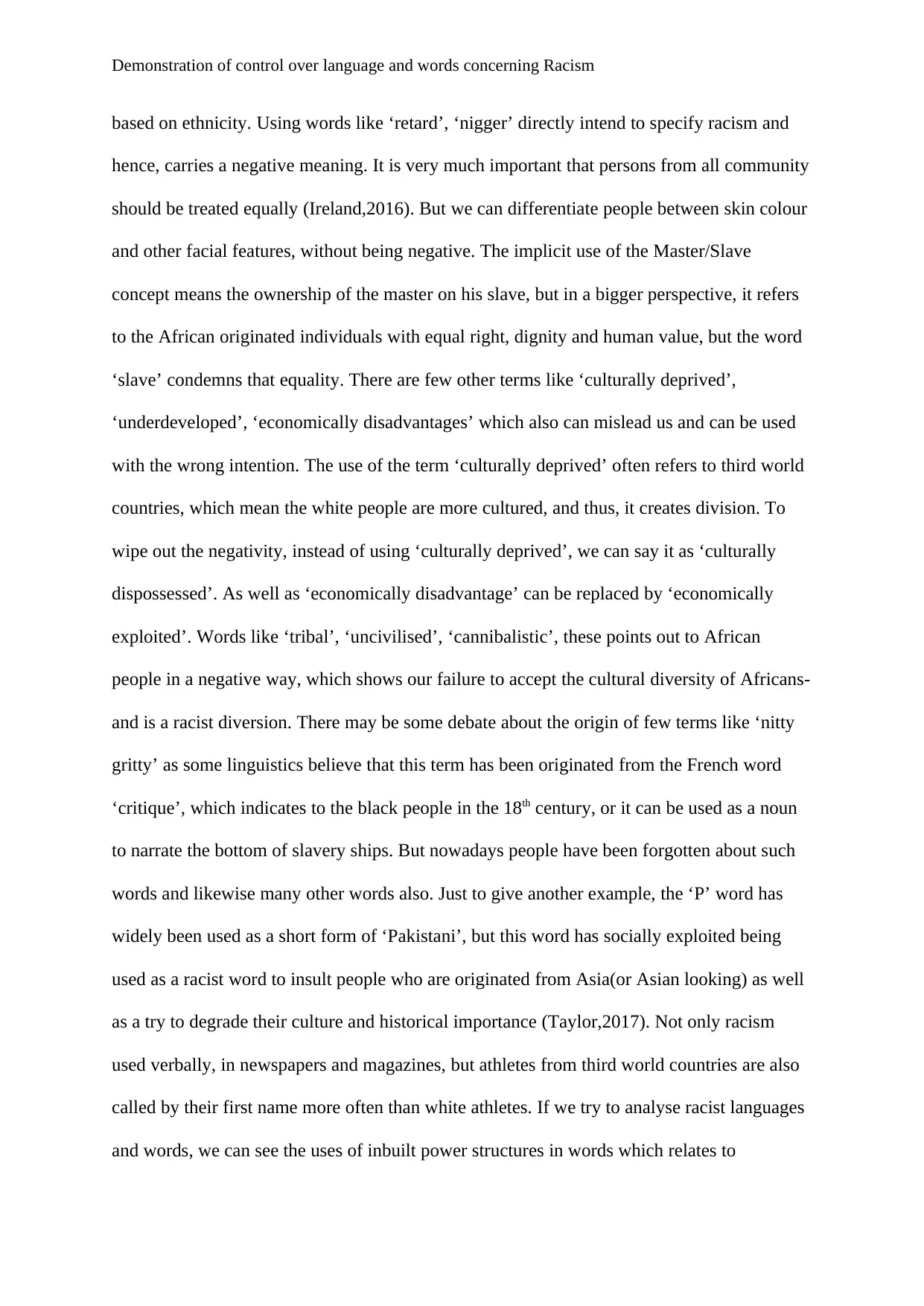
based on ethnicity. Using words like ‘retard’, ‘nigger’ directly intend to specify racism and
hence, carries a negative meaning. It is very much important that persons from all community
should be treated equally (Ireland,2016). But we can differentiate people between skin colour
and other facial features, without being negative. The implicit use of the Master/Slave
concept means the ownership of the master on his slave, but in a bigger perspective, it refers
to the African originated individuals with equal right, dignity and human value, but the word
‘slave’ condemns that equality. There are few other terms like ‘culturally deprived’,
‘underdeveloped’, ‘economically disadvantages’ which also can mislead us and can be used
with the wrong intention. The use of the term ‘culturally deprived’ often refers to third world
countries, which mean the white people are more cultured, and thus, it creates division. To
wipe out the negativity, instead of using ‘culturally deprived’, we can say it as ‘culturally
dispossessed’. As well as ‘economically disadvantage’ can be replaced by ‘economically
exploited’. Words like ‘tribal’, ‘uncivilised’, ‘cannibalistic’, these points out to African
people in a negative way, which shows our failure to accept the cultural diversity of Africans-
and is a racist diversion. There may be some debate about the origin of few terms like ‘nitty
gritty’ as some linguistics believe that this term has been originated from the French word
‘critique’, which indicates to the black people in the 18th century, or it can be used as a noun
to narrate the bottom of slavery ships. But nowadays people have been forgotten about such
words and likewise many other words also. Just to give another example, the ‘P’ word has
widely been used as a short form of ‘Pakistani’, but this word has socially exploited being
used as a racist word to insult people who are originated from Asia(or Asian looking) as well
as a try to degrade their culture and historical importance (Taylor,2017). Not only racism
used verbally, in newspapers and magazines, but athletes from third world countries are also
called by their first name more often than white athletes. If we try to analyse racist languages
and words, we can see the uses of inbuilt power structures in words which relates to
Document Page
Demonstration of control over language and words concerning Racism
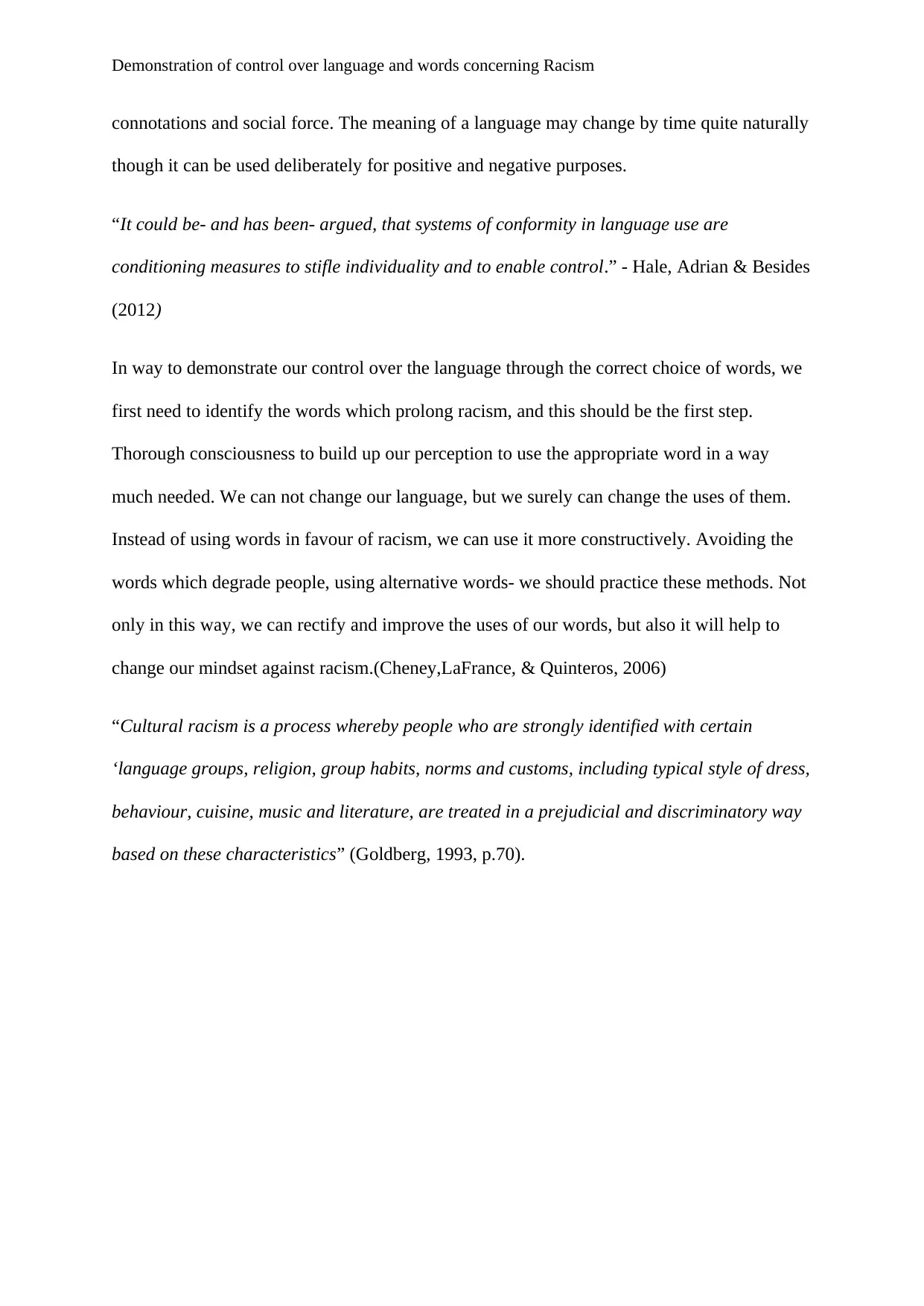
connotations and social force. The meaning of a language may change by time quite naturally
though it can be used deliberately for positive and negative purposes.
It could be- and has been- argued, that systems of conformity in language use are
conditioning measures to stifle individuality and to enable control.” - Hale, Adrian & Besides
(2012)
In way to demonstrate our control over the language through the correct choice of words, we
first need to identify the words which prolong racism, and this should be the first step.
Thorough consciousness to build up our perception to use the appropriate word in a way
much needed. We can not change our language, but we surely can change the uses of them.
Instead of using words in favour of racism, we can use it more constructively. Avoiding the
words which degrade people, using alternative words- we should practice these methods. Not
only in this way, we can rectify and improve the uses of our words, but also it will help to
change our mindset against racism.(Cheney,LaFrance, & Quinteros, 2006)
Cultural racism is a process whereby people who are strongly identified with certain
‘language groups, religion, group habits, norms and customs, including typical style of dress,
behaviour, cuisine, music and literature, are treated in a prejudicial and discriminatory way
based on these characteristics” (Goldberg, 1993, p.70).
tabler-icon-diamond-filled.svg

Paraphrase This Document

Need a fresh take? Get an instant paraphrase of this document with our AI Paraphraser
Document Page
Demonstration of control over language and words concerning Racism
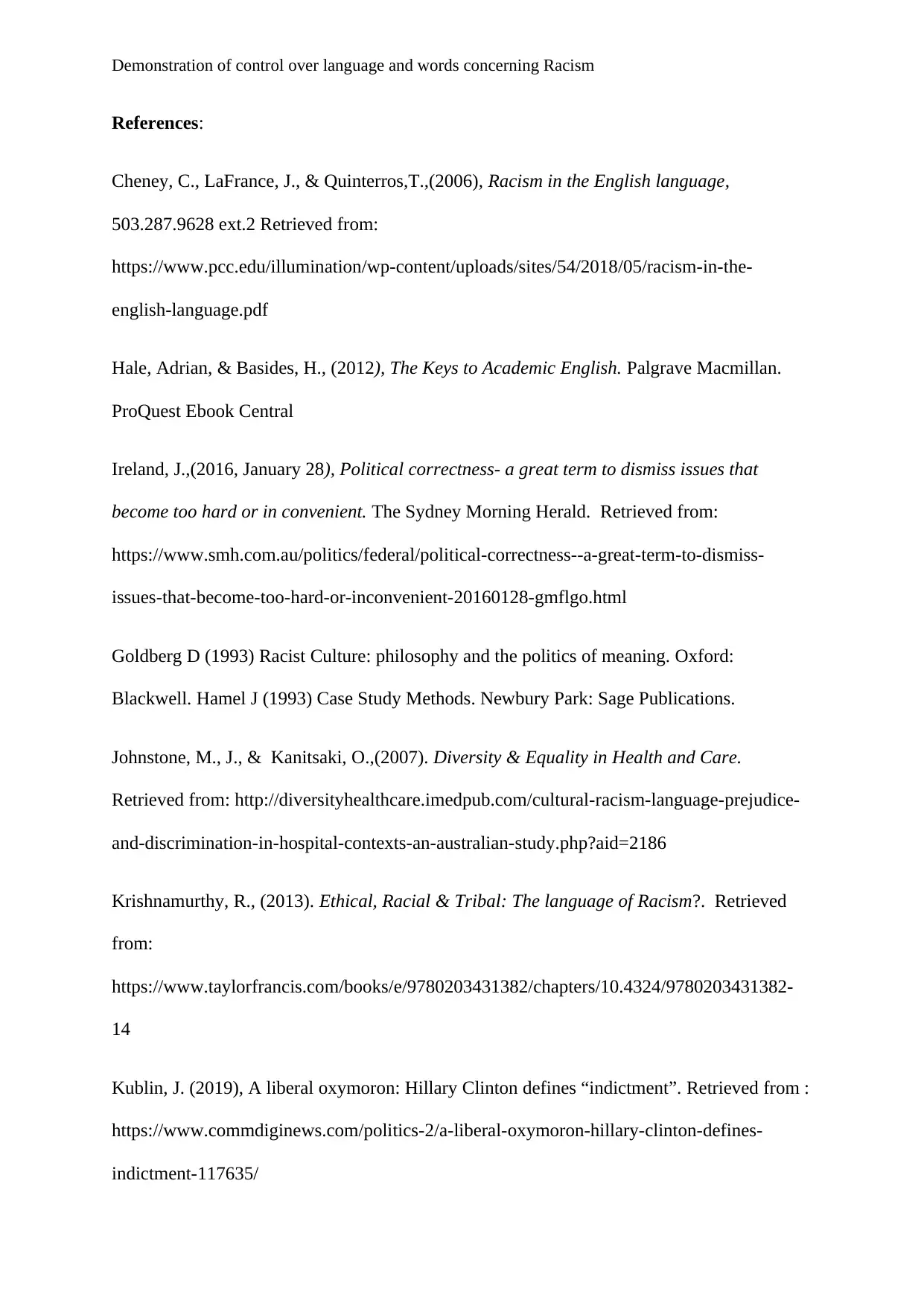
References:
Cheney, C., LaFrance, J., & Quinterros,T.,(2006), Racism in the English language,
503.287.9628 ext.2 Retrieved from:
https://www.pcc.edu/illumination/wp-content/uploads/sites/54/2018/05/racism-in-the-
english-language.pdf
Hale, Adrian, & Basides, H., (2012), The Keys to Academic English. Palgrave Macmillan.
ProQuest Ebook Central
Ireland, J.,(2016, January 28), Political correctness- a great term to dismiss issues that
become too hard or in convenient. The Sydney Morning Herald. Retrieved from:
https://www.smh.com.au/politics/federal/political-correctness--a-great-term-to-dismiss-
issues-that-become-too-hard-or-inconvenient-20160128-gmflgo.html
Goldberg D (1993) Racist Culture: philosophy and the politics of meaning. Oxford:
Blackwell. Hamel J (1993) Case Study Methods. Newbury Park: Sage Publications.
Johnstone, M., J., & Kanitsaki, O.,(2007). Diversity & Equality in Health and Care.
Retrieved from: http://diversityhealthcare.imedpub.com/cultural-racism-language-prejudice-
and-discrimination-in-hospital-contexts-an-australian-study.php?aid=2186
Krishnamurthy, R., (2013). Ethical, Racial & Tribal: The language of Racism?. Retrieved
from:
https://www.taylorfrancis.com/books/e/9780203431382/chapters/10.4324/9780203431382-
14
Kublin, J. (2019), A liberal oxymoron: Hillary Clinton defines “indictment”. Retrieved from :
https://www.commdiginews.com/politics-2/a-liberal-oxymoron-hillary-clinton-defines-
indictment-117635/
Document Page
Demonstration of control over language and words concerning Racism
Michael, R. (2011), Sierra Leone: A look at ID Card and naturalization policies, Retrieved
from: http://www.thepatrioticvanguard.com/sierra-leone-a-look-at-id-card-and-naturalization-
policies
Taylor,C.,R.,(2017), Racism and Language .Retrieved from:
https://www.huffingtonpost.co.uk/roanna-carletontaylor/racism-and-
language_b_18007182.html
The Importance of Ethical and Accurate Language. Module 12. Retrieved from:
https://courses.lumenlearning.com/publicspeakingprinciples/chapter/chapter-10-the-
importance-of-ethical-and-accurate-language/
chevron_up_icon
1 out of 6
circle_padding
hide_on_mobile
zoom_out_icon
[object Object]