Control Systems Homework Assignment Solution and Response Analysis

Verified

Added on  2022/08/22

|13
|791
|25
Homework Assignment
AI Summary
This document presents a complete solution to a control systems homework assignment, analyzing two different problems. The first problem focuses on determining the transfer function of an open-loop system and then analyzing the response of both unity and non-unity feedback systems. The solution involves deriving the transfer functions, calculating time constants, and comparing the transient responses of each system, including rise time and settling time. The second problem delves into a second-order system, deriving the transfer function from a given response graph. It calculates key parameters such as natural frequency and damping ratio. Furthermore, the solution compares the performance of open-loop, unity feedback, and non-unity feedback systems, including their stability and transient response characteristics. The document includes relevant graphs illustrating system responses and concludes with a bibliography of cited sources.
Document Page
1
Control systems
Student’s Name
Institutional Affiliation
Date
tabler-icon-diamond-filled.svg

Paraphrase This Document

Need a fresh take? Get an instant paraphrase of this document with our AI Paraphraser
Document Page
2
Q1
a)
The general transfer function is given as,
G ( s )= k
(1+ τs)
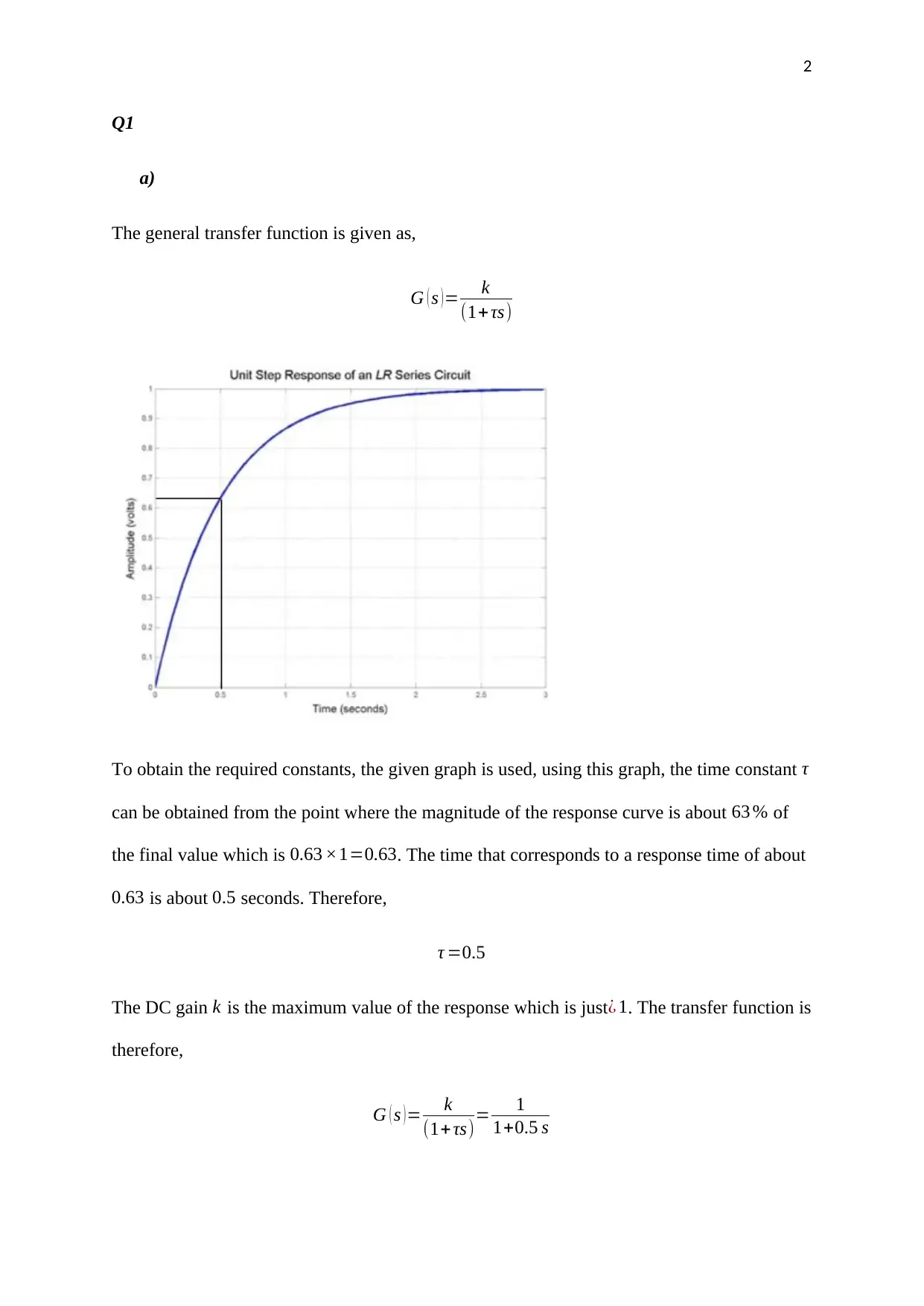
To obtain the required constants, the given graph is used, using this graph, the time constant τ
can be obtained from the point where the magnitude of the response curve is about 63 % of
the final value which is 0.63 ×1=0.63. The time that corresponds to a response time of about
0.63 is about 0.5 seconds. Therefore,
τ =0.5
The DC gain k is the maximum value of the response which is just¿ 1. The transfer function is
therefore,
G ( s )= k
(1+ τs)= 1
1+0.5 s
Document Page
3
G ( s )= 2
s +2
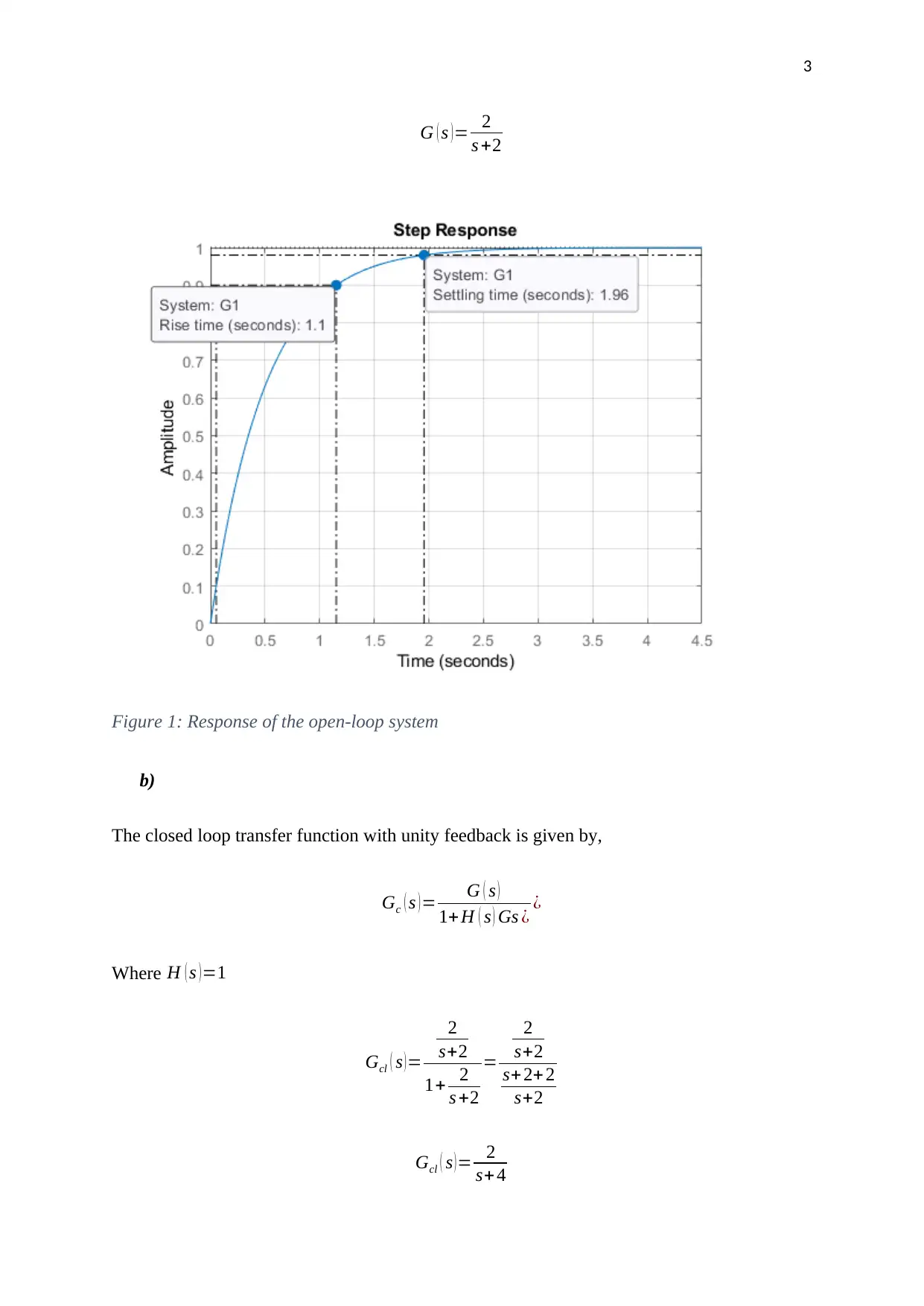
Figure 1: Response of the open-loop system
b)
The closed loop transfer function with unity feedback is given by,
Gc ( s ) = G ( s )
1+ H ( s ) Gs ¿ ¿
Where H ( s )=1
Gcl ( s )=
2
s+2
1+ 2
s +2
=
2
s+2
s+ 2+ 2
s+2
Gcl ( s ) = 2
s+ 4
Document Page
4
Gcl ( s ) = 0.5
1+0.25 s
From which,
τ =0.25
k =0.5
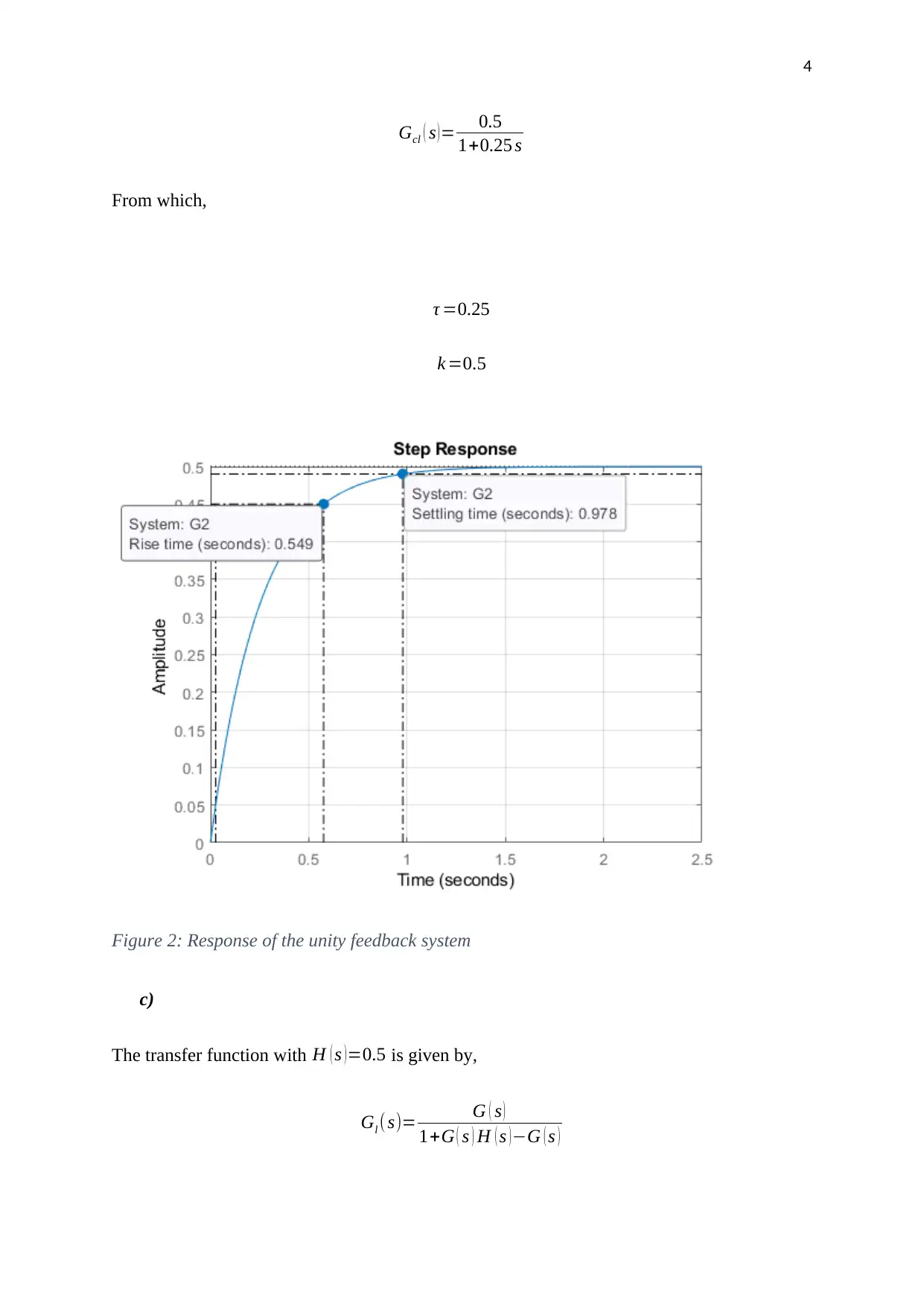
Figure 2: Response of the unity feedback system
c)
The transfer function with H ( s )=0.5 is given by,
Gl ( s)= G ( s )
1+G ( s ) H ( s )G ( s )
tabler-icon-diamond-filled.svg

Paraphrase This Document

Need a fresh take? Get an instant paraphrase of this document with our AI Paraphraser
Document Page
5
Gl ( s)=
2
s+ 2
1+ 2
s+2 H ( s ) 2
s+ 2
Gl (s)=
2
s +2
1+ 2( 0.5)
s +2 2
s+2
Gl ( s )= 2
s +1
This gives,
τ =1
k =2
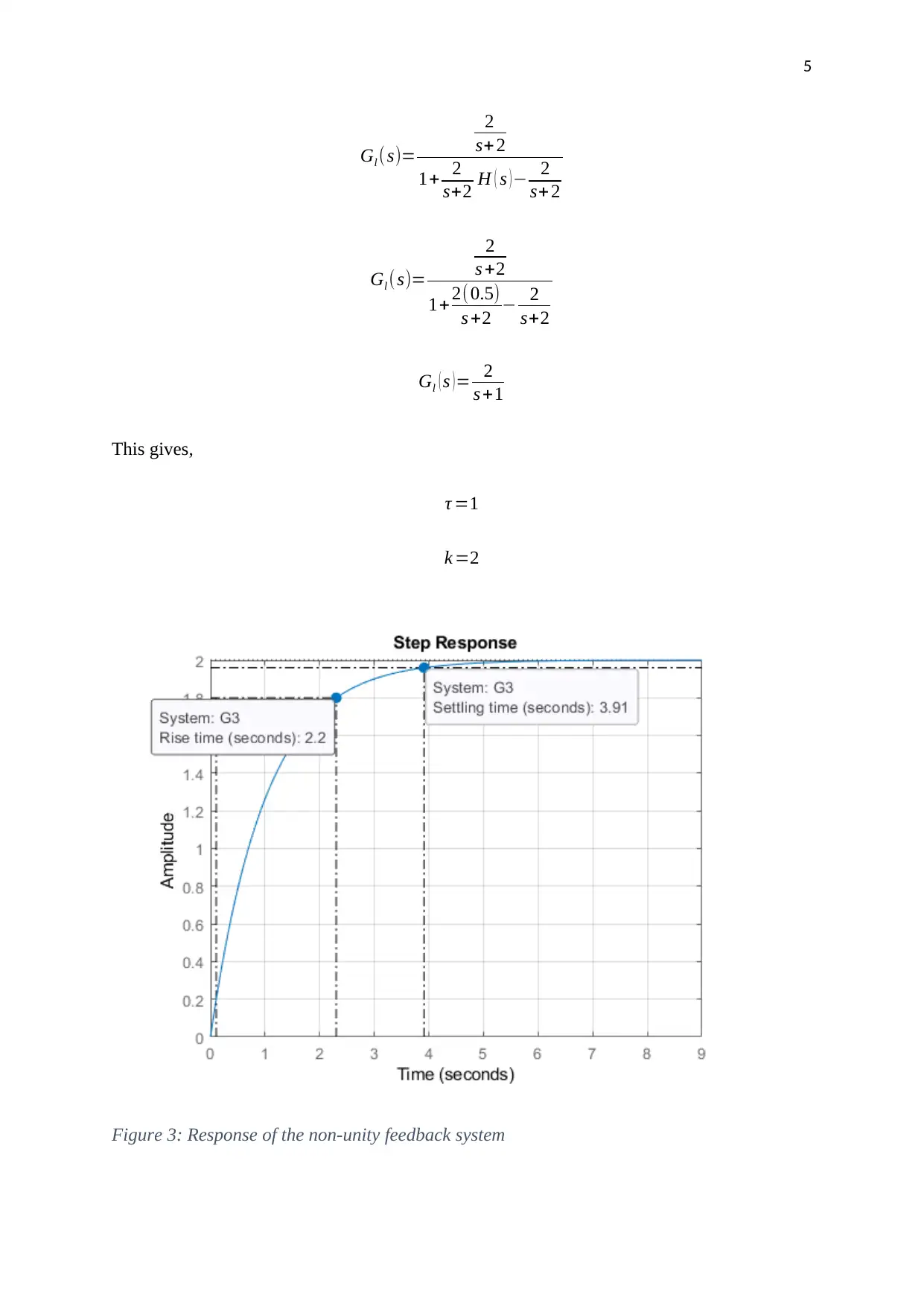
Figure 3: Response of the non-unity feedback system
Document Page
6
d)
The response of the obtained transfer function closely matches the given original response of
the system. The system has a rise time of about 1.1 seconds and a settling time of about 1.96
seconds. The response of the unity feedback system is shown in figure 2. This response has a
faster response compared to the open-loop system. It has a rise time of 0.549 seconds and a
settling time of 0.978seconds which are superior to those of the open-loop system. The non-
unity feedback system, on the other hand, exhibits a slower response than both the open-loop
and unity feedback systems with its rise time of 2.2 seconds and a settling time of 3.91
seconds. Therefore, the unity feedback system gave the best transient response.
Q2
a)
A second-order system has a transfer function of the form,
Document Page
7
G ( s ) = k ss ωn
2
s2 +2 ξ ωn s+ωn
2
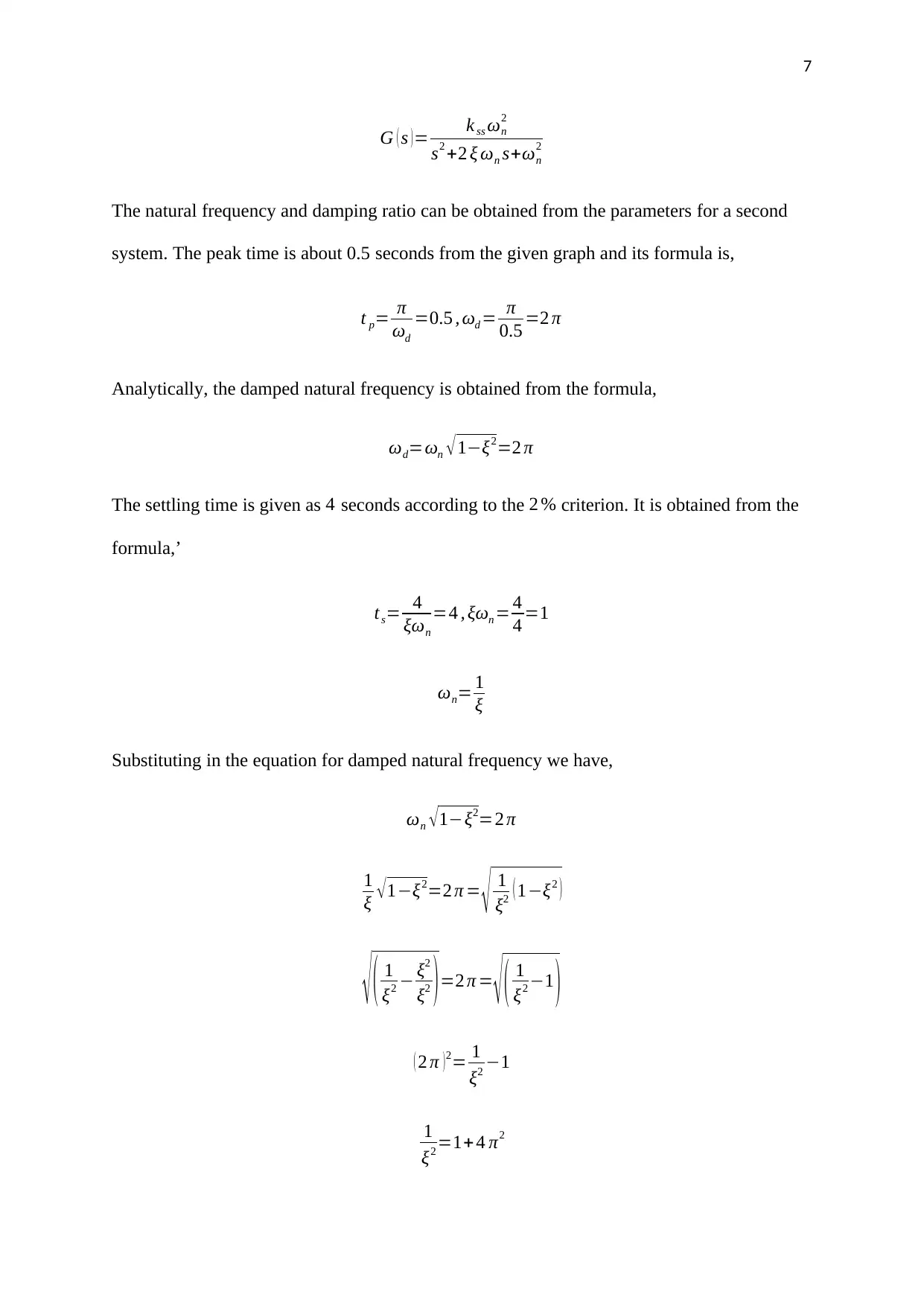
The natural frequency and damping ratio can be obtained from the parameters for a second
system. The peak time is about 0.5 seconds from the given graph and its formula is,
t p= π
ωd
=0.5 , ωd = π
0.5 =2 π
Analytically, the damped natural frequency is obtained from the formula,
ωd=ωn 1ξ2=2 π
The settling time is given as 4 seconds according to the 2 % criterion. It is obtained from the
formula,’
ts= 4
ξωn
=4 , ξωn = 4
4 =1
ωn= 1
ξ
Substituting in the equation for damped natural frequency we have,
ωn 1ξ2=2 π
1
ξ 1ξ2=2 π = 1
ξ2 ( 1ξ2 )
( 1
ξ2 ξ2
ξ2 )=2 π = ( 1
ξ2 1 )
( 2 π )2= 1
ξ2 1
1
ξ2 =1+ 4 π2
tabler-icon-diamond-filled.svg

Paraphrase This Document

Need a fresh take? Get an instant paraphrase of this document with our AI Paraphraser
Document Page
8
ξ2= 1
( 1+4 π2 )
ξ=
1
( 1+4 π2 )
ξ=0.157
The undamped natural frequency is thus,
ωn= 1
ξ = 1
0.157 =6.369 rad /s
The transfer function is thus,
G ( s )= k ss ωn
2
s2 +2 ξ ωn s+ωn
2 = 40.56 k ss
s2+2 s+40.56
From the graph, the DC gain is2.5, therefore,
G ( s )= 101.4
s2 +2 s+ 40.56
Document Page
9
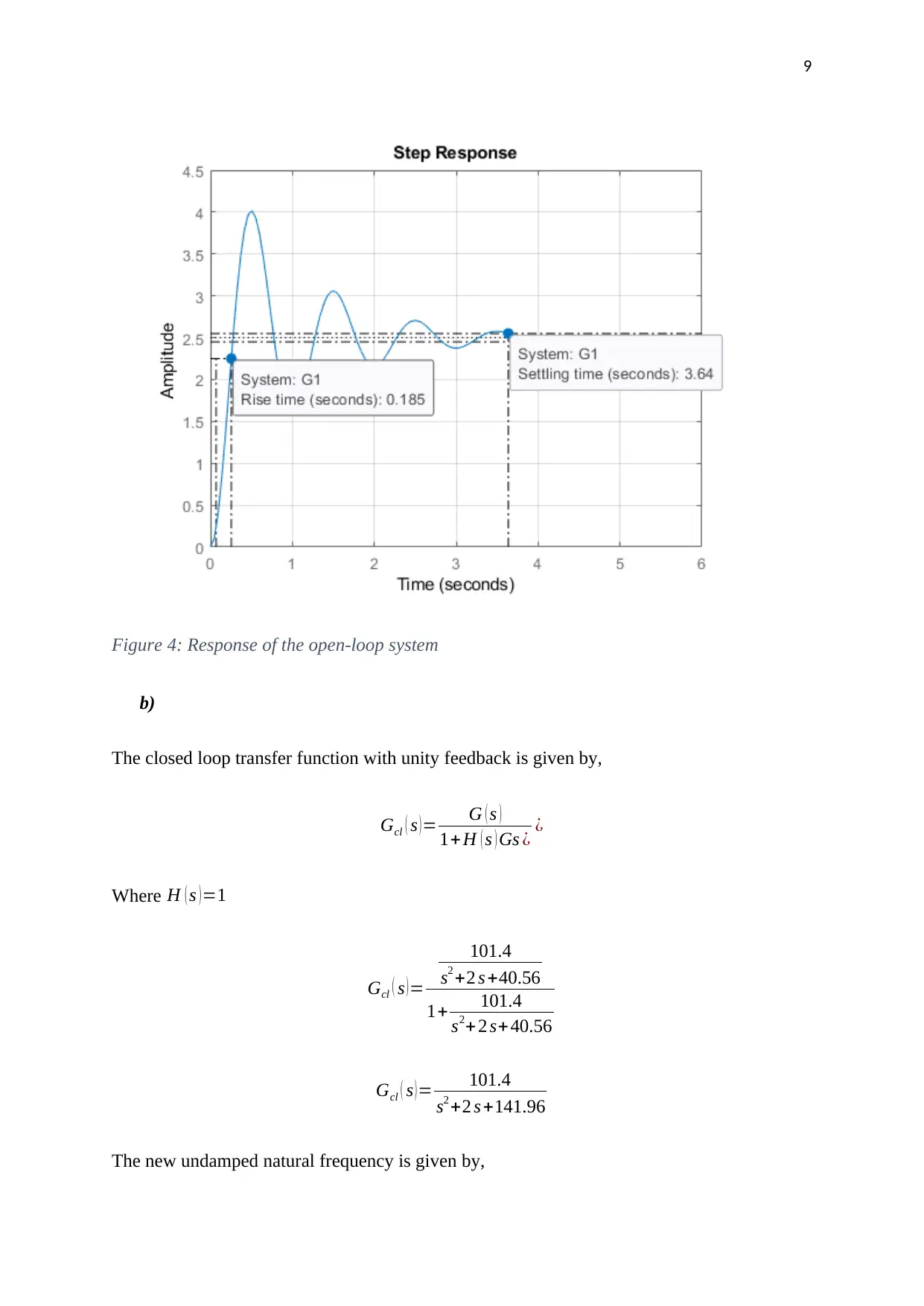
Figure 4: Response of the open-loop system
b)
The closed loop transfer function with unity feedback is given by,
Gcl ( s )= G ( s )
1+ H ( s ) Gs ¿ ¿
Where H ( s )=1
Gcl ( s ) =
101.4
s2 +2 s +40.56
1+ 101.4
s2+ 2 s+40.56
Gcl ( s ) = 101.4
s2 +2 s +141.96
The new undamped natural frequency is given by,
Document Page
10
ωn
2=141.96 , ωn=11.915 rad /s
The damping ratio becomes,
2 ξ ωn=2
ξ= 2
2 ωn
= 2
2× 11.915 =0.0839
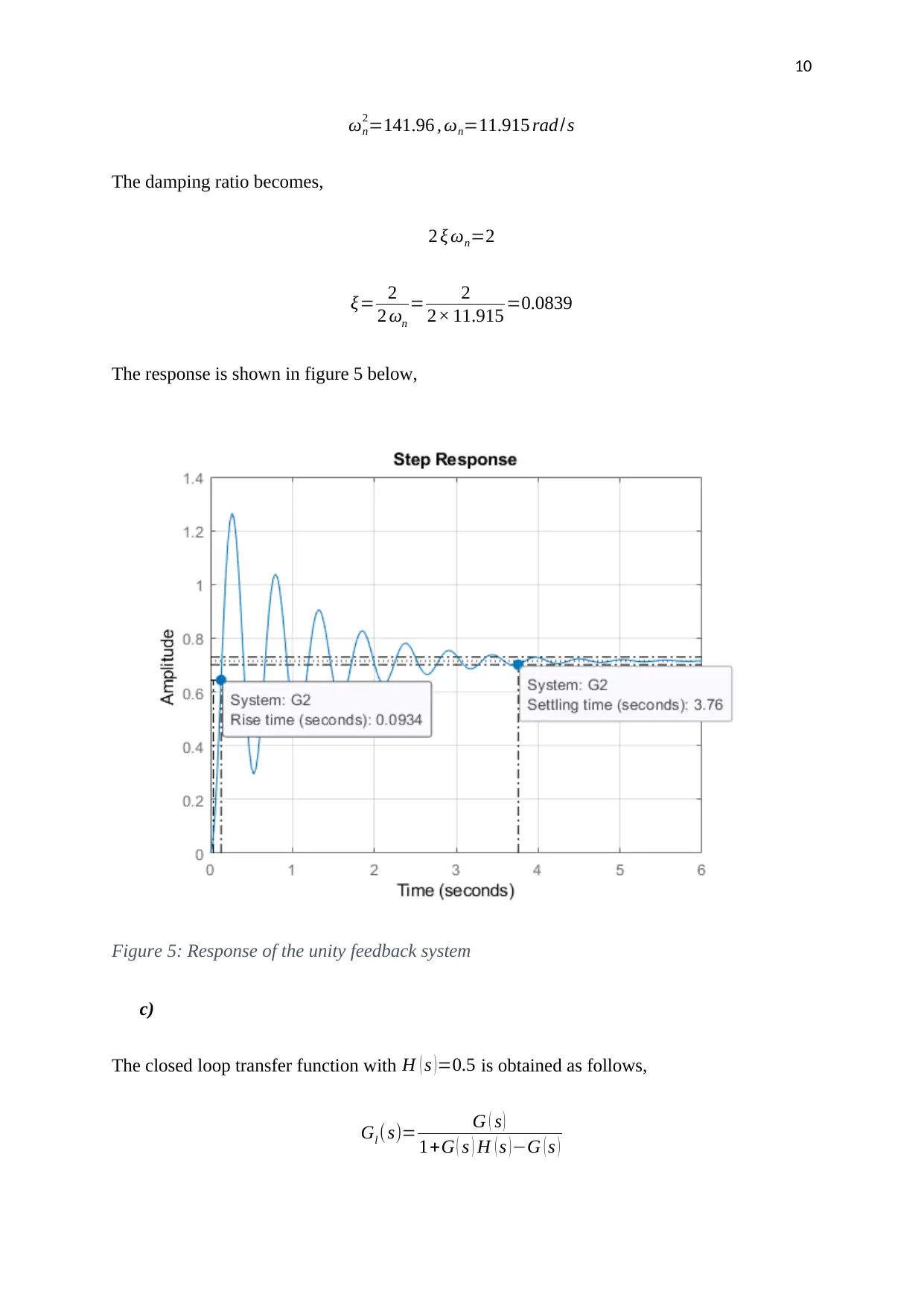
The response is shown in figure 5 below,
Figure 5: Response of the unity feedback system
c)
The closed loop transfer function with H ( s )=0.5 is obtained as follows,
Gl ( s)= G ( s )
1+G ( s ) H ( s )G ( s )
tabler-icon-diamond-filled.svg

Paraphrase This Document

Need a fresh take? Get an instant paraphrase of this document with our AI Paraphraser
Document Page
11
Gl ( s)=
101.4
s2 +2 s+ 40.56
1+ 101.4
s2 +2 s +40.56 ×0.5 101.4
s2+ 2 s+ 40.56
Gl ( s)=
101.4
s2 +2 s+ 40.56
1+ 101.4
s2 +2 s +40.56 ×0.5 101.4
s2+ 2 s+ 40.56
Gl ( s)=
101.4
s2 +2 s+40.56
1+ 50.7
s2 +2 s +40.56 101.4
s2 +2 s +40.56
Gl ( s ) =
101.4
s2+ 2 s+ 40.56
1+ 50.7101.4
s2 +2 s +40.56
=
101.4
s2 +2 s+ 40.56
s2+2 s+ 40.56+50.7101.4
s2 +2 s+ 40.56
Gl ( s ) =
101.4
s2 +2 s +40.56
s2 +2 s +40.5650.7
s2 +2 s +40.56
Gl ( s )= 101.4
s2+ 2 s+ 40.56 × s2 +2 s +40.56
s2 +2 s +40.5650.7 = 101.4
s2 +2 s10.14
The undamped natural frequency is thus,
ωn
2=10.14
ωn= 10.14
ωn= j 10.14= j 3.184 rad /s
The damping ratio becomes,
2 ξ ωn=2
Document Page
12
ξ ωn =1
ξ= 1
ωn
= 1
j3.184
ξ= j 0.314
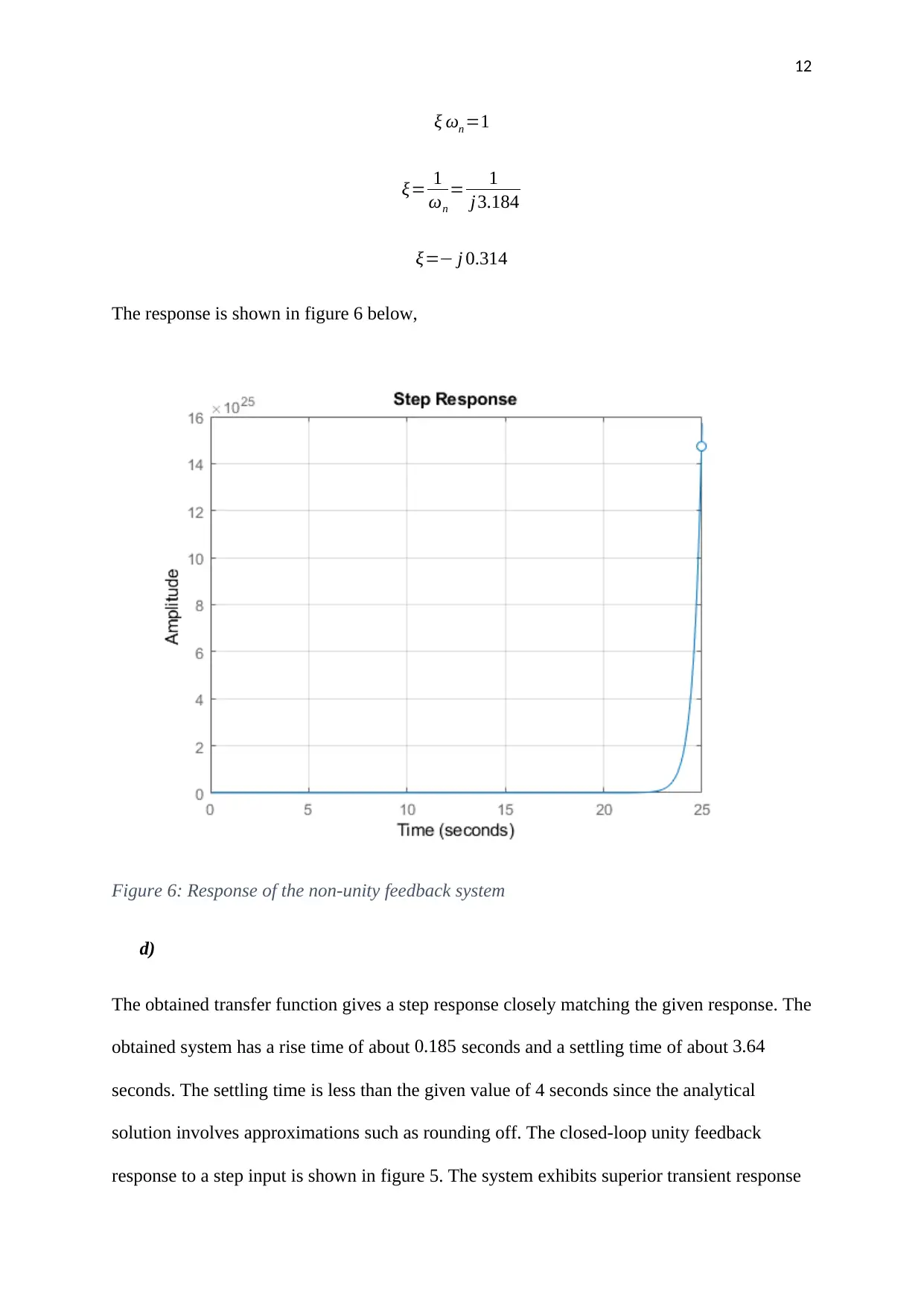
The response is shown in figure 6 below,
Figure 6: Response of the non-unity feedback system
d)
The obtained transfer function gives a step response closely matching the given response. The
obtained system has a rise time of about 0.185 seconds and a settling time of about 3.64
seconds. The settling time is less than the given value of 4 seconds since the analytical
solution involves approximations such as rounding off. The closed-loop unity feedback
response to a step input is shown in figure 5. The system exhibits superior transient response
chevron_up_icon
1 out of 13
circle_padding
hide_on_mobile
zoom_out_icon
[object Object]