COOK: Global Market Environment and Expansion Strategies Report
VerifiedAdded on 2020/07/22
|9
|2391
|60
Report
AI Summary
This report analyzes COOK's strategy for expanding into international markets. It begins by defining the global business environment for small and medium-sized enterprises (SMEs), particularly in the context of the UK-based frozen ready meal manufacturer, COOK. The report explores the threats and opportunities SMEs face in this environment, including the impact of globalization and competition. It then delves into the advantages and disadvantages of international trading blocs and agreements, as well as various tariff and non-tariff barriers that businesses encounter. The analysis covers topics such as increased foreign direct investment, competition, economies of scale, and trade effects. The report concludes by emphasizing the importance of considering these factors for successful international market entry and highlighting the need for SMEs like COOK to adapt to the global landscape.
Tapping into new
and international
market
and international
market

Paraphrase This Document
Need a fresh take? Get an instant paraphrase of this document with our AI Paraphraser
Table of Contents
INTRODUCTION...........................................................................................................................1
TASK 1............................................................................................................................................1
P1 Explain global business environment in which small business operates..........................1
P2 Threats and opportunities which are faced by SMEs........................................................2
TASK 2............................................................................................................................................3
P3 Advantages and disadvantages of international trading blocs and agreements................3
P4 Various tariff and non-tariffs barriers of international trading environment....................4
TASK 3............................................................................................................................................5
(Covered in Broacher)............................................................................................................5
TASK 4............................................................................................................................................5
(Covered in Broacher)............................................................................................................5
CONCLUSION................................................................................................................................5
REFERENCES................................................................................................................................5
INTRODUCTION...........................................................................................................................1
TASK 1............................................................................................................................................1
P1 Explain global business environment in which small business operates..........................1
P2 Threats and opportunities which are faced by SMEs........................................................2
TASK 2............................................................................................................................................3
P3 Advantages and disadvantages of international trading blocs and agreements................3
P4 Various tariff and non-tariffs barriers of international trading environment....................4
TASK 3............................................................................................................................................5
(Covered in Broacher)............................................................................................................5
TASK 4............................................................................................................................................5
(Covered in Broacher)............................................................................................................5
CONCLUSION................................................................................................................................5
REFERENCES................................................................................................................................5
INTRODUCTION
Expanding a business into intern level is one of the imperative decision of a corporate
association as it supports to extend its market presence or operations beyond its domestic
markets and into foreign markets. In this modern era, every small and large organisation tend to
expand their functions into international markets and for this they acquire effective strategies and
policies so as to get succeed in same markets (Bharosa and et. al., 2013). Along with this,
COOK is a retailer or manufacturer of frozen ready meals which was founded in 1997. The main
objective of the firm is – to cook using the same ingredients and techniques for providing
delicious taste to people. On the other hand, the report will be define global environment in
which a SME operates and different threats and opportunities are faced by it at there. Readers
will also come to know advantages and disadvantages of international trading agreements and
barriers which exists at there.
TASK 1
P1 Explain global business environment in which small business operates
The term global business environment is a dimensional concept, such as – process,
philosophy and phenomenon. It can be definite as an environment in which diverse sovereign
nations having elements exogenous to domestic environment of a business organisation; it
hinders decision making process, utilisation of available resources and working capabilities of
the company in direct and indirect manner (Cavusgil, Rammal and Freeman, 2011). Apart from
this, in UK small and medium sized firms have been accounted since past decades for 93% of
sectors and 60 to 70% employment. In context of COOK, the business association is located in
United Kingdom, it provides its services so as to give a delicious or unique taste of food to
people. Although, the small business have succeed in London and now it wants spread its
business area in other countries also, i.e. Asia, United states, Australia etc. For this purpose,
management already has started to prepare a marketing plan that is based upon global business
environment. Cook is a manufacturer and retailer of frozen ready meals and was established in
1997. They manufacture tasty ranges of frozen meals that are easy to prepare. Company is
planning to expand their business in other countries. In order to achieve success in global market,
they need to manufacture meals which are used and prepared in a particular country. They might
face problems in some countries due to presence of competition of rival teams as frozen foods
are common now a days and mostly preferred by customers. This challenges company to
1
Expanding a business into intern level is one of the imperative decision of a corporate
association as it supports to extend its market presence or operations beyond its domestic
markets and into foreign markets. In this modern era, every small and large organisation tend to
expand their functions into international markets and for this they acquire effective strategies and
policies so as to get succeed in same markets (Bharosa and et. al., 2013). Along with this,
COOK is a retailer or manufacturer of frozen ready meals which was founded in 1997. The main
objective of the firm is – to cook using the same ingredients and techniques for providing
delicious taste to people. On the other hand, the report will be define global environment in
which a SME operates and different threats and opportunities are faced by it at there. Readers
will also come to know advantages and disadvantages of international trading agreements and
barriers which exists at there.
TASK 1
P1 Explain global business environment in which small business operates
The term global business environment is a dimensional concept, such as – process,
philosophy and phenomenon. It can be definite as an environment in which diverse sovereign
nations having elements exogenous to domestic environment of a business organisation; it
hinders decision making process, utilisation of available resources and working capabilities of
the company in direct and indirect manner (Cavusgil, Rammal and Freeman, 2011). Apart from
this, in UK small and medium sized firms have been accounted since past decades for 93% of
sectors and 60 to 70% employment. In context of COOK, the business association is located in
United Kingdom, it provides its services so as to give a delicious or unique taste of food to
people. Although, the small business have succeed in London and now it wants spread its
business area in other countries also, i.e. Asia, United states, Australia etc. For this purpose,
management already has started to prepare a marketing plan that is based upon global business
environment. Cook is a manufacturer and retailer of frozen ready meals and was established in
1997. They manufacture tasty ranges of frozen meals that are easy to prepare. Company is
planning to expand their business in other countries. In order to achieve success in global market,
they need to manufacture meals which are used and prepared in a particular country. They might
face problems in some countries due to presence of competition of rival teams as frozen foods
are common now a days and mostly preferred by customers. This challenges company to
1
⊘ This is a preview!⊘
Do you want full access?
Subscribe today to unlock all pages.

Trusted by 1+ million students worldwide
manufacture more delicious and quality products in order to attract customers and to establish its
business in market.
P2 Threats and opportunities which are faced by SMEs
Small and medium enterprise plays a vital role in nation's economy development and is
affected by globalisation and competition by other enterprise. They have created many job
opportunities for people of the country. In the era of globalisation, a great number of markets are
increasingly competitive and international, even though the situation is more distinct for small
and medium sized enterprise than for multinational company (Khakhar and Rammal, 2013).
Small and medium enterprise mainly include start ups, sole traders, general store, etc. UK are
basically improving and investing in a long lasting platform to provide competitive edge.
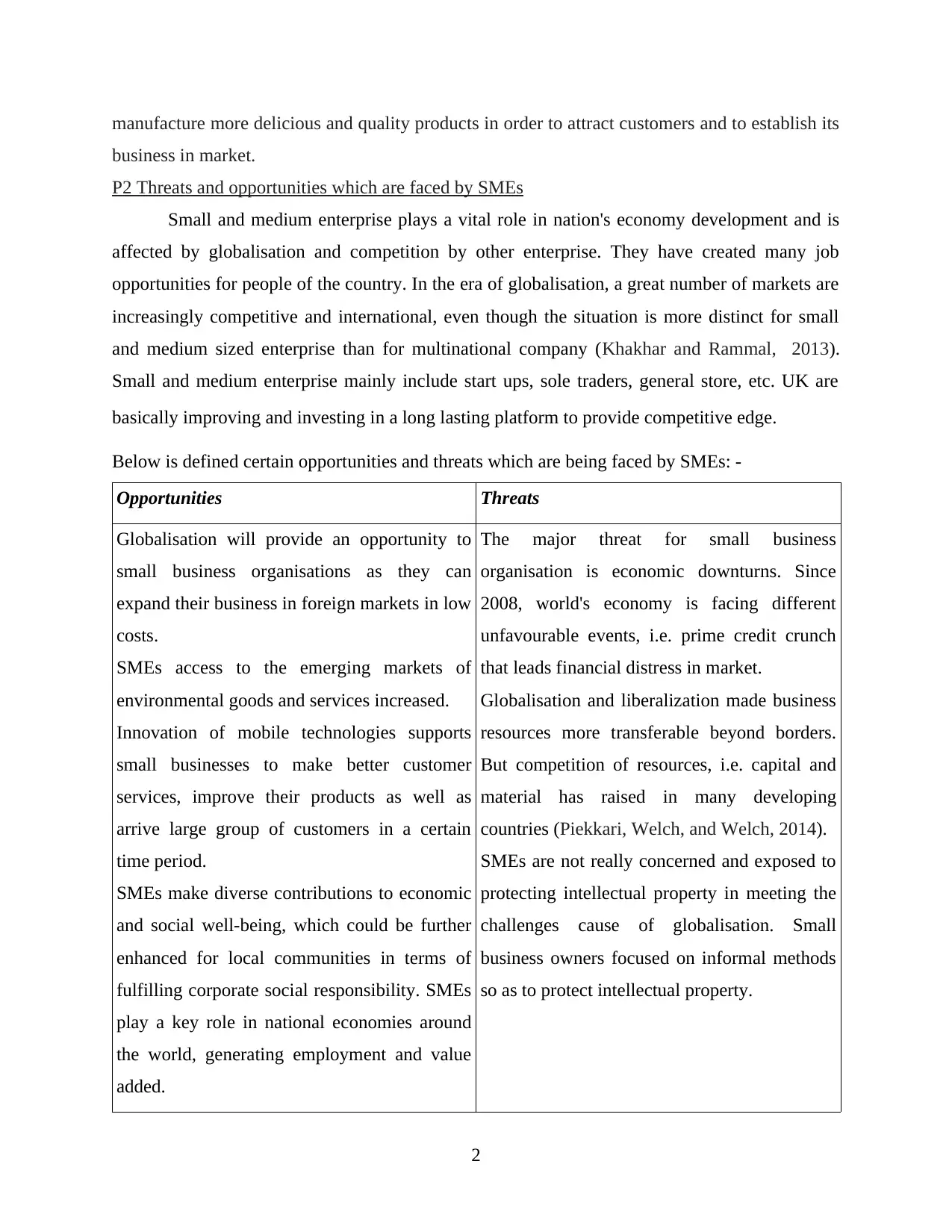
Below is defined certain opportunities and threats which are being faced by SMEs: -
Opportunities Threats
Globalisation will provide an opportunity to
small business organisations as they can
expand their business in foreign markets in low
costs.
SMEs access to the emerging markets of
environmental goods and services increased.
Innovation of mobile technologies supports
small businesses to make better customer
services, improve their products as well as
arrive large group of customers in a certain
time period.
SMEs make diverse contributions to economic
and social well-being, which could be further
enhanced for local communities in terms of
fulfilling corporate social responsibility. SMEs
play a key role in national economies around
the world, generating employment and value
added.
The major threat for small business
organisation is economic downturns. Since
2008, world's economy is facing different
unfavourable events, i.e. prime credit crunch
that leads financial distress in market.
Globalisation and liberalization made business
resources more transferable beyond borders.
But competition of resources, i.e. capital and
material has raised in many developing
countries (Piekkari, Welch, and Welch, 2014).
SMEs are not really concerned and exposed to
protecting intellectual property in meeting the
challenges cause of globalisation. Small
business owners focused on informal methods
so as to protect intellectual property.
2
business in market.
P2 Threats and opportunities which are faced by SMEs
Small and medium enterprise plays a vital role in nation's economy development and is
affected by globalisation and competition by other enterprise. They have created many job
opportunities for people of the country. In the era of globalisation, a great number of markets are
increasingly competitive and international, even though the situation is more distinct for small
and medium sized enterprise than for multinational company (Khakhar and Rammal, 2013).
Small and medium enterprise mainly include start ups, sole traders, general store, etc. UK are
basically improving and investing in a long lasting platform to provide competitive edge.
Below is defined certain opportunities and threats which are being faced by SMEs: -
Opportunities Threats
Globalisation will provide an opportunity to
small business organisations as they can
expand their business in foreign markets in low
costs.
SMEs access to the emerging markets of
environmental goods and services increased.
Innovation of mobile technologies supports
small businesses to make better customer
services, improve their products as well as
arrive large group of customers in a certain
time period.
SMEs make diverse contributions to economic
and social well-being, which could be further
enhanced for local communities in terms of
fulfilling corporate social responsibility. SMEs
play a key role in national economies around
the world, generating employment and value
added.
The major threat for small business
organisation is economic downturns. Since
2008, world's economy is facing different
unfavourable events, i.e. prime credit crunch
that leads financial distress in market.
Globalisation and liberalization made business
resources more transferable beyond borders.
But competition of resources, i.e. capital and
material has raised in many developing
countries (Piekkari, Welch, and Welch, 2014).
SMEs are not really concerned and exposed to
protecting intellectual property in meeting the
challenges cause of globalisation. Small
business owners focused on informal methods
so as to protect intellectual property.
2
Paraphrase This Document
Need a fresh take? Get an instant paraphrase of this document with our AI Paraphraser
Therefore, it can be said that there are several opportunities of small businesses in global
business environment and supports to accomplish business goals and objectives in a certain time
period. Even small business organisations also expands their business in global economy but
foreign market competition has a great impact on local competitiveness as well as security is one
of the biggest challenge for every business owner (Meyer, Mudambi and Narula, 2011). Thus, in
order to maintain their viability in global business environment COOK is required to consider all
above mentioned opportunities and then address these challenges.
TASK 2
P3 Advantages and disadvantages of international trading blocs and agreements
A trading blocs is a kind of inter-government agreement that is often a part of inter-
government agreement in which obstacles of trade, i.e. tariffs or non-tariffs get reduces among
engaging states. In other words, it allows others to trade with each others as easy as possible.
Along with this, international trade agreements can provide new opportunities to business
owners and they also access to import or export competitively from others.
Advantages of international trading blocs and agreements
Increased foreign direct investment - Enhancement of foreign direct investments which
results creating trade blocs and agreements. It will contribute in expanding businesses and
generating new jobs to countries.
Competition – International trade blocs influence business owners to participate in other
countries so as to compete with rivals and get high competitive advantage. Although, increase
competition may raise pressure for greater efficiency for firms it results customers' will get
products on lower prices. For example- COOK is going to expand its business in foreign market
by having greater efficiency which ensure survival of food items with low prices because tariffs
are removed.
Economies of scale – International markets create through trade blocs that allows firms
to achieve high edge of economics of scale. As average costs of products tends raises in
production; it results low rates for customers (Govindan, Sivasubramaniam and Urgaonkar,
2011).
Trade effects – Another advantage of trade blocs is to diminish tariffs that driven up
import costs. It results, consumers will save money by purchasing imported goods at lower rates
3
business environment and supports to accomplish business goals and objectives in a certain time
period. Even small business organisations also expands their business in global economy but
foreign market competition has a great impact on local competitiveness as well as security is one
of the biggest challenge for every business owner (Meyer, Mudambi and Narula, 2011). Thus, in
order to maintain their viability in global business environment COOK is required to consider all
above mentioned opportunities and then address these challenges.
TASK 2
P3 Advantages and disadvantages of international trading blocs and agreements
A trading blocs is a kind of inter-government agreement that is often a part of inter-
government agreement in which obstacles of trade, i.e. tariffs or non-tariffs get reduces among
engaging states. In other words, it allows others to trade with each others as easy as possible.
Along with this, international trade agreements can provide new opportunities to business
owners and they also access to import or export competitively from others.
Advantages of international trading blocs and agreements
Increased foreign direct investment - Enhancement of foreign direct investments which
results creating trade blocs and agreements. It will contribute in expanding businesses and
generating new jobs to countries.
Competition – International trade blocs influence business owners to participate in other
countries so as to compete with rivals and get high competitive advantage. Although, increase
competition may raise pressure for greater efficiency for firms it results customers' will get
products on lower prices. For example- COOK is going to expand its business in foreign market
by having greater efficiency which ensure survival of food items with low prices because tariffs
are removed.
Economies of scale – International markets create through trade blocs that allows firms
to achieve high edge of economics of scale. As average costs of products tends raises in
production; it results low rates for customers (Govindan, Sivasubramaniam and Urgaonkar,
2011).
Trade effects – Another advantage of trade blocs is to diminish tariffs that driven up
import costs. It results, consumers will save money by purchasing imported goods at lower rates
3
and they can spend their savings on other goods. In addition, reducing import costs also
decreases the prices of local products and it is beneficial for SMEs and countries.
Disadvantages of international trading blocs and agreements
International trading blocs are in favour of participating countries. No one nation or its businesses wants to let foreign firms attain high market share due to
he expansion of local companies. If a country wants to join trading bloc should be
prepared to make conscious (Neelankavil, 2015).
P4 Various tariff and non-tariffs barriers of international trading environment
Tariff are the taxes which are imposed on commodity which is imported into a country or
a region. They are the oldest forms of government intervention in economic activity. They are
imposed in order to achieve two main purposes. First, they provide revenue to government and
second, they improve economic returns to firms and suppliers of resources to domestic industry.
Whereas, non tariff barriers is a way to restrict using trade barriers in a form other than a tariff.
Following are some tariff and non tariff barriers:
Tariff Barriers:
Export tariff barriers: Taxes are imposed on those goods which leaves the country.
Import tariff barriers: Taxes are imposed on goods which are imported.
Transit tariff barriers: Taxes are imposed on those goods which pass through one
country boundary for another.
Non Tariff Barriers
Quotas: There are some limitation on quantity of goods imported to a country. If the
importer exceeds the limitation, they have to pay penalty for every exceeded goods.
There are some quotas which is used by countries like Voluntary Export Restraints
(VER), it is a quota which is imposed by exporting country, typically at the request of the
importing country.
Subsidies: It is basically a subsidy which is paid by government to a domestic producer.
For e.g., cash grants, low interest loans, tax breaks etc. They can help domestic producer
4
decreases the prices of local products and it is beneficial for SMEs and countries.
Disadvantages of international trading blocs and agreements
International trading blocs are in favour of participating countries. No one nation or its businesses wants to let foreign firms attain high market share due to
he expansion of local companies. If a country wants to join trading bloc should be
prepared to make conscious (Neelankavil, 2015).
P4 Various tariff and non-tariffs barriers of international trading environment
Tariff are the taxes which are imposed on commodity which is imported into a country or
a region. They are the oldest forms of government intervention in economic activity. They are
imposed in order to achieve two main purposes. First, they provide revenue to government and
second, they improve economic returns to firms and suppliers of resources to domestic industry.
Whereas, non tariff barriers is a way to restrict using trade barriers in a form other than a tariff.
Following are some tariff and non tariff barriers:
Tariff Barriers:
Export tariff barriers: Taxes are imposed on those goods which leaves the country.
Import tariff barriers: Taxes are imposed on goods which are imported.
Transit tariff barriers: Taxes are imposed on those goods which pass through one
country boundary for another.
Non Tariff Barriers
Quotas: There are some limitation on quantity of goods imported to a country. If the
importer exceeds the limitation, they have to pay penalty for every exceeded goods.
There are some quotas which is used by countries like Voluntary Export Restraints
(VER), it is a quota which is imposed by exporting country, typically at the request of the
importing country.
Subsidies: It is basically a subsidy which is paid by government to a domestic producer.
For e.g., cash grants, low interest loans, tax breaks etc. They can help domestic producer
4
⊘ This is a preview!⊘
Do you want full access?
Subscribe today to unlock all pages.
Trusted by 1+ million students worldwide
in two ways and that can be, first, it help them to compete against low cost foreign
imports and second is to gain access to export markets.
Others: It includes embargo, local content requirements, currency controls,
administrative delays, etc.
Embargoes: It is an government order imposing a trade barrier. It serves various purposes
like, it help country to achieve political goals, it avoids hurting religious feelings, etc.
Local content requirements: It is a legal stipulation that only a specified amount of goods
or service can be supplied by producer in the domestic markets.
TASK 3
(Covered in Broacher)
TASK 4
(Covered in Broacher)
CONCLUSION
As per the above mentioned report it get analysed that to compete and survival in external
environment small businesses are required to expand their operations in international market.
The report has stated that before expanding business in global environment, firms are required to
analyse all those factors which can affect their business in direct and indirect manner. In
addition, there are various methods of Joint venture, partnership agreement, franchising etc.
5
imports and second is to gain access to export markets.
Others: It includes embargo, local content requirements, currency controls,
administrative delays, etc.
Embargoes: It is an government order imposing a trade barrier. It serves various purposes
like, it help country to achieve political goals, it avoids hurting religious feelings, etc.
Local content requirements: It is a legal stipulation that only a specified amount of goods
or service can be supplied by producer in the domestic markets.
TASK 3
(Covered in Broacher)
TASK 4
(Covered in Broacher)
CONCLUSION
As per the above mentioned report it get analysed that to compete and survival in external
environment small businesses are required to expand their operations in international market.
The report has stated that before expanding business in global environment, firms are required to
analyse all those factors which can affect their business in direct and indirect manner. In
addition, there are various methods of Joint venture, partnership agreement, franchising etc.
5
Paraphrase This Document
Need a fresh take? Get an instant paraphrase of this document with our AI Paraphraser
REFERENCES
Books and Journal
Andrade, H., Gedik, B. and Wu, K. L., International Business Machines Corp, 2012. Method for
generating a distributed stream processing application. U.S. Patent 8,291,006.
Berends, H. and et. al., 2011. Thinking along: a process for tapping into knowledge across
boundaries. International Journal of Technology Management. 53(1). pp.69-88.
Bharosa, N. and et. al., 2013. Tapping into existing information flows: The transformation to
compliance by design in business-to-government information exchange. Government
Information Quarterly. 30. pp.S9-S18.
Buckley, P. J., 2011. The theory of international business pre-Hymer. Journal of World Business.
46(1). pp.61-73.
Cavusgil, S.T., Rammal, H. and Freeman, S., 2011. International business: The new realities.
Pearson Higher Education AU.
Dickson, B., Kaminsky, D. L. and Stockton, M. L. P., International Business Machines Corp,
2011. Protecting secret data entry from infrared and audio eavesdropping. U.S. Patent
7,899,325.
Govindan, S., Sivasubramaniam, A. and Urgaonkar, B., 2011, June. Benefits and limitations of
tapping into stored energy for datacenters. In ACM SIGARCH Computer Architecture
News. (Vol. 39, No. 3, pp. 341-352). ACM.
Holsapple, C. ed., 2013. Handbook on knowledge management 1: Knowledge matters (Vol. 1).
Springer Science & Business Media.
Hu, J. and et. al., International Business Machines Corp, 2012. Ranking expert responses and
finding experts based on rank. U.S. Patent 8,266,098.
Jensen, P. D. Ø. and Pedersen, T., 2012. Offshoring and international competitiveness:
Antecedents of offshoring advanced tasks. Journal of the Academy of Marketing
Science. 40(2). pp.313-328.
Khakhar, P. and Rammal, H. G., 2013. Culture and business networks: International business
negotiations with Arab managers. International Business Review. 22(3). pp.578-590.
Meyer, K. E., Mudambi, R. and Narula, R., 2011. Multinational enterprises and local contexts:
The opportunities and challenges of multiple embeddedness. Journal of management
studies. 48(2). pp.235-252.
Neelankavil, J. P., 2015. International business research. Routledge.
Piekkari, R., Welch, D. and Welch, L. S., 2014. Language in international business: The
multilingual reality of global business expansion. Edward Elgar Publishing.
Yeoh, E., Othman, K. and Ahmad, H., 2013. Understanding medical tourists: Word-of-mouth
and viral marketing as potent marketing tools. Tourism Management. 34. pp.196-201.
6
Books and Journal
Andrade, H., Gedik, B. and Wu, K. L., International Business Machines Corp, 2012. Method for
generating a distributed stream processing application. U.S. Patent 8,291,006.
Berends, H. and et. al., 2011. Thinking along: a process for tapping into knowledge across
boundaries. International Journal of Technology Management. 53(1). pp.69-88.
Bharosa, N. and et. al., 2013. Tapping into existing information flows: The transformation to
compliance by design in business-to-government information exchange. Government
Information Quarterly. 30. pp.S9-S18.
Buckley, P. J., 2011. The theory of international business pre-Hymer. Journal of World Business.
46(1). pp.61-73.
Cavusgil, S.T., Rammal, H. and Freeman, S., 2011. International business: The new realities.
Pearson Higher Education AU.
Dickson, B., Kaminsky, D. L. and Stockton, M. L. P., International Business Machines Corp,
2011. Protecting secret data entry from infrared and audio eavesdropping. U.S. Patent
7,899,325.
Govindan, S., Sivasubramaniam, A. and Urgaonkar, B., 2011, June. Benefits and limitations of
tapping into stored energy for datacenters. In ACM SIGARCH Computer Architecture
News. (Vol. 39, No. 3, pp. 341-352). ACM.
Holsapple, C. ed., 2013. Handbook on knowledge management 1: Knowledge matters (Vol. 1).
Springer Science & Business Media.
Hu, J. and et. al., International Business Machines Corp, 2012. Ranking expert responses and
finding experts based on rank. U.S. Patent 8,266,098.
Jensen, P. D. Ø. and Pedersen, T., 2012. Offshoring and international competitiveness:
Antecedents of offshoring advanced tasks. Journal of the Academy of Marketing
Science. 40(2). pp.313-328.
Khakhar, P. and Rammal, H. G., 2013. Culture and business networks: International business
negotiations with Arab managers. International Business Review. 22(3). pp.578-590.
Meyer, K. E., Mudambi, R. and Narula, R., 2011. Multinational enterprises and local contexts:
The opportunities and challenges of multiple embeddedness. Journal of management
studies. 48(2). pp.235-252.
Neelankavil, J. P., 2015. International business research. Routledge.
Piekkari, R., Welch, D. and Welch, L. S., 2014. Language in international business: The
multilingual reality of global business expansion. Edward Elgar Publishing.
Yeoh, E., Othman, K. and Ahmad, H., 2013. Understanding medical tourists: Word-of-mouth
and viral marketing as potent marketing tools. Tourism Management. 34. pp.196-201.
6

7
⊘ This is a preview!⊘
Do you want full access?
Subscribe today to unlock all pages.
Trusted by 1+ million students worldwide

1 out of 9


Related Documents


Your All-in-One AI-Powered Toolkit for Academic Success.
+13062052269
info@desklib.com
Available 24*7 on WhatsApp / Email
![[object Object]](/_next/static/media/star-bottom.7253800d.svg)
Unlock your academic potential
Copyright © 2020–2026 A2Z Services. All Rights Reserved. Developed and managed by ZUCOL.