Comprehensive Nursing Care Plan and Evaluation for COPD Patients
VerifiedAdded on 2022/08/18
|18
|4275
|18
Report
AI Summary
This report provides a detailed nursing care plan for a COPD patient, focusing on ineffective airway clearance. It begins with an introduction to COPD, emphasizing its prevalence and impact. The main body covers patient assessment, including primary and secondary assessments such as pulmonary function tests and arterial blood gas analysis. A comprehensive care plan is then presented, detailing nursing interventions and rationales to address the patient's symptoms. The care plan emphasizes maintaining airway patency, promoting proper breathing techniques, and ensuring adequate hydration. The evaluation section assesses the effectiveness of the care plan, acknowledging its strengths in patient-centered recovery and weaknesses in medication use. The report also highlights the importance of collaboration with a multidisciplinary team. The assignment adheres to module learning outcomes by demonstrating the ability to assess, plan, implement, and evaluate care, applying knowledge of anatomy and physiology, and analyzing the role of the multidisciplinary team in patient management. This assignment fulfills the requirements of the summative assessment, showcasing a thorough understanding of COPD management.
Running head: NURSING
COPD IN PATIENT X
Name of the Student
Name of the University
Author Note
COPD IN PATIENT X
Name of the Student
Name of the University
Author Note

Paraphrase This Document
Need a fresh take? Get an instant paraphrase of this document with our AI Paraphraser
1
NURSING
Table of Contents
Introduction........................................................................................................................3
Main body..........................................................................................................................4
Patient assessment........................................................................................................4
Care plan for patient.......................................................................................................6
Evaluation of the care plan............................................................................................9
Collaboration with multi-disciplinary team....................................................................10
Guidelines to support patient management.................................................................11
Conclusion.......................................................................................................................12
References.......................................................................................................................14
Appendices......................................................................................................................18
NURSING
Table of Contents
Introduction........................................................................................................................3
Main body..........................................................................................................................4
Patient assessment........................................................................................................4
Care plan for patient.......................................................................................................6
Evaluation of the care plan............................................................................................9
Collaboration with multi-disciplinary team....................................................................10
Guidelines to support patient management.................................................................11
Conclusion.......................................................................................................................12
References.......................................................................................................................14
Appendices......................................................................................................................18
2
NURSING
Introduction
COPD (Chronic obstructive pulmonary disease) has been defined as a common
lung disease that makes it hard for a person to breathe. Two main forms of COPD are
chronic bronchitis and Emphysema. COPD has been found to be associated with four
stages – Mild, Moderate, Severe and Very severe (O Voelkel, Mizuno & Cool, 2017). All
these stages are associated with different symptoms and the airflow has been found to
be limited to some extent. According to various research studies, it has been observed
that with COPD, the lung airways have become inflamed and thickened with tissue
where oxygen exchange has been destroyed. On a worldwide basis, it has been
observed that the prevalence of COPD led to the death of 3.2 million people worldwide
with an increase of 12 per cent compared to the value of 1990 (Quaderi & Hurst 2018).
In the United States, it has been observed that COPD increased by 44.2 per cent to 16
million adults. On a worldwide basis, this number increased to 174.5 million individuals
in terms of their percentiles. Statistical reports have shown that around 1.2 million
people have been living with diagnosed COPD since 2011, in the United Kingdom
(Landis et al., 2016). This number us very high accounting for 2% of the total population
in the UK. 40% of the UK people have been found to be diagnosed with COPD and
have been living with or without treatment since 2011 (Sullivan et al., 2018). In the
United Kingdom, it has been estimated that more than 3 million people have COPD.
More than 3 million people in the UK have COPD from which 2 million are still
undiagnosed officially (Sansbury, Bains & Landis, 2018). The prevalence of this disease
has been found to increase with age and is not diagnosed until the age becomes 50
years or above. COPD has been found to be associated with patients who are mostly
NURSING
Introduction
COPD (Chronic obstructive pulmonary disease) has been defined as a common
lung disease that makes it hard for a person to breathe. Two main forms of COPD are
chronic bronchitis and Emphysema. COPD has been found to be associated with four
stages – Mild, Moderate, Severe and Very severe (O Voelkel, Mizuno & Cool, 2017). All
these stages are associated with different symptoms and the airflow has been found to
be limited to some extent. According to various research studies, it has been observed
that with COPD, the lung airways have become inflamed and thickened with tissue
where oxygen exchange has been destroyed. On a worldwide basis, it has been
observed that the prevalence of COPD led to the death of 3.2 million people worldwide
with an increase of 12 per cent compared to the value of 1990 (Quaderi & Hurst 2018).
In the United States, it has been observed that COPD increased by 44.2 per cent to 16
million adults. On a worldwide basis, this number increased to 174.5 million individuals
in terms of their percentiles. Statistical reports have shown that around 1.2 million
people have been living with diagnosed COPD since 2011, in the United Kingdom
(Landis et al., 2016). This number us very high accounting for 2% of the total population
in the UK. 40% of the UK people have been found to be diagnosed with COPD and
have been living with or without treatment since 2011 (Sullivan et al., 2018). In the
United Kingdom, it has been estimated that more than 3 million people have COPD.
More than 3 million people in the UK have COPD from which 2 million are still
undiagnosed officially (Sansbury, Bains & Landis, 2018). The prevalence of this disease
has been found to increase with age and is not diagnosed until the age becomes 50
years or above. COPD has been found to be associated with patients who are mostly
⊘ This is a preview!⊘
Do you want full access?
Subscribe today to unlock all pages.

Trusted by 1+ million students worldwide
3
NURSING
above 50 years of age or with an existing lung disorder (Lin et al., 2018). Habits such as
smoking and other smoke associated substance and drug abuse have been found to
trigger COPD in patients (Riesco et al., 2017). In some cases, it has been observed that
COPD has progressed to acute critical respiratory symptoms which can become life-
threatening in various situations. COPD has a large number of pathophysiological and
clinical manifestations. From all of these clinical manifestations, management of COPD
patient X will be discussed in this case study who is affected by impaired breathing and
ineffective airway clearance. This paper will discuss the management procedure to be
applied to a patient who is suffering from COPD. The simulated patient history
associated with this study will be discussed in the appendices section. This paper will
be divided into an introduction, the main body of the assignment where the symptoms
and management of the disorders will be discussed and a conclusion to summarize the
findings.
Main body
Patient assessment
Patient assessment is required to allow a nurse to obtain a complete overview of
the current condition of the patient. Here the patient considered Mr X who has been
suffering from COPD since last year. The main purpose of patient assessment is to
perform a focused physical examination to ensure the presence or absence of any type
of medical risks of disorders in him. This assessment plays the most significant role in
admitting a patient to a medical emergency service. Two types of assessments are
used for patients and those will be used for the patient associated with this assignment
also (Locantore et al., 2017). One of the types is the primary assessment. This
NURSING
above 50 years of age or with an existing lung disorder (Lin et al., 2018). Habits such as
smoking and other smoke associated substance and drug abuse have been found to
trigger COPD in patients (Riesco et al., 2017). In some cases, it has been observed that
COPD has progressed to acute critical respiratory symptoms which can become life-
threatening in various situations. COPD has a large number of pathophysiological and
clinical manifestations. From all of these clinical manifestations, management of COPD
patient X will be discussed in this case study who is affected by impaired breathing and
ineffective airway clearance. This paper will discuss the management procedure to be
applied to a patient who is suffering from COPD. The simulated patient history
associated with this study will be discussed in the appendices section. This paper will
be divided into an introduction, the main body of the assignment where the symptoms
and management of the disorders will be discussed and a conclusion to summarize the
findings.
Main body
Patient assessment
Patient assessment is required to allow a nurse to obtain a complete overview of
the current condition of the patient. Here the patient considered Mr X who has been
suffering from COPD since last year. The main purpose of patient assessment is to
perform a focused physical examination to ensure the presence or absence of any type
of medical risks of disorders in him. This assessment plays the most significant role in
admitting a patient to a medical emergency service. Two types of assessments are
used for patients and those will be used for the patient associated with this assignment
also (Locantore et al., 2017). One of the types is the primary assessment. This
Paraphrase This Document
Need a fresh take? Get an instant paraphrase of this document with our AI Paraphraser
4
NURSING
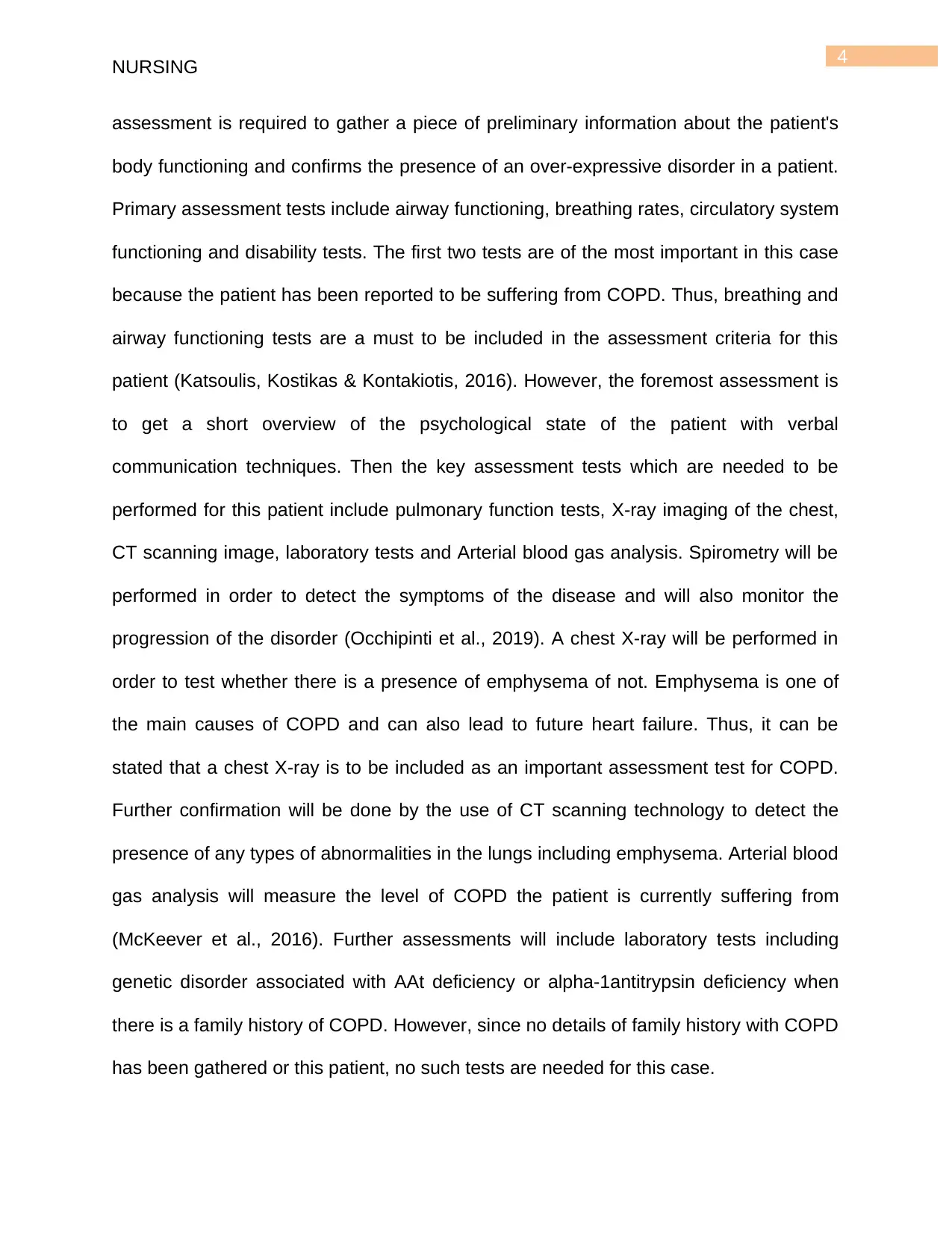
assessment is required to gather a piece of preliminary information about the patient's
body functioning and confirms the presence of an over-expressive disorder in a patient.
Primary assessment tests include airway functioning, breathing rates, circulatory system
functioning and disability tests. The first two tests are of the most important in this case
because the patient has been reported to be suffering from COPD. Thus, breathing and
airway functioning tests are a must to be included in the assessment criteria for this
patient (Katsoulis, Kostikas & Kontakiotis, 2016). However, the foremost assessment is
to get a short overview of the psychological state of the patient with verbal
communication techniques. Then the key assessment tests which are needed to be
performed for this patient include pulmonary function tests, X-ray imaging of the chest,
CT scanning image, laboratory tests and Arterial blood gas analysis. Spirometry will be
performed in order to detect the symptoms of the disease and will also monitor the
progression of the disorder (Occhipinti et al., 2019). A chest X-ray will be performed in
order to test whether there is a presence of emphysema of not. Emphysema is one of
the main causes of COPD and can also lead to future heart failure. Thus, it can be
stated that a chest X-ray is to be included as an important assessment test for COPD.
Further confirmation will be done by the use of CT scanning technology to detect the
presence of any types of abnormalities in the lungs including emphysema. Arterial blood
gas analysis will measure the level of COPD the patient is currently suffering from
(McKeever et al., 2016). Further assessments will include laboratory tests including
genetic disorder associated with AAt deficiency or alpha-1antitrypsin deficiency when
there is a family history of COPD. However, since no details of family history with COPD
has been gathered or this patient, no such tests are needed for this case.
NURSING
assessment is required to gather a piece of preliminary information about the patient's
body functioning and confirms the presence of an over-expressive disorder in a patient.
Primary assessment tests include airway functioning, breathing rates, circulatory system
functioning and disability tests. The first two tests are of the most important in this case
because the patient has been reported to be suffering from COPD. Thus, breathing and
airway functioning tests are a must to be included in the assessment criteria for this
patient (Katsoulis, Kostikas & Kontakiotis, 2016). However, the foremost assessment is
to get a short overview of the psychological state of the patient with verbal
communication techniques. Then the key assessment tests which are needed to be
performed for this patient include pulmonary function tests, X-ray imaging of the chest,
CT scanning image, laboratory tests and Arterial blood gas analysis. Spirometry will be
performed in order to detect the symptoms of the disease and will also monitor the
progression of the disorder (Occhipinti et al., 2019). A chest X-ray will be performed in
order to test whether there is a presence of emphysema of not. Emphysema is one of
the main causes of COPD and can also lead to future heart failure. Thus, it can be
stated that a chest X-ray is to be included as an important assessment test for COPD.
Further confirmation will be done by the use of CT scanning technology to detect the
presence of any types of abnormalities in the lungs including emphysema. Arterial blood
gas analysis will measure the level of COPD the patient is currently suffering from
(McKeever et al., 2016). Further assessments will include laboratory tests including
genetic disorder associated with AAt deficiency or alpha-1antitrypsin deficiency when
there is a family history of COPD. However, since no details of family history with COPD
has been gathered or this patient, no such tests are needed for this case.
5
NURSING
Care plan for the patient
A nursing care plan will provide all the directions needed for an individualized (Mr X)
care. This plan will follow a unique list of diagnostic procedures and should be made
according to the specific needs of the patient. This care plan will be based on the
principle of continuity of care which will include communication means and constant
change of nursing staffs. Thus it can be stated that this care plan will be followed in
collaboration with a multi-disciplinary team (Zwakman et al., 2019). This patient has
been reported to be suffering from ineffective airway clearance. Thus, it has been
observed that the patient is suffering from an inability to clear the secretions associated
with obstructions from the respiratory tracts for the maintenance of a clear airway. The
care plan has been derived on the basis of difficulty in breathing statements, changes
occurring in respiration rates and depth rates including the use of accessory muscles,
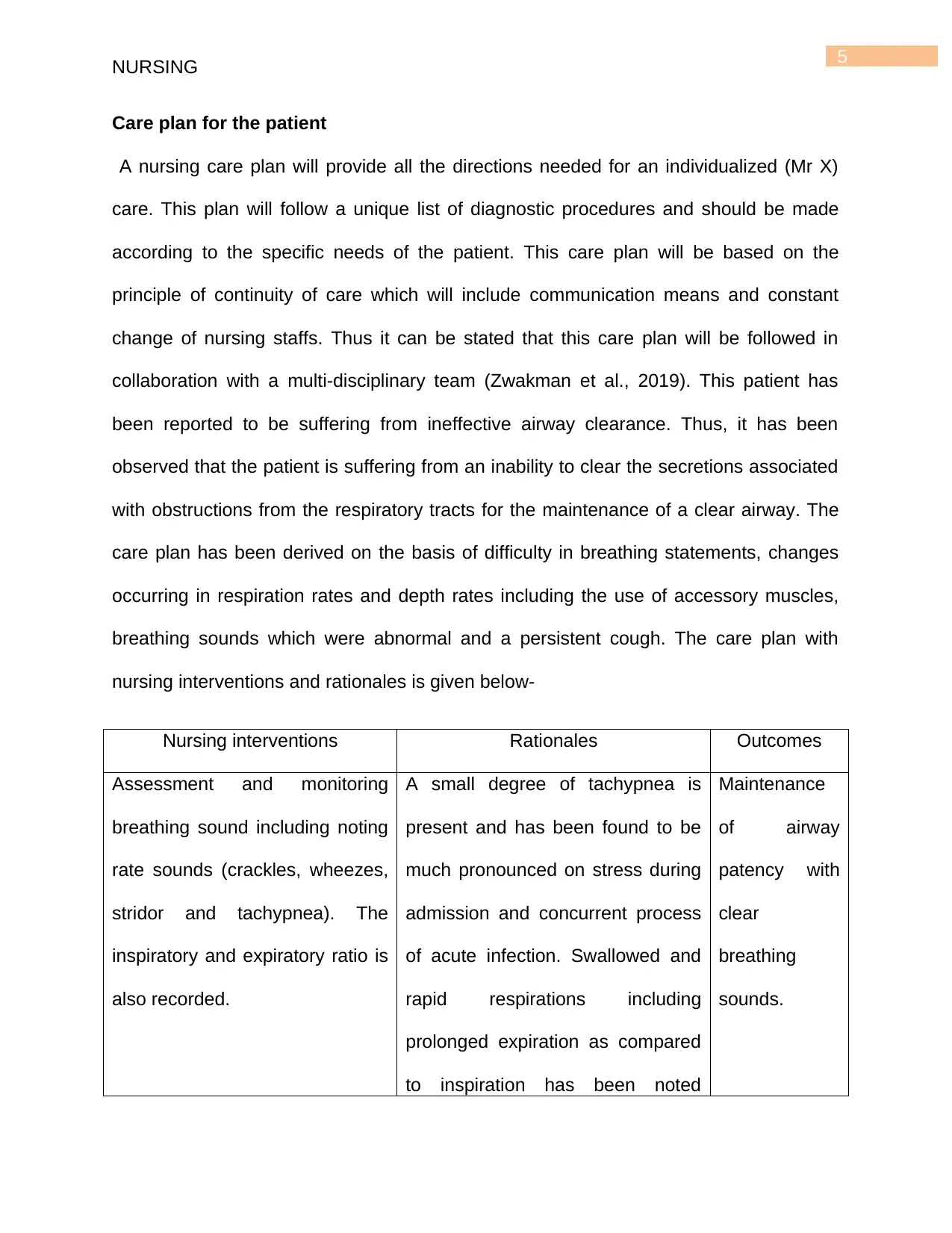
breathing sounds which were abnormal and a persistent cough. The care plan with
nursing interventions and rationales is given below-
Nursing interventions Rationales Outcomes
Assessment and monitoring
breathing sound including noting
rate sounds (crackles, wheezes,
stridor and tachypnea). The
inspiratory and expiratory ratio is
also recorded.
A small degree of tachypnea is
present and has been found to be
much pronounced on stress during
admission and concurrent process
of acute infection. Swallowed and
rapid respirations including
prolonged expiration as compared
to inspiration has been noted
Maintenance
of airway
patency with
clear
breathing
sounds.
NURSING
Care plan for the patient
A nursing care plan will provide all the directions needed for an individualized (Mr X)
care. This plan will follow a unique list of diagnostic procedures and should be made
according to the specific needs of the patient. This care plan will be based on the
principle of continuity of care which will include communication means and constant
change of nursing staffs. Thus it can be stated that this care plan will be followed in
collaboration with a multi-disciplinary team (Zwakman et al., 2019). This patient has
been reported to be suffering from ineffective airway clearance. Thus, it has been
observed that the patient is suffering from an inability to clear the secretions associated
with obstructions from the respiratory tracts for the maintenance of a clear airway. The
care plan has been derived on the basis of difficulty in breathing statements, changes
occurring in respiration rates and depth rates including the use of accessory muscles,
breathing sounds which were abnormal and a persistent cough. The care plan with
nursing interventions and rationales is given below-
Nursing interventions Rationales Outcomes
Assessment and monitoring
breathing sound including noting
rate sounds (crackles, wheezes,
stridor and tachypnea). The
inspiratory and expiratory ratio is
also recorded.
A small degree of tachypnea is
present and has been found to be
much pronounced on stress during
admission and concurrent process
of acute infection. Swallowed and
rapid respirations including
prolonged expiration as compared
to inspiration has been noted
Maintenance
of airway
patency with
clear
breathing
sounds.
⊘ This is a preview!⊘
Do you want full access?
Subscribe today to unlock all pages.
Trusted by 1+ million students worldwide
6
NURSING
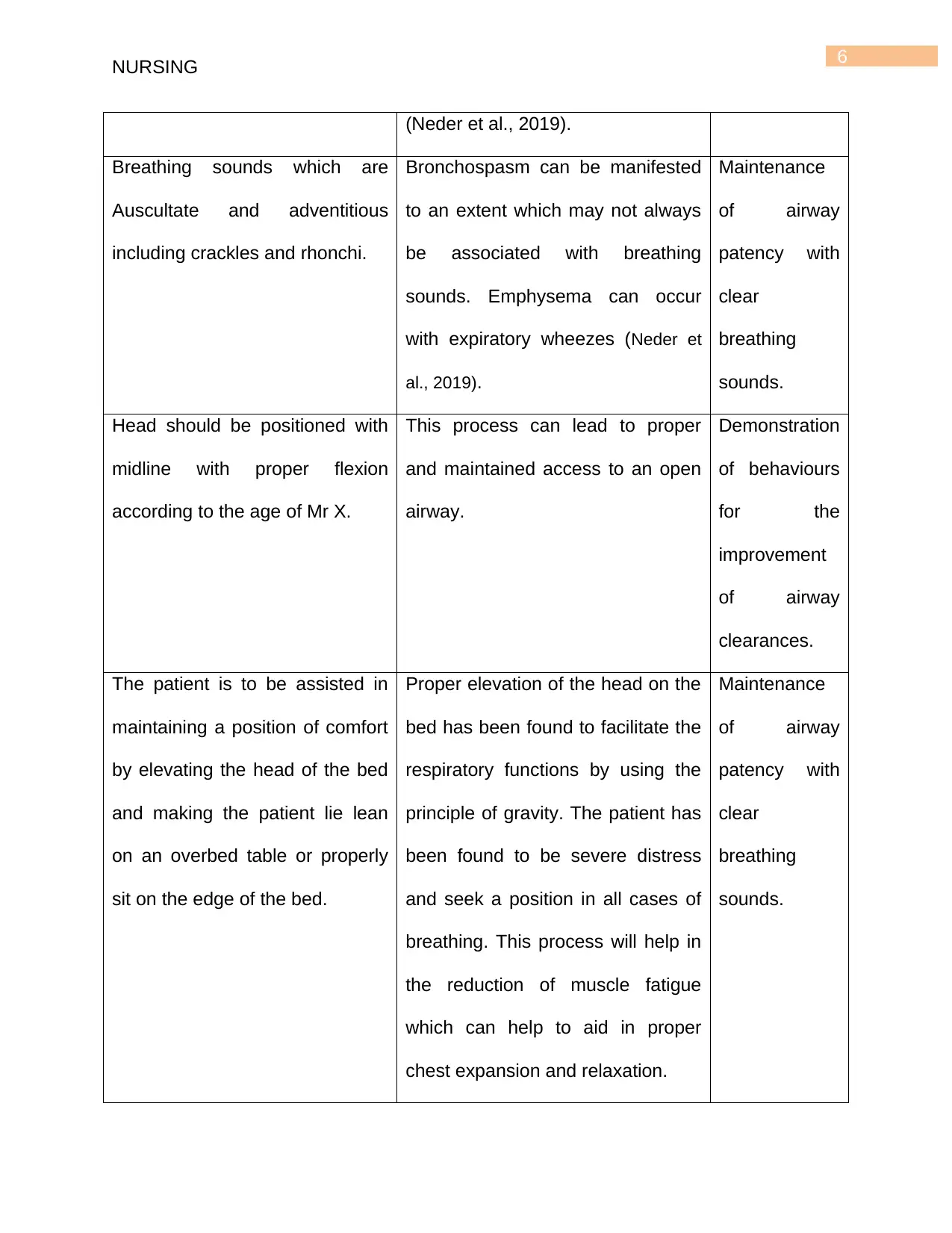
(Neder et al., 2019).
Breathing sounds which are
Auscultate and adventitious
including crackles and rhonchi.
Bronchospasm can be manifested
to an extent which may not always
be associated with breathing
sounds. Emphysema can occur
with expiratory wheezes (Neder et
al., 2019).
Maintenance
of airway
patency with
clear
breathing
sounds.
Head should be positioned with
midline with proper flexion
according to the age of Mr X.
This process can lead to proper
and maintained access to an open
airway.
Demonstration
of behaviours
for the
improvement
of airway
clearances.
The patient is to be assisted in
maintaining a position of comfort
by elevating the head of the bed
and making the patient lie lean
on an overbed table or properly
sit on the edge of the bed.
Proper elevation of the head on the
bed has been found to facilitate the
respiratory functions by using the
principle of gravity. The patient has
been found to be severe distress
and seek a position in all cases of
breathing. This process will help in
the reduction of muscle fatigue
which can help to aid in proper
chest expansion and relaxation.
Maintenance
of airway
patency with
clear
breathing
sounds.
NURSING
(Neder et al., 2019).
Breathing sounds which are
Auscultate and adventitious
including crackles and rhonchi.
Bronchospasm can be manifested
to an extent which may not always
be associated with breathing
sounds. Emphysema can occur
with expiratory wheezes (Neder et
al., 2019).
Maintenance
of airway
patency with
clear
breathing
sounds.
Head should be positioned with
midline with proper flexion
according to the age of Mr X.
This process can lead to proper
and maintained access to an open
airway.
Demonstration
of behaviours
for the
improvement
of airway
clearances.
The patient is to be assisted in
maintaining a position of comfort
by elevating the head of the bed
and making the patient lie lean
on an overbed table or properly
sit on the edge of the bed.
Proper elevation of the head on the
bed has been found to facilitate the
respiratory functions by using the
principle of gravity. The patient has
been found to be severe distress
and seek a position in all cases of
breathing. This process will help in
the reduction of muscle fatigue
which can help to aid in proper
chest expansion and relaxation.
Maintenance
of airway
patency with
clear
breathing
sounds.
Paraphrase This Document
Need a fresh take? Get an instant paraphrase of this document with our AI Paraphraser
7
NURSING
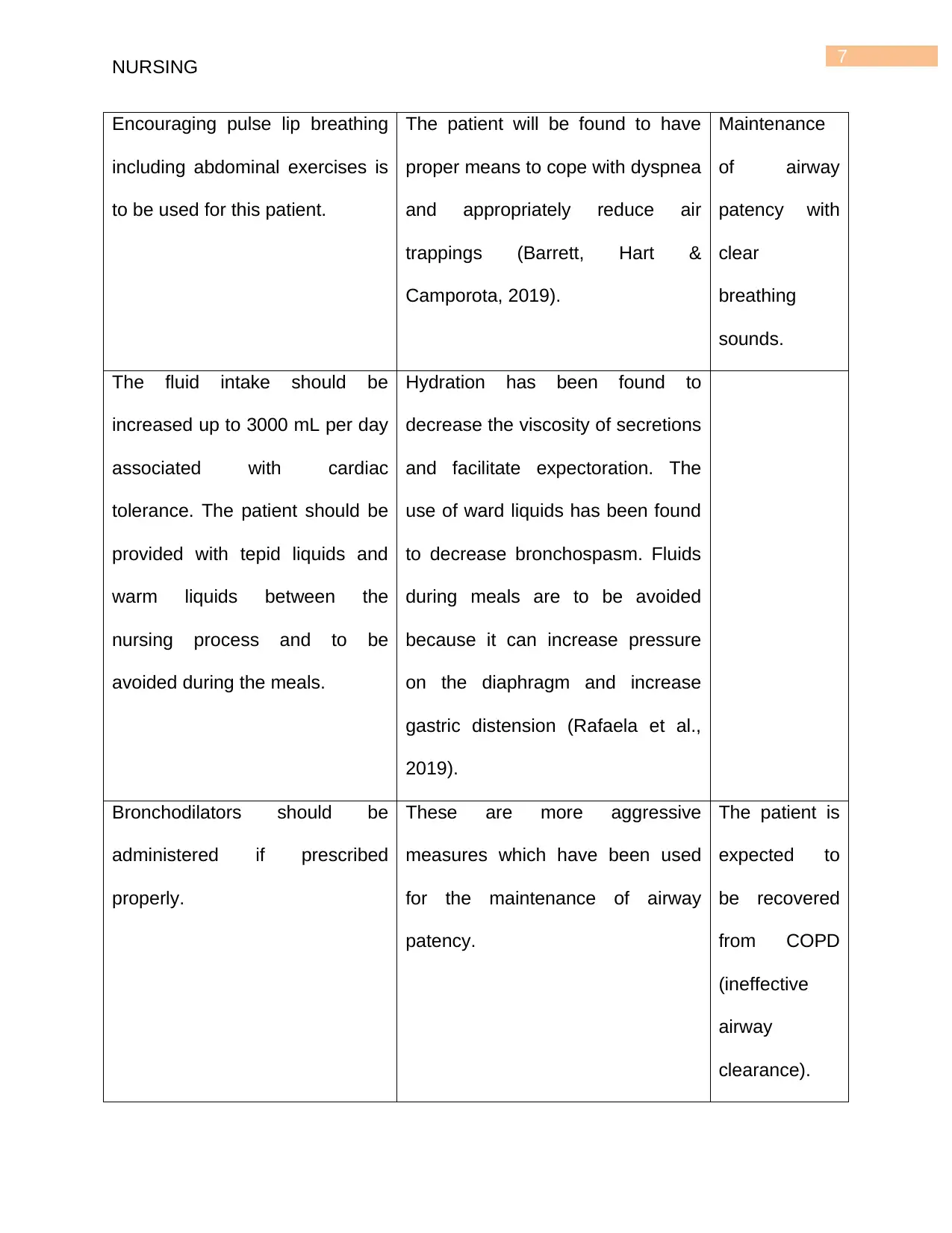
Encouraging pulse lip breathing
including abdominal exercises is
to be used for this patient.
The patient will be found to have
proper means to cope with dyspnea
and appropriately reduce air
trappings (Barrett, Hart &
Camporota, 2019).
Maintenance
of airway
patency with
clear
breathing
sounds.
The fluid intake should be
increased up to 3000 mL per day
associated with cardiac
tolerance. The patient should be
provided with tepid liquids and
warm liquids between the
nursing process and to be
avoided during the meals.
Hydration has been found to
decrease the viscosity of secretions
and facilitate expectoration. The
use of ward liquids has been found
to decrease bronchospasm. Fluids
during meals are to be avoided
because it can increase pressure
on the diaphragm and increase
gastric distension (Rafaela et al.,
2019).
Bronchodilators should be
administered if prescribed
properly.
These are more aggressive
measures which have been used
for the maintenance of airway
patency.
The patient is
expected to
be recovered
from COPD
(ineffective
airway
clearance).
NURSING
Encouraging pulse lip breathing
including abdominal exercises is
to be used for this patient.
The patient will be found to have
proper means to cope with dyspnea
and appropriately reduce air
trappings (Barrett, Hart &
Camporota, 2019).
Maintenance
of airway
patency with
clear
breathing
sounds.
The fluid intake should be
increased up to 3000 mL per day
associated with cardiac
tolerance. The patient should be
provided with tepid liquids and
warm liquids between the
nursing process and to be
avoided during the meals.
Hydration has been found to
decrease the viscosity of secretions
and facilitate expectoration. The
use of ward liquids has been found
to decrease bronchospasm. Fluids
during meals are to be avoided
because it can increase pressure
on the diaphragm and increase
gastric distension (Rafaela et al.,
2019).
Bronchodilators should be
administered if prescribed
properly.
These are more aggressive
measures which have been used
for the maintenance of airway
patency.
The patient is
expected to
be recovered
from COPD
(ineffective
airway
clearance).
8
NURSING
Evaluation of the care plan
The care plan associated with ineffective airway clearance of COPD can be
stated to be effective because it will help the patient to recover from COPD. This is
because of the fact that the person has been found to be affected by ineffective airway
clearance. Thus, it can be stated that there is a blockage in the lung airways. This factor
has been found to be connected with impaired gas exchanges too. All the physical
recovery strategies which have been incorporated in the care plan has been found to be
very much effective in the recovery of the patient from the condition of COPD. The
breathing pattern of the patient has also been found to be gradually normalized after
elevating the head level of the patient while he is lying on the bed. However, a major
weakness of this care plan is that it lacked the use of medications for the improvement
of airway clearance which has been blocked due to COPD. Several bronchodilators
have been found to be used for the recovery from COPD. These drugs are aclidinium,
formoterol and salmeterol which has been used in various care plans to help the patient
in recovering fast from his or her COPD condition. However, the fact that
bronchodilators have been placed at the last of this care plan cannot be ruled out fully.
Thus, it can be stated that this care plan focused on the process of patient-centred
recovery without the use of medications. Medication is to be only used at very critical
and emergency cases which has not been observed for this case. After going through
this care plant, it can be evaluated that this plan is free from the risks of medication
errors. However, still, a weakness exists in this care plan due to lack of interventions
considering medications for COPD. Keeping all the weaknesses aside, it can be stated
NURSING
Evaluation of the care plan
The care plan associated with ineffective airway clearance of COPD can be
stated to be effective because it will help the patient to recover from COPD. This is
because of the fact that the person has been found to be affected by ineffective airway
clearance. Thus, it can be stated that there is a blockage in the lung airways. This factor
has been found to be connected with impaired gas exchanges too. All the physical
recovery strategies which have been incorporated in the care plan has been found to be
very much effective in the recovery of the patient from the condition of COPD. The
breathing pattern of the patient has also been found to be gradually normalized after
elevating the head level of the patient while he is lying on the bed. However, a major
weakness of this care plan is that it lacked the use of medications for the improvement
of airway clearance which has been blocked due to COPD. Several bronchodilators
have been found to be used for the recovery from COPD. These drugs are aclidinium,
formoterol and salmeterol which has been used in various care plans to help the patient
in recovering fast from his or her COPD condition. However, the fact that
bronchodilators have been placed at the last of this care plan cannot be ruled out fully.
Thus, it can be stated that this care plan focused on the process of patient-centred
recovery without the use of medications. Medication is to be only used at very critical
and emergency cases which has not been observed for this case. After going through
this care plant, it can be evaluated that this plan is free from the risks of medication
errors. However, still, a weakness exists in this care plan due to lack of interventions
considering medications for COPD. Keeping all the weaknesses aside, it can be stated
⊘ This is a preview!⊘
Do you want full access?
Subscribe today to unlock all pages.
Trusted by 1+ million students worldwide
9
NURSING
that this care plan will be effective in helping Mrs to recover from his current condition of
COPD.
Collaboration with the multi-disciplinary team
Healthcare system, by its design, has been defined as a team consisting of
multidisciplinary professions including nurses, doctors and health professionals who
belong to different specialities which work together and communicate to share
resources. Multidisciplinary collaboration has been used as a novel approach to guide
the practice and thinking patterns of all the healthcare professionals inside a healthcare
system. A multidisciplinary team has been stated to comprise of members from
healthcare teams including complementary expertise, experience and skills (Martins et
al., 2016). A nurse does not know everything about a disorder which is diagnosed. He
or she can work according to the combination of self-knowledge and as prescribed by
the doctor. The nurse will require the collaboration of all the team members including a
pharmacist to assist the patient in recovering from the condition of COPD. This team
has been found to comprise of the physician, nurses, pharmacists, respiratory therapy
groups and sometimes family members of a patient if applicable. This function is
important in conveying benefits to both the health professionals and patient who are
working as a team to solve the condition. In a similar way, the nurse associated here will
work with a multidisciplinary team as stated above including both physicians and
respiratory therapy professionals to help Mr X recover fast from COPD. Improved health
outcomes have been found to be enhanced by the client satisfaction and more efficient
use of resources have been found to be gained by the collaboration of multidisciplinary
team (McDonald, Roberts & Inder, 2018). Collaboration with the respiratory therapy
NURSING
that this care plan will be effective in helping Mrs to recover from his current condition of
COPD.
Collaboration with the multi-disciplinary team
Healthcare system, by its design, has been defined as a team consisting of
multidisciplinary professions including nurses, doctors and health professionals who
belong to different specialities which work together and communicate to share
resources. Multidisciplinary collaboration has been used as a novel approach to guide
the practice and thinking patterns of all the healthcare professionals inside a healthcare
system. A multidisciplinary team has been stated to comprise of members from
healthcare teams including complementary expertise, experience and skills (Martins et
al., 2016). A nurse does not know everything about a disorder which is diagnosed. He
or she can work according to the combination of self-knowledge and as prescribed by
the doctor. The nurse will require the collaboration of all the team members including a
pharmacist to assist the patient in recovering from the condition of COPD. This team
has been found to comprise of the physician, nurses, pharmacists, respiratory therapy
groups and sometimes family members of a patient if applicable. This function is
important in conveying benefits to both the health professionals and patient who are
working as a team to solve the condition. In a similar way, the nurse associated here will
work with a multidisciplinary team as stated above including both physicians and
respiratory therapy professionals to help Mr X recover fast from COPD. Improved health
outcomes have been found to be enhanced by the client satisfaction and more efficient
use of resources have been found to be gained by the collaboration of multidisciplinary
team (McDonald, Roberts & Inder, 2018). Collaboration with the respiratory therapy
Paraphrase This Document
Need a fresh take? Get an instant paraphrase of this document with our AI Paraphraser
10
NURSING
group is very much essential for this care plan because Mr X has been diagnosed with
COPD. In this way, a collaborative approach by the nurse is to be maintained for the
wellbeing of the patient.
Guidelines to support patient management
The first guideline which has been used to support the COPD patient
management for this case is Joint guidelines for stable COPD management by the
American College of Physicians, European Respiratory Society, American Thoracic
Society and American College of Chest Physicians. The second guideline used for the
management of COPD patient in this study is the Global Initiative for Chronic
Obstructive Lung Disease (GOLD) (Doenges, Moorhouse, & Murr, 2019). Both these
guidelines have been found to provide several managing strategies for healthcare
professionals dealing with COPD patients. On a worldwide basis, it has been observed
that the prevalence of COPD led to the death of 4.2 million people worldwide with an
increase of 12 per cent compared to the value of 1995 (Quaderi & Hurst 2018). In the
United States, it has been observed that COPD increased by 44.2 per cent to 19 million
adults (Quaderi & Hurst 2018). On a worldwide basis, this number increased to 174.5
million individuals in terms of their percentiles. The first guideline has been developed
after the joint collaboration of the United Kingdom and the United States whereas the
second is a guideline derived from the United States. Both these guidelines have been
found to state all the necessary physical therapies and medication therapies that are
applicable for a fast recovery of COPD patients. Since COPD is a preventable and
treatable disease, various guidelines have been stated by the American Health
Department for the prevention of this disorder. The main focus of these guidelines is to
NURSING
group is very much essential for this care plan because Mr X has been diagnosed with
COPD. In this way, a collaborative approach by the nurse is to be maintained for the
wellbeing of the patient.
Guidelines to support patient management
The first guideline which has been used to support the COPD patient
management for this case is Joint guidelines for stable COPD management by the
American College of Physicians, European Respiratory Society, American Thoracic
Society and American College of Chest Physicians. The second guideline used for the
management of COPD patient in this study is the Global Initiative for Chronic
Obstructive Lung Disease (GOLD) (Doenges, Moorhouse, & Murr, 2019). Both these
guidelines have been found to provide several managing strategies for healthcare
professionals dealing with COPD patients. On a worldwide basis, it has been observed
that the prevalence of COPD led to the death of 4.2 million people worldwide with an
increase of 12 per cent compared to the value of 1995 (Quaderi & Hurst 2018). In the
United States, it has been observed that COPD increased by 44.2 per cent to 19 million
adults (Quaderi & Hurst 2018). On a worldwide basis, this number increased to 174.5
million individuals in terms of their percentiles. The first guideline has been developed
after the joint collaboration of the United Kingdom and the United States whereas the
second is a guideline derived from the United States. Both these guidelines have been
found to state all the necessary physical therapies and medication therapies that are
applicable for a fast recovery of COPD patients. Since COPD is a preventable and
treatable disease, various guidelines have been stated by the American Health
Department for the prevention of this disorder. The main focus of these guidelines is to
11
NURSING
prevent the progression of COPD to critical and acute respiratory symptoms known as
exacerbations. Since this patient has been found to suffer from ineffective airway
clearance and impaired gas exchange, this guideline has been used for the
management of the patient.
Conclusion
After the long discussion, it has been observed that COPD is one of the most
dangerous diseases occurring on a worldwide basis. This disease is very harmful to
human beings and has the potential to cause a permanent respiratory failure if not
treated at the right time. For the achievement of this goal, this disease needs to be
diagnosed at the correct time. For early diagnosis, the patient must visit the healthcare
services and diagnose for the cause of any types of chronic respiratory syndromes. This
report clearly stated an effective care plan for the identification recovery of Mr X from
the clinical manifestation of COPD. The most effective physical intervention followed in
this paper is the fluid intake should be increased up to 3000 mL per day associated with
cardiac tolerance. The patient should be provided with tepid liquids and warm liquids
between the nursing process and to be avoided during the meals. The use of
medications has been kept at the last on the failure of all the nursing interventions as
stated at the top of the care plan. Thus, it can be stated that the person will recover
soon provided the weaknesses of the care plan are properly managed. This report
showed that COPD has been found to be associated with four stages – Mild, Moderate,
Severe and Very severe. COPD stages are associated with different symptoms and the
airflow has been found to be limited to some extent. According to the discussion of
COPD associated with Mr X, it has been observed that with COPD, the lung airways
NURSING
prevent the progression of COPD to critical and acute respiratory symptoms known as
exacerbations. Since this patient has been found to suffer from ineffective airway
clearance and impaired gas exchange, this guideline has been used for the
management of the patient.
Conclusion
After the long discussion, it has been observed that COPD is one of the most
dangerous diseases occurring on a worldwide basis. This disease is very harmful to
human beings and has the potential to cause a permanent respiratory failure if not
treated at the right time. For the achievement of this goal, this disease needs to be
diagnosed at the correct time. For early diagnosis, the patient must visit the healthcare
services and diagnose for the cause of any types of chronic respiratory syndromes. This
report clearly stated an effective care plan for the identification recovery of Mr X from
the clinical manifestation of COPD. The most effective physical intervention followed in
this paper is the fluid intake should be increased up to 3000 mL per day associated with
cardiac tolerance. The patient should be provided with tepid liquids and warm liquids
between the nursing process and to be avoided during the meals. The use of
medications has been kept at the last on the failure of all the nursing interventions as
stated at the top of the care plan. Thus, it can be stated that the person will recover
soon provided the weaknesses of the care plan are properly managed. This report
showed that COPD has been found to be associated with four stages – Mild, Moderate,
Severe and Very severe. COPD stages are associated with different symptoms and the
airflow has been found to be limited to some extent. According to the discussion of
COPD associated with Mr X, it has been observed that with COPD, the lung airways
⊘ This is a preview!⊘
Do you want full access?
Subscribe today to unlock all pages.
Trusted by 1+ million students worldwide

1 out of 18


Related Documents


Your All-in-One AI-Powered Toolkit for Academic Success.
+13062052269
info@desklib.com
Available 24*7 on WhatsApp / Email
![[object Object]](/_next/static/media/star-bottom.7253800d.svg)
Unlock your academic potential
Copyright © 2020–2026 A2Z Services. All Rights Reserved. Developed and managed by ZUCOL.