Copersucar Case Study: Strategic Analysis and Recommendations
VerifiedAdded on 2023/03/20
|11
|2471
|73
Case Study
AI Summary
This case study analyzes Copersucar, a Brazilian cooperative and global leader in sugar and ethanol trading. It examines the company's situation, including its mission, market share, and operational excellence in Brazil and internationally. The analysis includes a problem statement focusing on market demand, competition, and management challenges. The case explores Copersucar's diversification and penetration strategies, evaluating its business model, logistic operations, ethanol market position, and sales efforts. Recommendations are provided, highlighting the company's strengths in integrating operations, expanding globally, and adapting to competitive forces. The study emphasizes the importance of strategic investments, market analysis, and risk management for sustained success in the dynamic agribusiness sector.
1
COPERSUCAR
Student’s Name:
Institution:
COPERSUCAR
Student’s Name:
Institution:

Paraphrase This Document
Need a fresh take? Get an instant paraphrase of this document with our AI Paraphraser
2
Table of Contents
1.0 Situation Analysis..................................................................................................................3
2.0 Problem Statement.................................................................................................................4
3.0 Alternatives and Evaluation of Alternatives..........................................................................5
4.0 Recommendation and Justification........................................................................................8
5.0 Implementation......................................................................................................................9
6.0 Appendixes...........................................................................................................................10
Table of Contents
1.0 Situation Analysis..................................................................................................................3
2.0 Problem Statement.................................................................................................................4
3.0 Alternatives and Evaluation of Alternatives..........................................................................5
4.0 Recommendation and Justification........................................................................................8
5.0 Implementation......................................................................................................................9
6.0 Appendixes...........................................................................................................................10
3
1.0 Situation Analysis
Copersucar is an organization situated in Brazil and was established in 1959. It’s the
largest organization dealing with sugar trade as well as the biggest firm which trade in ethanol.
The mission is to create value in all its trading operations, logistics and ensuring operational
excellence. In a large organization located in Brazil and have 800 employees and is beyond $8.1
billion1 in sales. The growth rate of the organization has a market share of 12%, and sells 8.6
million tonnes out of which 6.9 million get exported each year. The starting place of sugar is
Asia and has spread to various parts of the globe, currently it is grown in Brazil. The plant is
perennial in nature and grows favorably in wet tropical areas. Sugar production globally is huge
and one of the biggest crops produced in large scale. Beside the production of sugar, the plant is
utilized for the production of ethanol. The supply chain starts from the input suppliers; then the
producers; processors; distributors; and final consumer. The purchase of sugar is a complex
operations but it depend on contractual agreement between the farmers and millers where they
get to process to get the final product. The following gives the alternatives to remedy Luis and
ensures that the organization carries on the legacy of creating, seizing, and sharing value in
logistics as well as commercialization of merchandises. In order to guard itself against credit
risks and employs risk management techniques and hence the organization follows international
standards of payment. The payment of sugar is made within a period of twenty days and fifteen
days for ethanol. There are conditions set for international markets that there must be cash against
document. Also, the company uses credit insurance of international banks. The company has over
80% good relations with most of its clients which span for over 5 years of good relationship and
losses. Another risk is liquidity and this is the ability of an organization to face debts and
liabilities. The company through their policy is to encounter the obligations in the confines of the
1.0 Situation Analysis
Copersucar is an organization situated in Brazil and was established in 1959. It’s the
largest organization dealing with sugar trade as well as the biggest firm which trade in ethanol.
The mission is to create value in all its trading operations, logistics and ensuring operational
excellence. In a large organization located in Brazil and have 800 employees and is beyond $8.1
billion1 in sales. The growth rate of the organization has a market share of 12%, and sells 8.6
million tonnes out of which 6.9 million get exported each year. The starting place of sugar is
Asia and has spread to various parts of the globe, currently it is grown in Brazil. The plant is
perennial in nature and grows favorably in wet tropical areas. Sugar production globally is huge
and one of the biggest crops produced in large scale. Beside the production of sugar, the plant is
utilized for the production of ethanol. The supply chain starts from the input suppliers; then the
producers; processors; distributors; and final consumer. The purchase of sugar is a complex
operations but it depend on contractual agreement between the farmers and millers where they
get to process to get the final product. The following gives the alternatives to remedy Luis and
ensures that the organization carries on the legacy of creating, seizing, and sharing value in
logistics as well as commercialization of merchandises. In order to guard itself against credit
risks and employs risk management techniques and hence the organization follows international
standards of payment. The payment of sugar is made within a period of twenty days and fifteen
days for ethanol. There are conditions set for international markets that there must be cash against
document. Also, the company uses credit insurance of international banks. The company has over
80% good relations with most of its clients which span for over 5 years of good relationship and
losses. Another risk is liquidity and this is the ability of an organization to face debts and
liabilities. The company through their policy is to encounter the obligations in the confines of the
⊘ This is a preview!⊘
Do you want full access?
Subscribe today to unlock all pages.

Trusted by 1+ million students worldwide
4
contractual situations so that the reputation of the company gets maintained. The company is in
good books with no legal suits. The other aspect is the market risk. This is one of the complex
issues facing organizations world over. These risks get encountered through exchange rates, price
of commodities, and changes in interest rates. The sales of ethanol are in the local market. Even
though still not a popular way used in the market, hedging is the best way to guard against risks.
The company protects its products through currency hedging. There are losses that get
encountered while doing business. These are operational losses. These losses arise through
processes, technology, personnel, external factors and infrastructure.
2.0 Problem Statement
In examination of the organization through the lenses of Luís Pogetti one looks into the
future and sees vast opportunities in the car industry designed to use ethanol and gasoline. With
the market currently standing at 3.5 million sold cars, the future prospects is 50 million cars by
2020 of which 40 million cars will be using ethanol, gasoline or both. The question that comes
into mind is whether the company will meet the demand of ethanol in the market with the 12%
ethanol production given that the feasibility of ethanol remains an elusive. Additionally, will the
project penetrate the US regulations on the adoption of E153? The other challenge is the
emergence of competition from other countries and especially from the Asian sphere. Moreover,
even though there is a growth of energy consumption that ranges from 5% to 7%, this cannot be
quenched and the energy from biomass is another competing force and their prices will not allow
other competitors compete. The company has other sugar products obtained from crushing
sugarcane and this is going to augment investments. The myriad of challenges faced by the Luis
is on the management of the twenty four organizations which are shareholders; and forty-seven
units which are all under his umbrella.
contractual situations so that the reputation of the company gets maintained. The company is in
good books with no legal suits. The other aspect is the market risk. This is one of the complex
issues facing organizations world over. These risks get encountered through exchange rates, price
of commodities, and changes in interest rates. The sales of ethanol are in the local market. Even
though still not a popular way used in the market, hedging is the best way to guard against risks.
The company protects its products through currency hedging. There are losses that get
encountered while doing business. These are operational losses. These losses arise through
processes, technology, personnel, external factors and infrastructure.
2.0 Problem Statement
In examination of the organization through the lenses of Luís Pogetti one looks into the
future and sees vast opportunities in the car industry designed to use ethanol and gasoline. With
the market currently standing at 3.5 million sold cars, the future prospects is 50 million cars by
2020 of which 40 million cars will be using ethanol, gasoline or both. The question that comes
into mind is whether the company will meet the demand of ethanol in the market with the 12%
ethanol production given that the feasibility of ethanol remains an elusive. Additionally, will the
project penetrate the US regulations on the adoption of E153? The other challenge is the
emergence of competition from other countries and especially from the Asian sphere. Moreover,
even though there is a growth of energy consumption that ranges from 5% to 7%, this cannot be
quenched and the energy from biomass is another competing force and their prices will not allow
other competitors compete. The company has other sugar products obtained from crushing
sugarcane and this is going to augment investments. The myriad of challenges faced by the Luis
is on the management of the twenty four organizations which are shareholders; and forty-seven
units which are all under his umbrella.
Paraphrase This Document
Need a fresh take? Get an instant paraphrase of this document with our AI Paraphraser
5
3.0 Alternatives and Evaluation of Alternatives
1. Diversification Strategy
The Company’s Business Model: The organization adopted the differential model where all
tasks that comprise the supply chain, and production of products from the initial stage to the final
stage ought to use the company’s logistics, capacity and associating with partner mills. The
model ensures that the partner groups, industrial units, and shareholders sit in in executive board.
This brings in 11 positions including 8 partner mill positions two independent sources and the
manager as the president. Under this conservative board, the model respects and acknowledges
each unit individually in terms of decision making as well as in management. The uniqueness of
the model is that it cannot be duplicated owing to long-term supply of partner mill’s contract-
thus creating origination. Investments are ensured by future production as well as the flexibility
of storage. Additionally, the model presents the advantage that it requires low capital and
expands organically with increase in origination.
The Logistic Operation and Trading: As this is the core business activity, the task is to
integrate operation and trading with the aim of reducing costs of expenditure. Ethanol and sugar
are the main commodities an therefore the section considers the capacity of storage which include
keeping of 2.5 million tonnes of sugar and 3 billion of ethanol and exploitation of pipelines, trains
and transport firms. The company has been using train to transport its sugar for Santos Port and
the use of train has allowed the organization to save over 70,000 truck trips. In building strong
logistic and operation section, the company invested $1.5 billion in logistic jointly with investors
and government. Additionally, the organization has also participated in Logum-800 mile pipe to
transport ethanol from producing regions to the port and this initiative has resulted in reduction of
3.0 Alternatives and Evaluation of Alternatives
1. Diversification Strategy
The Company’s Business Model: The organization adopted the differential model where all
tasks that comprise the supply chain, and production of products from the initial stage to the final
stage ought to use the company’s logistics, capacity and associating with partner mills. The
model ensures that the partner groups, industrial units, and shareholders sit in in executive board.
This brings in 11 positions including 8 partner mill positions two independent sources and the
manager as the president. Under this conservative board, the model respects and acknowledges
each unit individually in terms of decision making as well as in management. The uniqueness of
the model is that it cannot be duplicated owing to long-term supply of partner mill’s contract-
thus creating origination. Investments are ensured by future production as well as the flexibility
of storage. Additionally, the model presents the advantage that it requires low capital and
expands organically with increase in origination.
The Logistic Operation and Trading: As this is the core business activity, the task is to
integrate operation and trading with the aim of reducing costs of expenditure. Ethanol and sugar
are the main commodities an therefore the section considers the capacity of storage which include
keeping of 2.5 million tonnes of sugar and 3 billion of ethanol and exploitation of pipelines, trains
and transport firms. The company has been using train to transport its sugar for Santos Port and
the use of train has allowed the organization to save over 70,000 truck trips. In building strong
logistic and operation section, the company invested $1.5 billion in logistic jointly with investors
and government. Additionally, the organization has also participated in Logum-800 mile pipe to
transport ethanol from producing regions to the port and this initiative has resulted in reduction of
6
the company’s cost of operation. In Santos Port, the company has constructed storage warehouse
where products get stored before they are shipped to various destinations and this facility has
facilitated lowest cost of operation for the organization. Additionally, as a way of maintaining
excellence to its stakeholders, the organization has invested also in infrastructure where it has
investments in firms who transport and sell products and their participation is seen in every part.
In estimating the investments of the company through 2015, it is clear that the organization has
spent $710 million. These includes the Logum initiatives, the pipeline, enhancement of the
Açucareiro Copersucar (TAC) terminal, the ethanol terminal- Terminal Copersucar de Etanol
(TEC) which begun its operations in 2014. The company has heavily invested. This is because of
the company’s strategy to facilitate the logistic section and allow part in revenue generation.
When the structural capacity of the organization get enhance, marginal operation costs get
reduced. This will increase the chances of selling services to other firms.
The Ethanol Market and Regulations: Ethanol is one of the organization’s commodities. Its
use as a fuel for cars has become widely known. In Brazil, there are 20 million cars that use
ethanol. This is more than the vehicles that use gasoline. It is estimated that over 85% of 3.5
million cars developed in Brazil, 40 vehicles will use ethanol. The price of flex-fuel is
equivalent to the price of oil but in Brazil, this has been lowered as a way for the benefits of its
people. However, the market prospect of ethanol market if wide and huge. The market will cut
across the social glass as there is no segmentation based on democracy. It will on be
segmented using the social status-class type. In the direction of off prospect, Ethanol is now
one of the best sought alternatives and countries and institutions are seeing the possibilities of
blending ethanol and gasoline. India for instance has created the ‘Green Initiative’ mandating a
5% blend of ethanol to gasoline. The US on the other hand has put in place the initiative E85
the company’s cost of operation. In Santos Port, the company has constructed storage warehouse
where products get stored before they are shipped to various destinations and this facility has
facilitated lowest cost of operation for the organization. Additionally, as a way of maintaining
excellence to its stakeholders, the organization has invested also in infrastructure where it has
investments in firms who transport and sell products and their participation is seen in every part.
In estimating the investments of the company through 2015, it is clear that the organization has
spent $710 million. These includes the Logum initiatives, the pipeline, enhancement of the
Açucareiro Copersucar (TAC) terminal, the ethanol terminal- Terminal Copersucar de Etanol
(TEC) which begun its operations in 2014. The company has heavily invested. This is because of
the company’s strategy to facilitate the logistic section and allow part in revenue generation.
When the structural capacity of the organization get enhance, marginal operation costs get
reduced. This will increase the chances of selling services to other firms.
The Ethanol Market and Regulations: Ethanol is one of the organization’s commodities. Its
use as a fuel for cars has become widely known. In Brazil, there are 20 million cars that use
ethanol. This is more than the vehicles that use gasoline. It is estimated that over 85% of 3.5
million cars developed in Brazil, 40 vehicles will use ethanol. The price of flex-fuel is
equivalent to the price of oil but in Brazil, this has been lowered as a way for the benefits of its
people. However, the market prospect of ethanol market if wide and huge. The market will cut
across the social glass as there is no segmentation based on democracy. It will on be
segmented using the social status-class type. In the direction of off prospect, Ethanol is now
one of the best sought alternatives and countries and institutions are seeing the possibilities of
blending ethanol and gasoline. India for instance has created the ‘Green Initiative’ mandating a
5% blend of ethanol to gasoline. The US on the other hand has put in place the initiative E85
⊘ This is a preview!⊘
Do you want full access?
Subscribe today to unlock all pages.
Trusted by 1+ million students worldwide
7
which is advocating the use of ethanol of it vehicles; however, the initiative is questionable
whether it is going to be feasible. The positive side is that there are promising technologies and
innovation underway to enhance the sugar production. The aim is to develop a product that is
going to produce many times of ethanol as compared to the ordinary sugarcane.
2. Penetration Strategy
Sales Efforts and Strategies
In line with strengthening the logistic section, the organizations also seek to increase its
competitiveness globally; the organization is aware that there are competitive forces in the sugar
industry. The most crucial market is Brazil, however, since organizations sells in the world
market. In this respect, the organization has put investment in other companies around the world.
Additionally, the organization opened a subsidiary in Hong Kong established with the aim of
building intimacy with Asian buyers as well as ensuring that sugar is spread to the Asian market.
Furthermore, this permits the organization’s presence to move closer to China which is another
big market even though the freight costs are not favorable. Another expansion was the joint
venture with Alvean, a move that surprised many, but it is expected to contribute positively to the
new organizations. In addition, the organization acquired 65% of Eco-Energy which is a US-
based company with 9% market share. This serves as a way of increasing the global presence in
ethanol which is still low. The company is now the leading Ethanol firm trading ethanol and
therefore it can continue to enhance its platform. In the business model of the two organizations
are similar and therefore one can say that the can penetrate the market in Energy related products
with no strong outside forces. Besides, Copersucar is going to diversify their operations and this
might call for sourcing of ethanol from different sources in two different regions. In addition, they
will strive to eliminate risks in relation to the climate.it is going to facilitate Copersucar construct
which is advocating the use of ethanol of it vehicles; however, the initiative is questionable
whether it is going to be feasible. The positive side is that there are promising technologies and
innovation underway to enhance the sugar production. The aim is to develop a product that is
going to produce many times of ethanol as compared to the ordinary sugarcane.
2. Penetration Strategy
Sales Efforts and Strategies
In line with strengthening the logistic section, the organizations also seek to increase its
competitiveness globally; the organization is aware that there are competitive forces in the sugar
industry. The most crucial market is Brazil, however, since organizations sells in the world
market. In this respect, the organization has put investment in other companies around the world.
Additionally, the organization opened a subsidiary in Hong Kong established with the aim of
building intimacy with Asian buyers as well as ensuring that sugar is spread to the Asian market.
Furthermore, this permits the organization’s presence to move closer to China which is another
big market even though the freight costs are not favorable. Another expansion was the joint
venture with Alvean, a move that surprised many, but it is expected to contribute positively to the
new organizations. In addition, the organization acquired 65% of Eco-Energy which is a US-
based company with 9% market share. This serves as a way of increasing the global presence in
ethanol which is still low. The company is now the leading Ethanol firm trading ethanol and
therefore it can continue to enhance its platform. In the business model of the two organizations
are similar and therefore one can say that the can penetrate the market in Energy related products
with no strong outside forces. Besides, Copersucar is going to diversify their operations and this
might call for sourcing of ethanol from different sources in two different regions. In addition, they
will strive to eliminate risks in relation to the climate.it is going to facilitate Copersucar construct
Paraphrase This Document
Need a fresh take? Get an instant paraphrase of this document with our AI Paraphraser
8
storage and distribution for long-term export contract and hence imports between the two nations.
Irrespective of the positive initiatives, there is still the issue of management. There are the
challenges as a result of acquisition, operational integration of two firms, and cultural differences.
4.0 Recommendation and Justification
The organization has a good business model that has put the organization in a good
position in Brazil and some other markets. The strategy to integrate its operation and trading was
with the aim of reducing costs of expenditure. This has led to the maintenance of excellence to the
stakeholders. It has seen development activities like in infrastructure happening where it where it
would not have happened. It has created good relations with organizations and especially with
firms who transport and sell products together with the company.
The company increased its global competitiveness by strengthening the logistic section.
This is in line with it strategic objectives to strengthen logistic and operation sector; the
organization is aware that there are competitive forces in the sugar industry. The most crucial
market is Brazil, however, since organizations sells in the world market. In this respect, the
organization has put investment in other companies around the world. The organization’s
subsidiary in Hong Kong was established with the aim of building intimacy with Asian buyers
as well as ensuring that the product is spread to the Asian market but also will permits the
organization’s presence to move closer to China which is another big market even though the
freight costs are not favorable.
The joint-venture undertaken with US based firm and buying 65% of Eco-Energy serves
as a way of increasing the global presence in ethanol which is still low. The company is now the
leading Ethanol firm trading ethanol and therefore it can continue to enhance its platform. In the
business model of the two organizations are similar and therefore one can say that the can
storage and distribution for long-term export contract and hence imports between the two nations.
Irrespective of the positive initiatives, there is still the issue of management. There are the
challenges as a result of acquisition, operational integration of two firms, and cultural differences.
4.0 Recommendation and Justification
The organization has a good business model that has put the organization in a good
position in Brazil and some other markets. The strategy to integrate its operation and trading was
with the aim of reducing costs of expenditure. This has led to the maintenance of excellence to the
stakeholders. It has seen development activities like in infrastructure happening where it where it
would not have happened. It has created good relations with organizations and especially with
firms who transport and sell products together with the company.
The company increased its global competitiveness by strengthening the logistic section.
This is in line with it strategic objectives to strengthen logistic and operation sector; the
organization is aware that there are competitive forces in the sugar industry. The most crucial
market is Brazil, however, since organizations sells in the world market. In this respect, the
organization has put investment in other companies around the world. The organization’s
subsidiary in Hong Kong was established with the aim of building intimacy with Asian buyers
as well as ensuring that the product is spread to the Asian market but also will permits the
organization’s presence to move closer to China which is another big market even though the
freight costs are not favorable.
The joint-venture undertaken with US based firm and buying 65% of Eco-Energy serves
as a way of increasing the global presence in ethanol which is still low. The company is now the
leading Ethanol firm trading ethanol and therefore it can continue to enhance its platform. In the
business model of the two organizations are similar and therefore one can say that the can
9
penetrate the market in Energy related products with no strong outside forces. Besides,
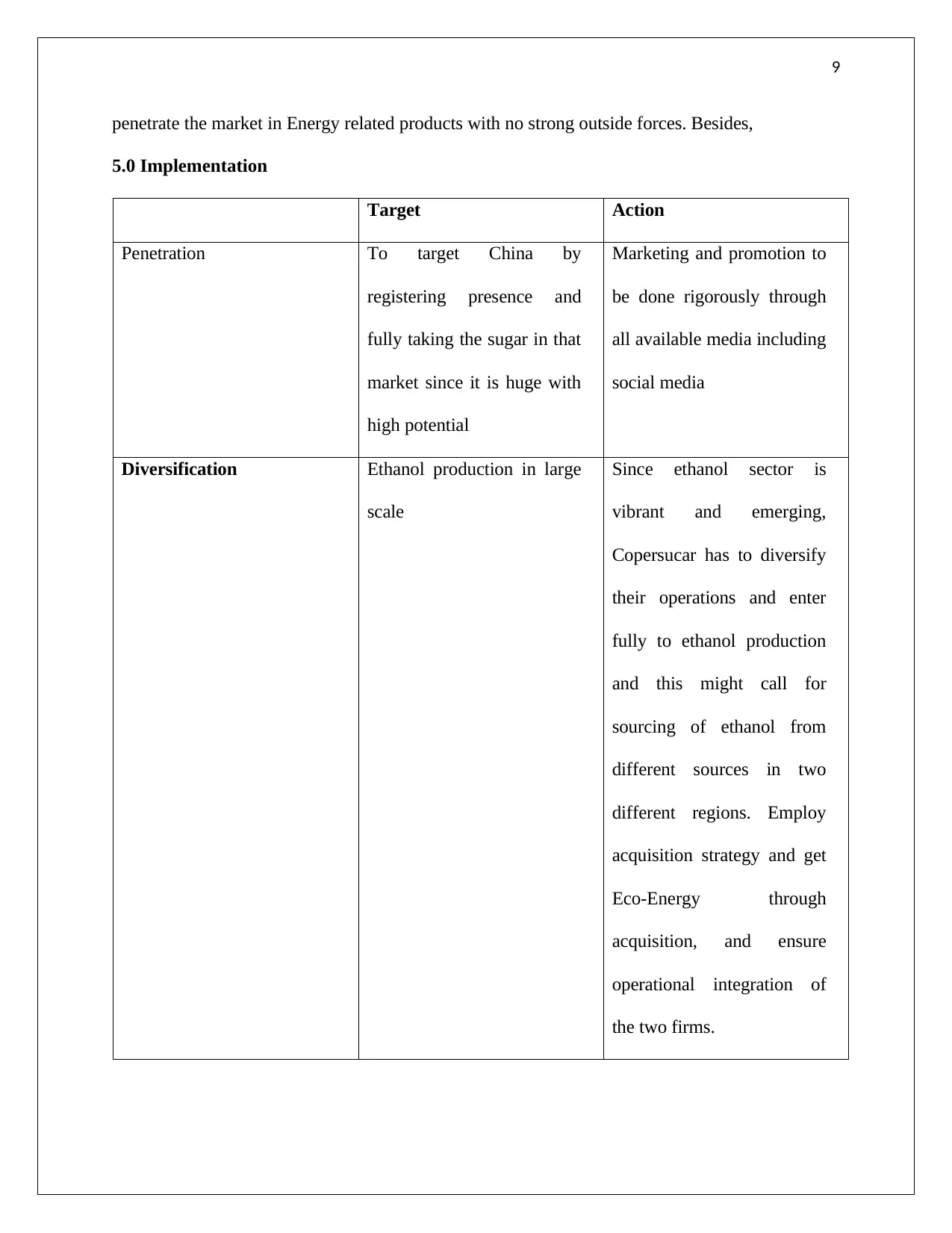
5.0 Implementation
Target Action
Penetration To target China by
registering presence and
fully taking the sugar in that
market since it is huge with
high potential
Marketing and promotion to
be done rigorously through
all available media including
social media
Diversification Ethanol production in large
scale
Since ethanol sector is
vibrant and emerging,
Copersucar has to diversify
their operations and enter
fully to ethanol production
and this might call for
sourcing of ethanol from
different sources in two
different regions. Employ
acquisition strategy and get
Eco-Energy through
acquisition, and ensure
operational integration of
the two firms.
penetrate the market in Energy related products with no strong outside forces. Besides,
5.0 Implementation
Target Action
Penetration To target China by
registering presence and
fully taking the sugar in that
market since it is huge with
high potential
Marketing and promotion to
be done rigorously through
all available media including
social media
Diversification Ethanol production in large
scale
Since ethanol sector is
vibrant and emerging,
Copersucar has to diversify
their operations and enter
fully to ethanol production
and this might call for
sourcing of ethanol from
different sources in two
different regions. Employ
acquisition strategy and get
Eco-Energy through
acquisition, and ensure
operational integration of
the two firms.
⊘ This is a preview!⊘
Do you want full access?
Subscribe today to unlock all pages.
Trusted by 1+ million students worldwide
10
6.0 Appendixes
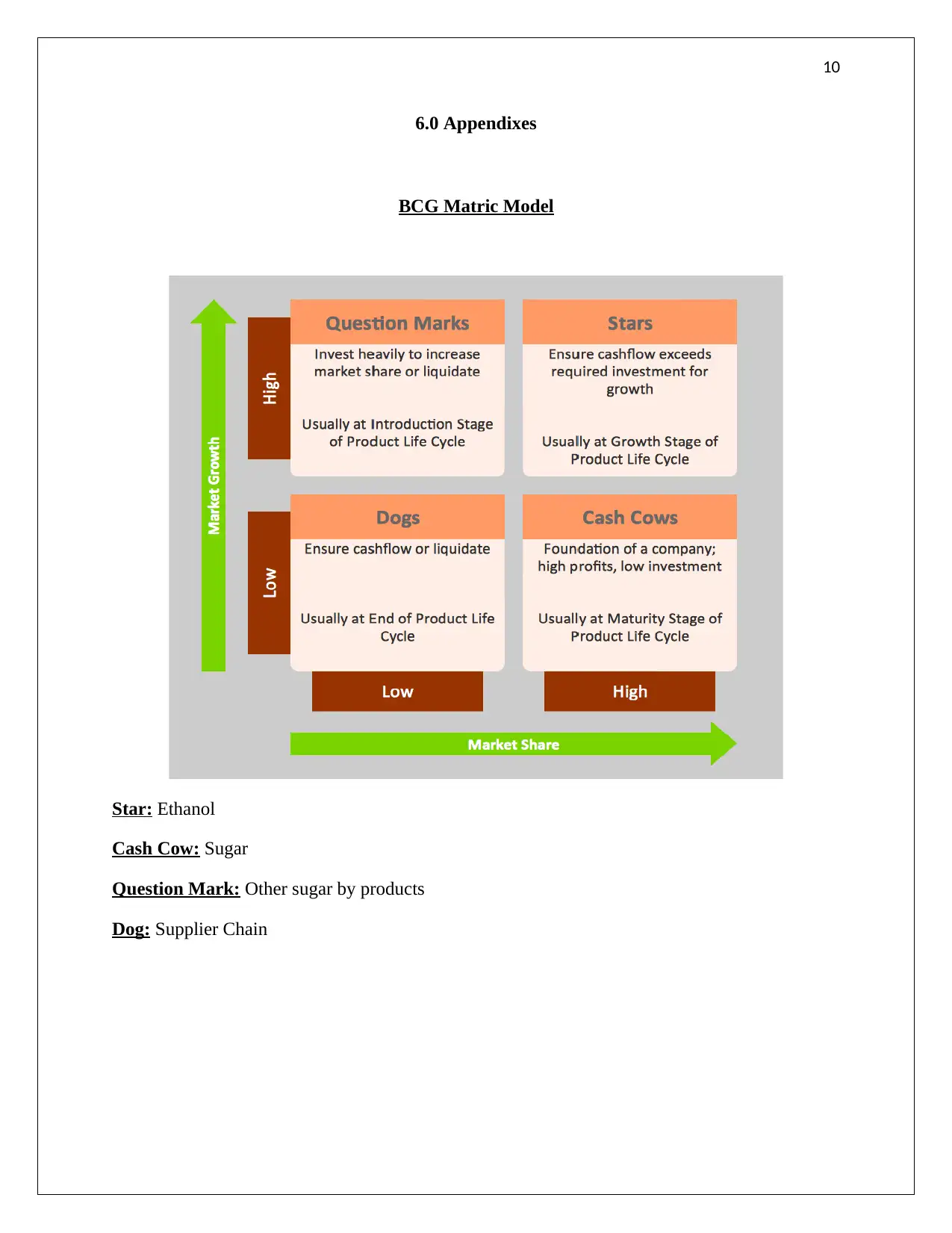
BCG Matric Model
Star: Ethanol
Cash Cow: Sugar
Question Mark: Other sugar by products
Dog: Supplier Chain
6.0 Appendixes
BCG Matric Model
Star: Ethanol
Cash Cow: Sugar
Question Mark: Other sugar by products
Dog: Supplier Chain
Paraphrase This Document
Need a fresh take? Get an instant paraphrase of this document with our AI Paraphraser
11
SWOT Analysis
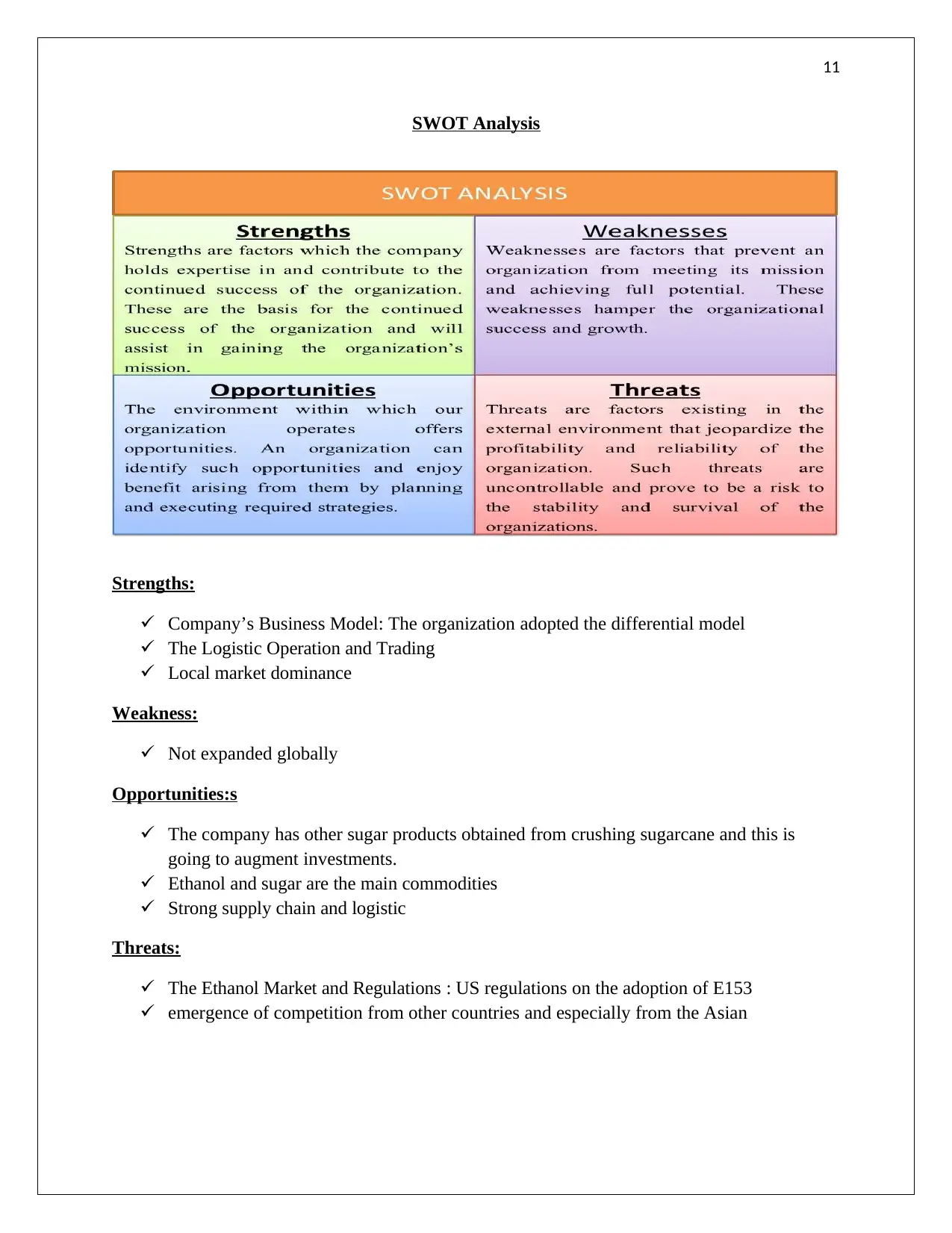
Strengths:
Company’s Business Model: The organization adopted the differential model
The Logistic Operation and Trading
Local market dominance
Weakness:
Not expanded globally
Opportunities:s
The company has other sugar products obtained from crushing sugarcane and this is
going to augment investments.
Ethanol and sugar are the main commodities
Strong supply chain and logistic
Threats:
The Ethanol Market and Regulations : US regulations on the adoption of E153
emergence of competition from other countries and especially from the Asian
SWOT Analysis
Strengths:
Company’s Business Model: The organization adopted the differential model
The Logistic Operation and Trading
Local market dominance
Weakness:
Not expanded globally
Opportunities:s
The company has other sugar products obtained from crushing sugarcane and this is
going to augment investments.
Ethanol and sugar are the main commodities
Strong supply chain and logistic
Threats:
The Ethanol Market and Regulations : US regulations on the adoption of E153
emergence of competition from other countries and especially from the Asian

1 out of 11


Your All-in-One AI-Powered Toolkit for Academic Success.
+13062052269
info@desklib.com
Available 24*7 on WhatsApp / Email
![[object Object]](/_next/static/media/star-bottom.7253800d.svg)
Unlock your academic potential
Copyright © 2020–2026 A2Z Services. All Rights Reserved. Developed and managed by ZUCOL.