Copyright Law in America: Historical Context, Fair Use & Design

Verified

Added on  2023/05/31

|7
|1619
|122
Essay
AI Summary
This essay provides a comprehensive overview of American copyright law, tracing its historical roots from the Statute of Anne to the Copyright Act of 1976. It examines the importance of key rulings like Kirtsaeng v. John Wiley & Sons, Inc., which clarified the doctrine of first sale, and explores the application of copyright law in design businesses, particularly within the music industry, highlighting the distinction between musical composition and sound recording rights. The essay further delves into the concept of fair use, outlining the four key principles—purpose and character of use, nature of the copyrighted work, amount of work used, and effect on the potential market—and their significance in balancing public interest with authors' rights. The paper concludes by underscoring the law's role in fostering creativity while ensuring equitable access to information and artistic works, with Desklib offering additional solved assignments and resources for students.
Document Page
Running head: COPYRIGHT LAW IN AMERICA
Copyright Law in America
[Author Name(s), First M. Last, Omit Titles and Degrees]
[Institutional Affiliation(s)]
Author Note
[Include any grant/funding information and a complete correspondence address.]
tabler-icon-diamond-filled.svg

Paraphrase This Document

Need a fresh take? Get an instant paraphrase of this document with our AI Paraphraser
Document Page
COPYRIGHT LAW IN AMERICA 1
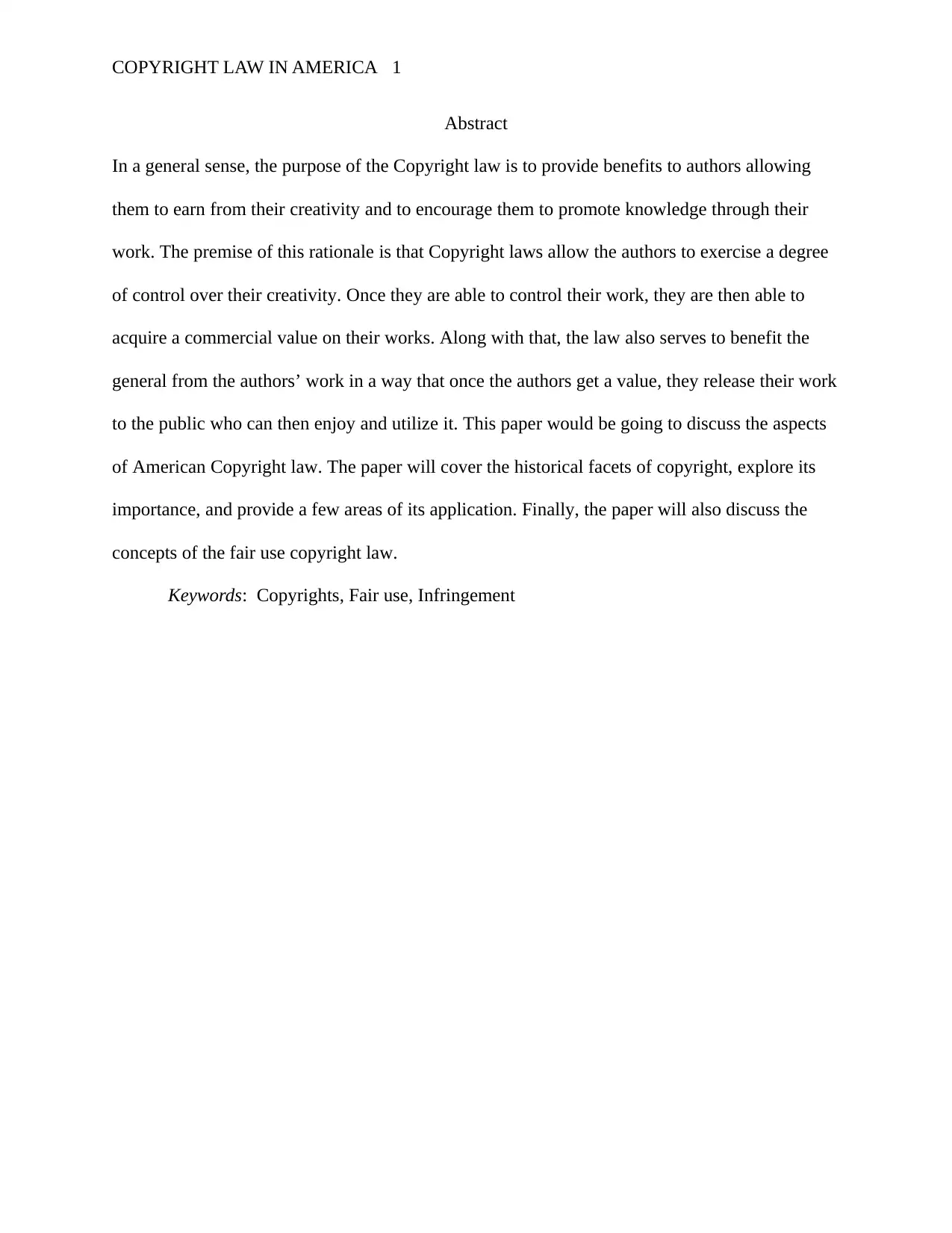
Abstract
In a general sense, the purpose of the Copyright law is to provide benefits to authors allowing
them to earn from their creativity and to encourage them to promote knowledge through their
work. The premise of this rationale is that Copyright laws allow the authors to exercise a degree
of control over their creativity. Once they are able to control their work, they are then able to
acquire a commercial value on their works. Along with that, the law also serves to benefit the
general from the authors’ work in a way that once the authors get a value, they release their work
to the public who can then enjoy and utilize it. This paper would be going to discuss the aspects
of American Copyright law. The paper will cover the historical facets of copyright, explore its
importance, and provide a few areas of its application. Finally, the paper will also discuss the
concepts of the fair use copyright law.
Keywords: Copyrights, Fair use, Infringement
Document Page
COPYRIGHT LAW IN AMERICA 2
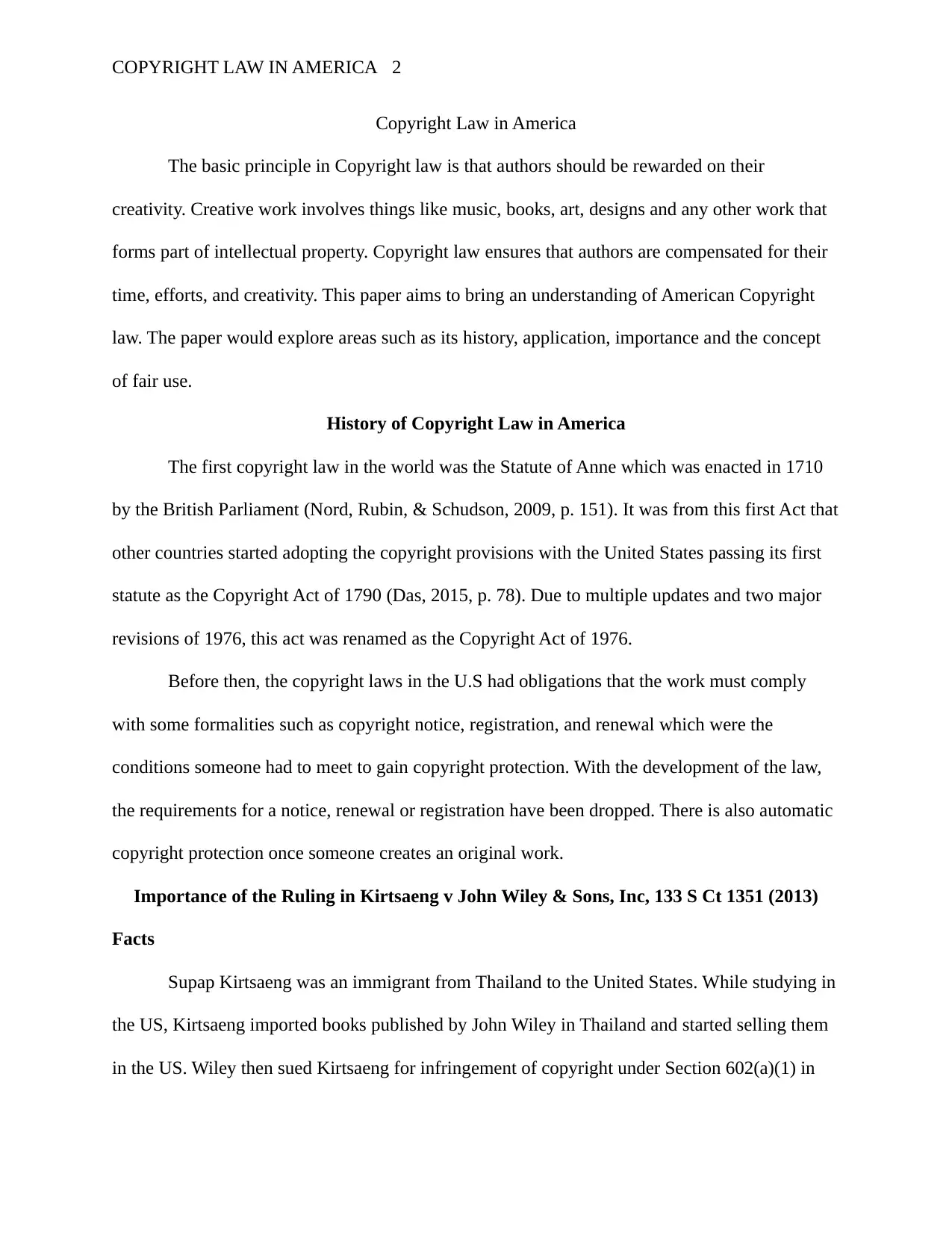
Copyright Law in America
The basic principle in Copyright law is that authors should be rewarded on their
creativity. Creative work involves things like music, books, art, designs and any other work that
forms part of intellectual property. Copyright law ensures that authors are compensated for their
time, efforts, and creativity. This paper aims to bring an understanding of American Copyright
law. The paper would explore areas such as its history, application, importance and the concept
of fair use.
History of Copyright Law in America
The first copyright law in the world was the Statute of Anne which was enacted in 1710
by the British Parliament (Nord, Rubin, & Schudson, 2009, p. 151). It was from this first Act that
other countries started adopting the copyright provisions with the United States passing its first
statute as the Copyright Act of 1790 (Das, 2015, p. 78). Due to multiple updates and two major
revisions of 1976, this act was renamed as the Copyright Act of 1976.
Before then, the copyright laws in the U.S had obligations that the work must comply
with some formalities such as copyright notice, registration, and renewal which were the
conditions someone had to meet to gain copyright protection. With the development of the law,
the requirements for a notice, renewal or registration have been dropped. There is also automatic
copyright protection once someone creates an original work.
Importance of the Ruling in Kirtsaeng v John Wiley & Sons, Inc, 133 S Ct 1351 (2013)
Facts
Supap Kirtsaeng was an immigrant from Thailand to the United States. While studying in
the US, Kirtsaeng imported books published by John Wiley in Thailand and started selling them
in the US. Wiley then sued Kirtsaeng for infringement of copyright under Section 602(a)(1) in
Document Page
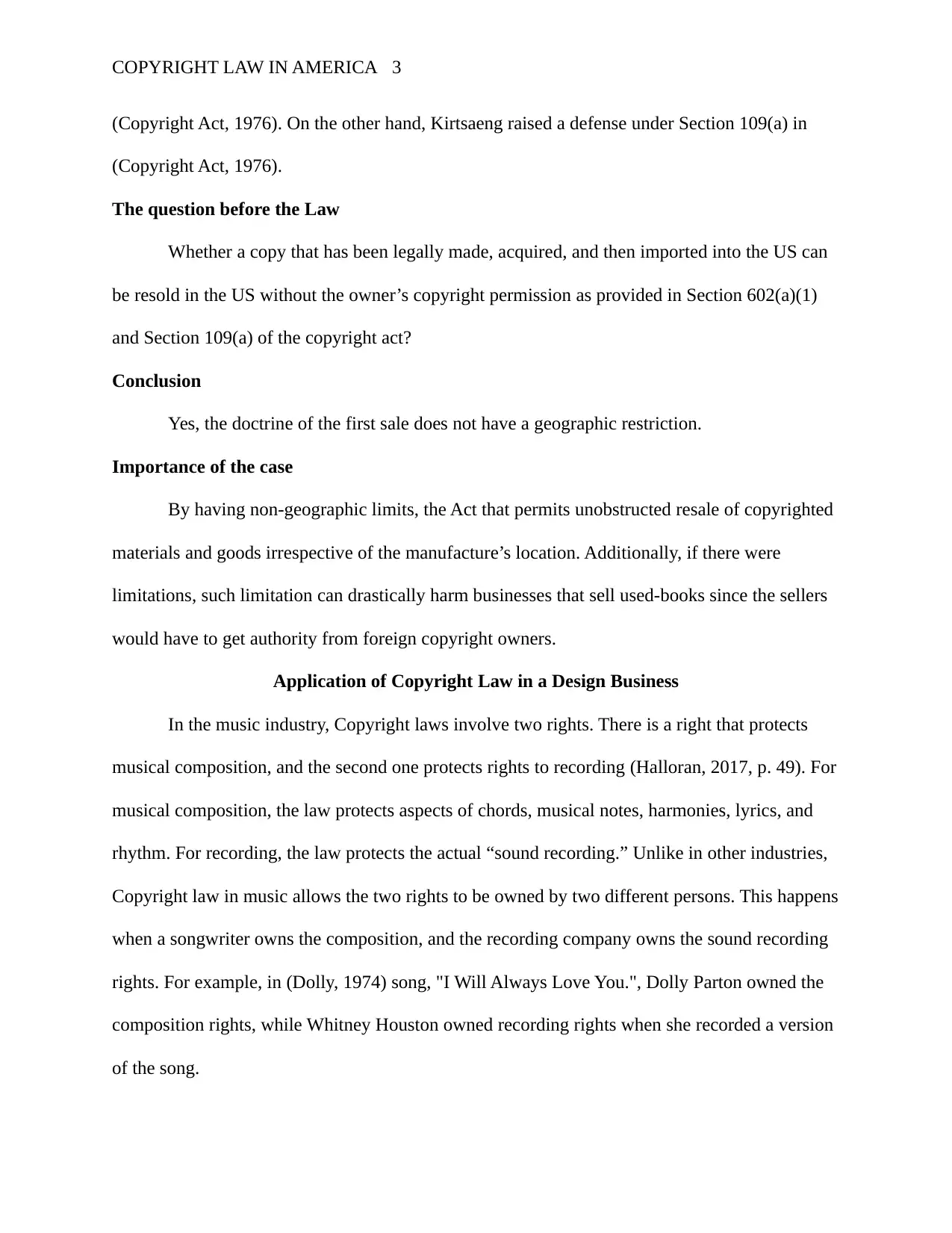
COPYRIGHT LAW IN AMERICA 3
(Copyright Act, 1976). On the other hand, Kirtsaeng raised a defense under Section 109(a) in
(Copyright Act, 1976).
The question before the Law
Whether a copy that has been legally made, acquired, and then imported into the US can
be resold in the US without the owner’s copyright permission as provided in Section 602(a)(1)
and Section 109(a) of the copyright act?
Conclusion
Yes, the doctrine of the first sale does not have a geographic restriction.
Importance of the case
By having non-geographic limits, the Act that permits unobstructed resale of copyrighted
materials and goods irrespective of the manufacture’s location. Additionally, if there were
limitations, such limitation can drastically harm businesses that sell used-books since the sellers
would have to get authority from foreign copyright owners.
Application of Copyright Law in a Design Business
In the music industry, Copyright laws involve two rights. There is a right that protects
musical composition, and the second one protects rights to recording (Halloran, 2017, p. 49). For
musical composition, the law protects aspects of chords, musical notes, harmonies, lyrics, and
rhythm. For recording, the law protects the actual “sound recording.” Unlike in other industries,
Copyright law in music allows the two rights to be owned by two different persons. This happens
when a songwriter owns the composition, and the recording company owns the sound recording
rights. For example, in (Dolly, 1974) song, "I Will Always Love You.", Dolly Parton owned the
composition rights, while Whitney Houston owned recording rights when she recorded a version
of the song.
tabler-icon-diamond-filled.svg

Paraphrase This Document

Need a fresh take? Get an instant paraphrase of this document with our AI Paraphraser
Document Page
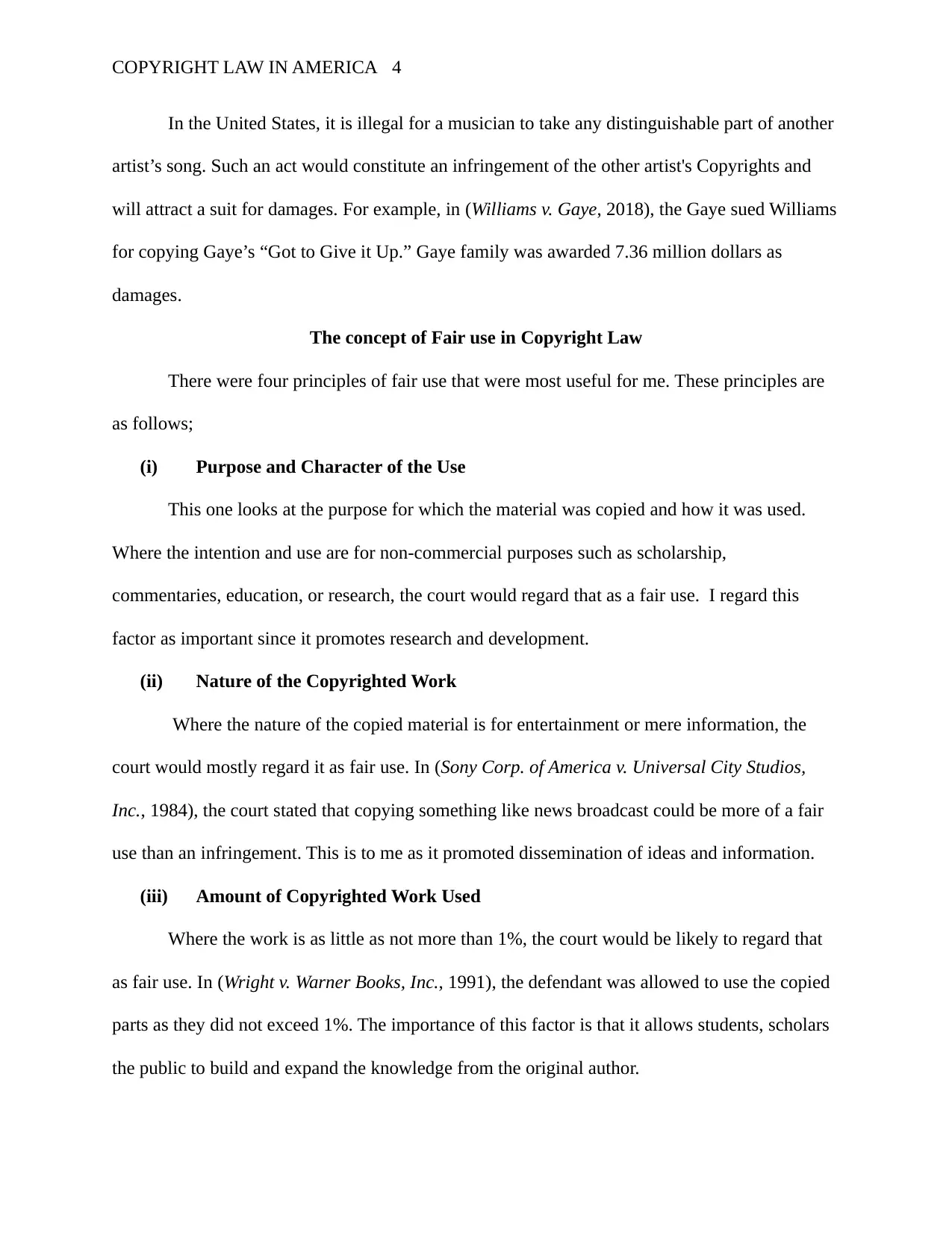
COPYRIGHT LAW IN AMERICA 4
In the United States, it is illegal for a musician to take any distinguishable part of another
artist’s song. Such an act would constitute an infringement of the other artist's Copyrights and
will attract a suit for damages. For example, in (Williams v. Gaye, 2018), the Gaye sued Williams
for copying Gaye’s “Got to Give it Up.” Gaye family was awarded 7.36 million dollars as
damages.
The concept of Fair use in Copyright Law
There were four principles of fair use that were most useful for me. These principles are
as follows;
(i) Purpose and Character of the Use
This one looks at the purpose for which the material was copied and how it was used.
Where the intention and use are for non-commercial purposes such as scholarship,
commentaries, education, or research, the court would regard that as a fair use. I regard this
factor as important since it promotes research and development.
(ii) Nature of the Copyrighted Work
Where the nature of the copied material is for entertainment or mere information, the
court would mostly regard it as fair use. In (Sony Corp. of America v. Universal City Studios,
Inc., 1984), the court stated that copying something like news broadcast could be more of a fair
use than an infringement. This is to me as it promoted dissemination of ideas and information.
(iii) Amount of Copyrighted Work Used
Where the work is as little as not more than 1%, the court would be likely to regard that
as fair use. In (Wright v. Warner Books, Inc., 1991), the defendant was allowed to use the copied
parts as they did not exceed 1%. The importance of this factor is that it allows students, scholars
the public to build and expand the knowledge from the original author.
Document Page
COPYRIGHT LAW IN AMERICA 5
(iv) Effect of the Use on the Potential Market for the Work
This one looks at how the copied work affected the original owner. Again, where there is
no effect on the original owner, that would be counted as fair use. In (Rogers v. Koons, 1991) a
photograph adapted to a sculpture was taken to harm the market for the original work. This factor
is important as it strikes a balance between the public use and financial gain of the original
author.
Conclusion
This paper aimed to provide an understanding of the scope of American Copyright law.
The paper has covered the history and development of the law by discussing one of the cases that
clarified on the law regarding the doctrine of resale. The paper then discussed the law on fair use.
Document Page
COPYRIGHT LAW IN AMERICA 6
References
Copyright Act (1976).
Das, J. K. (2015). Law of Copyright (1st edition). Prentice-Hall of India Pvt.Ltd.
Dolly, P. (1974). I Will Always Love You.
Halloran, M. (2017). The Musician’s Business and Legal Guide (5 edition). New York ; London:
Routledge.
Nord, D. P., Rubin, J. S., & Schudson, M. (Eds.). (2009). A History of the Book in America:
Volume 5: The Enduring Book: Print Culture in Postwar America (New edition edition).
Chapel Hill: The University of North Carolina Press.
Rogers v. Koons, 960 F. 2d 301 (Court of Appeals, 2nd Circuit 1991).
Sony Corp. of America v. Universal City Studios, Inc., 464 US (Supreme Court 1984).
Williams v. Gaye, 885 F. 3d (Court of Appeals, 9th Circuit 2018).
Wright v. Warner Books, Inc., 953 F. 2d 731 (Court of Appeals, 2nd Circuit 1991).
chevron_up_icon
1 out of 7
circle_padding
hide_on_mobile
zoom_out_icon
[object Object]