Cornell University SHA532: Forecasting and Availability Action Plan
VerifiedAdded on 2022/10/02
|8
|2408
|343
Project
AI Summary
This assignment presents a comprehensive action plan for hotel revenue management, focusing on forecasting and availability controls. The student identifies key business problems related to forecasting, such as predicting room demand and managing early departures. The plan outlines relevant revenue management strategies including maintaining accurate records, utilizing historical data, and analyzing competitor actions. Steps for implementation include data collection, monitoring forecasts, and team collaboration. The timeline spans five months, detailing actions for each month and quarter. Measurement strategies include using RevPAR to assess the impact of forecasting solutions and considering event-related fluctuations. The student references modules covering forecasting, booking curves, group forecasting, error measurement, rate setting, and length-of-stay management. The project integrates concepts learned throughout the course and provides references to support the strategies and methodologies discussed, aiming to improve revenue management effectiveness within the hotel industry.
SHA532: Forecasting and Availability Controls in Hotel Revenue Management
Cornell University School of Hotel Administration
Forecasting and Availability Controls in Hotel Revenue
Management Action Plan
Complete the grid below.
© 2016 eCornell. All rights reserved. All other copyrights, trademarks, trade names, and logos are the sole property of their respective owners.
1
Cornell University School of Hotel Administration
Forecasting and Availability Controls in Hotel Revenue
Management Action Plan
Complete the grid below.
© 2016 eCornell. All rights reserved. All other copyrights, trademarks, trade names, and logos are the sole property of their respective owners.
1

Paraphrase This Document
Need a fresh take? Get an instant paraphrase of this document with our AI Paraphraser
SHA532: Forecasting and Availability Controls in Hotel Revenue Management
Cornell University School of Hotel Administration
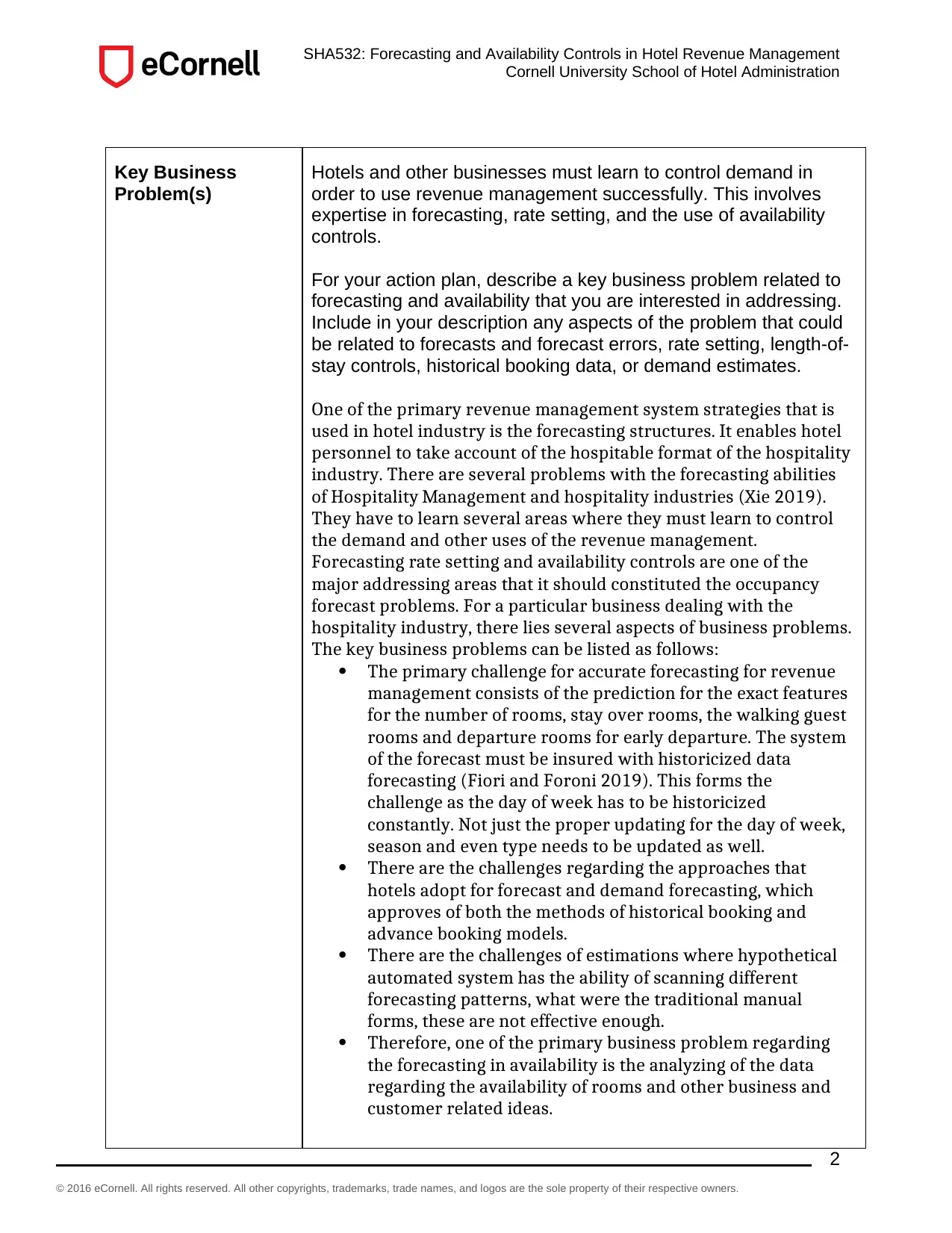
Key Business
Problem(s)
Hotels and other businesses must learn to control demand in
order to use revenue management successfully. This involves
expertise in forecasting, rate setting, and the use of availability
controls.
For your action plan, describe a key business problem related to
forecasting and availability that you are interested in addressing.
Include in your description any aspects of the problem that could
be related to forecasts and forecast errors, rate setting, length-of-
stay controls, historical booking data, or demand estimates.
One of the primary revenue management system strategies that is
used in hotel industry is the forecasting structures. It enables hotel
personnel to take account of the hospitable format of the hospitality
industry. There are several problems with the forecasting abilities
of Hospitality Management and hospitality industries (Xie 2019).
They have to learn several areas where they must learn to control
the demand and other uses of the revenue management.
Forecasting rate setting and availability controls are one of the
major addressing areas that it should constituted the occupancy
forecast problems. For a particular business dealing with the
hospitality industry, there lies several aspects of business problems.
The key business problems can be listed as follows:
The primary challenge for accurate forecasting for revenue
management consists of the prediction for the exact features
for the number of rooms, stay over rooms, the walking guest
rooms and departure rooms for early departure. The system
of the forecast must be insured with historicized data
forecasting (Fiori and Foroni 2019). This forms the
challenge as the day of week has to be historicized
constantly. Not just the proper updating for the day of week,
season and even type needs to be updated as well.
There are the challenges regarding the approaches that
hotels adopt for forecast and demand forecasting, which
approves of both the methods of historical booking and
advance booking models.
There are the challenges of estimations where hypothetical
automated system has the ability of scanning different
forecasting patterns, what were the traditional manual
forms, these are not effective enough.
Therefore, one of the primary business problem regarding
the forecasting in availability is the analyzing of the data
regarding the availability of rooms and other business and
customer related ideas.
© 2016 eCornell. All rights reserved. All other copyrights, trademarks, trade names, and logos are the sole property of their respective owners.
2
Cornell University School of Hotel Administration
Key Business
Problem(s)
Hotels and other businesses must learn to control demand in
order to use revenue management successfully. This involves
expertise in forecasting, rate setting, and the use of availability
controls.
For your action plan, describe a key business problem related to
forecasting and availability that you are interested in addressing.
Include in your description any aspects of the problem that could
be related to forecasts and forecast errors, rate setting, length-of-
stay controls, historical booking data, or demand estimates.
One of the primary revenue management system strategies that is
used in hotel industry is the forecasting structures. It enables hotel
personnel to take account of the hospitable format of the hospitality
industry. There are several problems with the forecasting abilities
of Hospitality Management and hospitality industries (Xie 2019).
They have to learn several areas where they must learn to control
the demand and other uses of the revenue management.
Forecasting rate setting and availability controls are one of the
major addressing areas that it should constituted the occupancy
forecast problems. For a particular business dealing with the
hospitality industry, there lies several aspects of business problems.
The key business problems can be listed as follows:
The primary challenge for accurate forecasting for revenue
management consists of the prediction for the exact features
for the number of rooms, stay over rooms, the walking guest
rooms and departure rooms for early departure. The system
of the forecast must be insured with historicized data
forecasting (Fiori and Foroni 2019). This forms the
challenge as the day of week has to be historicized
constantly. Not just the proper updating for the day of week,
season and even type needs to be updated as well.
There are the challenges regarding the approaches that
hotels adopt for forecast and demand forecasting, which
approves of both the methods of historical booking and
advance booking models.
There are the challenges of estimations where hypothetical
automated system has the ability of scanning different
forecasting patterns, what were the traditional manual
forms, these are not effective enough.
Therefore, one of the primary business problem regarding
the forecasting in availability is the analyzing of the data
regarding the availability of rooms and other business and
customer related ideas.
© 2016 eCornell. All rights reserved. All other copyrights, trademarks, trade names, and logos are the sole property of their respective owners.
2
SHA532: Forecasting and Availability Controls in Hotel Revenue Management
Cornell University School of Hotel Administration
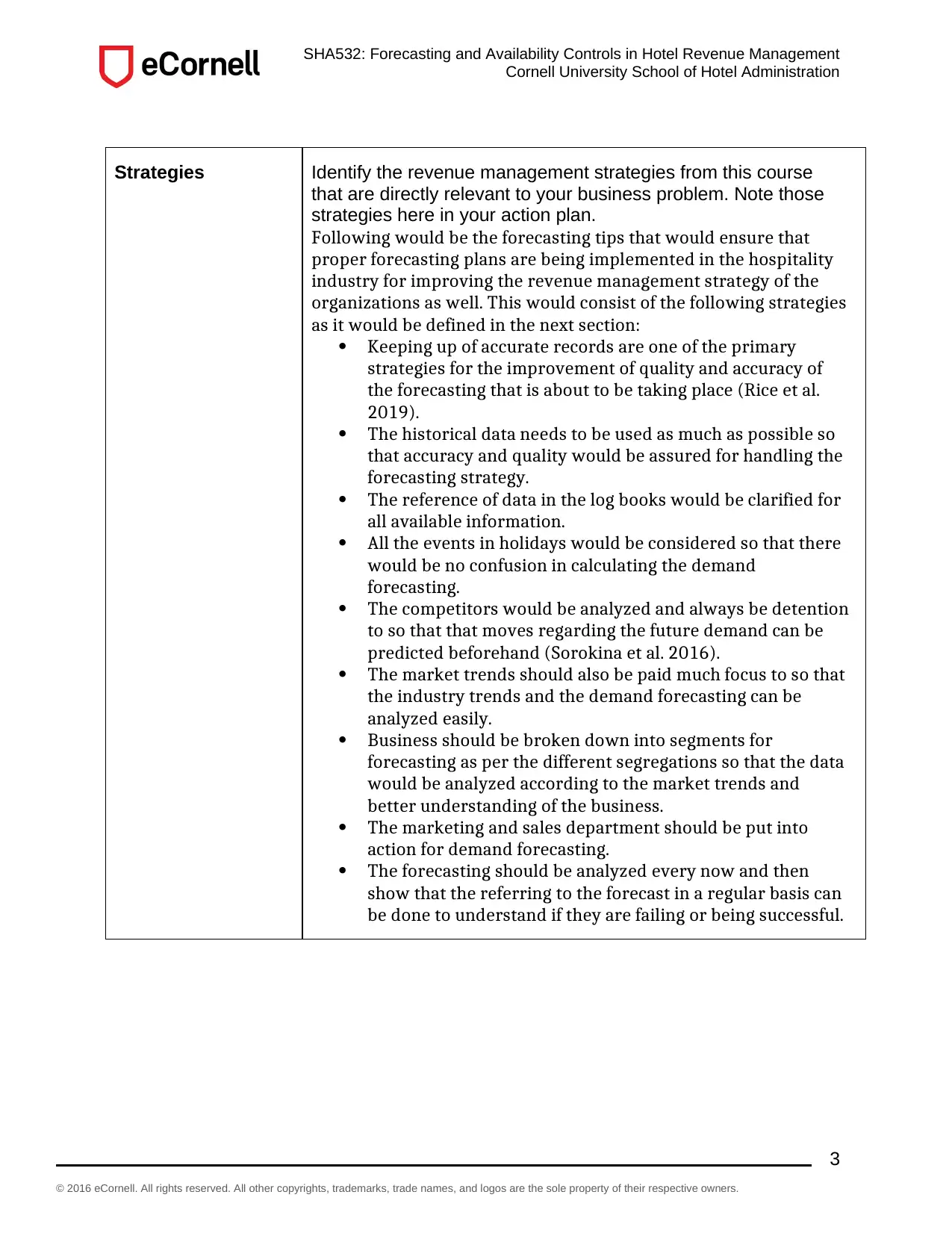
Strategies Identify the revenue management strategies from this course
that are directly relevant to your business problem. Note those
strategies here in your action plan.
Following would be the forecasting tips that would ensure that
proper forecasting plans are being implemented in the hospitality
industry for improving the revenue management strategy of the
organizations as well. This would consist of the following strategies
as it would be defined in the next section:
Keeping up of accurate records are one of the primary
strategies for the improvement of quality and accuracy of
the forecasting that is about to be taking place (Rice et al.
2019).
The historical data needs to be used as much as possible so
that accuracy and quality would be assured for handling the
forecasting strategy.
The reference of data in the log books would be clarified for
all available information.
All the events in holidays would be considered so that there
would be no confusion in calculating the demand
forecasting.
The competitors would be analyzed and always be detention
to so that that moves regarding the future demand can be
predicted beforehand (Sorokina et al. 2016).
The market trends should also be paid much focus to so that
the industry trends and the demand forecasting can be
analyzed easily.
Business should be broken down into segments for
forecasting as per the different segregations so that the data
would be analyzed according to the market trends and
better understanding of the business.
The marketing and sales department should be put into
action for demand forecasting.
The forecasting should be analyzed every now and then
show that the referring to the forecast in a regular basis can
be done to understand if they are failing or being successful.
© 2016 eCornell. All rights reserved. All other copyrights, trademarks, trade names, and logos are the sole property of their respective owners.
3
Cornell University School of Hotel Administration
Strategies Identify the revenue management strategies from this course
that are directly relevant to your business problem. Note those
strategies here in your action plan.
Following would be the forecasting tips that would ensure that
proper forecasting plans are being implemented in the hospitality
industry for improving the revenue management strategy of the
organizations as well. This would consist of the following strategies
as it would be defined in the next section:
Keeping up of accurate records are one of the primary
strategies for the improvement of quality and accuracy of
the forecasting that is about to be taking place (Rice et al.
2019).
The historical data needs to be used as much as possible so
that accuracy and quality would be assured for handling the
forecasting strategy.
The reference of data in the log books would be clarified for
all available information.
All the events in holidays would be considered so that there
would be no confusion in calculating the demand
forecasting.
The competitors would be analyzed and always be detention
to so that that moves regarding the future demand can be
predicted beforehand (Sorokina et al. 2016).
The market trends should also be paid much focus to so that
the industry trends and the demand forecasting can be
analyzed easily.
Business should be broken down into segments for
forecasting as per the different segregations so that the data
would be analyzed according to the market trends and
better understanding of the business.
The marketing and sales department should be put into
action for demand forecasting.
The forecasting should be analyzed every now and then
show that the referring to the forecast in a regular basis can
be done to understand if they are failing or being successful.
© 2016 eCornell. All rights reserved. All other copyrights, trademarks, trade names, and logos are the sole property of their respective owners.
3
⊘ This is a preview!⊘
Do you want full access?
Subscribe today to unlock all pages.

Trusted by 1+ million students worldwide
SHA532: Forecasting and Availability Controls in Hotel Revenue Management
Cornell University School of Hotel Administration
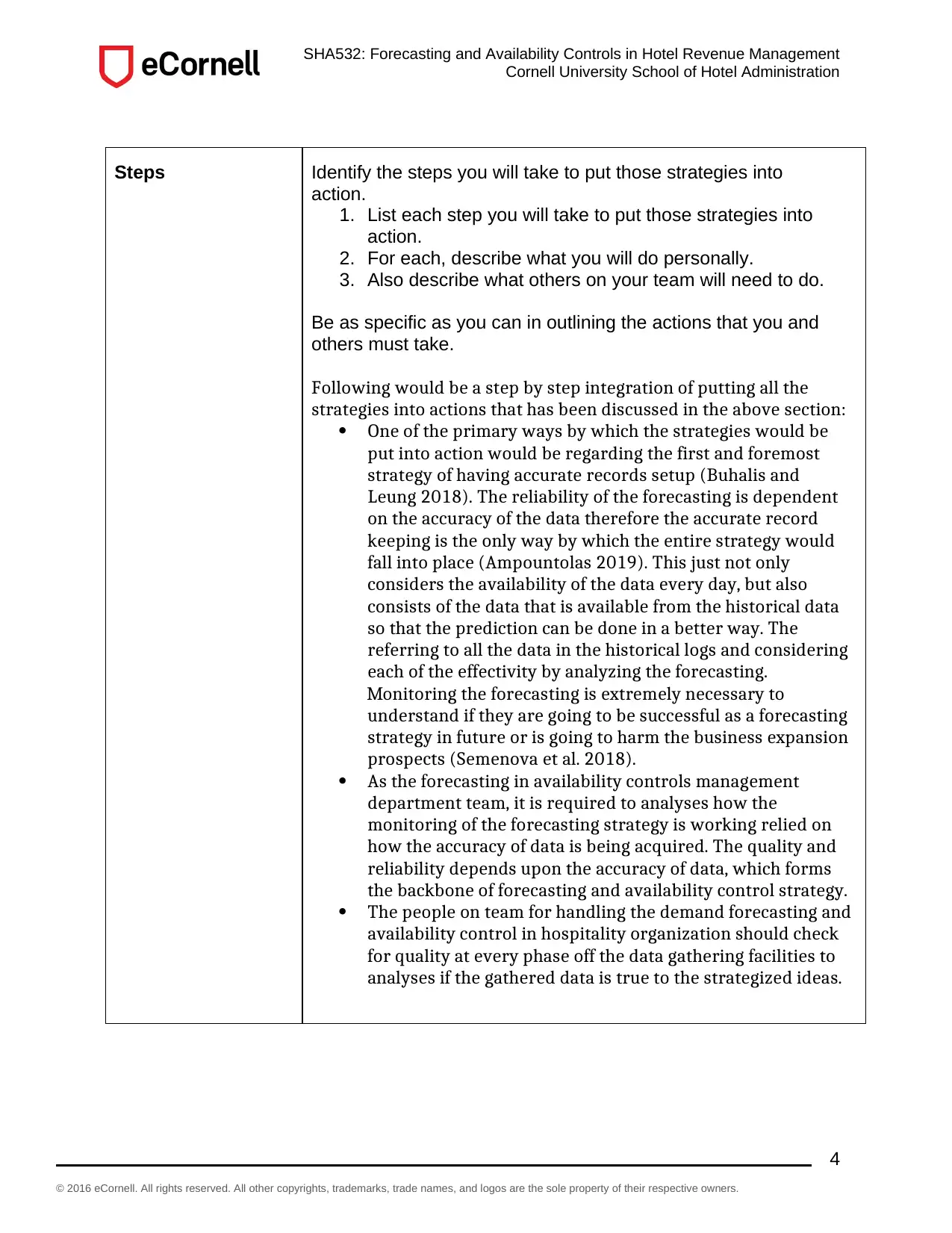
Steps Identify the steps you will take to put those strategies into
action.
1. List each step you will take to put those strategies into
action.
2. For each, describe what you will do personally.
3. Also describe what others on your team will need to do.
Be as specific as you can in outlining the actions that you and
others must take.
Following would be a step by step integration of putting all the
strategies into actions that has been discussed in the above section:
One of the primary ways by which the strategies would be
put into action would be regarding the first and foremost
strategy of having accurate records setup (Buhalis and
Leung 2018). The reliability of the forecasting is dependent
on the accuracy of the data therefore the accurate record
keeping is the only way by which the entire strategy would
fall into place (Ampountolas 2019). This just not only
considers the availability of the data every day, but also
consists of the data that is available from the historical data
so that the prediction can be done in a better way. The
referring to all the data in the historical logs and considering
each of the effectivity by analyzing the forecasting.
Monitoring the forecasting is extremely necessary to
understand if they are going to be successful as a forecasting
strategy in future or is going to harm the business expansion
prospects (Semenova et al. 2018).
As the forecasting in availability controls management
department team, it is required to analyses how the
monitoring of the forecasting strategy is working relied on
how the accuracy of data is being acquired. The quality and
reliability depends upon the accuracy of data, which forms
the backbone of forecasting and availability control strategy.
The people on team for handling the demand forecasting and
availability control in hospitality organization should check
for quality at every phase off the data gathering facilities to
analyses if the gathered data is true to the strategized ideas.
© 2016 eCornell. All rights reserved. All other copyrights, trademarks, trade names, and logos are the sole property of their respective owners.
4
Cornell University School of Hotel Administration
Steps Identify the steps you will take to put those strategies into
action.
1. List each step you will take to put those strategies into
action.
2. For each, describe what you will do personally.
3. Also describe what others on your team will need to do.
Be as specific as you can in outlining the actions that you and
others must take.
Following would be a step by step integration of putting all the
strategies into actions that has been discussed in the above section:
One of the primary ways by which the strategies would be
put into action would be regarding the first and foremost
strategy of having accurate records setup (Buhalis and
Leung 2018). The reliability of the forecasting is dependent
on the accuracy of the data therefore the accurate record
keeping is the only way by which the entire strategy would
fall into place (Ampountolas 2019). This just not only
considers the availability of the data every day, but also
consists of the data that is available from the historical data
so that the prediction can be done in a better way. The
referring to all the data in the historical logs and considering
each of the effectivity by analyzing the forecasting.
Monitoring the forecasting is extremely necessary to
understand if they are going to be successful as a forecasting
strategy in future or is going to harm the business expansion
prospects (Semenova et al. 2018).
As the forecasting in availability controls management
department team, it is required to analyses how the
monitoring of the forecasting strategy is working relied on
how the accuracy of data is being acquired. The quality and
reliability depends upon the accuracy of data, which forms
the backbone of forecasting and availability control strategy.
The people on team for handling the demand forecasting and
availability control in hospitality organization should check
for quality at every phase off the data gathering facilities to
analyses if the gathered data is true to the strategized ideas.
© 2016 eCornell. All rights reserved. All other copyrights, trademarks, trade names, and logos are the sole property of their respective owners.
4
Paraphrase This Document
Need a fresh take? Get an instant paraphrase of this document with our AI Paraphraser
SHA532: Forecasting and Availability Controls in Hotel Revenue Management
Cornell University School of Hotel Administration
Timeline Identify a timeline for implementation.
1. What will you (or your team) do in the next month?
2. What will you have completed over the next quarter?
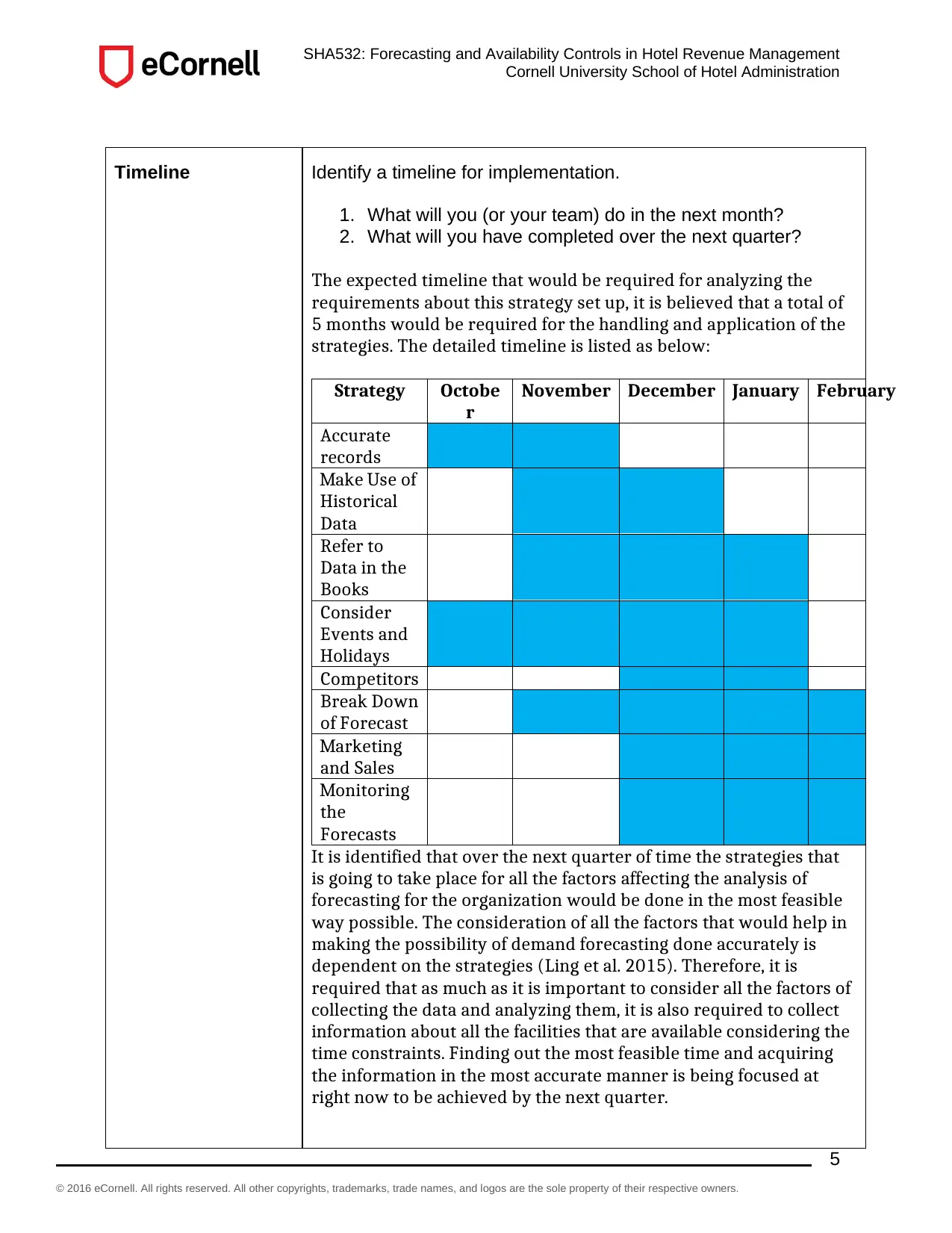
The expected timeline that would be required for analyzing the
requirements about this strategy set up, it is believed that a total of
5 months would be required for the handling and application of the
strategies. The detailed timeline is listed as below:
Strategy Octobe
r
November December January February
Accurate
records
Make Use of
Historical
Data
Refer to
Data in the
Books
Consider
Events and
Holidays
Competitors
Break Down
of Forecast
Marketing
and Sales
Monitoring
the
Forecasts
It is identified that over the next quarter of time the strategies that
is going to take place for all the factors affecting the analysis of
forecasting for the organization would be done in the most feasible
way possible. The consideration of all the factors that would help in
making the possibility of demand forecasting done accurately is
dependent on the strategies (Ling et al. 2015). Therefore, it is
required that as much as it is important to consider all the factors of
collecting the data and analyzing them, it is also required to collect
information about all the facilities that are available considering the
time constraints. Finding out the most feasible time and acquiring
the information in the most accurate manner is being focused at
right now to be achieved by the next quarter.
© 2016 eCornell. All rights reserved. All other copyrights, trademarks, trade names, and logos are the sole property of their respective owners.
5
Cornell University School of Hotel Administration
Timeline Identify a timeline for implementation.
1. What will you (or your team) do in the next month?
2. What will you have completed over the next quarter?
The expected timeline that would be required for analyzing the
requirements about this strategy set up, it is believed that a total of
5 months would be required for the handling and application of the
strategies. The detailed timeline is listed as below:
Strategy Octobe
r
November December January February
Accurate
records
Make Use of
Historical
Data
Refer to
Data in the
Books
Consider
Events and
Holidays
Competitors
Break Down
of Forecast
Marketing
and Sales
Monitoring
the
Forecasts
It is identified that over the next quarter of time the strategies that
is going to take place for all the factors affecting the analysis of
forecasting for the organization would be done in the most feasible
way possible. The consideration of all the factors that would help in
making the possibility of demand forecasting done accurately is
dependent on the strategies (Ling et al. 2015). Therefore, it is
required that as much as it is important to consider all the factors of
collecting the data and analyzing them, it is also required to collect
information about all the facilities that are available considering the
time constraints. Finding out the most feasible time and acquiring
the information in the most accurate manner is being focused at
right now to be achieved by the next quarter.
© 2016 eCornell. All rights reserved. All other copyrights, trademarks, trade names, and logos are the sole property of their respective owners.
5
SHA532: Forecasting and Availability Controls in Hotel Revenue Management
Cornell University School of Hotel Administration
Measurement/
Results
How are you going to measure your results or demonstrate that
your solution has had a positive impact? Outline your
measurement strategies here.
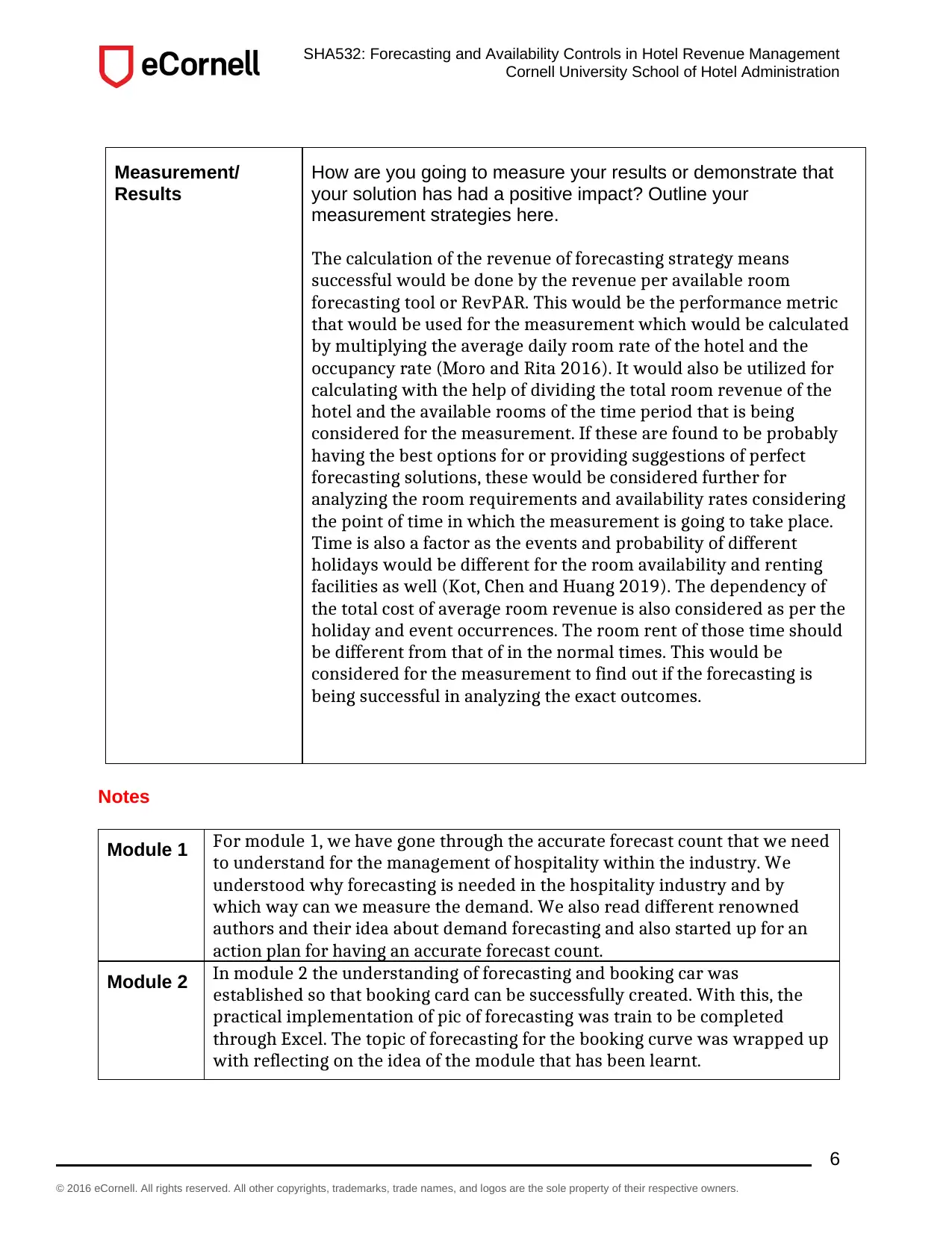
The calculation of the revenue of forecasting strategy means
successful would be done by the revenue per available room
forecasting tool or RevPAR. This would be the performance metric
that would be used for the measurement which would be calculated
by multiplying the average daily room rate of the hotel and the
occupancy rate (Moro and Rita 2016). It would also be utilized for
calculating with the help of dividing the total room revenue of the
hotel and the available rooms of the time period that is being
considered for the measurement. If these are found to be probably
having the best options for or providing suggestions of perfect
forecasting solutions, these would be considered further for
analyzing the room requirements and availability rates considering
the point of time in which the measurement is going to take place.
Time is also a factor as the events and probability of different
holidays would be different for the room availability and renting
facilities as well (Kot, Chen and Huang 2019). The dependency of
the total cost of average room revenue is also considered as per the
holiday and event occurrences. The room rent of those time should
be different from that of in the normal times. This would be
considered for the measurement to find out if the forecasting is
being successful in analyzing the exact outcomes.
Notes
Module 1 For module 1, we have gone through the accurate forecast count that we need
to understand for the management of hospitality within the industry. We
understood why forecasting is needed in the hospitality industry and by
which way can we measure the demand. We also read different renowned
authors and their idea about demand forecasting and also started up for an
action plan for having an accurate forecast count.
Module 2 In module 2 the understanding of forecasting and booking car was
established so that booking card can be successfully created. With this, the
practical implementation of pic of forecasting was train to be completed
through Excel. The topic of forecasting for the booking curve was wrapped up
with reflecting on the idea of the module that has been learnt.
© 2016 eCornell. All rights reserved. All other copyrights, trademarks, trade names, and logos are the sole property of their respective owners.
6
Cornell University School of Hotel Administration
Measurement/
Results
How are you going to measure your results or demonstrate that
your solution has had a positive impact? Outline your
measurement strategies here.
The calculation of the revenue of forecasting strategy means
successful would be done by the revenue per available room
forecasting tool or RevPAR. This would be the performance metric
that would be used for the measurement which would be calculated
by multiplying the average daily room rate of the hotel and the
occupancy rate (Moro and Rita 2016). It would also be utilized for
calculating with the help of dividing the total room revenue of the
hotel and the available rooms of the time period that is being
considered for the measurement. If these are found to be probably
having the best options for or providing suggestions of perfect
forecasting solutions, these would be considered further for
analyzing the room requirements and availability rates considering
the point of time in which the measurement is going to take place.
Time is also a factor as the events and probability of different
holidays would be different for the room availability and renting
facilities as well (Kot, Chen and Huang 2019). The dependency of
the total cost of average room revenue is also considered as per the
holiday and event occurrences. The room rent of those time should
be different from that of in the normal times. This would be
considered for the measurement to find out if the forecasting is
being successful in analyzing the exact outcomes.
Notes
Module 1 For module 1, we have gone through the accurate forecast count that we need
to understand for the management of hospitality within the industry. We
understood why forecasting is needed in the hospitality industry and by
which way can we measure the demand. We also read different renowned
authors and their idea about demand forecasting and also started up for an
action plan for having an accurate forecast count.
Module 2 In module 2 the understanding of forecasting and booking car was
established so that booking card can be successfully created. With this, the
practical implementation of pic of forecasting was train to be completed
through Excel. The topic of forecasting for the booking curve was wrapped up
with reflecting on the idea of the module that has been learnt.
© 2016 eCornell. All rights reserved. All other copyrights, trademarks, trade names, and logos are the sole property of their respective owners.
6
⊘ This is a preview!⊘
Do you want full access?
Subscribe today to unlock all pages.
Trusted by 1+ million students worldwide
SHA532: Forecasting and Availability Controls in Hotel Revenue Management
Cornell University School of Hotel Administration
Module 3 Module 3 was about forecasting groups that included forecasting groups,
channels in segments. Creation of forecast groups and reflecting on the
forecasting was done at the wrap up of the module.
Module 4 Module 4 was about measuring the forecast error. It consisted of the errors
that are normally made and forecasting and the use of absolute value. It also
included calculating error with the theories of MAD and MAPE. The
identification of the error and measuring the forecast error was wrapped up
for the module.
Module 5 In module 5 we learnt about setting the rates based on demand. For
hospitality industry it is extremely important so that the trigger points and
demand control can be calculated with recommending capability gaining.
With this module we could learn how to recommend it and how to set the
rates based on demand.
Module 6 With the last and sixth module it was learn how managing the length of stay
can be calculated and control at the same time. We learnt what are the do's
and don'ts of length of stay and how to fill a particular hotel with the
controlling availability. The advantages and disadvantages of learning the
controlling availability was also learnt and laptop with a practical approach
of managing the length of stay, including an action plan and wrapping up the
entire learning with thank you and farewell.
To submit this assignment, please refer to the instructions in the course.
© 2016 eCornell. All rights reserved. All other copyrights, trademarks, trade names, and logos are the sole property of their respective owners.
7
Cornell University School of Hotel Administration
Module 3 Module 3 was about forecasting groups that included forecasting groups,
channels in segments. Creation of forecast groups and reflecting on the
forecasting was done at the wrap up of the module.
Module 4 Module 4 was about measuring the forecast error. It consisted of the errors
that are normally made and forecasting and the use of absolute value. It also
included calculating error with the theories of MAD and MAPE. The
identification of the error and measuring the forecast error was wrapped up
for the module.
Module 5 In module 5 we learnt about setting the rates based on demand. For
hospitality industry it is extremely important so that the trigger points and
demand control can be calculated with recommending capability gaining.
With this module we could learn how to recommend it and how to set the
rates based on demand.
Module 6 With the last and sixth module it was learn how managing the length of stay
can be calculated and control at the same time. We learnt what are the do's
and don'ts of length of stay and how to fill a particular hotel with the
controlling availability. The advantages and disadvantages of learning the
controlling availability was also learnt and laptop with a practical approach
of managing the length of stay, including an action plan and wrapping up the
entire learning with thank you and farewell.
To submit this assignment, please refer to the instructions in the course.
© 2016 eCornell. All rights reserved. All other copyrights, trademarks, trade names, and logos are the sole property of their respective owners.
7
Paraphrase This Document
Need a fresh take? Get an instant paraphrase of this document with our AI Paraphraser
SHA532: Forecasting and Availability Controls in Hotel Revenue Management
Cornell University School of Hotel Administration
References
Ampountolas, A., 2019. Forecasting hotel demand uncertainty using time series Bayesian
VAR models. Tourism Economics, 25(5), pp.734-756.
Buhalis, D. and Leung, R., 2018. Smart hospitality—Interconnectivity and interoperability
towards an ecosystem. International Journal of Hospitality Management, 71, pp.41-50.
Fiori, A.M. and Foroni, I., 2019. Reservation Forecasting Models for Hospitality SMEs with a
View to Enhance Their Economic Sustainability. Sustainability, 11(5), p.1274.
Kot, H.W., Chen, M.H. and Huang, H., 2019. Understanding short selling activity in the
hospitality industry. International Journal of Hospitality Management, 82, pp.136-148.
Ling, L., Dong, Y., Guo, X. and Liang, L., 2015. Availability management of hotel rooms under
cooperation with online travel agencies. International Journal of Hospitality Management, 50,
pp.145-152.
Moro, S. and Rita, P., 2016. Forecasting tomorrow’s tourist. Worldwide Hospitality and
Tourism Themes, 8(6), pp.643-653.
Rice, W.L., Park, S.Y., Pan, B. and Newman, P., 2019. Forecasting campground demand in US
national parks. Annals of Tourism Research, 75, pp.424-438.
Semenova, L.V., Zaitseva, N.A., Larionova, A.A., Senyugina, I.A., Ivanova, E.V. and
Polozhentseva, I.V., 2018. Development of a system of quantitative and qualitative indicators
for assessing the competitiveness of the hospitality industry. Espacios, 39(22), pp.9-18.
Sorokina, E., Semrad, K. and Mills, B., 2016. Practical Sales Forecasting: Potential Solutions
for Independently Owned Hotels. Tourism Analysis, 21(6), pp.631-644.
Xie, C., 2019. A Systematic Analysis of the Financial Competencies in the Hospitality
Industry: Does it Reflect on Students' Financial Literacy?.
© 2016 eCornell. All rights reserved. All other copyrights, trademarks, trade names, and logos are the sole property of their respective owners.
8
Cornell University School of Hotel Administration
References
Ampountolas, A., 2019. Forecasting hotel demand uncertainty using time series Bayesian
VAR models. Tourism Economics, 25(5), pp.734-756.
Buhalis, D. and Leung, R., 2018. Smart hospitality—Interconnectivity and interoperability
towards an ecosystem. International Journal of Hospitality Management, 71, pp.41-50.
Fiori, A.M. and Foroni, I., 2019. Reservation Forecasting Models for Hospitality SMEs with a
View to Enhance Their Economic Sustainability. Sustainability, 11(5), p.1274.
Kot, H.W., Chen, M.H. and Huang, H., 2019. Understanding short selling activity in the
hospitality industry. International Journal of Hospitality Management, 82, pp.136-148.
Ling, L., Dong, Y., Guo, X. and Liang, L., 2015. Availability management of hotel rooms under
cooperation with online travel agencies. International Journal of Hospitality Management, 50,
pp.145-152.
Moro, S. and Rita, P., 2016. Forecasting tomorrow’s tourist. Worldwide Hospitality and
Tourism Themes, 8(6), pp.643-653.
Rice, W.L., Park, S.Y., Pan, B. and Newman, P., 2019. Forecasting campground demand in US
national parks. Annals of Tourism Research, 75, pp.424-438.
Semenova, L.V., Zaitseva, N.A., Larionova, A.A., Senyugina, I.A., Ivanova, E.V. and
Polozhentseva, I.V., 2018. Development of a system of quantitative and qualitative indicators
for assessing the competitiveness of the hospitality industry. Espacios, 39(22), pp.9-18.
Sorokina, E., Semrad, K. and Mills, B., 2016. Practical Sales Forecasting: Potential Solutions
for Independently Owned Hotels. Tourism Analysis, 21(6), pp.631-644.
Xie, C., 2019. A Systematic Analysis of the Financial Competencies in the Hospitality
Industry: Does it Reflect on Students' Financial Literacy?.
© 2016 eCornell. All rights reserved. All other copyrights, trademarks, trade names, and logos are the sole property of their respective owners.
8

1 out of 8


Related Documents


Your All-in-One AI-Powered Toolkit for Academic Success.
+13062052269
info@desklib.com
Available 24*7 on WhatsApp / Email
![[object Object]](/_next/static/media/star-bottom.7253800d.svg)
Unlock your academic potential
Copyright © 2020–2026 A2Z Services. All Rights Reserved. Developed and managed by ZUCOL.