Corporation Law: Trial Procedures, Evidence, and Legal Rights
VerifiedAdded on 2023/03/17
|7
|1435
|74
Homework Assignment
AI Summary
This assignment delves into various aspects of corporation law, examining trial procedures, the roles of court reporters and juries, and the credibility of witnesses. It explores the Canadian Charter of Rights and Freedoms, including Section 11, and analyzes factors determining reasonable trial delays, referencing the R. v. Askov case. The assignment also covers concepts like similar facts, hearsay opinions, and expert opinions, alongside the significance of character evidence. A journal entry reflects on trial procedures and the importance of truth-seeking in the criminal process. Additionally, a quiz assesses understanding of legal rights and trial delays, including the potential for staying criminal proceedings. The assignment provides a comprehensive overview of legal concepts and their practical applications within the Canadian legal framework.
Running head: CORPORATION LAW
CORPORATION LAW
Name of the Student:
Name of the University:
Author Note:
CORPORATION LAW
Name of the Student:
Name of the University:
Author Note:
Paraphrase This Document
Need a fresh take? Get an instant paraphrase of this document with our AI Paraphraser

1CORPORATION LAW
TUTORIAL QUESTIONS:
1.
The court recorders are regarded as the ‘silent guardian’ of the record as they perform a
very crucial role in every case in the court. During the appeal process, cases usually come from
trials and they are subjected to review so that there lies no error. The transcripts created by the
court reporters are used to carry forward those reviews as they besides identifying each person
who had spoken during the trial proceedings but also contain a verbatim record of the words
spoken by them. Without the court reporters, it is practically impossible to control and maintain
record of proceedings of any trial in the court (Edmond and Roberts 2017).
2.
Some people are generally not included from the jury duty; they are as follows:
politicians,
the doctors, veterinarians, coroners,
the law enforcement officers and their spouses,
the judges, lawyers, justices and law students,
visually impaired people,
people having mental or physical disabilities,
people convicted of indictable offence, to whom pardon was not granted,
people who had been part of jury within last 2 to 3 years.
3.
The credibility of the witnesses is usually decided by the jury. It means the truthfulness of
the witness. Under the law of evidence, a credible witness is a person who is giving testimony in
TUTORIAL QUESTIONS:
1.
The court recorders are regarded as the ‘silent guardian’ of the record as they perform a
very crucial role in every case in the court. During the appeal process, cases usually come from
trials and they are subjected to review so that there lies no error. The transcripts created by the
court reporters are used to carry forward those reviews as they besides identifying each person
who had spoken during the trial proceedings but also contain a verbatim record of the words
spoken by them. Without the court reporters, it is practically impossible to control and maintain
record of proceedings of any trial in the court (Edmond and Roberts 2017).
2.
Some people are generally not included from the jury duty; they are as follows:
politicians,
the doctors, veterinarians, coroners,
the law enforcement officers and their spouses,
the judges, lawyers, justices and law students,
visually impaired people,
people having mental or physical disabilities,
people convicted of indictable offence, to whom pardon was not granted,
people who had been part of jury within last 2 to 3 years.
3.
The credibility of the witnesses is usually decided by the jury. It means the truthfulness of
the witness. Under the law of evidence, a credible witness is a person who is giving testimony in

2CORPORATION LAW
the court or in any other tribunal or acting as a witness whose credibility cannot be impeached.
Some general factors that determine the credibility of the testimony provided by the witnesses
must include that the witness is having personal knowledge of the facts stated by him, he was
actually present at the crime scene, and he had paid attention and observed the scene and
accordingly he stated what he had seen. The probative value of the witness is not an essential
element in the criminal case however it is important in civil cases.
4.
Similar fact means that the accused had committed similar kinds of offences in the past
and is used to prove a pattern of behavior known as the similar fact rule. For example, A walks
for 1 hour in the park daily in the morning. The fact that he may be present during the act of
assault that occurred in the park in the morning can be deduced from the similar fact.
Hearsay opinion means the facts stated by a party who has not himself heard, seen or
perceiving the occurrence of such facts (Schuller 2015). For example, A had seen B stabbing D.
A has said this to C who was not present actually in the crime scene. Evidence given by C in the
court that B stabbed D is a hearsay opinion.
The evidence on the basis of observation of an expert who may be needed to be paid for
giving testimony in the court is called the expert opinion. For example, report of autopsy
prepared by a forensic expert indicating the cause and time of death of the victim.
Character means information regarding the kind of person an accused is, for example his
behavior, attitude and other external factors constitute his character. Good Character can be used
to indicate the unlikely hood to commit the crime. Past good character can be used as a valid
evidence.
5.
the court or in any other tribunal or acting as a witness whose credibility cannot be impeached.
Some general factors that determine the credibility of the testimony provided by the witnesses
must include that the witness is having personal knowledge of the facts stated by him, he was
actually present at the crime scene, and he had paid attention and observed the scene and
accordingly he stated what he had seen. The probative value of the witness is not an essential
element in the criminal case however it is important in civil cases.
4.
Similar fact means that the accused had committed similar kinds of offences in the past
and is used to prove a pattern of behavior known as the similar fact rule. For example, A walks
for 1 hour in the park daily in the morning. The fact that he may be present during the act of
assault that occurred in the park in the morning can be deduced from the similar fact.
Hearsay opinion means the facts stated by a party who has not himself heard, seen or
perceiving the occurrence of such facts (Schuller 2015). For example, A had seen B stabbing D.
A has said this to C who was not present actually in the crime scene. Evidence given by C in the
court that B stabbed D is a hearsay opinion.
The evidence on the basis of observation of an expert who may be needed to be paid for
giving testimony in the court is called the expert opinion. For example, report of autopsy
prepared by a forensic expert indicating the cause and time of death of the victim.
Character means information regarding the kind of person an accused is, for example his
behavior, attitude and other external factors constitute his character. Good Character can be used
to indicate the unlikely hood to commit the crime. Past good character can be used as a valid
evidence.
5.
⊘ This is a preview!⊘
Do you want full access?
Subscribe today to unlock all pages.

Trusted by 1+ million students worldwide

3CORPORATION LAW
The Head juror presents the jury’s verdict to the court. He is also called the foreperson or
a foreman.
Journal:
Having a thorough knowledge about the trial procedures, will help to understand the path
by following which the final judgment is reached by the court. It will help me to understand how
a case is being adjudicated by making it go through different stages of the trial one after another.
By knowing the trial procedure, it will be known to me already that Canada followed
adversarial system in the trial where two or more opposite parties are present and they argue their
case in the court. I am also aware of the fact that an accused to be proved guilty the jury or judge
must prove their guilt beyond reasonable doubt in the court.
While working in the legal office, I will already know about several participants of the
courtrooms and their respective roles and duties. I will be able to know how a case is decided by
the judge or the jury. Truth seeking is very important at each and every step of the criminal
process. The value behind the criminal procedure is revealing the truth. It is important to
understand that the process must identify, apprehend and punish the persons who have
committed the crime.
As a legal officer, I must know that my major duty will be to prevent the wrong
convictions and to give huge respect to the dignity of the individual. Presumption of innocence
of the accused is the main motto of this system. No one can be treated as a criminal unless his
guilt is proved. I should keep this in mind that dignity, respect and status of an individual are the
essential factors of trial procedure. A punishment can only be imposed after a process that give
The Head juror presents the jury’s verdict to the court. He is also called the foreperson or
a foreman.
Journal:
Having a thorough knowledge about the trial procedures, will help to understand the path
by following which the final judgment is reached by the court. It will help me to understand how
a case is being adjudicated by making it go through different stages of the trial one after another.
By knowing the trial procedure, it will be known to me already that Canada followed
adversarial system in the trial where two or more opposite parties are present and they argue their
case in the court. I am also aware of the fact that an accused to be proved guilty the jury or judge
must prove their guilt beyond reasonable doubt in the court.
While working in the legal office, I will already know about several participants of the
courtrooms and their respective roles and duties. I will be able to know how a case is decided by
the judge or the jury. Truth seeking is very important at each and every step of the criminal
process. The value behind the criminal procedure is revealing the truth. It is important to
understand that the process must identify, apprehend and punish the persons who have
committed the crime.
As a legal officer, I must know that my major duty will be to prevent the wrong
convictions and to give huge respect to the dignity of the individual. Presumption of innocence
of the accused is the main motto of this system. No one can be treated as a criminal unless his
guilt is proved. I should keep this in mind that dignity, respect and status of an individual are the
essential factors of trial procedure. A punishment can only be imposed after a process that give
Paraphrase This Document
Need a fresh take? Get an instant paraphrase of this document with our AI Paraphraser

4CORPORATION LAW
respect to the dignity and status is being followed, even if such process is confusing, slow and
likely to cause errors that can be ignored.
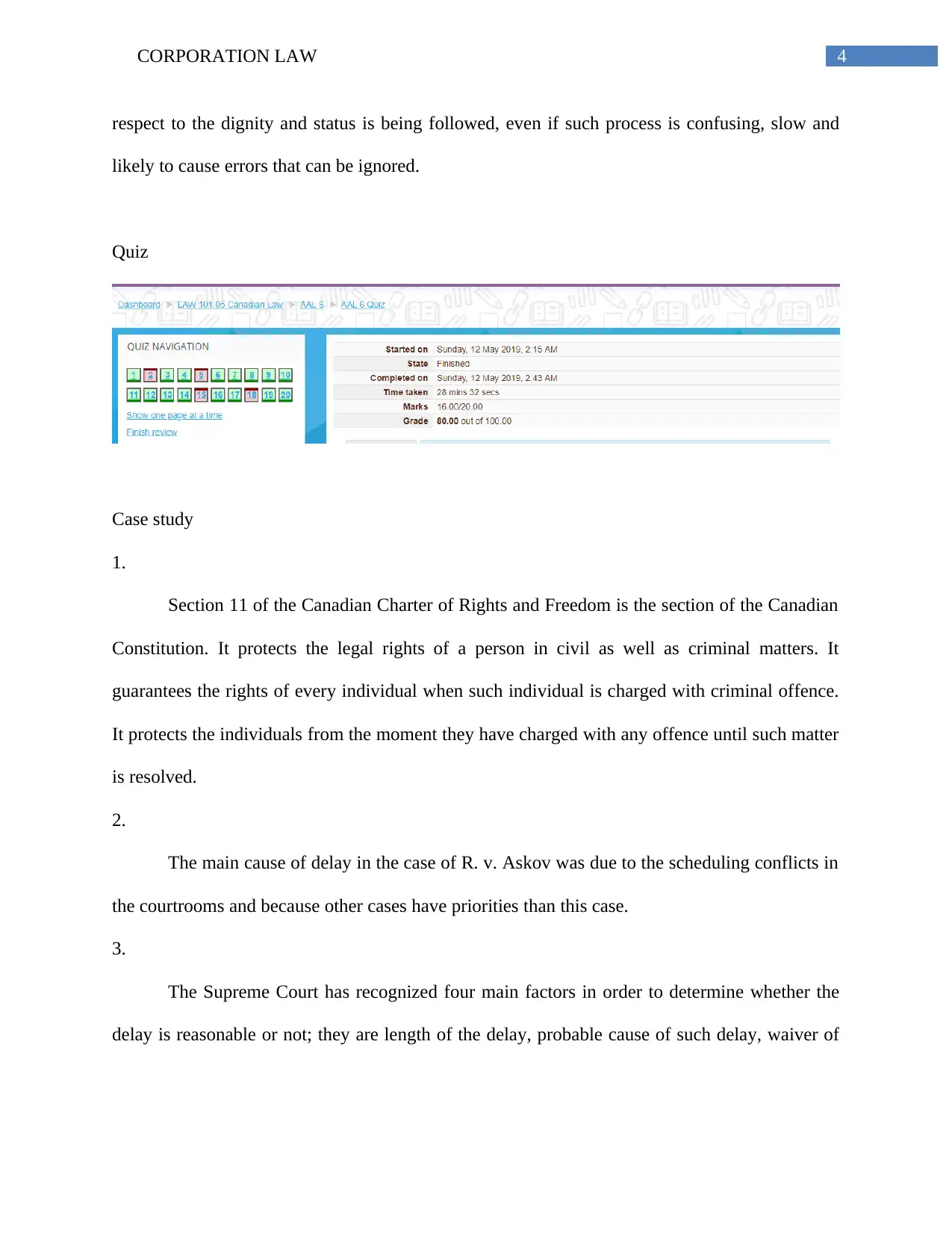
Quiz
Case study
1.
Section 11 of the Canadian Charter of Rights and Freedom is the section of the Canadian
Constitution. It protects the legal rights of a person in civil as well as criminal matters. It
guarantees the rights of every individual when such individual is charged with criminal offence.
It protects the individuals from the moment they have charged with any offence until such matter
is resolved.
2.
The main cause of delay in the case of R. v. Askov was due to the scheduling conflicts in
the courtrooms and because other cases have priorities than this case.
3.
The Supreme Court has recognized four main factors in order to determine whether the
delay is reasonable or not; they are length of the delay, probable cause of such delay, waiver of
respect to the dignity and status is being followed, even if such process is confusing, slow and
likely to cause errors that can be ignored.
Quiz
Case study
1.
Section 11 of the Canadian Charter of Rights and Freedom is the section of the Canadian
Constitution. It protects the legal rights of a person in civil as well as criminal matters. It
guarantees the rights of every individual when such individual is charged with criminal offence.
It protects the individuals from the moment they have charged with any offence until such matter
is resolved.
2.
The main cause of delay in the case of R. v. Askov was due to the scheduling conflicts in
the courtrooms and because other cases have priorities than this case.
3.
The Supreme Court has recognized four main factors in order to determine whether the
delay is reasonable or not; they are length of the delay, probable cause of such delay, waiver of

5CORPORATION LAW
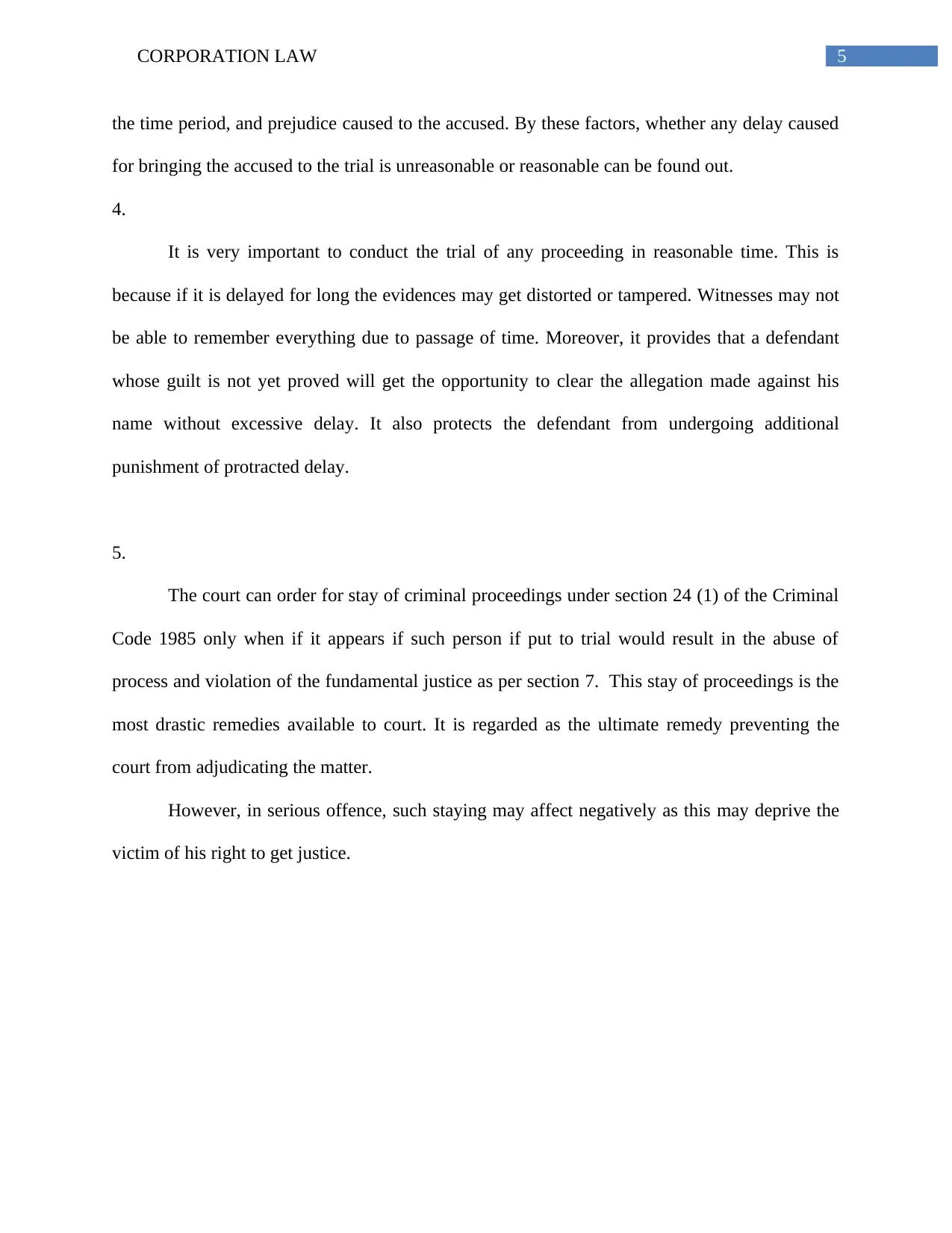
the time period, and prejudice caused to the accused. By these factors, whether any delay caused
for bringing the accused to the trial is unreasonable or reasonable can be found out.
4.
It is very important to conduct the trial of any proceeding in reasonable time. This is
because if it is delayed for long the evidences may get distorted or tampered. Witnesses may not
be able to remember everything due to passage of time. Moreover, it provides that a defendant
whose guilt is not yet proved will get the opportunity to clear the allegation made against his
name without excessive delay. It also protects the defendant from undergoing additional
punishment of protracted delay.
5.
The court can order for stay of criminal proceedings under section 24 (1) of the Criminal
Code 1985 only when if it appears if such person if put to trial would result in the abuse of
process and violation of the fundamental justice as per section 7. This stay of proceedings is the
most drastic remedies available to court. It is regarded as the ultimate remedy preventing the
court from adjudicating the matter.
However, in serious offence, such staying may affect negatively as this may deprive the
victim of his right to get justice.
the time period, and prejudice caused to the accused. By these factors, whether any delay caused
for bringing the accused to the trial is unreasonable or reasonable can be found out.
4.
It is very important to conduct the trial of any proceeding in reasonable time. This is
because if it is delayed for long the evidences may get distorted or tampered. Witnesses may not
be able to remember everything due to passage of time. Moreover, it provides that a defendant
whose guilt is not yet proved will get the opportunity to clear the allegation made against his
name without excessive delay. It also protects the defendant from undergoing additional
punishment of protracted delay.
5.
The court can order for stay of criminal proceedings under section 24 (1) of the Criminal
Code 1985 only when if it appears if such person if put to trial would result in the abuse of
process and violation of the fundamental justice as per section 7. This stay of proceedings is the
most drastic remedies available to court. It is regarded as the ultimate remedy preventing the
court from adjudicating the matter.
However, in serious offence, such staying may affect negatively as this may deprive the
victim of his right to get justice.
⊘ This is a preview!⊘
Do you want full access?
Subscribe today to unlock all pages.

Trusted by 1+ million students worldwide

6CORPORATION LAW
References:
Canadian Charter of Rights and Freedom.
Edmond, G. and Roberts, A., 2017. The law commission’s report on expert evidence in criminal
proceedings. Expert Evidence and Scientific Proof in Criminal Trials.
Schuller, R.A., 2015 Expert evidence and hearsay. Law and Human Behavior, 19(4), pp.345-
362.
References:
Canadian Charter of Rights and Freedom.
Edmond, G. and Roberts, A., 2017. The law commission’s report on expert evidence in criminal
proceedings. Expert Evidence and Scientific Proof in Criminal Trials.
Schuller, R.A., 2015 Expert evidence and hearsay. Law and Human Behavior, 19(4), pp.345-
362.
1 out of 7
Related Documents
Your All-in-One AI-Powered Toolkit for Academic Success.
+13062052269
info@desklib.com
Available 24*7 on WhatsApp / Email
Unlock your academic potential
Copyright © 2020–2025 A2Z Services. All Rights Reserved. Developed and managed by ZUCOL.