Detailed Analysis of Corporate Accounting and Reporting Issues
VerifiedAdded on 2021/05/31
|13
|2743
|24
Report
AI Summary
This report comprehensively examines corporate accounting and reporting, focusing on share forfeiture and impairment of assets. It begins with an introduction to the advantages of issuing shares in installments and the procedures for accounting for share forfeiture and reissue, including the necessary notices and journal entries. The report details the accounting treatment for forfeited shares, including the impact on share capital and the issuance of shares at a premium. Part B of the report then presents an analysis of an impairment loss, including calculations and journal entries. The report provides insights into the Corporations Act 2001 and the importance of financial reporting in the Australian context. It also includes journal entries for recording the applications received and assets' carrying amount. The report concludes with a summary of the key findings and implications of the analysis.
Running head: CORPORATE ACCOUNTING AND REPORTING
Corporate Accounting and Reporting
Name of the Student:
Name of the University:
Author’s Note:
Course ID:
Corporate Accounting and Reporting
Name of the Student:
Name of the University:
Author’s Note:
Course ID:

Paraphrase This Document
Need a fresh take? Get an instant paraphrase of this document with our AI Paraphraser
1CORPORATE ACCOUNTING AND REPORTING
Table of Contents
Answer to Part A:...............................................................................................................2
Introduction:...................................................................................................................2
Accounting for forfeiture and reissue of shares:............................................................2
Conclusion:.....................................................................................................................8
Answer to Part B:...............................................................................................................8
References:......................................................................................................................12
Table of Contents
Answer to Part A:...............................................................................................................2
Introduction:...................................................................................................................2
Accounting for forfeiture and reissue of shares:............................................................2
Conclusion:.....................................................................................................................8
Answer to Part B:...............................................................................................................8
References:......................................................................................................................12
2CORPORATE ACCOUNTING AND REPORTING
Answer to Part A:
Introduction:
There are certain advantages of issuing shares in the form of instalments. One of
them is that it is possible for the investors to purchase many shares by not paying the
lump sum amount at once like certain number of instalments made for purchasing
assets. However, the organisations are deemed to have legally binding commitments
for making payment of the calls made (Jena, Mishra and Rajib 2016). In case, a
shareholder fails to pay allotted money or a part or call by the stipulated fixed amount
for payment, the board of directors of the organisation progress in forfeiting the shares
on which allotted money or call has been in-arrear.
Accounting for forfeiture and reissue of shares:
There are certain procedures related to accounting for forfeiture and reissue of
shares. In such instances, a notice needs to be provided to the defaulter by asking the
person to clear the unsettled amount along with the accrued interest at a certain point of
time. There is another significant aspect that needs to be mentioned in the notice as
well.
It needs to inform the defaulter that if the payment is not made within the
stipulated time before the due date, the shares for which the notice is served would be
forfeited (Beams, Brozovsky and Shoulders 2017). During the time of share forfeiture,
the name of the shareholder would be removed from the member register and the
amount incurred by the individual on shares is forfeited to the organisation. This could
be treated in the form of capital gain and the amount would be credited to the “Forfeited
Answer to Part A:
Introduction:
There are certain advantages of issuing shares in the form of instalments. One of
them is that it is possible for the investors to purchase many shares by not paying the
lump sum amount at once like certain number of instalments made for purchasing
assets. However, the organisations are deemed to have legally binding commitments
for making payment of the calls made (Jena, Mishra and Rajib 2016). In case, a
shareholder fails to pay allotted money or a part or call by the stipulated fixed amount
for payment, the board of directors of the organisation progress in forfeiting the shares
on which allotted money or call has been in-arrear.
Accounting for forfeiture and reissue of shares:
There are certain procedures related to accounting for forfeiture and reissue of
shares. In such instances, a notice needs to be provided to the defaulter by asking the
person to clear the unsettled amount along with the accrued interest at a certain point of
time. There is another significant aspect that needs to be mentioned in the notice as
well.
It needs to inform the defaulter that if the payment is not made within the
stipulated time before the due date, the shares for which the notice is served would be
forfeited (Beams, Brozovsky and Shoulders 2017). During the time of share forfeiture,
the name of the shareholder would be removed from the member register and the
amount incurred by the individual on shares is forfeited to the organisation. This could
be treated in the form of capital gain and the amount would be credited to the “Forfeited
⊘ This is a preview!⊘
Do you want full access?
Subscribe today to unlock all pages.

Trusted by 1+ million students worldwide
3CORPORATE ACCOUNTING AND REPORTING
Shares Account”. There is possibility of reissuing the forfeited shares at a loss.
However, the loss incurred on reissuance could not exceed the profit made on forfeiture
of the reissued shares. Moreover, it is necessary to consider certain provisions
associated with the forfeiture and reissue of shares and they are briefly discussed as
follows:
Firstly, if any shareholder could not pay any call or instalment related on or
before the stipulated date, the board of the organisation has the right to provide a notice
to the individual asking for payment (Carnegie and O’Connell 2014). In addition, the
individual is needed to make the interest payment as well, which is accrued on or before
the stipulated timeframe. Secondly, the notice to be sent to the defaulter would
comprise of certain components within the same. An additional date after the due date
would be provided on which the shareholders needs to make the overall outstanding
payment, as per the notice. In case, if the shareholder misses the due date again or
event of non-payment takes place, the shares in relation to which the call has been
made would be liable to be forfeited. If the defaulter does not meet any of the
requirements mentioned in the notice, the board would forfeit the shares of the defaulter
and the decision would come into effect (Collier 2015).
Once the decision of forfeiture is taken, the shares could be sold or disposed on
certain terms and conditions, as deemed appropriate by the board of the organisation.
However, it needs to be mentioned that before selling or disposing the shares, the
board has the full right of cancelling the forfeiture on certain terms as deemed fit. It
might sometimes happen that when a shareholder realises about the inability of paying
the calls made, the individual has an option of surrendering the shares voluntarily to the
Shares Account”. There is possibility of reissuing the forfeited shares at a loss.
However, the loss incurred on reissuance could not exceed the profit made on forfeiture
of the reissued shares. Moreover, it is necessary to consider certain provisions
associated with the forfeiture and reissue of shares and they are briefly discussed as
follows:
Firstly, if any shareholder could not pay any call or instalment related on or
before the stipulated date, the board of the organisation has the right to provide a notice
to the individual asking for payment (Carnegie and O’Connell 2014). In addition, the
individual is needed to make the interest payment as well, which is accrued on or before
the stipulated timeframe. Secondly, the notice to be sent to the defaulter would
comprise of certain components within the same. An additional date after the due date
would be provided on which the shareholders needs to make the overall outstanding
payment, as per the notice. In case, if the shareholder misses the due date again or
event of non-payment takes place, the shares in relation to which the call has been
made would be liable to be forfeited. If the defaulter does not meet any of the
requirements mentioned in the notice, the board would forfeit the shares of the defaulter
and the decision would come into effect (Collier 2015).
Once the decision of forfeiture is taken, the shares could be sold or disposed on
certain terms and conditions, as deemed appropriate by the board of the organisation.
However, it needs to be mentioned that before selling or disposing the shares, the
board has the full right of cancelling the forfeiture on certain terms as deemed fit. It
might sometimes happen that when a shareholder realises about the inability of paying
the calls made, the individual has an option of surrendering the shares voluntarily to the
Paraphrase This Document
Need a fresh take? Get an instant paraphrase of this document with our AI Paraphraser
4CORPORATE ACCOUNTING AND REPORTING
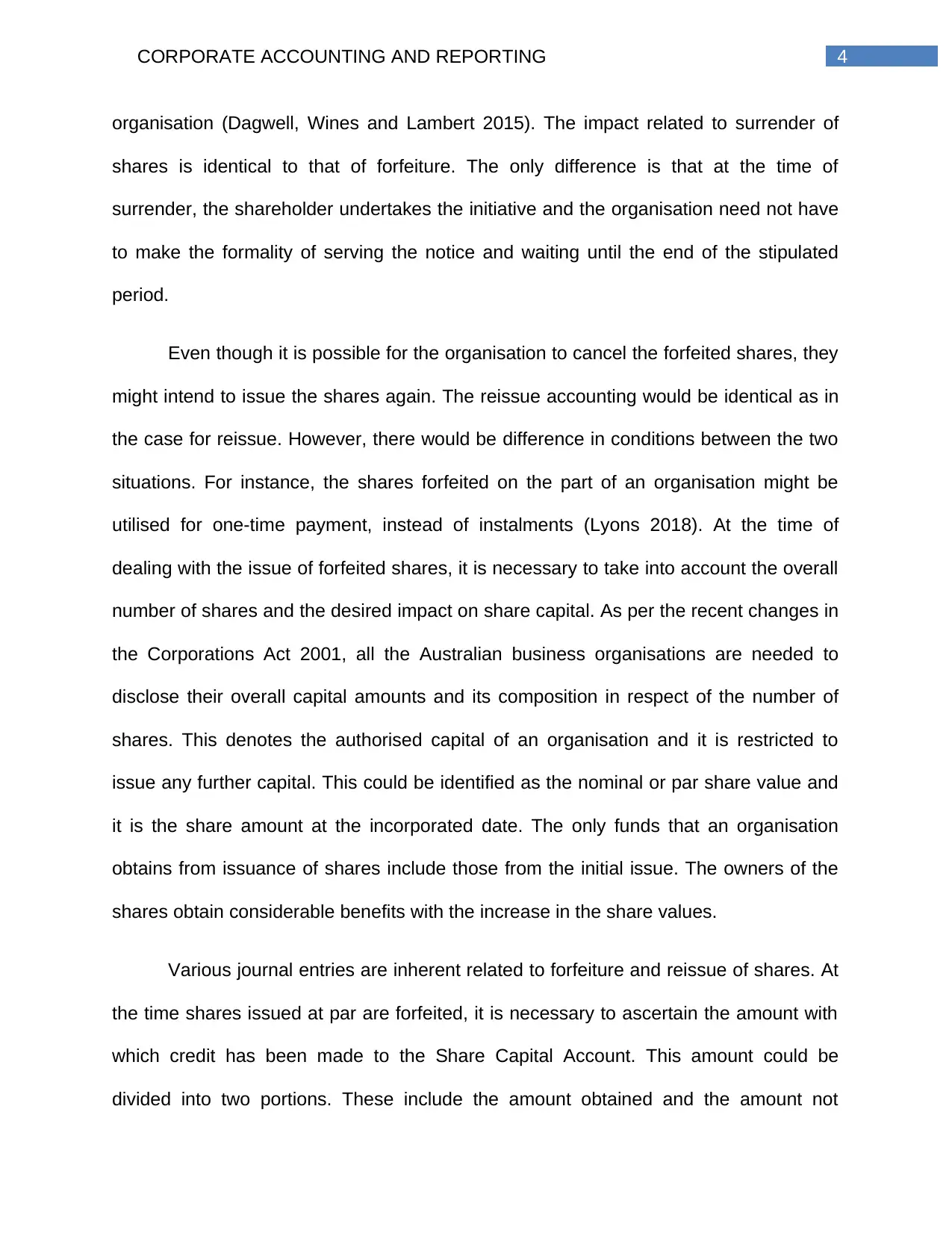
organisation (Dagwell, Wines and Lambert 2015). The impact related to surrender of
shares is identical to that of forfeiture. The only difference is that at the time of
surrender, the shareholder undertakes the initiative and the organisation need not have
to make the formality of serving the notice and waiting until the end of the stipulated
period.
Even though it is possible for the organisation to cancel the forfeited shares, they
might intend to issue the shares again. The reissue accounting would be identical as in
the case for reissue. However, there would be difference in conditions between the two
situations. For instance, the shares forfeited on the part of an organisation might be
utilised for one-time payment, instead of instalments (Lyons 2018). At the time of
dealing with the issue of forfeited shares, it is necessary to take into account the overall
number of shares and the desired impact on share capital. As per the recent changes in
the Corporations Act 2001, all the Australian business organisations are needed to
disclose their overall capital amounts and its composition in respect of the number of
shares. This denotes the authorised capital of an organisation and it is restricted to
issue any further capital. This could be identified as the nominal or par share value and
it is the share amount at the incorporated date. The only funds that an organisation
obtains from issuance of shares include those from the initial issue. The owners of the
shares obtain considerable benefits with the increase in the share values.
Various journal entries are inherent related to forfeiture and reissue of shares. At
the time shares issued at par are forfeited, it is necessary to ascertain the amount with
which credit has been made to the Share Capital Account. This amount could be
divided into two portions. These include the amount obtained and the amount not
organisation (Dagwell, Wines and Lambert 2015). The impact related to surrender of
shares is identical to that of forfeiture. The only difference is that at the time of
surrender, the shareholder undertakes the initiative and the organisation need not have
to make the formality of serving the notice and waiting until the end of the stipulated
period.
Even though it is possible for the organisation to cancel the forfeited shares, they
might intend to issue the shares again. The reissue accounting would be identical as in
the case for reissue. However, there would be difference in conditions between the two
situations. For instance, the shares forfeited on the part of an organisation might be
utilised for one-time payment, instead of instalments (Lyons 2018). At the time of
dealing with the issue of forfeited shares, it is necessary to take into account the overall
number of shares and the desired impact on share capital. As per the recent changes in
the Corporations Act 2001, all the Australian business organisations are needed to
disclose their overall capital amounts and its composition in respect of the number of
shares. This denotes the authorised capital of an organisation and it is restricted to
issue any further capital. This could be identified as the nominal or par share value and
it is the share amount at the incorporated date. The only funds that an organisation
obtains from issuance of shares include those from the initial issue. The owners of the
shares obtain considerable benefits with the increase in the share values.
Various journal entries are inherent related to forfeiture and reissue of shares. At
the time shares issued at par are forfeited, it is necessary to ascertain the amount with
which credit has been made to the Share Capital Account. This amount could be
divided into two portions. These include the amount obtained and the amount not
5CORPORATE ACCOUNTING AND REPORTING
obtained due to which the forfeiture of shares is conducted. The received amount could
be considered as a capital gain for the organisation and it is to be credited to the Share
Forfeiture Account. The amount not obtained might fall in Calls-in-Arrear Account. In
case, the organisation does not have any Calls-in-Arrear Account, credit could be made
to share allotment accounts or other call accounts (Fogarty, Zimmerman and
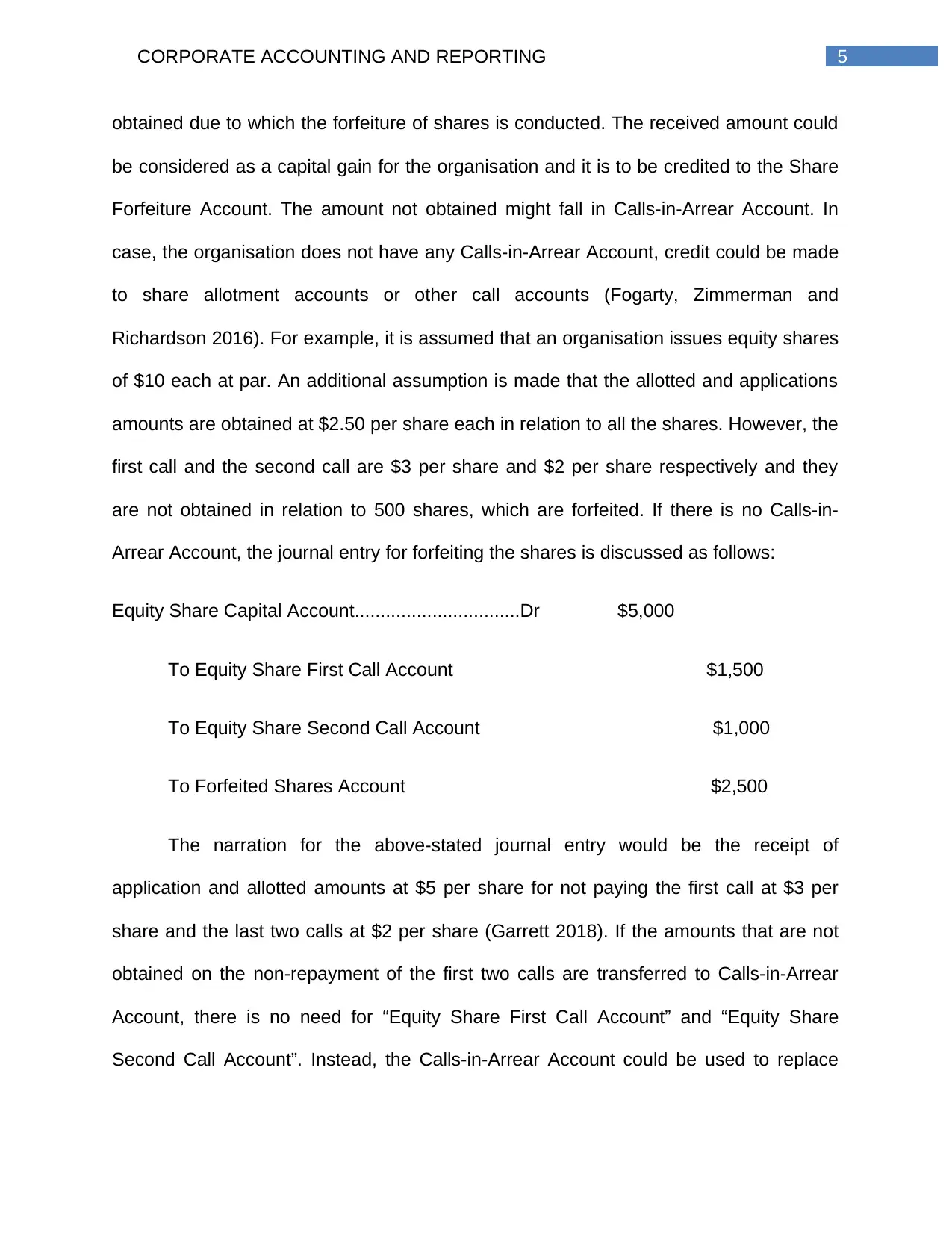
Richardson 2016). For example, it is assumed that an organisation issues equity shares
of $10 each at par. An additional assumption is made that the allotted and applications
amounts are obtained at $2.50 per share each in relation to all the shares. However, the
first call and the second call are $3 per share and $2 per share respectively and they
are not obtained in relation to 500 shares, which are forfeited. If there is no Calls-in-
Arrear Account, the journal entry for forfeiting the shares is discussed as follows:
Equity Share Capital Account................................Dr $5,000
To Equity Share First Call Account $1,500
To Equity Share Second Call Account $1,000
To Forfeited Shares Account $2,500
The narration for the above-stated journal entry would be the receipt of
application and allotted amounts at $5 per share for not paying the first call at $3 per
share and the last two calls at $2 per share (Garrett 2018). If the amounts that are not
obtained on the non-repayment of the first two calls are transferred to Calls-in-Arrear
Account, there is no need for “Equity Share First Call Account” and “Equity Share
Second Call Account”. Instead, the Calls-in-Arrear Account could be used to replace
obtained due to which the forfeiture of shares is conducted. The received amount could
be considered as a capital gain for the organisation and it is to be credited to the Share
Forfeiture Account. The amount not obtained might fall in Calls-in-Arrear Account. In
case, the organisation does not have any Calls-in-Arrear Account, credit could be made
to share allotment accounts or other call accounts (Fogarty, Zimmerman and
Richardson 2016). For example, it is assumed that an organisation issues equity shares
of $10 each at par. An additional assumption is made that the allotted and applications
amounts are obtained at $2.50 per share each in relation to all the shares. However, the
first call and the second call are $3 per share and $2 per share respectively and they
are not obtained in relation to 500 shares, which are forfeited. If there is no Calls-in-
Arrear Account, the journal entry for forfeiting the shares is discussed as follows:
Equity Share Capital Account................................Dr $5,000
To Equity Share First Call Account $1,500
To Equity Share Second Call Account $1,000
To Forfeited Shares Account $2,500
The narration for the above-stated journal entry would be the receipt of
application and allotted amounts at $5 per share for not paying the first call at $3 per
share and the last two calls at $2 per share (Garrett 2018). If the amounts that are not
obtained on the non-repayment of the first two calls are transferred to Calls-in-Arrear
Account, there is no need for “Equity Share First Call Account” and “Equity Share
Second Call Account”. Instead, the Calls-in-Arrear Account could be used to replace
⊘ This is a preview!⊘
Do you want full access?
Subscribe today to unlock all pages.
Trusted by 1+ million students worldwide
6CORPORATE ACCOUNTING AND REPORTING
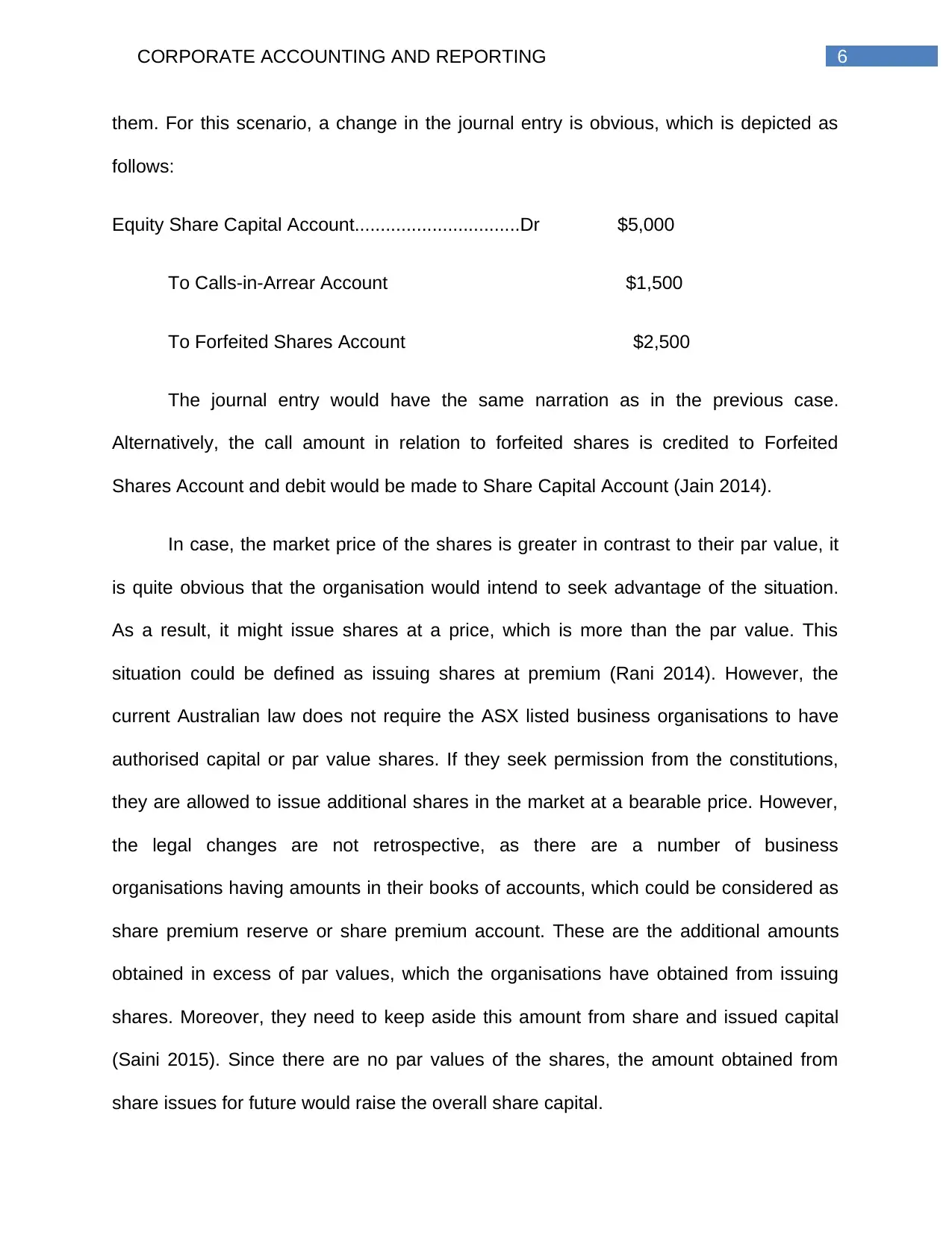
them. For this scenario, a change in the journal entry is obvious, which is depicted as
follows:
Equity Share Capital Account................................Dr $5,000
To Calls-in-Arrear Account $1,500
To Forfeited Shares Account $2,500
The journal entry would have the same narration as in the previous case.
Alternatively, the call amount in relation to forfeited shares is credited to Forfeited
Shares Account and debit would be made to Share Capital Account (Jain 2014).
In case, the market price of the shares is greater in contrast to their par value, it
is quite obvious that the organisation would intend to seek advantage of the situation.
As a result, it might issue shares at a price, which is more than the par value. This
situation could be defined as issuing shares at premium (Rani 2014). However, the
current Australian law does not require the ASX listed business organisations to have
authorised capital or par value shares. If they seek permission from the constitutions,
they are allowed to issue additional shares in the market at a bearable price. However,
the legal changes are not retrospective, as there are a number of business
organisations having amounts in their books of accounts, which could be considered as
share premium reserve or share premium account. These are the additional amounts
obtained in excess of par values, which the organisations have obtained from issuing
shares. Moreover, they need to keep aside this amount from share and issued capital
(Saini 2015). Since there are no par values of the shares, the amount obtained from
share issues for future would raise the overall share capital.
them. For this scenario, a change in the journal entry is obvious, which is depicted as
follows:
Equity Share Capital Account................................Dr $5,000
To Calls-in-Arrear Account $1,500
To Forfeited Shares Account $2,500
The journal entry would have the same narration as in the previous case.
Alternatively, the call amount in relation to forfeited shares is credited to Forfeited
Shares Account and debit would be made to Share Capital Account (Jain 2014).
In case, the market price of the shares is greater in contrast to their par value, it
is quite obvious that the organisation would intend to seek advantage of the situation.
As a result, it might issue shares at a price, which is more than the par value. This
situation could be defined as issuing shares at premium (Rani 2014). However, the
current Australian law does not require the ASX listed business organisations to have
authorised capital or par value shares. If they seek permission from the constitutions,
they are allowed to issue additional shares in the market at a bearable price. However,
the legal changes are not retrospective, as there are a number of business
organisations having amounts in their books of accounts, which could be considered as
share premium reserve or share premium account. These are the additional amounts
obtained in excess of par values, which the organisations have obtained from issuing
shares. Moreover, they need to keep aside this amount from share and issued capital
(Saini 2015). Since there are no par values of the shares, the amount obtained from
share issues for future would raise the overall share capital.
Paraphrase This Document
Need a fresh take? Get an instant paraphrase of this document with our AI Paraphraser
7CORPORATE ACCOUNTING AND REPORTING
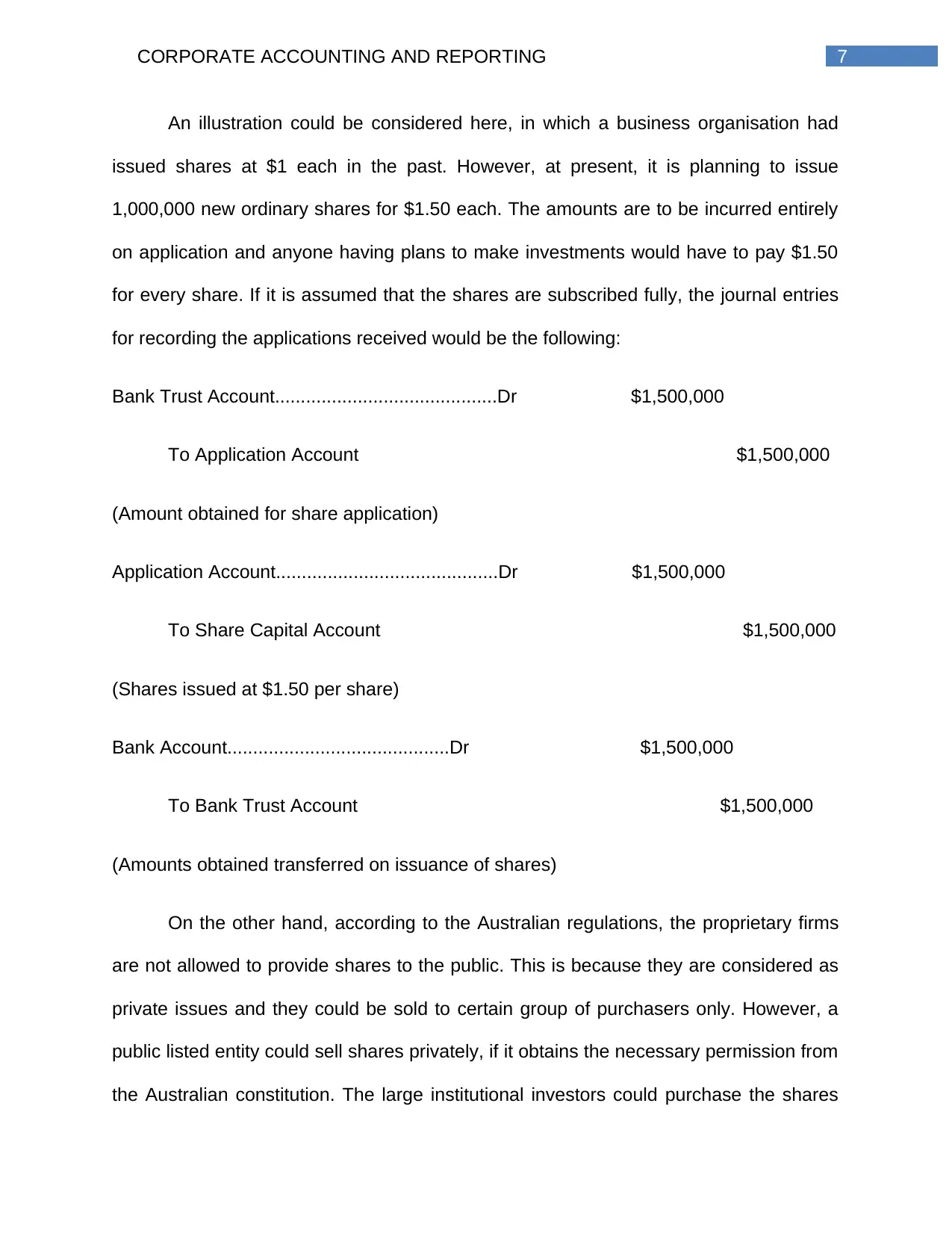
An illustration could be considered here, in which a business organisation had
issued shares at $1 each in the past. However, at present, it is planning to issue
1,000,000 new ordinary shares for $1.50 each. The amounts are to be incurred entirely
on application and anyone having plans to make investments would have to pay $1.50
for every share. If it is assumed that the shares are subscribed fully, the journal entries
for recording the applications received would be the following:
Bank Trust Account...........................................Dr $1,500,000
To Application Account $1,500,000
(Amount obtained for share application)
Application Account...........................................Dr $1,500,000
To Share Capital Account $1,500,000
(Shares issued at $1.50 per share)
Bank Account...........................................Dr $1,500,000
To Bank Trust Account $1,500,000
(Amounts obtained transferred on issuance of shares)
On the other hand, according to the Australian regulations, the proprietary firms
are not allowed to provide shares to the public. This is because they are considered as
private issues and they could be sold to certain group of purchasers only. However, a
public listed entity could sell shares privately, if it obtains the necessary permission from
the Australian constitution. The large institutional investors could purchase the shares
An illustration could be considered here, in which a business organisation had
issued shares at $1 each in the past. However, at present, it is planning to issue
1,000,000 new ordinary shares for $1.50 each. The amounts are to be incurred entirely
on application and anyone having plans to make investments would have to pay $1.50
for every share. If it is assumed that the shares are subscribed fully, the journal entries
for recording the applications received would be the following:
Bank Trust Account...........................................Dr $1,500,000
To Application Account $1,500,000
(Amount obtained for share application)
Application Account...........................................Dr $1,500,000
To Share Capital Account $1,500,000
(Shares issued at $1.50 per share)
Bank Account...........................................Dr $1,500,000
To Bank Trust Account $1,500,000
(Amounts obtained transferred on issuance of shares)
On the other hand, according to the Australian regulations, the proprietary firms
are not allowed to provide shares to the public. This is because they are considered as
private issues and they could be sold to certain group of purchasers only. However, a
public listed entity could sell shares privately, if it obtains the necessary permission from
the Australian constitution. The large institutional investors could purchase the shares
8CORPORATE ACCOUNTING AND REPORTING
for avoiding the cost and time taken in an overall public issue. However, there are
restrictions on the part of ASX regarding the share percentage, which the listed public
organisations could issue privately.
An organisation might sell the right of purchasing a number of shares in the
organisation at a later point of time in future. Such right could be termed as the
company-issued call option. At the time an organisation is involved in issuing options for
few useful considerations, the equity of the shareholders would be increased from the
amount obtained (Thornton 2018).
Conclusion:
Based on the above discussion, it could be evaluated that In case, a shareholder
fails to pay allotted money or a part or call by the stipulated fixed amount for payment,
the board of directors of the organisation progress in forfeiting the shares on which
allotted money or call has been in-arrear. In case, the market price of the shares is
greater in contrast to their par value, it is quite obvious that the organisation would
intend to seek advantage of the situation. As a result, it might issue shares at a price,
which is more than the par value. This situation could be defined as issuing shares at
premium.
Answer to Part B:
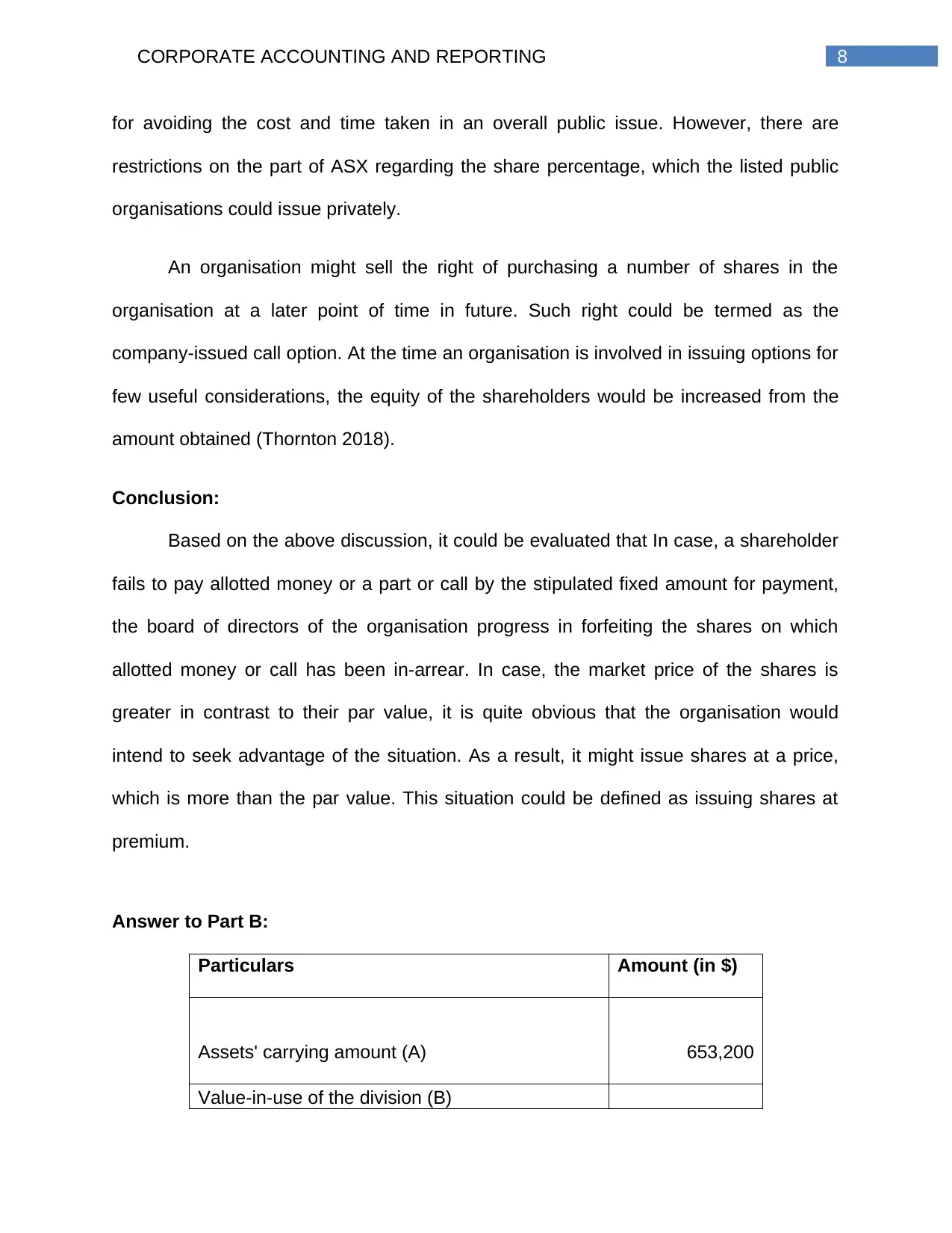
Particulars Amount (in $)
Assets' carrying amount (A) 653,200
Value-in-use of the division (B)
for avoiding the cost and time taken in an overall public issue. However, there are
restrictions on the part of ASX regarding the share percentage, which the listed public
organisations could issue privately.
An organisation might sell the right of purchasing a number of shares in the
organisation at a later point of time in future. Such right could be termed as the
company-issued call option. At the time an organisation is involved in issuing options for
few useful considerations, the equity of the shareholders would be increased from the
amount obtained (Thornton 2018).
Conclusion:
Based on the above discussion, it could be evaluated that In case, a shareholder
fails to pay allotted money or a part or call by the stipulated fixed amount for payment,
the board of directors of the organisation progress in forfeiting the shares on which
allotted money or call has been in-arrear. In case, the market price of the shares is
greater in contrast to their par value, it is quite obvious that the organisation would
intend to seek advantage of the situation. As a result, it might issue shares at a price,
which is more than the par value. This situation could be defined as issuing shares at
premium.
Answer to Part B:
Particulars Amount (in $)
Assets' carrying amount (A) 653,200
Value-in-use of the division (B)
⊘ This is a preview!⊘
Do you want full access?
Subscribe today to unlock all pages.
Trusted by 1+ million students worldwide
9CORPORATE ACCOUNTING AND REPORTING
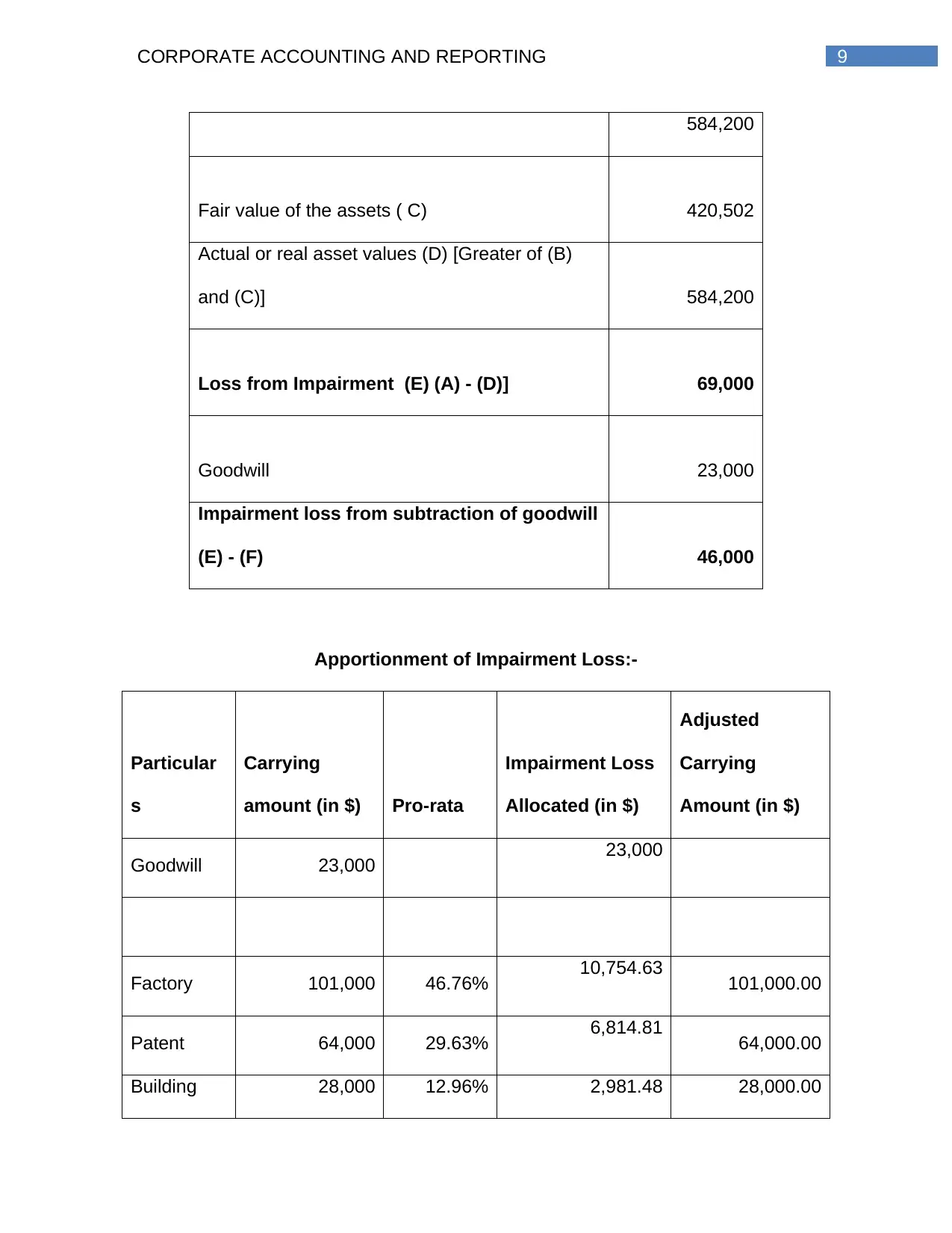
584,200
Fair value of the assets ( C) 420,502
Actual or real asset values (D) [Greater of (B)
and (C)] 584,200
Loss from Impairment (E) (A) - (D)] 69,000
Goodwill 23,000
Impairment loss from subtraction of goodwill
(E) - (F) 46,000
Apportionment of Impairment Loss:-
Particular
s
Carrying
amount (in $) Pro-rata
Impairment Loss
Allocated (in $)
Adjusted
Carrying
Amount (in $)
Goodwill 23,000 23,000
Factory 101,000 46.76% 10,754.63 101,000.00
Patent 64,000 29.63% 6,814.81 64,000.00
Building 28,000 12.96% 2,981.48 28,000.00
584,200
Fair value of the assets ( C) 420,502
Actual or real asset values (D) [Greater of (B)
and (C)] 584,200
Loss from Impairment (E) (A) - (D)] 69,000
Goodwill 23,000
Impairment loss from subtraction of goodwill
(E) - (F) 46,000
Apportionment of Impairment Loss:-
Particular
s
Carrying
amount (in $) Pro-rata
Impairment Loss
Allocated (in $)
Adjusted
Carrying
Amount (in $)
Goodwill 23,000 23,000
Factory 101,000 46.76% 10,754.63 101,000.00
Patent 64,000 29.63% 6,814.81 64,000.00
Building 28,000 12.96% 2,981.48 28,000.00
Paraphrase This Document
Need a fresh take? Get an instant paraphrase of this document with our AI Paraphraser
10CORPORATE ACCOUNTING AND REPORTING
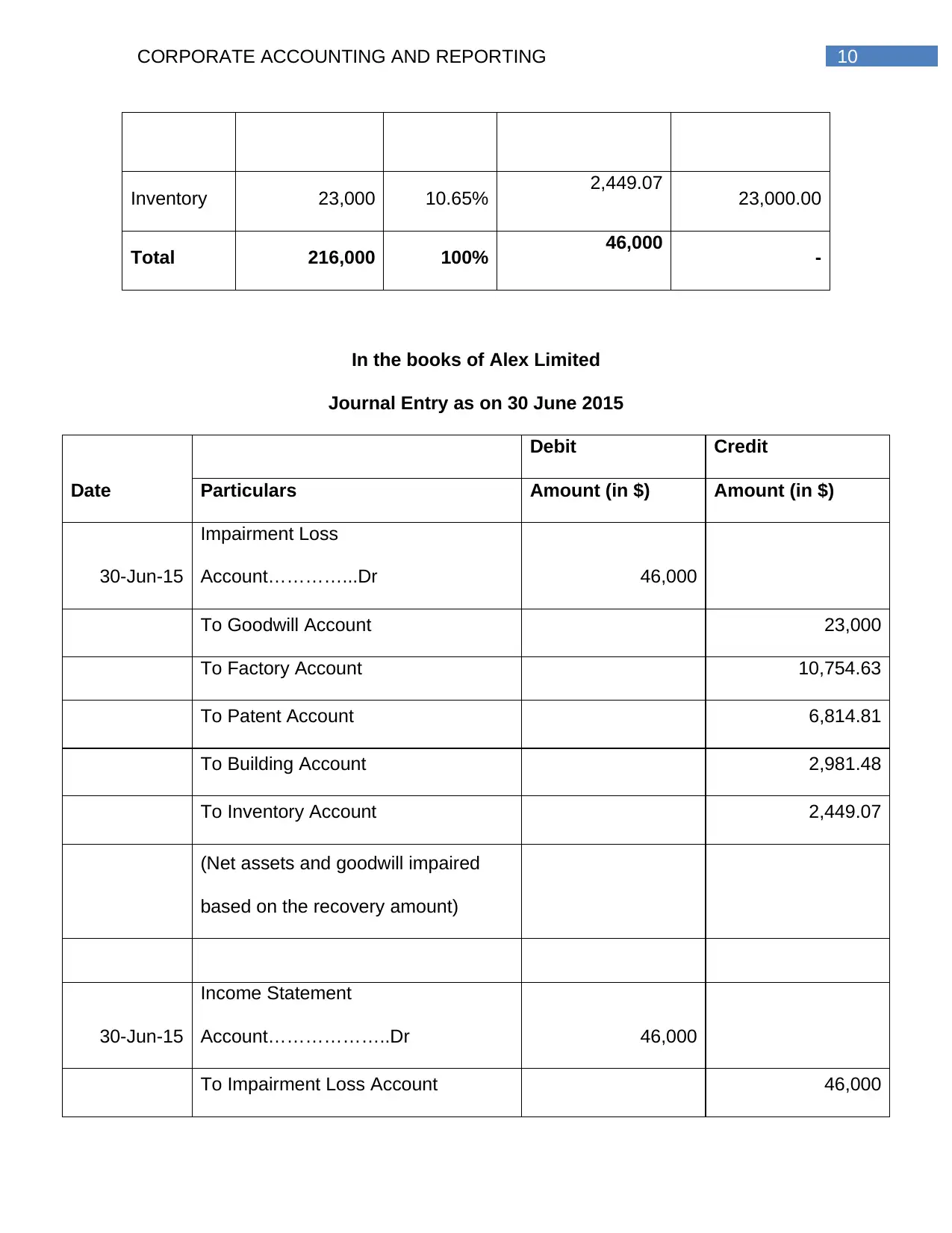
Inventory 23,000 10.65% 2,449.07 23,000.00
Total 216,000 100% 46,000 -
In the books of Alex Limited
Journal Entry as on 30 June 2015
Date
Debit Credit
Particulars Amount (in $) Amount (in $)
30-Jun-15
Impairment Loss
Account…………...Dr 46,000
To Goodwill Account 23,000
To Factory Account 10,754.63
To Patent Account 6,814.81
To Building Account 2,981.48
To Inventory Account 2,449.07
(Net assets and goodwill impaired
based on the recovery amount)
30-Jun-15
Income Statement
Account………………..Dr 46,000
To Impairment Loss Account 46,000
Inventory 23,000 10.65% 2,449.07 23,000.00
Total 216,000 100% 46,000 -
In the books of Alex Limited
Journal Entry as on 30 June 2015
Date
Debit Credit
Particulars Amount (in $) Amount (in $)
30-Jun-15
Impairment Loss
Account…………...Dr 46,000
To Goodwill Account 23,000
To Factory Account 10,754.63
To Patent Account 6,814.81
To Building Account 2,981.48
To Inventory Account 2,449.07
(Net assets and goodwill impaired
based on the recovery amount)
30-Jun-15
Income Statement
Account………………..Dr 46,000
To Impairment Loss Account 46,000
11CORPORATE ACCOUNTING AND REPORTING
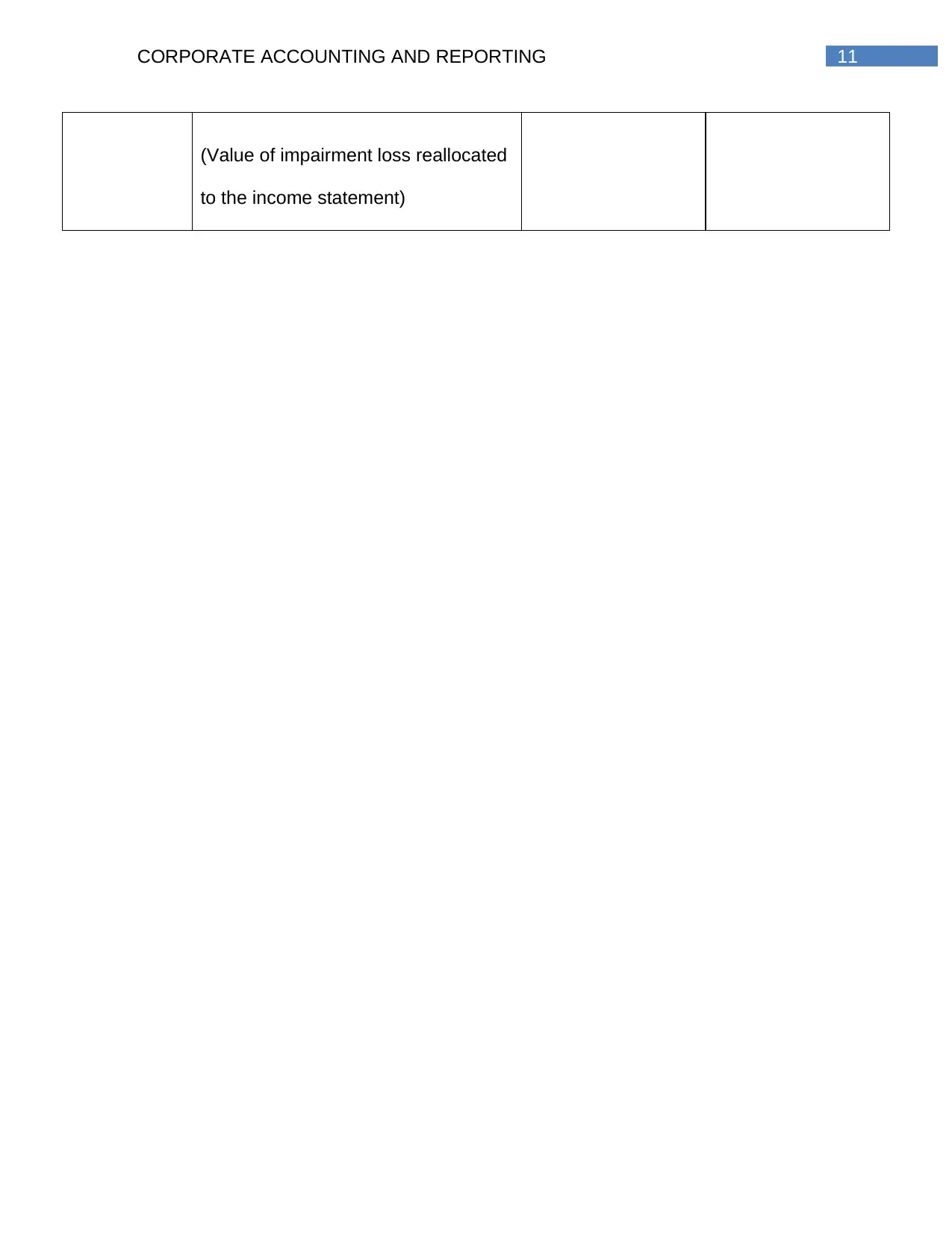
(Value of impairment loss reallocated
to the income statement)
(Value of impairment loss reallocated
to the income statement)
⊘ This is a preview!⊘
Do you want full access?
Subscribe today to unlock all pages.
Trusted by 1+ million students worldwide

1 out of 13


Related Documents


Your All-in-One AI-Powered Toolkit for Academic Success.
+13062052269
info@desklib.com
Available 24*7 on WhatsApp / Email
![[object Object]](/_next/static/media/star-bottom.7253800d.svg)
Unlock your academic potential
Copyright © 2020–2025 A2Z Services. All Rights Reserved. Developed and managed by ZUCOL.