Holmes Institute: Corporate Accounting and Consolidation Report
VerifiedAdded on 2022/12/27
|9
|2721
|44
Report
AI Summary
This report analyzes corporate accounting principles, specifically focusing on consolidation methods in the context of a corporate takeover scenario involving JKY Ltd and FAB Ltd. It details the equity and consolidated methods of accounting, outlining their procedures and factors to consider when selecting an appropriate method. The report also addresses intra-company transactions, emphasizing the importance of eliminating unrealized profits to ensure accurate financial statements. Furthermore, it explores the disclosure requirements for non-controlling interests, including the impact of these disclosures on the presentation of financial statements and the adjustments required for accurate representation. The report provides examples and explains the effects of these accounting practices on consolidated financial statements, offering a comprehensive overview of the key aspects of corporate accounting and consolidation.
Running head: Corporate Accounting
Corporate Accounting
Name of the Student
Name of the University
Author Note
Corporate Accounting
Name of the Student
Name of the University
Author Note

Paraphrase This Document
Need a fresh take? Get an instant paraphrase of this document with our AI Paraphraser
1
Corporate Accounting
Executive Summary
The report show about the consolidated statement and show about the JKY Ltd
which want to take over the FAB Ltd so it show the method which can adopted for
the consolidation. It even show about the intra transaction and how the unrealised
profit is to be deal with and it even show about the disclosure which is been required
in regards of the non-controlling interest.
Corporate Accounting
Executive Summary
The report show about the consolidated statement and show about the JKY Ltd
which want to take over the FAB Ltd so it show the method which can adopted for
the consolidation. It even show about the intra transaction and how the unrealised
profit is to be deal with and it even show about the disclosure which is been required
in regards of the non-controlling interest.
2
Corporate Accounting
Table of Contents
Introduction...................................................................................................................3
Part A............................................................................................................................3
Part B............................................................................................................................5
Part C............................................................................................................................6
Conclusion....................................................................................................................7
Reference.....................................................................................................................8
Corporate Accounting
Table of Contents
Introduction...................................................................................................................3
Part A............................................................................................................................3
Part B............................................................................................................................5
Part C............................................................................................................................6
Conclusion....................................................................................................................7
Reference.....................................................................................................................8
⊘ This is a preview!⊘
Do you want full access?
Subscribe today to unlock all pages.

Trusted by 1+ million students worldwide
3
Corporate Accounting
Introduction
Consolidation can be defined as the method through which a company,
known as parent company acquires another company, which is its subsidiary (Albu,
Albu and Alexander 2014). This report discusses about a company called JKY
Limited which intended to make FAB Limited its subsidiary company. It shows the
method used by them for this process and also contains information about intra sale
transactions involved in it. It also contains information about how JKY Limited should
disclose its non-controlling interest in the financial statements of the company.
Part A
The main purpose of consolidation is to help JKY Ltd increase its share in the
market. As consolidation is an extremely tedious and complex process, the
accounting is also required to be of a different kind. Hence, the company should
select an appropriate method of accounting for consolidation of the financial
statements. The most popular methods of accounting are the equity method and the
consolidated method of accounting. The company should select the method which
satisfies their needs and preferences. Since both methods have different principles
and procedures, various factors are to be considered before selecting a particular
method. An explanation of both the methods is detailed below:
Equity Method of Accounting
Equity is synonymous with investment. This method states that with respect to
consolidation, the company should mention only the profit or a part of it amount as
they do in terms of an investment. The takeover of subsidiary company should be
treated as an investment (Gillis, Petty and Suddaby 2014). The value of the
investment made in the subsidiary should always be recorded at cost.
Hence it suggests that the company should record the investment at the amount
which has been spent by them for the purpose of acquisition. Any changes in the
value of the investment should directly be charged to the income statement of the
company and should be consistent with the nature of the changes that take place in
the investment.
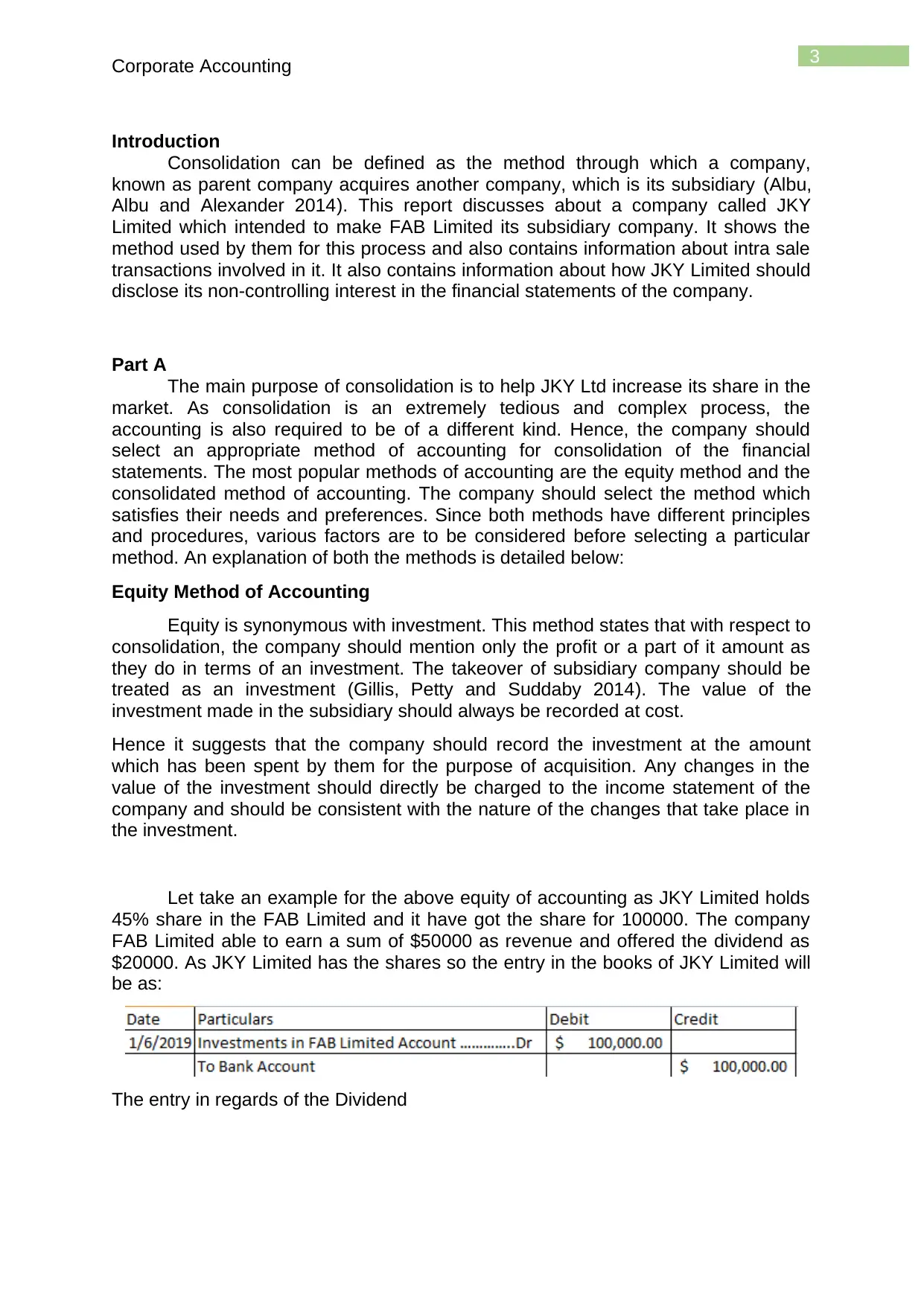
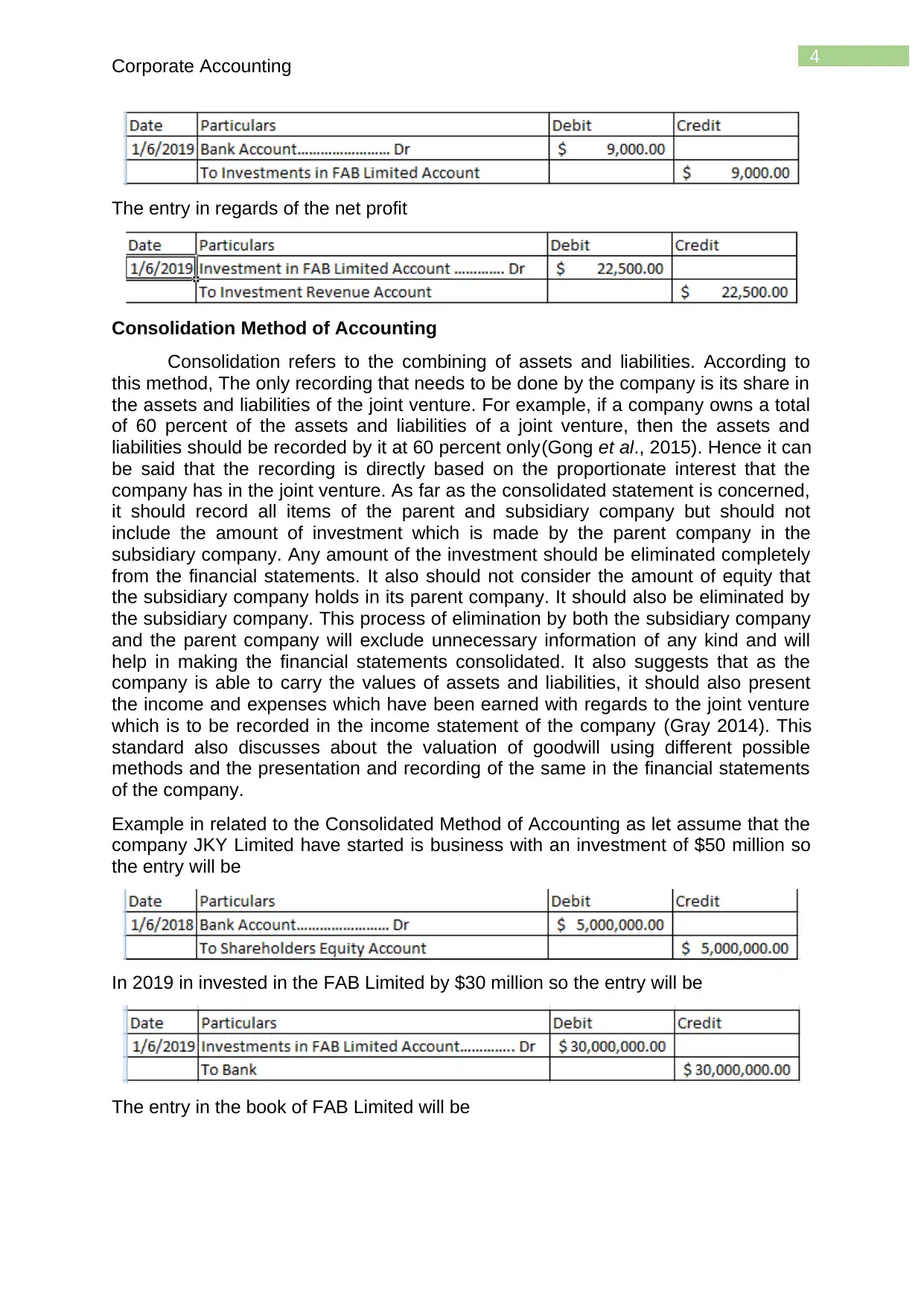
Let take an example for the above equity of accounting as JKY Limited holds
45% share in the FAB Limited and it have got the share for 100000. The company
FAB Limited able to earn a sum of $50000 as revenue and offered the dividend as
$20000. As JKY Limited has the shares so the entry in the books of JKY Limited will
be as:
The entry in regards of the Dividend
Corporate Accounting
Introduction
Consolidation can be defined as the method through which a company,
known as parent company acquires another company, which is its subsidiary (Albu,
Albu and Alexander 2014). This report discusses about a company called JKY
Limited which intended to make FAB Limited its subsidiary company. It shows the
method used by them for this process and also contains information about intra sale
transactions involved in it. It also contains information about how JKY Limited should
disclose its non-controlling interest in the financial statements of the company.
Part A
The main purpose of consolidation is to help JKY Ltd increase its share in the
market. As consolidation is an extremely tedious and complex process, the
accounting is also required to be of a different kind. Hence, the company should
select an appropriate method of accounting for consolidation of the financial
statements. The most popular methods of accounting are the equity method and the
consolidated method of accounting. The company should select the method which
satisfies their needs and preferences. Since both methods have different principles
and procedures, various factors are to be considered before selecting a particular
method. An explanation of both the methods is detailed below:
Equity Method of Accounting
Equity is synonymous with investment. This method states that with respect to
consolidation, the company should mention only the profit or a part of it amount as
they do in terms of an investment. The takeover of subsidiary company should be
treated as an investment (Gillis, Petty and Suddaby 2014). The value of the
investment made in the subsidiary should always be recorded at cost.
Hence it suggests that the company should record the investment at the amount
which has been spent by them for the purpose of acquisition. Any changes in the
value of the investment should directly be charged to the income statement of the
company and should be consistent with the nature of the changes that take place in
the investment.
Let take an example for the above equity of accounting as JKY Limited holds
45% share in the FAB Limited and it have got the share for 100000. The company
FAB Limited able to earn a sum of $50000 as revenue and offered the dividend as
$20000. As JKY Limited has the shares so the entry in the books of JKY Limited will
be as:
The entry in regards of the Dividend
Paraphrase This Document
Need a fresh take? Get an instant paraphrase of this document with our AI Paraphraser
4
Corporate Accounting
The entry in regards of the net profit
Consolidation Method of Accounting
Consolidation refers to the combining of assets and liabilities. According to
this method, The only recording that needs to be done by the company is its share in
the assets and liabilities of the joint venture. For example, if a company owns a total
of 60 percent of the assets and liabilities of a joint venture, then the assets and
liabilities should be recorded by it at 60 percent only(Gong et al., 2015). Hence it can
be said that the recording is directly based on the proportionate interest that the
company has in the joint venture. As far as the consolidated statement is concerned,
it should record all items of the parent and subsidiary company but should not
include the amount of investment which is made by the parent company in the
subsidiary company. Any amount of the investment should be eliminated completely
from the financial statements. It also should not consider the amount of equity that
the subsidiary company holds in its parent company. It should also be eliminated by
the subsidiary company. This process of elimination by both the subsidiary company
and the parent company will exclude unnecessary information of any kind and will
help in making the financial statements consolidated. It also suggests that as the
company is able to carry the values of assets and liabilities, it should also present
the income and expenses which have been earned with regards to the joint venture
which is to be recorded in the income statement of the company (Gray 2014). This
standard also discusses about the valuation of goodwill using different possible
methods and the presentation and recording of the same in the financial statements
of the company.
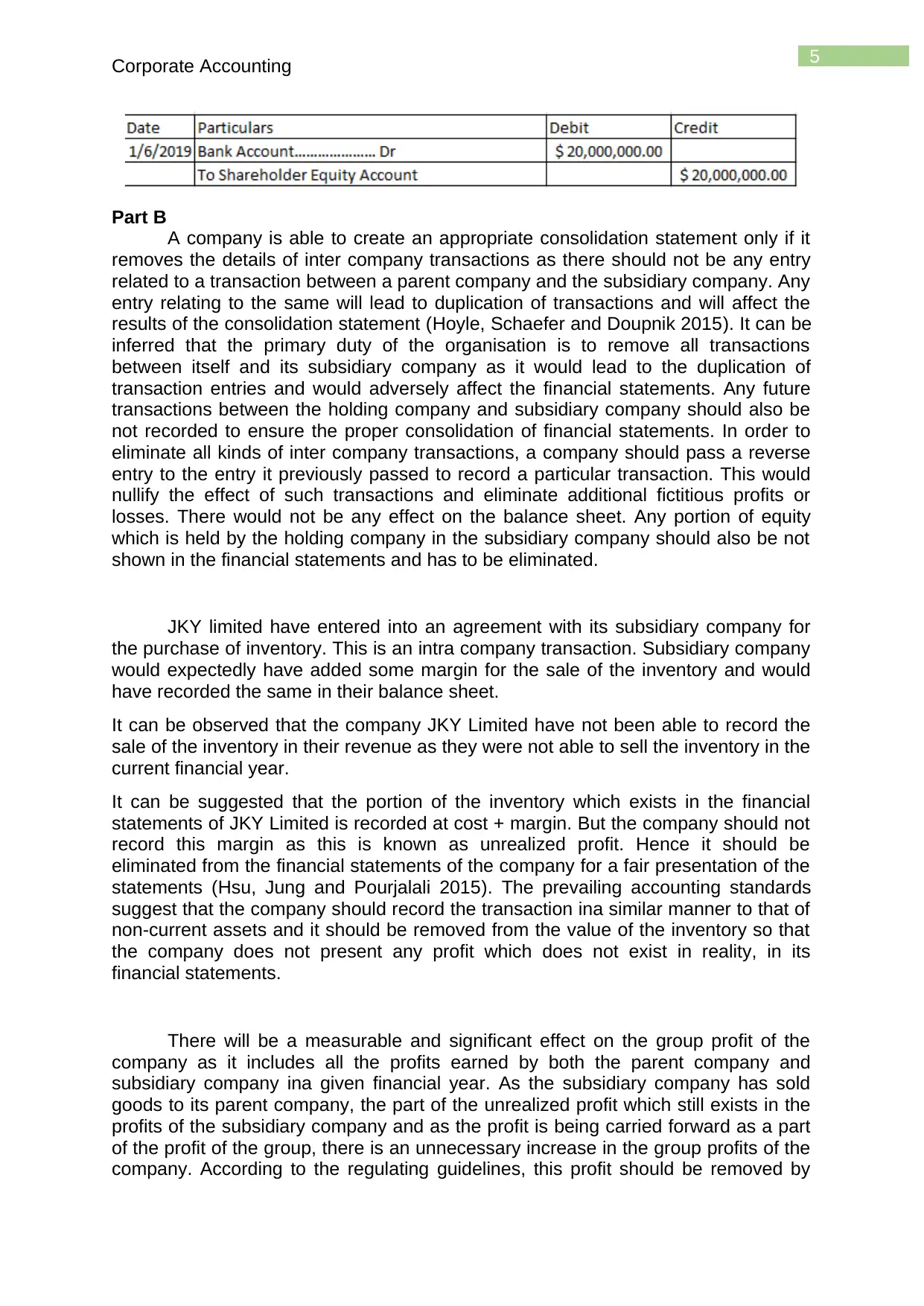
Example in related to the Consolidated Method of Accounting as let assume that the
company JKY Limited have started is business with an investment of $50 million so
the entry will be
In 2019 in invested in the FAB Limited by $30 million so the entry will be
The entry in the book of FAB Limited will be
Corporate Accounting
The entry in regards of the net profit
Consolidation Method of Accounting
Consolidation refers to the combining of assets and liabilities. According to
this method, The only recording that needs to be done by the company is its share in
the assets and liabilities of the joint venture. For example, if a company owns a total
of 60 percent of the assets and liabilities of a joint venture, then the assets and
liabilities should be recorded by it at 60 percent only(Gong et al., 2015). Hence it can
be said that the recording is directly based on the proportionate interest that the
company has in the joint venture. As far as the consolidated statement is concerned,
it should record all items of the parent and subsidiary company but should not
include the amount of investment which is made by the parent company in the
subsidiary company. Any amount of the investment should be eliminated completely
from the financial statements. It also should not consider the amount of equity that
the subsidiary company holds in its parent company. It should also be eliminated by
the subsidiary company. This process of elimination by both the subsidiary company
and the parent company will exclude unnecessary information of any kind and will
help in making the financial statements consolidated. It also suggests that as the
company is able to carry the values of assets and liabilities, it should also present
the income and expenses which have been earned with regards to the joint venture
which is to be recorded in the income statement of the company (Gray 2014). This
standard also discusses about the valuation of goodwill using different possible
methods and the presentation and recording of the same in the financial statements
of the company.
Example in related to the Consolidated Method of Accounting as let assume that the
company JKY Limited have started is business with an investment of $50 million so
the entry will be
In 2019 in invested in the FAB Limited by $30 million so the entry will be
The entry in the book of FAB Limited will be
5
Corporate Accounting
Part B
A company is able to create an appropriate consolidation statement only if it
removes the details of inter company transactions as there should not be any entry
related to a transaction between a parent company and the subsidiary company. Any
entry relating to the same will lead to duplication of transactions and will affect the
results of the consolidation statement (Hoyle, Schaefer and Doupnik 2015). It can be
inferred that the primary duty of the organisation is to remove all transactions
between itself and its subsidiary company as it would lead to the duplication of
transaction entries and would adversely affect the financial statements. Any future
transactions between the holding company and subsidiary company should also be
not recorded to ensure the proper consolidation of financial statements. In order to
eliminate all kinds of inter company transactions, a company should pass a reverse
entry to the entry it previously passed to record a particular transaction. This would
nullify the effect of such transactions and eliminate additional fictitious profits or
losses. There would not be any effect on the balance sheet. Any portion of equity
which is held by the holding company in the subsidiary company should also be not
shown in the financial statements and has to be eliminated.
JKY limited have entered into an agreement with its subsidiary company for
the purchase of inventory. This is an intra company transaction. Subsidiary company
would expectedly have added some margin for the sale of the inventory and would
have recorded the same in their balance sheet.
It can be observed that the company JKY Limited have not been able to record the
sale of the inventory in their revenue as they were not able to sell the inventory in the
current financial year.
It can be suggested that the portion of the inventory which exists in the financial
statements of JKY Limited is recorded at cost + margin. But the company should not
record this margin as this is known as unrealized profit. Hence it should be
eliminated from the financial statements of the company for a fair presentation of the
statements (Hsu, Jung and Pourjalali 2015). The prevailing accounting standards
suggest that the company should record the transaction ina similar manner to that of
non-current assets and it should be removed from the value of the inventory so that
the company does not present any profit which does not exist in reality, in its
financial statements.
There will be a measurable and significant effect on the group profit of the
company as it includes all the profits earned by both the parent company and
subsidiary company ina given financial year. As the subsidiary company has sold
goods to its parent company, the part of the unrealized profit which still exists in the
profits of the subsidiary company and as the profit is being carried forward as a part
of the profit of the group, there is an unnecessary increase in the group profits of the
company. According to the regulating guidelines, this profit should be removed by
Corporate Accounting
Part B
A company is able to create an appropriate consolidation statement only if it
removes the details of inter company transactions as there should not be any entry
related to a transaction between a parent company and the subsidiary company. Any
entry relating to the same will lead to duplication of transactions and will affect the
results of the consolidation statement (Hoyle, Schaefer and Doupnik 2015). It can be
inferred that the primary duty of the organisation is to remove all transactions
between itself and its subsidiary company as it would lead to the duplication of
transaction entries and would adversely affect the financial statements. Any future
transactions between the holding company and subsidiary company should also be
not recorded to ensure the proper consolidation of financial statements. In order to
eliminate all kinds of inter company transactions, a company should pass a reverse
entry to the entry it previously passed to record a particular transaction. This would
nullify the effect of such transactions and eliminate additional fictitious profits or
losses. There would not be any effect on the balance sheet. Any portion of equity
which is held by the holding company in the subsidiary company should also be not
shown in the financial statements and has to be eliminated.
JKY limited have entered into an agreement with its subsidiary company for
the purchase of inventory. This is an intra company transaction. Subsidiary company
would expectedly have added some margin for the sale of the inventory and would
have recorded the same in their balance sheet.
It can be observed that the company JKY Limited have not been able to record the
sale of the inventory in their revenue as they were not able to sell the inventory in the
current financial year.
It can be suggested that the portion of the inventory which exists in the financial
statements of JKY Limited is recorded at cost + margin. But the company should not
record this margin as this is known as unrealized profit. Hence it should be
eliminated from the financial statements of the company for a fair presentation of the
statements (Hsu, Jung and Pourjalali 2015). The prevailing accounting standards
suggest that the company should record the transaction ina similar manner to that of
non-current assets and it should be removed from the value of the inventory so that
the company does not present any profit which does not exist in reality, in its
financial statements.
There will be a measurable and significant effect on the group profit of the
company as it includes all the profits earned by both the parent company and
subsidiary company ina given financial year. As the subsidiary company has sold
goods to its parent company, the part of the unrealized profit which still exists in the
profits of the subsidiary company and as the profit is being carried forward as a part
of the profit of the group, there is an unnecessary increase in the group profits of the
company. According to the regulating guidelines, this profit should be removed by
⊘ This is a preview!⊘
Do you want full access?
Subscribe today to unlock all pages.
Trusted by 1+ million students worldwide
6
Corporate Accounting
passing an adjustment entry. An example of an adjustment entry which the company
should pass to ensure the removal of the unrealised profit is mentioned below
(Aasb.gov.au 2019).
For example the company have purchased the goods for $10000 and the
subsidiary company have a margin of 10% so the amount of the unrealized profit will
be (10/110)* 10000 = 909. So the amount of unrealized profit wills $909 so it should
be removed and the entry will be
Consolidated Profit Account Dr 909
To Consolidated Inventory Account 909
So this will removed all the unrealized profit which is there in the group account and
will show a fair amount of profit which is been earned by them.
Part C
Effects of NCI disclosure requirement in regards to the separate item in the
process of consolidation
In order to ensure a better presentation of the financial statements, the
company should separately present the non-controlling stake which it has in the
equity of that of the parent company. Hence, there should be a proper disclosure of
this matter so that the company is able to know about dealing with them in the
financial statements. As non-controlling interest has been disclosed regarding the
asset, it helps the user to understand how it has been implemented and also helps in
developing a proper accounting for this purpose(Aasb.gov.au 2019). Consolidated
statement is different with regards to non-controlling interest. It ensures that all
details of the equity and non-controlling interest are to be mentioned in an
appropriate manner. This standard assists the company to conduct accounting in a
much simpler manner so that the financial user is able to collect the information
properly and is also able to collect the information properly and is also able to
conduct an easy in-depth analysis while also taking proper decisions regarding the
same.
Every parent company has some kind of holding in the financial statements of
the subsidiary company. If there is a decrease in the stake of the holding company in
its subsidiary, it should be appropriately reported in the financial statements as it is
an extremely important event and the reason for the happening of such an event
should also be mentioned. The company should also mention the amount of non-
controlling interest which should be recorded by it in the financial statements for a
particular financial year.
Changes in order to ensure the accurate representation of the consolidated
financial statement
As per the consolidated statement is there company should record
all the adjusted amount of the asset and liabilities of both the company. According to
the guidelines of the preparation of the consolidated statements, a company should
record all of the assets and liabilities of itself and its subsidiary at an adjusted
amount. Any amount of investment which is related to or done in its subsidiary
Corporate Accounting
passing an adjustment entry. An example of an adjustment entry which the company
should pass to ensure the removal of the unrealised profit is mentioned below
(Aasb.gov.au 2019).
For example the company have purchased the goods for $10000 and the
subsidiary company have a margin of 10% so the amount of the unrealized profit will
be (10/110)* 10000 = 909. So the amount of unrealized profit wills $909 so it should
be removed and the entry will be
Consolidated Profit Account Dr 909
To Consolidated Inventory Account 909
So this will removed all the unrealized profit which is there in the group account and
will show a fair amount of profit which is been earned by them.
Part C
Effects of NCI disclosure requirement in regards to the separate item in the
process of consolidation
In order to ensure a better presentation of the financial statements, the
company should separately present the non-controlling stake which it has in the
equity of that of the parent company. Hence, there should be a proper disclosure of
this matter so that the company is able to know about dealing with them in the
financial statements. As non-controlling interest has been disclosed regarding the
asset, it helps the user to understand how it has been implemented and also helps in
developing a proper accounting for this purpose(Aasb.gov.au 2019). Consolidated
statement is different with regards to non-controlling interest. It ensures that all
details of the equity and non-controlling interest are to be mentioned in an
appropriate manner. This standard assists the company to conduct accounting in a
much simpler manner so that the financial user is able to collect the information
properly and is also able to collect the information properly and is also able to
conduct an easy in-depth analysis while also taking proper decisions regarding the
same.
Every parent company has some kind of holding in the financial statements of
the subsidiary company. If there is a decrease in the stake of the holding company in
its subsidiary, it should be appropriately reported in the financial statements as it is
an extremely important event and the reason for the happening of such an event
should also be mentioned. The company should also mention the amount of non-
controlling interest which should be recorded by it in the financial statements for a
particular financial year.
Changes in order to ensure the accurate representation of the consolidated
financial statement
As per the consolidated statement is there company should record
all the adjusted amount of the asset and liabilities of both the company. According to
the guidelines of the preparation of the consolidated statements, a company should
record all of the assets and liabilities of itself and its subsidiary at an adjusted
amount. Any amount of investment which is related to or done in its subsidiary
Paraphrase This Document
Need a fresh take? Get an instant paraphrase of this document with our AI Paraphraser
7
Corporate Accounting
company and the portion of equity should not be recorded in the financial statements
(Aasb.gov.au 2019Any kinds of losses incurred by the company should be recorded
appropriately in the consolidated statements of a company. The company should
follow the norms and guidelines which are mentioned in the standards related to
consolidation of financial statements. A proper estimation of the policy should also
be made while preparing the consolidated financial statements of the company. All
items related to both the companies should be mentioned in the consolidated
statements and the valuation of goodwill should also be done using an appropriate
manner.
Adjustments with regard to dividends related to preference shares
can also be done by the company so that the company is able to clear all of its
obligations before the preparation of the consolidated statements.
Effects of the changes upon the disclosure in the annual report
A proper disclosure of the methods and assumptions used by the company in
the preparation of the consolidated statements is of extreme importance in the
current business environment(Aasb.gov.au 2019). As it should record the amount of
the investment in the cost which is been done by the company in the joint venture. It
should also record the amount of investment at cost which it has made in the joint
venture. All the adjustment entries passed should also be disclosed to ensure the
removal of intra company sales and other transactions.
Both companies should report the financial statements on the same date. In
case of any difference in the dates of reporting, a proper disclosure and explanation
of the reasons for the difference in dates should be clearly mentioned in the financial
statements of the company. It is manadatory for the company to hold at least 50% of
the share of the subsidiary company. In case the company is not able to hold the
prescribed amount, the it should clearly disclose the same in the financial statements
so that the user is able to know that the company may lose its control over the
subsidiary company due to an unforeseen event. All these matters relating to both
the companies should be properly disclosed by the companies in their notes to
accounts.
Conclusion
To arrive at a conclusion based on the above discussion, in case of
consolidation done between two companies, the methods which are used by the
company with regards to consolidation and details about equity and consolidation
method of accounting should be mentioned. Details related to intra sales
transactions and how the company eliminates the unrealised profit from such
transactions should be mentioned. It should also contain disclosures about the non-
controlling interest of the parent company in its subsidiary company.
Corporate Accounting
company and the portion of equity should not be recorded in the financial statements
(Aasb.gov.au 2019Any kinds of losses incurred by the company should be recorded
appropriately in the consolidated statements of a company. The company should
follow the norms and guidelines which are mentioned in the standards related to
consolidation of financial statements. A proper estimation of the policy should also
be made while preparing the consolidated financial statements of the company. All
items related to both the companies should be mentioned in the consolidated
statements and the valuation of goodwill should also be done using an appropriate
manner.
Adjustments with regard to dividends related to preference shares
can also be done by the company so that the company is able to clear all of its
obligations before the preparation of the consolidated statements.
Effects of the changes upon the disclosure in the annual report
A proper disclosure of the methods and assumptions used by the company in
the preparation of the consolidated statements is of extreme importance in the
current business environment(Aasb.gov.au 2019). As it should record the amount of
the investment in the cost which is been done by the company in the joint venture. It
should also record the amount of investment at cost which it has made in the joint
venture. All the adjustment entries passed should also be disclosed to ensure the
removal of intra company sales and other transactions.
Both companies should report the financial statements on the same date. In
case of any difference in the dates of reporting, a proper disclosure and explanation
of the reasons for the difference in dates should be clearly mentioned in the financial
statements of the company. It is manadatory for the company to hold at least 50% of
the share of the subsidiary company. In case the company is not able to hold the
prescribed amount, the it should clearly disclose the same in the financial statements
so that the user is able to know that the company may lose its control over the
subsidiary company due to an unforeseen event. All these matters relating to both
the companies should be properly disclosed by the companies in their notes to
accounts.
Conclusion
To arrive at a conclusion based on the above discussion, in case of
consolidation done between two companies, the methods which are used by the
company with regards to consolidation and details about equity and consolidation
method of accounting should be mentioned. Details related to intra sales
transactions and how the company eliminates the unrealised profit from such
transactions should be mentioned. It should also contain disclosures about the non-
controlling interest of the parent company in its subsidiary company.
8
Corporate Accounting
Reference
Aasb.gov.au., 2019. [online] Available at:
https://www.aasb.gov.au/admin/file/content105/c9/AASB3_08-15.pdf [Accessed 31
May2019].
Aasb.gov.au., 2019. [online] Available at:
https://www.aasb.gov.au/admin/file/content105/c9/AASB128_08-11.pdf [Accessed
31 May2019].
Aasb.gov.au., 2019. [online] Available at:
https://www.aasb.gov.au/admin/file/content105/c9/AASB10_08-11.pdf [Accessed 31
May2019].
Aasb.gov.au., 2019. [online] Available at:
https://www.aasb.gov.au/admin/file/content105/c9/AASB127_08-
11_COMPjan15_07-15.pdf [Accessed 31 May2019].
Aasb.gov.au., 2019. [online] Available at:
https://www.aasb.gov.au/admin/file/content105/c9/AASB101_07-15.pdf [Accessed
31 May2019].
Albu, C.N., Albu, N. and Alexander, D., 2014. When global accounting standards
meet the local context—Insights from an emerging economy. Critical Perspectives
on Accounting, 25(6), pp.489-510.
Gillis, P., Petty, R. and Suddaby, R., 2014. The transnational regulation of
accounting: insights, gaps and an agenda for future research. Accounting, Auditing &
Accountability Journal, 27(6), pp.894-902.
Gong, Q., Li, O.Z., Lin, Y. and Wu, L., 2015. On the benefits of audit market
consolidation: Evidence from merged audit firms. The Accounting Review, 91(2),
pp.463-488.
Gray, S.J. ed., 2014. International accounting and transnational decisions.
Butterworth-Heinemann.
Hoyle, J.B., Schaefer, T. and Doupnik, T., 2015. Advanced accounting. McGraw Hill.
Hsu, A.W.H., Jung, B. and Pourjalali, H., 2015. Does international accounting
standard no. 27 improve investment efficiency?. Journal of Accounting, Auditing &
Finance, 30(4), pp.484-508.
Corporate Accounting
Reference
Aasb.gov.au., 2019. [online] Available at:
https://www.aasb.gov.au/admin/file/content105/c9/AASB3_08-15.pdf [Accessed 31
May2019].
Aasb.gov.au., 2019. [online] Available at:
https://www.aasb.gov.au/admin/file/content105/c9/AASB128_08-11.pdf [Accessed
31 May2019].
Aasb.gov.au., 2019. [online] Available at:
https://www.aasb.gov.au/admin/file/content105/c9/AASB10_08-11.pdf [Accessed 31
May2019].
Aasb.gov.au., 2019. [online] Available at:
https://www.aasb.gov.au/admin/file/content105/c9/AASB127_08-
11_COMPjan15_07-15.pdf [Accessed 31 May2019].
Aasb.gov.au., 2019. [online] Available at:
https://www.aasb.gov.au/admin/file/content105/c9/AASB101_07-15.pdf [Accessed
31 May2019].
Albu, C.N., Albu, N. and Alexander, D., 2014. When global accounting standards
meet the local context—Insights from an emerging economy. Critical Perspectives
on Accounting, 25(6), pp.489-510.
Gillis, P., Petty, R. and Suddaby, R., 2014. The transnational regulation of
accounting: insights, gaps and an agenda for future research. Accounting, Auditing &
Accountability Journal, 27(6), pp.894-902.
Gong, Q., Li, O.Z., Lin, Y. and Wu, L., 2015. On the benefits of audit market
consolidation: Evidence from merged audit firms. The Accounting Review, 91(2),
pp.463-488.
Gray, S.J. ed., 2014. International accounting and transnational decisions.
Butterworth-Heinemann.
Hoyle, J.B., Schaefer, T. and Doupnik, T., 2015. Advanced accounting. McGraw Hill.
Hsu, A.W.H., Jung, B. and Pourjalali, H., 2015. Does international accounting
standard no. 27 improve investment efficiency?. Journal of Accounting, Auditing &
Finance, 30(4), pp.484-508.
⊘ This is a preview!⊘
Do you want full access?
Subscribe today to unlock all pages.
Trusted by 1+ million students worldwide

1 out of 9


Related Documents


Your All-in-One AI-Powered Toolkit for Academic Success.
+13062052269
info@desklib.com
Available 24*7 on WhatsApp / Email
![[object Object]](/_next/static/media/star-bottom.7253800d.svg)
Unlock your academic potential
Copyright © 2020–2026 A2Z Services. All Rights Reserved. Developed and managed by ZUCOL.