Corporate Accounting Analysis of Fletcher Building Ltd's Finances
VerifiedAdded on 2020/05/16
|11
|2752
|50
Report
AI Summary
This report provides a comprehensive analysis of the corporate accounting practices of Fletcher Building Ltd, focusing on its 2017 financial year. The analysis examines key financial statement components, including equity, tax expenditure, deferred tax assets and liabilities, and current tax assets and liabilities. The report details the calculation of equity, including issued capital and reserves, and explores the factors influencing tax expenditure, such as tax rates and non-deductible items. It also investigates the differences between the effective and actual tax rates, as well as the reconciliation of income tax expenditure. Furthermore, the report delves into the treatment of deferred tax assets and liabilities, current tax assets and liabilities, and the relationship between income tax expenditure and income tax payable. Finally, the report highlights the differences in tax figures between the cash flow statement and income statement, and provides an overview of the company's tax treatment practices.
Running head: CORPORATE ACCOUNTING
Corporate Accounting
Name of the Student
Name of the University
Authors Note
Course ID
Corporate Accounting
Name of the Student
Name of the University
Authors Note
Course ID

Paraphrase This Document
Need a fresh take? Get an instant paraphrase of this document with our AI Paraphraser
1CORPORATE ACCOUNTING
Table of Contents
Answer to question I:.................................................................................................................2
Answer to question II:................................................................................................................3
Answer to Question III:..............................................................................................................4
Answer to question IV:..............................................................................................................4
Answer to question V:................................................................................................................6
Answer to question VI:..............................................................................................................6
Answer to question VII:.............................................................................................................7
Reference List:...........................................................................................................................9
Table of Contents
Answer to question I:.................................................................................................................2
Answer to question II:................................................................................................................3
Answer to Question III:..............................................................................................................4
Answer to question IV:..............................................................................................................4
Answer to question V:................................................................................................................6
Answer to question VI:..............................................................................................................6
Answer to question VII:.............................................................................................................7
Reference List:...........................................................................................................................9
2CORPORATE ACCOUNTING
Answer to question I:
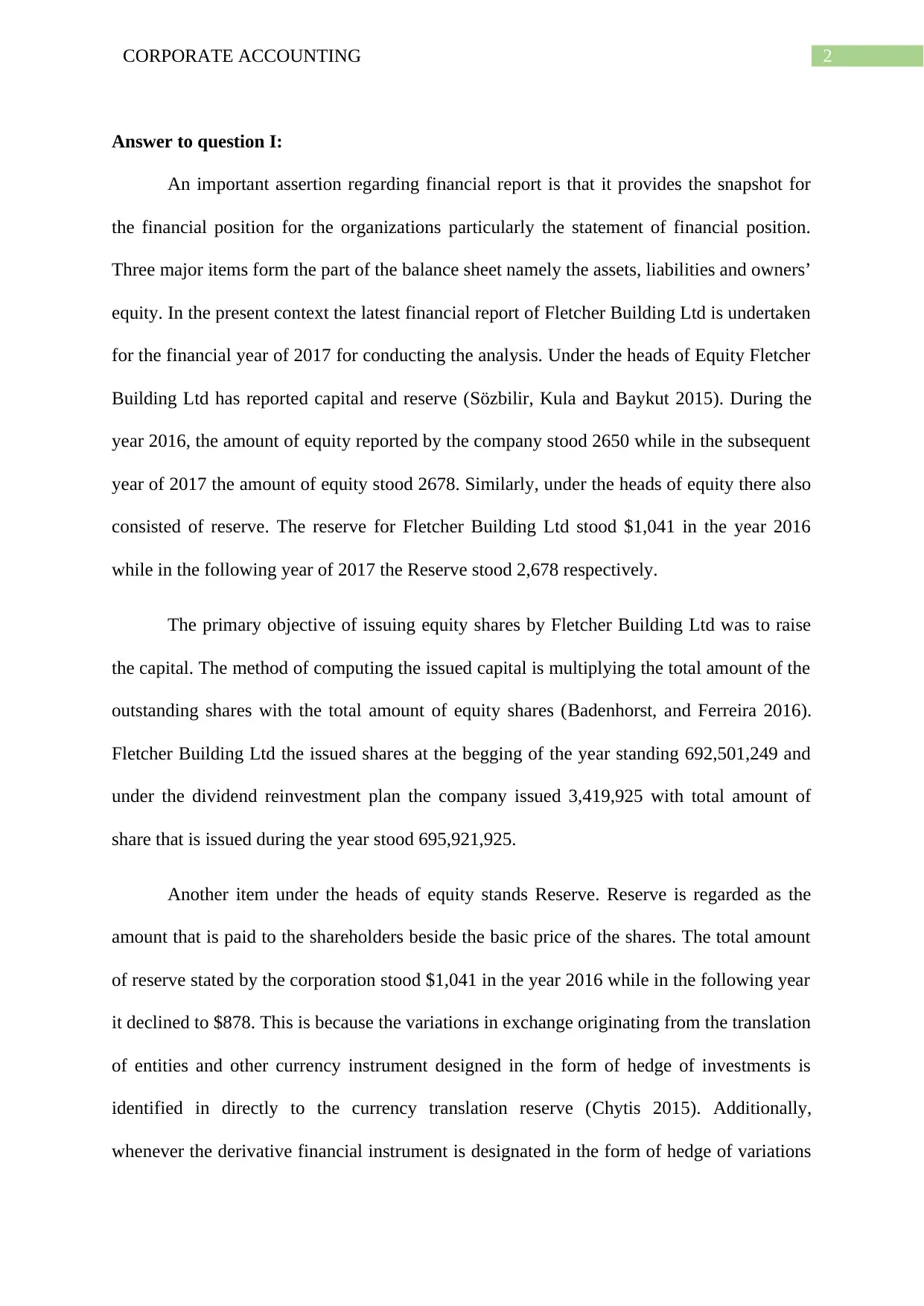
An important assertion regarding financial report is that it provides the snapshot for
the financial position for the organizations particularly the statement of financial position.
Three major items form the part of the balance sheet namely the assets, liabilities and owners’
equity. In the present context the latest financial report of Fletcher Building Ltd is undertaken
for the financial year of 2017 for conducting the analysis. Under the heads of Equity Fletcher
Building Ltd has reported capital and reserve (Sözbilir, Kula and Baykut 2015). During the
year 2016, the amount of equity reported by the company stood 2650 while in the subsequent
year of 2017 the amount of equity stood 2678. Similarly, under the heads of equity there also
consisted of reserve. The reserve for Fletcher Building Ltd stood $1,041 in the year 2016
while in the following year of 2017 the Reserve stood 2,678 respectively.
The primary objective of issuing equity shares by Fletcher Building Ltd was to raise
the capital. The method of computing the issued capital is multiplying the total amount of the
outstanding shares with the total amount of equity shares (Badenhorst, and Ferreira 2016).
Fletcher Building Ltd the issued shares at the begging of the year standing 692,501,249 and
under the dividend reinvestment plan the company issued 3,419,925 with total amount of
share that is issued during the year stood 695,921,925.
Another item under the heads of equity stands Reserve. Reserve is regarded as the
amount that is paid to the shareholders beside the basic price of the shares. The total amount
of reserve stated by the corporation stood $1,041 in the year 2016 while in the following year
it declined to $878. This is because the variations in exchange originating from the translation
of entities and other currency instrument designed in the form of hedge of investments is
identified in directly to the currency translation reserve (Chytis 2015). Additionally,
whenever the derivative financial instrument is designated in the form of hedge of variations
Answer to question I:
An important assertion regarding financial report is that it provides the snapshot for
the financial position for the organizations particularly the statement of financial position.
Three major items form the part of the balance sheet namely the assets, liabilities and owners’
equity. In the present context the latest financial report of Fletcher Building Ltd is undertaken
for the financial year of 2017 for conducting the analysis. Under the heads of Equity Fletcher
Building Ltd has reported capital and reserve (Sözbilir, Kula and Baykut 2015). During the
year 2016, the amount of equity reported by the company stood 2650 while in the subsequent
year of 2017 the amount of equity stood 2678. Similarly, under the heads of equity there also
consisted of reserve. The reserve for Fletcher Building Ltd stood $1,041 in the year 2016
while in the following year of 2017 the Reserve stood 2,678 respectively.
The primary objective of issuing equity shares by Fletcher Building Ltd was to raise
the capital. The method of computing the issued capital is multiplying the total amount of the
outstanding shares with the total amount of equity shares (Badenhorst, and Ferreira 2016).
Fletcher Building Ltd the issued shares at the begging of the year standing 692,501,249 and
under the dividend reinvestment plan the company issued 3,419,925 with total amount of
share that is issued during the year stood 695,921,925.
Another item under the heads of equity stands Reserve. Reserve is regarded as the
amount that is paid to the shareholders beside the basic price of the shares. The total amount
of reserve stated by the corporation stood $1,041 in the year 2016 while in the following year
it declined to $878. This is because the variations in exchange originating from the translation
of entities and other currency instrument designed in the form of hedge of investments is
identified in directly to the currency translation reserve (Chytis 2015). Additionally,
whenever the derivative financial instrument is designated in the form of hedge of variations
⊘ This is a preview!⊘
Do you want full access?
Subscribe today to unlock all pages.

Trusted by 1+ million students worldwide
3CORPORATE ACCOUNTING
in the cash flow of assets the effective portion of the gain or loss is identified directly in the
cash flow hedge reserve within equity and immediate earnings.
Answer to question II:
The execution of business operations requires organizations to experience different
types of operating expenditure, selling and administrative expenditure and other
miscellaneous expenditure. Tax expenditure is regarded as one of the essential part of the
business expenditure. Tax expenditure can be defined as the expenditure or the liability that is
owned to the federal, state or provincial and municipal governments (Wang, Butterfield and
Campbell 2016). Tax expenditure is computed by multiplying the adequate tax rate with the
business income generated prior to tax after taking into the account the factor such as the
non-deductible items, tax assets and tax liabilities.
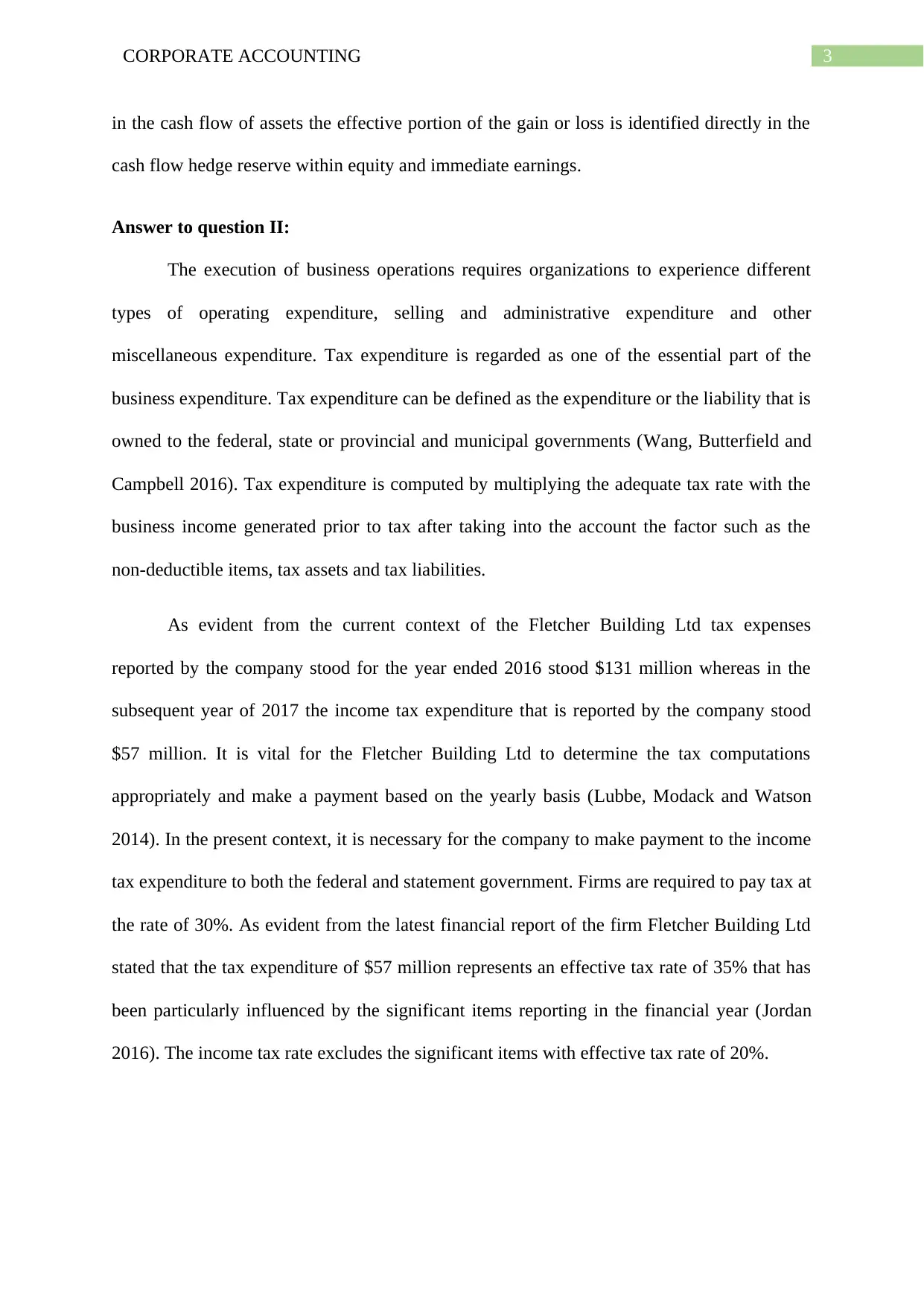
As evident from the current context of the Fletcher Building Ltd tax expenses
reported by the company stood for the year ended 2016 stood $131 million whereas in the
subsequent year of 2017 the income tax expenditure that is reported by the company stood
$57 million. It is vital for the Fletcher Building Ltd to determine the tax computations
appropriately and make a payment based on the yearly basis (Lubbe, Modack and Watson
2014). In the present context, it is necessary for the company to make payment to the income
tax expenditure to both the federal and statement government. Firms are required to pay tax at
the rate of 30%. As evident from the latest financial report of the firm Fletcher Building Ltd
stated that the tax expenditure of $57 million represents an effective tax rate of 35% that has
been particularly influenced by the significant items reporting in the financial year (Jordan
2016). The income tax rate excludes the significant items with effective tax rate of 20%.
in the cash flow of assets the effective portion of the gain or loss is identified directly in the
cash flow hedge reserve within equity and immediate earnings.
Answer to question II:
The execution of business operations requires organizations to experience different
types of operating expenditure, selling and administrative expenditure and other
miscellaneous expenditure. Tax expenditure is regarded as one of the essential part of the
business expenditure. Tax expenditure can be defined as the expenditure or the liability that is
owned to the federal, state or provincial and municipal governments (Wang, Butterfield and
Campbell 2016). Tax expenditure is computed by multiplying the adequate tax rate with the
business income generated prior to tax after taking into the account the factor such as the
non-deductible items, tax assets and tax liabilities.
As evident from the current context of the Fletcher Building Ltd tax expenses
reported by the company stood for the year ended 2016 stood $131 million whereas in the
subsequent year of 2017 the income tax expenditure that is reported by the company stood
$57 million. It is vital for the Fletcher Building Ltd to determine the tax computations
appropriately and make a payment based on the yearly basis (Lubbe, Modack and Watson
2014). In the present context, it is necessary for the company to make payment to the income
tax expenditure to both the federal and statement government. Firms are required to pay tax at
the rate of 30%. As evident from the latest financial report of the firm Fletcher Building Ltd
stated that the tax expenditure of $57 million represents an effective tax rate of 35% that has
been particularly influenced by the significant items reporting in the financial year (Jordan
2016). The income tax rate excludes the significant items with effective tax rate of 20%.
Paraphrase This Document
Need a fresh take? Get an instant paraphrase of this document with our AI Paraphraser
4CORPORATE ACCOUNTING
Answer to Question III:
As evident from the annual report of Fletcher Building Ltd the organizations profit
before tax during the year 2016 stood $719 million while in the subsequent year of 2017 the
earnings before tax for Fletcher Building Ltd stood $273 million (White 2014). The income
tax rate for the corporation stood 35% for the year 2017. In the income statement of the
Fletcher Building Ltd the actual tax rate for the business stood 35% while in the subsequent
year of 2016 the company reported an effective tax rate of 22%. This represents a differences
in the tax expenditure for Fletcher Building Ltd. As evident from the tax differences the
reconciliation of the income tax expenditure represents numerous factors that contribute to
such differences in the income tax expenditure (Bradbury and Mear 2017). The primary
factor that resulted in differences between the Australian and international tax rate is the
differences in the tax rate. The overseas tax rate is lower than the Australian tax rate.
Another factor that is accountable for the variations in the tax rate is the non-
deductible amount of depreciation and the amortization. As evident from the financial report
of the organization is the depreciation and the amortization from the expenditure of tax is
deducted along with the interest paid. Because of this $99 million of cash tax paid is deducted
from the depreciation and amortization expenditure (Zhou 2016). This expenditure represents
the deductible items from the profit of the organization. Additionally, from the operating
earnings before significant items is deducted from the tax expenditure.
Answer to question IV:
Deferred tax liability and the deferred tax asset are viewed as the most important
element the statement of financial position. A deferred tax liability can be regarded as the
account of an organization balance sheet that result in provisional differences amid the
organization bookkeeping and tax carrying values (Reid and Myddelton 2017). The deferred
Answer to Question III:
As evident from the annual report of Fletcher Building Ltd the organizations profit
before tax during the year 2016 stood $719 million while in the subsequent year of 2017 the
earnings before tax for Fletcher Building Ltd stood $273 million (White 2014). The income
tax rate for the corporation stood 35% for the year 2017. In the income statement of the
Fletcher Building Ltd the actual tax rate for the business stood 35% while in the subsequent
year of 2016 the company reported an effective tax rate of 22%. This represents a differences
in the tax expenditure for Fletcher Building Ltd. As evident from the tax differences the
reconciliation of the income tax expenditure represents numerous factors that contribute to
such differences in the income tax expenditure (Bradbury and Mear 2017). The primary
factor that resulted in differences between the Australian and international tax rate is the
differences in the tax rate. The overseas tax rate is lower than the Australian tax rate.
Another factor that is accountable for the variations in the tax rate is the non-
deductible amount of depreciation and the amortization. As evident from the financial report
of the organization is the depreciation and the amortization from the expenditure of tax is
deducted along with the interest paid. Because of this $99 million of cash tax paid is deducted
from the depreciation and amortization expenditure (Zhou 2016). This expenditure represents
the deductible items from the profit of the organization. Additionally, from the operating
earnings before significant items is deducted from the tax expenditure.
Answer to question IV:
Deferred tax liability and the deferred tax asset are viewed as the most important
element the statement of financial position. A deferred tax liability can be regarded as the
account of an organization balance sheet that result in provisional differences amid the
organization bookkeeping and tax carrying values (Reid and Myddelton 2017). The deferred
5CORPORATE ACCOUNTING
tax liability represents the anticipated and enacted income tax rate along with the projected
amount of tax that is payable for the present year.
Deferred tax asset on the other hand represents an accounting term where the
company has paid in excess the taxes or it has paid the levies in advance on its balance sheet.
These deferred tax asset amount are eventually returned to the business as the tax relief with
the amount that is overpaid stands as the asset for the organization (Jaya 2016). As evident
from the current financial report of the Fletcher Building Ltd the deferred tax asset reported
by the company for the financial year 2016 stood $24 million while in the subsequent year of
2017 the deferred tax asset stood $52 million. The deferred tax asset has increased in the
subsequent year of 2017, this is because the tax losses for which the no deferred tax asset was
recognized. On the other hand, the deferred tax liabilities for the firm stood $58 million while
in the subsequent year of 2017 the deferred tax liabilities stood $47 million (Kirchler and
Hoelzl 2017). The fall in the deferred tax liability represents $69 million relating to the Iplex
Australia where the goodwill and the brands of the company have been impaired.
Fletcher Building Ltd Has Offset the impairment of the brands with the reversal of
$11 million that was related to the deferred tax liability through the tax expenditure. Deferred
tax is identified based on the provisional differences among the carrying value of the assets
and the liabilities (Saad 2014). The taxable value apart from the circumstances when the
deferred tax liability originates from the early identification of the goodwill or the asset and
liability in the transaction, which is not the trade combination. Similarly, the deferred tax
assets and deferred tax liability neither creates an impact on the accounting profit nor it
creates an impact on the profit and loss.
tax liability represents the anticipated and enacted income tax rate along with the projected
amount of tax that is payable for the present year.
Deferred tax asset on the other hand represents an accounting term where the
company has paid in excess the taxes or it has paid the levies in advance on its balance sheet.
These deferred tax asset amount are eventually returned to the business as the tax relief with
the amount that is overpaid stands as the asset for the organization (Jaya 2016). As evident
from the current financial report of the Fletcher Building Ltd the deferred tax asset reported
by the company for the financial year 2016 stood $24 million while in the subsequent year of
2017 the deferred tax asset stood $52 million. The deferred tax asset has increased in the
subsequent year of 2017, this is because the tax losses for which the no deferred tax asset was
recognized. On the other hand, the deferred tax liabilities for the firm stood $58 million while
in the subsequent year of 2017 the deferred tax liabilities stood $47 million (Kirchler and
Hoelzl 2017). The fall in the deferred tax liability represents $69 million relating to the Iplex
Australia where the goodwill and the brands of the company have been impaired.
Fletcher Building Ltd Has Offset the impairment of the brands with the reversal of
$11 million that was related to the deferred tax liability through the tax expenditure. Deferred
tax is identified based on the provisional differences among the carrying value of the assets
and the liabilities (Saad 2014). The taxable value apart from the circumstances when the
deferred tax liability originates from the early identification of the goodwill or the asset and
liability in the transaction, which is not the trade combination. Similarly, the deferred tax
assets and deferred tax liability neither creates an impact on the accounting profit nor it
creates an impact on the profit and loss.
⊘ This is a preview!⊘
Do you want full access?
Subscribe today to unlock all pages.
Trusted by 1+ million students worldwide
6CORPORATE ACCOUNTING
Answer to question V:
During the procedure of tax treatment current tax assets, current tax liabilities and
income tax payable are regarded as the important factors. During the year 2016 Fletcher
Building Ltd reported a current tax asset of $2 million while in the subsequent year of 2017
the current tax assets stood $15 million (Piketty 2015). As evident from the annual report of
Fletcher Building Ltd the provision for current tax represents the anticipated amount because
of the payment made by the group during the 12 months period. The current tax liabilities on
the other hand stood $26 million during the year 2016 while in the subsequent year of 2017
the current tax liabilities stood $30 million. As evident from the annual report it is evident
that there prevails a differences in the income tax expenditure and income tax payable.
Consequently, from the tax figures reported by the company the current tax liabilities
represents the income tax that is payable for the income year and the same is payable in
regard to the earlier year (Khan and Gedamkar 2015). Accordingly, the situation is entirely
different in respect of the income tax expenditure. The income tax expenditure is regarded as
the liability for Fletcher Building Ltd since the amount of tax is computed on the present year
revenue generated by the firm. Therefore, this result in high differences amid the concepts of
income tax payable and the income tax expenditure.
Answer to question VI:
Organizations generally provide information relating to the income tax expenditure in
the statement of income along with the statement of cash flows. In agreement with the
income tax expenditure Fletcher Building Ltd reported a differences in income tax
expenditure and income tax paid. The statement of cash flow provides that the company paid
the income tax amount of $99 however the tax expenditure reported by Fletcher Building Ltd
for the year 2017 stood 57 million. Evidently it is found that the figures of tax are different
amount of tax in both the statement of cash flow and income statement. The operating income
Answer to question V:
During the procedure of tax treatment current tax assets, current tax liabilities and
income tax payable are regarded as the important factors. During the year 2016 Fletcher
Building Ltd reported a current tax asset of $2 million while in the subsequent year of 2017
the current tax assets stood $15 million (Piketty 2015). As evident from the annual report of
Fletcher Building Ltd the provision for current tax represents the anticipated amount because
of the payment made by the group during the 12 months period. The current tax liabilities on
the other hand stood $26 million during the year 2016 while in the subsequent year of 2017
the current tax liabilities stood $30 million. As evident from the annual report it is evident
that there prevails a differences in the income tax expenditure and income tax payable.
Consequently, from the tax figures reported by the company the current tax liabilities
represents the income tax that is payable for the income year and the same is payable in
regard to the earlier year (Khan and Gedamkar 2015). Accordingly, the situation is entirely
different in respect of the income tax expenditure. The income tax expenditure is regarded as
the liability for Fletcher Building Ltd since the amount of tax is computed on the present year
revenue generated by the firm. Therefore, this result in high differences amid the concepts of
income tax payable and the income tax expenditure.
Answer to question VI:
Organizations generally provide information relating to the income tax expenditure in
the statement of income along with the statement of cash flows. In agreement with the
income tax expenditure Fletcher Building Ltd reported a differences in income tax
expenditure and income tax paid. The statement of cash flow provides that the company paid
the income tax amount of $99 however the tax expenditure reported by Fletcher Building Ltd
for the year 2017 stood 57 million. Evidently it is found that the figures of tax are different
amount of tax in both the statement of cash flow and income statement. The operating income
Paraphrase This Document
Need a fresh take? Get an instant paraphrase of this document with our AI Paraphraser
7CORPORATE ACCOUNTING
before the significant items stood $525 million the amount of tax paid standing $99 million
(Fletcherbuilding.com 2018).
The income tax payable falls under the heads of current tax liabilities. Because of this,
Fletcher Building Ltd reported the payment of the income tax payable in the cash flow
statement and this primarily contributed to the differences in the statement of cash flow.
Along with this, there are different forms of deductible and non-deductible items, which
cannot be included in the cash flow statement since the reconciliation of the items is
conducted in the later stages. Because of this, the amount of income tax paid provided in the
statement of the cash flow represents is less in comparison to the tax expense reported in the
income statement. Hence, the above stated reasons are accountable for creating the
differences among the income tax reported in the cash flow and income statement.
Answer to question VII:
As evident from the analysis of the financial report of the Fletcher Building Ltd an
important consideration can be paid regarding the treatment of the tax expenditure and tax
paid. As evident from the analysis, it can be stated that the Fletcher Building Ltd has
interestingly computed the tax expenditure. In agreement with the reconciliation, relating to
tax the company has taken into the considerations the necessary factors that has contributed
to the differences in the tax reconciliation. Interestingly considering the differences of the
income tax relating to current and deferred tax.
The annual report provides that the business project the provision of the current tax
with the amount that is due for the payment during the next fiscal year. Interestingly the
provision for the deferred tax is computed by using the balance sheet liability technique.
Furthermore, the deferred tax is identified based on the temperance variances reported by the
company on the carrying amount of the assets and liabilities along with the assessable value.
before the significant items stood $525 million the amount of tax paid standing $99 million
(Fletcherbuilding.com 2018).
The income tax payable falls under the heads of current tax liabilities. Because of this,
Fletcher Building Ltd reported the payment of the income tax payable in the cash flow
statement and this primarily contributed to the differences in the statement of cash flow.
Along with this, there are different forms of deductible and non-deductible items, which
cannot be included in the cash flow statement since the reconciliation of the items is
conducted in the later stages. Because of this, the amount of income tax paid provided in the
statement of the cash flow represents is less in comparison to the tax expense reported in the
income statement. Hence, the above stated reasons are accountable for creating the
differences among the income tax reported in the cash flow and income statement.
Answer to question VII:
As evident from the analysis of the financial report of the Fletcher Building Ltd an
important consideration can be paid regarding the treatment of the tax expenditure and tax
paid. As evident from the analysis, it can be stated that the Fletcher Building Ltd has
interestingly computed the tax expenditure. In agreement with the reconciliation, relating to
tax the company has taken into the considerations the necessary factors that has contributed
to the differences in the tax reconciliation. Interestingly considering the differences of the
income tax relating to current and deferred tax.
The annual report provides that the business project the provision of the current tax
with the amount that is due for the payment during the next fiscal year. Interestingly the
provision for the deferred tax is computed by using the balance sheet liability technique.
Furthermore, the deferred tax is identified based on the temperance variances reported by the
company on the carrying amount of the assets and liabilities along with the assessable value.
8CORPORATE ACCOUNTING
It is understood that the deferred tax is not identified based on the temporary differences and
tax losses unless the recovery becomes probable. Further the learnings from the annual report
provides that there is no significant amount of deferred tax liabilities is recorded relating to
the undistributed amount of profits of the subsidiaries and associates. Apart from these
learnings can be gained relating to the fact of the differences in the treatment of tax for every
nation.
It is understood that the deferred tax is not identified based on the temporary differences and
tax losses unless the recovery becomes probable. Further the learnings from the annual report
provides that there is no significant amount of deferred tax liabilities is recorded relating to
the undistributed amount of profits of the subsidiaries and associates. Apart from these
learnings can be gained relating to the fact of the differences in the treatment of tax for every
nation.
⊘ This is a preview!⊘
Do you want full access?
Subscribe today to unlock all pages.
Trusted by 1+ million students worldwide
9CORPORATE ACCOUNTING
Reference List:
Badenhorst, W.M. and Ferreira, P.H., 2016. The Financial Crisis and the Value‐relevance of
Recognised Deferred Tax Assets. Australian Accounting Review, 26(3), pp.291-300.
Bradbury, M.E. and Mear, K.M., 2017. Interpreting the Impact of IFRS Adoption. Australian
Accounting Review, 27(2), pp.214-219.
Chytis, E., 2015, February. Deferred Tax Assets from unused Tax Losses under the prism of
Financial Crisis. In International Conference on Business & Economics of the Hellenic Open
University, Athens. Retrieved from http://193.108 (Vol. 160).
Fletcherbuilding.com. (2018). 2017 Annual Report | Fletcher Building. [online] Available at:
https://fletcherbuilding.com/investor-centre/financial-results/2017-annual-report/ [Accessed
31 Jan. 2018].
Jaya, T.E., 2016. Earnings, leverage, and deferred tax on tax penalties and fines (case study in
Indonesia). Review of Integrative Business and Economics Research, 5(3), pp.369-377.
Jordan, C.E., 2016. FASB's New Standard for Classifying Deferred Taxes. The CPA
Journal, 86(7), p.22.
Khan, E. and Gedamkar, P., 2015. Performance Evaluation of Equity Shares and Mutual
Funds with Respect to their Risk and Return. KHOJ: Journal of Indian Management
Research and Practices, pp.149-155.
Kirchler, E. and Hoelzl, E., 2017. 16 Tax Behaviour. Economic Psychology, 2380, p.255.
Lubbe, I., Modack, G. and Watson, A., 2014. Financial accounting GAAP principles. OUP
Catalogue.
Reference List:
Badenhorst, W.M. and Ferreira, P.H., 2016. The Financial Crisis and the Value‐relevance of
Recognised Deferred Tax Assets. Australian Accounting Review, 26(3), pp.291-300.
Bradbury, M.E. and Mear, K.M., 2017. Interpreting the Impact of IFRS Adoption. Australian
Accounting Review, 27(2), pp.214-219.
Chytis, E., 2015, February. Deferred Tax Assets from unused Tax Losses under the prism of
Financial Crisis. In International Conference on Business & Economics of the Hellenic Open
University, Athens. Retrieved from http://193.108 (Vol. 160).
Fletcherbuilding.com. (2018). 2017 Annual Report | Fletcher Building. [online] Available at:
https://fletcherbuilding.com/investor-centre/financial-results/2017-annual-report/ [Accessed
31 Jan. 2018].
Jaya, T.E., 2016. Earnings, leverage, and deferred tax on tax penalties and fines (case study in
Indonesia). Review of Integrative Business and Economics Research, 5(3), pp.369-377.
Jordan, C.E., 2016. FASB's New Standard for Classifying Deferred Taxes. The CPA
Journal, 86(7), p.22.
Khan, E. and Gedamkar, P., 2015. Performance Evaluation of Equity Shares and Mutual
Funds with Respect to their Risk and Return. KHOJ: Journal of Indian Management
Research and Practices, pp.149-155.
Kirchler, E. and Hoelzl, E., 2017. 16 Tax Behaviour. Economic Psychology, 2380, p.255.
Lubbe, I., Modack, G. and Watson, A., 2014. Financial accounting GAAP principles. OUP
Catalogue.
Paraphrase This Document
Need a fresh take? Get an instant paraphrase of this document with our AI Paraphraser
10CORPORATE ACCOUNTING
Piketty, T., 2015. About capital in the twenty-first century. American Economic
Review, 105(5), pp.48-53.
Reid, W. and Myddelton, D.R., 2017. The meaning of company accounts. Routledge.
Saad, N., 2014. Tax knowledge, tax complexity and tax compliance: Taxpayers’
view. Procedia-Social and Behavioral Sciences, 109, pp.1069-1075.
Sözbilir, H., Kula, V. and Baykut, L.E., 2015. A Research on Deferred Taxes: A Case Study
of BIST Listed Banks in Turkey. European Journal of Business and Management, 7(2), pp.1-
10.
Wang, Y., Butterfield, S. and Campbell, M., 2016. Deferred tax items as earnings
management indicators. International Management Review, 12(2), p.37.
White, S.D., 2014. Deferred Tax Assets and Credit Risk.
Zhou, M., 2016. Does accounting for uncertain tax benefits provide information about the
relation between book-tax differences and earnings persistence?. Review of Accounting and
Finance, 15(1), pp.65-84.
Piketty, T., 2015. About capital in the twenty-first century. American Economic
Review, 105(5), pp.48-53.
Reid, W. and Myddelton, D.R., 2017. The meaning of company accounts. Routledge.
Saad, N., 2014. Tax knowledge, tax complexity and tax compliance: Taxpayers’
view. Procedia-Social and Behavioral Sciences, 109, pp.1069-1075.
Sözbilir, H., Kula, V. and Baykut, L.E., 2015. A Research on Deferred Taxes: A Case Study
of BIST Listed Banks in Turkey. European Journal of Business and Management, 7(2), pp.1-
10.
Wang, Y., Butterfield, S. and Campbell, M., 2016. Deferred tax items as earnings
management indicators. International Management Review, 12(2), p.37.
White, S.D., 2014. Deferred Tax Assets and Credit Risk.
Zhou, M., 2016. Does accounting for uncertain tax benefits provide information about the
relation between book-tax differences and earnings persistence?. Review of Accounting and
Finance, 15(1), pp.65-84.

1 out of 11


Related Documents


Your All-in-One AI-Powered Toolkit for Academic Success.
+13062052269
info@desklib.com
Available 24*7 on WhatsApp / Email
![[object Object]](/_next/static/media/star-bottom.7253800d.svg)
Unlock your academic potential
Copyright © 2020–2026 A2Z Services. All Rights Reserved. Developed and managed by ZUCOL.