Exploring Corporate and Commercial Law: Liability and Negligence
VerifiedAdded on 2023/06/14
|8
|2076
|384
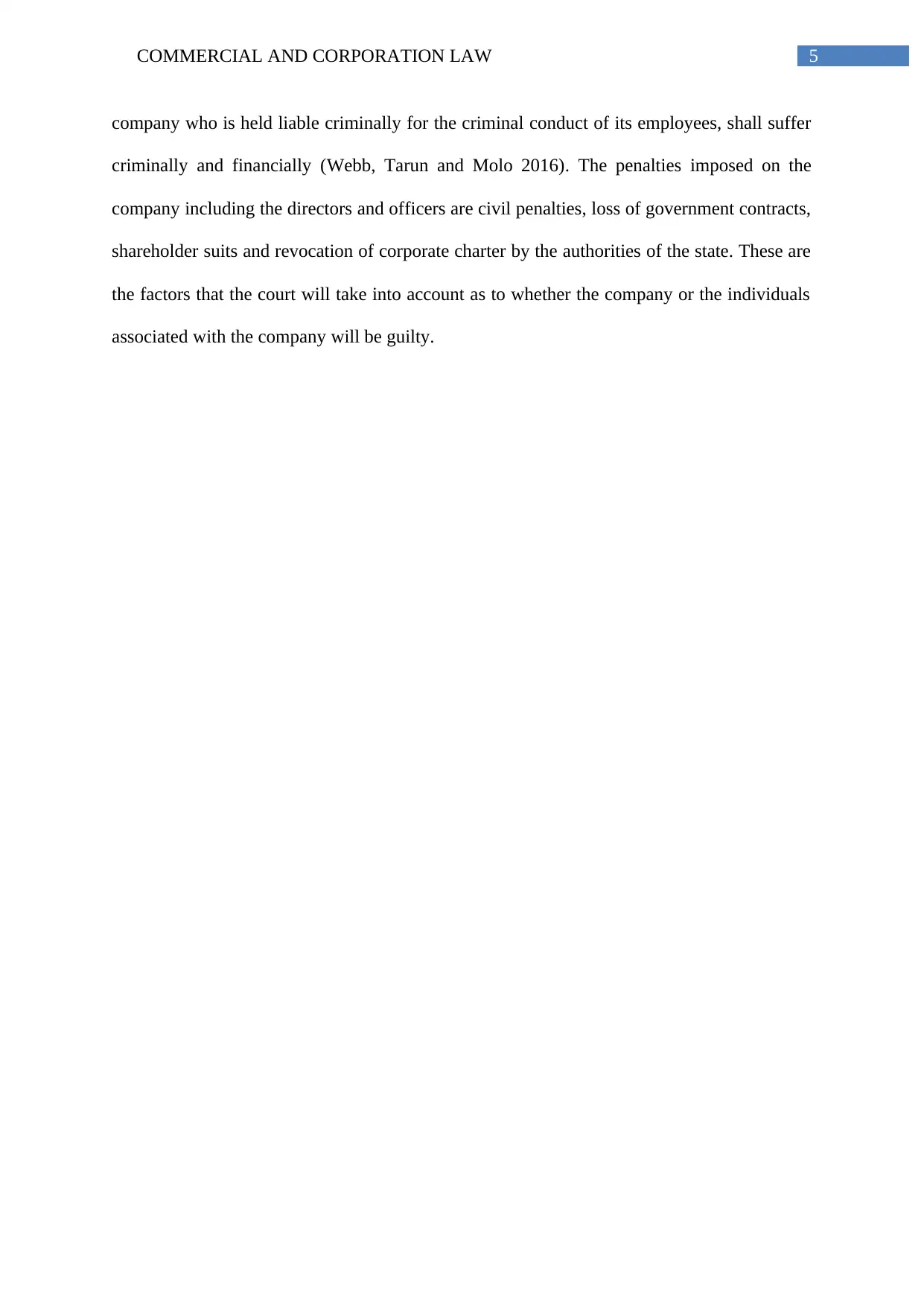
Essay
AI Summary
This essay delves into the complexities of commercial and corporation law, specifically addressing liability and negligence within a company. It examines scenarios where a company employee, who is also a shareholder or director, is negligent and explores whether a company can be liable to its own shareholders under tort law, referencing relevant cases like Solomon v Solomon and Greenfield v. Colonial Stores Inc. The analysis extends to corporate criminal liability, discussing the principles courts consider when determining guilt between the company and individual actors, with references to cases like Barnett v Chelsea & Kensington Hospital and Limpus v London General Omnibus Co. The essay also highlights potential liabilities of directors, shareholders, and officers, and the implications of corporate plea agreements, emphasizing the importance of compliance and cooperation with law enforcement to mitigate criminal charges. The document concludes by mentioning the penalties imposed on the company including the directors and officers.
Running head: COMMERCIAL AND CORPORATION LAW
Commercial and Corporation Law
Name of the Student
Name of the University
Author note
Commercial and Corporation Law
Name of the Student
Name of the University
Author note
Paraphrase This Document
Need a fresh take? Get an instant paraphrase of this document with our AI Paraphraser

1COMMERCIAL AND CORPORATION LAW
Part A
A company employee can also be director or a shareholder of the company. He will
have the right to be paid when the services will be carried out of the company. A company is
therefore considered to be a separate legal entity with its independent existence from the
members and shareholders. The property is owned by the company and has its own rights.
The property of the company is not the property of the employees, shareholders or directors
of the company as was observed in the case of Solomon v Solomon. Directors, members or
shareholders can be negligent with their respective duties. The usual duties of directors and
the executive directors will be bound by the terms of the employment contract. The company
has innumerable legal duties. The duties are included under the Companies Act. However,
the directors or the shareholders can be negligent while carrying out their duties. The concept
of negligence is treated under the Law of Torts. A legal wrong that is usually suffered by
someone due to the activities of another person is treated to be a tort of negligence. Torts is a
civil wrong that can be caused by any individual. If a director or shareholder becomes
negligent during his work either the company or they themselves will be liable for the acts.
Directors, shareholders, officers and the company itself are subjected to a few specific
liabilities. Liability is also limited to a certain level to make sure that there is a possibility of
carrying on the business that had no constant legal suit. It was assumed previously that a
corporation itself had a low set of liabilities. Those liabilities were only considered to be civil
in nature. As per the Company Act, it can be stated that the directors, employees and officers
have always held companies liable for the obligations and contracts that are entered into on
their behalf (Brickey and Taub 2017). Netheremere Ltd v Taverna & Gardiner held that
outworkers could be considered to be employees if they are exercising the same work as the
ones in the workplace. This is a concept of vicarious liability. When a contract is entered into
prior to the actual moment of an incorporation of company, it will be the liability of the
Part A
A company employee can also be director or a shareholder of the company. He will
have the right to be paid when the services will be carried out of the company. A company is
therefore considered to be a separate legal entity with its independent existence from the
members and shareholders. The property is owned by the company and has its own rights.
The property of the company is not the property of the employees, shareholders or directors
of the company as was observed in the case of Solomon v Solomon. Directors, members or
shareholders can be negligent with their respective duties. The usual duties of directors and
the executive directors will be bound by the terms of the employment contract. The company
has innumerable legal duties. The duties are included under the Companies Act. However,
the directors or the shareholders can be negligent while carrying out their duties. The concept
of negligence is treated under the Law of Torts. A legal wrong that is usually suffered by
someone due to the activities of another person is treated to be a tort of negligence. Torts is a
civil wrong that can be caused by any individual. If a director or shareholder becomes
negligent during his work either the company or they themselves will be liable for the acts.
Directors, shareholders, officers and the company itself are subjected to a few specific
liabilities. Liability is also limited to a certain level to make sure that there is a possibility of
carrying on the business that had no constant legal suit. It was assumed previously that a
corporation itself had a low set of liabilities. Those liabilities were only considered to be civil
in nature. As per the Company Act, it can be stated that the directors, employees and officers
have always held companies liable for the obligations and contracts that are entered into on
their behalf (Brickey and Taub 2017). Netheremere Ltd v Taverna & Gardiner held that
outworkers could be considered to be employees if they are exercising the same work as the
ones in the workplace. This is a concept of vicarious liability. When a contract is entered into
prior to the actual moment of an incorporation of company, it will be the liability of the

2COMMERCIAL AND CORPORATION LAW
company (Lacoste 2016). These pre-incorporation of contracts when entered into by the
promoters of the company, it becomes the company’s obligation itself when they are either
adopted by the corporation or if the company agrees with the merits of the contract. As far as
torts is concerned, usually a company has a degree of liability for the torts that have been
dedicated by the employees or the directors of the company during the course of the
employment (Lacoste 2016). It also depends on the effect and nature of the tort. The basic
and common rule of the liability of the company related to torts is that it ignores the liability
for the intentional torts on the parts where the directors or the employees are involved.
However, this may be held liable for unintentional torts that are committed by the employees
(Sadgrove 2016). Therefore, if the tort that is intentional and the corporate directors
anticipated and if the company accepts the merits of the commission then the company will
held liable even if the tort was committed intentionally by an employee as observed in
Greenfield v. Colonial Stores Inc. A company can be liable to its own directors or
shareholders if the case is a matter of negligence. However, when a breach is caused, there
are consequences faced by the shareholders and the company. Remedies are available for the
breach of the duties in the company (Sadgrove 2016). A breach also falls under the ground
for termination of an executive director’s service contract. When the shareholders have been
negligent in their work, the corporation as well as the shareholders will be liable for the
negligent activity (Harding and Kohl 2016). The liability to the shareholders is considered to
be more limited compared to the officers and directors. The shareholders themselves elect
their managers to act as their agents for protecting their investment. Fiduciary duty is not
owed to the shareholders or the corporation. This is due to the scenario that shareholders have
less influence in the decision making process of the corporation. Therefore, in this regard, it
is noteworthy to mention here that shareholders are completely immune from liability (Webb,
Tarun and Molo 2016). Therefore, if a director or shareholder is negligent at work, they will
company (Lacoste 2016). These pre-incorporation of contracts when entered into by the
promoters of the company, it becomes the company’s obligation itself when they are either
adopted by the corporation or if the company agrees with the merits of the contract. As far as
torts is concerned, usually a company has a degree of liability for the torts that have been
dedicated by the employees or the directors of the company during the course of the
employment (Lacoste 2016). It also depends on the effect and nature of the tort. The basic
and common rule of the liability of the company related to torts is that it ignores the liability
for the intentional torts on the parts where the directors or the employees are involved.
However, this may be held liable for unintentional torts that are committed by the employees
(Sadgrove 2016). Therefore, if the tort that is intentional and the corporate directors
anticipated and if the company accepts the merits of the commission then the company will
held liable even if the tort was committed intentionally by an employee as observed in
Greenfield v. Colonial Stores Inc. A company can be liable to its own directors or
shareholders if the case is a matter of negligence. However, when a breach is caused, there
are consequences faced by the shareholders and the company. Remedies are available for the
breach of the duties in the company (Sadgrove 2016). A breach also falls under the ground
for termination of an executive director’s service contract. When the shareholders have been
negligent in their work, the corporation as well as the shareholders will be liable for the
negligent activity (Harding and Kohl 2016). The liability to the shareholders is considered to
be more limited compared to the officers and directors. The shareholders themselves elect
their managers to act as their agents for protecting their investment. Fiduciary duty is not
owed to the shareholders or the corporation. This is due to the scenario that shareholders have
less influence in the decision making process of the corporation. Therefore, in this regard, it
is noteworthy to mention here that shareholders are completely immune from liability (Webb,
Tarun and Molo 2016). Therefore, if a director or shareholder is negligent at work, they will
⊘ This is a preview!⊘
Do you want full access?
Subscribe today to unlock all pages.

Trusted by 1+ million students worldwide

3COMMERCIAL AND CORPORATION LAW
be liable for their own activities. In certain cases, a company can be liable to its own
shareholders or directors under the law of torts.
PART B
The directors, officers and employees of a corporation can be held liable criminally if
any kind of criminal acts are committed. If the acts are committed personally despite, whether
they were acting in furtherance of the interests of the corporation, the officers and directors
will be held liable (Bainbridge 2015). Corporations or companies are considered to be
separate legal entities. They are not individuals but in the eye of law, corporations are treated
as a person for a few specific purposes. For instance, if the agents of the company have
committed a criminal act during their course of duty, they will held responsible and liable for
each elements of the crime and it commits the crime to obtain profits of the company
compared to the profits gained by the individuals (Brickey and Taub 2017). The corporation
itself can be found guilty of the crime. The agents of the company have committed the
essentials of crime that are associated with the corporation as the company will be charged to
be guilty of the crime. If the number of individuals involved is more than two then the
prosecution should provide evidence that an agent of the company must have been guilty of
the crime as it was committed knowingly. Small companies do not face such complicated
situations (Pearce 2016). However, companies are known as legal persons who have the
power of getting sued and suing are capable of committing crimes. According to the
respondent superior, a corporation is generally held liable criminally for carrying out illegal
activities of the directors, agents and employees. To hold a company for these actions, the
government should be determining actions of the corporate agents. Barnett v Chelsea &
Kensington Hospital discussed the elements of negligence appearing in companies. Either
the employees or the directors are generally held liable for being negligent. It should be
proved within the scope of the duties and for the benefit of the corporation (West and Gail
be liable for their own activities. In certain cases, a company can be liable to its own
shareholders or directors under the law of torts.
PART B
The directors, officers and employees of a corporation can be held liable criminally if
any kind of criminal acts are committed. If the acts are committed personally despite, whether
they were acting in furtherance of the interests of the corporation, the officers and directors
will be held liable (Bainbridge 2015). Corporations or companies are considered to be
separate legal entities. They are not individuals but in the eye of law, corporations are treated
as a person for a few specific purposes. For instance, if the agents of the company have
committed a criminal act during their course of duty, they will held responsible and liable for
each elements of the crime and it commits the crime to obtain profits of the company
compared to the profits gained by the individuals (Brickey and Taub 2017). The corporation
itself can be found guilty of the crime. The agents of the company have committed the
essentials of crime that are associated with the corporation as the company will be charged to
be guilty of the crime. If the number of individuals involved is more than two then the
prosecution should provide evidence that an agent of the company must have been guilty of
the crime as it was committed knowingly. Small companies do not face such complicated
situations (Pearce 2016). However, companies are known as legal persons who have the
power of getting sued and suing are capable of committing crimes. According to the
respondent superior, a corporation is generally held liable criminally for carrying out illegal
activities of the directors, agents and employees. To hold a company for these actions, the
government should be determining actions of the corporate agents. Barnett v Chelsea &
Kensington Hospital discussed the elements of negligence appearing in companies. Either
the employees or the directors are generally held liable for being negligent. It should be
proved within the scope of the duties and for the benefit of the corporation (West and Gail
Paraphrase This Document
Need a fresh take? Get an instant paraphrase of this document with our AI Paraphraser

4COMMERCIAL AND CORPORATION LAW
2015). If the owner of the corporation loots money from his or her own business then it will
be beneficial from the crime but generally the company does not. The owner will be guilty of
the crime and not the company (Wan, 2016). For instance, if the manager of that particular
company has his or her employees hazardous waste dumped illegally then the company will
be benefitted from the crime committed (Brickey and Taub 2017). As observed in the case of
Limpus v London General Omnibus Co. when the employer but if has restricted the conduct
of the employee the act itself is authorized then the employer will be held liable. The money
can be saved by disposing and therefore the company will be guilty even if the owners or the
shareholders were clueless about the manager committing the crime. If the agents of a
company commit a crime on his behalf, the company can be held liable and guilty if it is
proved that the owners were not associated with it. There are cases and situations in a
company when an employee’s unauthorized criminal actions represent the potential of the
company’s criminal charges (Bussmann 2015). However, the company can protect itself from
getting charged of actively cooperation with the government. If a manager of the company
identifies a group of persons who has been engaged with the fraudulent orders and gets them
fired then the company will be held guilty of fraud. For avoiding such a situation, it is the
duty of the company to inform the enforcement of law related to the criminal acts of the
salespeople (Bainbridge 2015). When a corporate plea agreement is positioned, it should
include the specific provisions that can identify the nature of the crime and makes sure that
the principles of punishment and rehabilitation that are met. As per law, when a corporation
is held liable, the individuals engaged with the company will also be held liable. The officers
and the board of directors will always be held liable criminally as well. A person is generally
held liable criminally for the illegal act of another employee under the compliance liability
theory. If a person encourages or instructs another employee to commit or associate in a
criminal conduct, they will be held liable for the criminal act of the employees. Therefore, a
2015). If the owner of the corporation loots money from his or her own business then it will
be beneficial from the crime but generally the company does not. The owner will be guilty of
the crime and not the company (Wan, 2016). For instance, if the manager of that particular
company has his or her employees hazardous waste dumped illegally then the company will
be benefitted from the crime committed (Brickey and Taub 2017). As observed in the case of
Limpus v London General Omnibus Co. when the employer but if has restricted the conduct
of the employee the act itself is authorized then the employer will be held liable. The money
can be saved by disposing and therefore the company will be guilty even if the owners or the
shareholders were clueless about the manager committing the crime. If the agents of a
company commit a crime on his behalf, the company can be held liable and guilty if it is
proved that the owners were not associated with it. There are cases and situations in a
company when an employee’s unauthorized criminal actions represent the potential of the
company’s criminal charges (Bussmann 2015). However, the company can protect itself from
getting charged of actively cooperation with the government. If a manager of the company
identifies a group of persons who has been engaged with the fraudulent orders and gets them
fired then the company will be held guilty of fraud. For avoiding such a situation, it is the
duty of the company to inform the enforcement of law related to the criminal acts of the
salespeople (Bainbridge 2015). When a corporate plea agreement is positioned, it should
include the specific provisions that can identify the nature of the crime and makes sure that
the principles of punishment and rehabilitation that are met. As per law, when a corporation
is held liable, the individuals engaged with the company will also be held liable. The officers
and the board of directors will always be held liable criminally as well. A person is generally
held liable criminally for the illegal act of another employee under the compliance liability
theory. If a person encourages or instructs another employee to commit or associate in a
criminal conduct, they will be held liable for the criminal act of the employees. Therefore, a

5COMMERCIAL AND CORPORATION LAW
company who is held liable criminally for the criminal conduct of its employees, shall suffer
criminally and financially (Webb, Tarun and Molo 2016). The penalties imposed on the
company including the directors and officers are civil penalties, loss of government contracts,
shareholder suits and revocation of corporate charter by the authorities of the state. These are
the factors that the court will take into account as to whether the company or the individuals
associated with the company will be guilty.
company who is held liable criminally for the criminal conduct of its employees, shall suffer
criminally and financially (Webb, Tarun and Molo 2016). The penalties imposed on the
company including the directors and officers are civil penalties, loss of government contracts,
shareholder suits and revocation of corporate charter by the authorities of the state. These are
the factors that the court will take into account as to whether the company or the individuals
associated with the company will be guilty.
⊘ This is a preview!⊘
Do you want full access?
Subscribe today to unlock all pages.

Trusted by 1+ million students worldwide

6COMMERCIAL AND CORPORATION LAW
References:
Bainbridge, S.M., 2015. 11. Preserving director primacy by managing shareholder
interventions. Research Handbook on Shareholder Power, p.231.
Brickey, K.F. and Taub, J., 2017. Corporate and white collar crime: cases and materials.
Wolters Kluwer Law & Business.
Bussmann, K.D., 2015. The impact of personality and company culture on company anti-
corruption programmes. The Routledge handbook of white-collar and corporate crime in
Europe, pp.435-452.
Harding, C. and Kohl, U., 2016. Human rights in the market place: the exploitation of rights
protection by economic actors. Routledge.
Hillary, R. ed., 2017. Small and medium-sized enterprises and the environment: business
imperatives. Routledge.
Lacoste, S., 2016. Sustainable value co-creation in business networks. Industrial Marketing
Management, 52, pp.151-162.
Pearce, R., 2016. Business management, environmental health and the EHP/business
interface. Clay's Handbook of Environmental Health, p.252.
Sadgrove, K., 2016. The complete guide to business risk management. Routledge.
Wan, W.Y., 2016. The illegality defence in corporate law claims against directors and
officers. Hong Kong Law Journal, 46(1), p.225.
Webb, D.K., Tarun, R.W. and Molo, S.F., 2016. Corporate Internal Investigations. Law
Journal Press.
References:
Bainbridge, S.M., 2015. 11. Preserving director primacy by managing shareholder
interventions. Research Handbook on Shareholder Power, p.231.
Brickey, K.F. and Taub, J., 2017. Corporate and white collar crime: cases and materials.
Wolters Kluwer Law & Business.
Bussmann, K.D., 2015. The impact of personality and company culture on company anti-
corruption programmes. The Routledge handbook of white-collar and corporate crime in
Europe, pp.435-452.
Harding, C. and Kohl, U., 2016. Human rights in the market place: the exploitation of rights
protection by economic actors. Routledge.
Hillary, R. ed., 2017. Small and medium-sized enterprises and the environment: business
imperatives. Routledge.
Lacoste, S., 2016. Sustainable value co-creation in business networks. Industrial Marketing
Management, 52, pp.151-162.
Pearce, R., 2016. Business management, environmental health and the EHP/business
interface. Clay's Handbook of Environmental Health, p.252.
Sadgrove, K., 2016. The complete guide to business risk management. Routledge.
Wan, W.Y., 2016. The illegality defence in corporate law claims against directors and
officers. Hong Kong Law Journal, 46(1), p.225.
Webb, D.K., Tarun, R.W. and Molo, S.F., 2016. Corporate Internal Investigations. Law
Journal Press.
Paraphrase This Document
Need a fresh take? Get an instant paraphrase of this document with our AI Paraphraser

7COMMERCIAL AND CORPORATION LAW
West, G.D. and Gail, D.B., 2015. Tort Law's Continued Intrusion Into the M&A Agreement
—What to Do About It, If Anything.
Yeager, P., 2017. Corporate Crime. Routledge.
West, G.D. and Gail, D.B., 2015. Tort Law's Continued Intrusion Into the M&A Agreement
—What to Do About It, If Anything.
Yeager, P., 2017. Corporate Crime. Routledge.
1 out of 8
Related Documents
Your All-in-One AI-Powered Toolkit for Academic Success.
+13062052269
info@desklib.com
Available 24*7 on WhatsApp / Email
Unlock your academic potential
Copyright © 2020–2025 A2Z Services. All Rights Reserved. Developed and managed by ZUCOL.