Corporate Culture Impact on Aviation Industry Safety
VerifiedAdded on 2023/02/01
|7
|1075
|49
Homework Assignment
AI Summary
This homework assignment analyzes the role of corporate culture in the aviation industry, focusing on safety protocols and risk management. The assignment addresses the importance of employee behavior and attitudes toward safety, exploring elements such as behavioral approaches, guest perceptions, and crew resource management (CRM). It examines how corporate governance and management decisions impact safety standards, highlighting potential conflicts between profit motives and safety measures. The paper discusses the significance of employee perceptions of safety culture, and the consequences of ignoring CRM principles in mergers and joint flight departments. The analysis draws on various scholarly articles and provides a comprehensive overview of the critical factors influencing corporate culture's impact on safety within the aviation sector.
Running head: CORPORATE CULTURE
Corporate Culture
Name of the Student:
Name of the University:
Author Note:
Corporate Culture
Name of the Student:
Name of the University:
Author Note:
Paraphrase This Document
Need a fresh take? Get an instant paraphrase of this document with our AI Paraphraser

1CORPORATE CULTURE
Table of Contents
Question 1..................................................................................................................................2
Question 2..................................................................................................................................2
Question 3..................................................................................................................................2
Question 4..................................................................................................................................3
Question 5..................................................................................................................................3
Question 6..................................................................................................................................3
Question 7..................................................................................................................................4
Question 8..................................................................................................................................4
Question 9..................................................................................................................................4
Question 10................................................................................................................................5
Bibliography...............................................................................................................................6
Table of Contents
Question 1..................................................................................................................................2
Question 2..................................................................................................................................2
Question 3..................................................................................................................................2
Question 4..................................................................................................................................3
Question 5..................................................................................................................................3
Question 6..................................................................................................................................3
Question 7..................................................................................................................................4
Question 8..................................................................................................................................4
Question 9..................................................................................................................................4
Question 10................................................................................................................................5
Bibliography...............................................................................................................................6

2CORPORATE CULTURE
Question 1
Several uncertainties of risk may occur in the plans and processes if an aviation
industry. In this context, every single individual connected with the industry should be
careful enough to take care of the rules and orders of safety. The essential elements that
would design a safe workplace culture at an aviation organisation are determined as;
The Behavioural approach of the employees of the organisation towards safety.
The improvement in the personal attitude of guests approaches toward safety.
The responsibility of the corporate management of the aviation industry towards
safety.
Question 2
As opined by Freud (2018), human nature toward safety is something that they think
would come naturally to them. However, the actual theory is opposite to this ideology. In this
connection, the people connected to the aviation industry should be capable enough of taking
risks. However, it was examined by the study that the employees of the aviation industry try
to take shortcuts to fulfill their tasks faster in their workplace. The human feels dull and
boring when it comes to working on the safety part. In this connection, the organisation of
aviation needs to take approaches towards making safety a way to live life in the workplace.
Question 3
As opined by Benckendorff, Xiang & Sheldon (2019), the personal attitude of guests
at an aviation industry towards safety differs from person to person. Where some take an
interest in knowing about the pros and cons of the same, some guests also neglects it. The
critical elements in this connection are determined as;
Question 1
Several uncertainties of risk may occur in the plans and processes if an aviation
industry. In this context, every single individual connected with the industry should be
careful enough to take care of the rules and orders of safety. The essential elements that
would design a safe workplace culture at an aviation organisation are determined as;
The Behavioural approach of the employees of the organisation towards safety.
The improvement in the personal attitude of guests approaches toward safety.
The responsibility of the corporate management of the aviation industry towards
safety.
Question 2
As opined by Freud (2018), human nature toward safety is something that they think
would come naturally to them. However, the actual theory is opposite to this ideology. In this
connection, the people connected to the aviation industry should be capable enough of taking
risks. However, it was examined by the study that the employees of the aviation industry try
to take shortcuts to fulfill their tasks faster in their workplace. The human feels dull and
boring when it comes to working on the safety part. In this connection, the organisation of
aviation needs to take approaches towards making safety a way to live life in the workplace.
Question 3
As opined by Benckendorff, Xiang & Sheldon (2019), the personal attitude of guests
at an aviation industry towards safety differs from person to person. Where some take an
interest in knowing about the pros and cons of the same, some guests also neglects it. The
critical elements in this connection are determined as;
⊘ This is a preview!⊘
Do you want full access?
Subscribe today to unlock all pages.

Trusted by 1+ million students worldwide

3CORPORATE CULTURE
The anti-authority attitude of passengers, who don't like anybody telling them
anything.
Impulsivity attitude of doing everything on a quick basis.
Invulnerability attitude of thinking nothing will happen to them.
The macho attitude in the guests who try to prove they are the best.
Resignation attitude of employees where they don't find themselves that their efforts
make a difference.
Question 4
As examined by the article of Journal of Aviation; the behaviour based approach
towards safety in the aviation industry is explained as the actions of the employees as well as
the organisation towards safety. The concerned method focuses on personal on job
behaviours along with organisational behaviour. This mentioned approach is both proactive
and preventive in its concept. It identifies the issues and therefore gathers the analytical data
that would help in improving those issues in the workplace.
Question 5
The Crew Management Course is that part of the aviation industry that uses all the
available resources effectively and efficiently. This particular course was designed to reduce
the accidents that are caused due to the negligence of human factors. This method of Crew
course also helps in the organisation of flights because it trains the employees about the
personnel of the aviation industry.
Question 6
The main goal and purpose of the aviation firm are to offer services and products to
the guests in a manner that it would provide the maximum of the profit to the stakeholders of
The anti-authority attitude of passengers, who don't like anybody telling them
anything.
Impulsivity attitude of doing everything on a quick basis.
Invulnerability attitude of thinking nothing will happen to them.
The macho attitude in the guests who try to prove they are the best.
Resignation attitude of employees where they don't find themselves that their efforts
make a difference.
Question 4
As examined by the article of Journal of Aviation; the behaviour based approach
towards safety in the aviation industry is explained as the actions of the employees as well as
the organisation towards safety. The concerned method focuses on personal on job
behaviours along with organisational behaviour. This mentioned approach is both proactive
and preventive in its concept. It identifies the issues and therefore gathers the analytical data
that would help in improving those issues in the workplace.
Question 5
The Crew Management Course is that part of the aviation industry that uses all the
available resources effectively and efficiently. This particular course was designed to reduce
the accidents that are caused due to the negligence of human factors. This method of Crew
course also helps in the organisation of flights because it trains the employees about the
personnel of the aviation industry.
Question 6
The main goal and purpose of the aviation firm are to offer services and products to
the guests in a manner that it would provide the maximum of the profit to the stakeholders of
Paraphrase This Document
Need a fresh take? Get an instant paraphrase of this document with our AI Paraphraser

4CORPORATE CULTURE
the industry. However, the management is accountable to achieve the same without
neglecting the degree of safety. In this connection, the conflicts that arise amongst the two
variables are recognised as;
The conviction of the outcome.
The feedback earned in the connection of service.
Question 7
As examined by the article, it was analysed that the safety experts allocated for taking
care of the safety rules often blames the senior management for the failure of the same. The
article critically stated that corporate governance adheres the safety issue only at the cost of
earning profit from the same. Therefore, the complete responsibility falls on the safety officer
to handle the safety officer.
Question 8
Corporate culture is defined as the behaviour of the employees of the aviation
industry in connection with handling the business processes and transactions. It relates to the
safety culture in the manner that employees are to change their behavioural approach towards
the practices and policies of adhering safety in the organisation and not being neglecting
towards it.
Question 9
The importance of employee perceptions towards the safety culture is that the
employees are the ones to handle the corporate social responsibility and also are trained to
handle the uncertainties of risk that may take place at any point of time from the take-off of
the flight to its departure.
the industry. However, the management is accountable to achieve the same without
neglecting the degree of safety. In this connection, the conflicts that arise amongst the two
variables are recognised as;
The conviction of the outcome.
The feedback earned in the connection of service.
Question 7
As examined by the article, it was analysed that the safety experts allocated for taking
care of the safety rules often blames the senior management for the failure of the same. The
article critically stated that corporate governance adheres the safety issue only at the cost of
earning profit from the same. Therefore, the complete responsibility falls on the safety officer
to handle the safety officer.
Question 8
Corporate culture is defined as the behaviour of the employees of the aviation
industry in connection with handling the business processes and transactions. It relates to the
safety culture in the manner that employees are to change their behavioural approach towards
the practices and policies of adhering safety in the organisation and not being neglecting
towards it.
Question 9
The importance of employee perceptions towards the safety culture is that the
employees are the ones to handle the corporate social responsibility and also are trained to
handle the uncertainties of risk that may take place at any point of time from the take-off of
the flight to its departure.

5CORPORATE CULTURE
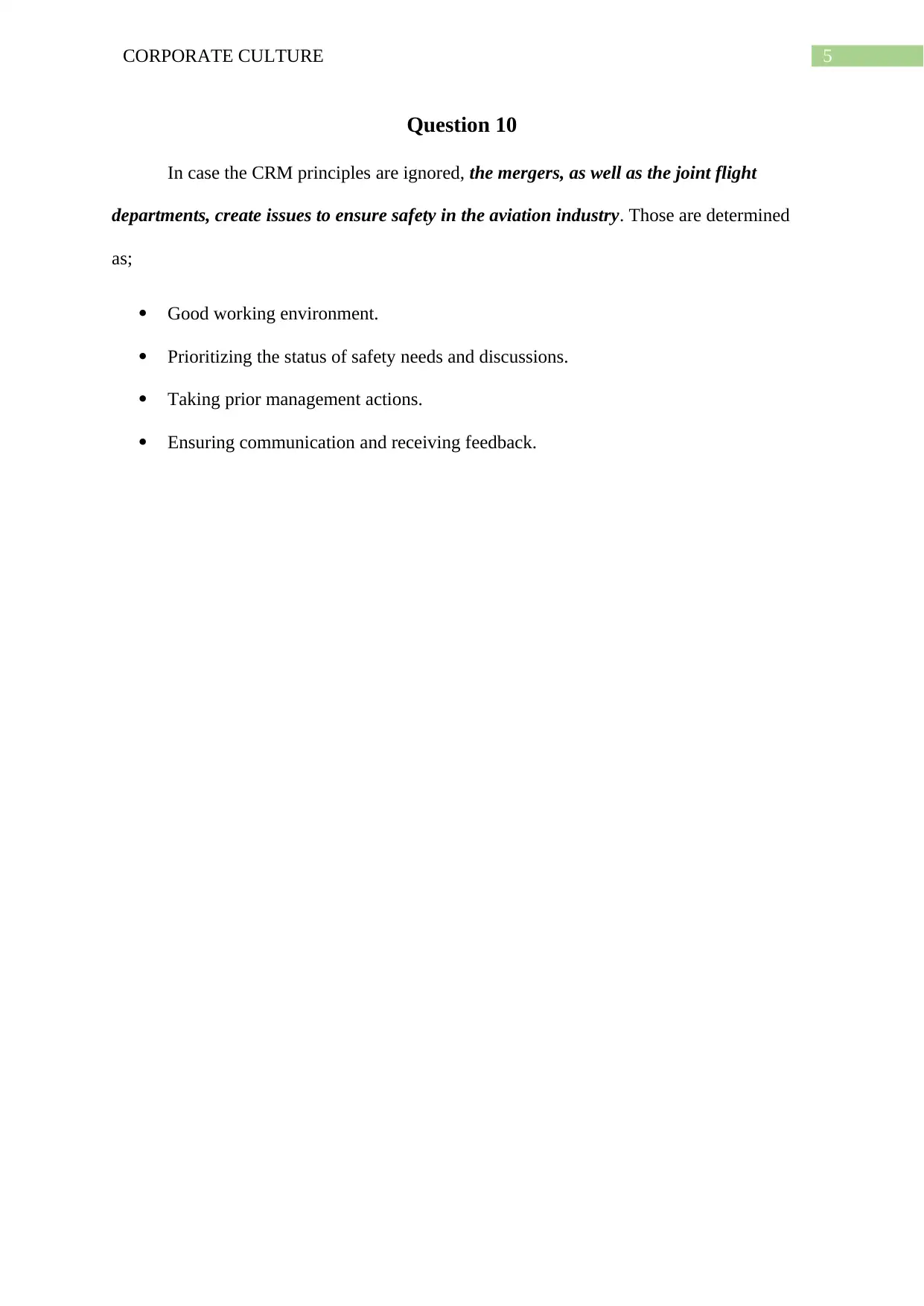
Question 10
In case the CRM principles are ignored, the mergers, as well as the joint flight
departments, create issues to ensure safety in the aviation industry. Those are determined
as;
Good working environment.
Prioritizing the status of safety needs and discussions.
Taking prior management actions.
Ensuring communication and receiving feedback.
Question 10
In case the CRM principles are ignored, the mergers, as well as the joint flight
departments, create issues to ensure safety in the aviation industry. Those are determined
as;
Good working environment.
Prioritizing the status of safety needs and discussions.
Taking prior management actions.
Ensuring communication and receiving feedback.
⊘ This is a preview!⊘
Do you want full access?
Subscribe today to unlock all pages.

Trusted by 1+ million students worldwide

6CORPORATE CULTURE
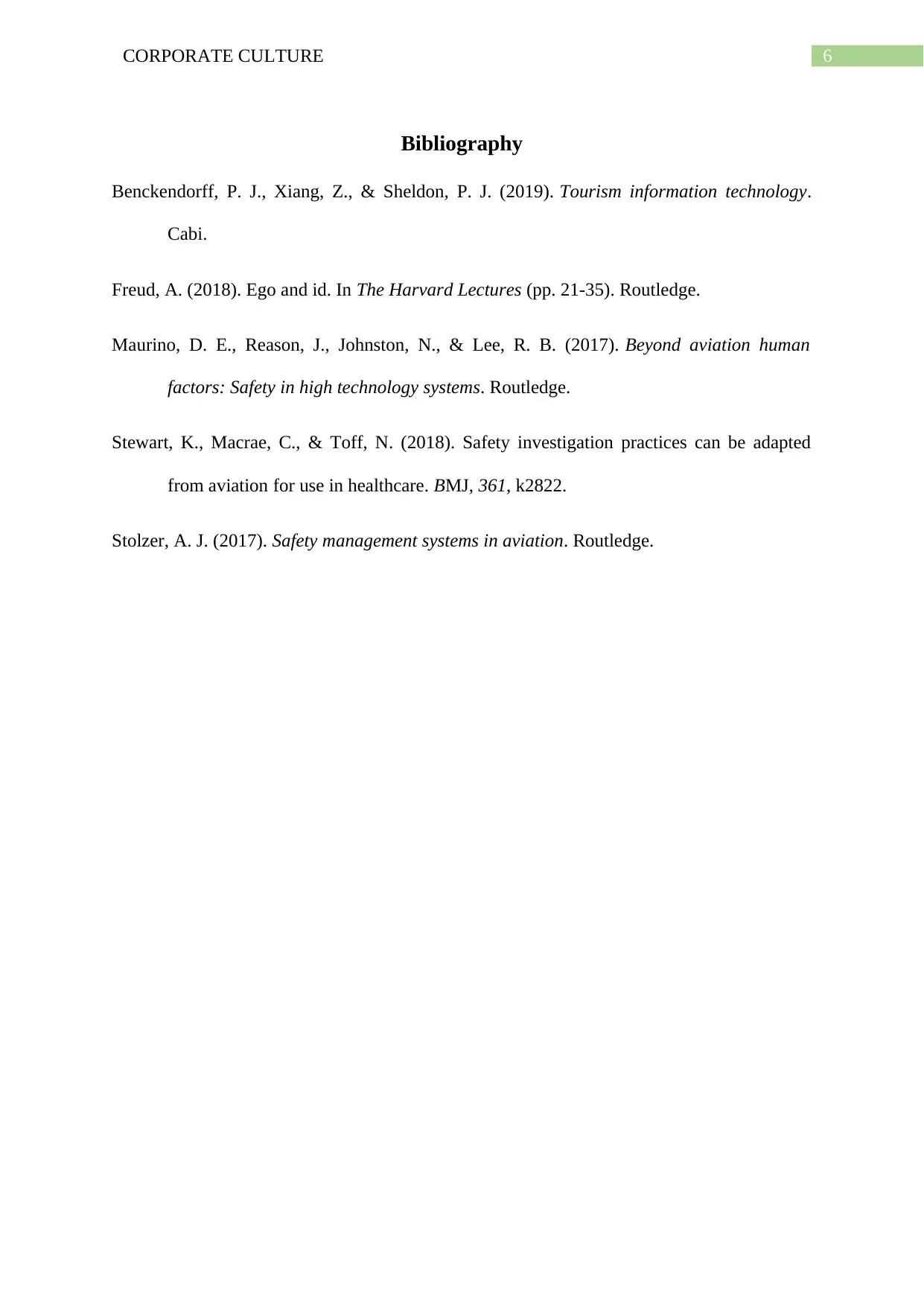
Bibliography
Benckendorff, P. J., Xiang, Z., & Sheldon, P. J. (2019). Tourism information technology.
Cabi.
Freud, A. (2018). Ego and id. In The Harvard Lectures (pp. 21-35). Routledge.
Maurino, D. E., Reason, J., Johnston, N., & Lee, R. B. (2017). Beyond aviation human
factors: Safety in high technology systems. Routledge.
Stewart, K., Macrae, C., & Toff, N. (2018). Safety investigation practices can be adapted
from aviation for use in healthcare. BMJ, 361, k2822.
Stolzer, A. J. (2017). Safety management systems in aviation. Routledge.
Bibliography
Benckendorff, P. J., Xiang, Z., & Sheldon, P. J. (2019). Tourism information technology.
Cabi.
Freud, A. (2018). Ego and id. In The Harvard Lectures (pp. 21-35). Routledge.
Maurino, D. E., Reason, J., Johnston, N., & Lee, R. B. (2017). Beyond aviation human
factors: Safety in high technology systems. Routledge.
Stewart, K., Macrae, C., & Toff, N. (2018). Safety investigation practices can be adapted
from aviation for use in healthcare. BMJ, 361, k2822.
Stolzer, A. J. (2017). Safety management systems in aviation. Routledge.
1 out of 7
Related Documents
Your All-in-One AI-Powered Toolkit for Academic Success.
+13062052269
info@desklib.com
Available 24*7 on WhatsApp / Email
Unlock your academic potential
Copyright © 2020–2025 A2Z Services. All Rights Reserved. Developed and managed by ZUCOL.