Critical Analysis: Eggleston Principles in Australian Corporate Law
VerifiedAdded on 2022/09/01
|6
|1419
|24
Report
AI Summary
This report critically analyzes the Eggleston Principles, which form the basis of Australian takeover law, ensuring efficient, informed, and competitive markets. It examines how these principles are reflected in the Australian Corporations Act 2001 (Cth), Australian case law (including ACCC v Pacific National Pty Limited and Re Arnotts Limited), and takeover practices. The report demonstrates the application of these principles, highlighting strengths like efficient control acquisition and weaknesses such as valuation complexities and customer disruptions. The discussion covers off-market bids, schemes of arrangement, and the regulatory framework, including Section 602 of the Corporations Act. The paper concludes with the need for improved regulatory frameworks to address the drawbacks and ensure less disruption in company operations. The report also references key literature by authors such as Ramsay and Bugeja, providing a comprehensive overview of the topic.
Running head: MERGERS AND ACQUISITIONS
MERGERS AND ACQUISITIONS
Name of the Student
Name of the University
Author Note
MERGERS AND ACQUISITIONS
Name of the Student
Name of the University
Author Note
Paraphrase This Document
Need a fresh take? Get an instant paraphrase of this document with our AI Paraphraser

1MERGERS AND ACQUISITIONS
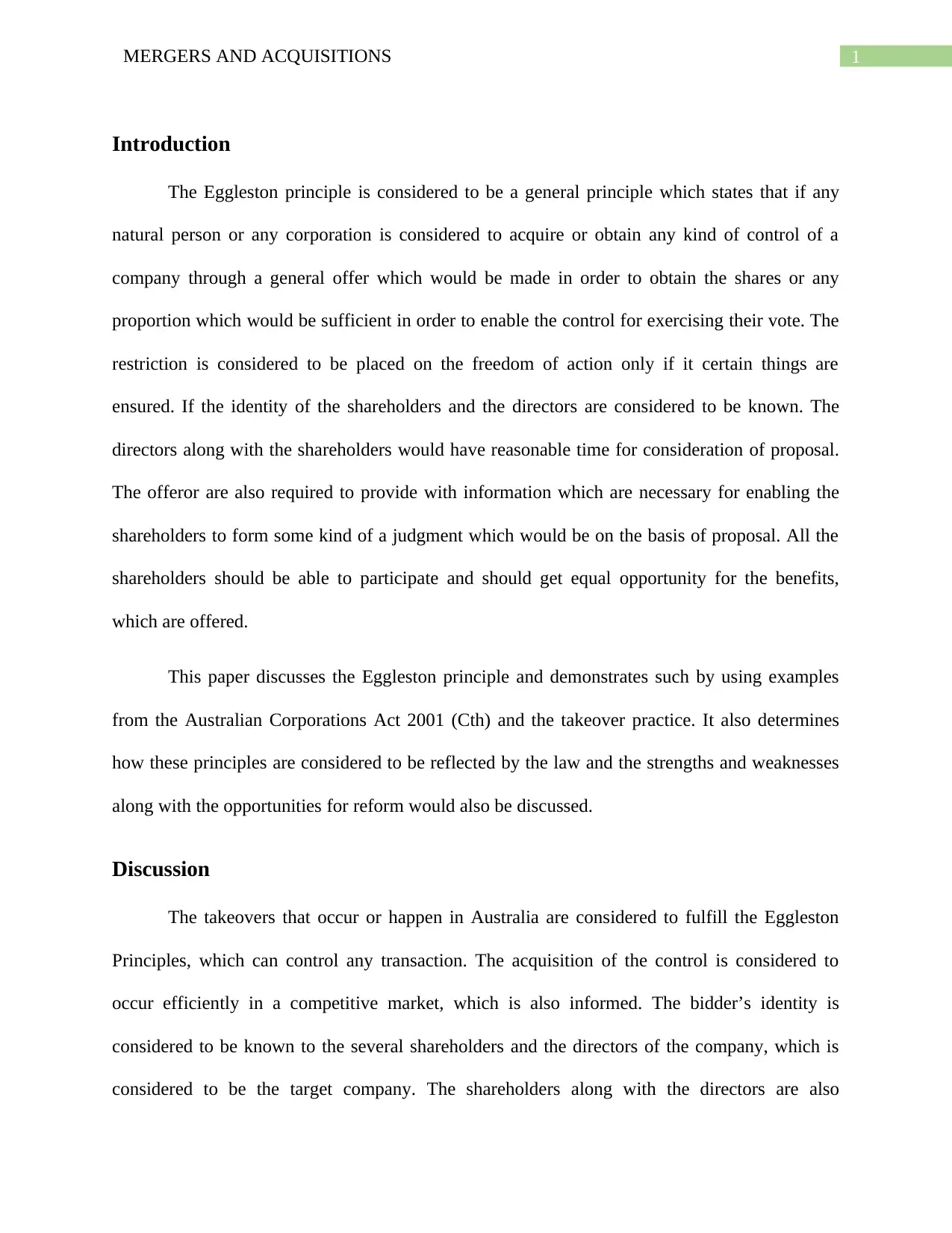
Introduction
The Eggleston principle is considered to be a general principle which states that if any
natural person or any corporation is considered to acquire or obtain any kind of control of a
company through a general offer which would be made in order to obtain the shares or any
proportion which would be sufficient in order to enable the control for exercising their vote. The
restriction is considered to be placed on the freedom of action only if it certain things are
ensured. If the identity of the shareholders and the directors are considered to be known. The
directors along with the shareholders would have reasonable time for consideration of proposal.
The offeror are also required to provide with information which are necessary for enabling the
shareholders to form some kind of a judgment which would be on the basis of proposal. All the
shareholders should be able to participate and should get equal opportunity for the benefits,
which are offered.
This paper discusses the Eggleston principle and demonstrates such by using examples
from the Australian Corporations Act 2001 (Cth) and the takeover practice. It also determines
how these principles are considered to be reflected by the law and the strengths and weaknesses
along with the opportunities for reform would also be discussed.
Discussion
The takeovers that occur or happen in Australia are considered to fulfill the Eggleston
Principles, which can control any transaction. The acquisition of the control is considered to
occur efficiently in a competitive market, which is also informed. The bidder’s identity is
considered to be known to the several shareholders and the directors of the company, which is
considered to be the target company. The shareholders along with the directors are also
Introduction
The Eggleston principle is considered to be a general principle which states that if any
natural person or any corporation is considered to acquire or obtain any kind of control of a
company through a general offer which would be made in order to obtain the shares or any
proportion which would be sufficient in order to enable the control for exercising their vote. The
restriction is considered to be placed on the freedom of action only if it certain things are
ensured. If the identity of the shareholders and the directors are considered to be known. The
directors along with the shareholders would have reasonable time for consideration of proposal.
The offeror are also required to provide with information which are necessary for enabling the
shareholders to form some kind of a judgment which would be on the basis of proposal. All the
shareholders should be able to participate and should get equal opportunity for the benefits,
which are offered.
This paper discusses the Eggleston principle and demonstrates such by using examples
from the Australian Corporations Act 2001 (Cth) and the takeover practice. It also determines
how these principles are considered to be reflected by the law and the strengths and weaknesses
along with the opportunities for reform would also be discussed.
Discussion
The takeovers that occur or happen in Australia are considered to fulfill the Eggleston
Principles, which can control any transaction. The acquisition of the control is considered to
occur efficiently in a competitive market, which is also informed. The bidder’s identity is
considered to be known to the several shareholders and the directors of the company, which is
considered to be the target company. The shareholders along with the directors are also

2MERGERS AND ACQUISITIONS
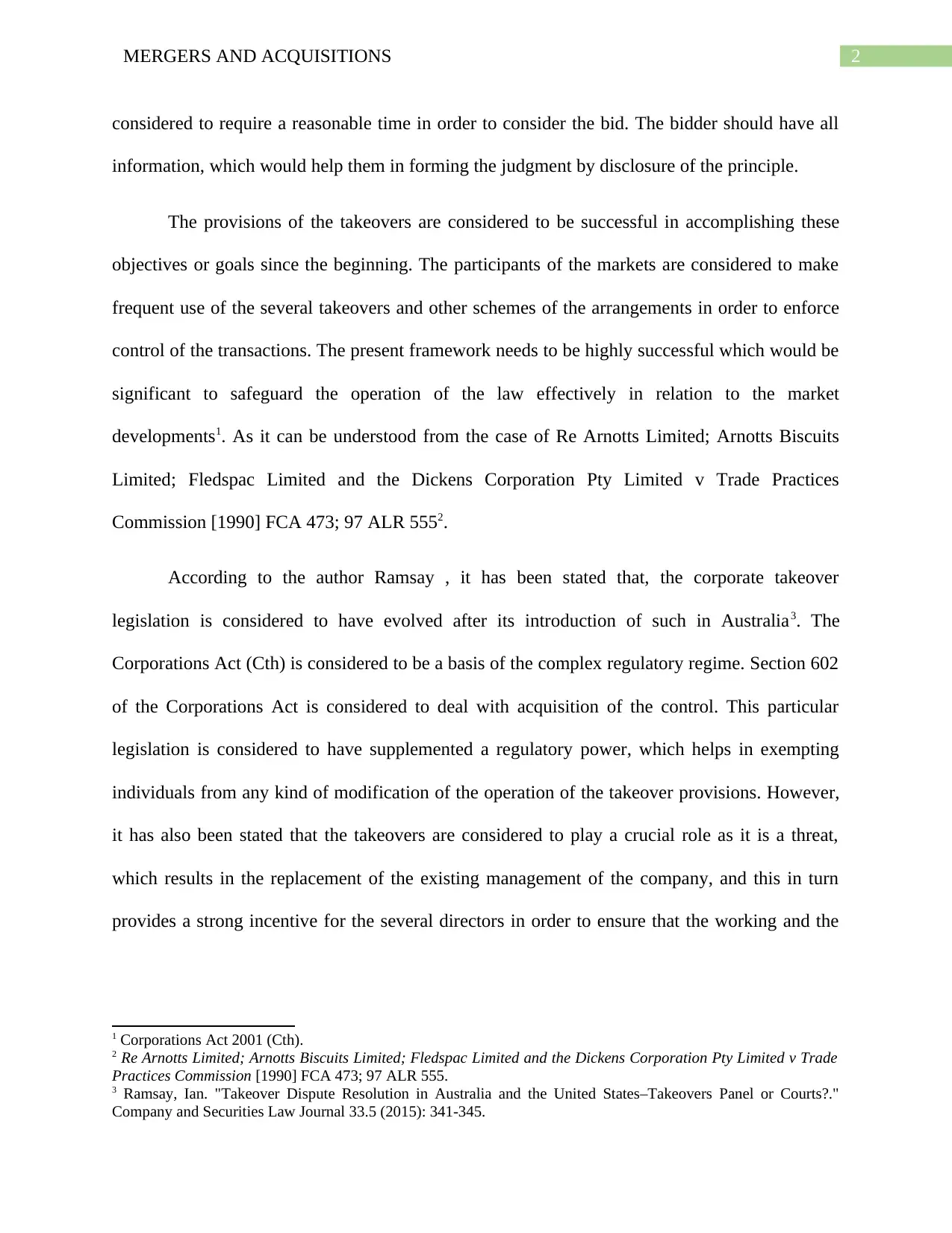
considered to require a reasonable time in order to consider the bid. The bidder should have all
information, which would help them in forming the judgment by disclosure of the principle.
The provisions of the takeovers are considered to be successful in accomplishing these
objectives or goals since the beginning. The participants of the markets are considered to make
frequent use of the several takeovers and other schemes of the arrangements in order to enforce
control of the transactions. The present framework needs to be highly successful which would be
significant to safeguard the operation of the law effectively in relation to the market
developments1. As it can be understood from the case of Re Arnotts Limited; Arnotts Biscuits
Limited; Fledspac Limited and the Dickens Corporation Pty Limited v Trade Practices
Commission [1990] FCA 473; 97 ALR 5552.
According to the author Ramsay , it has been stated that, the corporate takeover
legislation is considered to have evolved after its introduction of such in Australia3. The
Corporations Act (Cth) is considered to be a basis of the complex regulatory regime. Section 602
of the Corporations Act is considered to deal with acquisition of the control. This particular
legislation is considered to have supplemented a regulatory power, which helps in exempting
individuals from any kind of modification of the operation of the takeover provisions. However,
it has also been stated that the takeovers are considered to play a crucial role as it is a threat,
which results in the replacement of the existing management of the company, and this in turn
provides a strong incentive for the several directors in order to ensure that the working and the
1 Corporations Act 2001 (Cth).
2 Re Arnotts Limited; Arnotts Biscuits Limited; Fledspac Limited and the Dickens Corporation Pty Limited v Trade
Practices Commission [1990] FCA 473; 97 ALR 555.
3 Ramsay, Ian. "Takeover Dispute Resolution in Australia and the United States–Takeovers Panel or Courts?."
Company and Securities Law Journal 33.5 (2015): 341-345.
considered to require a reasonable time in order to consider the bid. The bidder should have all
information, which would help them in forming the judgment by disclosure of the principle.
The provisions of the takeovers are considered to be successful in accomplishing these
objectives or goals since the beginning. The participants of the markets are considered to make
frequent use of the several takeovers and other schemes of the arrangements in order to enforce
control of the transactions. The present framework needs to be highly successful which would be
significant to safeguard the operation of the law effectively in relation to the market
developments1. As it can be understood from the case of Re Arnotts Limited; Arnotts Biscuits
Limited; Fledspac Limited and the Dickens Corporation Pty Limited v Trade Practices
Commission [1990] FCA 473; 97 ALR 5552.
According to the author Ramsay , it has been stated that, the corporate takeover
legislation is considered to have evolved after its introduction of such in Australia3. The
Corporations Act (Cth) is considered to be a basis of the complex regulatory regime. Section 602
of the Corporations Act is considered to deal with acquisition of the control. This particular
legislation is considered to have supplemented a regulatory power, which helps in exempting
individuals from any kind of modification of the operation of the takeover provisions. However,
it has also been stated that the takeovers are considered to play a crucial role as it is a threat,
which results in the replacement of the existing management of the company, and this in turn
provides a strong incentive for the several directors in order to ensure that the working and the
1 Corporations Act 2001 (Cth).
2 Re Arnotts Limited; Arnotts Biscuits Limited; Fledspac Limited and the Dickens Corporation Pty Limited v Trade
Practices Commission [1990] FCA 473; 97 ALR 555.
3 Ramsay, Ian. "Takeover Dispute Resolution in Australia and the United States–Takeovers Panel or Courts?."
Company and Securities Law Journal 33.5 (2015): 341-345.
⊘ This is a preview!⊘
Do you want full access?
Subscribe today to unlock all pages.

Trusted by 1+ million students worldwide

3MERGERS AND ACQUISITIONS
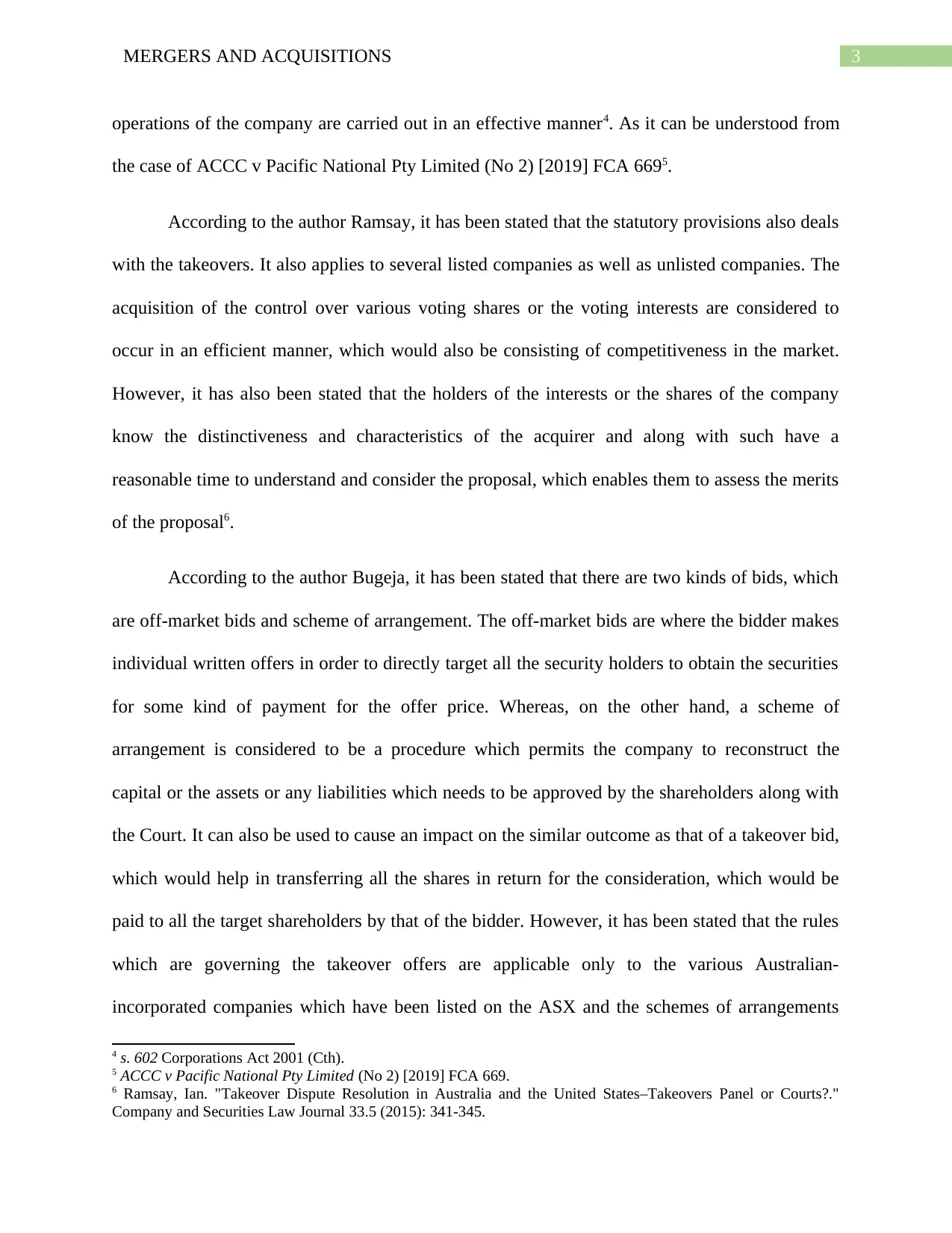
operations of the company are carried out in an effective manner4. As it can be understood from
the case of ACCC v Pacific National Pty Limited (No 2) [2019] FCA 6695.
According to the author Ramsay, it has been stated that the statutory provisions also deals
with the takeovers. It also applies to several listed companies as well as unlisted companies. The
acquisition of the control over various voting shares or the voting interests are considered to
occur in an efficient manner, which would also be consisting of competitiveness in the market.
However, it has also been stated that the holders of the interests or the shares of the company
know the distinctiveness and characteristics of the acquirer and along with such have a
reasonable time to understand and consider the proposal, which enables them to assess the merits
of the proposal6.
According to the author Bugeja, it has been stated that there are two kinds of bids, which
are off-market bids and scheme of arrangement. The off-market bids are where the bidder makes
individual written offers in order to directly target all the security holders to obtain the securities
for some kind of payment for the offer price. Whereas, on the other hand, a scheme of
arrangement is considered to be a procedure which permits the company to reconstruct the
capital or the assets or any liabilities which needs to be approved by the shareholders along with
the Court. It can also be used to cause an impact on the similar outcome as that of a takeover bid,
which would help in transferring all the shares in return for the consideration, which would be
paid to all the target shareholders by that of the bidder. However, it has been stated that the rules
which are governing the takeover offers are applicable only to the various Australian-
incorporated companies which have been listed on the ASX and the schemes of arrangements
4 s. 602 Corporations Act 2001 (Cth).
5 ACCC v Pacific National Pty Limited (No 2) [2019] FCA 669.
6 Ramsay, Ian. "Takeover Dispute Resolution in Australia and the United States–Takeovers Panel or Courts?."
Company and Securities Law Journal 33.5 (2015): 341-345.
operations of the company are carried out in an effective manner4. As it can be understood from
the case of ACCC v Pacific National Pty Limited (No 2) [2019] FCA 6695.
According to the author Ramsay, it has been stated that the statutory provisions also deals
with the takeovers. It also applies to several listed companies as well as unlisted companies. The
acquisition of the control over various voting shares or the voting interests are considered to
occur in an efficient manner, which would also be consisting of competitiveness in the market.
However, it has also been stated that the holders of the interests or the shares of the company
know the distinctiveness and characteristics of the acquirer and along with such have a
reasonable time to understand and consider the proposal, which enables them to assess the merits
of the proposal6.
According to the author Bugeja, it has been stated that there are two kinds of bids, which
are off-market bids and scheme of arrangement. The off-market bids are where the bidder makes
individual written offers in order to directly target all the security holders to obtain the securities
for some kind of payment for the offer price. Whereas, on the other hand, a scheme of
arrangement is considered to be a procedure which permits the company to reconstruct the
capital or the assets or any liabilities which needs to be approved by the shareholders along with
the Court. It can also be used to cause an impact on the similar outcome as that of a takeover bid,
which would help in transferring all the shares in return for the consideration, which would be
paid to all the target shareholders by that of the bidder. However, it has been stated that the rules
which are governing the takeover offers are applicable only to the various Australian-
incorporated companies which have been listed on the ASX and the schemes of arrangements
4 s. 602 Corporations Act 2001 (Cth).
5 ACCC v Pacific National Pty Limited (No 2) [2019] FCA 669.
6 Ramsay, Ian. "Takeover Dispute Resolution in Australia and the United States–Takeovers Panel or Courts?."
Company and Securities Law Journal 33.5 (2015): 341-345.
Paraphrase This Document
Need a fresh take? Get an instant paraphrase of this document with our AI Paraphraser

4MERGERS AND ACQUISITIONS
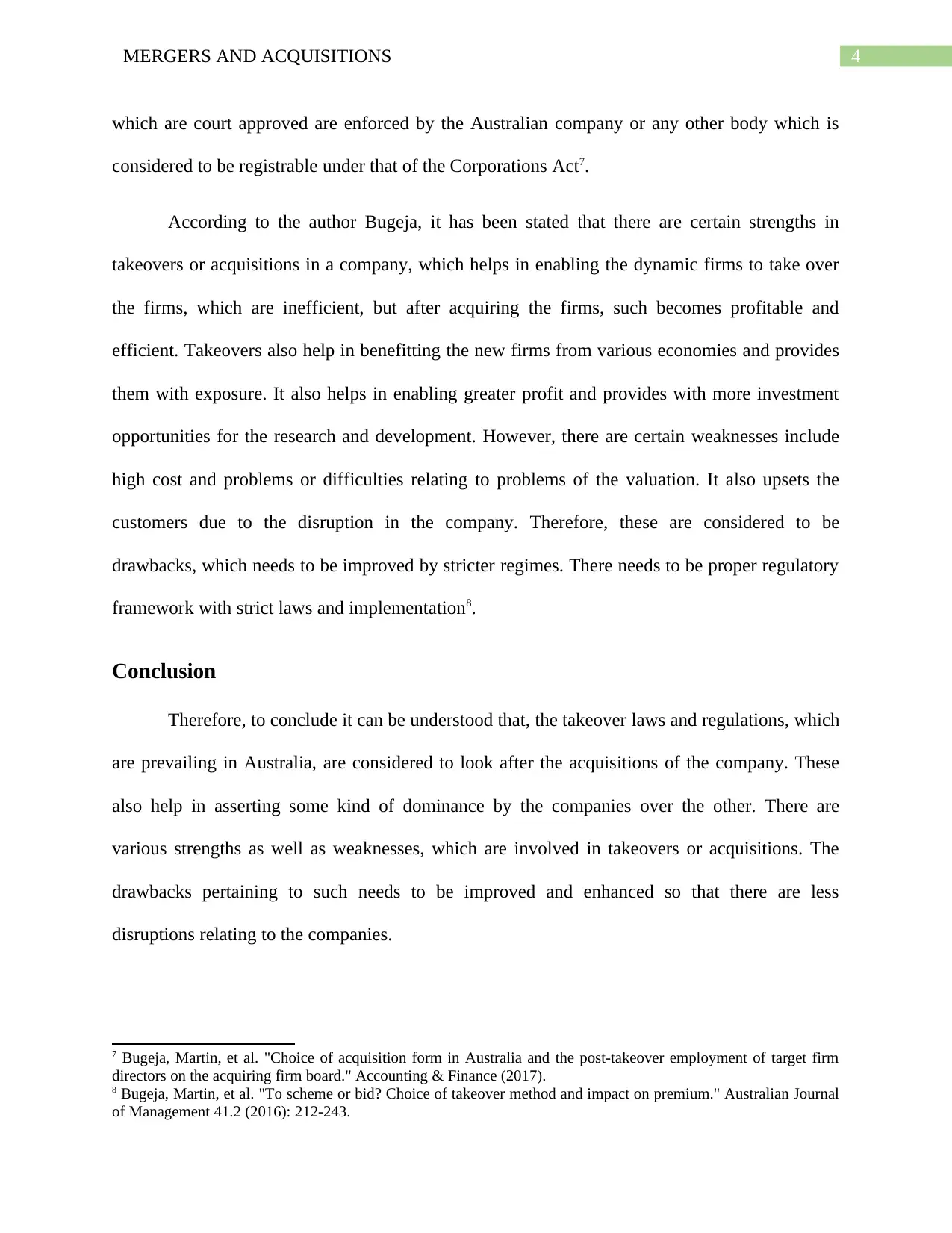
which are court approved are enforced by the Australian company or any other body which is
considered to be registrable under that of the Corporations Act7.
According to the author Bugeja, it has been stated that there are certain strengths in
takeovers or acquisitions in a company, which helps in enabling the dynamic firms to take over
the firms, which are inefficient, but after acquiring the firms, such becomes profitable and
efficient. Takeovers also help in benefitting the new firms from various economies and provides
them with exposure. It also helps in enabling greater profit and provides with more investment
opportunities for the research and development. However, there are certain weaknesses include
high cost and problems or difficulties relating to problems of the valuation. It also upsets the
customers due to the disruption in the company. Therefore, these are considered to be
drawbacks, which needs to be improved by stricter regimes. There needs to be proper regulatory
framework with strict laws and implementation8.
Conclusion
Therefore, to conclude it can be understood that, the takeover laws and regulations, which
are prevailing in Australia, are considered to look after the acquisitions of the company. These
also help in asserting some kind of dominance by the companies over the other. There are
various strengths as well as weaknesses, which are involved in takeovers or acquisitions. The
drawbacks pertaining to such needs to be improved and enhanced so that there are less
disruptions relating to the companies.
7 Bugeja, Martin, et al. "Choice of acquisition form in Australia and the post‐takeover employment of target firm
directors on the acquiring firm board." Accounting & Finance (2017).
8 Bugeja, Martin, et al. "To scheme or bid? Choice of takeover method and impact on premium." Australian Journal
of Management 41.2 (2016): 212-243.
which are court approved are enforced by the Australian company or any other body which is
considered to be registrable under that of the Corporations Act7.
According to the author Bugeja, it has been stated that there are certain strengths in
takeovers or acquisitions in a company, which helps in enabling the dynamic firms to take over
the firms, which are inefficient, but after acquiring the firms, such becomes profitable and
efficient. Takeovers also help in benefitting the new firms from various economies and provides
them with exposure. It also helps in enabling greater profit and provides with more investment
opportunities for the research and development. However, there are certain weaknesses include
high cost and problems or difficulties relating to problems of the valuation. It also upsets the
customers due to the disruption in the company. Therefore, these are considered to be
drawbacks, which needs to be improved by stricter regimes. There needs to be proper regulatory
framework with strict laws and implementation8.
Conclusion
Therefore, to conclude it can be understood that, the takeover laws and regulations, which
are prevailing in Australia, are considered to look after the acquisitions of the company. These
also help in asserting some kind of dominance by the companies over the other. There are
various strengths as well as weaknesses, which are involved in takeovers or acquisitions. The
drawbacks pertaining to such needs to be improved and enhanced so that there are less
disruptions relating to the companies.
7 Bugeja, Martin, et al. "Choice of acquisition form in Australia and the post‐takeover employment of target firm
directors on the acquiring firm board." Accounting & Finance (2017).
8 Bugeja, Martin, et al. "To scheme or bid? Choice of takeover method and impact on premium." Australian Journal
of Management 41.2 (2016): 212-243.

5MERGERS AND ACQUISITIONS
Bibliography
Case Laws
ACCC v Pacific National Pty Limited (No 2) [2019] FCA 669.
Re Arnotts Limited; Arnotts Biscuits Limited; Fledspac Limited and the Dickens Corporation Pty
Limited v Trade Practices Commission [1990] FCA 473; 97 ALR 555.
Books, Journals and Articles
Bugeja, Martin, et al. "Choice of acquisition form in Australia and the post‐takeover employment
of target firm directors on the acquiring firm board." Accounting & Finance (2017).
Bugeja, Martin, et al. "To scheme or bid? Choice of takeover method and impact on premium."
Australian Journal of Management 41.2 (2016): 212-243.
Ramsay, Ian. "Takeover Dispute Resolution in Australia and the United States–Takeovers Panel
or Courts?." Company and Securities Law Journal 33.5 (2015): 341-345.
Legislation
Corporations Act 2001 (Cth).
s. 602 Corporations Act 2001 (Cth).
Bibliography
Case Laws
ACCC v Pacific National Pty Limited (No 2) [2019] FCA 669.
Re Arnotts Limited; Arnotts Biscuits Limited; Fledspac Limited and the Dickens Corporation Pty
Limited v Trade Practices Commission [1990] FCA 473; 97 ALR 555.
Books, Journals and Articles
Bugeja, Martin, et al. "Choice of acquisition form in Australia and the post‐takeover employment
of target firm directors on the acquiring firm board." Accounting & Finance (2017).
Bugeja, Martin, et al. "To scheme or bid? Choice of takeover method and impact on premium."
Australian Journal of Management 41.2 (2016): 212-243.
Ramsay, Ian. "Takeover Dispute Resolution in Australia and the United States–Takeovers Panel
or Courts?." Company and Securities Law Journal 33.5 (2015): 341-345.
Legislation
Corporations Act 2001 (Cth).
s. 602 Corporations Act 2001 (Cth).
⊘ This is a preview!⊘
Do you want full access?
Subscribe today to unlock all pages.

Trusted by 1+ million students worldwide
1 out of 6
Related Documents
Your All-in-One AI-Powered Toolkit for Academic Success.
+13062052269
info@desklib.com
Available 24*7 on WhatsApp / Email
Unlock your academic potential
Copyright © 2020–2025 A2Z Services. All Rights Reserved. Developed and managed by ZUCOL.