Kaplan Business School FIN203: Corporate Finance Assignment Report
VerifiedAdded on 2022/09/17
|12
|2366
|21
AI Summary
This document presents a comprehensive analysis of a corporate finance assignment, focusing on Amazon's financial performance and investment decisions. The assignment begins with an examination of Amazon's cash conversion cycle (CCC) compared to Walmart in 2014, highlighting Amazon's strong working capital management due to its negative CCC. The analysis further explores the implications of a negative CCC for investment in new products and discusses financing options like issuing shares or taking loans. The document also compares Amazon's CCC from 2014 to 2018, identifying significant risks such as intense competition, fluctuations in operational results, and challenges in expanding new products and services. The assignment then delves into bond valuation, calculating the market value and holding period return of a bond. Part B examines the impact of opening new stores on Amazon's free cash flow, calculates the net present value (NPV) and internal rate of return (IRR) for a project, and evaluates the payback period. It also discusses the weaknesses of cash flow forecasting and concludes with a recommendation on whether to accept the Amazon Go project based on NPV and IRR results. References are provided to support the analysis.
Running head: CORPORATE FINANCE
Corporate finance
Name of the Student
Name of the University
Author Note
Corporate finance
Name of the Student
Name of the University
Author Note

Paraphrase This Document
Need a fresh take? Get an instant paraphrase of this document with our AI Paraphraser
CORPORATE FINANCE
Table of Contents
Introduction................................................................................................................................2
Part A:........................................................................................................................................2
Answer to requirement 1:...........................................................................................................2
Answer to requirement 2:...........................................................................................................2
Answer to requirement 3:...........................................................................................................3
Answer to requirement 4:...........................................................................................................4
Answer to requirement 5:...........................................................................................................4
Answer to requirement 6:...........................................................................................................5
Answer to requirement 7:...........................................................................................................6
Part B:.........................................................................................................................................6
Answer to requirement 1:...........................................................................................................6
Answer to requirement 2:...........................................................................................................6
Answer to requirement 3:...........................................................................................................6
Answer to requirement 4:...........................................................................................................7
Answer to requirement 5:...........................................................................................................7
Table of Contents
Introduction................................................................................................................................2
Part A:........................................................................................................................................2
Answer to requirement 1:...........................................................................................................2
Answer to requirement 2:...........................................................................................................2
Answer to requirement 3:...........................................................................................................3
Answer to requirement 4:...........................................................................................................4
Answer to requirement 5:...........................................................................................................4
Answer to requirement 6:...........................................................................................................5
Answer to requirement 7:...........................................................................................................6
Part B:.........................................................................................................................................6
Answer to requirement 1:...........................................................................................................6
Answer to requirement 2:...........................................................................................................6
Answer to requirement 3:...........................................................................................................6
Answer to requirement 4:...........................................................................................................7
Answer to requirement 5:...........................................................................................................7
CORPORATE FINANCE
Introduction
Part A:
Answer to requirement 1:
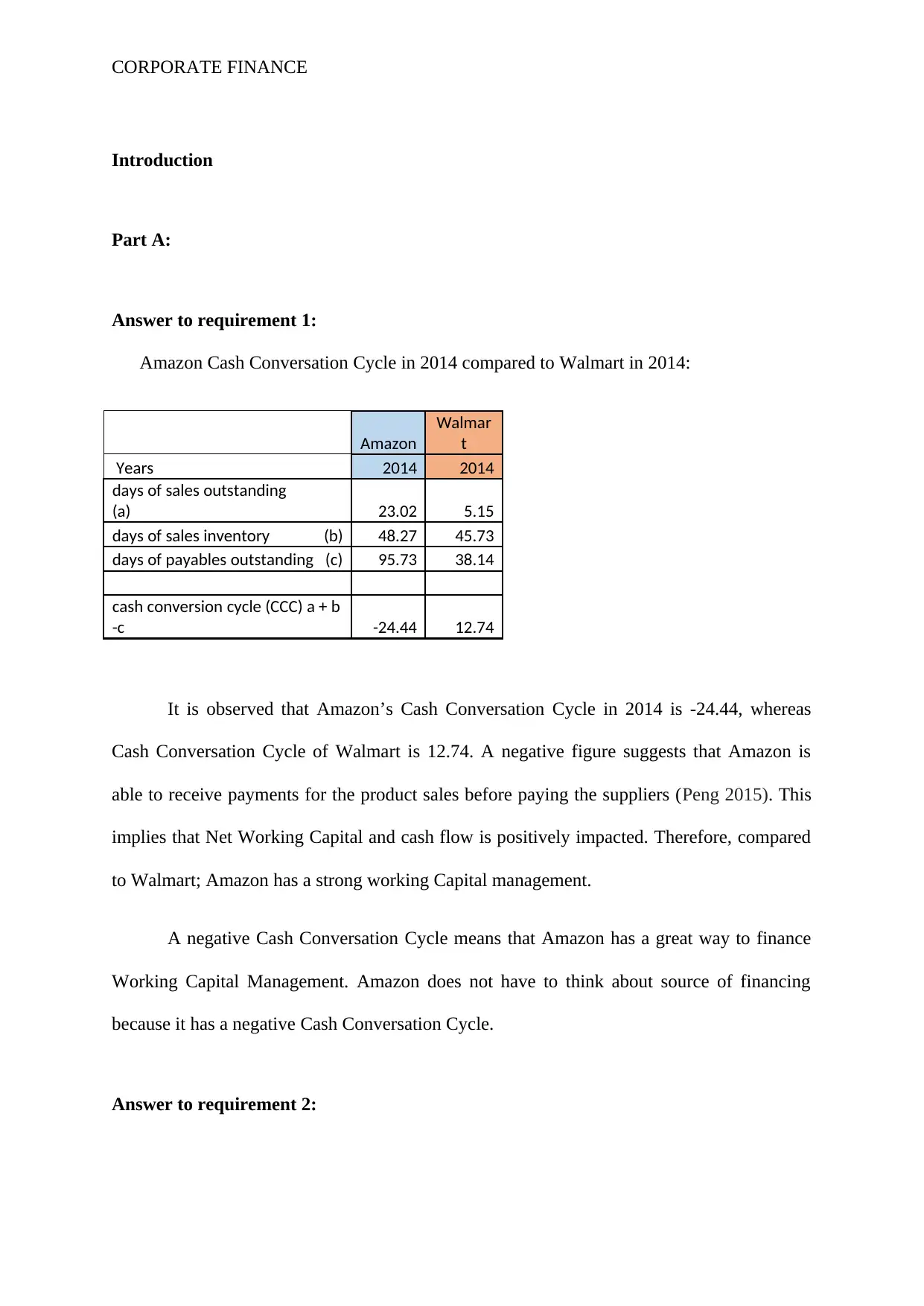
Amazon Cash Conversation Cycle in 2014 compared to Walmart in 2014:
Amazon
Walmar
t
Years 2014 2014
days of sales outstanding
(a) 23.02 5.15
days of sales inventory (b) 48.27 45.73
days of payables outstanding (c) 95.73 38.14
cash conversion cycle (CCC) a + b
-c -24.44 12.74
It is observed that Amazon’s Cash Conversation Cycle in 2014 is -24.44, whereas
Cash Conversation Cycle of Walmart is 12.74. A negative figure suggests that Amazon is
able to receive payments for the product sales before paying the suppliers (Peng 2015). This
implies that Net Working Capital and cash flow is positively impacted. Therefore, compared
to Walmart; Amazon has a strong working Capital management.
A negative Cash Conversation Cycle means that Amazon has a great way to finance
Working Capital Management. Amazon does not have to think about source of financing
because it has a negative Cash Conversation Cycle.
Answer to requirement 2:
Introduction
Part A:
Answer to requirement 1:
Amazon Cash Conversation Cycle in 2014 compared to Walmart in 2014:
Amazon
Walmar
t
Years 2014 2014
days of sales outstanding
(a) 23.02 5.15
days of sales inventory (b) 48.27 45.73
days of payables outstanding (c) 95.73 38.14
cash conversion cycle (CCC) a + b
-c -24.44 12.74
It is observed that Amazon’s Cash Conversation Cycle in 2014 is -24.44, whereas
Cash Conversation Cycle of Walmart is 12.74. A negative figure suggests that Amazon is
able to receive payments for the product sales before paying the suppliers (Peng 2015). This
implies that Net Working Capital and cash flow is positively impacted. Therefore, compared
to Walmart; Amazon has a strong working Capital management.
A negative Cash Conversation Cycle means that Amazon has a great way to finance
Working Capital Management. Amazon does not have to think about source of financing
because it has a negative Cash Conversation Cycle.
Answer to requirement 2:
⊘ This is a preview!⊘
Do you want full access?
Subscribe today to unlock all pages.

Trusted by 1+ million students worldwide
CORPORATE FINANCE
It is observed that negative Cash Conversation Cycle gives a positive impact on a
company, it is also has a positive effect if a company wants to invest in new products.
According to the source 2, it is observed that if the cash were used only to finance the
company then company would have continuous growth. The company does not need to
borrow the money, after the payment to the suppliers, the goods are to be manufactured and
the sales is initiated. Through this cycle of Cash Conversion, the company will succeed with
the investing in the new products development (Ogneva et al. 2018).
Answer to requirement 3:
To fund new projects, the financing option other than cash that can be used by
Amazon is issuing share to the public and the other is taking a loan from financial
institutions.
The positive side of issue of share is that the public will invest the money for the
growth or the expansion of the company. There will be no repayments, as there will be a
return like dividends against the shares. The negative side of issuing share is that the
company is giving away the ownership to the investors i.e. the shareholders. They have their
rights to vote on issues that the company decide (Habib and Hasan 2018). Therefore, shares
can be issued by the company that will in expansion.
The other option, which the Amazon can opt for, is to get a loan from any financial
institution. The positive side of taking a loan is that the interest is tax deductible and for many
business loan the interest rate can be fixed because it is easy for the business to plan for a
longer time. Bank loan is temporary; Amazon can repay the loan when they want to. The
It is observed that negative Cash Conversation Cycle gives a positive impact on a
company, it is also has a positive effect if a company wants to invest in new products.
According to the source 2, it is observed that if the cash were used only to finance the
company then company would have continuous growth. The company does not need to
borrow the money, after the payment to the suppliers, the goods are to be manufactured and
the sales is initiated. Through this cycle of Cash Conversion, the company will succeed with
the investing in the new products development (Ogneva et al. 2018).
Answer to requirement 3:
To fund new projects, the financing option other than cash that can be used by
Amazon is issuing share to the public and the other is taking a loan from financial
institutions.
The positive side of issue of share is that the public will invest the money for the
growth or the expansion of the company. There will be no repayments, as there will be a
return like dividends against the shares. The negative side of issuing share is that the
company is giving away the ownership to the investors i.e. the shareholders. They have their
rights to vote on issues that the company decide (Habib and Hasan 2018). Therefore, shares
can be issued by the company that will in expansion.
The other option, which the Amazon can opt for, is to get a loan from any financial
institution. The positive side of taking a loan is that the interest is tax deductible and for many
business loan the interest rate can be fixed because it is easy for the business to plan for a
longer time. Bank loan is temporary; Amazon can repay the loan when they want to. The
Paraphrase This Document
Need a fresh take? Get an instant paraphrase of this document with our AI Paraphraser
CORPORATE FINANCE
negative side of taking a loan is that there can be a higher interest rate, so the company
should have a proper financial plan before taking a loan (Foley and Manova 2015).
Answer to requirement 4:
Amazon
year 2014 2018
days of sales outstanding (a) 23.02 26.14
days of sales inventory (b) 48.27 45.05
days of payables outstanding (c) 95.73
100.1
8
cash conversion cycle (CCC) a + b -c -24.44
-
28.99
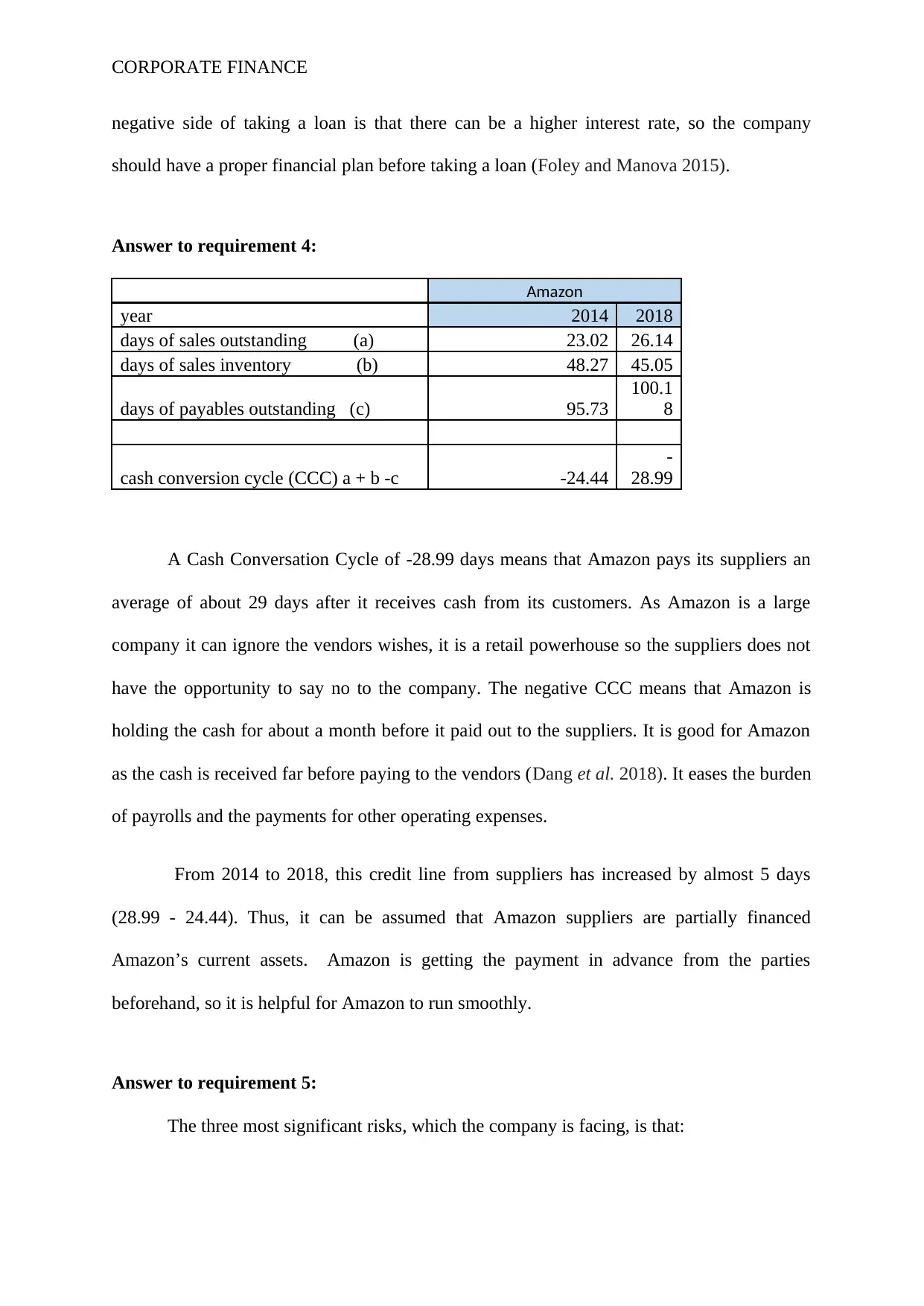
A Cash Conversation Cycle of -28.99 days means that Amazon pays its suppliers an
average of about 29 days after it receives cash from its customers. As Amazon is a large
company it can ignore the vendors wishes, it is a retail powerhouse so the suppliers does not
have the opportunity to say no to the company. The negative CCC means that Amazon is
holding the cash for about a month before it paid out to the suppliers. It is good for Amazon
as the cash is received far before paying to the vendors (Dang et al. 2018). It eases the burden
of payrolls and the payments for other operating expenses.
From 2014 to 2018, this credit line from suppliers has increased by almost 5 days
(28.99 - 24.44). Thus, it can be assumed that Amazon suppliers are partially financed
Amazon’s current assets. Amazon is getting the payment in advance from the parties
beforehand, so it is helpful for Amazon to run smoothly.
Answer to requirement 5:
The three most significant risks, which the company is facing, is that:
negative side of taking a loan is that there can be a higher interest rate, so the company
should have a proper financial plan before taking a loan (Foley and Manova 2015).
Answer to requirement 4:
Amazon
year 2014 2018
days of sales outstanding (a) 23.02 26.14
days of sales inventory (b) 48.27 45.05
days of payables outstanding (c) 95.73
100.1
8
cash conversion cycle (CCC) a + b -c -24.44
-
28.99
A Cash Conversation Cycle of -28.99 days means that Amazon pays its suppliers an
average of about 29 days after it receives cash from its customers. As Amazon is a large
company it can ignore the vendors wishes, it is a retail powerhouse so the suppliers does not
have the opportunity to say no to the company. The negative CCC means that Amazon is
holding the cash for about a month before it paid out to the suppliers. It is good for Amazon
as the cash is received far before paying to the vendors (Dang et al. 2018). It eases the burden
of payrolls and the payments for other operating expenses.
From 2014 to 2018, this credit line from suppliers has increased by almost 5 days
(28.99 - 24.44). Thus, it can be assumed that Amazon suppliers are partially financed
Amazon’s current assets. Amazon is getting the payment in advance from the parties
beforehand, so it is helpful for Amazon to run smoothly.
Answer to requirement 5:
The three most significant risks, which the company is facing, is that:
CORPORATE FINANCE
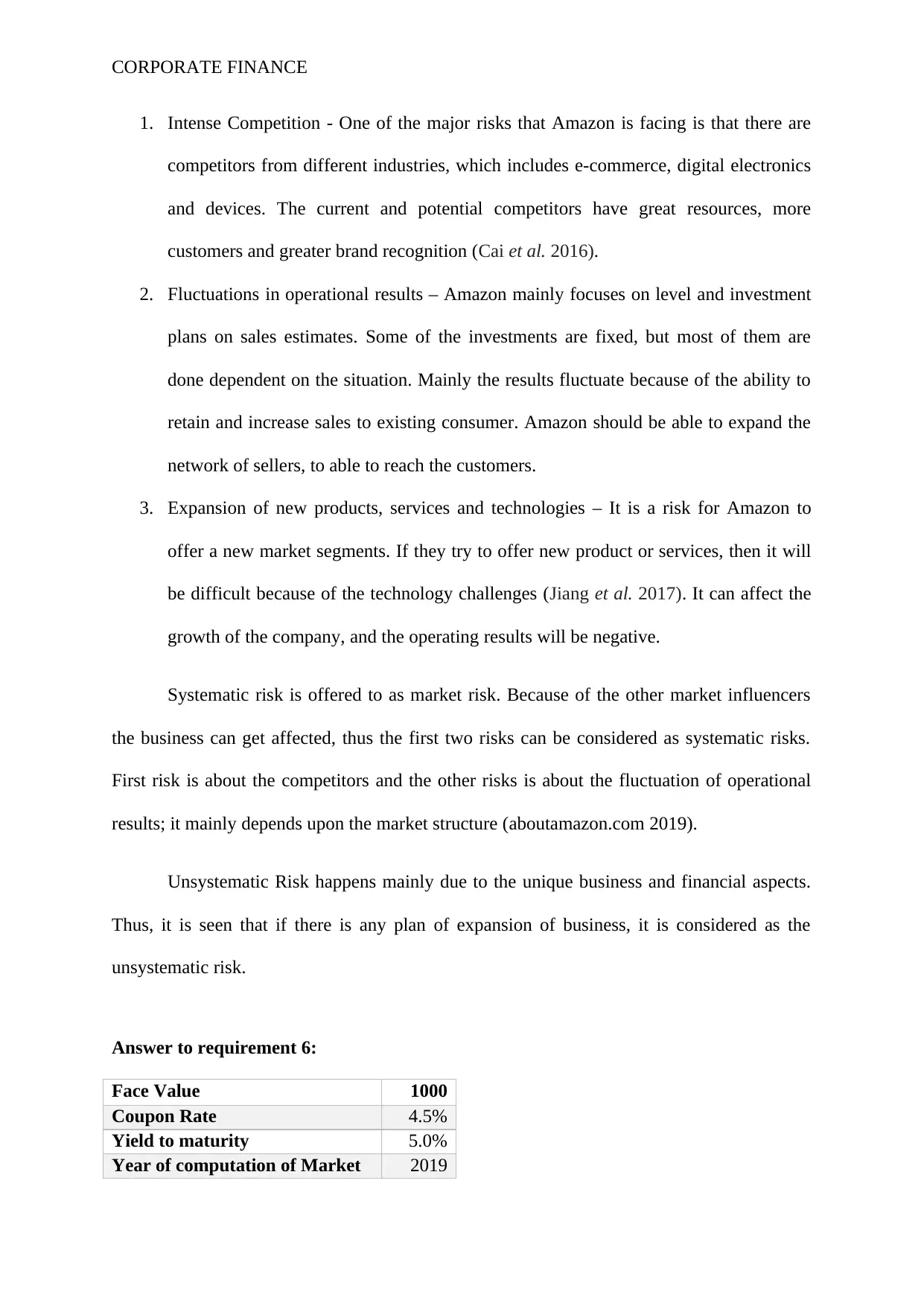
1. Intense Competition - One of the major risks that Amazon is facing is that there are
competitors from different industries, which includes e-commerce, digital electronics
and devices. The current and potential competitors have great resources, more
customers and greater brand recognition (Cai et al. 2016).
2. Fluctuations in operational results – Amazon mainly focuses on level and investment
plans on sales estimates. Some of the investments are fixed, but most of them are
done dependent on the situation. Mainly the results fluctuate because of the ability to
retain and increase sales to existing consumer. Amazon should be able to expand the
network of sellers, to able to reach the customers.
3. Expansion of new products, services and technologies – It is a risk for Amazon to
offer a new market segments. If they try to offer new product or services, then it will
be difficult because of the technology challenges (Jiang et al. 2017). It can affect the
growth of the company, and the operating results will be negative.
Systematic risk is offered to as market risk. Because of the other market influencers
the business can get affected, thus the first two risks can be considered as systematic risks.
First risk is about the competitors and the other risks is about the fluctuation of operational
results; it mainly depends upon the market structure (aboutamazon.com 2019).
Unsystematic Risk happens mainly due to the unique business and financial aspects.
Thus, it is seen that if there is any plan of expansion of business, it is considered as the
unsystematic risk.
Answer to requirement 6:
Face Value 1000
Coupon Rate 4.5%
Yield to maturity 5.0%
Year of computation of Market 2019
1. Intense Competition - One of the major risks that Amazon is facing is that there are
competitors from different industries, which includes e-commerce, digital electronics
and devices. The current and potential competitors have great resources, more
customers and greater brand recognition (Cai et al. 2016).
2. Fluctuations in operational results – Amazon mainly focuses on level and investment
plans on sales estimates. Some of the investments are fixed, but most of them are
done dependent on the situation. Mainly the results fluctuate because of the ability to
retain and increase sales to existing consumer. Amazon should be able to expand the
network of sellers, to able to reach the customers.
3. Expansion of new products, services and technologies – It is a risk for Amazon to
offer a new market segments. If they try to offer new product or services, then it will
be difficult because of the technology challenges (Jiang et al. 2017). It can affect the
growth of the company, and the operating results will be negative.
Systematic risk is offered to as market risk. Because of the other market influencers
the business can get affected, thus the first two risks can be considered as systematic risks.
First risk is about the competitors and the other risks is about the fluctuation of operational
results; it mainly depends upon the market structure (aboutamazon.com 2019).
Unsystematic Risk happens mainly due to the unique business and financial aspects.
Thus, it is seen that if there is any plan of expansion of business, it is considered as the
unsystematic risk.
Answer to requirement 6:
Face Value 1000
Coupon Rate 4.5%
Yield to maturity 5.0%
Year of computation of Market 2019
⊘ This is a preview!⊘
Do you want full access?
Subscribe today to unlock all pages.
Trusted by 1+ million students worldwide
CORPORATE FINANCE
Price
Year of maturity 2020
Market value at the end of 2019 995.24
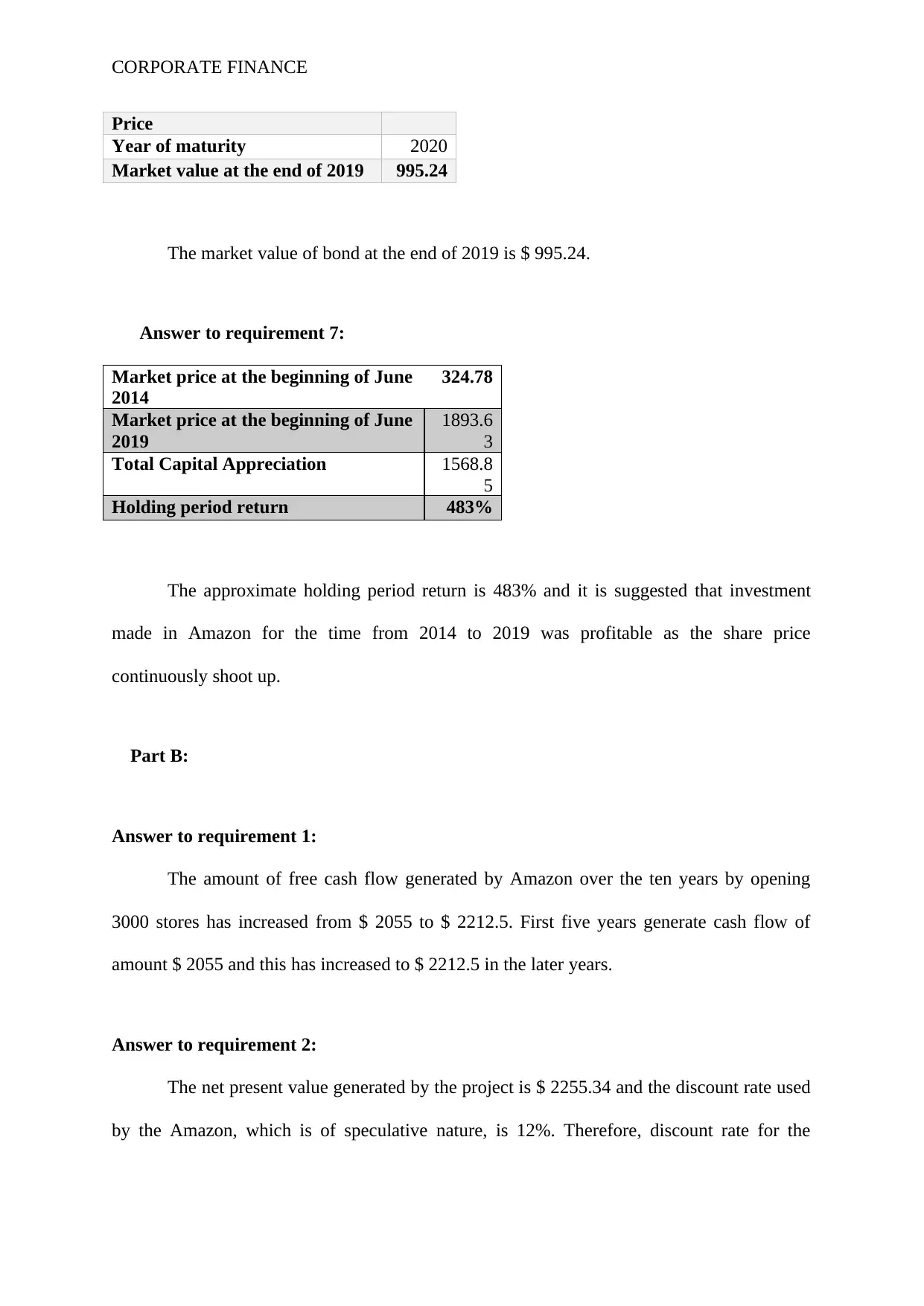
The market value of bond at the end of 2019 is $ 995.24.
Answer to requirement 7:
Market price at the beginning of June
2014
324.78
Market price at the beginning of June
2019
1893.6
3
Total Capital Appreciation 1568.8
5
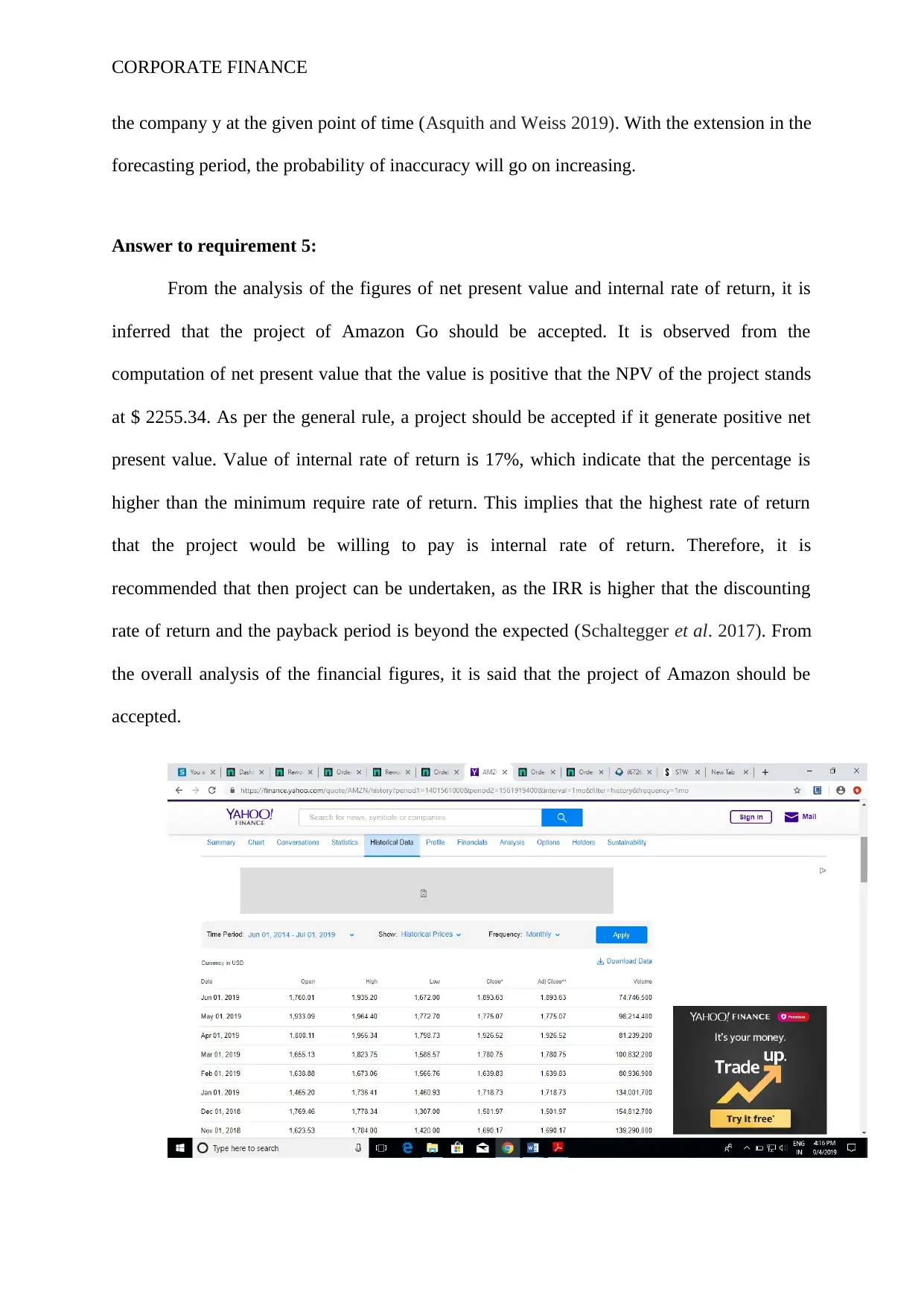
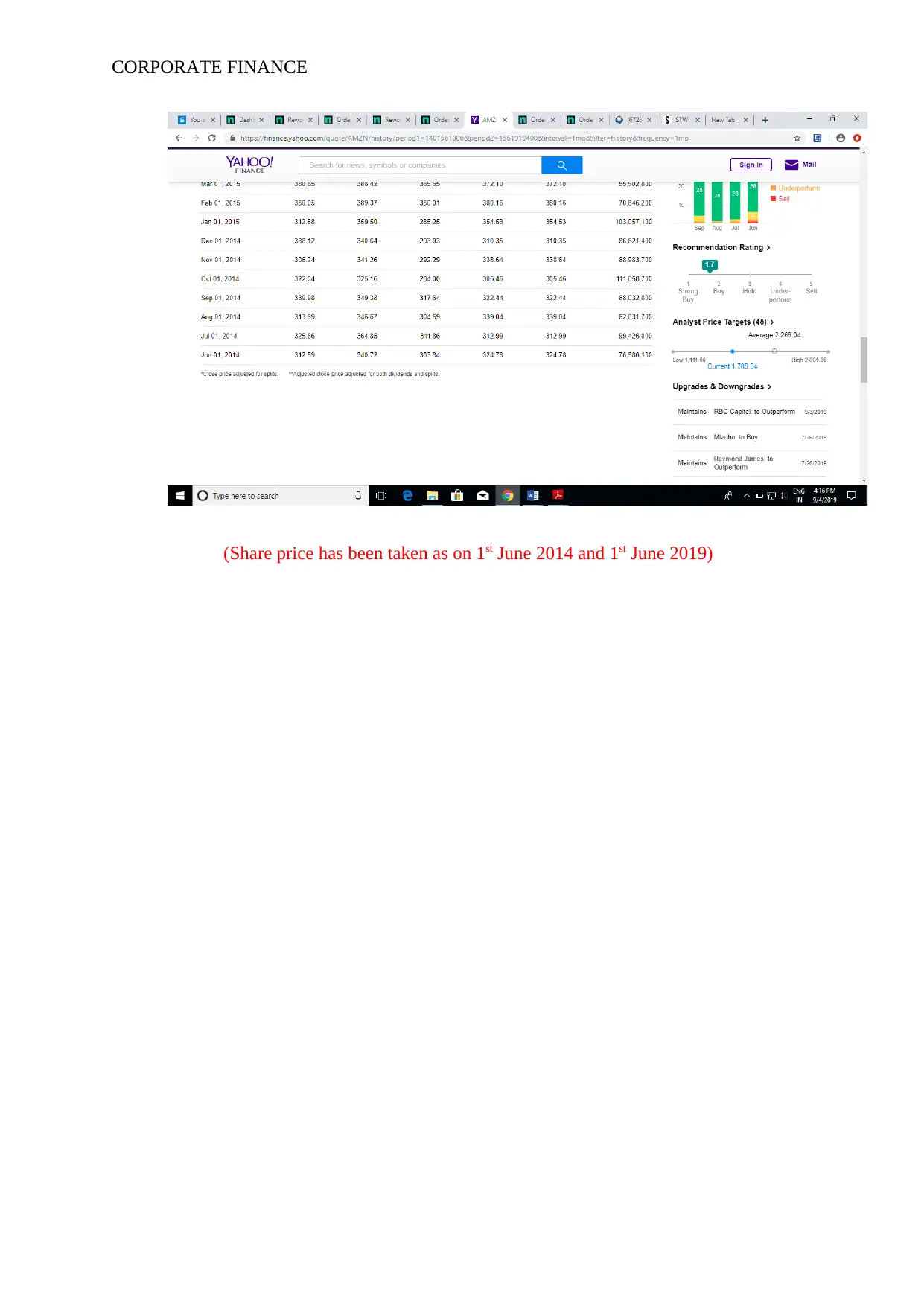
Holding period return 483%
The approximate holding period return is 483% and it is suggested that investment
made in Amazon for the time from 2014 to 2019 was profitable as the share price
continuously shoot up.
Part B:
Answer to requirement 1:
The amount of free cash flow generated by Amazon over the ten years by opening
3000 stores has increased from $ 2055 to $ 2212.5. First five years generate cash flow of
amount $ 2055 and this has increased to $ 2212.5 in the later years.
Answer to requirement 2:
The net present value generated by the project is $ 2255.34 and the discount rate used
by the Amazon, which is of speculative nature, is 12%. Therefore, discount rate for the
Price
Year of maturity 2020
Market value at the end of 2019 995.24
The market value of bond at the end of 2019 is $ 995.24.
Answer to requirement 7:
Market price at the beginning of June
2014
324.78
Market price at the beginning of June
2019
1893.6
3
Total Capital Appreciation 1568.8
5
Holding period return 483%
The approximate holding period return is 483% and it is suggested that investment
made in Amazon for the time from 2014 to 2019 was profitable as the share price
continuously shoot up.
Part B:
Answer to requirement 1:
The amount of free cash flow generated by Amazon over the ten years by opening
3000 stores has increased from $ 2055 to $ 2212.5. First five years generate cash flow of
amount $ 2055 and this has increased to $ 2212.5 in the later years.
Answer to requirement 2:
The net present value generated by the project is $ 2255.34 and the discount rate used
by the Amazon, which is of speculative nature, is 12%. Therefore, discount rate for the
Paraphrase This Document
Need a fresh take? Get an instant paraphrase of this document with our AI Paraphraser
CORPORATE FINANCE
project is 12% and since it is a project of shirt term venture, higher return is expected from
the project.
Answer to requirement 3:
The payback period for this project is 4.87 and it is impossible for the company to
recover the amount that has been invested initially in a period of two years. The target set by
the company does not seem to be realistic as the time taken to recover the initial amount
would be beyond the payback period. The payback period has been computed using Excel
function and the first step requires entering initial amount in the initial outlay row and then
entering after tax cash flow for each year column and then a cumulative cash flow is
computed for each year and the result is entered in the row of cash flow. In the next step, a
fraction row is added that ascertain the percentage of negative flow of cash as the percentage
of first positive cumulative cash flow. After that, total number of year when cash flow was
negative is computed. The fraction of year for which cumulative cash flow is negative is
counted. The exact time in years is obtained by adding last two steps, which show the number
of year, require to-break-even. The cash flow statement, internal rate of return, and
discounted rate of return data has been taken and analyzed from the annual report of the
company. Microsoft Excel has been used for the calculation of the cash flow and statement
and internal rate of return.
Answer to requirement 4:
The weakness of the cash flow is attributable to the fact that the estimated figure can
go wrong and thereby giving the inaccurate picture of the cash flow of the project. The major
disadvantage of the cash flow forecast is relying on the roughly estimates. A degree of
probability is involved in cash flow forecasting no matter how valuable the information is to
project is 12% and since it is a project of shirt term venture, higher return is expected from
the project.
Answer to requirement 3:
The payback period for this project is 4.87 and it is impossible for the company to
recover the amount that has been invested initially in a period of two years. The target set by
the company does not seem to be realistic as the time taken to recover the initial amount
would be beyond the payback period. The payback period has been computed using Excel
function and the first step requires entering initial amount in the initial outlay row and then
entering after tax cash flow for each year column and then a cumulative cash flow is
computed for each year and the result is entered in the row of cash flow. In the next step, a
fraction row is added that ascertain the percentage of negative flow of cash as the percentage
of first positive cumulative cash flow. After that, total number of year when cash flow was
negative is computed. The fraction of year for which cumulative cash flow is negative is
counted. The exact time in years is obtained by adding last two steps, which show the number
of year, require to-break-even. The cash flow statement, internal rate of return, and
discounted rate of return data has been taken and analyzed from the annual report of the
company. Microsoft Excel has been used for the calculation of the cash flow and statement
and internal rate of return.
Answer to requirement 4:
The weakness of the cash flow is attributable to the fact that the estimated figure can
go wrong and thereby giving the inaccurate picture of the cash flow of the project. The major
disadvantage of the cash flow forecast is relying on the roughly estimates. A degree of
probability is involved in cash flow forecasting no matter how valuable the information is to
CORPORATE FINANCE
the company y at the given point of time (Asquith and Weiss 2019). With the extension in the
forecasting period, the probability of inaccuracy will go on increasing.
Answer to requirement 5:
From the analysis of the figures of net present value and internal rate of return, it is
inferred that the project of Amazon Go should be accepted. It is observed from the
computation of net present value that the value is positive that the NPV of the project stands
at $ 2255.34. As per the general rule, a project should be accepted if it generate positive net
present value. Value of internal rate of return is 17%, which indicate that the percentage is
higher than the minimum require rate of return. This implies that the highest rate of return
that the project would be willing to pay is internal rate of return. Therefore, it is
recommended that then project can be undertaken, as the IRR is higher that the discounting
rate of return and the payback period is beyond the expected (Schaltegger et al. 2017). From
the overall analysis of the financial figures, it is said that the project of Amazon should be
accepted.
the company y at the given point of time (Asquith and Weiss 2019). With the extension in the
forecasting period, the probability of inaccuracy will go on increasing.
Answer to requirement 5:
From the analysis of the figures of net present value and internal rate of return, it is
inferred that the project of Amazon Go should be accepted. It is observed from the
computation of net present value that the value is positive that the NPV of the project stands
at $ 2255.34. As per the general rule, a project should be accepted if it generate positive net
present value. Value of internal rate of return is 17%, which indicate that the percentage is
higher than the minimum require rate of return. This implies that the highest rate of return
that the project would be willing to pay is internal rate of return. Therefore, it is
recommended that then project can be undertaken, as the IRR is higher that the discounting
rate of return and the payback period is beyond the expected (Schaltegger et al. 2017). From
the overall analysis of the financial figures, it is said that the project of Amazon should be
accepted.
⊘ This is a preview!⊘
Do you want full access?
Subscribe today to unlock all pages.
Trusted by 1+ million students worldwide
CORPORATE FINANCE
(Share price has been taken as on 1st June 2014 and 1st June 2019)
(Share price has been taken as on 1st June 2014 and 1st June 2019)
Paraphrase This Document
Need a fresh take? Get an instant paraphrase of this document with our AI Paraphraser
CORPORATE FINANCE
References list:
Asquith, P. and Weiss, L.A., 2019. Lessons in corporate finance: A case studies approach to
financial tools, financial policies, and valuation. John Wiley & Sons.
Brigham, E.F. and Houston, J.F., 2015. Fundamentals of Financial Management, concise 8th
edition. Mason, OH: South-Western, Cengage Learning.
Cai, L., Cui, J. and Jo, H., 2016. Corporate environmental responsibility and firm
risk. Journal of Business Ethics, 139(3), pp.563-594.
Dang, C., Li, Z.F. and Yang, C., 2018. Measuring firm size in empirical corporate
finance. Journal of Banking & Finance, 86, pp.159-176.
Foley, C.F. and Manova, K., 2015. International trade, multinational activity, and corporate
finance. economics, 7(1), pp.119-146.
Habib, A. and Hasan, M.M., 2018. Corporate life cycle research in accounting, finance and
corporate governance: A survey, and directions for future research. International Review of
Financial Analysis.
Jiang, F., Jiang, Z. and Kim, K.A., 2017. Capital markets, financial institutions, and corporate
finance in China. Journal of Corporate Finance.
Ogneva, M., Piotroski, J.D. and Zakolyukina, A.A., 2018. Accounting fundamentals and
systematic risk: Corporate failure over the business cycle. Chicago Booth Research Paper,
(14-31), pp.14-37.
Peng, C.C., 2015. Textbook Readability and Student Performance in Online Introductory
Corporate Finance Classes. Journal of Educators Online, 12(2), pp.35-49.
References list:
Asquith, P. and Weiss, L.A., 2019. Lessons in corporate finance: A case studies approach to
financial tools, financial policies, and valuation. John Wiley & Sons.
Brigham, E.F. and Houston, J.F., 2015. Fundamentals of Financial Management, concise 8th
edition. Mason, OH: South-Western, Cengage Learning.
Cai, L., Cui, J. and Jo, H., 2016. Corporate environmental responsibility and firm
risk. Journal of Business Ethics, 139(3), pp.563-594.
Dang, C., Li, Z.F. and Yang, C., 2018. Measuring firm size in empirical corporate
finance. Journal of Banking & Finance, 86, pp.159-176.
Foley, C.F. and Manova, K., 2015. International trade, multinational activity, and corporate
finance. economics, 7(1), pp.119-146.
Habib, A. and Hasan, M.M., 2018. Corporate life cycle research in accounting, finance and
corporate governance: A survey, and directions for future research. International Review of
Financial Analysis.
Jiang, F., Jiang, Z. and Kim, K.A., 2017. Capital markets, financial institutions, and corporate
finance in China. Journal of Corporate Finance.
Ogneva, M., Piotroski, J.D. and Zakolyukina, A.A., 2018. Accounting fundamentals and
systematic risk: Corporate failure over the business cycle. Chicago Booth Research Paper,
(14-31), pp.14-37.
Peng, C.C., 2015. Textbook Readability and Student Performance in Online Introductory
Corporate Finance Classes. Journal of Educators Online, 12(2), pp.35-49.

CORPORATE FINANCE
Schaltegger, S., Burritt, R. and Petersen, H., 2017. An introduction to corporate
environmental management: Striving for sustainability. Routledge.
Trinh, T.H. and Thao, L.T.N., 2017. Corporate valuation modeling for strategic financial
decisions. Asian Economic and Financial Review, 7(12), p.1153.
US About Amazon. (2019). About Amazon. [online] Available at:
https://www.aboutamazon.com/ [Accessed 4 Sep. 2019].
Schaltegger, S., Burritt, R. and Petersen, H., 2017. An introduction to corporate
environmental management: Striving for sustainability. Routledge.
Trinh, T.H. and Thao, L.T.N., 2017. Corporate valuation modeling for strategic financial
decisions. Asian Economic and Financial Review, 7(12), p.1153.
US About Amazon. (2019). About Amazon. [online] Available at:
https://www.aboutamazon.com/ [Accessed 4 Sep. 2019].
⊘ This is a preview!⊘
Do you want full access?
Subscribe today to unlock all pages.
Trusted by 1+ million students worldwide

1 out of 12


Related Documents


Your All-in-One AI-Powered Toolkit for Academic Success.
+13062052269
info@desklib.com
Available 24*7 on WhatsApp / Email
![[object Object]](/_next/static/media/star-bottom.7253800d.svg)
Unlock your academic potential
Copyright © 2020–2026 A2Z Services. All Rights Reserved. Developed and managed by ZUCOL.