Corporate Finance Assignment: Solutions, Calculations, and Analysis
VerifiedAdded on 2021/10/07
|9
|1649
|212
Homework Assignment
AI Summary
This document presents a comprehensive solution to a corporate finance assignment, addressing a range of topics. The assignment delves into liquidity and default risk premiums, interest rate calculations, and the time value of money, including present and future value computations for annuities and lump sums. It explores bond valuation, including holding period yield and effective annual yield, and tackles problems involving compound interest calculations with different compounding frequencies. The assignment also analyzes project net present values (NPV) to determine project acceptance and examines portfolio returns, including time-weighted and money-weighted returns. Finally, it provides solutions to various financial problems and calculations, using formulas and data to arrive at the correct answers, supported by relevant references.
CORPORATE FINANCE
STUDENT ID:
[Pick the date]
STUDENT ID:
[Pick the date]
Paraphrase This Document
Need a fresh take? Get an instant paraphrase of this document with our AI Paraphraser

Question 1
1) Based on the given data, it is apparent that the liquidity is low for Investment 2 while it is
high for Investment 1. As a result, the liquidity risk premium would be higher for investment
2 when compared to investment 1. One of the determinants of interest rate on a given
investment is the liquidity risk premium. Since this is higher for Investment 2, hence interest
rate is also higher than investment 1 (Parrino and Kidwell, 2014).
2) In order to estimate the default rate premium consideration would be given to Investment 4
and Investment 5 which have the same maturity but different default risk. The difference in
the interest rates on these two investments should give a value of the default risk premium.
However, adjustment would need to be made for difference in liquidity and hence 0.5%
liquidity premium would be considered (Damodaran, 2015).
Hence, default risk premium = (6.5-4) -0.5 = 2%
3) The lower limit for r3 would be 2.5% since the liquidity and default risk of Investment 3 is
similar to Investment 2. However, investment 3 has a higher maturity compared to
investment 2 and hence the interest rate would be higher than 2.5% (Brealey, Myers and
Allen, 2014). The interest rate on investment 4 would become 4.5 % if the liquidity is made
low. After making this change, all the parameters of investment 4 would match with
investment 3 except the maturity. The maturity of investment 3 is lower than that of
investment 4 and hence the upper limit is 4.5 % and r3 would be lower than this (Petty et. al.,
2015).
Question 2
Based on the information provided, the payments of $ 20,000 each would be received at t=2,
t=3 and t=4. The objective is to find the cumulative value of the above cash flows at t=6
when the client would retire.
Amount at the time for retirement for payment received at t=2 is 20000*1.094 = $ 28,231.63
Amount at the time for retirement for payment received at t=3 is 20000*1.093 = $ 25,900.58
Amount at the time for retirement for payment received at t=4 is 20000*1.092 = $23,762
Total amount at retirement = 28,231.63 + 25,900.58 + 23,762 = $77,894.21
1) Based on the given data, it is apparent that the liquidity is low for Investment 2 while it is
high for Investment 1. As a result, the liquidity risk premium would be higher for investment
2 when compared to investment 1. One of the determinants of interest rate on a given
investment is the liquidity risk premium. Since this is higher for Investment 2, hence interest
rate is also higher than investment 1 (Parrino and Kidwell, 2014).
2) In order to estimate the default rate premium consideration would be given to Investment 4
and Investment 5 which have the same maturity but different default risk. The difference in
the interest rates on these two investments should give a value of the default risk premium.
However, adjustment would need to be made for difference in liquidity and hence 0.5%
liquidity premium would be considered (Damodaran, 2015).
Hence, default risk premium = (6.5-4) -0.5 = 2%
3) The lower limit for r3 would be 2.5% since the liquidity and default risk of Investment 3 is
similar to Investment 2. However, investment 3 has a higher maturity compared to
investment 2 and hence the interest rate would be higher than 2.5% (Brealey, Myers and
Allen, 2014). The interest rate on investment 4 would become 4.5 % if the liquidity is made
low. After making this change, all the parameters of investment 4 would match with
investment 3 except the maturity. The maturity of investment 3 is lower than that of
investment 4 and hence the upper limit is 4.5 % and r3 would be lower than this (Petty et. al.,
2015).
Question 2
Based on the information provided, the payments of $ 20,000 each would be received at t=2,
t=3 and t=4. The objective is to find the cumulative value of the above cash flows at t=6
when the client would retire.
Amount at the time for retirement for payment received at t=2 is 20000*1.094 = $ 28,231.63
Amount at the time for retirement for payment received at t=3 is 20000*1.093 = $ 25,900.58
Amount at the time for retirement for payment received at t=4 is 20000*1.092 = $23,762
Total amount at retirement = 28,231.63 + 25,900.58 + 23,762 = $77,894.21

Question 3
The formula for present value of annuity is indicated below (Damodaran, 2015).
Based on the given information, P = $100,000, r=5%, n=10
PV of annuity = 100000*(1-1.05-10)/0.05 = $ 772,173.5
Hence, the lump sum payment which must be accepted for forgoing the annuity is $
772,173.5.
Question 4
The first step is to estimate the size of corpus that would be required when the child’s college
would begin. The relevant formula for estimating the present value of annuity due would be
used considering that the college expenses would be borne at the beginning of the year. This
formula is indicated below (Petty et. al., 2015).
Based on the given information, P = $20,000, n=4 years, r=5%
Hence, amount of funds required by the age of 18 = 20000 + 20000(1-1.05-4+1)/0.05 =
$74,464.96
The formula for present value of annuity is indicated below (Damodaran, 2015).
Based on the given information, P = $100,000, r=5%, n=10
PV of annuity = 100000*(1-1.05-10)/0.05 = $ 772,173.5
Hence, the lump sum payment which must be accepted for forgoing the annuity is $
772,173.5.
Question 4
The first step is to estimate the size of corpus that would be required when the child’s college
would begin. The relevant formula for estimating the present value of annuity due would be
used considering that the college expenses would be borne at the beginning of the year. This
formula is indicated below (Petty et. al., 2015).
Based on the given information, P = $20,000, n=4 years, r=5%
Hence, amount of funds required by the age of 18 = 20000 + 20000(1-1.05-4+1)/0.05 =
$74,464.96
⊘ This is a preview!⊘
Do you want full access?
Subscribe today to unlock all pages.

Trusted by 1+ million students worldwide

Let the annual repayment made by $ X. This payment should be such that the future of the
annuity should be equal to $74,464.96. The formula for estimation of future value of annuity
is indicated below (Parrino and Kidwell, 2014).
Based on the given information, P =X , r=5%, n = 17
74,464.96 = X*(1.0517-1)/0.05
Solving the above, we get X = $ 2,881.73
Question 5
a) Principal = $ 75,000
Interest rate = 7% p.a. compounded quarterly
Time period = 6 years or 6*4 = 24 quarters
Value in six years = 75000*(1+(7/400))24 = $ 113,733.2
b) Let the principal be $ X
Amount = £100,000
Time period = 1 year or (365/7) weeks
Interest rate = 2.5% p.a. compounded weekly
Hence, 100000 = X(1+(2.5*7/36500))(365/7)
Solving the above, we get X= £ 97,531.58
c) Principal = ¥ 250,000
Amount desires = ¥ 1,000,000
annuity should be equal to $74,464.96. The formula for estimation of future value of annuity
is indicated below (Parrino and Kidwell, 2014).
Based on the given information, P =X , r=5%, n = 17
74,464.96 = X*(1.0517-1)/0.05
Solving the above, we get X = $ 2,881.73
Question 5
a) Principal = $ 75,000
Interest rate = 7% p.a. compounded quarterly
Time period = 6 years or 6*4 = 24 quarters
Value in six years = 75000*(1+(7/400))24 = $ 113,733.2
b) Let the principal be $ X
Amount = £100,000
Time period = 1 year or (365/7) weeks
Interest rate = 2.5% p.a. compounded weekly
Hence, 100000 = X(1+(2.5*7/36500))(365/7)
Solving the above, we get X= £ 97,531.58
c) Principal = ¥ 250,000
Amount desires = ¥ 1,000,000
Paraphrase This Document
Need a fresh take? Get an instant paraphrase of this document with our AI Paraphraser

Interest rate = 3% p.a. compounded daily
Let t be the time in months
Hence, 1000000 = 250000*(1+(3/36500))30t
Solving the above, we get t= 562.241 months
d) Principal = € 1,000,000
Time = 4 years
Interest rate = 3%
Amount under continuous compounding = 1000000*e4*0.03 = € 1,127,497
Interest earned = € 1,127,497 - € 1,000,000 = € 127,497
Amount under daily compounding = 1000000*(1+(3/36500))365*4 = € 1,127,491.29
Interest earned = € 1,127,491.29 - € 1,000,000 = € 127,491.29
Difference in interest = € 1,127,497 - € 127,491.29 = € 5.71
e) Present value of the stock = (2/(6/4))*(1+(6/4)))-4 = $ 126
Question 6
The cash flows arising from the project are indicated below.
Amount at the end of four years for € 700 received at t =1 with 2% p.a. interest which is
compounded monthly = 700 (1+ (2/1200))36 =€ 743.25
Amount at the end of four years for € 700 received at t =2 with 2% p.a. interest which is
compounded monthly = 700 (1+ (2/1200))24 = € 728.54
Let t be the time in months
Hence, 1000000 = 250000*(1+(3/36500))30t
Solving the above, we get t= 562.241 months
d) Principal = € 1,000,000
Time = 4 years
Interest rate = 3%
Amount under continuous compounding = 1000000*e4*0.03 = € 1,127,497
Interest earned = € 1,127,497 - € 1,000,000 = € 127,497
Amount under daily compounding = 1000000*(1+(3/36500))365*4 = € 1,127,491.29
Interest earned = € 1,127,491.29 - € 1,000,000 = € 127,491.29
Difference in interest = € 1,127,497 - € 127,491.29 = € 5.71
e) Present value of the stock = (2/(6/4))*(1+(6/4)))-4 = $ 126
Question 6
The cash flows arising from the project are indicated below.
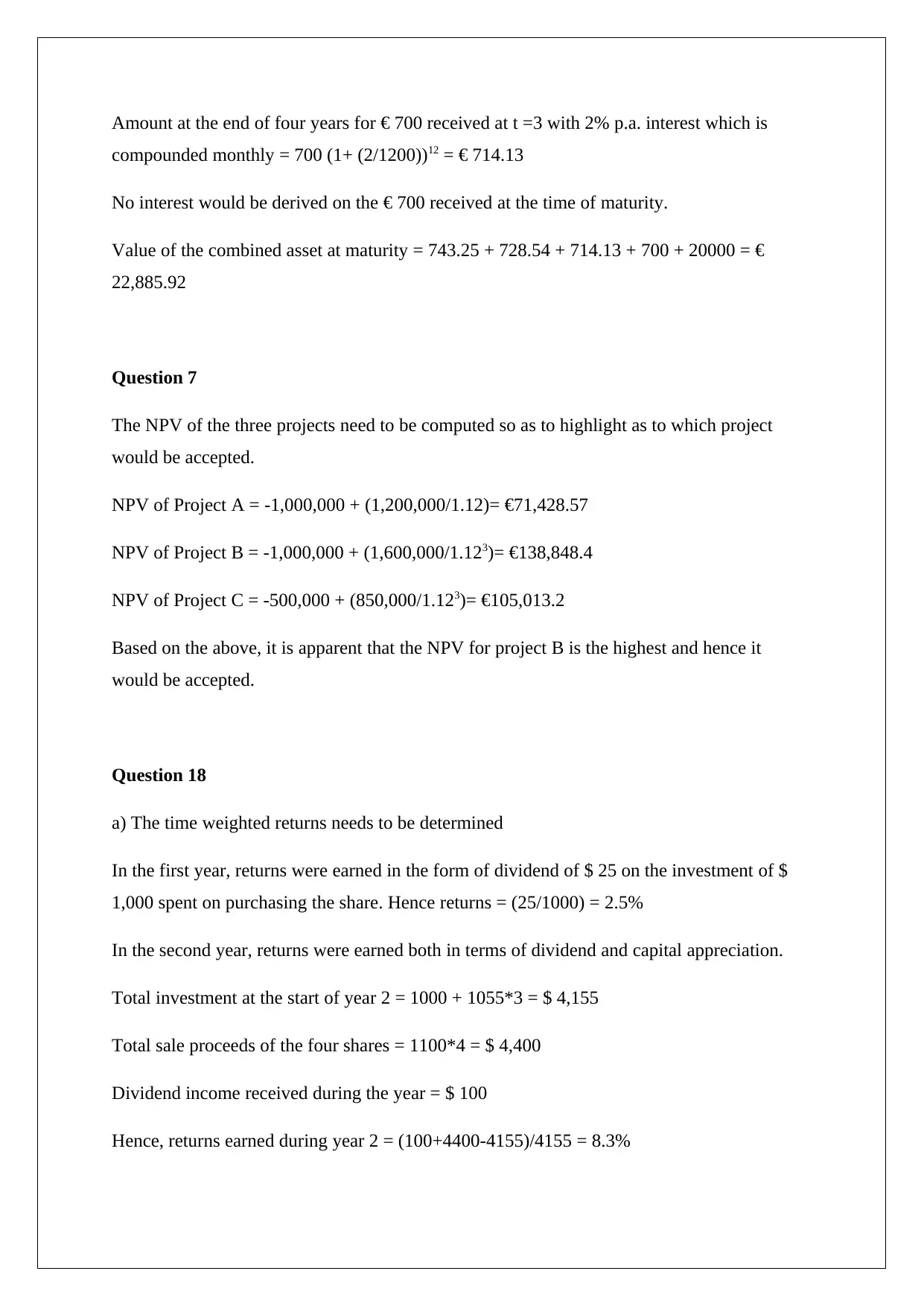
Amount at the end of four years for € 700 received at t =1 with 2% p.a. interest which is
compounded monthly = 700 (1+ (2/1200))36 =€ 743.25
Amount at the end of four years for € 700 received at t =2 with 2% p.a. interest which is
compounded monthly = 700 (1+ (2/1200))24 = € 728.54

Amount at the end of four years for € 700 received at t =3 with 2% p.a. interest which is
compounded monthly = 700 (1+ (2/1200))12 = € 714.13
No interest would be derived on the € 700 received at the time of maturity.
Value of the combined asset at maturity = 743.25 + 728.54 + 714.13 + 700 + 20000 = €
22,885.92
Question 7
The NPV of the three projects need to be computed so as to highlight as to which project
would be accepted.
NPV of Project A = -1,000,000 + (1,200,000/1.12)= €71,428.57
NPV of Project B = -1,000,000 + (1,600,000/1.123)= €138,848.4
NPV of Project C = -500,000 + (850,000/1.123)= €105,013.2
Based on the above, it is apparent that the NPV for project B is the highest and hence it
would be accepted.
Question 18
a) The time weighted returns needs to be determined
In the first year, returns were earned in the form of dividend of $ 25 on the investment of $
1,000 spent on purchasing the share. Hence returns = (25/1000) = 2.5%
In the second year, returns were earned both in terms of dividend and capital appreciation.
Total investment at the start of year 2 = 1000 + 1055*3 = $ 4,155
Total sale proceeds of the four shares = 1100*4 = $ 4,400
Dividend income received during the year = $ 100
Hence, returns earned during year 2 = (100+4400-4155)/4155 = 8.3%
compounded monthly = 700 (1+ (2/1200))12 = € 714.13
No interest would be derived on the € 700 received at the time of maturity.
Value of the combined asset at maturity = 743.25 + 728.54 + 714.13 + 700 + 20000 = €
22,885.92
Question 7
The NPV of the three projects need to be computed so as to highlight as to which project
would be accepted.
NPV of Project A = -1,000,000 + (1,200,000/1.12)= €71,428.57
NPV of Project B = -1,000,000 + (1,600,000/1.123)= €138,848.4
NPV of Project C = -500,000 + (850,000/1.123)= €105,013.2
Based on the above, it is apparent that the NPV for project B is the highest and hence it
would be accepted.
Question 18
a) The time weighted returns needs to be determined
In the first year, returns were earned in the form of dividend of $ 25 on the investment of $
1,000 spent on purchasing the share. Hence returns = (25/1000) = 2.5%
In the second year, returns were earned both in terms of dividend and capital appreciation.
Total investment at the start of year 2 = 1000 + 1055*3 = $ 4,155
Total sale proceeds of the four shares = 1100*4 = $ 4,400
Dividend income received during the year = $ 100
Hence, returns earned during year 2 = (100+4400-4155)/4155 = 8.3%
⊘ This is a preview!⊘
Do you want full access?
Subscribe today to unlock all pages.

Trusted by 1+ million students worldwide

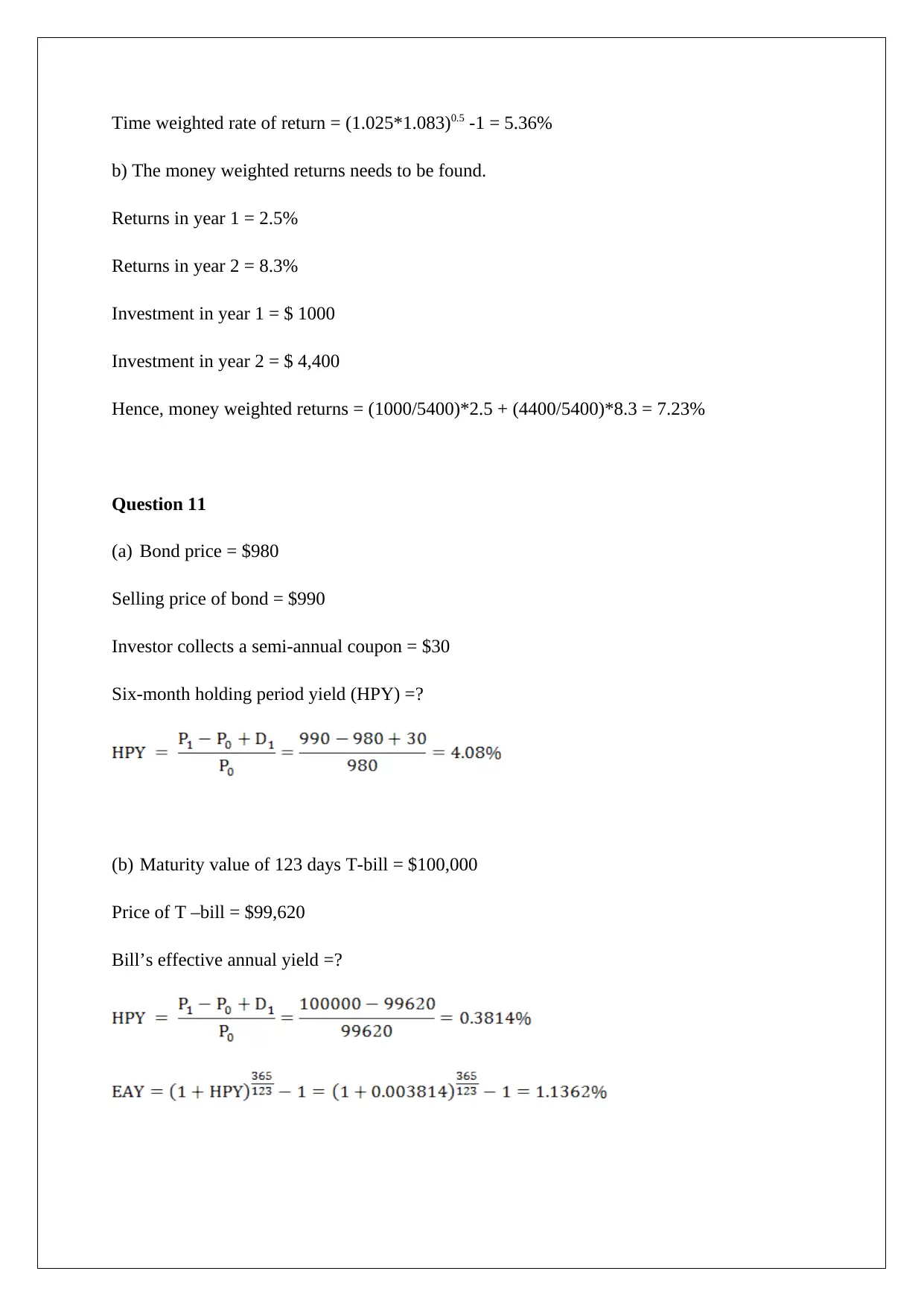
Time weighted rate of return = (1.025*1.083)0.5 -1 = 5.36%
b) The money weighted returns needs to be found.
Returns in year 1 = 2.5%
Returns in year 2 = 8.3%
Investment in year 1 = $ 1000
Investment in year 2 = $ 4,400
Hence, money weighted returns = (1000/5400)*2.5 + (4400/5400)*8.3 = 7.23%
Question 11
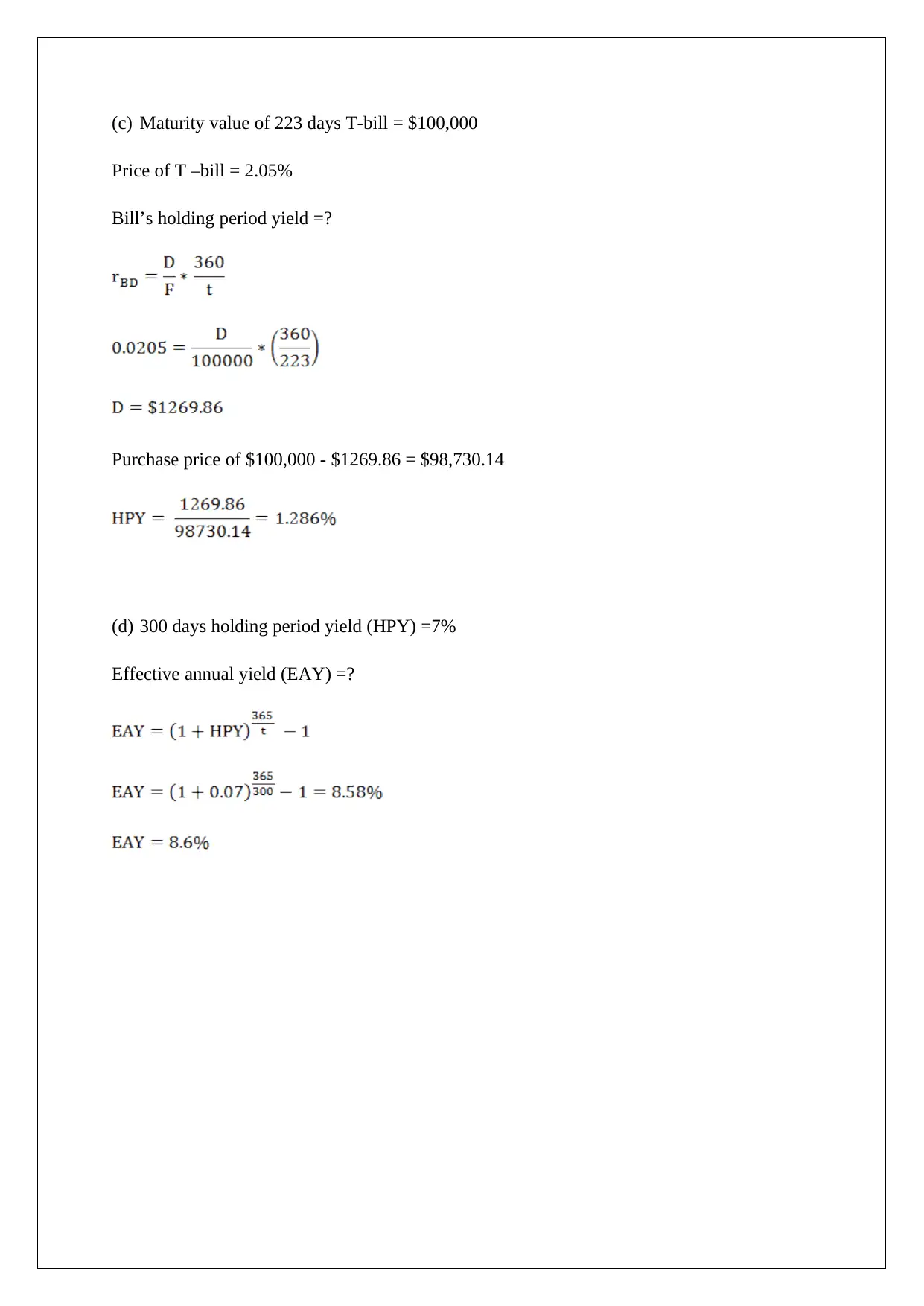
(a) Bond price = $980
Selling price of bond = $990
Investor collects a semi-annual coupon = $30
Six-month holding period yield (HPY) =?
(b) Maturity value of 123 days T-bill = $100,000
Price of T –bill = $99,620
Bill’s effective annual yield =?
b) The money weighted returns needs to be found.
Returns in year 1 = 2.5%
Returns in year 2 = 8.3%
Investment in year 1 = $ 1000
Investment in year 2 = $ 4,400
Hence, money weighted returns = (1000/5400)*2.5 + (4400/5400)*8.3 = 7.23%
Question 11
(a) Bond price = $980
Selling price of bond = $990
Investor collects a semi-annual coupon = $30
Six-month holding period yield (HPY) =?
(b) Maturity value of 123 days T-bill = $100,000
Price of T –bill = $99,620
Bill’s effective annual yield =?
Paraphrase This Document
Need a fresh take? Get an instant paraphrase of this document with our AI Paraphraser

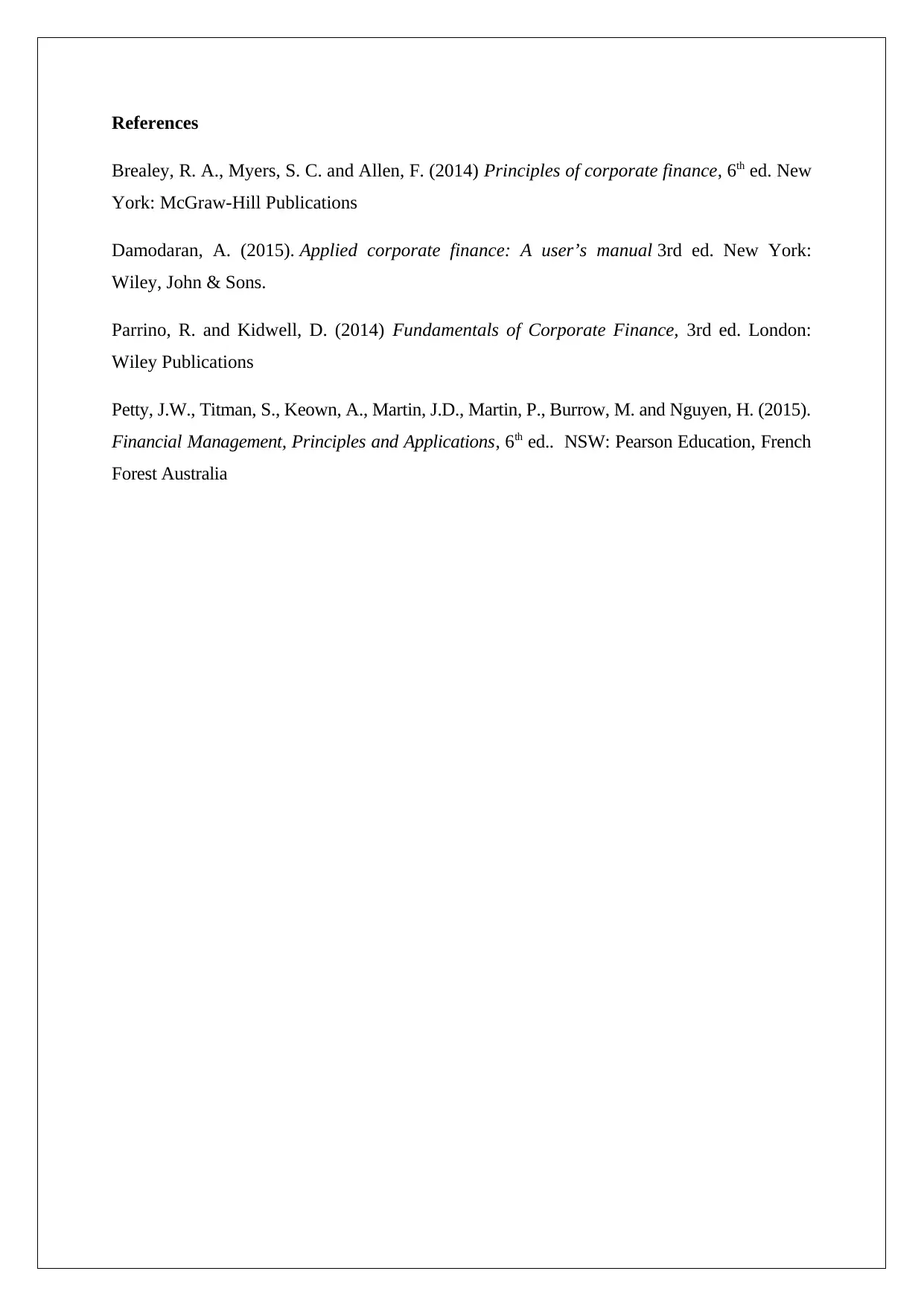
(c) Maturity value of 223 days T-bill = $100,000
Price of T –bill = 2.05%
Bill’s holding period yield =?
Purchase price of $100,000 - $1269.86 = $98,730.14
(d) 300 days holding period yield (HPY) =7%
Effective annual yield (EAY) =?
Price of T –bill = 2.05%
Bill’s holding period yield =?
Purchase price of $100,000 - $1269.86 = $98,730.14
(d) 300 days holding period yield (HPY) =7%
Effective annual yield (EAY) =?

References
Brealey, R. A., Myers, S. C. and Allen, F. (2014) Principles of corporate finance, 6th ed. New
York: McGraw-Hill Publications
Damodaran, A. (2015). Applied corporate finance: A user’s manual 3rd ed. New York:
Wiley, John & Sons.
Parrino, R. and Kidwell, D. (2014) Fundamentals of Corporate Finance, 3rd ed. London:
Wiley Publications
Petty, J.W., Titman, S., Keown, A., Martin, J.D., Martin, P., Burrow, M. and Nguyen, H. (2015).
Financial Management, Principles and Applications, 6th ed.. NSW: Pearson Education, French
Forest Australia
Brealey, R. A., Myers, S. C. and Allen, F. (2014) Principles of corporate finance, 6th ed. New
York: McGraw-Hill Publications
Damodaran, A. (2015). Applied corporate finance: A user’s manual 3rd ed. New York:
Wiley, John & Sons.
Parrino, R. and Kidwell, D. (2014) Fundamentals of Corporate Finance, 3rd ed. London:
Wiley Publications
Petty, J.W., Titman, S., Keown, A., Martin, J.D., Martin, P., Burrow, M. and Nguyen, H. (2015).
Financial Management, Principles and Applications, 6th ed.. NSW: Pearson Education, French
Forest Australia
⊘ This is a preview!⊘
Do you want full access?
Subscribe today to unlock all pages.

Trusted by 1+ million students worldwide
1 out of 9
Related Documents
Your All-in-One AI-Powered Toolkit for Academic Success.
+13062052269
info@desklib.com
Available 24*7 on WhatsApp / Email
Unlock your academic potential
Copyright © 2020–2026 A2Z Services. All Rights Reserved. Developed and managed by ZUCOL.