Corporate Finance: Causes, Impacts, and Reforms of Financial Crisis
VerifiedAdded on 2020/05/16
|12
|3022
|32
Report
AI Summary
This report provides an in-depth analysis of the 2008 financial crisis, examining its root causes such as subprime mortgages, interest rate hikes, and the securitization of mortgages, and the deregulation of the financial industry. It investigates the potential for future financial crises, considering factors like oil prices, the Chinese economy, and rising national debts. The report assesses the impact of the crisis on both developing and developed countries, with a specific focus on Australia. Furthermore, it outlines the proposed reforms implemented to control the crisis, including stimulus packages and restrictions on short selling. The report provides a comprehensive overview of the crisis and its implications for the global economy.
Running head: CORPORATE FINANCE
Corporate Finance
Name of the Student:
Name of the University:
Authors Note:
Corporate Finance
Name of the Student:
Name of the University:
Authors Note:

Paraphrase This Document
Need a fresh take? Get an instant paraphrase of this document with our AI Paraphraser
CORPORATE FINANCE
1
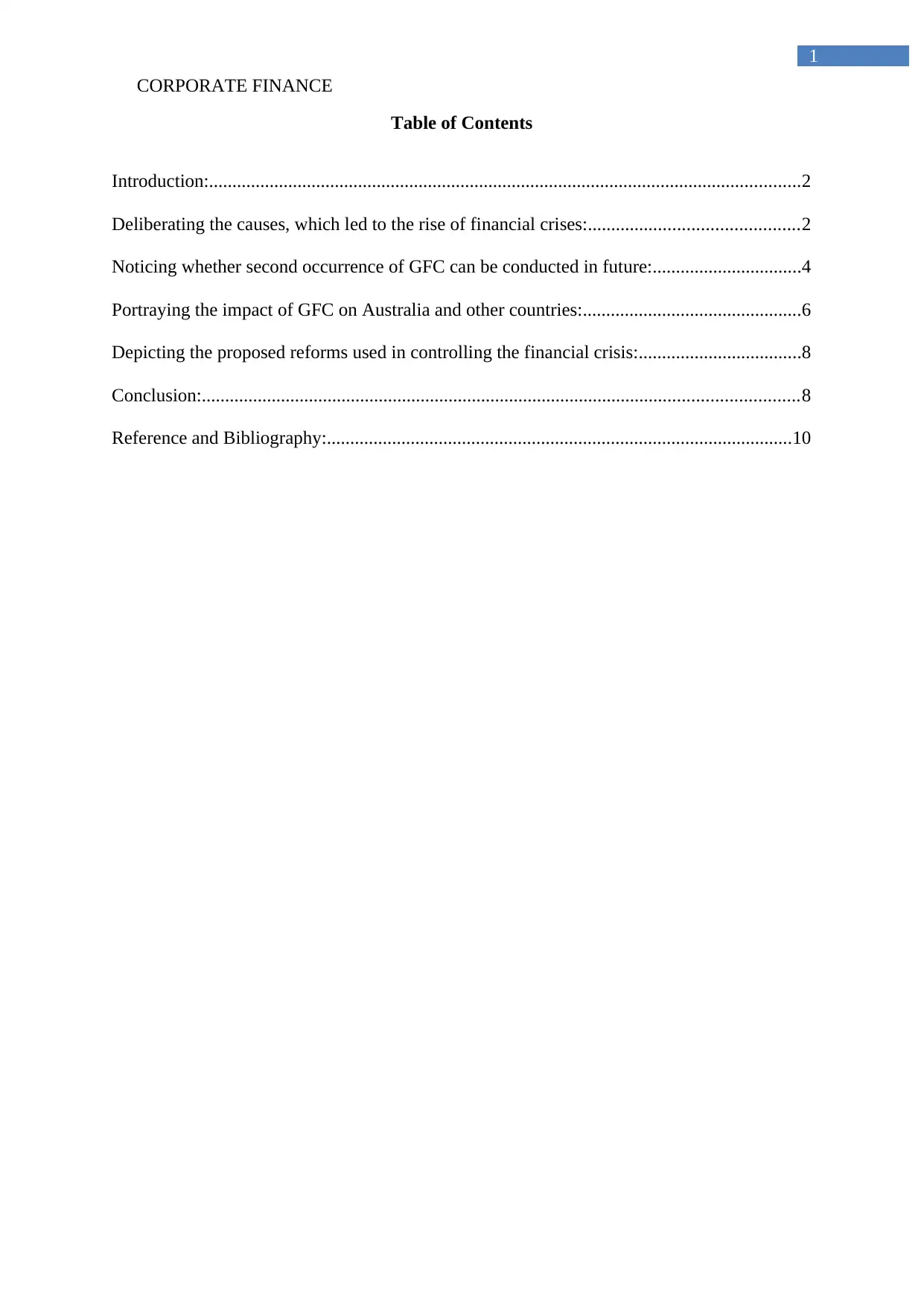
Table of Contents
Introduction:...............................................................................................................................2
Deliberating the causes, which led to the rise of financial crises:.............................................2
Noticing whether second occurrence of GFC can be conducted in future:................................4
Portraying the impact of GFC on Australia and other countries:...............................................6
Depicting the proposed reforms used in controlling the financial crisis:...................................8
Conclusion:................................................................................................................................8
Reference and Bibliography:....................................................................................................10
1
Table of Contents
Introduction:...............................................................................................................................2
Deliberating the causes, which led to the rise of financial crises:.............................................2
Noticing whether second occurrence of GFC can be conducted in future:................................4
Portraying the impact of GFC on Australia and other countries:...............................................6
Depicting the proposed reforms used in controlling the financial crisis:...................................8
Conclusion:................................................................................................................................8
Reference and Bibliography:....................................................................................................10
CORPORATE FINANCE
2
Introduction:
The impact of financial crisis is mainly evaluated in the overall assessment, where in
depth problems that was faced by countries and companies during the financial crisis is
adequately depicted. In addition, performance of the companies during the financial crisis is
evaluated and its impact on developed and developing countries also appraised. The
assessment also identifies possible causes for the rise of financial crisis during 2008.
identifications eventually help understanding the problems and wrong decision taken by the
government. Lastly, adequate measures that was taken by governments all the world are also
depicted, which would help in understanding its impact on actual economies. The impact of
financial crisis on the economic condition of Australia is also evaluated to understand the
problems faced by companies during the crisis.
Deliberating the causes, which led to the rise of financial crises:
The financial crisis was mainly conducted due to the manipulation delivered by
Financial Institutions and banks. There were many causes that led to the rise of financial
crisis, as governments was not able to control risk accumulation by banks. Relevant causes
depicted as follows, which result then the rise of financial crisis of 2008.
Growing demand for subprime mortgages:
After the regulations passed by US government regarding the fulfillment of American
dream, where loans are provided to individuals for their home. In addition, the redline areas
marked by banks were removed by the US government, which allowed them to take bank
loans for the home. Additional financial institution such as Fannie Mae and Freddie Mac was
mainly introduced to convert mortgage and loans into mortgage bonds such as CDO and
MBS. Many of these Financial Institutions was created to convert mortgage and loan into
2
Introduction:
The impact of financial crisis is mainly evaluated in the overall assessment, where in
depth problems that was faced by countries and companies during the financial crisis is
adequately depicted. In addition, performance of the companies during the financial crisis is
evaluated and its impact on developed and developing countries also appraised. The
assessment also identifies possible causes for the rise of financial crisis during 2008.
identifications eventually help understanding the problems and wrong decision taken by the
government. Lastly, adequate measures that was taken by governments all the world are also
depicted, which would help in understanding its impact on actual economies. The impact of
financial crisis on the economic condition of Australia is also evaluated to understand the
problems faced by companies during the crisis.
Deliberating the causes, which led to the rise of financial crises:
The financial crisis was mainly conducted due to the manipulation delivered by
Financial Institutions and banks. There were many causes that led to the rise of financial
crisis, as governments was not able to control risk accumulation by banks. Relevant causes
depicted as follows, which result then the rise of financial crisis of 2008.
Growing demand for subprime mortgages:
After the regulations passed by US government regarding the fulfillment of American
dream, where loans are provided to individuals for their home. In addition, the redline areas
marked by banks were removed by the US government, which allowed them to take bank
loans for the home. Additional financial institution such as Fannie Mae and Freddie Mac was
mainly introduced to convert mortgage and loans into mortgage bonds such as CDO and
MBS. Many of these Financial Institutions was created to convert mortgage and loan into
⊘ This is a preview!⊘
Do you want full access?
Subscribe today to unlock all pages.

Trusted by 1+ million students worldwide
CORPORATE FINANCE
3
financial instruments, which could be traded in the secondary market. Due to the believe that
mortgage market will never decline or fall (Allayannis et al. 2017). These instruments were
handsomely traded all around the secondary market. However, Fannie Mae and Freddie Mac
used credit ratings to determine price of the bones, which were mainly manipulated and was
found after the end of the financial crisis. These financial instruments directly allowed banks
to accumulate more capital to continue with their operations and provide home loans to
individuals.
Boost in interest rates:
Relevant boost in interest rates before the financial crisis was an immediate Trigger,
which instigated borrowers to default, due to non-availability of funds for repayment.
Majority of the borrowers were not financially sound, which resulted in high default rate of
borrowers. Hence, it was assumed that borrowers were willing to default rather than pay
installment on the loan due to high interest rates. The change in interest rates conducted by
FED directly impacted the overall payment amount of the borrowers. During the loan
providing us the interest rate laid down by fed was mainly at the levels of 1%, while before
the financial crisis it was at 5.25%. This substantially increased finance cost of the borrowers,
which was not comprehending with their actual income at the current moment (Amies et al.
2017). This phenomenon raised the level of defaulters in mortgage bonds, which became junk
and hampered financial stability of companies holding the financial instrument.
Converting mortgages into security funds:
Major cause behind the fall of US economy was mainly led by security funds such as
MBS and CDOs, which were complicated enough to fool the investors. The security funds
formally created from mortgage bonds that was accumulated by banks for different
borrowers. banks providing loan services and accumulated mortgages after which these
3
financial instruments, which could be traded in the secondary market. Due to the believe that
mortgage market will never decline or fall (Allayannis et al. 2017). These instruments were
handsomely traded all around the secondary market. However, Fannie Mae and Freddie Mac
used credit ratings to determine price of the bones, which were mainly manipulated and was
found after the end of the financial crisis. These financial instruments directly allowed banks
to accumulate more capital to continue with their operations and provide home loans to
individuals.
Boost in interest rates:
Relevant boost in interest rates before the financial crisis was an immediate Trigger,
which instigated borrowers to default, due to non-availability of funds for repayment.
Majority of the borrowers were not financially sound, which resulted in high default rate of
borrowers. Hence, it was assumed that borrowers were willing to default rather than pay
installment on the loan due to high interest rates. The change in interest rates conducted by
FED directly impacted the overall payment amount of the borrowers. During the loan
providing us the interest rate laid down by fed was mainly at the levels of 1%, while before
the financial crisis it was at 5.25%. This substantially increased finance cost of the borrowers,
which was not comprehending with their actual income at the current moment (Amies et al.
2017). This phenomenon raised the level of defaulters in mortgage bonds, which became junk
and hampered financial stability of companies holding the financial instrument.
Converting mortgages into security funds:
Major cause behind the fall of US economy was mainly led by security funds such as
MBS and CDOs, which were complicated enough to fool the investors. The security funds
formally created from mortgage bonds that was accumulated by banks for different
borrowers. banks providing loan services and accumulated mortgages after which these
Paraphrase This Document
Need a fresh take? Get an instant paraphrase of this document with our AI Paraphraser
CORPORATE FINANCE
4
mortgages were converted to financial instruments, where the securitization directly led to the
augmentation of the financial crisis. Mortgage backed securities and credit default swaps
other two instruments used in the process of converting mortgages into tradable bonds
(Armantier et al. 2015). These financial instruments were the main factor in allowing
Financial Institutions to create these instruments in secondary market. companies depending
on Bon payments used the financial instruments to generate a constant return from the
investment. However, incremental default read made the mortgage bonds in to junk bond,
which were not traded in the secondary market.
The cancelation of regulations conducted by US government:
There were certain laws implemented by the US government before 2000, which
directly controlled was taking capabilities of banks. The termination of regulations such as
Glass Steagall Act of 1933 and Commodity Future Modernization Act mainly allowed
Financial Institutions require more risk and reduce their cash reserve. Banks after the
deregulation mainly accumulated high risk assets to providing loans to anybody who wants a
home. This attitude directly increases the chances of default among borrowers, which
hampered financial stability of the bank (Benetrix, Lane and Shambaugh 2015). However, the
banks were merging the mortgage loans with one another and making them into financial
instrument, which was highly traded in the secondary market. These fashion instruments were
the main reason behind the fall of mortgage market, which laid the foundation of financial
crisis.
Noticing whether second occurrence of GFC can be conducted in future:
After the 2008 great financial crisis there were minor setbacks or recession that are
identified such as 2013 and 2016 recession. There is a major possibility for the occurrence of
great financial crisis, as the measures taken by countries to reduce negative impact of
4
mortgages were converted to financial instruments, where the securitization directly led to the
augmentation of the financial crisis. Mortgage backed securities and credit default swaps
other two instruments used in the process of converting mortgages into tradable bonds
(Armantier et al. 2015). These financial instruments were the main factor in allowing
Financial Institutions to create these instruments in secondary market. companies depending
on Bon payments used the financial instruments to generate a constant return from the
investment. However, incremental default read made the mortgage bonds in to junk bond,
which were not traded in the secondary market.
The cancelation of regulations conducted by US government:
There were certain laws implemented by the US government before 2000, which
directly controlled was taking capabilities of banks. The termination of regulations such as
Glass Steagall Act of 1933 and Commodity Future Modernization Act mainly allowed
Financial Institutions require more risk and reduce their cash reserve. Banks after the
deregulation mainly accumulated high risk assets to providing loans to anybody who wants a
home. This attitude directly increases the chances of default among borrowers, which
hampered financial stability of the bank (Benetrix, Lane and Shambaugh 2015). However, the
banks were merging the mortgage loans with one another and making them into financial
instrument, which was highly traded in the secondary market. These fashion instruments were
the main reason behind the fall of mortgage market, which laid the foundation of financial
crisis.
Noticing whether second occurrence of GFC can be conducted in future:
After the 2008 great financial crisis there were minor setbacks or recession that are
identified such as 2013 and 2016 recession. There is a major possibility for the occurrence of
great financial crisis, as the measures taken by countries to reduce negative impact of
CORPORATE FINANCE
5
financial crisis has back fight. Banks did not utilize the injection of taxpayer’s money
adequately to support their financial requirements. Instant managers and executives of banks
roughly stimulated taxpayer’s money in buying expensive gifts. This mainly prompted cash
stagnation within the economy, which could be seen during 2013 recession (Carvalho,
Ferreira and Matos 2015). However, the 2016 setback came due to the involvement of Greece
who was at the brink of being a defaulter. The country being a default is a major indication of
the financial health currently present in world economy. There are certain factors that are
evaluated from news which could argument the chance of next financial crisis, authorities did
not use adequate measures.
Oil prices:
Reducing oil prices can be identified as one of the major factors, which could start the
second financial crisis, as oil generating countries are not able to improve their financial
position. oil is one of the driving factors of an economy, which supports both manufacturing
and production processes. This decline in oil prices indicates the overall reduction in demand
from customers, which is hindering actual profitability of all generating companies. The oil
sector is relatively large, where maximum of the profits generated by countries has
immensely reduced (DeYoung et al. 2015). This reduced price is directly affecting oil
producing countries ability to support their death payments, which could result in default and
might start another financial crisis.
Chinese economy:
During the previous financial crisis, the Chinese economy was not affected due to its
progressive attitude, which enable the country to experience growth in both manufacturing
and production system. However, in recent years due to economic and environmental
conditions the Chinese economy has slowed down, which is affecting its capital market
5
financial crisis has back fight. Banks did not utilize the injection of taxpayer’s money
adequately to support their financial requirements. Instant managers and executives of banks
roughly stimulated taxpayer’s money in buying expensive gifts. This mainly prompted cash
stagnation within the economy, which could be seen during 2013 recession (Carvalho,
Ferreira and Matos 2015). However, the 2016 setback came due to the involvement of Greece
who was at the brink of being a defaulter. The country being a default is a major indication of
the financial health currently present in world economy. There are certain factors that are
evaluated from news which could argument the chance of next financial crisis, authorities did
not use adequate measures.
Oil prices:
Reducing oil prices can be identified as one of the major factors, which could start the
second financial crisis, as oil generating countries are not able to improve their financial
position. oil is one of the driving factors of an economy, which supports both manufacturing
and production processes. This decline in oil prices indicates the overall reduction in demand
from customers, which is hindering actual profitability of all generating companies. The oil
sector is relatively large, where maximum of the profits generated by countries has
immensely reduced (DeYoung et al. 2015). This reduced price is directly affecting oil
producing countries ability to support their death payments, which could result in default and
might start another financial crisis.
Chinese economy:
During the previous financial crisis, the Chinese economy was not affected due to its
progressive attitude, which enable the country to experience growth in both manufacturing
and production system. However, in recent years due to economic and environmental
conditions the Chinese economy has slowed down, which is affecting its capital market
⊘ This is a preview!⊘
Do you want full access?
Subscribe today to unlock all pages.
Trusted by 1+ million students worldwide
CORPORATE FINANCE
6
(Feldkircher 2014). Therefore, it is estimated by and list that the second financial crisis with
start from China, due to its declining manufacturing and production process.
Rise in Debt by countries:
Increment in debt can be seen in majority of the countries, due to the negative impact
of financial crisis. Countries to support the expenditure mainly issued by high bearing bonds
during the crisis, which they were not able to pay after the end of crisis. This relevant
phenomenon can be identified from the actions of Greece which was conducted during 2016.
Greece was on a blink of default, as their expenditure rose immensely in comparison to the
revenue generated by the nation (Goh et al. 2015). This this could indicate that countries are
acquiring more debt to support their expenditure, which is raising the amount of repayment
that needs to be conducted. USA is one of the high debt accumulated country, any chance of
decline in payments could start another financial crisis.
Portraying the impact of GFC on Australia and other countries:
The augmentation of financial crisis mainly reduced ability of major countries in
supporting their expenditure. During the financial crisis overall economy of US trembled,
which forced the institutional investors to abandon the capital market. The mass selling
conducted during the financial crisis mainly hampered both Australian as well as other
countries. Furthermore, the impact of financial crisis was not restricted to developed
countries it also reached developing countries all around the world. Impact of the financial
crisis on different economic stated as follows.
Impact of financial crisis on developing countries:
The developing countries mainly faced problems regarding mass selling that was
conducted doing the financial crisis by foreign direct Investments. Developing countries
6
(Feldkircher 2014). Therefore, it is estimated by and list that the second financial crisis with
start from China, due to its declining manufacturing and production process.
Rise in Debt by countries:
Increment in debt can be seen in majority of the countries, due to the negative impact
of financial crisis. Countries to support the expenditure mainly issued by high bearing bonds
during the crisis, which they were not able to pay after the end of crisis. This relevant
phenomenon can be identified from the actions of Greece which was conducted during 2016.
Greece was on a blink of default, as their expenditure rose immensely in comparison to the
revenue generated by the nation (Goh et al. 2015). This this could indicate that countries are
acquiring more debt to support their expenditure, which is raising the amount of repayment
that needs to be conducted. USA is one of the high debt accumulated country, any chance of
decline in payments could start another financial crisis.
Portraying the impact of GFC on Australia and other countries:
The augmentation of financial crisis mainly reduced ability of major countries in
supporting their expenditure. During the financial crisis overall economy of US trembled,
which forced the institutional investors to abandon the capital market. The mass selling
conducted during the financial crisis mainly hampered both Australian as well as other
countries. Furthermore, the impact of financial crisis was not restricted to developed
countries it also reached developing countries all around the world. Impact of the financial
crisis on different economic stated as follows.
Impact of financial crisis on developing countries:
The developing countries mainly faced problems regarding mass selling that was
conducted doing the financial crisis by foreign direct Investments. Developing countries
Paraphrase This Document
Need a fresh take? Get an instant paraphrase of this document with our AI Paraphraser
CORPORATE FINANCE
7
capital market is mainly focused on the investments conducted by foreign investors.
However, during the financial crisis foreign investors mainly sold all the shares in developing
countries, which started off selling movement in the capital market. Thus, foreign investors
mainly conducted selling to support their actual financial requirements during the crisis, as
cash stagnation was present within the economy (Haas and Lelyveld 2014). This directly led
to the fall of capital market in developing countries hampered growth and increased
unemployment.
Impact of financial crisis on developed countries:
The global financial crisis also had in fact of developed countries, as their financial
sector was interlinked due to the presence of free trade. Countries such as USA and UK
frequently conducted financial agreements and trades on instruments such as CDOs and
MBS. This relevant increment in financial crisis directly resulted in default which made these
financial instruments junk. this directly affected the financial sector of developed countries
who are dependent on the return that would be provided from mortgage bonds (Helleiner
2014). This directly led to the augmentation of cash stagnation within the financial sector
hampered growth of developed countries. The panic during the financial crisis was enough to
Trigger selling sphere in the market.
Impact of financial crises on Australia:
The financial crisis also impacted operational capability of Australia, which directly
hampered its economy and decline in growth during the fiscal year. Mass selling and panic
investors was the main face of financial crisis in Australia, which declined value of the
capital market. the financial crisis had a negative impact on company is present in Australia,
who were not able to support growth, due to cash stagnation in the economy. The Australian
economy was drastically hit by the financial crisis, which increased unemployment rate and
7
capital market is mainly focused on the investments conducted by foreign investors.
However, during the financial crisis foreign investors mainly sold all the shares in developing
countries, which started off selling movement in the capital market. Thus, foreign investors
mainly conducted selling to support their actual financial requirements during the crisis, as
cash stagnation was present within the economy (Haas and Lelyveld 2014). This directly led
to the fall of capital market in developing countries hampered growth and increased
unemployment.
Impact of financial crisis on developed countries:
The global financial crisis also had in fact of developed countries, as their financial
sector was interlinked due to the presence of free trade. Countries such as USA and UK
frequently conducted financial agreements and trades on instruments such as CDOs and
MBS. This relevant increment in financial crisis directly resulted in default which made these
financial instruments junk. this directly affected the financial sector of developed countries
who are dependent on the return that would be provided from mortgage bonds (Helleiner
2014). This directly led to the augmentation of cash stagnation within the financial sector
hampered growth of developed countries. The panic during the financial crisis was enough to
Trigger selling sphere in the market.
Impact of financial crises on Australia:
The financial crisis also impacted operational capability of Australia, which directly
hampered its economy and decline in growth during the fiscal year. Mass selling and panic
investors was the main face of financial crisis in Australia, which declined value of the
capital market. the financial crisis had a negative impact on company is present in Australia,
who were not able to support growth, due to cash stagnation in the economy. The Australian
economy was drastically hit by the financial crisis, which increased unemployment rate and
CORPORATE FINANCE
8
closed medium organizations (Kuppuswamy and Villalonga 2015). The financial crisis
directly reduced ability of organizations to support their financial requirements, as adequate
revenue was not generated. However, small and medium companies mainly felt the overall
financial crisis due to the rise in their interest payments, which force them to default or
liquidate.
Depicting the proposed reforms used in controlling the financial crisis:
The financial crisis was mainly dealt by implementing reforms by the government for
halting its progress. Government took relevant measures all around the World for reducing
the negative impact of financial crisis on their economy. Stimulus packages were mainly
proposed by US government which was followed by other government all around the world.
This stimulus package mainly held cash injections that was inserted into the economy, which
directly reduced cash stagnation within the economy (Luchtenberg and Vu 2015). Taxpayers
money was mainly used in the stimulus package for supporting the banks to increase their
cash reserve ratio.
The second measure that was taken by the government was restriction on short
selling, which was directly conducted to restrict further fall of capital market. This restriction
on short selling mainly helped in curbing rapid decline of the capital market, which in turn
helped in improving share value of financial sector. The use of credit control and Housing
and Economic Recovery Act 2008 was used for reducing the negative impact of financial
crisis (Pianeselli and Zaghini 2014).
Conclusion:
The impact of financial crisis and the reforms that was conducted by governments are
depicted in the above assessment. the augmentation of the financial crisis was mainly due to
8
closed medium organizations (Kuppuswamy and Villalonga 2015). The financial crisis
directly reduced ability of organizations to support their financial requirements, as adequate
revenue was not generated. However, small and medium companies mainly felt the overall
financial crisis due to the rise in their interest payments, which force them to default or
liquidate.
Depicting the proposed reforms used in controlling the financial crisis:
The financial crisis was mainly dealt by implementing reforms by the government for
halting its progress. Government took relevant measures all around the World for reducing
the negative impact of financial crisis on their economy. Stimulus packages were mainly
proposed by US government which was followed by other government all around the world.
This stimulus package mainly held cash injections that was inserted into the economy, which
directly reduced cash stagnation within the economy (Luchtenberg and Vu 2015). Taxpayers
money was mainly used in the stimulus package for supporting the banks to increase their
cash reserve ratio.
The second measure that was taken by the government was restriction on short
selling, which was directly conducted to restrict further fall of capital market. This restriction
on short selling mainly helped in curbing rapid decline of the capital market, which in turn
helped in improving share value of financial sector. The use of credit control and Housing
and Economic Recovery Act 2008 was used for reducing the negative impact of financial
crisis (Pianeselli and Zaghini 2014).
Conclusion:
The impact of financial crisis and the reforms that was conducted by governments are
depicted in the above assessment. the augmentation of the financial crisis was mainly due to
⊘ This is a preview!⊘
Do you want full access?
Subscribe today to unlock all pages.
Trusted by 1+ million students worldwide
CORPORATE FINANCE
9
no restrictions implemented on financial sector, which allowed Bank to increase the rate of
risk involved in their investment. moreover, interest rates side by side before the financial
crisis and during the financial crisis also lead to is augmentation. However, measures such as
credit control, restriction on short selling, and housing and economic recovery Act 2008
mainly stop the continuity of financial crisis. nevertheless, there is still chance for another
financial crisis in future, due to the current debt accumulation conducted by countries.
9
no restrictions implemented on financial sector, which allowed Bank to increase the rate of
risk involved in their investment. moreover, interest rates side by side before the financial
crisis and during the financial crisis also lead to is augmentation. However, measures such as
credit control, restriction on short selling, and housing and economic recovery Act 2008
mainly stop the continuity of financial crisis. nevertheless, there is still chance for another
financial crisis in future, due to the current debt accumulation conducted by countries.
Paraphrase This Document
Need a fresh take? Get an instant paraphrase of this document with our AI Paraphraser
CORPORATE FINANCE
10
Reference and Bibliography:
Allayannis, G., Allayannis, G., Allayannis, G. and Allayannis, G., 2017. The Financial Crisis
of 2007–2009: The Road to Systemic Risk. Darden Business Publishing Cases, pp.1-16.
Amies, B., Munford, L. and Sutton, M., 2017. OP63 The effects of the 2007–9 financial crisis
on mental health in the uk: a longitudinal analysis of non-suicide mental health trends.
Armantier, O., Ghysels, E., Sarkar, A. and Shrader, J., 2015. Discount window stigma during
the 2007–2008 financial crisis. Journal of Financial Economics, 118(2), pp.317-335.
Bénétrix, A.S., Lane, P.R. and Shambaugh, J.C., 2015. International currency exposures,
valuation effects and the global financial crisis. Journal of International Economics, 96,
pp.S98-S109.
Carvalho, D., Ferreira, M.A. and Matos, P., 2015. Lending relationships and the effect of
bank distress: evidence from the 2007–2009 financial crisis. Journal of Financial and
Quantitative Analysis, 50(6), pp.1165-1197.
DeYoung, R., Gron, A., Torna, G. and Winton, A., 2015. Risk overhang and loan portfolio
decisions: small business loan supply before and during the financial crisis. The Journal of
Finance, 70(6), pp.2451-2488.
Feldkircher, M., 2014. The determinants of vulnerability to the global financial crisis 2008 to
2009: Credit growth and other sources of risk. Journal of international Money and
Finance, 43, pp.19-49.
Goh, B.W., Li, D., Ng, J. and Yong, K.O., 2015. Market pricing of banks’ fair value assets
reported under SFAS 157 since the 2008 financial crisis. Journal of Accounting and Public
Policy, 34(2), pp.129-145.
10
Reference and Bibliography:
Allayannis, G., Allayannis, G., Allayannis, G. and Allayannis, G., 2017. The Financial Crisis
of 2007–2009: The Road to Systemic Risk. Darden Business Publishing Cases, pp.1-16.
Amies, B., Munford, L. and Sutton, M., 2017. OP63 The effects of the 2007–9 financial crisis
on mental health in the uk: a longitudinal analysis of non-suicide mental health trends.
Armantier, O., Ghysels, E., Sarkar, A. and Shrader, J., 2015. Discount window stigma during
the 2007–2008 financial crisis. Journal of Financial Economics, 118(2), pp.317-335.
Bénétrix, A.S., Lane, P.R. and Shambaugh, J.C., 2015. International currency exposures,
valuation effects and the global financial crisis. Journal of International Economics, 96,
pp.S98-S109.
Carvalho, D., Ferreira, M.A. and Matos, P., 2015. Lending relationships and the effect of
bank distress: evidence from the 2007–2009 financial crisis. Journal of Financial and
Quantitative Analysis, 50(6), pp.1165-1197.
DeYoung, R., Gron, A., Torna, G. and Winton, A., 2015. Risk overhang and loan portfolio
decisions: small business loan supply before and during the financial crisis. The Journal of
Finance, 70(6), pp.2451-2488.
Feldkircher, M., 2014. The determinants of vulnerability to the global financial crisis 2008 to
2009: Credit growth and other sources of risk. Journal of international Money and
Finance, 43, pp.19-49.
Goh, B.W., Li, D., Ng, J. and Yong, K.O., 2015. Market pricing of banks’ fair value assets
reported under SFAS 157 since the 2008 financial crisis. Journal of Accounting and Public
Policy, 34(2), pp.129-145.
CORPORATE FINANCE
11
Haas, R. and Lelyveld, I., 2014. Multinational banks and the global financial crisis:
Weathering the perfect storm?. Journal of Money, Credit and Banking, 46(s1), pp.333-364.
Helleiner, E., 2014. The status quo crisis: Global financial governance after the 2008
meltdown. Oxford University Press.
Kuppuswamy, V. and Villalonga, B., 2015. Does diversification create value in the presence
of external financing constraints? Evidence from the 2007–2009 financial crisis. Management
Science, 62(4), pp.905-923.
Luchtenberg, K.F. and Vu, Q.V., 2015. The 2008 financial crisis: Stock market contagion and
its determinants. Research in International Business and Finance, 33, pp.178-203.
Pianeselli, D. and Zaghini, A., 2014. The cost of firms’ debt financing and the global
financial crisis. Finance Research Letters, 11(2), pp.74-83.
Reddy, K.S., Nangia, V.K. and Agrawal, R., 2014. The 2007–2008 global financial crisis,
and cross-border mergers and acquisitions: A 26-nation exploratory study. Global Journal of
Emerging Market Economies, 6(3), pp.257-281.
Vazquez, F. and Federico, P., 2015. Bank funding structures and risk: Evidence from the
global financial crisis. Journal of banking & finance, 61, pp.1-14.
Wang, L., 2014. Who moves East Asian stock markets? The role of the 2007–2009 global
financial crisis. Journal of International Financial Markets, Institutions and Money, 28,
pp.182-203.
11
Haas, R. and Lelyveld, I., 2014. Multinational banks and the global financial crisis:
Weathering the perfect storm?. Journal of Money, Credit and Banking, 46(s1), pp.333-364.
Helleiner, E., 2014. The status quo crisis: Global financial governance after the 2008
meltdown. Oxford University Press.
Kuppuswamy, V. and Villalonga, B., 2015. Does diversification create value in the presence
of external financing constraints? Evidence from the 2007–2009 financial crisis. Management
Science, 62(4), pp.905-923.
Luchtenberg, K.F. and Vu, Q.V., 2015. The 2008 financial crisis: Stock market contagion and
its determinants. Research in International Business and Finance, 33, pp.178-203.
Pianeselli, D. and Zaghini, A., 2014. The cost of firms’ debt financing and the global
financial crisis. Finance Research Letters, 11(2), pp.74-83.
Reddy, K.S., Nangia, V.K. and Agrawal, R., 2014. The 2007–2008 global financial crisis,
and cross-border mergers and acquisitions: A 26-nation exploratory study. Global Journal of
Emerging Market Economies, 6(3), pp.257-281.
Vazquez, F. and Federico, P., 2015. Bank funding structures and risk: Evidence from the
global financial crisis. Journal of banking & finance, 61, pp.1-14.
Wang, L., 2014. Who moves East Asian stock markets? The role of the 2007–2009 global
financial crisis. Journal of International Financial Markets, Institutions and Money, 28,
pp.182-203.
⊘ This is a preview!⊘
Do you want full access?
Subscribe today to unlock all pages.
Trusted by 1+ million students worldwide

1 out of 12


Related Documents


Your All-in-One AI-Powered Toolkit for Academic Success.
+13062052269
info@desklib.com
Available 24*7 on WhatsApp / Email
![[object Object]](/_next/static/media/star-bottom.7253800d.svg)
Unlock your academic potential
Copyright © 2020–2026 A2Z Services. All Rights Reserved. Developed and managed by ZUCOL.