Corporate Accounting Assignment: Financial Analysis and Valuation

Verified

Added on  2020/04/07

|10
|2109
|62
Homework Assignment
AI Summary
This comprehensive corporate accounting assignment delves into financial statement analysis, offering solutions to various problems. It begins by constructing hypothetical balance sheets and profit and loss statements for two companies, ABC Limited and XYZ Limited, using assumed figures to demonstrate ratio calculations. The assignment then calculates and compares key financial ratios, including working capital turnover, total assets turnover, return on assets, return on equity, and debt-to-total assets, providing insights into liquidity, profitability, leverage, and activity. Further solutions address the impact of profit distribution on debt-to-equity ratios over three years, and the market value of bonds. The assignment concludes with an exploration of factors affecting beta and strategies to reduce the current ratio, along with associated risks. References to relevant academic sources are also included.
Document Page
Corporate Accounting
1
tabler-icon-diamond-filled.svg

Paraphrase This Document

Need a fresh take? Get an instant paraphrase of this document with our AI Paraphraser
Document Page
Solution 1:
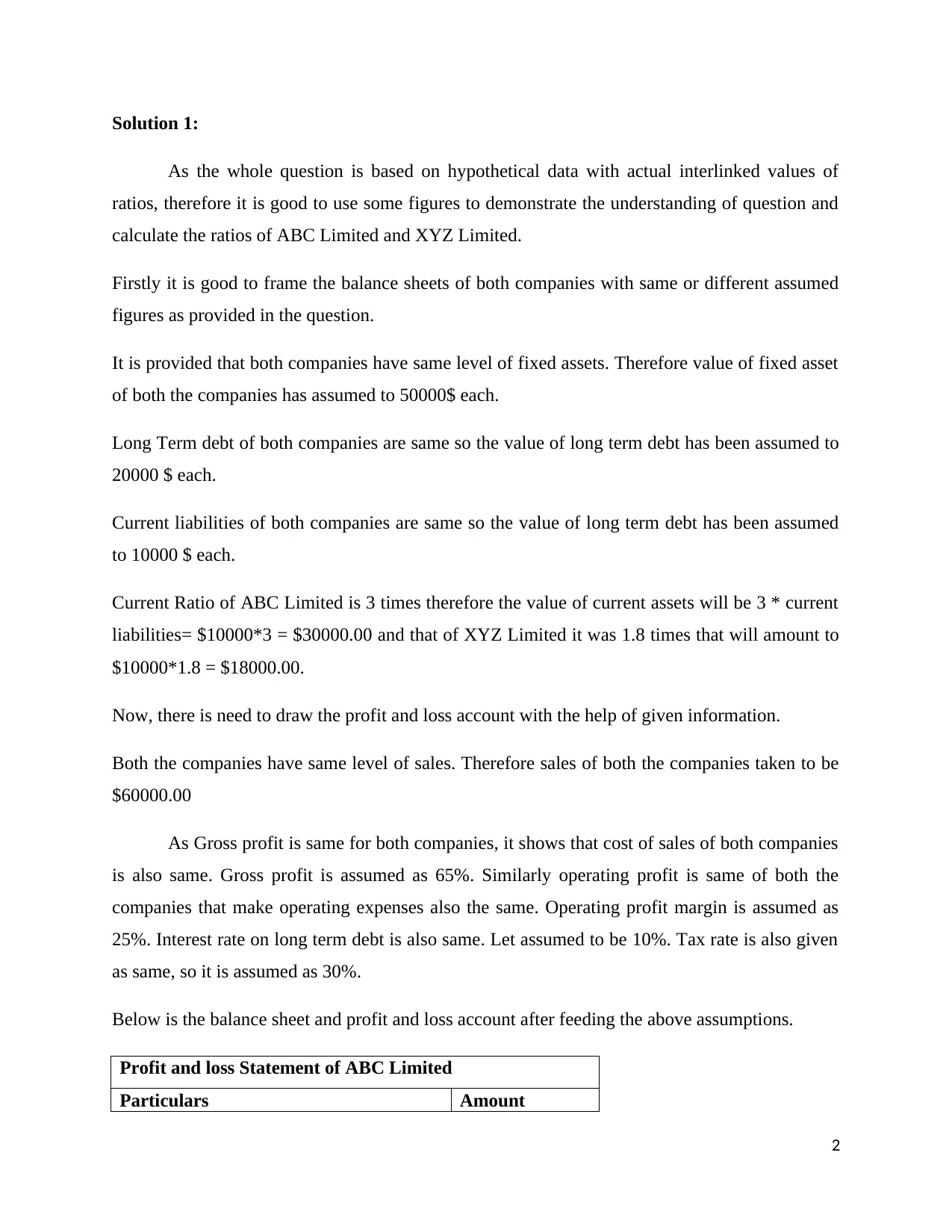
As the whole question is based on hypothetical data with actual interlinked values of
ratios, therefore it is good to use some figures to demonstrate the understanding of question and
calculate the ratios of ABC Limited and XYZ Limited.
Firstly it is good to frame the balance sheets of both companies with same or different assumed
figures as provided in the question.
It is provided that both companies have same level of fixed assets. Therefore value of fixed asset
of both the companies has assumed to 50000$ each.
Long Term debt of both companies are same so the value of long term debt has been assumed to
20000 $ each.
Current liabilities of both companies are same so the value of long term debt has been assumed
to 10000 $ each.
Current Ratio of ABC Limited is 3 times therefore the value of current assets will be 3 * current
liabilities= $10000*3 = $30000.00 and that of XYZ Limited it was 1.8 times that will amount to
$10000*1.8 = $18000.00.
Now, there is need to draw the profit and loss account with the help of given information.
Both the companies have same level of sales. Therefore sales of both the companies taken to be
$60000.00
As Gross profit is same for both companies, it shows that cost of sales of both companies
is also same. Gross profit is assumed as 65%. Similarly operating profit is same of both the
companies that make operating expenses also the same. Operating profit margin is assumed as
25%. Interest rate on long term debt is also same. Let assumed to be 10%. Tax rate is also given
as same, so it is assumed as 30%.
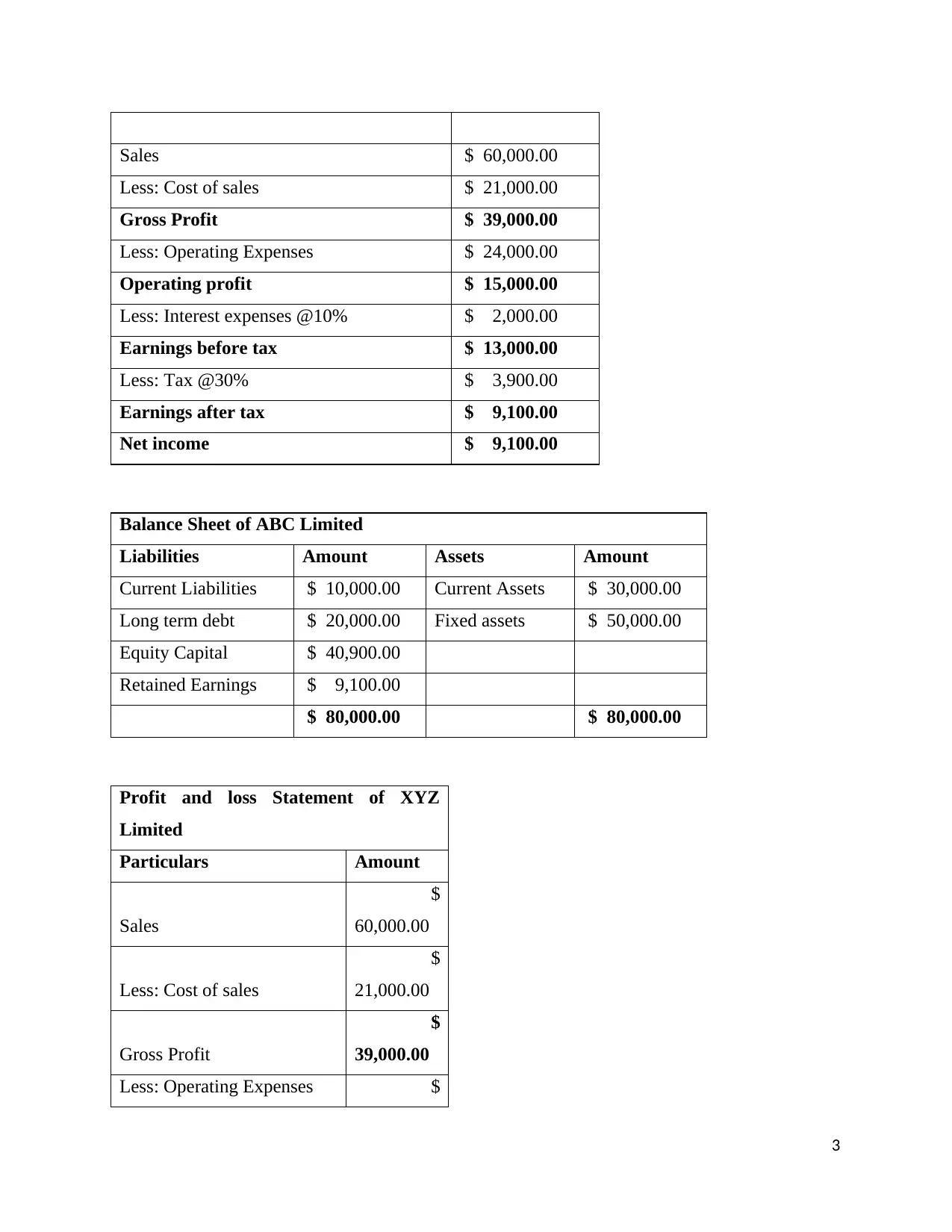
Below is the balance sheet and profit and loss account after feeding the above assumptions.
Profit and loss Statement of ABC Limited
Particulars Amount
2
Document Page
Sales $ 60,000.00
Less: Cost of sales $ 21,000.00
Gross Profit $ 39,000.00
Less: Operating Expenses $ 24,000.00
Operating profit $ 15,000.00
Less: Interest expenses @10% $ 2,000.00
Earnings before tax $ 13,000.00
Less: Tax @30% $ 3,900.00
Earnings after tax $ 9,100.00
Net income $ 9,100.00
Balance Sheet of ABC Limited
Liabilities Amount Assets Amount
Current Liabilities $ 10,000.00 Current Assets $ 30,000.00
Long term debt $ 20,000.00 Fixed assets $ 50,000.00
Equity Capital $ 40,900.00
Retained Earnings $ 9,100.00
$ 80,000.00 $ 80,000.00
Profit and loss Statement of XYZ
Limited
Particulars Amount
Sales
$
60,000.00
Less: Cost of sales
$
21,000.00
Gross Profit
$
39,000.00
Less: Operating Expenses $
3
Document Page
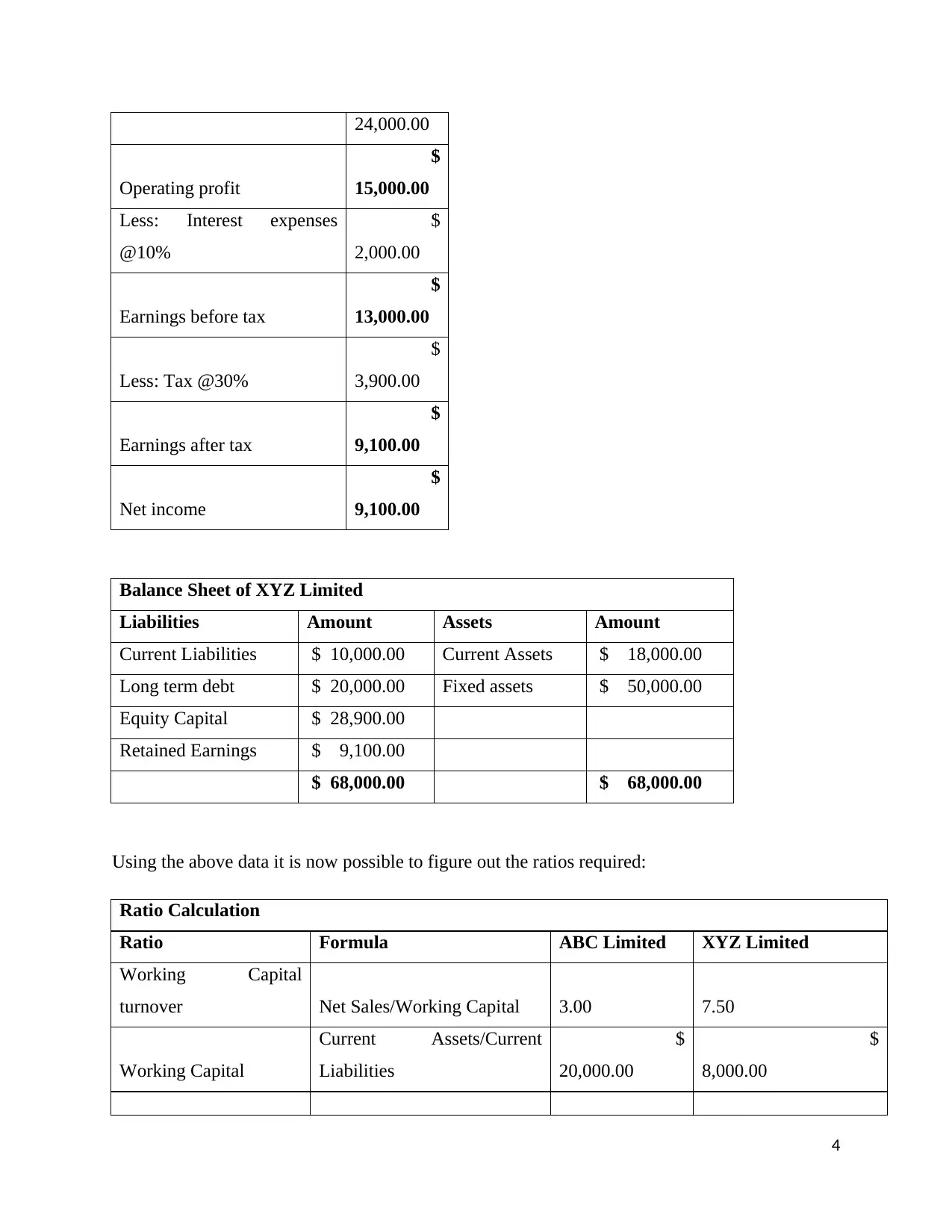
24,000.00
Operating profit
$
15,000.00
Less: Interest expenses
@10%
$
2,000.00
Earnings before tax
$
13,000.00
Less: Tax @30%
$
3,900.00
Earnings after tax
$
9,100.00
Net income
$
9,100.00
Balance Sheet of XYZ Limited
Liabilities Amount Assets Amount
Current Liabilities $ 10,000.00 Current Assets $ 18,000.00
Long term debt $ 20,000.00 Fixed assets $ 50,000.00
Equity Capital $ 28,900.00
Retained Earnings $ 9,100.00
$ 68,000.00 $ 68,000.00
Using the above data it is now possible to figure out the ratios required:
Ratio Calculation
Ratio Formula ABC Limited XYZ Limited
Working Capital
turnover Net Sales/Working Capital 3.00 7.50
Working Capital
Current Assets/Current
Liabilities
$
20,000.00
$
8,000.00
4
tabler-icon-diamond-filled.svg

Paraphrase This Document

Need a fresh take? Get an instant paraphrase of this document with our AI Paraphraser
Document Page
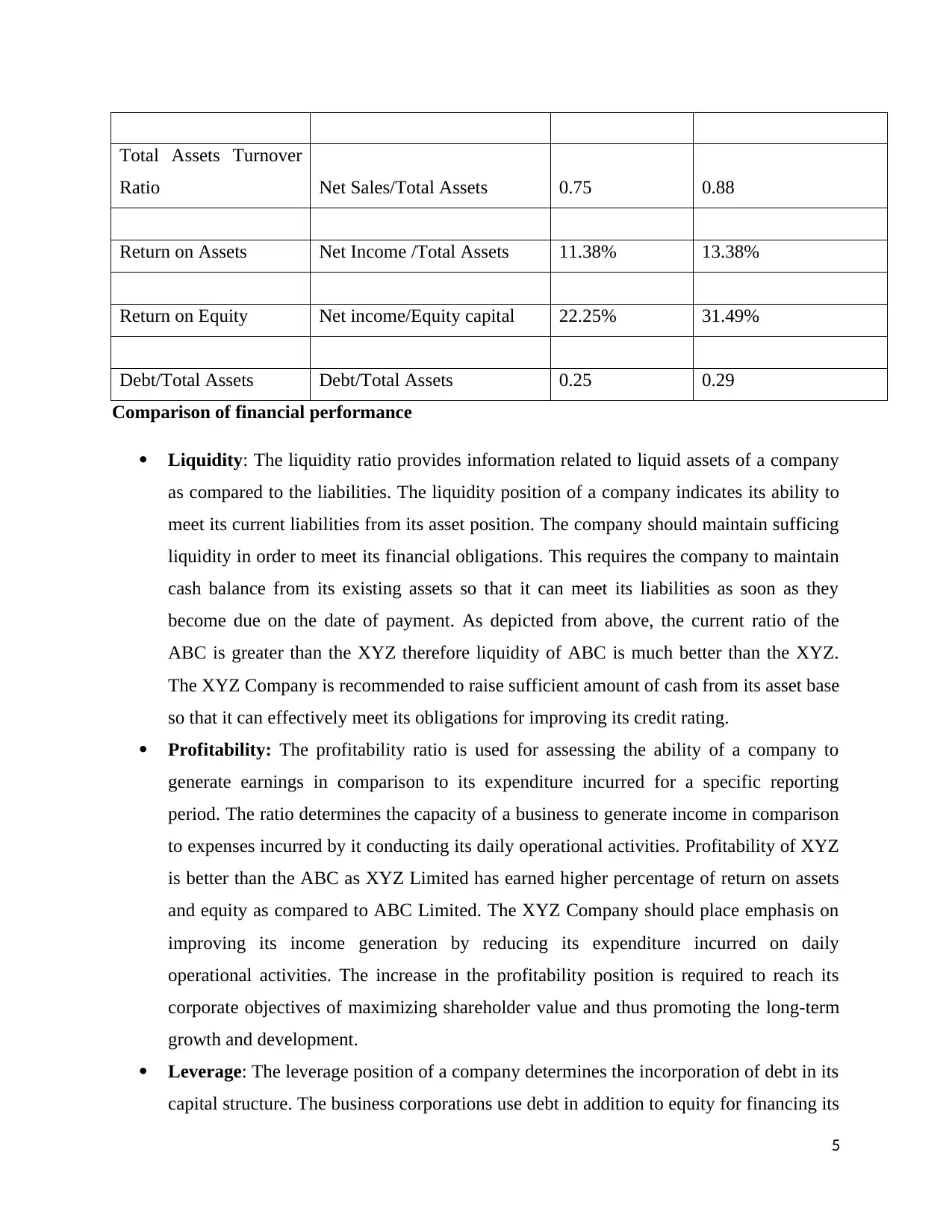
Total Assets Turnover
Ratio Net Sales/Total Assets 0.75 0.88
Return on Assets Net Income /Total Assets 11.38% 13.38%
Return on Equity Net income/Equity capital 22.25% 31.49%
Debt/Total Assets Debt/Total Assets 0.25 0.29
Comparison of financial performance
Liquidity: The liquidity ratio provides information related to liquid assets of a company
as compared to the liabilities. The liquidity position of a company indicates its ability to
meet its current liabilities from its asset position. The company should maintain sufficing
liquidity in order to meet its financial obligations. This requires the company to maintain
cash balance from its existing assets so that it can meet its liabilities as soon as they
become due on the date of payment. As depicted from above, the current ratio of the
ABC is greater than the XYZ therefore liquidity of ABC is much better than the XYZ.
The XYZ Company is recommended to raise sufficient amount of cash from its asset base
so that it can effectively meet its obligations for improving its credit rating.
Profitability: The profitability ratio is used for assessing the ability of a company to
generate earnings in comparison to its expenditure incurred for a specific reporting
period. The ratio determines the capacity of a business to generate income in comparison
to expenses incurred by it conducting its daily operational activities. Profitability of XYZ
is better than the ABC as XYZ Limited has earned higher percentage of return on assets
and equity as compared to ABC Limited. The XYZ Company should place emphasis on
improving its income generation by reducing its expenditure incurred on daily
operational activities. The increase in the profitability position is required to reach its
corporate objectives of maximizing shareholder value and thus promoting the long-term
growth and development.
Leverage: The leverage position of a company determines the incorporation of debt in its
capital structure. The business corporations use debt in addition to equity for financing its
5
Document Page
daily operational activities. However, in this context it is important for a company to
generate sufficient cash for meeting its debt obligations. The leverage position of a
company indicates the amount of cash it should maintain to appropriately pay of its debt
obligations. XYZ Limited is more leveraged as compare to ABC Limited as debt to asset
ratio of ABC is lower than the XYZ. This is an issue of major concern for the company
as it has lower liquidity position and high leverage that can result in difficulties in
meeting its debt obligations in the long-term.
Activity: The activity ratio is used to analyse and evaluate the capacity of a business
company to transform its asset, liability into the cash or sales. The company should be
able to quickly transform its asset base to cash for measuring its efficiency position. XYZ
Limited is more efficient in using the resources to convert them in sales as compare to
ABC Limited (Asquith and Weiss, 2016).
Solution 2:
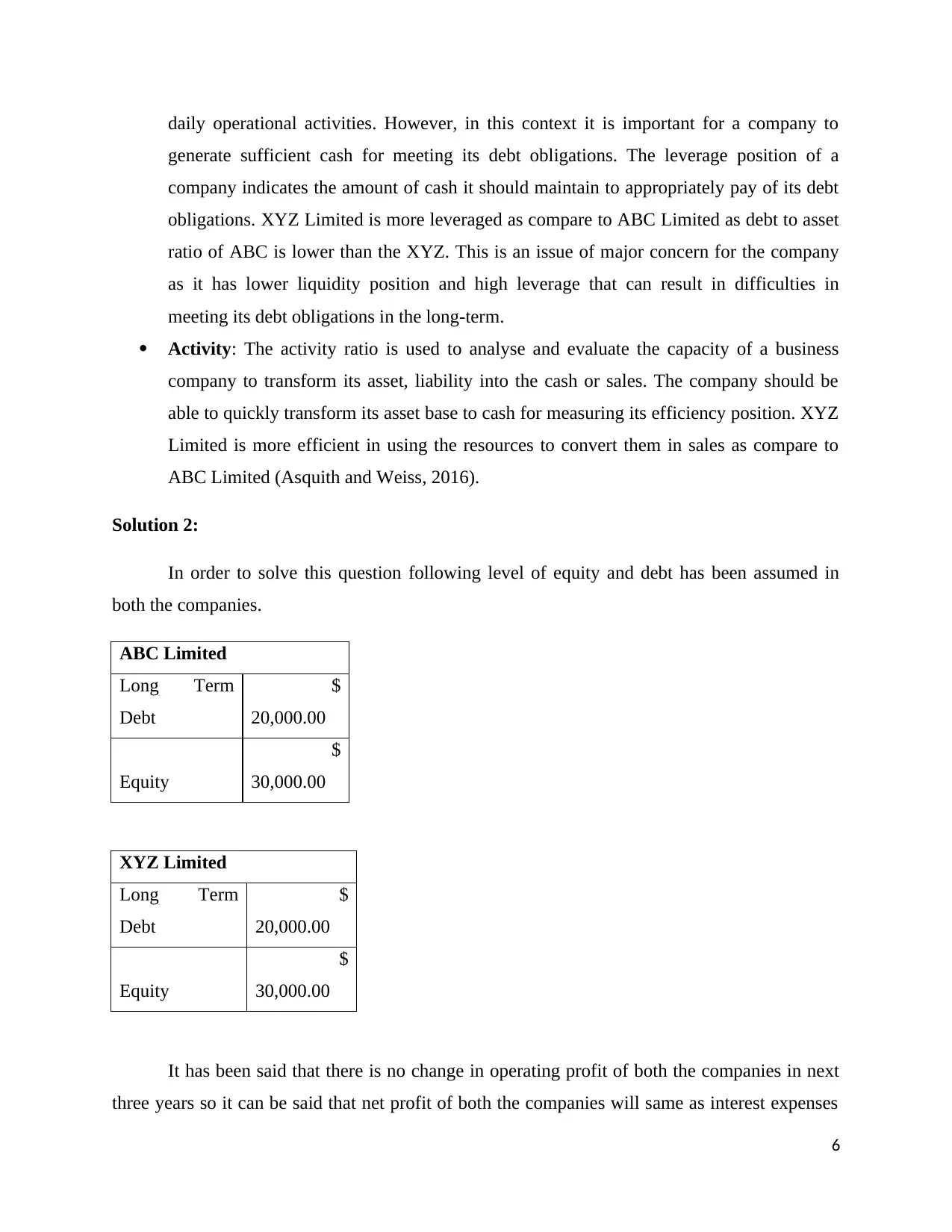
In order to solve this question following level of equity and debt has been assumed in
both the companies.
ABC Limited
Long Term
Debt
$
20,000.00
Equity
$
30,000.00
XYZ Limited
Long Term
Debt
$
20,000.00
Equity
$
30,000.00
It has been said that there is no change in operating profit of both the companies in next
three years so it can be said that net profit of both the companies will same as interest expenses
6
Document Page
and tax rate of both companies are same. Only the value of retained earnings will be different in
all the three years in case of XYZ Limited because has distributed only 50 % capital has been
distributed by XYZ Limited and rest it was retained. In case of ABC Limited all profits are
distributed. So there will be change in value of retained earnings (Equity) in case of XYZ
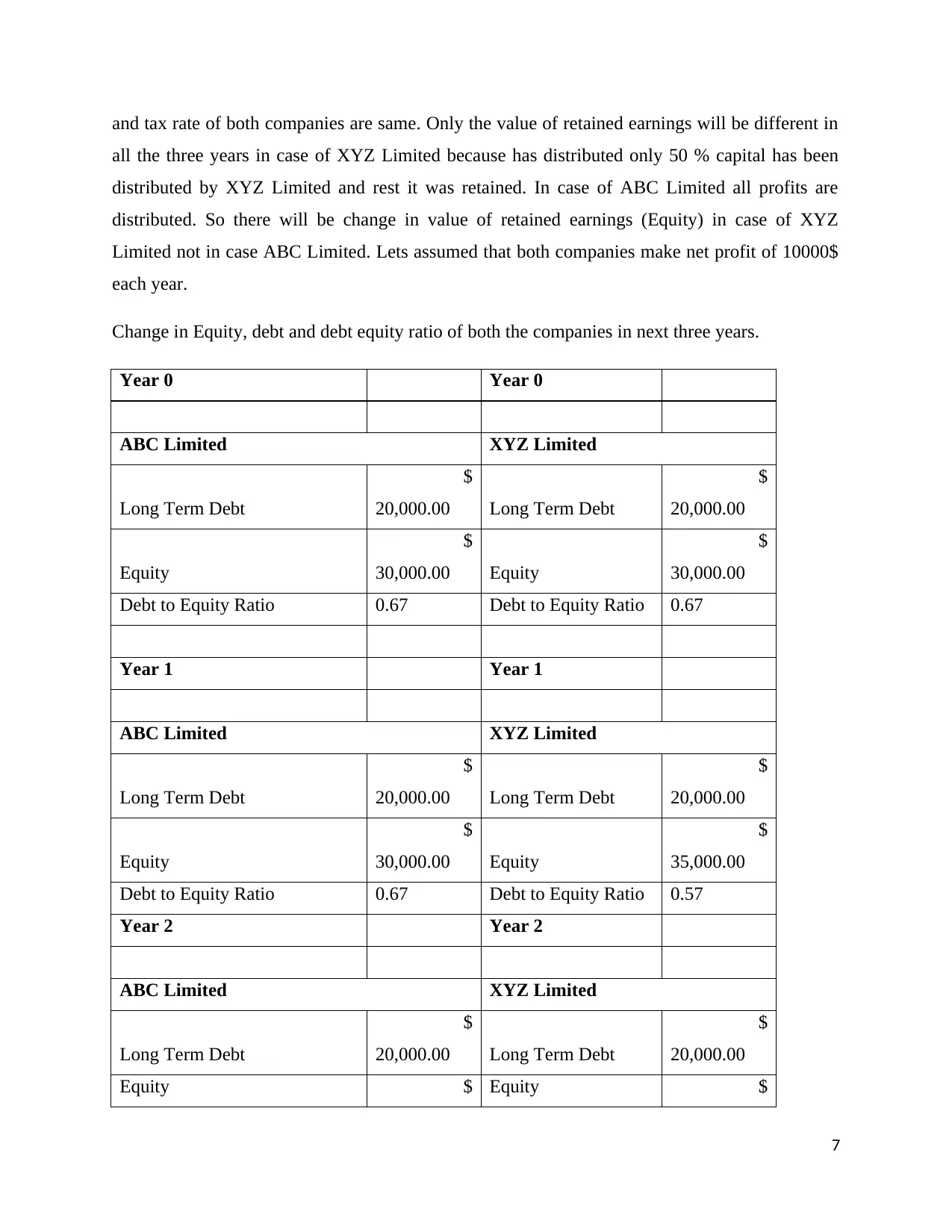
Limited not in case ABC Limited. Lets assumed that both companies make net profit of 10000$
each year.
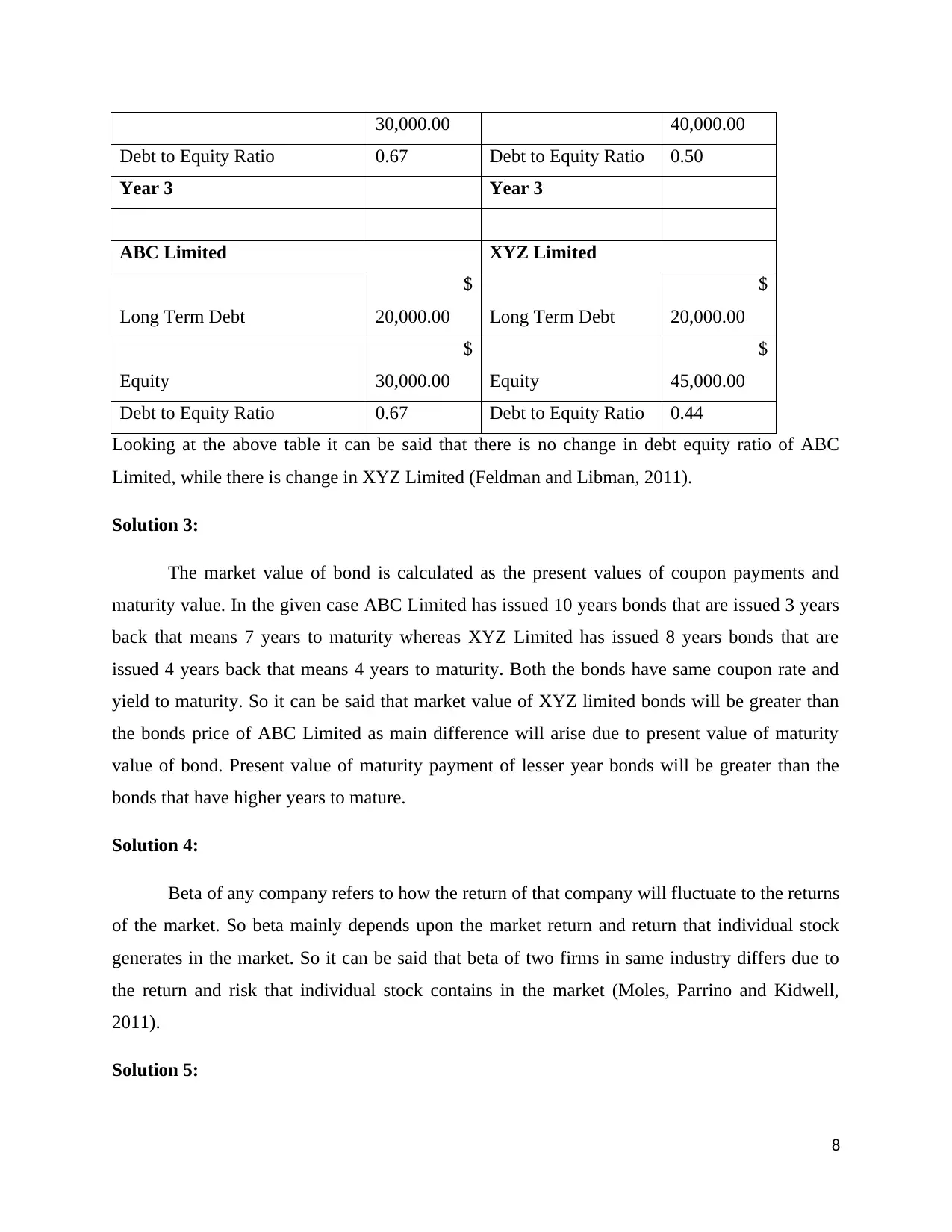
Change in Equity, debt and debt equity ratio of both the companies in next three years.
Year 0 Year 0
ABC Limited XYZ Limited
Long Term Debt
$
20,000.00 Long Term Debt
$
20,000.00
Equity
$
30,000.00 Equity
$
30,000.00
Debt to Equity Ratio 0.67 Debt to Equity Ratio 0.67
Year 1 Year 1
ABC Limited XYZ Limited
Long Term Debt
$
20,000.00 Long Term Debt
$
20,000.00
Equity
$
30,000.00 Equity
$
35,000.00
Debt to Equity Ratio 0.67 Debt to Equity Ratio 0.57
Year 2 Year 2
ABC Limited XYZ Limited
Long Term Debt
$
20,000.00 Long Term Debt
$
20,000.00
Equity $ Equity $
7
tabler-icon-diamond-filled.svg

Paraphrase This Document

Need a fresh take? Get an instant paraphrase of this document with our AI Paraphraser
Document Page
30,000.00 40,000.00
Debt to Equity Ratio 0.67 Debt to Equity Ratio 0.50
Year 3 Year 3
ABC Limited XYZ Limited
Long Term Debt
$
20,000.00 Long Term Debt
$
20,000.00
Equity
$
30,000.00 Equity
$
45,000.00
Debt to Equity Ratio 0.67 Debt to Equity Ratio 0.44
Looking at the above table it can be said that there is no change in debt equity ratio of ABC
Limited, while there is change in XYZ Limited (Feldman and Libman, 2011).
Solution 3:
The market value of bond is calculated as the present values of coupon payments and
maturity value. In the given case ABC Limited has issued 10 years bonds that are issued 3 years
back that means 7 years to maturity whereas XYZ Limited has issued 8 years bonds that are
issued 4 years back that means 4 years to maturity. Both the bonds have same coupon rate and
yield to maturity. So it can be said that market value of XYZ limited bonds will be greater than
the bonds price of ABC Limited as main difference will arise due to present value of maturity
value of bond. Present value of maturity payment of lesser year bonds will be greater than the
bonds that have higher years to mature.
Solution 4:
Beta of any company refers to how the return of that company will fluctuate to the returns
of the market. So beta mainly depends upon the market return and return that individual stock
generates in the market. So it can be said that beta of two firms in same industry differs due to
the return and risk that individual stock contains in the market (Moles, Parrino and Kidwell,
2011).
Solution 5:
8
Document Page
There are various ways to reduce the current ratio and they are as under together with the risk
associated with each alternative:
Value of cash assets can be reduced such that it decreases the value of current assets but
no change in the current liabilities. Due to this there can be shortage of cash availability.
For example, the value of current ratio is 3:1 and thus it can be assumed that the value of
current assets is 3, 00,000 and the value of current liabilities is 1,00,000. The value of
cash in the total value of current assets if estimated to be 70,000 and reduced by an
amount to 20,000 due to increase in prepaid expenses then it will reduce the current ratio
by a significant amount. Now, the new current assets will be 250000 and the current ratio
will be 2.5.
Inventory can be sold at discount and credit period is allowed for more than 1 year. In
this alternative, current asset will be converted into non-current assets and will directly
impacts the operating cash cycle. For example, the value of inventory is valued at
1,00,000 in the overall value of current assets and is now significantly reduced to 20,000
indicating a net decrease in the value of inventory by 80,000 due to physical damage. The
value of current assets is 2,20,000 and as such the value of current ratio will decrease to
2.2
Current liabilities can be increased through purchasing the fixed assets or through late
payment of various expenditures. There will increase pressure on the company to settle
the liabilities that can hamper the operations (Ferran and Ho, 2014). For example, the
value of current liabilities is increased by 50,000 from the initial value of 1, 00,000 due to
increase in accounts payable and thus amounting to 1,50,000. The value of current ratio
as such will be 2:1.
9
Document Page
References
Asquith, P. and Weiss, L.A 2016. Lessons in Corporate Finance: A Case Studies Approach to
Financial Tools, Financial Policies, and Valuation. John Wiley & Sons.
Feldman, M. and Libman, A. 2011. Crash Course in Accounting and Financial Statement
Analysis. John Wiley & Sons.
Ferran, E. and Ho, L.C. 2014. Principles of Corporate Finance Law. OUP Oxford.
Moles, P., Parrino, R. and Kidwell, D.S. 2011. Corporate Finance. John Wiley & Sons.
10
chevron_up_icon
1 out of 10
circle_padding
hide_on_mobile
zoom_out_icon
[object Object]