Corporate Finance Report: Investment Analysis and Recommendations

Verified

Added on  2021/12/23

|12
|1887
|16
Report
AI Summary
This report provides a comprehensive analysis of corporate finance principles, focusing on an investment recommendation for Philip Morris International. The report begins with an executive summary and strategic rationale, followed by a background analysis of the company's current situation and market position. It outlines project objectives, effects, and benefits, including financial projections using WACC and APV valuations. The report identifies key project risks, such as declining cigarette consumption and regulatory requirements, and proposes alternative scenarios. Business performance metrics, including revenue, profit, and key ratios, are presented and analyzed. The report concludes with a detailed financial analysis, offering insights into investment strategies and decision-making processes within the context of the tobacco industry. The analysis includes both financial and non-financial factors, considering market performance, regulatory requirements, and sustainability initiatives.
Document Page
Running head: CORPORATE FINANCE
Corporate Finance
Name of the Student:
Name of the University:
Author Note:
tabler-icon-diamond-filled.svg

Paraphrase This Document

Need a fresh take? Get an instant paraphrase of this document with our AI Paraphraser
Document Page
1.
Document Page
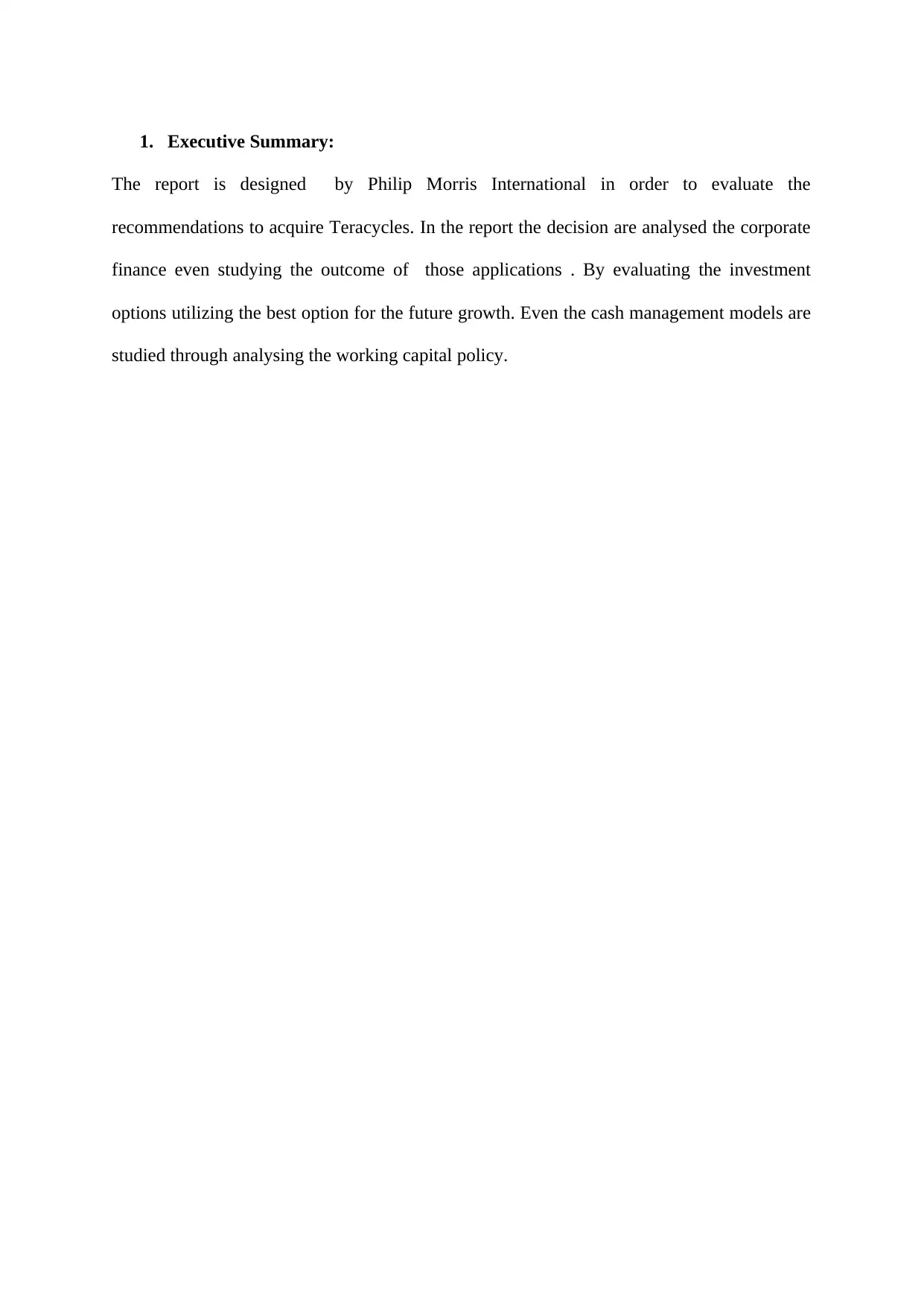
1. Executive Summary:
The report is designed by Philip Morris International in order to evaluate the
recommendations to acquire Teracycles. In the report the decision are analysed the corporate
finance even studying the outcome of those applications . By evaluating the investment
options utilizing the best option for the future growth. Even the cash management models are
studied through analysing the working capital policy.
Document Page
2.
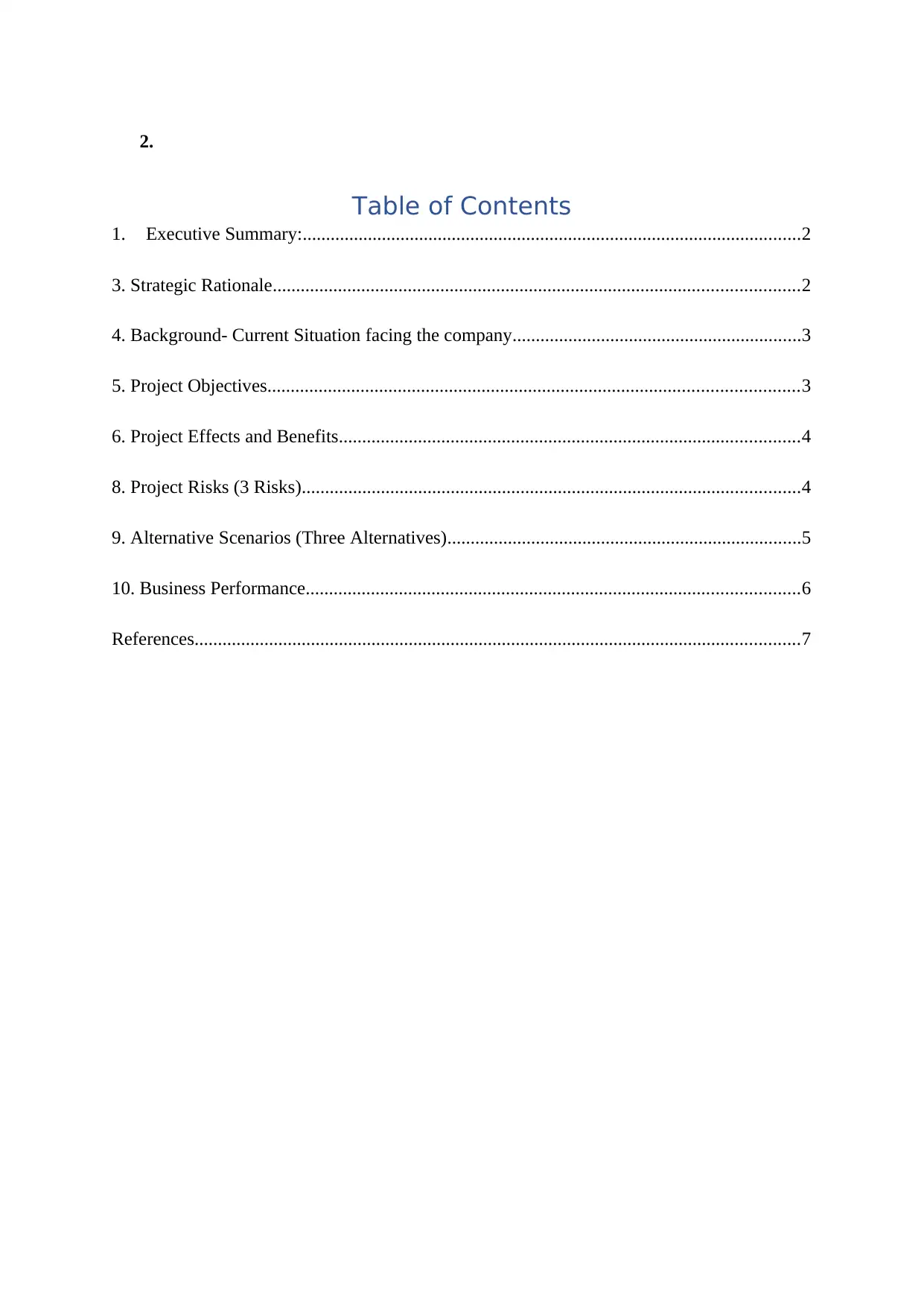
Table of Contents
1. Executive Summary:...........................................................................................................2
3. Strategic Rationale.................................................................................................................2
4. Background- Current Situation facing the company..............................................................3
5. Project Objectives..................................................................................................................3
6. Project Effects and Benefits...................................................................................................4
8. Project Risks (3 Risks)...........................................................................................................4
9. Alternative Scenarios (Three Alternatives)............................................................................5
10. Business Performance..........................................................................................................6
References..................................................................................................................................7
tabler-icon-diamond-filled.svg

Paraphrase This Document

Need a fresh take? Get an instant paraphrase of this document with our AI Paraphraser
Document Page
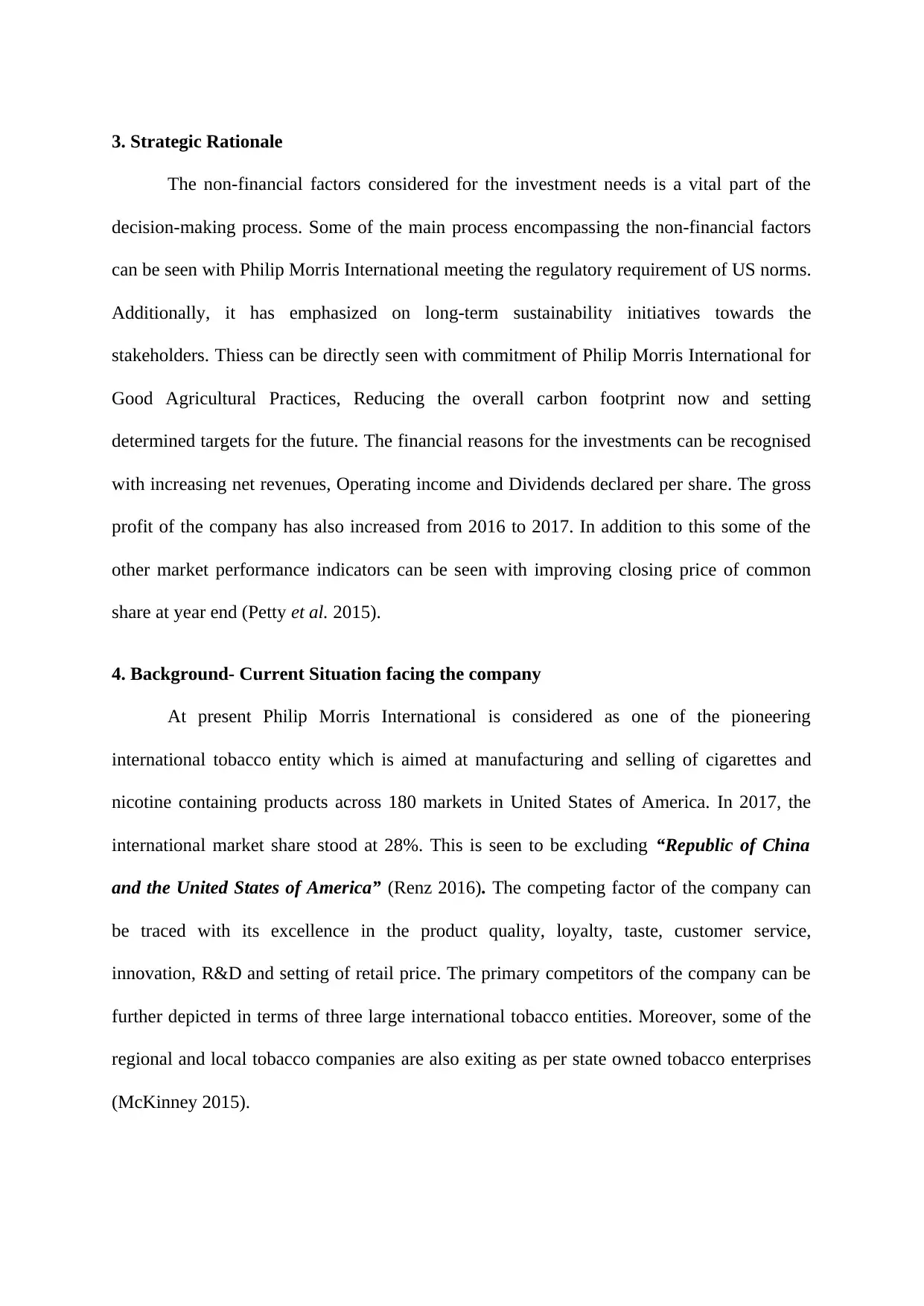
3. Strategic Rationale
The non-financial factors considered for the investment needs is a vital part of the
decision-making process. Some of the main process encompassing the non-financial factors
can be seen with Philip Morris International meeting the regulatory requirement of US norms.
Additionally, it has emphasized on long-term sustainability initiatives towards the
stakeholders. Thiess can be directly seen with commitment of Philip Morris International for
Good Agricultural Practices, Reducing the overall carbon footprint now and setting
determined targets for the future. The financial reasons for the investments can be recognised
with increasing net revenues, Operating income and Dividends declared per share. The gross
profit of the company has also increased from 2016 to 2017. In addition to this some of the
other market performance indicators can be seen with improving closing price of common
share at year end (Petty et al. 2015).
4. Background- Current Situation facing the company
At present Philip Morris International is considered as one of the pioneering
international tobacco entity which is aimed at manufacturing and selling of cigarettes and
nicotine containing products across 180 markets in United States of America. In 2017, the
international market share stood at 28%. This is seen to be excluding “Republic of China
and the United States of America” (Renz 2016). The competing factor of the company can
be traced with its excellence in the product quality, loyalty, taste, customer service,
innovation, R&D and setting of retail price. The primary competitors of the company can be
further depicted in terms of three large international tobacco entities. Moreover, some of the
regional and local tobacco companies are also exiting as per state owned tobacco enterprises
(McKinney 2015).
Document Page
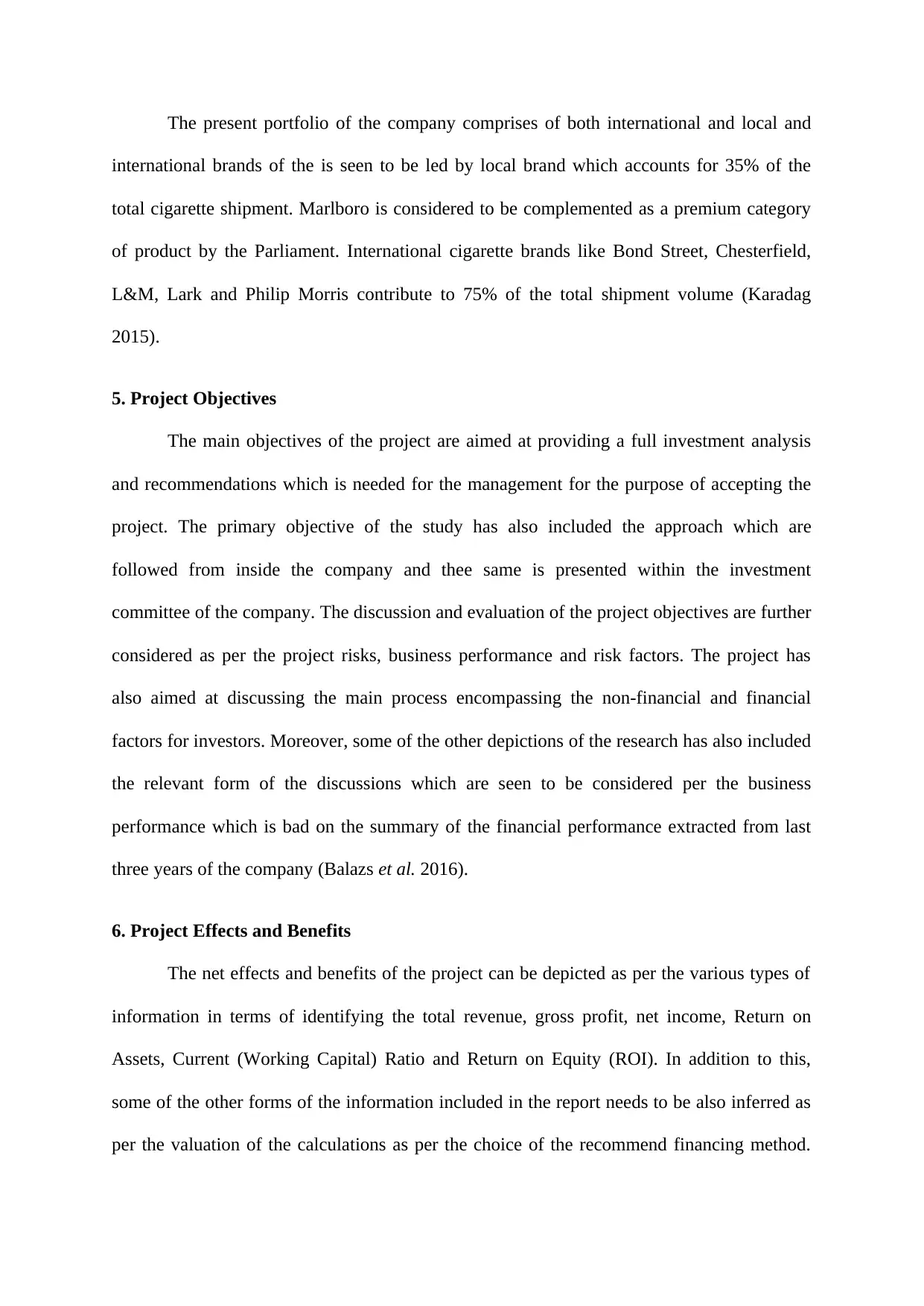
The present portfolio of the company comprises of both international and local and
international brands of the is seen to be led by local brand which accounts for 35% of the
total cigarette shipment. Marlboro is considered to be complemented as a premium category
of product by the Parliament. International cigarette brands like Bond Street, Chesterfield,
L&M, Lark and Philip Morris contribute to 75% of the total shipment volume (Karadag
2015).
5. Project Objectives
The main objectives of the project are aimed at providing a full investment analysis
and recommendations which is needed for the management for the purpose of accepting the
project. The primary objective of the study has also included the approach which are
followed from inside the company and thee same is presented within the investment
committee of the company. The discussion and evaluation of the project objectives are further
considered as per the project risks, business performance and risk factors. The project has
also aimed at discussing the main process encompassing the non-financial and financial
factors for investors. Moreover, some of the other depictions of the research has also included
the relevant form of the discussions which are seen to be considered per the business
performance which is bad on the summary of the financial performance extracted from last
three years of the company (Balazs et al. 2016).
6. Project Effects and Benefits
The net effects and benefits of the project can be depicted as per the various types of
information in terms of identifying the total revenue, gross profit, net income, Return on
Assets, Current (Working Capital) Ratio and Return on Equity (ROI). In addition to this,
some of the other forms of the information included in the report needs to be also inferred as
per the valuation of the calculations as per the choice of the recommend financing method.
Document Page
The benefits of the project can be inferred as per the depth of understanding the exploration,
insight and research items (Finkler et al. 2016). The different types of the specification of the
research needs to be further identified as per the various types of the initiatives related to
mitigating the present risk of the project. The qualitative and quantitative analysis is also
considered as the beneficial outcome of the project (Zietlow et al. 2018).
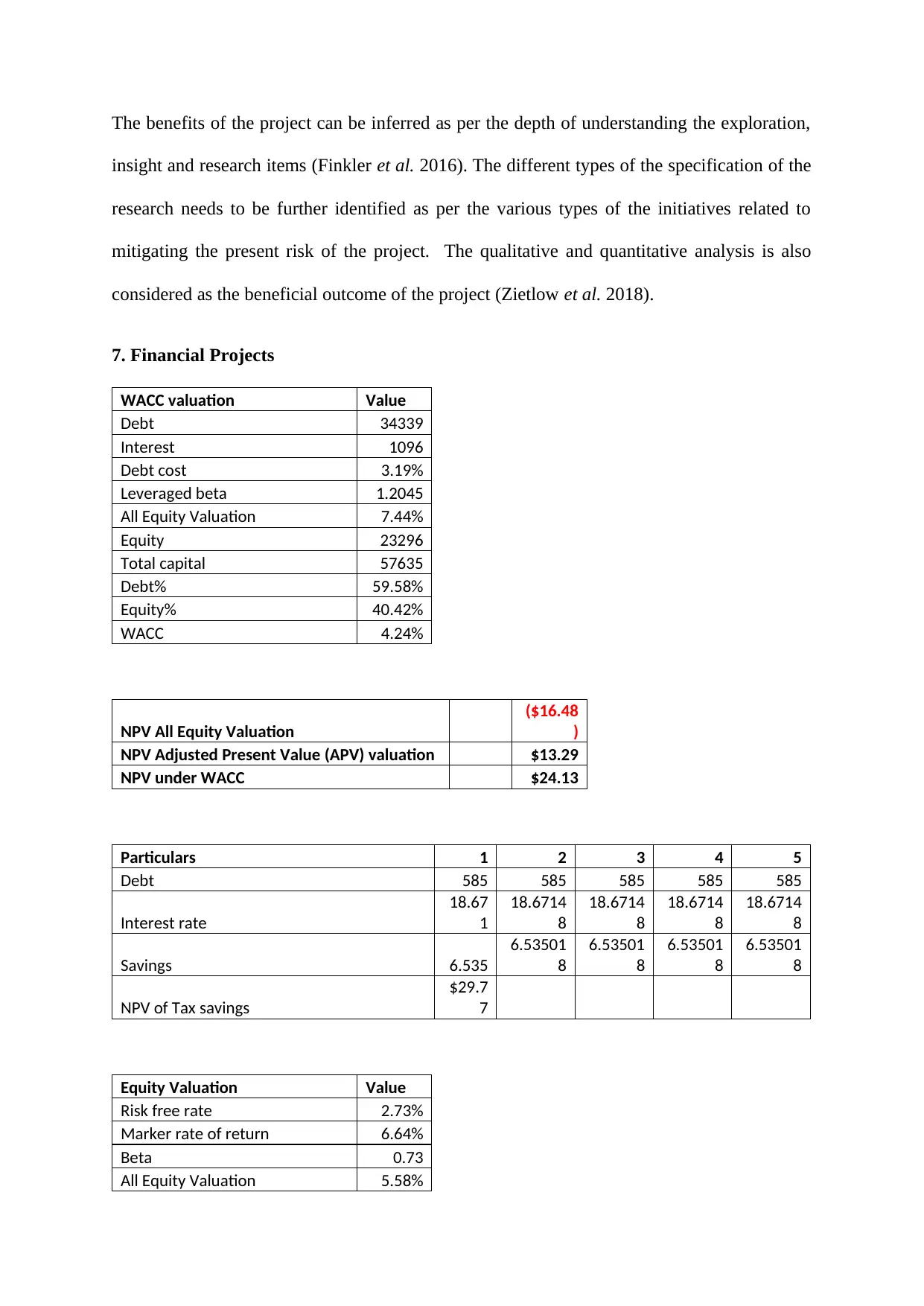
7. Financial Projects
WACC valuation Value
Debt 34339
Interest 1096
Debt cost 3.19%
Leveraged beta 1.2045
All Equity Valuation 7.44%
Equity 23296
Total capital 57635
Debt% 59.58%
Equity% 40.42%
WACC 4.24%
NPV All Equity Valuation
($16.48
)
NPV Adjusted Present Value (APV) valuation $13.29
NPV under WACC $24.13
Particulars 1 2 3 4 5
Debt 585 585 585 585 585
Interest rate
18.67
1
18.6714
8
18.6714
8
18.6714
8
18.6714
8
Savings 6.535
6.53501
8
6.53501
8
6.53501
8
6.53501
8
NPV of Tax savings
$29.7
7
Equity Valuation Value
Risk free rate 2.73%
Marker rate of return 6.64%
Beta 0.73
All Equity Valuation 5.58%
tabler-icon-diamond-filled.svg

Paraphrase This Document

Need a fresh take? Get an instant paraphrase of this document with our AI Paraphraser
Document Page
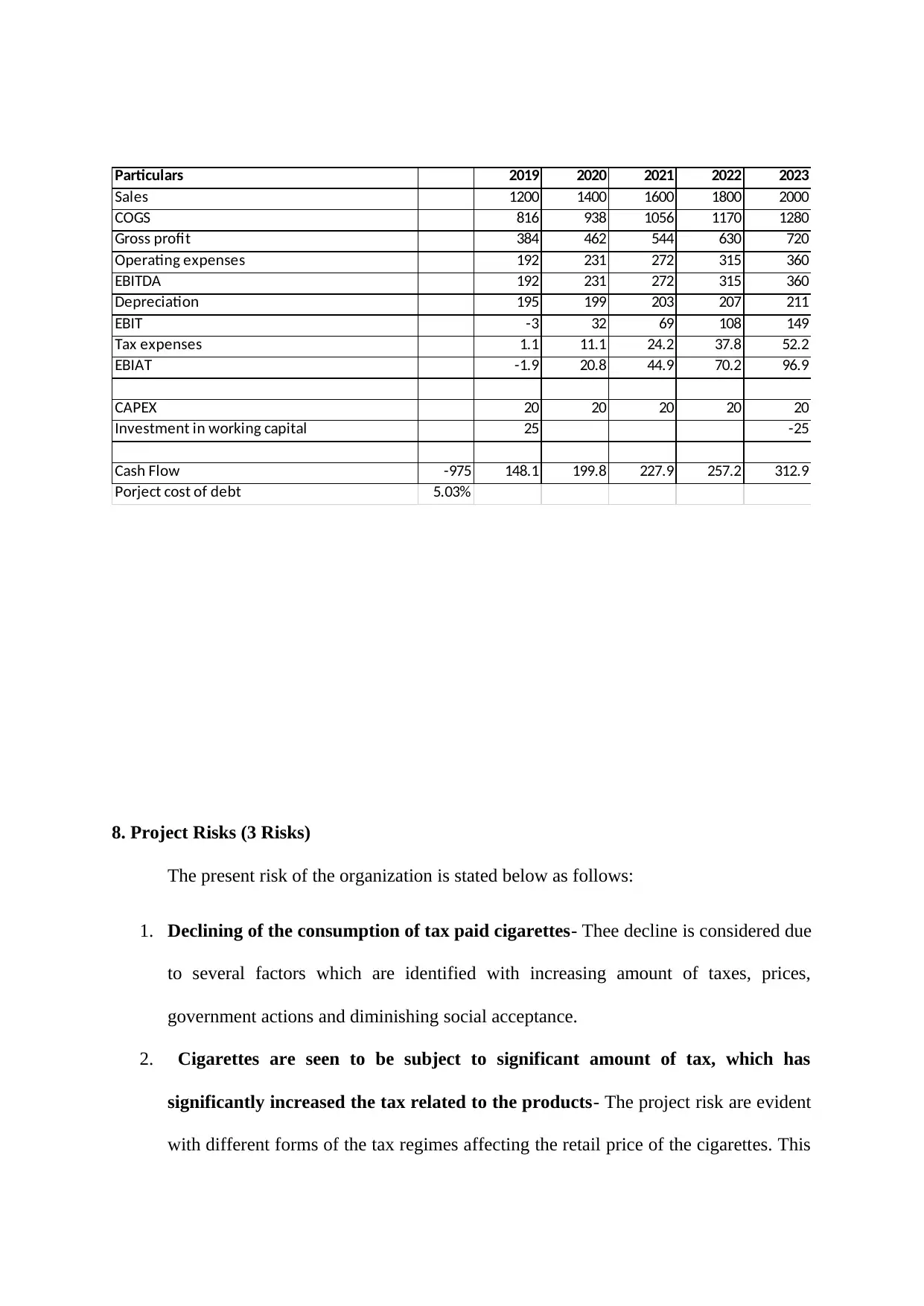
Particulars 2019 2020 2021 2022 2023
Sales 1200 1400 1600 1800 2000
COGS 816 938 1056 1170 1280
Gross profit 384 462 544 630 720
Operating expenses 192 231 272 315 360
EBITDA 192 231 272 315 360
Depreciation 195 199 203 207 211
EBIT -3 32 69 108 149
Tax expenses 1.1 11.1 24.2 37.8 52.2
EBIAT -1.9 20.8 44.9 70.2 96.9
CAPEX 20 20 20 20 20
Investment in working capital 25 -25
Cash Flow -975 148.1 199.8 227.9 257.2 312.9
Porject cost of debt 5.03%
8. Project Risks (3 Risks)
The present risk of the organization is stated below as follows:
1. Declining of the consumption of tax paid cigarettes- Thee decline is considered due
to several factors which are identified with increasing amount of taxes, prices,
government actions and diminishing social acceptance.
2. Cigarettes are seen to be subject to significant amount of tax, which has
significantly increased the tax related to the products- The project risk are evident
with different forms of the tax regimes affecting the retail price of the cigarettes. This
Document Page
is inclusive of the excise taxes, sales taxes and import duties affecting the retail price
of the cigarettes in compared to the combustible tobacco (Burtonshaw-Gunn 2017).
3. The business is subject to increased number of regulatory requirements with the
intention of reducing and preventing the use of tobacco products- This risk can be
directly considered with the combination of the number of issues which are seen with
the reducing effect of the social acceptance of smoking. These are also related to the
private action s of the company which has reduced the industry volume in many in
several markets. The inclusion of some of some of the other facets by the company is
at risk with the restrictions of licensing (Balazs et al. 2016)
9. Alternative Scenarios (Three Alternatives)
The three alternative scenarios of the project are discussed below as follows:
Scenario 1- Do nothing
This scenario relates to the evaluation of the do-nothing scenario can be predicted
with non-considerations of the increase of total revenue, gross profit, net income, Return on
Assets, Current (Working Capital) Ratio and Return on Equity (ROI) due to threats in the
external market.
Scenario 2- Considering for investment with the performance ratio
This scenario relates to investors solely relying on the performance ratios of the
company. This needs to be depicted as per the increasing net revenues, Operating income and
Dividends declared per share. The gross profit of the company has also increased from 2016
to 2017.
Scenario 3- Considering the decision for investment with market performance ratio
Document Page
This scenario relates to investors considering to invest only as per the evaluation of
the market performance ratio such as improving closing price of common share at year end
(Zietlow et al. 2018).
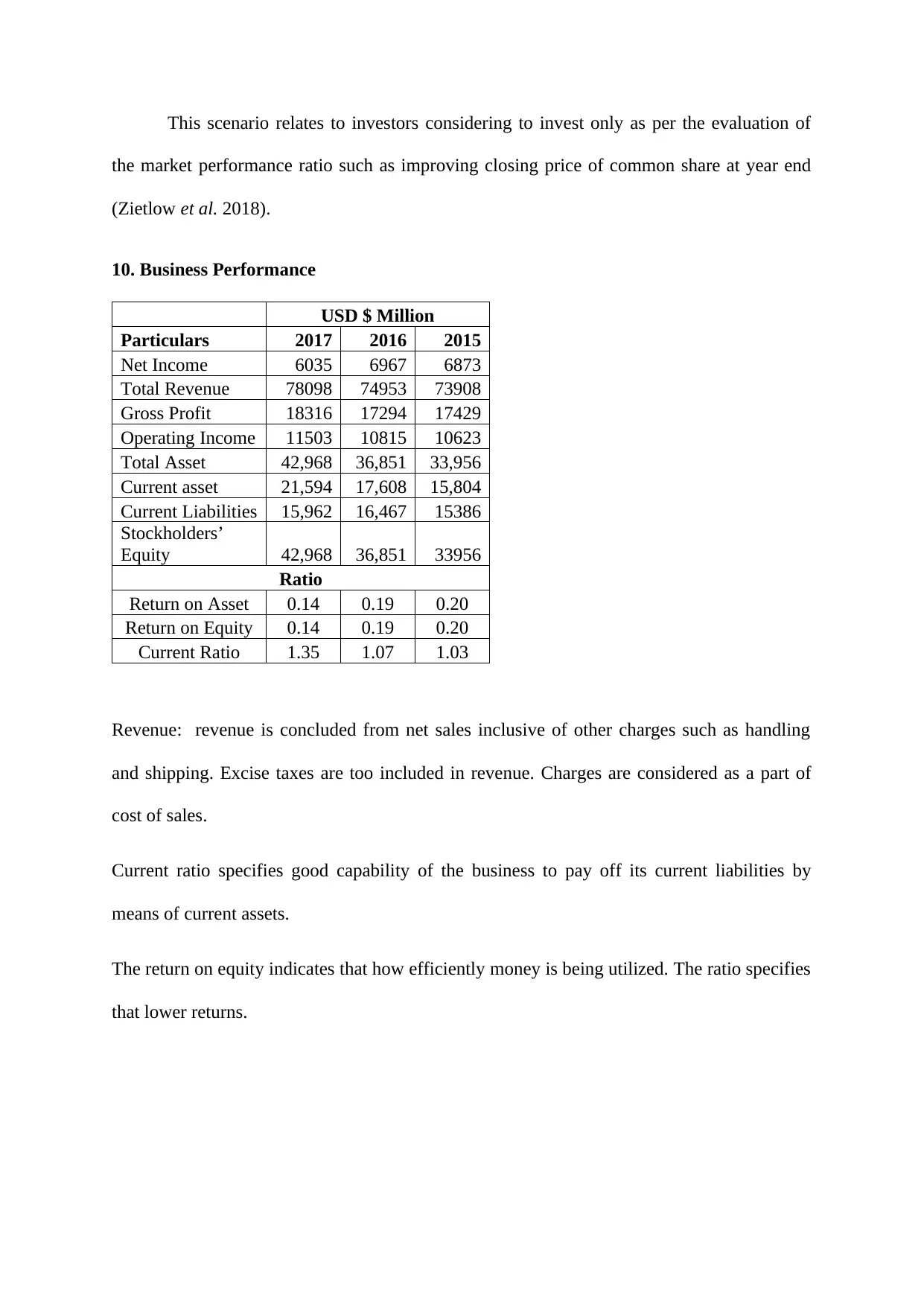
10. Business Performance
USD $ Million
Particulars 2017 2016 2015
Net Income 6035 6967 6873
Total Revenue 78098 74953 73908
Gross Profit 18316 17294 17429
Operating Income 11503 10815 10623
Total Asset 42,968 36,851 33,956
Current asset 21,594 17,608 15,804
Current Liabilities 15,962 16,467 15386
Stockholders’
Equity 42,968 36,851 33956
Ratio
Return on Asset 0.14 0.19 0.20
Return on Equity 0.14 0.19 0.20
Current Ratio 1.35 1.07 1.03
Revenue: revenue is concluded from net sales inclusive of other charges such as handling
and shipping. Excise taxes are too included in revenue. Charges are considered as a part of
cost of sales.
Current ratio specifies good capability of the business to pay off its current liabilities by
means of current assets.
The return on equity indicates that how efficiently money is being utilized. The ratio specifies
that lower returns.
tabler-icon-diamond-filled.svg

Paraphrase This Document

Need a fresh take? Get an instant paraphrase of this document with our AI Paraphraser
Document Page
References
Burtonshaw-Gunn, S.A., 2017. Risk and financial management in construction. Routledge.
Finkler, S.A., Smith, D.L., Calabrese, T.D. and Purtell, R.M., 2016. Financial management
for public, health, and not-for-profit organizations. CQ Press.
Karadag, H., 2015. Financial management challenges in small and medium-sized enterprises:
A strategic management approach. EMAJ: Emerging Markets Journal, 5(1), pp.26-40.
Krüger, P., Landier, A. and Thesmar, D., 2015. The WACC fallacy: The real effects of using
a unique discount rate. The Journal of Finance, 70(3), pp.1253-1285.
Magni, C.A., 2015. Investment, financing and the role of ROA and WACC in value
creation. European Journal of Operational Research, 244(3), pp.855-866.
McKinney, J.B., 2015. Effective financial management in public and nonprofit agencies.
ABC-CLIO.
Petty, J.W., Titman, S., Keown, A.J., Martin, P., Martin, J.D. and Burrow, M.,
2015. Financial management: Principles and applications. Pearson Higher Education AU.
Pricing, I. and Tribunal, R., 2013. Review of WACC methodology. Research–Final report.
Balazs, A.G., Liu-Barker, X.C., Foiles, D.L., Thomas, M.P.I. and Lee, R.E., Intuit Inc, 2016.
Methods, systems, and articles of manufacture for implementing adaptive levels of assurance
in a financial management system. U.S. Patent 9,444,824.
Renz, D.O., 2016. The Jossey-Bass handbook of nonprofit leadership and management. John
Wiley & Sons.
Zietlow, J., Hankin, J.A., Seidner, A. and O'Brien, T., 2018. Financial management for
nonprofit organizations: Policies and practices. John Wiley & Sons.
Document Page
chevron_up_icon
1 out of 12
circle_padding
hide_on_mobile
zoom_out_icon
[object Object]