Managerial Finance: Corporate Governance and Bankruptcy Analysis
VerifiedAdded on 2021/04/21
|11
|3411
|44
Literature Review
AI Summary
This literature review examines the critical link between corporate governance practices and the risk of corporate bankruptcy. It delves into various aspects, including the impact of managerial ownership, board size, CEO duality, and independent directors on a company's financial health and distress probability. The research highlights that while corporate governance mechanisms influence bankruptcy risk, specific variables like CEO duality and institutional ownership play significant roles. The review further explores how the composition and effectiveness of the board of directors, particularly the presence of independent directors, can mitigate financial distress. It also emphasizes the importance of strong corporate governance structures in protecting shareholder interests and maintaining investor trust, especially in light of past corporate scandals. The study analyzes how these factors contribute to a company's ability to navigate financial challenges and maintain long-term sustainability.
MANAGERIAL FINANCE

Paraphrase This Document
Need a fresh take? Get an instant paraphrase of this document with our AI Paraphraser
Corporate bankruptcy risk
Literature Review
Abstract
Corporate governance is the need of the hour and has far sighted impact on various factors
that prevails in the organization. In this report, the impact of corporate governance on the
bankruptcy code has been taken into consideration. The study sheds light on the practice of
corporate governance and its impact on financial distress that happens round the corner. The
attributes such as managerial ownership, board size, etc has been considered for the report
purpose. The research indicates that the mechanism of corporate governance has an impact on
the corporate bankruptcy risk but when it comes to the attribute of the cross section have an
important impact that is CEO duality and institutional ownership. The study even stresses that
the specific variable of the company have a pivotal role to play when it comes to financial
distress probability
2
Literature Review
Abstract
Corporate governance is the need of the hour and has far sighted impact on various factors
that prevails in the organization. In this report, the impact of corporate governance on the
bankruptcy code has been taken into consideration. The study sheds light on the practice of
corporate governance and its impact on financial distress that happens round the corner. The
attributes such as managerial ownership, board size, etc has been considered for the report
purpose. The research indicates that the mechanism of corporate governance has an impact on
the corporate bankruptcy risk but when it comes to the attribute of the cross section have an
important impact that is CEO duality and institutional ownership. The study even stresses that
the specific variable of the company have a pivotal role to play when it comes to financial
distress probability
2
Corporate bankruptcy risk
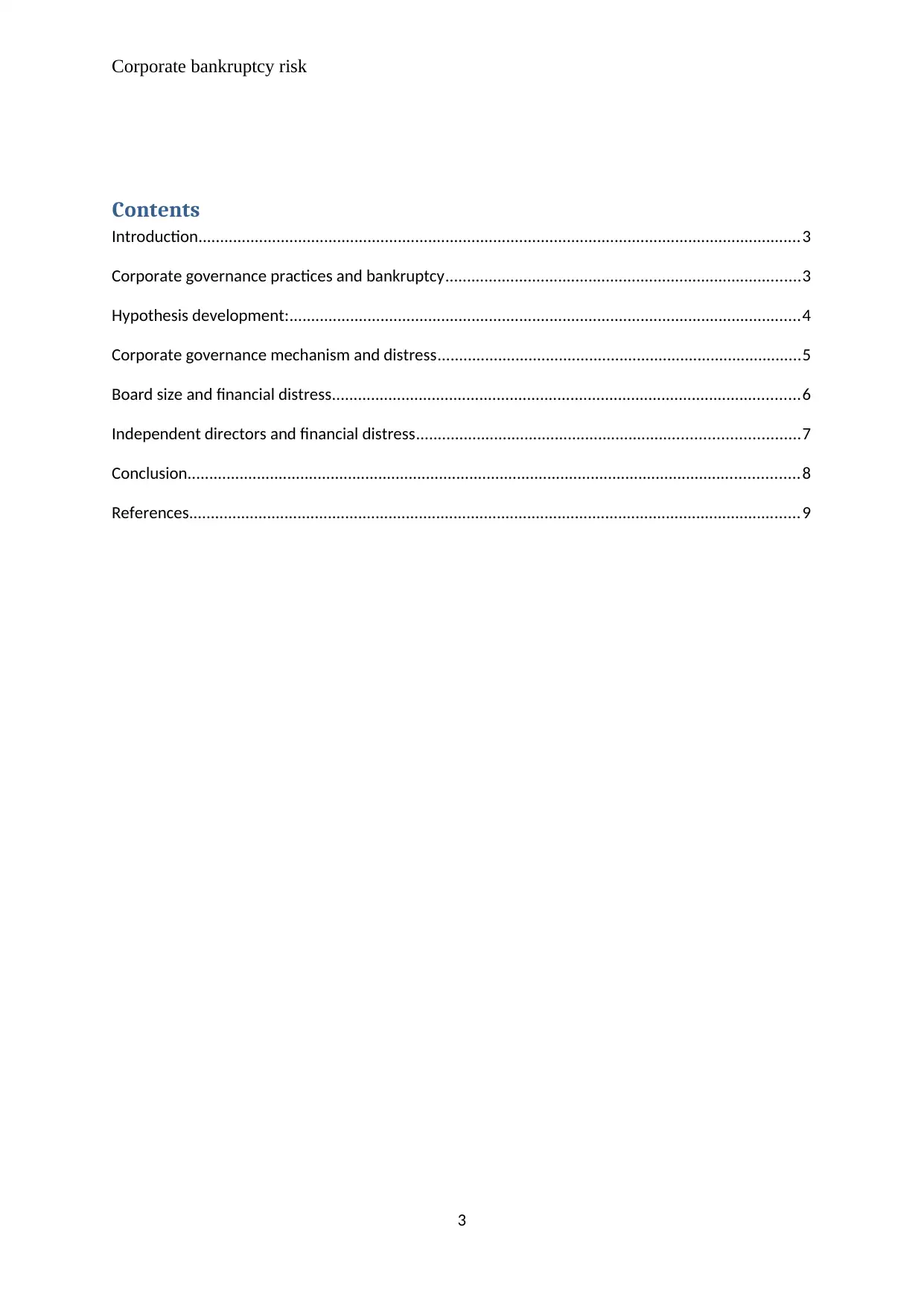
Contents
Introduction...........................................................................................................................................3
Corporate governance practices and bankruptcy..................................................................................3
Hypothesis development:......................................................................................................................4
Corporate governance mechanism and distress....................................................................................5
Board size and financial distress............................................................................................................6
Independent directors and financial distress........................................................................................7
Conclusion.............................................................................................................................................8
References.............................................................................................................................................9
3
Contents
Introduction...........................................................................................................................................3
Corporate governance practices and bankruptcy..................................................................................3
Hypothesis development:......................................................................................................................4
Corporate governance mechanism and distress....................................................................................5
Board size and financial distress............................................................................................................6
Independent directors and financial distress........................................................................................7
Conclusion.............................................................................................................................................8
References.............................................................................................................................................9
3
⊘ This is a preview!⊘
Do you want full access?
Subscribe today to unlock all pages.

Trusted by 1+ million students worldwide
Corporate bankruptcy risk
Introduction
As explained by Bhasin (2008), the debatable term corporate bankruptcy risk can be sub-
divided into four specific terms which are very common in the use of business research:
Failure, insolvency, bankruptcy, and default. The term defaults us also divided into two
further sub-categories named legal and technical. Both the types of default are used to inform
that the firm is going to face a risk of bankruptcy or bad performance in future. The chances
bankruptcy of a firm increases when a shift occurs from the agents towards the shareholders.
Some other theorists define the term bankruptcy as a condition when the firm is not able to
maintain the operating cash flows to the level of current expenses like trade credit or interest
expenses.
Adams and Ferreira (2007) define the term bankruptcy risk as the position when a firm’s
revenue doesn’t meet the current expenditure and thus making the firm incapable of paying
its creditors and leaving it in a harsh situation. Still, the indicators of bankruptcy are not
limited to the firm’s incapability to meet debt commitments. Another theorist had a view that
bankruptcy is the condition which takes place because of the unhealthy economic
environment and the penurious governance of the firm. The condition of bankruptcy is not
suitable for the environment of a firm, but still, it helps to make a situation for a firm’s to
restock the resources by using the mechanisms of corporate governance which may be
helpful for the firm to improve its chances survival (Adams and Ferreira, 2007). There has
been a lot of research on the effects of the corporate governance on the healthy firms and also
that on the weak firms. The study of corporate governance practice also helps one analyze the
probability of the company going bankrupt. It has been found that in most of the cases
bankruptcy has been linked to the company’s corporate governance practices (Roach, 2010).
Corporate governance practices and bankruptcy
The relationship between the corporate governance practices and bankruptcy was further
studies and it resulted that the practices of the CEO of the company in connection with the
corporate governance are directly related to bankruptcy. Another study also helped establish
the same fact that inappropriate corporate governance practices of the CEO had a direct
relationship with the company going bankrupt (Habbash, 2013). The effect of the ownership
of the company o the financial status of the company could not be clearly established, but
there was this research which concluded that high percentage of people holding large blocks
of a stake in the company has a negative effect on the financials of the company (Daily &
4
Introduction
As explained by Bhasin (2008), the debatable term corporate bankruptcy risk can be sub-
divided into four specific terms which are very common in the use of business research:
Failure, insolvency, bankruptcy, and default. The term defaults us also divided into two
further sub-categories named legal and technical. Both the types of default are used to inform
that the firm is going to face a risk of bankruptcy or bad performance in future. The chances
bankruptcy of a firm increases when a shift occurs from the agents towards the shareholders.
Some other theorists define the term bankruptcy as a condition when the firm is not able to
maintain the operating cash flows to the level of current expenses like trade credit or interest
expenses.
Adams and Ferreira (2007) define the term bankruptcy risk as the position when a firm’s
revenue doesn’t meet the current expenditure and thus making the firm incapable of paying
its creditors and leaving it in a harsh situation. Still, the indicators of bankruptcy are not
limited to the firm’s incapability to meet debt commitments. Another theorist had a view that
bankruptcy is the condition which takes place because of the unhealthy economic
environment and the penurious governance of the firm. The condition of bankruptcy is not
suitable for the environment of a firm, but still, it helps to make a situation for a firm’s to
restock the resources by using the mechanisms of corporate governance which may be
helpful for the firm to improve its chances survival (Adams and Ferreira, 2007). There has
been a lot of research on the effects of the corporate governance on the healthy firms and also
that on the weak firms. The study of corporate governance practice also helps one analyze the
probability of the company going bankrupt. It has been found that in most of the cases
bankruptcy has been linked to the company’s corporate governance practices (Roach, 2010).
Corporate governance practices and bankruptcy
The relationship between the corporate governance practices and bankruptcy was further
studies and it resulted that the practices of the CEO of the company in connection with the
corporate governance are directly related to bankruptcy. Another study also helped establish
the same fact that inappropriate corporate governance practices of the CEO had a direct
relationship with the company going bankrupt (Habbash, 2013). The effect of the ownership
of the company o the financial status of the company could not be clearly established, but
there was this research which concluded that high percentage of people holding large blocks
of a stake in the company has a negative effect on the financials of the company (Daily &
4
Paraphrase This Document
Need a fresh take? Get an instant paraphrase of this document with our AI Paraphraser
Corporate bankruptcy risk
Dalton, 1994). A high percentage of large block stakeholders in the company also increase
management problem and the probability bankruptcy within the company (Chung et. al,
2005). As discussed, we have established the fact that weak corporate governance policies
increase the probability of bankruptcy of the company. It has been seen that the lack of
independence in the board of directors leads to corporate governance failures which increase
the bankruptcy risk. Due to lack of independence, the decision making the power of the board
is compromised which results are less effective board (Daily et. al, 2003).
The performance of the company is highly sensitive to the corporate governance policies of
the company. The recent corporate scandal such as that of WorldCom and Enron are the lice
examples of how weak corporate governance policies lead to manipulation of financial data,
which results in bankruptcy of the company. Hence we can say that the financial performance
of the company is directly related to the corporate governance policies of the company. The
corporate governance structure helps the investor analyze the effectiveness of the board and
its ability to perform (Lajili & Zeghal, 2010). If the company fails to abide by the rules of
corporate governance, it reflects weakness in the company, which takes away the trust, from
the investors. Unsound and ineffective corporate governance policies of the organization lead
to the high probability of bankruptcy risk and it also weakens the shareholder trust (Parker
et. al, 2011).
Hypothesis development:
The dispute between the shareholder of the company and its management arise mainly when
there is a conflict of interest between them. This conflict mainly arises when the management
seeks to keep their personal interest above the interest of shareholders. This behavior leads to
uneven information spread among shareholders. The unconventional and valuable measures
are always helpful in protecting the shareholders’ interest (Pilbeam, 2009). It was also
observed that the corporate governance mechanisms help to reduce the agency expenditures
and also reduces the disagreement while assigning the authority. These terms include
auditors, interdependent BOD, corporate system and bureaucratic shareholders for control.
The activities of the managers are observed because of the governance mechanism which is
considered a major point in interdependency (Hui & Jing-Jing, 2008). It helps to study the
transparency of the business and remove the conflicts to improve firm’s performance.
Therefore it is considered that financial reporting styles of the auditing committee help to
reduce irrelevant information and solve internal agency disputes. The independent auditing
5
Dalton, 1994). A high percentage of large block stakeholders in the company also increase
management problem and the probability bankruptcy within the company (Chung et. al,
2005). As discussed, we have established the fact that weak corporate governance policies
increase the probability of bankruptcy of the company. It has been seen that the lack of
independence in the board of directors leads to corporate governance failures which increase
the bankruptcy risk. Due to lack of independence, the decision making the power of the board
is compromised which results are less effective board (Daily et. al, 2003).
The performance of the company is highly sensitive to the corporate governance policies of
the company. The recent corporate scandal such as that of WorldCom and Enron are the lice
examples of how weak corporate governance policies lead to manipulation of financial data,
which results in bankruptcy of the company. Hence we can say that the financial performance
of the company is directly related to the corporate governance policies of the company. The
corporate governance structure helps the investor analyze the effectiveness of the board and
its ability to perform (Lajili & Zeghal, 2010). If the company fails to abide by the rules of
corporate governance, it reflects weakness in the company, which takes away the trust, from
the investors. Unsound and ineffective corporate governance policies of the organization lead
to the high probability of bankruptcy risk and it also weakens the shareholder trust (Parker
et. al, 2011).
Hypothesis development:
The dispute between the shareholder of the company and its management arise mainly when
there is a conflict of interest between them. This conflict mainly arises when the management
seeks to keep their personal interest above the interest of shareholders. This behavior leads to
uneven information spread among shareholders. The unconventional and valuable measures
are always helpful in protecting the shareholders’ interest (Pilbeam, 2009). It was also
observed that the corporate governance mechanisms help to reduce the agency expenditures
and also reduces the disagreement while assigning the authority. These terms include
auditors, interdependent BOD, corporate system and bureaucratic shareholders for control.
The activities of the managers are observed because of the governance mechanism which is
considered a major point in interdependency (Hui & Jing-Jing, 2008). It helps to study the
transparency of the business and remove the conflicts to improve firm’s performance.
Therefore it is considered that financial reporting styles of the auditing committee help to
reduce irrelevant information and solve internal agency disputes. The independent auditing
5
Corporate bankruptcy risk
committees improve the performance and also decrease the returns of defaults. The financial
reporting process is observed to be carried out by the audit committees of the board of
directors giving the interdependent directors the valid reason for monitoring the management.
This gives the directors the power to report any unworthy financial operations they have
remarked. They generally have the function of financial reporting, information declaration
and the risk of bankruptcy suffered by the firm with a core function of corporate governance
(Goergen, 2012).
According to the theorist's investigation of the independent audit committee and the returns
from the financial survival of the firm are inversely related thus improving the quality of
reporting. After the examination of the one-thirty-eighth U.S. publically listed firm, for the
period starting from first January 2001 to thirty-first December 2002 it is observed that more
the percentage of the affiliated directors in audit committee less is the probability of distress
compared to it. This result helps to assist the concern of managers or directors about the
quality of financial reports and also the fact for increasing more independent audit
committees. Moreover, some theorist found the negative effect of the independent audit
committee over the financially risked firms by scrutinizing the risks of the bankruptcy of the
firms during the nineteen nineties (Lajili & Zeghal, 2010).
Corporate governance mechanism and distress
Financial marketplaces have now created a bridge between the corporate governance and the
academic excellence and other provisional satisfactions with the organizational press. In this
fast developing world of technology and ideas, it is difficult for the company to thrive every
situation with its intelligence. Also, there is much more competition and major environmental
changes. Without any perfect analysis, it would be unfair to say that whether the corporate
systems are still able to deliver services or not. Major studies have been followed to date to
analyze the bridge between corporate and financial distress (Chou et. al, 2010). Henry found
that the corporate governance is directly related to topics of bankruptcy and finances, so to
follow proper methods can be a savior from financial losses. The usage of CG variables in
association with a way to understand the corporate governance was a good idea in Australia
to mark a path between corporate governance practices and to deal with the financial losses.
Parker et al were responsible for conducting a survey of those firms that are on the verge of a
downfall but are somewhat thriving (Goergen, 2012). The report showed that they were still
up just by following some of the methods of corporate governance that were insider turnover
6
committees improve the performance and also decrease the returns of defaults. The financial
reporting process is observed to be carried out by the audit committees of the board of
directors giving the interdependent directors the valid reason for monitoring the management.
This gives the directors the power to report any unworthy financial operations they have
remarked. They generally have the function of financial reporting, information declaration
and the risk of bankruptcy suffered by the firm with a core function of corporate governance
(Goergen, 2012).
According to the theorist's investigation of the independent audit committee and the returns
from the financial survival of the firm are inversely related thus improving the quality of
reporting. After the examination of the one-thirty-eighth U.S. publically listed firm, for the
period starting from first January 2001 to thirty-first December 2002 it is observed that more
the percentage of the affiliated directors in audit committee less is the probability of distress
compared to it. This result helps to assist the concern of managers or directors about the
quality of financial reports and also the fact for increasing more independent audit
committees. Moreover, some theorist found the negative effect of the independent audit
committee over the financially risked firms by scrutinizing the risks of the bankruptcy of the
firms during the nineteen nineties (Lajili & Zeghal, 2010).
Corporate governance mechanism and distress
Financial marketplaces have now created a bridge between the corporate governance and the
academic excellence and other provisional satisfactions with the organizational press. In this
fast developing world of technology and ideas, it is difficult for the company to thrive every
situation with its intelligence. Also, there is much more competition and major environmental
changes. Without any perfect analysis, it would be unfair to say that whether the corporate
systems are still able to deliver services or not. Major studies have been followed to date to
analyze the bridge between corporate and financial distress (Chou et. al, 2010). Henry found
that the corporate governance is directly related to topics of bankruptcy and finances, so to
follow proper methods can be a savior from financial losses. The usage of CG variables in
association with a way to understand the corporate governance was a good idea in Australia
to mark a path between corporate governance practices and to deal with the financial losses.
Parker et al were responsible for conducting a survey of those firms that are on the verge of a
downfall but are somewhat thriving (Goergen, 2012). The report showed that they were still
up just by following some of the methods of corporate governance that were insider turnover
6
⊘ This is a preview!⊘
Do you want full access?
Subscribe today to unlock all pages.
Trusted by 1+ million students worldwide
Corporate bankruptcy risk
and ownership structure. By surveying twenty-one matched pair of retail companies, Chou et.
al (2010) proved that the topic of interdependence and a larger board of directors is an utter
positive effect of the corporate governance. By surveying fifty pairs of matched bankrupt
companies, Daily and Dalton assured that the matter like CEO duality and lower
independence of directors are directly linked to the losses suffered by the company.
According to Goergen (2012), the corporate governance practices are significantly linked
with bankruptcy and also found that ownership concentration increases the likelihood of
financial distress. But Goergen (2012) surveyed that ownership concentration has a negative
deflection with respect to financial losses but the outside director’s directorship has a positive
result. All this was done by analyzing forty-six healthy and forty-six distressed and fifty-four
distress firms in Canada. Wang and Deng (2006) found that the corporate governance
qualities, i.e. managerial ownership, board size, CEO duality, have an immaterial bang on
financial misery. In Malaysia Abdullah’s work showed that there exists a negative bridge
between ownership and financial losses. These research works were done by undertaking
shares from the ruling party of the company that is the directors of the company. But as per
the UAE practices and with respect to the UAE banks it is seen that there lies a positive
bridge between the corporate governance practices and the financial losses of the company.
It is very true that the corporate governance procedures have the strength to change the
financial orders of the company. In recent times there have been large-scale scandals like
Enron and WorldCom, which proves that a dangling structure of the corporate governance
leads to a company’s mismanagement and losses of the company. It is very much clear that
the financial loss of a company depends on the structure of the corporate governance
followed by the company (Chang, 2009). As told earlier, a company will have its way to
bankruptcy and total damage if it has a weak a manipulated structure of corporate
governance. If it wants to get saved from such situations then it must have a well structured
and maintained corporate governance so as to comply with all circumstances and minimize
the financial losses to a minimum.
Board size and financial distress
The Board of directors forms a very crucial part of the management of the company. It is
responsible for undertaking all the major decisions of the company. This is the body which is
associated with the increase in the value of the share of the company. A good governed body
7
and ownership structure. By surveying twenty-one matched pair of retail companies, Chou et.
al (2010) proved that the topic of interdependence and a larger board of directors is an utter
positive effect of the corporate governance. By surveying fifty pairs of matched bankrupt
companies, Daily and Dalton assured that the matter like CEO duality and lower
independence of directors are directly linked to the losses suffered by the company.
According to Goergen (2012), the corporate governance practices are significantly linked
with bankruptcy and also found that ownership concentration increases the likelihood of
financial distress. But Goergen (2012) surveyed that ownership concentration has a negative
deflection with respect to financial losses but the outside director’s directorship has a positive
result. All this was done by analyzing forty-six healthy and forty-six distressed and fifty-four
distress firms in Canada. Wang and Deng (2006) found that the corporate governance
qualities, i.e. managerial ownership, board size, CEO duality, have an immaterial bang on
financial misery. In Malaysia Abdullah’s work showed that there exists a negative bridge
between ownership and financial losses. These research works were done by undertaking
shares from the ruling party of the company that is the directors of the company. But as per
the UAE practices and with respect to the UAE banks it is seen that there lies a positive
bridge between the corporate governance practices and the financial losses of the company.
It is very true that the corporate governance procedures have the strength to change the
financial orders of the company. In recent times there have been large-scale scandals like
Enron and WorldCom, which proves that a dangling structure of the corporate governance
leads to a company’s mismanagement and losses of the company. It is very much clear that
the financial loss of a company depends on the structure of the corporate governance
followed by the company (Chang, 2009). As told earlier, a company will have its way to
bankruptcy and total damage if it has a weak a manipulated structure of corporate
governance. If it wants to get saved from such situations then it must have a well structured
and maintained corporate governance so as to comply with all circumstances and minimize
the financial losses to a minimum.
Board size and financial distress
The Board of directors forms a very crucial part of the management of the company. It is
responsible for undertaking all the major decisions of the company. This is the body which is
associated with the increase in the value of the share of the company. A good governed body
7
Paraphrase This Document
Need a fresh take? Get an instant paraphrase of this document with our AI Paraphraser
Corporate bankruptcy risk
which is a good Board of directors’ body is very important for the structure and management
and also the well-being of the company (Chang, 2009).
A number of surveys and studies have been conducted in the past which explain that a small
board of director is beneficial for the company’s management. Dahya et. al (2008) continued
to study on these matters and after analyzing the 10-year financial data they found out that the
small board of directors is only positive for the management of the company. There are many
features of the small board of directors. If any circumstances arise then the board can be
gathered in a quick succession and all the decisions can be made in no time, which is very
much beneficial for the company (Hoi et. al, 2009). All this contribute to the management of
the company and thus save the company from financial losses.
There are also many that suggest that a long board of directors is healthy and necessary for
the company. A survey was planned in which 200 companies were taken into consideration.
Out of these 88 companies were suffering from financial problems and the rest 112 used the
board of directors as a proxy and out-loud one topic that a long board of directors is very
much beneficial for the company. The features of a long board of directors are diverse ideas,
more thinking, and quality decisions.
Independent directors and financial distress
The independent board of directors is not at all linked with the management of the company
and has no work with its procedures. The independent board is just to give its idea and
prevent conflicts and to increase shareholder value in several matters in which it is
considered. The independent directors are not entitled to any responsibility and cannot from a
part of the management as per the CSRC (Lajili & Zeghal, 2010). But it is legal for the
independent directors to hold shares of the company. Independent directors have been
considered as a boon for the company as they keep the company procedures in check and act
as a top class monitoring system (Gillan, 2006). They also reduce the cost of the company
and eliminate the problems.
Non-executive directors have a weak hold on the management of the company. The outside
directors don’t know much about the company but it is also seen that they tend to perform
well for the company as they protect the interests of the shareholders (Gillan, 2006).
8
which is a good Board of directors’ body is very important for the structure and management
and also the well-being of the company (Chang, 2009).
A number of surveys and studies have been conducted in the past which explain that a small
board of director is beneficial for the company’s management. Dahya et. al (2008) continued
to study on these matters and after analyzing the 10-year financial data they found out that the
small board of directors is only positive for the management of the company. There are many
features of the small board of directors. If any circumstances arise then the board can be
gathered in a quick succession and all the decisions can be made in no time, which is very
much beneficial for the company (Hoi et. al, 2009). All this contribute to the management of
the company and thus save the company from financial losses.
There are also many that suggest that a long board of directors is healthy and necessary for
the company. A survey was planned in which 200 companies were taken into consideration.
Out of these 88 companies were suffering from financial problems and the rest 112 used the
board of directors as a proxy and out-loud one topic that a long board of directors is very
much beneficial for the company. The features of a long board of directors are diverse ideas,
more thinking, and quality decisions.
Independent directors and financial distress
The independent board of directors is not at all linked with the management of the company
and has no work with its procedures. The independent board is just to give its idea and
prevent conflicts and to increase shareholder value in several matters in which it is
considered. The independent directors are not entitled to any responsibility and cannot from a
part of the management as per the CSRC (Lajili & Zeghal, 2010). But it is legal for the
independent directors to hold shares of the company. Independent directors have been
considered as a boon for the company as they keep the company procedures in check and act
as a top class monitoring system (Gillan, 2006). They also reduce the cost of the company
and eliminate the problems.
Non-executive directors have a weak hold on the management of the company. The outside
directors don’t know much about the company but it is also seen that they tend to perform
well for the company as they protect the interests of the shareholders (Gillan, 2006).
8
Corporate bankruptcy risk
Conclusion
As per the study conducted above, vital policies, as well as implications came to the
forefront. The finding indicates that the level of corporate governance varies from one
country to another. The study provides guidelines of basic nature for the policymakers for the
establishment of strong corporate governance method that helps to safeguard minority
shareholders. Further, the implementation of various codes and conduct of corporate
governance is important when it comes to the bankruptcy code. Corporate governance is vital
and mandatory for every organization as it helps in providing a strong stability. The study
supports the academic literature regarding corporate governance and corporate financial
distress to fulfill the geographical context. Two theories are assumed that is the looms agency
and the stakeholder theory. Hence, this study stress upon the effect of corporate mechanism
on the corporate bankruptcy risk. Therefore, the structure of corporate is divided into two
issues. Initially, it is investigated whether different features of corporate governance such as
institutional shareholder, board structure, and CEO duality have an impact on the financial
distress.
Secondly, an association of corporate governance method is evaluated with financial distress
by ensuring a strong focus on the literature. This study indicates that empirical evidence on
the practice of corporate governance has an influence on the survival of the business. The
study explores the structure of the corporate governance in tune to the agency problem and
the influence of stakeholder theory on the corporate bankruptcy risk.
9
Conclusion
As per the study conducted above, vital policies, as well as implications came to the
forefront. The finding indicates that the level of corporate governance varies from one
country to another. The study provides guidelines of basic nature for the policymakers for the
establishment of strong corporate governance method that helps to safeguard minority
shareholders. Further, the implementation of various codes and conduct of corporate
governance is important when it comes to the bankruptcy code. Corporate governance is vital
and mandatory for every organization as it helps in providing a strong stability. The study
supports the academic literature regarding corporate governance and corporate financial
distress to fulfill the geographical context. Two theories are assumed that is the looms agency
and the stakeholder theory. Hence, this study stress upon the effect of corporate mechanism
on the corporate bankruptcy risk. Therefore, the structure of corporate is divided into two
issues. Initially, it is investigated whether different features of corporate governance such as
institutional shareholder, board structure, and CEO duality have an impact on the financial
distress.
Secondly, an association of corporate governance method is evaluated with financial distress
by ensuring a strong focus on the literature. This study indicates that empirical evidence on
the practice of corporate governance has an influence on the survival of the business. The
study explores the structure of the corporate governance in tune to the agency problem and
the influence of stakeholder theory on the corporate bankruptcy risk.
9
⊘ This is a preview!⊘
Do you want full access?
Subscribe today to unlock all pages.
Trusted by 1+ million students worldwide
Corporate bankruptcy risk
References
Adams, R. B & Ferreira, D 2007, ‘A theory of friendly boards’, The Journal of Finance vol.
62, no.1, pp. 217-250.
Bhasin, M. L 2008, ‘Corporate Governance and Role of the Forensic Accountant’, The
Chartered Secretary Journal, vol. 38, no. 10, pp. 1361-1368.
Chang, C 2009, ‘The corporate governance characteristics of financially distressed firms:
Evidence from Taiwan’, Journal of American Academy of business, vol.15, no. 1, pp. 125-
132.
Chou, H. I, Li, H & Yin, X 2010, ‘The effects of financial distress and capital structure on
the work effort of outside directors’, Journal of Empirical Finance vol. 17, no.3, pp. 300-
312.
Chung, R., Firth, M., & Kim, J. B 2005, ‘Earnings management, surplus free cash flow, and
external monitoring’, Journal of business research vol. 58, no. 6, pp.766-776.
Dahya, J, Dimitrov, O, & McConnell, J. J 2008, ‘ Dominant shareholders, corporate boards,
and corporate value: A cross-country analysis’, Journal of Financial Economics vol.87, no.1,
pp. 73-100.
Daily, C. M & Dalton, D. R 1994, ‘Bankruptcy and corporate governance: The impact of
board composition and structure’, Academy of Management journal vo. 37, no. 6, pp. 1603-
1617.
Daily, C. M, Dalton, D. R & Cannella, A. A 2003, ‘Corporate governance: Decades of
dialogue and data’, Academy of management review vol. 28, no. 3, pp. 371-382.
Gillan, S. L 2006, ‘Recent developments in corporate governance: an overview’, Journal of
Corporate Finance vol. 12, pp. 381–402.
Goergen , M 2012, International Corporate Governance, Prentice Hall.
Habbash, M 2013, ‘Earnings management, audit committee effectiveness and the role of
blockholders ownership: evidence from UK large firms’, International Journal of Business
Governance and Ethics vol. 8, no.2, pp.155-180.
Hoi, C. K, Robin, A & Tessoni, D 2009, ‘Sarbanes-Oxley: are audit committees up to the
task?, Managerial Auditing Journal vol. 22, no. 3, pp. 255-67.
10
References
Adams, R. B & Ferreira, D 2007, ‘A theory of friendly boards’, The Journal of Finance vol.
62, no.1, pp. 217-250.
Bhasin, M. L 2008, ‘Corporate Governance and Role of the Forensic Accountant’, The
Chartered Secretary Journal, vol. 38, no. 10, pp. 1361-1368.
Chang, C 2009, ‘The corporate governance characteristics of financially distressed firms:
Evidence from Taiwan’, Journal of American Academy of business, vol.15, no. 1, pp. 125-
132.
Chou, H. I, Li, H & Yin, X 2010, ‘The effects of financial distress and capital structure on
the work effort of outside directors’, Journal of Empirical Finance vol. 17, no.3, pp. 300-
312.
Chung, R., Firth, M., & Kim, J. B 2005, ‘Earnings management, surplus free cash flow, and
external monitoring’, Journal of business research vol. 58, no. 6, pp.766-776.
Dahya, J, Dimitrov, O, & McConnell, J. J 2008, ‘ Dominant shareholders, corporate boards,
and corporate value: A cross-country analysis’, Journal of Financial Economics vol.87, no.1,
pp. 73-100.
Daily, C. M & Dalton, D. R 1994, ‘Bankruptcy and corporate governance: The impact of
board composition and structure’, Academy of Management journal vo. 37, no. 6, pp. 1603-
1617.
Daily, C. M, Dalton, D. R & Cannella, A. A 2003, ‘Corporate governance: Decades of
dialogue and data’, Academy of management review vol. 28, no. 3, pp. 371-382.
Gillan, S. L 2006, ‘Recent developments in corporate governance: an overview’, Journal of
Corporate Finance vol. 12, pp. 381–402.
Goergen , M 2012, International Corporate Governance, Prentice Hall.
Habbash, M 2013, ‘Earnings management, audit committee effectiveness and the role of
blockholders ownership: evidence from UK large firms’, International Journal of Business
Governance and Ethics vol. 8, no.2, pp.155-180.
Hoi, C. K, Robin, A & Tessoni, D 2009, ‘Sarbanes-Oxley: are audit committees up to the
task?, Managerial Auditing Journal vol. 22, no. 3, pp. 255-67.
10
Paraphrase This Document
Need a fresh take? Get an instant paraphrase of this document with our AI Paraphraser
Corporate bankruptcy risk
Hui, H, & Jing-Jing, Z 2008, ‘Relationship between corporate governance and financial
distress: An empirical study of distressed companies in China’, International Journal of
Management vol. 25, no. 4, pp. 654.
Lajili, K & Zéghal, D 2010, ‘Corporate governance and bankruptcy filing decisions’, Journal
of General Management vol. 35, no. 4, pp. 11- 23
Parker, L, Guthrie, J & Linacre, S 2011, The relationship between academic
accounting research and professional practice, Accounting , Auditing &
Accountability Journal, vol. 24, no. 1, pp. 5-14.
Pilbeam, K 2009, Finance and Financial Markets, Palgrave Macmillan
Roach, L 2010, Auditor Liability: Liability Limitation Agreements, Pearson.
11
Hui, H, & Jing-Jing, Z 2008, ‘Relationship between corporate governance and financial
distress: An empirical study of distressed companies in China’, International Journal of
Management vol. 25, no. 4, pp. 654.
Lajili, K & Zéghal, D 2010, ‘Corporate governance and bankruptcy filing decisions’, Journal
of General Management vol. 35, no. 4, pp. 11- 23
Parker, L, Guthrie, J & Linacre, S 2011, The relationship between academic
accounting research and professional practice, Accounting , Auditing &
Accountability Journal, vol. 24, no. 1, pp. 5-14.
Pilbeam, K 2009, Finance and Financial Markets, Palgrave Macmillan
Roach, L 2010, Auditor Liability: Liability Limitation Agreements, Pearson.
11

1 out of 11


Related Documents


Your All-in-One AI-Powered Toolkit for Academic Success.
+13062052269
info@desklib.com
Available 24*7 on WhatsApp / Email
![[object Object]](/_next/static/media/star-bottom.7253800d.svg)
Unlock your academic potential
Copyright © 2020–2026 A2Z Services. All Rights Reserved. Developed and managed by ZUCOL.