LC4S181: Corporate Law and Governance - UK Development Report
VerifiedAdded on 2023/03/17
|13
|3675
|81
Report
AI Summary
This report provides a comprehensive overview of the development of corporate governance in the UK, tracing its evolution from the late 1980s to the present day. It examines the roles and impacts of key committees, including the Cadbury, Greenbury, and Hampel Committees, and the Combined Code of Corporate Governance. The report also discusses the Myners review and the Directors’ Remuneration Report Regulations, highlighting the increasing emphasis on shareholder rights and transparency. Furthermore, the report analyzes the impact of scandals like Enron and the Sarbanes-Oxley Act on corporate governance in the UK. The report concludes with an assessment of the effectiveness of the current corporate governance code and its impact on businesses.

Running Head: BUSINESS AND CORPORATION LAW 0
Corporate Law and Governance
5/31/2019
Student’s Name
Corporate Law and Governance
5/31/2019
Student’s Name

Paraphrase This Document
Need a fresh take? Get an instant paraphrase of this document with our AI Paraphraser
Corporate Law and Governance
1
Introduction
Every business is requires to have a well-defined set of practices and procedures to deal with
various stakeholders. Corporate Governance plays an important role here. It is a collection of
different rules, processes, and practices by which an organization is directed and controlled. As
the name implies this system is fully focused on the governance of an entity and the same is
required to be followed by management of an organization. For instance by directors and officers
in case of companies. Business forms an important part of the economy and in this way; they are
required to behave in a regulated and ethical manner. For different people, corporate governance
has different mean and significance and hence different theories on this subject have been
developed over time. In the case of companies, corporate governance becomes more significant
as many stakeholders are there and the company should maintain a healthy relationship with
them. Corporate governance helps directors and officers in the same. The system of corporate
governance provides many benefits. For example, it increases transparency. Further, good
corporate governance also reduces corruption, mismanagement, and risk in the business. In this
manner, it is clear that corporate governance is a highly important topic to study. Concept of
corporate governance has been developed in different countries at different times. It is not an
overnight process and takes a good volume of time. In the presented report, the discussion will
be focused on the development of corporate governance in the UK. In addition to this, the
present corporate governance code of the UK will also be reviewed. At last, the conclusion will
be made on the effectiveness of the subjective code.
Corporate Governance development in the UK
The concept of corporate governance is not new. In easy words, corporate governance can be
understood as good governance and such governance is required from ever. Nevertheless, this
1
Introduction
Every business is requires to have a well-defined set of practices and procedures to deal with
various stakeholders. Corporate Governance plays an important role here. It is a collection of
different rules, processes, and practices by which an organization is directed and controlled. As
the name implies this system is fully focused on the governance of an entity and the same is
required to be followed by management of an organization. For instance by directors and officers
in case of companies. Business forms an important part of the economy and in this way; they are
required to behave in a regulated and ethical manner. For different people, corporate governance
has different mean and significance and hence different theories on this subject have been
developed over time. In the case of companies, corporate governance becomes more significant
as many stakeholders are there and the company should maintain a healthy relationship with
them. Corporate governance helps directors and officers in the same. The system of corporate
governance provides many benefits. For example, it increases transparency. Further, good
corporate governance also reduces corruption, mismanagement, and risk in the business. In this
manner, it is clear that corporate governance is a highly important topic to study. Concept of
corporate governance has been developed in different countries at different times. It is not an
overnight process and takes a good volume of time. In the presented report, the discussion will
be focused on the development of corporate governance in the UK. In addition to this, the
present corporate governance code of the UK will also be reviewed. At last, the conclusion will
be made on the effectiveness of the subjective code.
Corporate Governance development in the UK
The concept of corporate governance is not new. In easy words, corporate governance can be
understood as good governance and such governance is required from ever. Nevertheless, this
Corporate Law and Governance
2
concept becomes more significant in recent years as many scandals have reported. Further, to
say, that in UK corporate governance has an interesting history as many of the committees and
their reports were involved in the process. In order to discuss the present form of corporate
governance, the past is necessary to be reviewed. This is to mention that the development of
corporate governance in the UK began in the late 1980s when some of the scandals such as Polly
Peck and Maxwell arose. Businesses were involved in the practices of irregular financing
reporting and therefore there was a requirement of the development of corporate governance. A
committee was established on the financial aspect of corporate governance, which was led by Sir
Adrian Cadbury, hence the committee became known as the Cadbury committee. key members
of the accountancy profession and the Financial Reporting Council, London Stock Exchange
(LSE), U.K. government and an independent regulator backed by accountancy organizations
launched the subjective committee.
The main motive behind the development of committee was to ensure that enough disclosures
related to accounts of the public company were there and the auditors were able to fulfill the
requirements and expectations of various users of financial information. In addition to this, the
committee also looked into another corporate governance issues communication of board with
different stakeholders, the liability of executive and non-executive directors to check the
performance of the board need for good internal control, and selection process of non-executive
directors and so on. After its establishments, the committee also became ready to form a code of
best practices. In the year 1992, this committee published its report in conjunction with the draft
code of practices1. As per this report, companies were required to publish the statement of
1 Alison L. Dempsey, Evolutions in Corporate Governance: Towards an Ethical Framework for Business Conduct
(Routledge 2017).
2
concept becomes more significant in recent years as many scandals have reported. Further, to
say, that in UK corporate governance has an interesting history as many of the committees and
their reports were involved in the process. In order to discuss the present form of corporate
governance, the past is necessary to be reviewed. This is to mention that the development of
corporate governance in the UK began in the late 1980s when some of the scandals such as Polly
Peck and Maxwell arose. Businesses were involved in the practices of irregular financing
reporting and therefore there was a requirement of the development of corporate governance. A
committee was established on the financial aspect of corporate governance, which was led by Sir
Adrian Cadbury, hence the committee became known as the Cadbury committee. key members
of the accountancy profession and the Financial Reporting Council, London Stock Exchange
(LSE), U.K. government and an independent regulator backed by accountancy organizations
launched the subjective committee.
The main motive behind the development of committee was to ensure that enough disclosures
related to accounts of the public company were there and the auditors were able to fulfill the
requirements and expectations of various users of financial information. In addition to this, the
committee also looked into another corporate governance issues communication of board with
different stakeholders, the liability of executive and non-executive directors to check the
performance of the board need for good internal control, and selection process of non-executive
directors and so on. After its establishments, the committee also became ready to form a code of
best practices. In the year 1992, this committee published its report in conjunction with the draft
code of practices1. As per this report, companies were required to publish the statement of
1 Alison L. Dempsey, Evolutions in Corporate Governance: Towards an Ethical Framework for Business Conduct
(Routledge 2017).
⊘ This is a preview!⊘
Do you want full access?
Subscribe today to unlock all pages.

Trusted by 1+ million students worldwide
Corporate Law and Governance
3
compliances in addition to its code while making an application to London stock exchange for a
listing.
Later on, the committee published the final code of practices in December 19922. This code acted
as the rationale behind the recommendations provided by the respective committee. The LSE
further supported the code and made the compliances with the same mandatory for all the
companies listed on this exchange. Companies that failed to comply with the code were required
to outlines reason of the same. The report and code developed by the Cadbury committee face
much criticism and critics stated that the guidelines provided by the committee were too vague.
Although to remove any kind of confusion regarding the recommendation of the Cadbury
committee, a working group on internal control was also been established yet the criticism
continued. This is to state that recommendations provided by the Cadbury Committee were one
of the lead steps in the direction of corporate governance development in the UK. The committee
became ‘the world leader’ in the sector of corporate governance and its leader Sir Adrian
Cadbury also became a very popular face.
After the Cadbury committee, another committee was established namely the Greenbury
Committee. The committee further addressed other issues such as remuneration of directors.
Confederation of British Industry established the subjective committee in 19953. The main
motive behind the development of this committee was to resolve the general queries regarding
accountability and different levels of remuneration of directors. On 17th July 1995, the committee
finally published its report which consisted of provisions related to director remuneration4. As
2 Dieter Ordelheide, Transnational Accounting (Springer, 2016) 2766.
3 Priyanka Kaushik Sharma, Corporate Governance Practices in India: A Synthesis of Theories, Practices, and
Cases (Springer 2015).
4 Icaew.com, ‘The Greenbury Report’ <https://www.icaew.com/technical/corporate-governance/codes-and-reports/
greenbury-report> accessed on 31 May 2019
3
compliances in addition to its code while making an application to London stock exchange for a
listing.
Later on, the committee published the final code of practices in December 19922. This code acted
as the rationale behind the recommendations provided by the respective committee. The LSE
further supported the code and made the compliances with the same mandatory for all the
companies listed on this exchange. Companies that failed to comply with the code were required
to outlines reason of the same. The report and code developed by the Cadbury committee face
much criticism and critics stated that the guidelines provided by the committee were too vague.
Although to remove any kind of confusion regarding the recommendation of the Cadbury
committee, a working group on internal control was also been established yet the criticism
continued. This is to state that recommendations provided by the Cadbury Committee were one
of the lead steps in the direction of corporate governance development in the UK. The committee
became ‘the world leader’ in the sector of corporate governance and its leader Sir Adrian
Cadbury also became a very popular face.
After the Cadbury committee, another committee was established namely the Greenbury
Committee. The committee further addressed other issues such as remuneration of directors.
Confederation of British Industry established the subjective committee in 19953. The main
motive behind the development of this committee was to resolve the general queries regarding
accountability and different levels of remuneration of directors. On 17th July 1995, the committee
finally published its report which consisted of provisions related to director remuneration4. As
2 Dieter Ordelheide, Transnational Accounting (Springer, 2016) 2766.
3 Priyanka Kaushik Sharma, Corporate Governance Practices in India: A Synthesis of Theories, Practices, and
Cases (Springer 2015).
4 Icaew.com, ‘The Greenbury Report’ <https://www.icaew.com/technical/corporate-governance/codes-and-reports/
greenbury-report> accessed on 31 May 2019
Paraphrase This Document
Need a fresh take? Get an instant paraphrase of this document with our AI Paraphraser
Corporate Law and Governance
4
per the recommendations provided by this committee, public companies were required to
develop a remuneration committee and to make a disclosure regarding the remuneration of
executive and non-executive directors in its annual report. Further, the report also prescribed the
best manner to decide the remuneration of directors5. In this way, the report and
recommendations of this committee enhance the level of transparency. Similar to the Cadbury
committee, Greenbury Committee also developed and provided a code of practice. This code was
divided into four sections namely Remuneration committee, Disclosures, Remuneration Policy
and Service contracts, and compensations.
As it is well known that, the development of rules is not enough and therefore the
implementation of the same are required to be a review on a timely basis. Adopting this formula,
a new committee was established in January 1996 that became known as the Hampel
Committee6. As mentioned above by this time, Cadbury and Greenbury committee already
provided their code and recommendations hence the Hampel Committee has been developed to
check the implementation and success of those recommendations provided by the earlier
committee. Another objective behind the development of this committee was to endorse the high
corporate governance standard in the country in order to provide safeguard to investors and to
increase the standing of companies on LSE. The committee has provided many of the
recommendations such as it requires auditors to report on the issue of internal control to directors
in a private manner. Further, the committee also recommended that directors of the company
must review and maintain all the controls and not just the economic ones. The committee
provided that those companies which do not have internal audit functions in place must review
5 A. C. Fernando, Business Ethics: An Indian Perspective (Pearson Education India 2009) 14.4.
6 Uk.practicallaw.thomsonreuters.com, ‘The Hampel Committee’ < https://uk.practicallaw.thomsonreuters.com/3-
100-0535?transitionType=Default&contextData=(sc.Default)&firstPage=true&comp=pluk&bhcp=1> accessed on
31 May 2019
4
per the recommendations provided by this committee, public companies were required to
develop a remuneration committee and to make a disclosure regarding the remuneration of
executive and non-executive directors in its annual report. Further, the report also prescribed the
best manner to decide the remuneration of directors5. In this way, the report and
recommendations of this committee enhance the level of transparency. Similar to the Cadbury
committee, Greenbury Committee also developed and provided a code of practice. This code was
divided into four sections namely Remuneration committee, Disclosures, Remuneration Policy
and Service contracts, and compensations.
As it is well known that, the development of rules is not enough and therefore the
implementation of the same are required to be a review on a timely basis. Adopting this formula,
a new committee was established in January 1996 that became known as the Hampel
Committee6. As mentioned above by this time, Cadbury and Greenbury committee already
provided their code and recommendations hence the Hampel Committee has been developed to
check the implementation and success of those recommendations provided by the earlier
committee. Another objective behind the development of this committee was to endorse the high
corporate governance standard in the country in order to provide safeguard to investors and to
increase the standing of companies on LSE. The committee has provided many of the
recommendations such as it requires auditors to report on the issue of internal control to directors
in a private manner. Further, the committee also recommended that directors of the company
must review and maintain all the controls and not just the economic ones. The committee
provided that those companies which do not have internal audit functions in place must review
5 A. C. Fernando, Business Ethics: An Indian Perspective (Pearson Education India 2009) 14.4.
6 Uk.practicallaw.thomsonreuters.com, ‘The Hampel Committee’ < https://uk.practicallaw.thomsonreuters.com/3-
100-0535?transitionType=Default&contextData=(sc.Default)&firstPage=true&comp=pluk&bhcp=1> accessed on
31 May 2019
Corporate Law and Governance
5
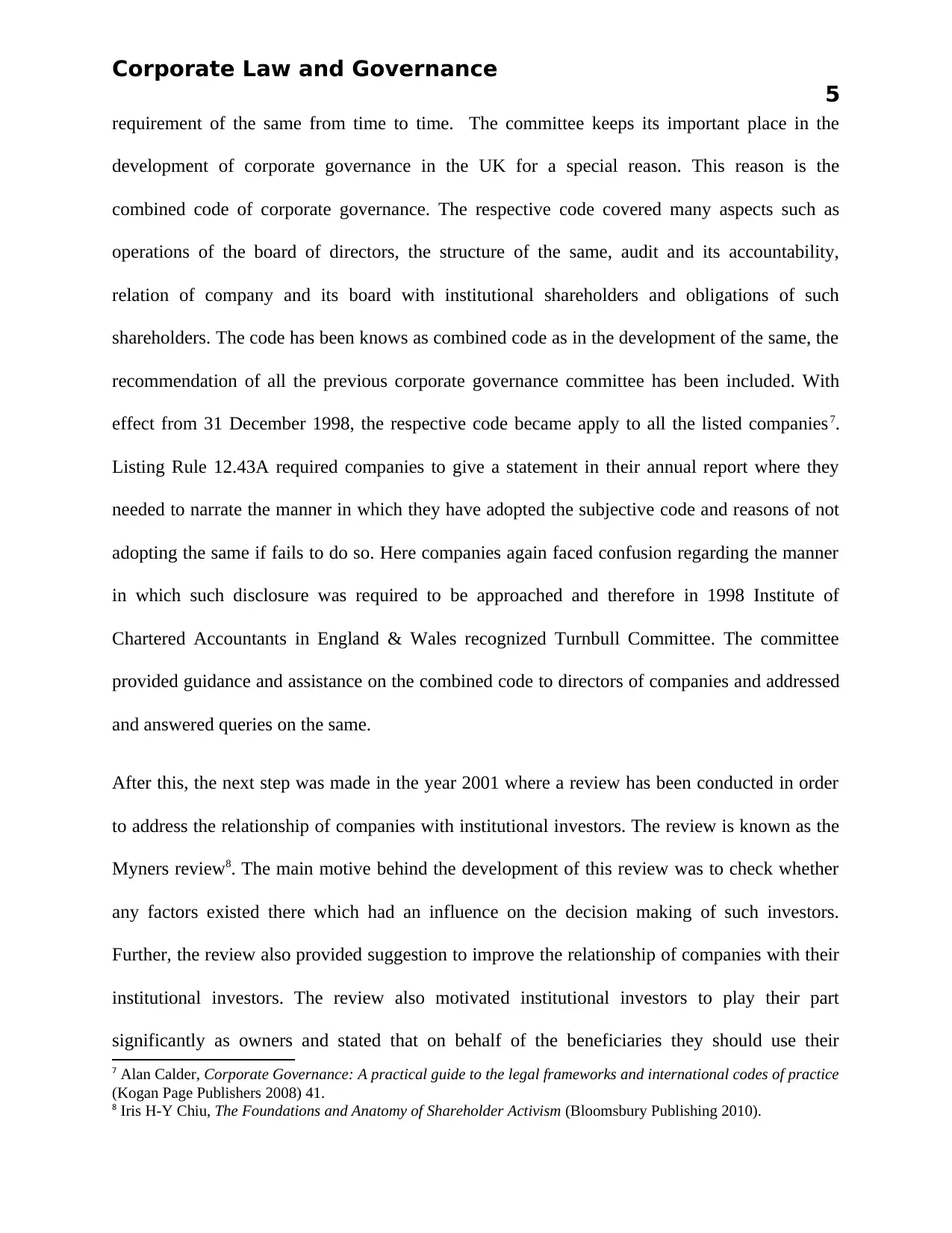
requirement of the same from time to time. The committee keeps its important place in the
development of corporate governance in the UK for a special reason. This reason is the
combined code of corporate governance. The respective code covered many aspects such as
operations of the board of directors, the structure of the same, audit and its accountability,
relation of company and its board with institutional shareholders and obligations of such
shareholders. The code has been knows as combined code as in the development of the same, the
recommendation of all the previous corporate governance committee has been included. With
effect from 31 December 1998, the respective code became apply to all the listed companies7.
Listing Rule 12.43A required companies to give a statement in their annual report where they
needed to narrate the manner in which they have adopted the subjective code and reasons of not
adopting the same if fails to do so. Here companies again faced confusion regarding the manner
in which such disclosure was required to be approached and therefore in 1998 Institute of
Chartered Accountants in England & Wales recognized Turnbull Committee. The committee
provided guidance and assistance on the combined code to directors of companies and addressed
and answered queries on the same.
After this, the next step was made in the year 2001 where a review has been conducted in order
to address the relationship of companies with institutional investors. The review is known as the
Myners review8. The main motive behind the development of this review was to check whether
any factors existed there which had an influence on the decision making of such investors.
Further, the review also provided suggestion to improve the relationship of companies with their
institutional investors. The review also motivated institutional investors to play their part
significantly as owners and stated that on behalf of the beneficiaries they should use their
7 Alan Calder, Corporate Governance: A practical guide to the legal frameworks and international codes of practice
(Kogan Page Publishers 2008) 41.
8 Iris H-Y Chiu, The Foundations and Anatomy of Shareholder Activism (Bloomsbury Publishing 2010).
5
requirement of the same from time to time. The committee keeps its important place in the
development of corporate governance in the UK for a special reason. This reason is the
combined code of corporate governance. The respective code covered many aspects such as
operations of the board of directors, the structure of the same, audit and its accountability,
relation of company and its board with institutional shareholders and obligations of such
shareholders. The code has been knows as combined code as in the development of the same, the
recommendation of all the previous corporate governance committee has been included. With
effect from 31 December 1998, the respective code became apply to all the listed companies7.
Listing Rule 12.43A required companies to give a statement in their annual report where they
needed to narrate the manner in which they have adopted the subjective code and reasons of not
adopting the same if fails to do so. Here companies again faced confusion regarding the manner
in which such disclosure was required to be approached and therefore in 1998 Institute of
Chartered Accountants in England & Wales recognized Turnbull Committee. The committee
provided guidance and assistance on the combined code to directors of companies and addressed
and answered queries on the same.
After this, the next step was made in the year 2001 where a review has been conducted in order
to address the relationship of companies with institutional investors. The review is known as the
Myners review8. The main motive behind the development of this review was to check whether
any factors existed there which had an influence on the decision making of such investors.
Further, the review also provided suggestion to improve the relationship of companies with their
institutional investors. The review also motivated institutional investors to play their part
significantly as owners and stated that on behalf of the beneficiaries they should use their
7 Alan Calder, Corporate Governance: A practical guide to the legal frameworks and international codes of practice
(Kogan Page Publishers 2008) 41.
8 Iris H-Y Chiu, The Foundations and Anatomy of Shareholder Activism (Bloomsbury Publishing 2010).
⊘ This is a preview!⊘
Do you want full access?
Subscribe today to unlock all pages.
Trusted by 1+ million students worldwide
Corporate Law and Governance
6
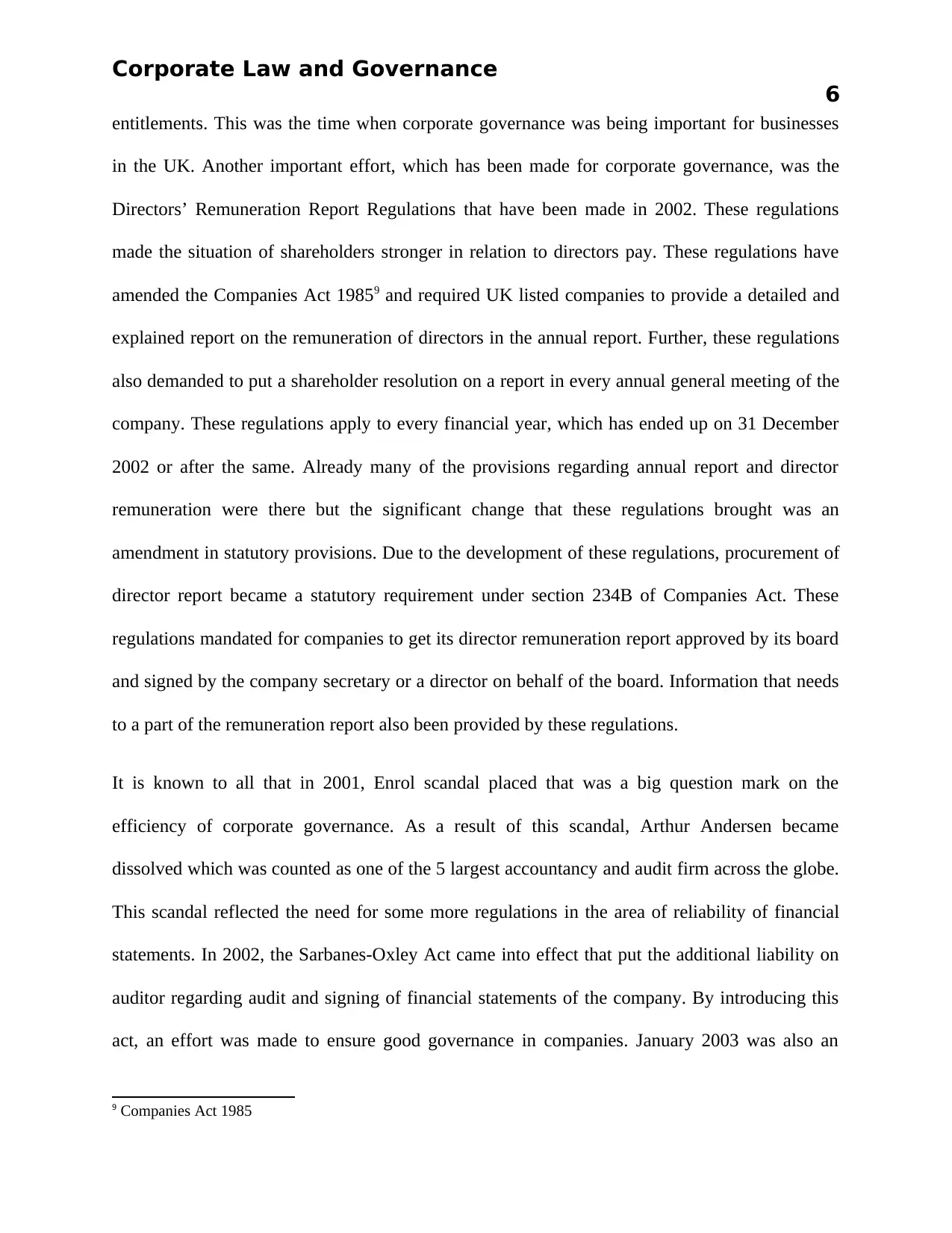
entitlements. This was the time when corporate governance was being important for businesses
in the UK. Another important effort, which has been made for corporate governance, was the
Directors’ Remuneration Report Regulations that have been made in 2002. These regulations
made the situation of shareholders stronger in relation to directors pay. These regulations have
amended the Companies Act 19859 and required UK listed companies to provide a detailed and
explained report on the remuneration of directors in the annual report. Further, these regulations
also demanded to put a shareholder resolution on a report in every annual general meeting of the
company. These regulations apply to every financial year, which has ended up on 31 December
2002 or after the same. Already many of the provisions regarding annual report and director
remuneration were there but the significant change that these regulations brought was an
amendment in statutory provisions. Due to the development of these regulations, procurement of
director report became a statutory requirement under section 234B of Companies Act. These
regulations mandated for companies to get its director remuneration report approved by its board
and signed by the company secretary or a director on behalf of the board. Information that needs
to a part of the remuneration report also been provided by these regulations.
It is known to all that in 2001, Enrol scandal placed that was a big question mark on the
efficiency of corporate governance. As a result of this scandal, Arthur Andersen became
dissolved which was counted as one of the 5 largest accountancy and audit firm across the globe.
This scandal reflected the need for some more regulations in the area of reliability of financial
statements. In 2002, the Sarbanes-Oxley Act came into effect that put the additional liability on
auditor regarding audit and signing of financial statements of the company. By introducing this
act, an effort was made to ensure good governance in companies. January 2003 was also an
9 Companies Act 1985
6
entitlements. This was the time when corporate governance was being important for businesses
in the UK. Another important effort, which has been made for corporate governance, was the
Directors’ Remuneration Report Regulations that have been made in 2002. These regulations
made the situation of shareholders stronger in relation to directors pay. These regulations have
amended the Companies Act 19859 and required UK listed companies to provide a detailed and
explained report on the remuneration of directors in the annual report. Further, these regulations
also demanded to put a shareholder resolution on a report in every annual general meeting of the
company. These regulations apply to every financial year, which has ended up on 31 December
2002 or after the same. Already many of the provisions regarding annual report and director
remuneration were there but the significant change that these regulations brought was an
amendment in statutory provisions. Due to the development of these regulations, procurement of
director report became a statutory requirement under section 234B of Companies Act. These
regulations mandated for companies to get its director remuneration report approved by its board
and signed by the company secretary or a director on behalf of the board. Information that needs
to a part of the remuneration report also been provided by these regulations.
It is known to all that in 2001, Enrol scandal placed that was a big question mark on the
efficiency of corporate governance. As a result of this scandal, Arthur Andersen became
dissolved which was counted as one of the 5 largest accountancy and audit firm across the globe.
This scandal reflected the need for some more regulations in the area of reliability of financial
statements. In 2002, the Sarbanes-Oxley Act came into effect that put the additional liability on
auditor regarding audit and signing of financial statements of the company. By introducing this
act, an effort was made to ensure good governance in companies. January 2003 was also an
9 Companies Act 1985
Paraphrase This Document
Need a fresh take? Get an instant paraphrase of this document with our AI Paraphraser
Corporate Law and Governance
7
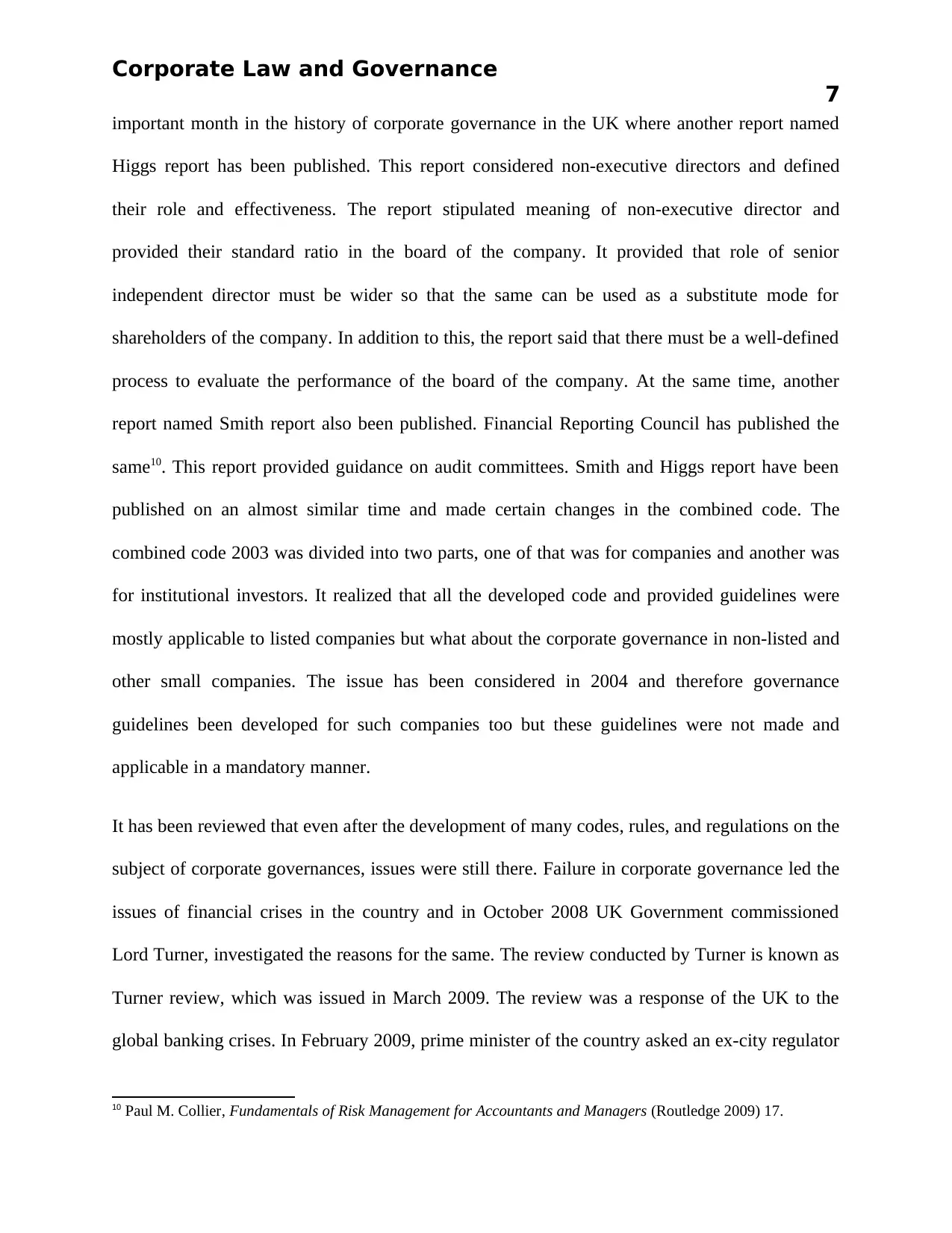
important month in the history of corporate governance in the UK where another report named
Higgs report has been published. This report considered non-executive directors and defined
their role and effectiveness. The report stipulated meaning of non-executive director and
provided their standard ratio in the board of the company. It provided that role of senior
independent director must be wider so that the same can be used as a substitute mode for
shareholders of the company. In addition to this, the report said that there must be a well-defined
process to evaluate the performance of the board of the company. At the same time, another
report named Smith report also been published. Financial Reporting Council has published the
same10. This report provided guidance on audit committees. Smith and Higgs report have been
published on an almost similar time and made certain changes in the combined code. The
combined code 2003 was divided into two parts, one of that was for companies and another was
for institutional investors. It realized that all the developed code and provided guidelines were
mostly applicable to listed companies but what about the corporate governance in non-listed and
other small companies. The issue has been considered in 2004 and therefore governance
guidelines been developed for such companies too but these guidelines were not made and
applicable in a mandatory manner.
It has been reviewed that even after the development of many codes, rules, and regulations on the
subject of corporate governances, issues were still there. Failure in corporate governance led the
issues of financial crises in the country and in October 2008 UK Government commissioned
Lord Turner, investigated the reasons for the same. The review conducted by Turner is known as
Turner review, which was issued in March 2009. The review was a response of the UK to the
global banking crises. In February 2009, prime minister of the country asked an ex-city regulator
10 Paul M. Collier, Fundamentals of Risk Management for Accountants and Managers (Routledge 2009) 17.
7
important month in the history of corporate governance in the UK where another report named
Higgs report has been published. This report considered non-executive directors and defined
their role and effectiveness. The report stipulated meaning of non-executive director and
provided their standard ratio in the board of the company. It provided that role of senior
independent director must be wider so that the same can be used as a substitute mode for
shareholders of the company. In addition to this, the report said that there must be a well-defined
process to evaluate the performance of the board of the company. At the same time, another
report named Smith report also been published. Financial Reporting Council has published the
same10. This report provided guidance on audit committees. Smith and Higgs report have been
published on an almost similar time and made certain changes in the combined code. The
combined code 2003 was divided into two parts, one of that was for companies and another was
for institutional investors. It realized that all the developed code and provided guidelines were
mostly applicable to listed companies but what about the corporate governance in non-listed and
other small companies. The issue has been considered in 2004 and therefore governance
guidelines been developed for such companies too but these guidelines were not made and
applicable in a mandatory manner.
It has been reviewed that even after the development of many codes, rules, and regulations on the
subject of corporate governances, issues were still there. Failure in corporate governance led the
issues of financial crises in the country and in October 2008 UK Government commissioned
Lord Turner, investigated the reasons for the same. The review conducted by Turner is known as
Turner review, which was issued in March 2009. The review was a response of the UK to the
global banking crises. In February 2009, prime minister of the country asked an ex-city regulator
10 Paul M. Collier, Fundamentals of Risk Management for Accountants and Managers (Routledge 2009) 17.
Corporate Law and Governance
8
named Sir David Walker to investigate the level of corporate governance in banks of this
country. It investigated that the serious ongoing issues related to corporate governance were
there and therefore a more transparent payment and bonus structure have been suggested for
highly earned people. The recommendations have been made on the risk management, the role of
institutional shareholders, and effectiveness of board practices and so on. It has been
recommended that Chief Risk officer should review and manages material risks and plays an
important role in the Board Risk Committee.
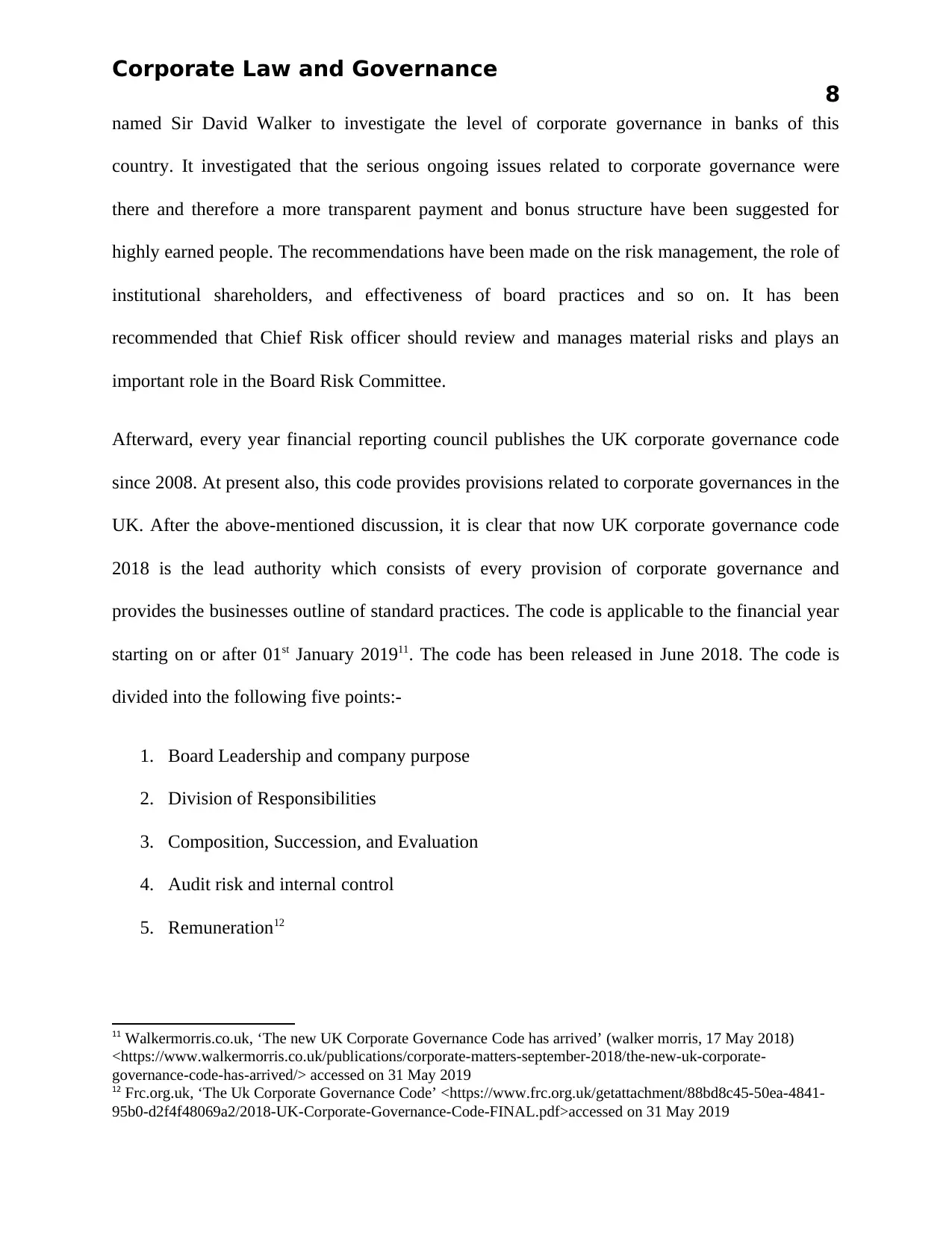
Afterward, every year financial reporting council publishes the UK corporate governance code
since 2008. At present also, this code provides provisions related to corporate governances in the
UK. After the above-mentioned discussion, it is clear that now UK corporate governance code
2018 is the lead authority which consists of every provision of corporate governance and
provides the businesses outline of standard practices. The code is applicable to the financial year
starting on or after 01st January 201911. The code has been released in June 2018. The code is
divided into the following five points:-
1. Board Leadership and company purpose
2. Division of Responsibilities
3. Composition, Succession, and Evaluation
4. Audit risk and internal control
5. Remuneration12
11 Walkermorris.co.uk, ‘The new UK Corporate Governance Code has arrived’ (walker morris, 17 May 2018)
<https://www.walkermorris.co.uk/publications/corporate-matters-september-2018/the-new-uk-corporate-
governance-code-has-arrived/> accessed on 31 May 2019
12 Frc.org.uk, ‘The Uk Corporate Governance Code’ <https://www.frc.org.uk/getattachment/88bd8c45-50ea-4841-
95b0-d2f4f48069a2/2018-UK-Corporate-Governance-Code-FINAL.pdf>accessed on 31 May 2019
8
named Sir David Walker to investigate the level of corporate governance in banks of this
country. It investigated that the serious ongoing issues related to corporate governance were
there and therefore a more transparent payment and bonus structure have been suggested for
highly earned people. The recommendations have been made on the risk management, the role of
institutional shareholders, and effectiveness of board practices and so on. It has been
recommended that Chief Risk officer should review and manages material risks and plays an
important role in the Board Risk Committee.
Afterward, every year financial reporting council publishes the UK corporate governance code
since 2008. At present also, this code provides provisions related to corporate governances in the
UK. After the above-mentioned discussion, it is clear that now UK corporate governance code
2018 is the lead authority which consists of every provision of corporate governance and
provides the businesses outline of standard practices. The code is applicable to the financial year
starting on or after 01st January 201911. The code has been released in June 2018. The code is
divided into the following five points:-
1. Board Leadership and company purpose
2. Division of Responsibilities
3. Composition, Succession, and Evaluation
4. Audit risk and internal control
5. Remuneration12
11 Walkermorris.co.uk, ‘The new UK Corporate Governance Code has arrived’ (walker morris, 17 May 2018)
<https://www.walkermorris.co.uk/publications/corporate-matters-september-2018/the-new-uk-corporate-
governance-code-has-arrived/> accessed on 31 May 2019
12 Frc.org.uk, ‘The Uk Corporate Governance Code’ <https://www.frc.org.uk/getattachment/88bd8c45-50ea-4841-
95b0-d2f4f48069a2/2018-UK-Corporate-Governance-Code-FINAL.pdf>accessed on 31 May 2019
⊘ This is a preview!⊘
Do you want full access?
Subscribe today to unlock all pages.
Trusted by 1+ million students worldwide
Corporate Law and Governance
9
If to discuss the code in brief, this is to state that the same provides duties and obligations of
directors and other officers of the company. The code provides that working of a company affect
society and economy as well and hence the same act in a responsible manner. The code is quite
effective as it covers all the possible aspects. In order to discuss the effectiveness of this code,
this is to state that the same is shorter as well as sharper in comparison to all the previous code. It
promotes integrity and transparency in the business. The same attracts investment in the UK and
in this manner provides benefits to the economy. The code also seems to be effective as it
provides a broadened definition of governance. It develops its focus on diversity and the
importance of a healthy corporate culture. This code has a total of 18 principles in addition to 41
corresponding provisions13.
The subjective code provides that it is the board of the company, which is liable to enforce the
plans and policies, which further develop a positive working culture. As the code is very recent,
therefore the success of the same is difficult to evaluate. However, the effectiveness of the same
can be measured by reviewing its provisions. As per the requirements of listing rules, listed
companies are required to provide the manner in which the same applies this code. Here
companies provide a summary of their good doings and stakeholders get to know more about
their company. Many disclosures are required there under this code and when a company
complies with the code, stakeholder understands how important they are for the company. It
enhances the trust and value of stakeholders and makes the performance of the compliances far
easy.
13 David Collins, Richard Barham and Candice Chapman, ‘UK: The 2018 UK Corporate Governance Code’
http://www.mondaq.com/uk/x/748672/Shareholders/The+2018+UK+Corporate+Governance+Code> accessed on 31
May 2019
9
If to discuss the code in brief, this is to state that the same provides duties and obligations of
directors and other officers of the company. The code provides that working of a company affect
society and economy as well and hence the same act in a responsible manner. The code is quite
effective as it covers all the possible aspects. In order to discuss the effectiveness of this code,
this is to state that the same is shorter as well as sharper in comparison to all the previous code. It
promotes integrity and transparency in the business. The same attracts investment in the UK and
in this manner provides benefits to the economy. The code also seems to be effective as it
provides a broadened definition of governance. It develops its focus on diversity and the
importance of a healthy corporate culture. This code has a total of 18 principles in addition to 41
corresponding provisions13.
The subjective code provides that it is the board of the company, which is liable to enforce the
plans and policies, which further develop a positive working culture. As the code is very recent,
therefore the success of the same is difficult to evaluate. However, the effectiveness of the same
can be measured by reviewing its provisions. As per the requirements of listing rules, listed
companies are required to provide the manner in which the same applies this code. Here
companies provide a summary of their good doings and stakeholders get to know more about
their company. Many disclosures are required there under this code and when a company
complies with the code, stakeholder understands how important they are for the company. It
enhances the trust and value of stakeholders and makes the performance of the compliances far
easy.
13 David Collins, Richard Barham and Candice Chapman, ‘UK: The 2018 UK Corporate Governance Code’
http://www.mondaq.com/uk/x/748672/Shareholders/The+2018+UK+Corporate+Governance+Code> accessed on 31
May 2019
Paraphrase This Document
Need a fresh take? Get an instant paraphrase of this document with our AI Paraphraser
Corporate Law and Governance
10
Conclusion
In order to conclude this report, this is to state that in UK corporate governance has a long
history. The same began in late 1980 and development still continues. In the presented report, the
discussion was made on each step that is involved in the development of corporate governance in
the UK. The process has been started with the establishment of the Cadbury Committee and
ended up the corporate governance codes. Greenbury Committee, Hample committee, Smith
Report are few of the bodies and documents that keep their unusual space in the history of
corporate governance in the UK. At present companies, follow governance code that provides
the manner in which a company is required to behave. From the duties and obligations of
directors and officers of the company to the composition of the board, everything is stipulated
under this code.
In a conclusive manner, this would not be wrongful to state that many efforts of different people
have been used in the corporate governance process and due to the same; the number of scandals
has reduced to a significant level in the county. The code seems to be way effective and
successful in the coming future too as they carry positive and ethical provisions and enhances the
interest and trust of stakeholders.
10
Conclusion
In order to conclude this report, this is to state that in UK corporate governance has a long
history. The same began in late 1980 and development still continues. In the presented report, the
discussion was made on each step that is involved in the development of corporate governance in
the UK. The process has been started with the establishment of the Cadbury Committee and
ended up the corporate governance codes. Greenbury Committee, Hample committee, Smith
Report are few of the bodies and documents that keep their unusual space in the history of
corporate governance in the UK. At present companies, follow governance code that provides
the manner in which a company is required to behave. From the duties and obligations of
directors and officers of the company to the composition of the board, everything is stipulated
under this code.
In a conclusive manner, this would not be wrongful to state that many efforts of different people
have been used in the corporate governance process and due to the same; the number of scandals
has reduced to a significant level in the county. The code seems to be way effective and
successful in the coming future too as they carry positive and ethical provisions and enhances the
interest and trust of stakeholders.
Corporate Law and Governance
11
Bibliography
Legislations
Companies Act 1985
Books/Journal
A. C. Fernando, Business Ethics: An Indian Perspective (Pearson Education India 2009)
Alan Calder, Corporate Governance: A practical guide to the legal frameworks and
international codes of practice (Kogan Page Publishers 2008)
Alison L. Dempsey, Evolutions in Corporate Governance: Towards an Ethical Framework for
Business Conduct (Routledge 2017)
Dieter Ordelheide, Transnational Accounting (Springer, 2016)
Iris H-Y Chiu, The Foundations and Anatomy of Shareholder Activism (Bloomsbury Publishing
2010)
Paul M. Collier, Fundamentals of Risk Management for Accountants and Managers (Routledge
2009)
Priyanka Kaushik Sharma, Corporate Governance Practices in India: A Synthesis of Theories,
Practices, and Cases (Springer 2015)
Other Resources
David Collins, Richard Barham and Candice Chapman, ‘UK: The 2018 UK Corporate
Governance Code’
11
Bibliography
Legislations
Companies Act 1985
Books/Journal
A. C. Fernando, Business Ethics: An Indian Perspective (Pearson Education India 2009)
Alan Calder, Corporate Governance: A practical guide to the legal frameworks and
international codes of practice (Kogan Page Publishers 2008)
Alison L. Dempsey, Evolutions in Corporate Governance: Towards an Ethical Framework for
Business Conduct (Routledge 2017)
Dieter Ordelheide, Transnational Accounting (Springer, 2016)
Iris H-Y Chiu, The Foundations and Anatomy of Shareholder Activism (Bloomsbury Publishing
2010)
Paul M. Collier, Fundamentals of Risk Management for Accountants and Managers (Routledge
2009)
Priyanka Kaushik Sharma, Corporate Governance Practices in India: A Synthesis of Theories,
Practices, and Cases (Springer 2015)
Other Resources
David Collins, Richard Barham and Candice Chapman, ‘UK: The 2018 UK Corporate
Governance Code’
⊘ This is a preview!⊘
Do you want full access?
Subscribe today to unlock all pages.
Trusted by 1+ million students worldwide

1 out of 13


Related Documents


Your All-in-One AI-Powered Toolkit for Academic Success.
+13062052269
info@desklib.com
Available 24*7 on WhatsApp / Email
![[object Object]](/_next/static/media/star-bottom.7253800d.svg)
Unlock your academic potential
Copyright © 2020–2026 A2Z Services. All Rights Reserved. Developed and managed by ZUCOL.