HI6026 Audit, Assurance: OZ Minerals Corporate Governance & Risk
VerifiedAdded on 2023/06/13
|11
|2520
|231
Report
AI Summary
This report provides a comprehensive analysis of OZ Minerals Limited's corporate governance practices and risk assessment procedures, aligning with the Australian Securities Exchange (ASX) Corporate Governance Principles. It examines the company's adherence to these principles, including board structure, ethical conduct, disclosure practices, and risk management strategies. The report identifies potential risk factors within OZ Minerals' operations, such as international business ventures, regulatory compliance, and business strategies, further analyzing key financial ratios to assess the company's risk exposure. It concludes with recommendations for mitigating identified risks, emphasizing the importance of robust internal controls, compliance with government regulations, and continuous internal audits. This assessment serves as a tool for auditors to form opinions on the fairness of the company's financial statements. Desklib provides a platform to explore similar solved assignments.
[Corporate governance and risk assessment analysis as a tool of auditing]
Student ID: Student Name:
2018
OZ Minerals limited
Student ID: Student Name:
2018
OZ Minerals limited

Paraphrase This Document
Need a fresh take? Get an instant paraphrase of this document with our AI Paraphraser
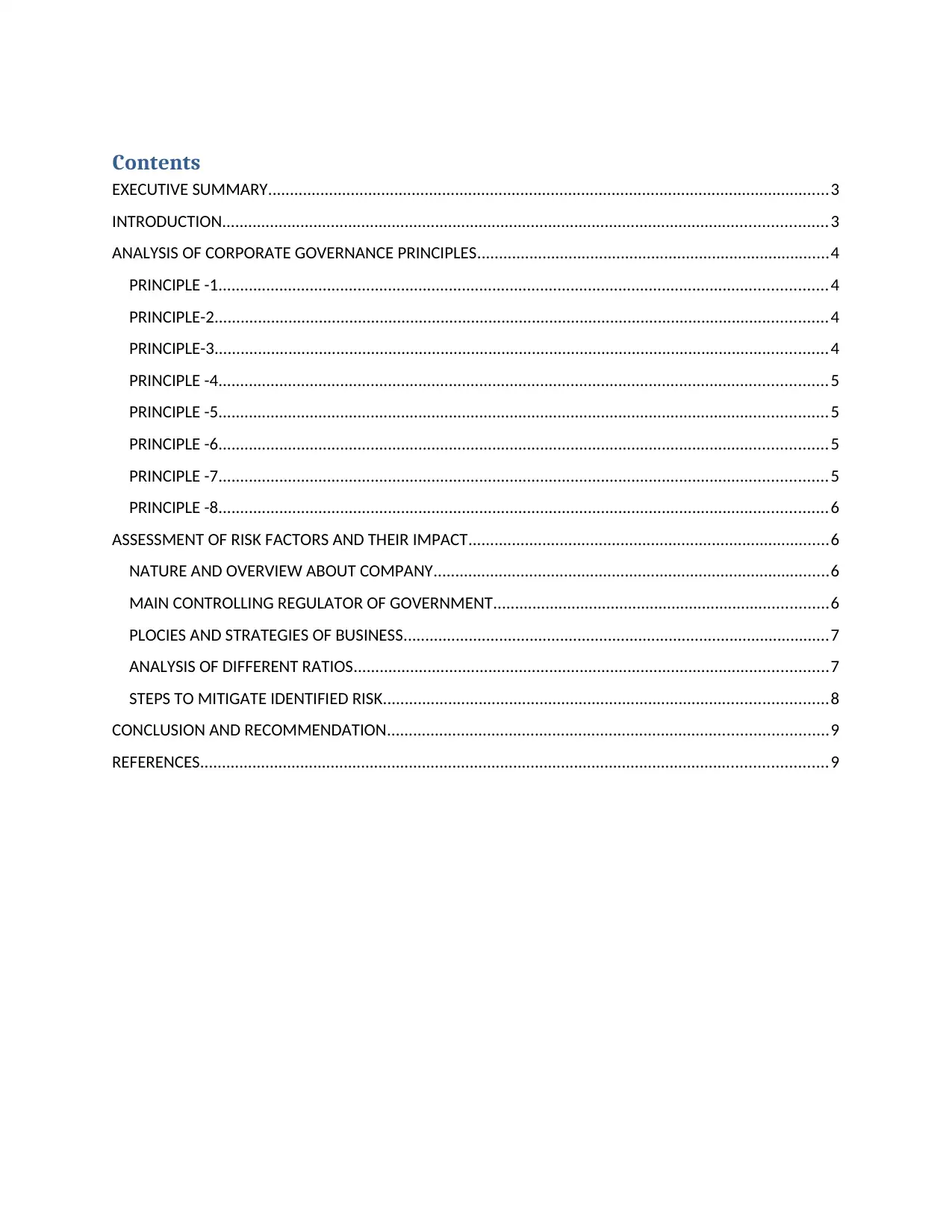
Contents
EXECUTIVE SUMMARY.................................................................................................................................3
INTRODUCTION...........................................................................................................................................3
ANALYSIS OF CORPORATE GOVERNANCE PRINCIPLES.................................................................................4
PRINCIPLE -1............................................................................................................................................4
PRINCIPLE-2.............................................................................................................................................4
PRINCIPLE-3.............................................................................................................................................4
PRINCIPLE -4............................................................................................................................................5
PRINCIPLE -5............................................................................................................................................5
PRINCIPLE -6............................................................................................................................................5
PRINCIPLE -7............................................................................................................................................5
PRINCIPLE -8............................................................................................................................................6
ASSESSMENT OF RISK FACTORS AND THEIR IMPACT...................................................................................6
NATURE AND OVERVIEW ABOUT COMPANY...........................................................................................6
MAIN CONTROLLING REGULATOR OF GOVERNMENT.............................................................................6
PLOCIES AND STRATEGIES OF BUSINESS..................................................................................................7
ANALYSIS OF DIFFERENT RATIOS.............................................................................................................7
STEPS TO MITIGATE IDENTIFIED RISK......................................................................................................8
CONCLUSION AND RECOMMENDATION.....................................................................................................9
REFERENCES................................................................................................................................................9
EXECUTIVE SUMMARY.................................................................................................................................3
INTRODUCTION...........................................................................................................................................3
ANALYSIS OF CORPORATE GOVERNANCE PRINCIPLES.................................................................................4
PRINCIPLE -1............................................................................................................................................4
PRINCIPLE-2.............................................................................................................................................4
PRINCIPLE-3.............................................................................................................................................4
PRINCIPLE -4............................................................................................................................................5
PRINCIPLE -5............................................................................................................................................5
PRINCIPLE -6............................................................................................................................................5
PRINCIPLE -7............................................................................................................................................5
PRINCIPLE -8............................................................................................................................................6
ASSESSMENT OF RISK FACTORS AND THEIR IMPACT...................................................................................6
NATURE AND OVERVIEW ABOUT COMPANY...........................................................................................6
MAIN CONTROLLING REGULATOR OF GOVERNMENT.............................................................................6
PLOCIES AND STRATEGIES OF BUSINESS..................................................................................................7
ANALYSIS OF DIFFERENT RATIOS.............................................................................................................7
STEPS TO MITIGATE IDENTIFIED RISK......................................................................................................8
CONCLUSION AND RECOMMENDATION.....................................................................................................9
REFERENCES................................................................................................................................................9
EXECUTIVE SUMMARY
Auditing is very important for every organization as it helps in easy decision making by different
users to accounting information. The auditors have to check and assess every areas/ information
of the company before framing an opinion towards the affairs of the company. This report has
been prepared to show how the corporate governance assessment and risk factors identification
along with their analysis is the major tool of auditing. The main aim of the report is to assess the
application of the corporate governance by the company as per the principles laid down by
Australian stock exchange. The other main aim of the report is to assess the risk factors and their
implication in the company so that these can be reported to different stakeholders and they can
take correct decisions about the working of the company. For the above intention, OZ minerals
limited registered in Australian in 2008 have been chosen. The report has been prepared using
different headings and subheadings.
INTRODUCTION
The report has been prepared using the title Corporate Governance and Risk Assessment as a
tool of Auditing. The report has been prepared to analyzed and examine whether the company
under consideration is following all the requirements of corporate governance principles and also
is there any material risk factor involved in the working of the company. The report has been
structured under major five heads. The first heads defines the intention of preparation of the
report. The second head define the structure of the report. The next head defines the implication
checking by the auditor for corporate governance principles. The next head defines the different
factors which can create the risky situations for the company. The report has been ended with
proper conclusion and recommendations. OZ Minerals Limited Company listed in Australian
Stock Exchange has been selected for the purpose of the analysis. The report has been prepared
Auditing is very important for every organization as it helps in easy decision making by different
users to accounting information. The auditors have to check and assess every areas/ information
of the company before framing an opinion towards the affairs of the company. This report has
been prepared to show how the corporate governance assessment and risk factors identification
along with their analysis is the major tool of auditing. The main aim of the report is to assess the
application of the corporate governance by the company as per the principles laid down by
Australian stock exchange. The other main aim of the report is to assess the risk factors and their
implication in the company so that these can be reported to different stakeholders and they can
take correct decisions about the working of the company. For the above intention, OZ minerals
limited registered in Australian in 2008 have been chosen. The report has been prepared using
different headings and subheadings.
INTRODUCTION
The report has been prepared using the title Corporate Governance and Risk Assessment as a
tool of Auditing. The report has been prepared to analyzed and examine whether the company
under consideration is following all the requirements of corporate governance principles and also
is there any material risk factor involved in the working of the company. The report has been
structured under major five heads. The first heads defines the intention of preparation of the
report. The second head define the structure of the report. The next head defines the implication
checking by the auditor for corporate governance principles. The next head defines the different
factors which can create the risky situations for the company. The report has been ended with
proper conclusion and recommendations. OZ Minerals Limited Company listed in Australian
Stock Exchange has been selected for the purpose of the analysis. The report has been prepared
⊘ This is a preview!⊘
Do you want full access?
Subscribe today to unlock all pages.

Trusted by 1+ million students worldwide
with using primary and secondary sources of information along with the annual reports and
corporate statement available on the company official website.
ANALYSIS OF CORPORATE GOVERNANCE PRINCIPLES
The ASX Stock exchange has laid eight principles of good corporate governance which has to be
followed by the company listed in ASX stock exchange. The analysis of the corporate
governance principles by OZ Minerals Limited has listed below:
PRINCIPLE -1
This Principle describes the board of the company, its appointment and composition. It also
describes the board members will be appointment in the company along with their term of
appointment. In the give company the board detail has been mentioned in corporate statement
along with details of roles of chief executive officer, company secretary and their performance
management. The company has created EXCO for the defining the role of the company board
(Company Official Website, 2017).
PRINCIPLE-2
The structure board of the OZ Minerals Limited is comprises of nomination committee, board
committee, board members, chairman and other people. The company has focus on the training
and induction of the people who is going to be the member of the board. The company is
enhancing the professional knowledge of the members of board so that management of the
company can become efficient.
PRINCIPLE-3
The company has define the directions according to which the member and board along with its
committee has to perform their roles and responsibilities. The company has given more focus on
defined actions for each type of work so that all legal formalities can be fulfilled and results of
actions can be assessed with the plan result. This nature of the company helps the different
corporate statement available on the company official website.
ANALYSIS OF CORPORATE GOVERNANCE PRINCIPLES
The ASX Stock exchange has laid eight principles of good corporate governance which has to be
followed by the company listed in ASX stock exchange. The analysis of the corporate
governance principles by OZ Minerals Limited has listed below:
PRINCIPLE -1
This Principle describes the board of the company, its appointment and composition. It also
describes the board members will be appointment in the company along with their term of
appointment. In the give company the board detail has been mentioned in corporate statement
along with details of roles of chief executive officer, company secretary and their performance
management. The company has created EXCO for the defining the role of the company board
(Company Official Website, 2017).
PRINCIPLE-2
The structure board of the OZ Minerals Limited is comprises of nomination committee, board
committee, board members, chairman and other people. The company has focus on the training
and induction of the people who is going to be the member of the board. The company is
enhancing the professional knowledge of the members of board so that management of the
company can become efficient.
PRINCIPLE-3
The company has define the directions according to which the member and board along with its
committee has to perform their roles and responsibilities. The company has given more focus on
defined actions for each type of work so that all legal formalities can be fulfilled and results of
actions can be assessed with the plan result. This nature of the company helps the different
Paraphrase This Document
Need a fresh take? Get an instant paraphrase of this document with our AI Paraphraser
stakeholders to assess the investment return in advance and create the trust effect among them
about the affairs of the company.
PRINCIPLE -4
The integrity and effectiveness of financial statements can be assesses with three committees
which the company has created. The first committee is Audit committee which helps in analysis
of the transactions of the company along with audit requirement on timely basis. The second
committee is Human Resource and Remuneration committee and the third is Sustainability
committee.
-
PRINCIPLE -5
The company has been following the market and dividend policy which is in addition with
continuous disclosure so that the all the information can be externally communicated to the
different stakeholders. The company has framed disclosure committee to ensure that all the
disclosure are accurate and on timely manner. These polices has been reviewed by board on
continuous basis.
PRINCIPLE -6
The company has introduced the investor’s relation program so that the communication with
shareholders can taken place without any interruption. For example, The Company has
developed the website www. Ozminerals.com to communicate all the information’s to its
shareholders. The annual report of the company is self explanatory helps the shareholders to
understand the financial and non financial growth of the company.
PRINCIPLE -7
To assess and mitigate risk, the company is following different risk assessment policies. The
company has developed internal control framework along with internal audit so that risk factors
can be identified at right time and right action can be taken to protect the company from harm
about the affairs of the company.
PRINCIPLE -4
The integrity and effectiveness of financial statements can be assesses with three committees
which the company has created. The first committee is Audit committee which helps in analysis
of the transactions of the company along with audit requirement on timely basis. The second
committee is Human Resource and Remuneration committee and the third is Sustainability
committee.
-
PRINCIPLE -5
The company has been following the market and dividend policy which is in addition with
continuous disclosure so that the all the information can be externally communicated to the
different stakeholders. The company has framed disclosure committee to ensure that all the
disclosure are accurate and on timely manner. These polices has been reviewed by board on
continuous basis.
PRINCIPLE -6
The company has introduced the investor’s relation program so that the communication with
shareholders can taken place without any interruption. For example, The Company has
developed the website www. Ozminerals.com to communicate all the information’s to its
shareholders. The annual report of the company is self explanatory helps the shareholders to
understand the financial and non financial growth of the company.
PRINCIPLE -7
To assess and mitigate risk, the company is following different risk assessment policies. The
company has developed internal control framework along with internal audit so that risk factors
can be identified at right time and right action can be taken to protect the company from harm
created by them. The company EXCO policy is the best to ensure that risk mitigation can be
started at the right time. Also the MD and CEO declaration helps in the assessing the
genuineness of the internal control procedures.
PRINCIPLE -8
The company is involved in development of its employees and formed the people committee
along with gender diversity policy. The industry has very less no of women employees but the
company is adopting the different polices through which the no of women employees have been
increased over years in the company.
ASSESSMENT OF RISK FACTORS AND THEIR IMPACT
Assessment of risk factors is the major auditing step with is required to done by the auditor
before framing an opinion as per Standard on Auditing laid down by ASSB. The assessment of
risk factors can be done with the help of analytical tools or assessing different aspects of the
working of the company (ACCA, 2016; Abidin & Baabbad, 2015). The following factors has
been identified in the given company so that whether risk is involved in the same can be
assessed: (AASB, 2009; Weiss, 2014 and Mock, 2015)
NATURE AND OVERVIEW ABOUT COMPANY
The company involved in international business from 2008 when it has been formed with the
merger of two major players i.e. Oxiana Limited and ZInifex Limited. The company world’s
second largest zinc producer and also involved in production of copper, gold, lead, silver and is
registered in Australia. The company is expanding in gas pipeline projects as well (Company
Official Website, 2017). The diversity in company’s operations in very short span of life of the
company is creating the risk on the wealth of the shareholders. The nature of company is such
that it is prone to high risk (Capital Markets Advisory Committee Meeting, 2013).
MAIN CONTROLLING REGULATOR OF GOVERNMENT
The major controlling regulator for the company is natural resources reservation board which
directs the company to have certain principle so that environment protect can be done (Company
Official Website, 2017 and Vasarhelyi, 2014). For example, the company ahs health and safety
policy for its employees so that the company can provide safe and disease free workplace to its
started at the right time. Also the MD and CEO declaration helps in the assessing the
genuineness of the internal control procedures.
PRINCIPLE -8
The company is involved in development of its employees and formed the people committee
along with gender diversity policy. The industry has very less no of women employees but the
company is adopting the different polices through which the no of women employees have been
increased over years in the company.
ASSESSMENT OF RISK FACTORS AND THEIR IMPACT
Assessment of risk factors is the major auditing step with is required to done by the auditor
before framing an opinion as per Standard on Auditing laid down by ASSB. The assessment of
risk factors can be done with the help of analytical tools or assessing different aspects of the
working of the company (ACCA, 2016; Abidin & Baabbad, 2015). The following factors has
been identified in the given company so that whether risk is involved in the same can be
assessed: (AASB, 2009; Weiss, 2014 and Mock, 2015)
NATURE AND OVERVIEW ABOUT COMPANY
The company involved in international business from 2008 when it has been formed with the
merger of two major players i.e. Oxiana Limited and ZInifex Limited. The company world’s
second largest zinc producer and also involved in production of copper, gold, lead, silver and is
registered in Australia. The company is expanding in gas pipeline projects as well (Company
Official Website, 2017). The diversity in company’s operations in very short span of life of the
company is creating the risk on the wealth of the shareholders. The nature of company is such
that it is prone to high risk (Capital Markets Advisory Committee Meeting, 2013).
MAIN CONTROLLING REGULATOR OF GOVERNMENT
The major controlling regulator for the company is natural resources reservation board which
directs the company to have certain principle so that environment protect can be done (Company
Official Website, 2017 and Vasarhelyi, 2014). For example, the company ahs health and safety
policy for its employees so that the company can provide safe and disease free workplace to its
⊘ This is a preview!⊘
Do you want full access?
Subscribe today to unlock all pages.
Trusted by 1+ million students worldwide
employees (Cooper, 2015). Second authority is Corporation Act, 2001 whereby the basic
principles of conceptual framework along with continuous disclosure has to adopted so that
company can run in Australian market (Baird,, 2015).
PLOCIES AND STRATEGIES OF BUSINESS
The company has two strategies which helps the company to create value and achieve its
objectives. The first is Customer Focus in which the company has focus to become global player
in removing impurities from iron and form copper ore by having highest customer base across
the globe. The second is multiple assets in which the company is expanding business in pipelines
as well. Losing the funds in long run is the major risk in the above two strategies (Kharisova,
2014).
ANALYSIS OF DIFFERENT RATIOS
Analytical procedures in audit can be used with Ratio analysis (Glover, 2014; Ullah, 2014).
RATIOS ANALYSIS
S.
NO. PARTICULARS 31ST DECEMBER 2017 31ST DECEMBER 2016
1 NET MARGIN
Net Margin After Tax 231.1 107.8
Revenue 1023.1 822.9
Net Margin Ratio 22.59% 13.10%
2 CURRENT RATIO
Current Assets 1148.1 944.3
Current Liabilties 227 174.8
Current RATIO 5.06 5.40
3 DEBT TO EQUITY
Total Liabilities 310 276.3
Total Equity 2516.3 2354.3
principles of conceptual framework along with continuous disclosure has to adopted so that
company can run in Australian market (Baird,, 2015).
PLOCIES AND STRATEGIES OF BUSINESS
The company has two strategies which helps the company to create value and achieve its
objectives. The first is Customer Focus in which the company has focus to become global player
in removing impurities from iron and form copper ore by having highest customer base across
the globe. The second is multiple assets in which the company is expanding business in pipelines
as well. Losing the funds in long run is the major risk in the above two strategies (Kharisova,
2014).
ANALYSIS OF DIFFERENT RATIOS
Analytical procedures in audit can be used with Ratio analysis (Glover, 2014; Ullah, 2014).
RATIOS ANALYSIS
S.
NO. PARTICULARS 31ST DECEMBER 2017 31ST DECEMBER 2016
1 NET MARGIN
Net Margin After Tax 231.1 107.8
Revenue 1023.1 822.9
Net Margin Ratio 22.59% 13.10%
2 CURRENT RATIO
Current Assets 1148.1 944.3
Current Liabilties 227 174.8
Current RATIO 5.06 5.40
3 DEBT TO EQUITY
Total Liabilities 310 276.3
Total Equity 2516.3 2354.3
Paraphrase This Document
Need a fresh take? Get an instant paraphrase of this document with our AI Paraphraser
RATIO 0.12 0.12
4 EQUITY
Total Equity 2516.3 2354.3
Total Assets 2826.3 2630.6
RATIO 0.89 0.89
5 DEBT TO ASSET
Total Liabilities 310 276.3
Total Assets 2826.3 2630.6
RATIO 0.11 0.11
6 Interest Coverage Ratio
Profit before Interest and Tax 320.7 127.2
Interest Expense 3.8 4.8
RATIO 84.39 26.50
The above analysis of ratios shows that the company is open to risky situations as the Net profit
has been jumped nearly twice i.e. 22.59% as compared to 13.10% in 2016. The interest coverage
ratio is also increased from 26.50 times to 84.39 times which is also indication of either growth
situation or high risk involved in company’s working (AASB, 2009 ; Anastasia, 2015; Chen,
2017).
STEPS TO MITIGATE IDENTIFIED RISK
The company can reduce the risk by applying different policies and procedures. The company
should assess and make its internal control system so strong that errors and frauds cannot take
place. The good corporate governance along with applying government regulations on timely
basis also reduces the risk factors and their impact. The company should have continuous or
internal audit so that the errors and frauds can be detected on early step and corrective actions
can be taken (Gary, 2017, Mao, 2014))
4 EQUITY
Total Equity 2516.3 2354.3
Total Assets 2826.3 2630.6
RATIO 0.89 0.89
5 DEBT TO ASSET
Total Liabilities 310 276.3
Total Assets 2826.3 2630.6
RATIO 0.11 0.11
6 Interest Coverage Ratio
Profit before Interest and Tax 320.7 127.2
Interest Expense 3.8 4.8
RATIO 84.39 26.50
The above analysis of ratios shows that the company is open to risky situations as the Net profit
has been jumped nearly twice i.e. 22.59% as compared to 13.10% in 2016. The interest coverage
ratio is also increased from 26.50 times to 84.39 times which is also indication of either growth
situation or high risk involved in company’s working (AASB, 2009 ; Anastasia, 2015; Chen,
2017).
STEPS TO MITIGATE IDENTIFIED RISK
The company can reduce the risk by applying different policies and procedures. The company
should assess and make its internal control system so strong that errors and frauds cannot take
place. The good corporate governance along with applying government regulations on timely
basis also reduces the risk factors and their impact. The company should have continuous or
internal audit so that the errors and frauds can be detected on early step and corrective actions
can be taken (Gary, 2017, Mao, 2014))
CONCLUSION AND RECOMMENDATION
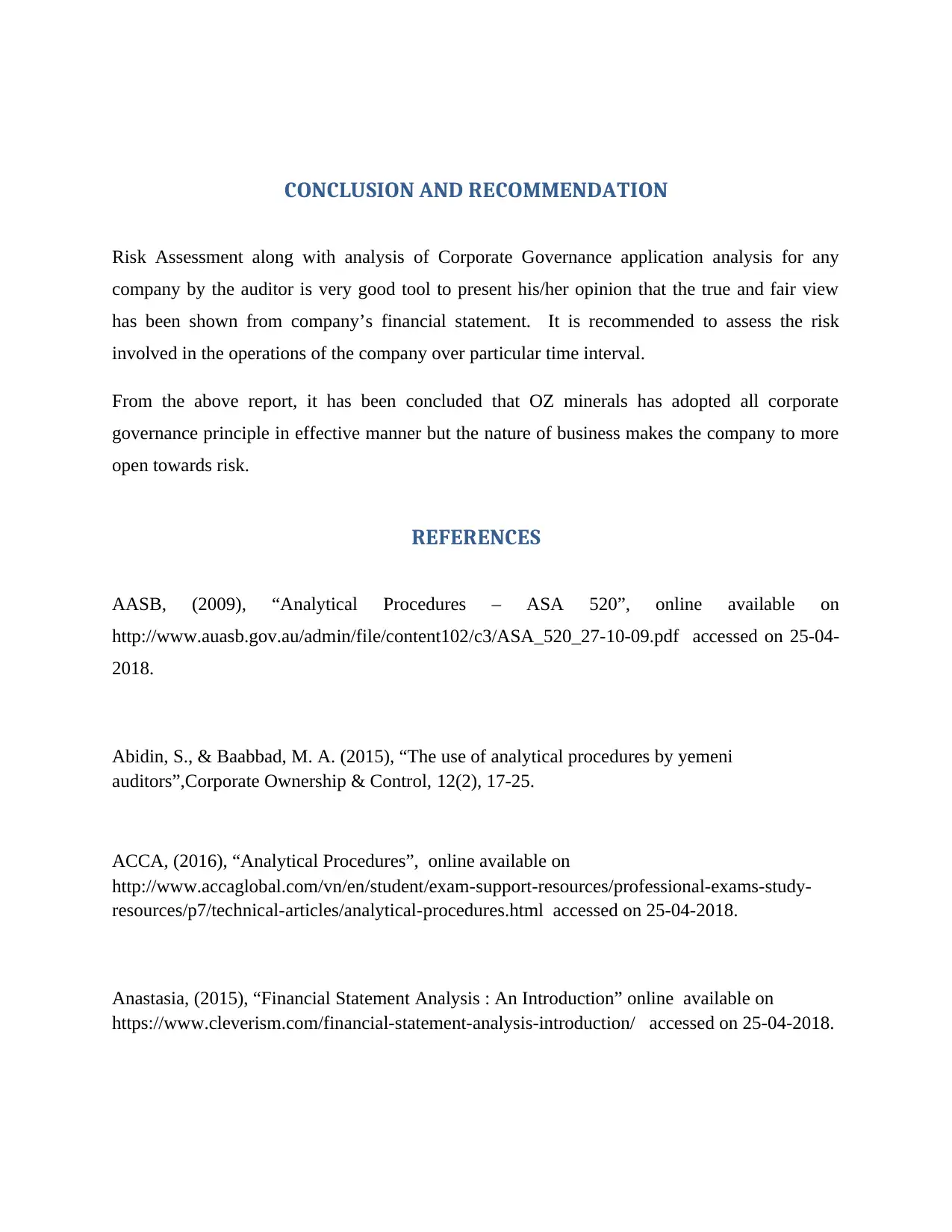
Risk Assessment along with analysis of Corporate Governance application analysis for any
company by the auditor is very good tool to present his/her opinion that the true and fair view
has been shown from company’s financial statement. It is recommended to assess the risk
involved in the operations of the company over particular time interval.
From the above report, it has been concluded that OZ minerals has adopted all corporate
governance principle in effective manner but the nature of business makes the company to more
open towards risk.
REFERENCES
AASB, (2009), “Analytical Procedures – ASA 520”, online available on
http://www.auasb.gov.au/admin/file/content102/c3/ASA_520_27-10-09.pdf accessed on 25-04-
2018.
Abidin, S., & Baabbad, M. A. (2015), “The use of analytical procedures by yemeni
auditors”,Corporate Ownership & Control, 12(2), 17-25.
ACCA, (2016), “Analytical Procedures”, online available on
http://www.accaglobal.com/vn/en/student/exam-support-resources/professional-exams-study-
resources/p7/technical-articles/analytical-procedures.html accessed on 25-04-2018.
Anastasia, (2015), “Financial Statement Analysis : An Introduction” online available on
https://www.cleverism.com/financial-statement-analysis-introduction/ accessed on 25-04-2018.
Risk Assessment along with analysis of Corporate Governance application analysis for any
company by the auditor is very good tool to present his/her opinion that the true and fair view
has been shown from company’s financial statement. It is recommended to assess the risk
involved in the operations of the company over particular time interval.
From the above report, it has been concluded that OZ minerals has adopted all corporate
governance principle in effective manner but the nature of business makes the company to more
open towards risk.
REFERENCES
AASB, (2009), “Analytical Procedures – ASA 520”, online available on
http://www.auasb.gov.au/admin/file/content102/c3/ASA_520_27-10-09.pdf accessed on 25-04-
2018.
Abidin, S., & Baabbad, M. A. (2015), “The use of analytical procedures by yemeni
auditors”,Corporate Ownership & Control, 12(2), 17-25.
ACCA, (2016), “Analytical Procedures”, online available on
http://www.accaglobal.com/vn/en/student/exam-support-resources/professional-exams-study-
resources/p7/technical-articles/analytical-procedures.html accessed on 25-04-2018.
Anastasia, (2015), “Financial Statement Analysis : An Introduction” online available on
https://www.cleverism.com/financial-statement-analysis-introduction/ accessed on 25-04-2018.
⊘ This is a preview!⊘
Do you want full access?
Subscribe today to unlock all pages.
Trusted by 1+ million students worldwide
Baird, I.S, (2015). “Toward a contingency model of strategic risk taking”, Academy of
management Review, 10(2), pp.35 – 47
Capital Markets Advisory Committee Meeting, (2013), “Conceptual Framework” online
available on http://www.ifrs.org/Meetings/MeetingDocs/Other%20Meeting/2013/March/AP
%203%20conceptual%20framework.pdf accessed on 25-04-2018
Chen, S., (2017), “Refer to Materiality as a Legal Concept”. Journal of Corporate Accounting &
Finance, 28(2), 55-61.
Company Official Website, (2017), “Annual Report”, online available on
https://www.ozminerals.com accessed on 25-04-2018.
Cooper S, (2015), “A Tale of Prudence”, online available on http://www.ifrs.org/Investor-
resources/Investor-perspectives-2/Documents/Prudence_Investor-Perspective_Conceptual-
FW.PDF accessed on 25-04-2018.
Gary S., (2017), “The Importance of Inherent Risk Factors: Auditor’s Perceptions”, Australian
Accounting Review, Vol 3, Pp 38-44.
Glover, (2014), “Between a Rock and a Hard Place: A Path Forward for Using Substantive
Analytical Procedures in Auditing Large P&L Accounts: Commentary and Analysis”. Auditing:
A Journal of Practice & Theory, 34(3), 161-179.
Kharisova, F. I., (2014), “Applying the category of Assertions (or preconditions)» in audit of
financial statement”. Mediterranean Journal of Social Sciences, 5(24), 180
management Review, 10(2), pp.35 – 47
Capital Markets Advisory Committee Meeting, (2013), “Conceptual Framework” online
available on http://www.ifrs.org/Meetings/MeetingDocs/Other%20Meeting/2013/March/AP
%203%20conceptual%20framework.pdf accessed on 25-04-2018
Chen, S., (2017), “Refer to Materiality as a Legal Concept”. Journal of Corporate Accounting &
Finance, 28(2), 55-61.
Company Official Website, (2017), “Annual Report”, online available on
https://www.ozminerals.com accessed on 25-04-2018.
Cooper S, (2015), “A Tale of Prudence”, online available on http://www.ifrs.org/Investor-
resources/Investor-perspectives-2/Documents/Prudence_Investor-Perspective_Conceptual-
FW.PDF accessed on 25-04-2018.
Gary S., (2017), “The Importance of Inherent Risk Factors: Auditor’s Perceptions”, Australian
Accounting Review, Vol 3, Pp 38-44.
Glover, (2014), “Between a Rock and a Hard Place: A Path Forward for Using Substantive
Analytical Procedures in Auditing Large P&L Accounts: Commentary and Analysis”. Auditing:
A Journal of Practice & Theory, 34(3), 161-179.
Kharisova, F. I., (2014), “Applying the category of Assertions (or preconditions)» in audit of
financial statement”. Mediterranean Journal of Social Sciences, 5(24), 180
Paraphrase This Document
Need a fresh take? Get an instant paraphrase of this document with our AI Paraphraser
Leung P, (2015), “Modern Auditing and Assurance Services”, Wiley John and Sons, Ed. 6, Pp
425-463, 582-684.
Mao, M., (2014), “Experimental Methods of Materiality Judgment on Auditor’s Experience and
Performance” In 3rd International Conference on Science and Social Research
(ICSSR 2014) Atlantis Press.
Mock, T. J, (2015). “Auditors' Risk Assessments: The Effects of Elicitation Approach and
Assertion Framing” Behavioral Research in Accounting, 28(2), 75-84.
Ullah A, (2014), “Planning and Audit of Financial Statements” online available on
http://leaccountant.com/2014/12/08/asa-300-summary-planning-an-audit-of-financial -
statements/ accessed on 25-04-2018
Vasarhelyi, M. A., (2014), “Embracing the Automated Audit: How the Audit Data Standards and
Audit Tools Can Enhance Auditor Judgment and Assurance” Journal of
accountancy, 217(4), 34.
Weiss D, (2014), “Faithful Representation” online available on
http://bschool.huji.ac.il/.upload/Seminars/Faithful%20Representation%20October%202014.pdf
accessed on 25-04-2018.
425-463, 582-684.
Mao, M., (2014), “Experimental Methods of Materiality Judgment on Auditor’s Experience and
Performance” In 3rd International Conference on Science and Social Research
(ICSSR 2014) Atlantis Press.
Mock, T. J, (2015). “Auditors' Risk Assessments: The Effects of Elicitation Approach and
Assertion Framing” Behavioral Research in Accounting, 28(2), 75-84.
Ullah A, (2014), “Planning and Audit of Financial Statements” online available on
http://leaccountant.com/2014/12/08/asa-300-summary-planning-an-audit-of-financial -
statements/ accessed on 25-04-2018
Vasarhelyi, M. A., (2014), “Embracing the Automated Audit: How the Audit Data Standards and
Audit Tools Can Enhance Auditor Judgment and Assurance” Journal of
accountancy, 217(4), 34.
Weiss D, (2014), “Faithful Representation” online available on
http://bschool.huji.ac.il/.upload/Seminars/Faithful%20Representation%20October%202014.pdf
accessed on 25-04-2018.

1 out of 11


Related Documents


Your All-in-One AI-Powered Toolkit for Academic Success.
+13062052269
info@desklib.com
Available 24*7 on WhatsApp / Email
![[object Object]](/_next/static/media/star-bottom.7253800d.svg)
Unlock your academic potential
Copyright © 2020–2026 A2Z Services. All Rights Reserved. Developed and managed by ZUCOL.