Innovation & Entrepreneurship: A Case Study Analysis of Company A
VerifiedAdded on 2024/04/25
|20
|4966
|272
Case Study
AI Summary
This report examines the case study of Company A, a heavy engineering organization that initially embraced innovation and creativity but failed to fully implement it, leading to its acquisition by a larger entity. The analysis contrasts the company's pre- and post-takeover scenarios, emphasizing the importance of creativity and innovation for organizations of all sizes. It explores how proactive implementation of creativity and innovation, guided by Amabile's conceptual model, could have prevented the takeover. Furthermore, it assesses the potential for promoting creativity and innovation under the new management's focus on shareholder value, utilizing Kurt Lewin's change model and Kotter's dual operating system. The report concludes with recommendations for organizations seeking to adopt creativity and innovation, considering their specific climate, structure, and policies.

CORPORATE INNOVATION AND ENTREPRENEURSHIP

Paraphrase This Document
Need a fresh take? Get an instant paraphrase of this document with our AI Paraphraser
EXECUTIVE SUMMARY
The report is based on the case study of the Company A which is a heavy engineering
organization that adopted the strategy of innovation and creativity but failed to implement it
fully but it resulted in the pockets of innovation. The partial implementation of innovation and
creativity resulted in its takeover by a much larger organization. This divides the case study into
two scenarios of the company that is one before the takeover and other after the takeover. The
initial level of this report is based on the introduction of the case study of the Company A and
importance of creativity and innovation for the organization regardless of their structure, size,
culture and climate.
The next section of this report is a detailed view of how the proper implementation of creativity
and innovation in the first scenario might have eliminated the need of takeover of the
organization and this could have been done by the adoption of the conceptual model of
creativity and innovation designed by Amabile and it is discussed in brief. Apart from this, this
section also answers the question related to the application of innovation and creativity in the
second scenario of the company. This question is answered and proper implementation of
creativity and innovation is discussed for the second scenario with the help of Kurt Lewin's
change model and Kotter's model of the dual operating system.
The next section of this report is the concluding paragraph of the report along with the
usefulness of models that can be applied. At last, the section of recommendations is given that
makes the organizations clear with the adoption of creativity and innovation and it also
suggests that how the organizations can adopt this creativity and innovation with particular
climate, structure, policies and time.
2
The report is based on the case study of the Company A which is a heavy engineering
organization that adopted the strategy of innovation and creativity but failed to implement it
fully but it resulted in the pockets of innovation. The partial implementation of innovation and
creativity resulted in its takeover by a much larger organization. This divides the case study into
two scenarios of the company that is one before the takeover and other after the takeover. The
initial level of this report is based on the introduction of the case study of the Company A and
importance of creativity and innovation for the organization regardless of their structure, size,
culture and climate.
The next section of this report is a detailed view of how the proper implementation of creativity
and innovation in the first scenario might have eliminated the need of takeover of the
organization and this could have been done by the adoption of the conceptual model of
creativity and innovation designed by Amabile and it is discussed in brief. Apart from this, this
section also answers the question related to the application of innovation and creativity in the
second scenario of the company. This question is answered and proper implementation of
creativity and innovation is discussed for the second scenario with the help of Kurt Lewin's
change model and Kotter's model of the dual operating system.
The next section of this report is the concluding paragraph of the report along with the
usefulness of models that can be applied. At last, the section of recommendations is given that
makes the organizations clear with the adoption of creativity and innovation and it also
suggests that how the organizations can adopt this creativity and innovation with particular
climate, structure, policies and time.
2
Contents
EXECUTIVE SUMMARY.................................................................................................................................2
INTRODUCTION...........................................................................................................................................4
ANALYSIS.....................................................................................................................................................6
CONCLUSION.............................................................................................................................................15
RECOMMENDATIONS................................................................................................................................17
REFERENCES..............................................................................................................................................18
3
EXECUTIVE SUMMARY.................................................................................................................................2
INTRODUCTION...........................................................................................................................................4
ANALYSIS.....................................................................................................................................................6
CONCLUSION.............................................................................................................................................15
RECOMMENDATIONS................................................................................................................................17
REFERENCES..............................................................................................................................................18
3
⊘ This is a preview!⊘
Do you want full access?
Subscribe today to unlock all pages.

Trusted by 1+ million students worldwide
INTRODUCTION
The term ‘Innovation’ is referred to the evolution and execution of a brand new and unused
idea that should be constructive to the organization while adopting it. In simple words,
innovation refers to the new products, services, procedures, methodologies, technologies,
production plans and to manage the transformations accordingly (Drucker, 2014). Similarly
‘Creativity’ can be explained as “the invention of new ideas to form something fresh, valuable
and irreplaceable”. Creativity and innovation together are considered to be a very prerequisite
for the development of a sustainable competitive advantage in a challenging and vibrant
atmosphere (Runco, 2014).
This report is based on the managerial level of investigation and it is focused on the case study
of Company A for assessing the reinforcement and/or obstacles to its inventiveness,
advancement and corporate entrepreneurship. Contemporary theories of creativity and
innovation, various models etc are used to analyse these barriers and meet the required
questions. Company A is a heavy engineering company serving in the areas of UK, USA, India
and China. It was established 200 years back and has a strong work culture and approaches
from ages. One of the UK sites the company operates in is Luton, Bedfordshire having 120
employees. 6 years back company implemented a wide-ranging transformation which would
develop a work environment, culture and leadership with a strong focus on creativity and
innovation in the operations. Projects having a time period of 6 months and less were provided
with SPEAR teams with the intention of developing and implementing innovative products and
services. However, this approach did not work as per the plan and instead of developing an all-
round culture of creativity and innovation small pockets of innovative solutions were created in
different departments. SPEAR teams were also required to streamline the organization and
make it more agile for the changing business environment which was not achieved fully. The
company failed to handle its position and this resulted in the takeover of the company by a
much larger organization in the month of September of the year 2017.
4
The term ‘Innovation’ is referred to the evolution and execution of a brand new and unused
idea that should be constructive to the organization while adopting it. In simple words,
innovation refers to the new products, services, procedures, methodologies, technologies,
production plans and to manage the transformations accordingly (Drucker, 2014). Similarly
‘Creativity’ can be explained as “the invention of new ideas to form something fresh, valuable
and irreplaceable”. Creativity and innovation together are considered to be a very prerequisite
for the development of a sustainable competitive advantage in a challenging and vibrant
atmosphere (Runco, 2014).
This report is based on the managerial level of investigation and it is focused on the case study
of Company A for assessing the reinforcement and/or obstacles to its inventiveness,
advancement and corporate entrepreneurship. Contemporary theories of creativity and
innovation, various models etc are used to analyse these barriers and meet the required
questions. Company A is a heavy engineering company serving in the areas of UK, USA, India
and China. It was established 200 years back and has a strong work culture and approaches
from ages. One of the UK sites the company operates in is Luton, Bedfordshire having 120
employees. 6 years back company implemented a wide-ranging transformation which would
develop a work environment, culture and leadership with a strong focus on creativity and
innovation in the operations. Projects having a time period of 6 months and less were provided
with SPEAR teams with the intention of developing and implementing innovative products and
services. However, this approach did not work as per the plan and instead of developing an all-
round culture of creativity and innovation small pockets of innovative solutions were created in
different departments. SPEAR teams were also required to streamline the organization and
make it more agile for the changing business environment which was not achieved fully. The
company failed to handle its position and this resulted in the takeover of the company by a
much larger organization in the month of September of the year 2017.
4
Paraphrase This Document
Need a fresh take? Get an instant paraphrase of this document with our AI Paraphraser
The company which took over company A focused majorly on enhancing shareholder value and
short-term deliverables in terms of profit and project execution. The initial three months of this
takeover resulted in the dismissal of the 10% of the total workforce of the company that is
around 50 employees working for the company at various locations. Along with this, the
remaining workforce is also not happy with the working environment and conditions of the
Company and planning to leave soon. In this assignment, the focus would be on answering two
different scenarios on the basis of critical evaluation of theories and its implementation on the
scenario. First when the company adopted the innovative and creative methods and created
SPEAR teams but failed to adopt the innovativeness at a high level and this gives rise to a
question that whether the more proactive approach of the promotion of creativity and
innovation would have helped the company from being taken over. Another scenario to be
answered is, with the new organization's management style and performance indicators like
shareholder value and short-term advantages, would it be possible to promote activities related
to creativity and innovation in work environment and leadership.
5
short-term deliverables in terms of profit and project execution. The initial three months of this
takeover resulted in the dismissal of the 10% of the total workforce of the company that is
around 50 employees working for the company at various locations. Along with this, the
remaining workforce is also not happy with the working environment and conditions of the
Company and planning to leave soon. In this assignment, the focus would be on answering two
different scenarios on the basis of critical evaluation of theories and its implementation on the
scenario. First when the company adopted the innovative and creative methods and created
SPEAR teams but failed to adopt the innovativeness at a high level and this gives rise to a
question that whether the more proactive approach of the promotion of creativity and
innovation would have helped the company from being taken over. Another scenario to be
answered is, with the new organization's management style and performance indicators like
shareholder value and short-term advantages, would it be possible to promote activities related
to creativity and innovation in work environment and leadership.
5
ANALYSIS
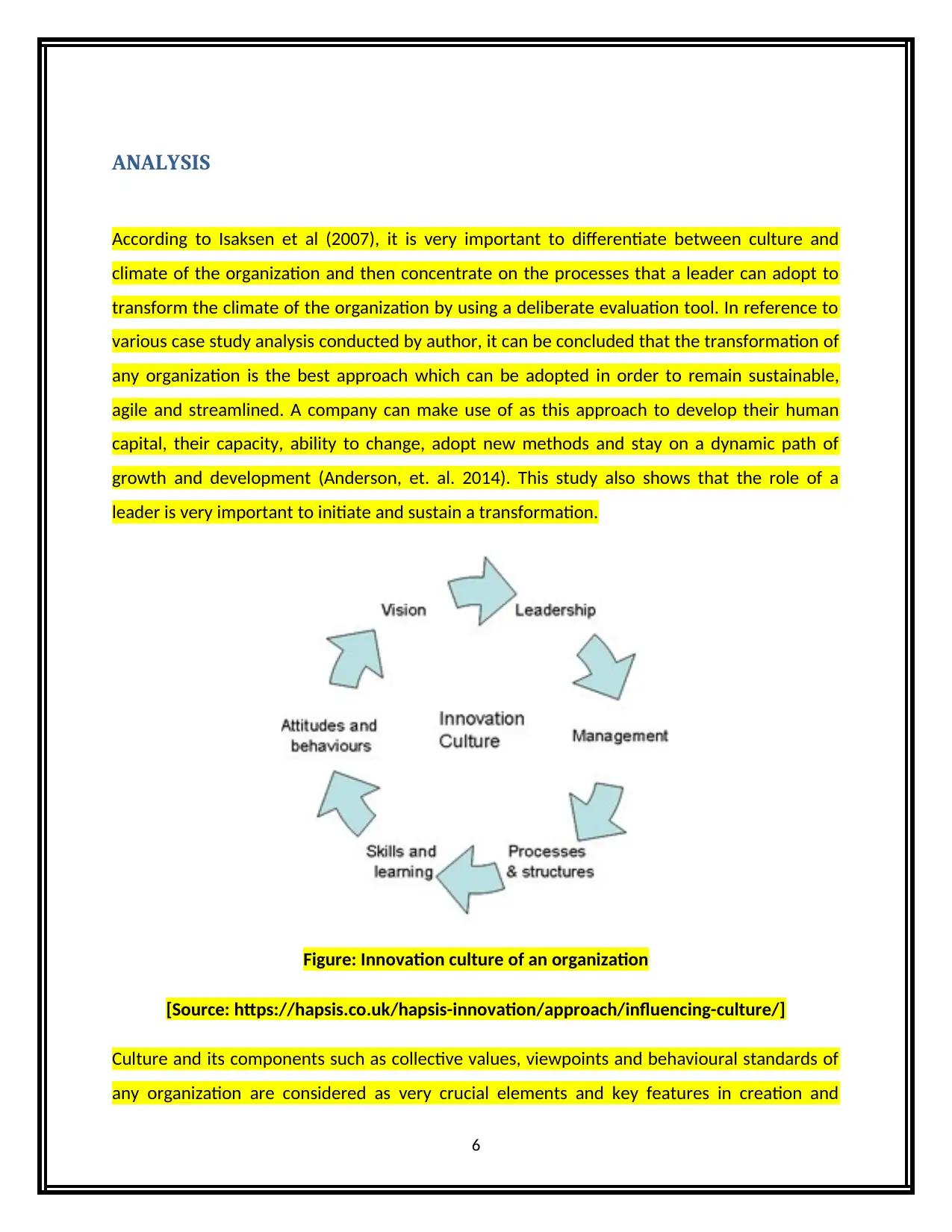
According to Isaksen et al (2007), it is very important to differentiate between culture and
climate of the organization and then concentrate on the processes that a leader can adopt to
transform the climate of the organization by using a deliberate evaluation tool. In reference to
various case study analysis conducted by author, it can be concluded that the transformation of
any organization is the best approach which can be adopted in order to remain sustainable,
agile and streamlined. A company can make use of as this approach to develop their human
capital, their capacity, ability to change, adopt new methods and stay on a dynamic path of
growth and development (Anderson, et. al. 2014). This study also shows that the role of a
leader is very important to initiate and sustain a transformation.
Figure: Innovation culture of an organization
[Source: https://hapsis.co.uk/hapsis-innovation/approach/influencing-culture/]
Culture and its components such as collective values, viewpoints and behavioural standards of
any organization are considered as very crucial elements and key features in creation and
6
According to Isaksen et al (2007), it is very important to differentiate between culture and
climate of the organization and then concentrate on the processes that a leader can adopt to
transform the climate of the organization by using a deliberate evaluation tool. In reference to
various case study analysis conducted by author, it can be concluded that the transformation of
any organization is the best approach which can be adopted in order to remain sustainable,
agile and streamlined. A company can make use of as this approach to develop their human
capital, their capacity, ability to change, adopt new methods and stay on a dynamic path of
growth and development (Anderson, et. al. 2014). This study also shows that the role of a
leader is very important to initiate and sustain a transformation.
Figure: Innovation culture of an organization
[Source: https://hapsis.co.uk/hapsis-innovation/approach/influencing-culture/]
Culture and its components such as collective values, viewpoints and behavioural standards of
any organization are considered as very crucial elements and key features in creation and
6
⊘ This is a preview!⊘
Do you want full access?
Subscribe today to unlock all pages.
Trusted by 1+ million students worldwide
execution of new and valuable ideas (Morris, et. al. 2010). Successful innovative organizations
such as Google have a cultural tendency which is focused on values and standards that support
the creation and execution of novel ideas (West and Sacramento, 2012). Some of these
standards and norms are focusing on creation of ideas, encouraging an uninterrupted learning.
These norms will develop a culture of innovation and creativity, calculated risk taking,
encouraging transformations at a low as well as high level; developing team spirit and
coordinated work approach, empowerment of employees (Isaksen and Akkermans, 2011).
Along with positive impacts of promoting creativity and innovation in an organization, there are
also some pitfalls that should be avoided such as giving under importance to individual
liabilities, concentrating very less or not at all on quantitative objectives and finances or
spending important resources on objectives which might jeopardize the existence of a
company.
Many organizations faces challenges to sustain creativity and innovation and one of these
challenges is that managers are not clear with proper handling, maintaining, motivating,
supporting and nourishment of creativity and innovation. With these unclear perceptions and
understanding of managers, organisations enthusiastically aspirant of creativity and innovation
remain unsuccessful to transform even with suitable management approaches and consistent
HR practices (Chen, et. al. 2010).
According to Amabile (1997), Employees of an organization are the elements that make the
organization to achieve the creativity and innovation. The organizational climate affects the
behaviour, creativity and innovation. The internal motivation is a key factor that influences the
creative behaviour of employees. The conceptual model designed by Amabile, et. al. (1996) is
used to assess the working environment for creativity and it also explains that how diverse
characteristics of the working conditions of the organization affects the insights of the work of
employees and their inventiveness.
7
such as Google have a cultural tendency which is focused on values and standards that support
the creation and execution of novel ideas (West and Sacramento, 2012). Some of these
standards and norms are focusing on creation of ideas, encouraging an uninterrupted learning.
These norms will develop a culture of innovation and creativity, calculated risk taking,
encouraging transformations at a low as well as high level; developing team spirit and
coordinated work approach, empowerment of employees (Isaksen and Akkermans, 2011).
Along with positive impacts of promoting creativity and innovation in an organization, there are
also some pitfalls that should be avoided such as giving under importance to individual
liabilities, concentrating very less or not at all on quantitative objectives and finances or
spending important resources on objectives which might jeopardize the existence of a
company.
Many organizations faces challenges to sustain creativity and innovation and one of these
challenges is that managers are not clear with proper handling, maintaining, motivating,
supporting and nourishment of creativity and innovation. With these unclear perceptions and
understanding of managers, organisations enthusiastically aspirant of creativity and innovation
remain unsuccessful to transform even with suitable management approaches and consistent
HR practices (Chen, et. al. 2010).
According to Amabile (1997), Employees of an organization are the elements that make the
organization to achieve the creativity and innovation. The organizational climate affects the
behaviour, creativity and innovation. The internal motivation is a key factor that influences the
creative behaviour of employees. The conceptual model designed by Amabile, et. al. (1996) is
used to assess the working environment for creativity and it also explains that how diverse
characteristics of the working conditions of the organization affects the insights of the work of
employees and their inventiveness.
7
Paraphrase This Document
Need a fresh take? Get an instant paraphrase of this document with our AI Paraphraser
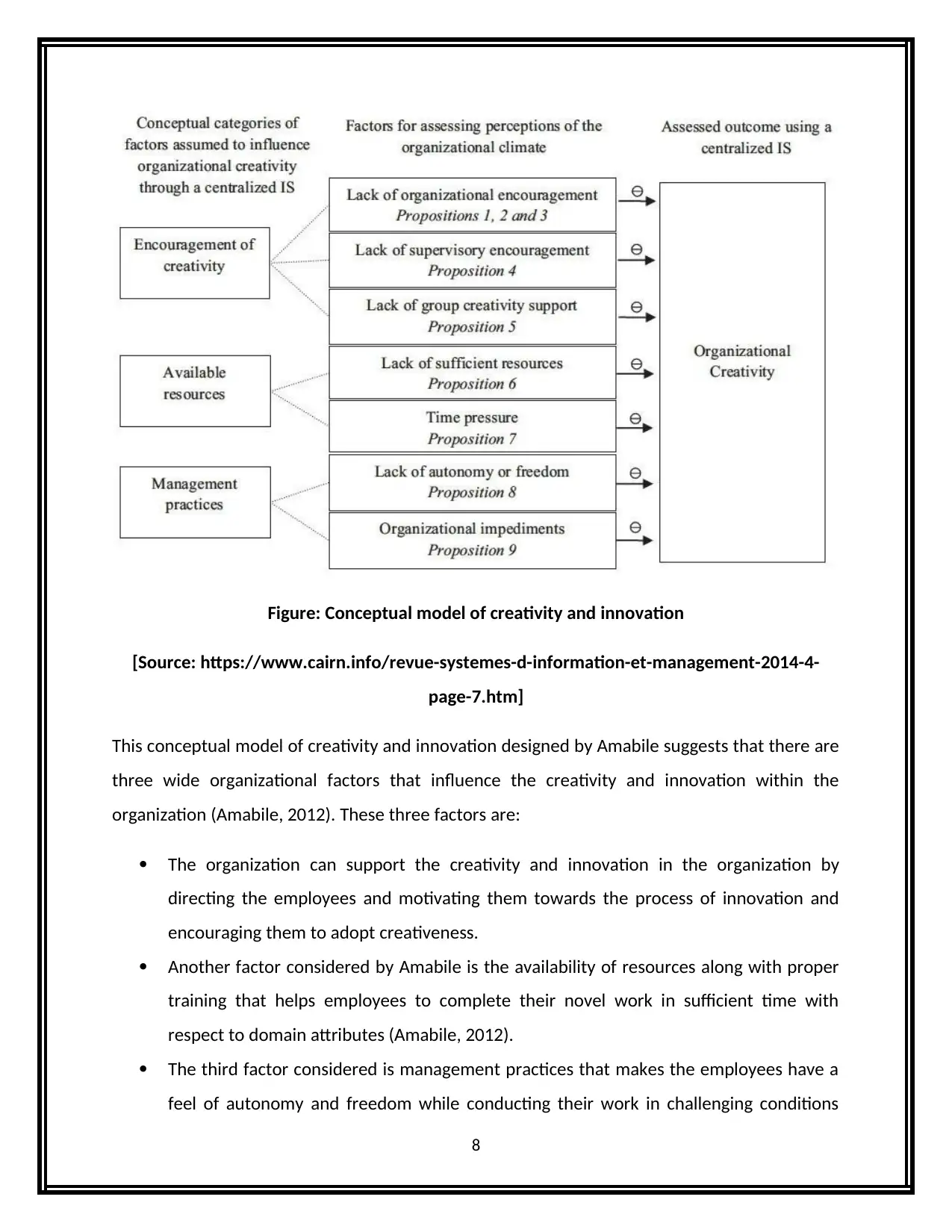
Figure: Conceptual model of creativity and innovation
[Source: https://www.cairn.info/revue-systemes-d-information-et-management-2014-4-
page-7.htm]
This conceptual model of creativity and innovation designed by Amabile suggests that there are
three wide organizational factors that influence the creativity and innovation within the
organization (Amabile, 2012). These three factors are:
The organization can support the creativity and innovation in the organization by
directing the employees and motivating them towards the process of innovation and
encouraging them to adopt creativeness.
Another factor considered by Amabile is the availability of resources along with proper
training that helps employees to complete their novel work in sufficient time with
respect to domain attributes (Amabile, 2012).
The third factor considered is management practices that makes the employees have a
feel of autonomy and freedom while conducting their work in challenging conditions
8
[Source: https://www.cairn.info/revue-systemes-d-information-et-management-2014-4-
page-7.htm]
This conceptual model of creativity and innovation designed by Amabile suggests that there are
three wide organizational factors that influence the creativity and innovation within the
organization (Amabile, 2012). These three factors are:
The organization can support the creativity and innovation in the organization by
directing the employees and motivating them towards the process of innovation and
encouraging them to adopt creativeness.
Another factor considered by Amabile is the availability of resources along with proper
training that helps employees to complete their novel work in sufficient time with
respect to domain attributes (Amabile, 2012).
The third factor considered is management practices that makes the employees have a
feel of autonomy and freedom while conducting their work in challenging conditions
8
and fascinating tasks with the choice of team that will share a same goal and diverse
skills.
Griffin, Sawyer and Woodman adopted this conceptual model of Amabile and redesigned it
with two extra factors which are external and affect the innovation and creativity of the
organization. One of these two factors is concerned with the group characteristics such as
approaches adopted to solve the problems, characteristics of work, employee roles, diversity of
the project, size of the project, cohesiveness of team and related norms. The other factor is
concerned with the organizational characteristics such as culture, resources, focus on
technology, strategies, structure, and rewards (Woodman, et. al. 2014).
As the first scenario of the Company A suggests, it adopted creativity and innovation but the
strategy resulted in the small pockets of innovation rather than the application of creativity and
innovation in the whole organization. This situation might have resolved with the proper
application of the conceptual model. The main problem that was hindering the innovation and
creativity of the organization was that the organization was not clear about their vision and
what they actually want to do. To be creative and innovative, it is very necessary for the
organization to have a clear view with respect to their missions and visions (Woodman, et. al.
2014).
Another problem faced by the company was that it was so dependent on its employees and
their ideas. To be open for the ideas from the employees is considered as a very great
technique to motivate them towards creativity and innovation but over-dependence can cause
the organization to lose the concept of teamwork and superiority for employees (Woodman, et.
al. 2014). Company A designed SPEAR teams with the intention of finding problems in particular
department and projects and to solve those problems to gain increased productivity at
organizational level but these teams limited their work at only project and department level.
According to the case study, the results of innovation were only seen at the departmental level
and this suggests that the SPEAR teams were focused only on improving departmental level
performance. This situation might have solved with the proper application of the conceptual
model of creativity and innovation designed by Amabile. Apart from this, proper
9
skills.
Griffin, Sawyer and Woodman adopted this conceptual model of Amabile and redesigned it
with two extra factors which are external and affect the innovation and creativity of the
organization. One of these two factors is concerned with the group characteristics such as
approaches adopted to solve the problems, characteristics of work, employee roles, diversity of
the project, size of the project, cohesiveness of team and related norms. The other factor is
concerned with the organizational characteristics such as culture, resources, focus on
technology, strategies, structure, and rewards (Woodman, et. al. 2014).
As the first scenario of the Company A suggests, it adopted creativity and innovation but the
strategy resulted in the small pockets of innovation rather than the application of creativity and
innovation in the whole organization. This situation might have resolved with the proper
application of the conceptual model. The main problem that was hindering the innovation and
creativity of the organization was that the organization was not clear about their vision and
what they actually want to do. To be creative and innovative, it is very necessary for the
organization to have a clear view with respect to their missions and visions (Woodman, et. al.
2014).
Another problem faced by the company was that it was so dependent on its employees and
their ideas. To be open for the ideas from the employees is considered as a very great
technique to motivate them towards creativity and innovation but over-dependence can cause
the organization to lose the concept of teamwork and superiority for employees (Woodman, et.
al. 2014). Company A designed SPEAR teams with the intention of finding problems in particular
department and projects and to solve those problems to gain increased productivity at
organizational level but these teams limited their work at only project and department level.
According to the case study, the results of innovation were only seen at the departmental level
and this suggests that the SPEAR teams were focused only on improving departmental level
performance. This situation might have solved with the proper application of the conceptual
model of creativity and innovation designed by Amabile. Apart from this, proper
9
⊘ This is a preview!⊘
Do you want full access?
Subscribe today to unlock all pages.
Trusted by 1+ million students worldwide
implementation of creative leadership and human resource management would have resulted
in the promotion of organizational level creativity and innovation. The organizational factors
that may have encouraged employees in the first scenario can be considered as employees
having same future image, management hoping for innovative work and also adaptive to
technology, having faith in their employees. The organization might have sustained the
situation if the failures were learning objective. Organizations appreciating hard work of
employees, maintaining healthy communication and teamwork, adopting system of new ideas,
encouraging employees, supervising innovative labours are considered as very successful in
innovative methods such as Google (Woodman, et. al. 2014). But the factors such as negative
competition and criticism, avoiding the situations having risk, providing less job security to
employees, feel of laziness, rigid procedures affects the organizations to enhance their
innovation and creativity and some of these were the factors that resulted in the takeover of
Company A.
This suggests that a more passionate approach to promoting creativity and innovation that
would not only have focused on the departmental level but at the organizational level might
have helped the organization to sustain with the constant innovation and development, and
also have barred the requirement for the takeover. This can be more explained with the
following conceptual model that describes that the company A should have focused on both
the levels individual as well as an organization while applying innovation and creativity to the
organization.
10
in the promotion of organizational level creativity and innovation. The organizational factors
that may have encouraged employees in the first scenario can be considered as employees
having same future image, management hoping for innovative work and also adaptive to
technology, having faith in their employees. The organization might have sustained the
situation if the failures were learning objective. Organizations appreciating hard work of
employees, maintaining healthy communication and teamwork, adopting system of new ideas,
encouraging employees, supervising innovative labours are considered as very successful in
innovative methods such as Google (Woodman, et. al. 2014). But the factors such as negative
competition and criticism, avoiding the situations having risk, providing less job security to
employees, feel of laziness, rigid procedures affects the organizations to enhance their
innovation and creativity and some of these were the factors that resulted in the takeover of
Company A.
This suggests that a more passionate approach to promoting creativity and innovation that
would not only have focused on the departmental level but at the organizational level might
have helped the organization to sustain with the constant innovation and development, and
also have barred the requirement for the takeover. This can be more explained with the
following conceptual model that describes that the company A should have focused on both
the levels individual as well as an organization while applying innovation and creativity to the
organization.
10
Paraphrase This Document
Need a fresh take? Get an instant paraphrase of this document with our AI Paraphraser
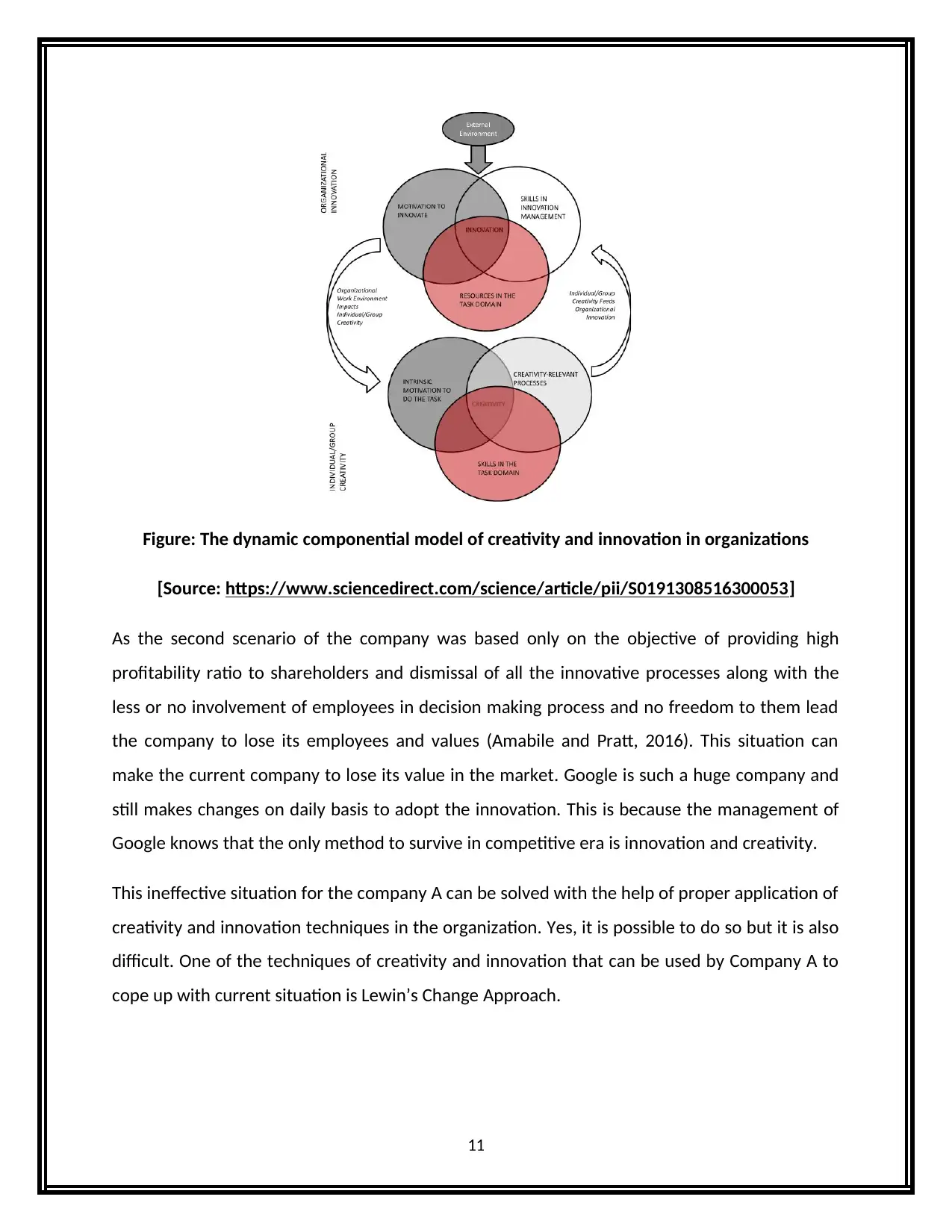
Figure: The dynamic componential model of creativity and innovation in organizations
[Source: https://www.sciencedirect.com/science/article/pii/S0191308516300053]
As the second scenario of the company was based only on the objective of providing high
profitability ratio to shareholders and dismissal of all the innovative processes along with the
less or no involvement of employees in decision making process and no freedom to them lead
the company to lose its employees and values (Amabile and Pratt, 2016). This situation can
make the current company to lose its value in the market. Google is such a huge company and
still makes changes on daily basis to adopt the innovation. This is because the management of
Google knows that the only method to survive in competitive era is innovation and creativity.
This ineffective situation for the company A can be solved with the help of proper application of
creativity and innovation techniques in the organization. Yes, it is possible to do so but it is also
difficult. One of the techniques of creativity and innovation that can be used by Company A to
cope up with current situation is Lewin’s Change Approach.
11
[Source: https://www.sciencedirect.com/science/article/pii/S0191308516300053]
As the second scenario of the company was based only on the objective of providing high
profitability ratio to shareholders and dismissal of all the innovative processes along with the
less or no involvement of employees in decision making process and no freedom to them lead
the company to lose its employees and values (Amabile and Pratt, 2016). This situation can
make the current company to lose its value in the market. Google is such a huge company and
still makes changes on daily basis to adopt the innovation. This is because the management of
Google knows that the only method to survive in competitive era is innovation and creativity.
This ineffective situation for the company A can be solved with the help of proper application of
creativity and innovation techniques in the organization. Yes, it is possible to do so but it is also
difficult. One of the techniques of creativity and innovation that can be used by Company A to
cope up with current situation is Lewin’s Change Approach.
11
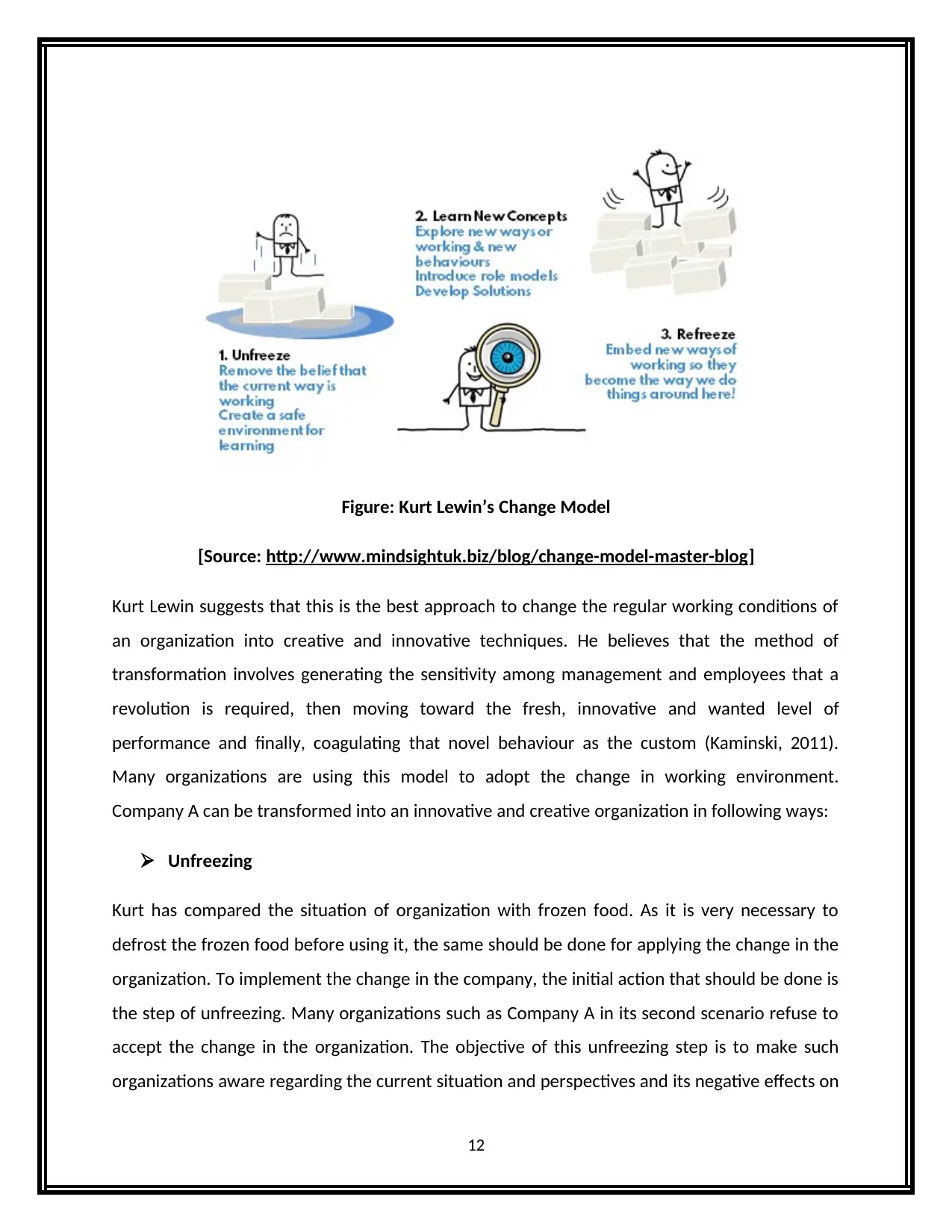
Figure: Kurt Lewin’s Change Model
[Source: http://www.mindsightuk.biz/blog/change-model-master-blog]
Kurt Lewin suggests that this is the best approach to change the regular working conditions of
an organization into creative and innovative techniques. He believes that the method of
transformation involves generating the sensitivity among management and employees that a
revolution is required, then moving toward the fresh, innovative and wanted level of
performance and finally, coagulating that novel behaviour as the custom (Kaminski, 2011).
Many organizations are using this model to adopt the change in working environment.
Company A can be transformed into an innovative and creative organization in following ways:
Unfreezing
Kurt has compared the situation of organization with frozen food. As it is very necessary to
defrost the frozen food before using it, the same should be done for applying the change in the
organization. To implement the change in the company, the initial action that should be done is
the step of unfreezing. Many organizations such as Company A in its second scenario refuse to
accept the change in the organization. The objective of this unfreezing step is to make such
organizations aware regarding the current situation and perspectives and its negative effects on
12
[Source: http://www.mindsightuk.biz/blog/change-model-master-blog]
Kurt Lewin suggests that this is the best approach to change the regular working conditions of
an organization into creative and innovative techniques. He believes that the method of
transformation involves generating the sensitivity among management and employees that a
revolution is required, then moving toward the fresh, innovative and wanted level of
performance and finally, coagulating that novel behaviour as the custom (Kaminski, 2011).
Many organizations are using this model to adopt the change in working environment.
Company A can be transformed into an innovative and creative organization in following ways:
Unfreezing
Kurt has compared the situation of organization with frozen food. As it is very necessary to
defrost the frozen food before using it, the same should be done for applying the change in the
organization. To implement the change in the company, the initial action that should be done is
the step of unfreezing. Many organizations such as Company A in its second scenario refuse to
accept the change in the organization. The objective of this unfreezing step is to make such
organizations aware regarding the current situation and perspectives and its negative effects on
12
⊘ This is a preview!⊘
Do you want full access?
Subscribe today to unlock all pages.
Trusted by 1+ million students worldwide

1 out of 20


Related Documents


Your All-in-One AI-Powered Toolkit for Academic Success.
+13062052269
info@desklib.com
Available 24*7 on WhatsApp / Email
![[object Object]](/_next/static/media/star-bottom.7253800d.svg)
Unlock your academic potential
Copyright © 2020–2026 A2Z Services. All Rights Reserved. Developed and managed by ZUCOL.