Literature Review: Corporate Philanthropy, Conglomerates, and CSR
VerifiedAdded on 2021/04/19
|26
|7073
|21
Literature Review
AI Summary
This literature review explores the multifaceted world of corporate philanthropy and its intricate relationship with conglomerate companies. It begins by examining the decline in philanthropic involvement by U.S. conglomerates and its impact on non-profit organizations. The review provides a conceptual framework, delves into the legitimacy of corporate philanthropy, and analyzes the debates surrounding Corporate Social Responsibility (CSR) and philanthropy. It identifies five key types of corporate philanthropy that non-profits should focus on, including matching gifts, volunteer grants, challenge grants, automatic payroll deductions, and fundraise matches. The review then explores the structure and strategies of conglomerates, highlighting their business diversification, global market approaches, and competitive nature. Political, integrative, and ethical theories related to CSR are discussed, emphasizing the importance of incorporating social demands and values for business growth. The review concludes by summarizing the key findings and implications of corporate philanthropy in the context of conglomerate companies and their strategies, offering insights into how businesses can effectively engage in philanthropic activities while achieving their goals.

Running head: LITERATURE REVIEW
Literature review
Name of the Student
Name of the University
Author note
Literature review
Name of the Student
Name of the University
Author note

Paraphrase This Document
Need a fresh take? Get an instant paraphrase of this document with our AI Paraphraser
1LITERATURE REVIEW
Table of Contents
Literature view...........................................................................................................................2
Introduction:...........................................................................................................................2
Conceptual framework...........................................................................................................2
Legitimacy of Corporate Philanthropy:.................................................................................2
Corporate Social Responsibility and Philanthropy debate:....................................................3
5 types of corporate philanthropy non-profits should focus on.............................................5
Understanding conglomerates................................................................................................8
Strategies of conglomerate companies in business diversification........................................9
Making a local brand global.............................................................................................10
Redirecting to the local engineering skills.......................................................................10
Global leadership in contracted product category............................................................11
Usage of natural resources...............................................................................................11
Application of specific business model............................................................................11
Competitive nature of conglomerate companies in the emerging market............................12
Political theories emphasizing the social power along with related corporation duty.........12
Needs of the business for incorporating the social demands along with social values for the
sake of growth and endurance..............................................................................................14
Ethical theories focusing on the normative questions of the relationship between society
and business.........................................................................................................................16
Conclusion............................................................................................................................18
Table of Contents
Literature view...........................................................................................................................2
Introduction:...........................................................................................................................2
Conceptual framework...........................................................................................................2
Legitimacy of Corporate Philanthropy:.................................................................................2
Corporate Social Responsibility and Philanthropy debate:....................................................3
5 types of corporate philanthropy non-profits should focus on.............................................5
Understanding conglomerates................................................................................................8
Strategies of conglomerate companies in business diversification........................................9
Making a local brand global.............................................................................................10
Redirecting to the local engineering skills.......................................................................10
Global leadership in contracted product category............................................................11
Usage of natural resources...............................................................................................11
Application of specific business model............................................................................11
Competitive nature of conglomerate companies in the emerging market............................12
Political theories emphasizing the social power along with related corporation duty.........12
Needs of the business for incorporating the social demands along with social values for the
sake of growth and endurance..............................................................................................14
Ethical theories focusing on the normative questions of the relationship between society
and business.........................................................................................................................16
Conclusion............................................................................................................................18

2LITERATURE REVIEW
References................................................................................................................................19
References................................................................................................................................19
⊘ This is a preview!⊘
Do you want full access?
Subscribe today to unlock all pages.

Trusted by 1+ million students worldwide
3LITERATURE REVIEW
Literature view
Introduction:
This section would take into account the declining factor of philanthropic
involvement by the U.S. conglomerate in the year 2016 along with the unfavourable impact it
will have on the non-profits. The year 2016 witnessed a drop of 50 per cent in the profit of
the company related to corporate philanthropy (Phaholyothin 2017). Corporate Philanthropy
has been influential to the survival of the non-profit organization along with the competitive
positioning of the companies. USA has been measured in being the top country related to
corporate philanthropy.
Conceptual framework
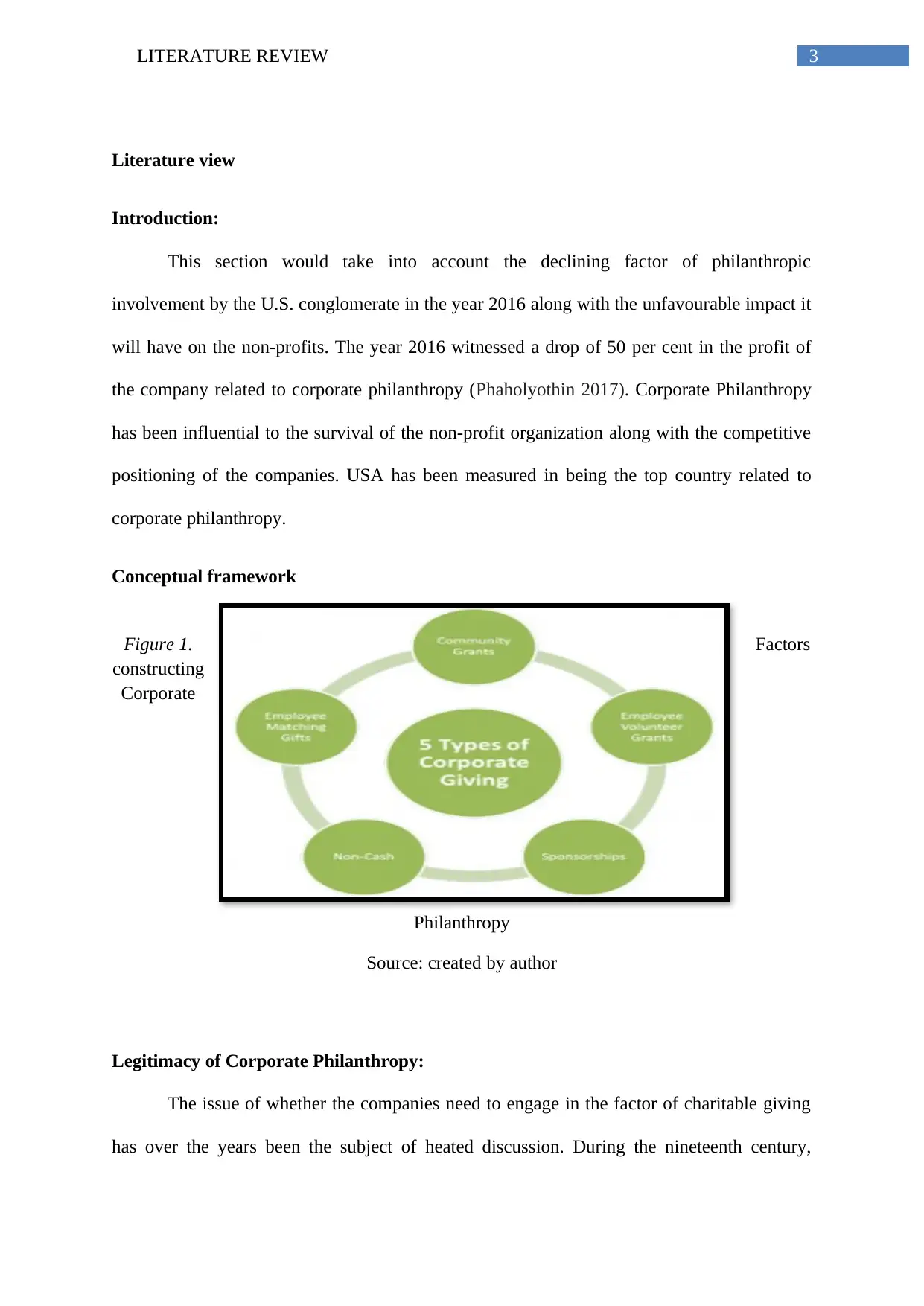
Figure 1. Factors
constructing
Corporate
Philanthropy
Source: created by author
Legitimacy of Corporate Philanthropy:
The issue of whether the companies need to engage in the factor of charitable giving
has over the years been the subject of heated discussion. During the nineteenth century,
Literature view
Introduction:
This section would take into account the declining factor of philanthropic
involvement by the U.S. conglomerate in the year 2016 along with the unfavourable impact it
will have on the non-profits. The year 2016 witnessed a drop of 50 per cent in the profit of
the company related to corporate philanthropy (Phaholyothin 2017). Corporate Philanthropy
has been influential to the survival of the non-profit organization along with the competitive
positioning of the companies. USA has been measured in being the top country related to
corporate philanthropy.
Conceptual framework
Figure 1. Factors
constructing
Corporate
Philanthropy
Source: created by author
Legitimacy of Corporate Philanthropy:
The issue of whether the companies need to engage in the factor of charitable giving
has over the years been the subject of heated discussion. During the nineteenth century,
Paraphrase This Document
Need a fresh take? Get an instant paraphrase of this document with our AI Paraphraser
4LITERATURE REVIEW
various rulings of the court delivered the usage of the corporate funds for the purposes of
charity efficiently illegal (Szőcs et al., 2016). The Proprietors of the Charles River ridge v.
Proprietors of the Warren Bridge case proscribed the exercise of the corporate funds for the
activities incongruent to the employed aims of the association that facilitated stockholders in
suing their organization for such act of ‘ultra vires’.
Nevertheless, corporations have made an attempt in justifying their contributions
towards libraries, schools, YMCA amenities in company towns as a strategy of recruiting
employee. During the times of economic downturns towards the end of the nineteenth
century, associations gradually more began contributing funds to the purposes of charity, and
were competent in defending themselves against the ultra vires claims of the stockholders in
courtroom by arguing that these were legitimately related to business, as they were directly
benefiting the employees (Szőcs et al., 2016).
Debates have been there, both within the courtrooms as well as in the general
dialogue, about the legitimacy of such corporate philanthropic that has continued into the
twentieth century (Jones, Willness & Madey, 2014). These were moreover fashioned by
various conflicting forces: a sentiment of anti0business within some contexts that rejected the
donations of the corporations as being tainted, the pervasiveness of laissez-faire arguments
asserting that it is immoral for the associations in giving away the money of the stakeholders.
Adding to that will be the increased examination of the corporate activities as ultra vires.
Corporate Social Responsibility and Philanthropy debate:
It has been argued by some that corporate philanthropy has essentially been an
‘agency cost’ that has the ability in bringing advantages to the individual executives along
with the managers through development of their personal reputations or prospects for
encroachment, however this generally comes at the cost of the wealth of the stakeholders.
various rulings of the court delivered the usage of the corporate funds for the purposes of
charity efficiently illegal (Szőcs et al., 2016). The Proprietors of the Charles River ridge v.
Proprietors of the Warren Bridge case proscribed the exercise of the corporate funds for the
activities incongruent to the employed aims of the association that facilitated stockholders in
suing their organization for such act of ‘ultra vires’.
Nevertheless, corporations have made an attempt in justifying their contributions
towards libraries, schools, YMCA amenities in company towns as a strategy of recruiting
employee. During the times of economic downturns towards the end of the nineteenth
century, associations gradually more began contributing funds to the purposes of charity, and
were competent in defending themselves against the ultra vires claims of the stockholders in
courtroom by arguing that these were legitimately related to business, as they were directly
benefiting the employees (Szőcs et al., 2016).
Debates have been there, both within the courtrooms as well as in the general
dialogue, about the legitimacy of such corporate philanthropic that has continued into the
twentieth century (Jones, Willness & Madey, 2014). These were moreover fashioned by
various conflicting forces: a sentiment of anti0business within some contexts that rejected the
donations of the corporations as being tainted, the pervasiveness of laissez-faire arguments
asserting that it is immoral for the associations in giving away the money of the stakeholders.
Adding to that will be the increased examination of the corporate activities as ultra vires.
Corporate Social Responsibility and Philanthropy debate:
It has been argued by some that corporate philanthropy has essentially been an
‘agency cost’ that has the ability in bringing advantages to the individual executives along
with the managers through development of their personal reputations or prospects for
encroachment, however this generally comes at the cost of the wealth of the stakeholders.
5LITERATURE REVIEW
Several responses materialized, sharing the assurance about the possibility of justifying the
corporate social responsibility notion.
In mapping out of the landscape of the literature, El Ghoul, Guedhami and Kim
(2017), recognized four main advancements to the subject, each of which has been pertinent
to the topic of ‘corporate philanthropy’: a. Instrumental theories where the activities of CSR
are being observed as influential to creation of wealth which is strategic philanthropy; b.
Political theories emphasizing the social power along with related corporation duty; c.
Integrative theories arguing the needs of the business for incorporating the social demands
along with social values for the sake of growth and endurance and d. Ethical theories
focusing on the normative questions of the relationship between society and business.
However, all this notions are being defined clearly in the literature. For instance, some
equate the corporate nationality with strategic philanthropy with others considering the
strategic CSR as being dissimilar from the CSR uses(Grant, 2016). It highlights the
‘competitive advantage’ of CSR, disagreeing on the instrumental advancements like the
cause-related marketing that they sustain needs to be assessed as marketing and not as
philanthropy.
Likewise, another concept that cuts across these segments is the apprehension with
looking beyond the financial accountability to the shareholders and mulling over the
relationship of the company with several stakeholders, inclusive of the employees, local
communities, media, customers along with the government (Blowfield and Murray 2014).
The stakeholder theory takes into account the extent of corporate responsibility in
emphasizing the significance of satisfying the multiple stakeholders group. Scholars who
have been working along this vein have been insisting on the needs of the corporation for
assuming the responsibility for all the varied constituents and being committed towards
Several responses materialized, sharing the assurance about the possibility of justifying the
corporate social responsibility notion.
In mapping out of the landscape of the literature, El Ghoul, Guedhami and Kim
(2017), recognized four main advancements to the subject, each of which has been pertinent
to the topic of ‘corporate philanthropy’: a. Instrumental theories where the activities of CSR
are being observed as influential to creation of wealth which is strategic philanthropy; b.
Political theories emphasizing the social power along with related corporation duty; c.
Integrative theories arguing the needs of the business for incorporating the social demands
along with social values for the sake of growth and endurance and d. Ethical theories
focusing on the normative questions of the relationship between society and business.
However, all this notions are being defined clearly in the literature. For instance, some
equate the corporate nationality with strategic philanthropy with others considering the
strategic CSR as being dissimilar from the CSR uses(Grant, 2016). It highlights the
‘competitive advantage’ of CSR, disagreeing on the instrumental advancements like the
cause-related marketing that they sustain needs to be assessed as marketing and not as
philanthropy.
Likewise, another concept that cuts across these segments is the apprehension with
looking beyond the financial accountability to the shareholders and mulling over the
relationship of the company with several stakeholders, inclusive of the employees, local
communities, media, customers along with the government (Blowfield and Murray 2014).
The stakeholder theory takes into account the extent of corporate responsibility in
emphasizing the significance of satisfying the multiple stakeholders group. Scholars who
have been working along this vein have been insisting on the needs of the corporation for
assuming the responsibility for all the varied constituents and being committed towards
⊘ This is a preview!⊘
Do you want full access?
Subscribe today to unlock all pages.
Trusted by 1+ million students worldwide
6LITERATURE REVIEW
society’s well-being. However, not all the scholars are sold on this substance. Some have
been contend with the fact that despite its connection with corporate philanthropy and social
responsibility, in reality, the stakeholder theory offers little regulation to the decisions of CSR
beyond the maximization of the shareholders; however, it has no recommendation for ways
of balancing the competing liabilities(Cheng, Lin & Wong, 2016). According to Drucker, for
converting its social responsibilities into responsibilities of the business, corporations need to
seek to roll a social issue into economic prospect along with the economic benefit into the
capacity of productivity and well paid jobs.
Even Friedman, despite being critique of the doctrine of social responsibility as being
the harmful to the society that is free, admitting the fact that the companies need to invest
resources within the local community for attracting better employees (Grant, 2016).
Institutional pressures generally play a significant role with the corporate executives finding
themselves progressively more under the hammer from several stakeholders like the activists,
governments, media consumers and certain other corporations.
5 types of corporate philanthropy non-profits should focus on
a. Matching gifts:
Matching gifts are stated to be an easy thing to acquire, though it has been a shame
that most of the non-profits do not seek them. A program of matching gift is an outline of
corporate giving that has been letting the employees decide on the ways their employer
facilitates funds related to corporate philanthropic (Jones, Willness & Madey, 2014). With
such kind of programs, an employer will be able to match the donation of the employees to
the suitable organizations.
society’s well-being. However, not all the scholars are sold on this substance. Some have
been contend with the fact that despite its connection with corporate philanthropy and social
responsibility, in reality, the stakeholder theory offers little regulation to the decisions of CSR
beyond the maximization of the shareholders; however, it has no recommendation for ways
of balancing the competing liabilities(Cheng, Lin & Wong, 2016). According to Drucker, for
converting its social responsibilities into responsibilities of the business, corporations need to
seek to roll a social issue into economic prospect along with the economic benefit into the
capacity of productivity and well paid jobs.
Even Friedman, despite being critique of the doctrine of social responsibility as being
the harmful to the society that is free, admitting the fact that the companies need to invest
resources within the local community for attracting better employees (Grant, 2016).
Institutional pressures generally play a significant role with the corporate executives finding
themselves progressively more under the hammer from several stakeholders like the activists,
governments, media consumers and certain other corporations.
5 types of corporate philanthropy non-profits should focus on
a. Matching gifts:
Matching gifts are stated to be an easy thing to acquire, though it has been a shame
that most of the non-profits do not seek them. A program of matching gift is an outline of
corporate giving that has been letting the employees decide on the ways their employer
facilitates funds related to corporate philanthropic (Jones, Willness & Madey, 2014). With
such kind of programs, an employer will be able to match the donation of the employees to
the suitable organizations.
Paraphrase This Document
Need a fresh take? Get an instant paraphrase of this document with our AI Paraphraser
7LITERATURE REVIEW
b. Volunteer Grants:
Employers are in the habit of rewarding their employees for their part of volunteerism
via the volunteer grants. It is also known as the dollars for doers, these programs of corporate
philanthropy let the associations donate to the organizations where the employees volunteer
time. Companies generally distribute a specified amount of funding based on the amount of
hours that has been spending in volunteering.
c. Challenge Grants:
Challenge grants are stated to be a challenge constituent. For receiving of a challenge
grant, a non-profit organization needs to grant making party for earning the funds upon
achievement of a formerly precise task(Cheng, Lin & Wong, 2016). In practical sense, this
signifies the fact that organizations need to agree in reaching certain goals for raising of funds
within a certain specified amount before it is being received as it has been promised but most
of the businesses analyze challenge grants as ways of encouraging the non-profits in going
out and raising the extra funds for going along with the contribution of the corporate.
d. Automatic payroll deductions
There are ample of bonuses for fundraising when they are set up, but at times it
appears to be difficult than some other options to keep it secure(El Ghoul, Guedhami & Kim,
2017). There are various business organizations who offer their workforces to donate a
specified or already set amount of their salary as a form of charity. In most cases these types
of deductions are automatic and thus the employees and the non-profit organizations would
not have to think regarding the procedure. It can be said that if the management of the
business organizations encourage the workforce or the donors to spend a small parentage of
their salary for charity, it can significantly increase the efforts of the organization to raise
b. Volunteer Grants:
Employers are in the habit of rewarding their employees for their part of volunteerism
via the volunteer grants. It is also known as the dollars for doers, these programs of corporate
philanthropy let the associations donate to the organizations where the employees volunteer
time. Companies generally distribute a specified amount of funding based on the amount of
hours that has been spending in volunteering.
c. Challenge Grants:
Challenge grants are stated to be a challenge constituent. For receiving of a challenge
grant, a non-profit organization needs to grant making party for earning the funds upon
achievement of a formerly precise task(Cheng, Lin & Wong, 2016). In practical sense, this
signifies the fact that organizations need to agree in reaching certain goals for raising of funds
within a certain specified amount before it is being received as it has been promised but most
of the businesses analyze challenge grants as ways of encouraging the non-profits in going
out and raising the extra funds for going along with the contribution of the corporate.
d. Automatic payroll deductions
There are ample of bonuses for fundraising when they are set up, but at times it
appears to be difficult than some other options to keep it secure(El Ghoul, Guedhami & Kim,
2017). There are various business organizations who offer their workforces to donate a
specified or already set amount of their salary as a form of charity. In most cases these types
of deductions are automatic and thus the employees and the non-profit organizations would
not have to think regarding the procedure. It can be said that if the management of the
business organizations encourage the workforce or the donors to spend a small parentage of
their salary for charity, it can significantly increase the efforts of the organization to raise
8LITERATURE REVIEW
funds. To find out the business corporations to check the deductions in payrolls an effective
screening of the loyal depositor or donors and continuous updating the information of the
employees should be performed (Jones, Willness & Madey, 2014). The key would be to find
out that how many organizations are there that have workforce who support such initiatives
and do those organizations have such deduction system. This might be a good option to
initiate such activities when some business organizations can make a list of the employees
who are willing to participate in such programs.
e. Fundraise matches
It is widely accepted that the participatory medals that the employees or the business
organizations receive for initiating and carrying out such charitable programs are one of the
most important and exciting awards to receive. Thu it can be said that there is such a trophy
or award named fundraising match and this can boost the mentality of the individuals to take
part in such programs. The majority of the business organizations carry out fundraising
matches in two possible ways. According to Bereskin, Campbell and Hsu (2016),some of the
organizations offer a grant amount for each activity of the employees in such programs. On
the other hand, other business organization’s managements sometimes donate equal or greater
value of on fund raised by the workforce of that particular company. In today’s world, almost
5% of the United States based money as charity comes from the business corporations. Such
business organizations have the needed resources and financial stability to help the
organizations (Grant, 2016). There are some business organizations who arrange specific
programs to make a significant difference nationally, locally and globally and such
behaviours project their wish to help the society(El Ghoul, Guedhami & Kim, 2017). If an
individual considers his or her organization to become focused on growth, they should utilize
all the necessary tools to raise more funds where the initiatives regarding corporate
funds. To find out the business corporations to check the deductions in payrolls an effective
screening of the loyal depositor or donors and continuous updating the information of the
employees should be performed (Jones, Willness & Madey, 2014). The key would be to find
out that how many organizations are there that have workforce who support such initiatives
and do those organizations have such deduction system. This might be a good option to
initiate such activities when some business organizations can make a list of the employees
who are willing to participate in such programs.
e. Fundraise matches
It is widely accepted that the participatory medals that the employees or the business
organizations receive for initiating and carrying out such charitable programs are one of the
most important and exciting awards to receive. Thu it can be said that there is such a trophy
or award named fundraising match and this can boost the mentality of the individuals to take
part in such programs. The majority of the business organizations carry out fundraising
matches in two possible ways. According to Bereskin, Campbell and Hsu (2016),some of the
organizations offer a grant amount for each activity of the employees in such programs. On
the other hand, other business organization’s managements sometimes donate equal or greater
value of on fund raised by the workforce of that particular company. In today’s world, almost
5% of the United States based money as charity comes from the business corporations. Such
business organizations have the needed resources and financial stability to help the
organizations (Grant, 2016). There are some business organizations who arrange specific
programs to make a significant difference nationally, locally and globally and such
behaviours project their wish to help the society(El Ghoul, Guedhami & Kim, 2017). If an
individual considers his or her organization to become focused on growth, they should utilize
all the necessary tools to raise more funds where the initiatives regarding corporate
⊘ This is a preview!⊘
Do you want full access?
Subscribe today to unlock all pages.
Trusted by 1+ million students worldwide
9LITERATURE REVIEW
philanthropy in involved. The non-profit organizations need to grab the opportunities that this
big business corporations provide in order to increase the amount of 5%.
Understanding conglomerates
The conglomerates actually represent the business organizations that are engaged in
various businesses. It is widely accepted that these organizations are multi-industry
organizations. In short it can be said that the assets of the conglomerate are used to venture in
various types of businesses that have no connection with each other (Grant, 2016). The
fundamental concept of conglomerate is to supply adequate income from all types of
businesses that can secure the operations of the newly started businesses. The idea of multi-
industrial business organizations are not relatively new as in the year of 1960 these types of
initiatives became popular.According to Bereskin, Campbell and Hsu (2016),the advantages
of doing conglomerate business are naturally long term and at times it may be important to
redefine the strategy of business utilizing new technologies. In some specific situations the
conglomerate organizations have the possibility of survival in the traditional market until an
opportunity emerges for the presence in the developed markets (Blowfield and Murray 2014).
It is a matter of fact that the conglomerate organizations are multi-industry companies that
have diversified operations and are generally owned by the investors and the founder
member. These organizations receive huge support from the government and are enriched by
using the network organizations under their conglomerate and enjoy easy access to the
knowledge and the market of capitol. In this regard it can be said that Arcelik is a major
Turkish manufacturing business organization that manufactures household appliances and
they are under a major conglomerate KOC group operating in Turkey. This organization is a
publicly owned organization and they have the right to issue or sell bonds and shares of the
organization in the stock market(Robertson & Upton, 2017). Usually the securities of the
business organization which are traded are certainly the property of the various investors.
philanthropy in involved. The non-profit organizations need to grab the opportunities that this
big business corporations provide in order to increase the amount of 5%.
Understanding conglomerates
The conglomerates actually represent the business organizations that are engaged in
various businesses. It is widely accepted that these organizations are multi-industry
organizations. In short it can be said that the assets of the conglomerate are used to venture in
various types of businesses that have no connection with each other (Grant, 2016). The
fundamental concept of conglomerate is to supply adequate income from all types of
businesses that can secure the operations of the newly started businesses. The idea of multi-
industrial business organizations are not relatively new as in the year of 1960 these types of
initiatives became popular.According to Bereskin, Campbell and Hsu (2016),the advantages
of doing conglomerate business are naturally long term and at times it may be important to
redefine the strategy of business utilizing new technologies. In some specific situations the
conglomerate organizations have the possibility of survival in the traditional market until an
opportunity emerges for the presence in the developed markets (Blowfield and Murray 2014).
It is a matter of fact that the conglomerate organizations are multi-industry companies that
have diversified operations and are generally owned by the investors and the founder
member. These organizations receive huge support from the government and are enriched by
using the network organizations under their conglomerate and enjoy easy access to the
knowledge and the market of capitol. In this regard it can be said that Arcelik is a major
Turkish manufacturing business organization that manufactures household appliances and
they are under a major conglomerate KOC group operating in Turkey. This organization is a
publicly owned organization and they have the right to issue or sell bonds and shares of the
organization in the stock market(Robertson & Upton, 2017). Usually the securities of the
business organization which are traded are certainly the property of the various investors.
Paraphrase This Document
Need a fresh take? Get an instant paraphrase of this document with our AI Paraphraser
10LITERATURE REVIEW
Strategies of conglomerate companies in business diversification
The unrelated diversification of the business organizations are considered in
accordance with the destruction of values in the developed markets along with the
conventional way of thought process.According to Benn,Dunphy and Griffiths (2014), it can
be said that the similar strategy has been used for years and has produced effective results in
the markets that are emerging. According to Blowfield and Murray (2014), various studies
show that in the markets that are emerging with the presence of institutional void, the
conglomerate organizations can definitely take the advantage of the market imperfections.
Thus the diversification of the process can be looked at as a good strategy to take up in the
market that is emerging. This strategy is linked with various issues that are mentioned below;
What are the institutional factors that can positively influence the growth of the
conglomerate in the market that is emerging?
Possible alternative strategic response of adjustment of the conglomerates that have
highly diversified business ventures as a response to the institutional changes.
Recommendations for the top managers and the shareholders of the organizations.
The extent to which the institutional context change because of the economic reforms
in the nations with emerging market and is higher level of diversification in those
situation are sustainable?
In this regard it can be said that the concentration of the power is restrained to a few
companies that have experienced reduced market development institutions in the
nations that are developing.According to Bereskin, Campbell and Hsu (2016)this
facilitated some more benefits to the conglomerate organizations with efficient
investments in order to strengthen the internal capacity that can get replaced with the
market failures(Robertson & Upton, 2017). The conglomerates hailing from the
emerging markets have identified the changes which are important to change the
Strategies of conglomerate companies in business diversification
The unrelated diversification of the business organizations are considered in
accordance with the destruction of values in the developed markets along with the
conventional way of thought process.According to Benn,Dunphy and Griffiths (2014), it can
be said that the similar strategy has been used for years and has produced effective results in
the markets that are emerging. According to Blowfield and Murray (2014), various studies
show that in the markets that are emerging with the presence of institutional void, the
conglomerate organizations can definitely take the advantage of the market imperfections.
Thus the diversification of the process can be looked at as a good strategy to take up in the
market that is emerging. This strategy is linked with various issues that are mentioned below;
What are the institutional factors that can positively influence the growth of the
conglomerate in the market that is emerging?
Possible alternative strategic response of adjustment of the conglomerates that have
highly diversified business ventures as a response to the institutional changes.
Recommendations for the top managers and the shareholders of the organizations.
The extent to which the institutional context change because of the economic reforms
in the nations with emerging market and is higher level of diversification in those
situation are sustainable?
In this regard it can be said that the concentration of the power is restrained to a few
companies that have experienced reduced market development institutions in the
nations that are developing.According to Bereskin, Campbell and Hsu (2016)this
facilitated some more benefits to the conglomerate organizations with efficient
investments in order to strengthen the internal capacity that can get replaced with the
market failures(Robertson & Upton, 2017). The conglomerates hailing from the
emerging markets have identified the changes which are important to change the
11LITERATURE REVIEW
scope of the diversification if they want to adapt that. For this the managements of
those conglomerates can apply three strategies and those are;
To focus on the narrow portfolio of the organizations that has international or
regional potential.
Accumulating large portfolio for businesses that are home related.
Building a portfolio of the conglomerates operating in countries that are
developing.
As per The Boston Consulting Group the conglomerates also uses five more strategies
and those are mentioned in this section of the literature review;
Making a local brand global
For an example it can be said that Hisense is a Chinese company that owns 15% share
in the Tv industry in the domestic market. The business organization has modified the
strategy and concentrated on the world market with a range of consumer products such as
computers, tools used for telecommunication and air conditioners (Jones, Willness & Madey,
2014). There are manufacturing units in the market of South Africa, Hungary, Iran and
Algeria. The domestic market of China allows the organization to manufacture in cheaper
price and provides additional advantages like R&D centres and designs.
Redirecting to the local engineering skills
This strategy basically is redirecting to the local engineering skills and as an example
it can be said that a renowned Brazilian organization Embraer is backed up by the
government of Brazil and eventually became the largest manufacturer of aircrafts in the
world replacing a Canadian company Bombardier (Grant, 2016). Embraer utilized the local
skills of producing aircrafts and manufactured a jet plane. The subsequent merger with a
Chinese organization China Aviation Industry Corporation II took place with vision of
scope of the diversification if they want to adapt that. For this the managements of
those conglomerates can apply three strategies and those are;
To focus on the narrow portfolio of the organizations that has international or
regional potential.
Accumulating large portfolio for businesses that are home related.
Building a portfolio of the conglomerates operating in countries that are
developing.
As per The Boston Consulting Group the conglomerates also uses five more strategies
and those are mentioned in this section of the literature review;
Making a local brand global
For an example it can be said that Hisense is a Chinese company that owns 15% share
in the Tv industry in the domestic market. The business organization has modified the
strategy and concentrated on the world market with a range of consumer products such as
computers, tools used for telecommunication and air conditioners (Jones, Willness & Madey,
2014). There are manufacturing units in the market of South Africa, Hungary, Iran and
Algeria. The domestic market of China allows the organization to manufacture in cheaper
price and provides additional advantages like R&D centres and designs.
Redirecting to the local engineering skills
This strategy basically is redirecting to the local engineering skills and as an example
it can be said that a renowned Brazilian organization Embraer is backed up by the
government of Brazil and eventually became the largest manufacturer of aircrafts in the
world replacing a Canadian company Bombardier (Grant, 2016). Embraer utilized the local
skills of producing aircrafts and manufactured a jet plane. The subsequent merger with a
Chinese organization China Aviation Industry Corporation II took place with vision of
⊘ This is a preview!⊘
Do you want full access?
Subscribe today to unlock all pages.
Trusted by 1+ million students worldwide

1 out of 26


Your All-in-One AI-Powered Toolkit for Academic Success.
+13062052269
info@desklib.com
Available 24*7 on WhatsApp / Email
![[object Object]](/_next/static/media/star-bottom.7253800d.svg)
Unlock your academic potential
Copyright © 2020–2026 A2Z Services. All Rights Reserved. Developed and managed by ZUCOL.