Corporate Risk and Crime Management: A Detailed Report on BP
VerifiedAdded on 2019/12/03
|12
|3287
|170
Report
AI Summary
This report provides a comprehensive analysis of BP's risk management strategies, focusing on the identification, assessment, and mitigation of various risks. It examines the company's approach to operational, financial, strategic, and compliance risks, highlighting the use of tools such as risk registers and heat maps. The report emphasizes the importance of risk management in the oil industry, particularly in light of past incidents like the BP oil spill in the Gulf of Mexico. It discusses BP's risk management system, including daily risk management, operational risk management, and board risk management. The report also details the key risk register entries for BP, including operational, financial, strategic, and compliance risks, and the use of heat maps to visually represent and manage these risks. The report concludes by underscoring the significance of a proactive risk management approach for BP, given the inherent risks in the oil and gas sector.
MANAGING
CORPORATE RISK
AND CRIME
CORPORATE RISK
AND CRIME

Paraphrase This Document
Need a fresh take? Get an instant paraphrase of this document with our AI Paraphraser
EXECUTIVE SUMMARY
Risk and crime management is required in every organization in order to identify, assess
and prioritize the effect of risk and fraud. Risk management is done with an aim of minimizing,
monitoring and controlling the impact of unfortunate event. This report is mainly emphasized on
the risk management in BP which is a large international organization which operates their
activity across the globe (Tummala and Schoenherr, 2011). This company has experienced many
incidents such as explosion of oil wells while drilling and extracting oil form oil wells. For this
purpose, BP has to create and maintain risk management in a proper and accurate manner.
Company has divided or separated different types of risk under a particular heads and then those
risk are managed by using risk management tools such as risk register in which all types of risk
are entered and then their level of impact and frequency of occurring has been done so that their
risk can be prevented or its level can be reduced.
The risk is also identified and represented using the heat map in which key risks are
mentioned along with their extent and possibility of occurring. This will help the company to get
the knowledge of type of risk, its level of impact, the measures which can be taken in order to
prevent or reduce the risk. Thus, it is inferred that BP has managed its risk in a proper or accurate
manner because it has taken a lesson from its past experience of various incident such as BP oill
spill in Gulf of Mexico (Olsson, 2008).
2
Risk and crime management is required in every organization in order to identify, assess
and prioritize the effect of risk and fraud. Risk management is done with an aim of minimizing,
monitoring and controlling the impact of unfortunate event. This report is mainly emphasized on
the risk management in BP which is a large international organization which operates their
activity across the globe (Tummala and Schoenherr, 2011). This company has experienced many
incidents such as explosion of oil wells while drilling and extracting oil form oil wells. For this
purpose, BP has to create and maintain risk management in a proper and accurate manner.
Company has divided or separated different types of risk under a particular heads and then those
risk are managed by using risk management tools such as risk register in which all types of risk
are entered and then their level of impact and frequency of occurring has been done so that their
risk can be prevented or its level can be reduced.
The risk is also identified and represented using the heat map in which key risks are
mentioned along with their extent and possibility of occurring. This will help the company to get
the knowledge of type of risk, its level of impact, the measures which can be taken in order to
prevent or reduce the risk. Thus, it is inferred that BP has managed its risk in a proper or accurate
manner because it has taken a lesson from its past experience of various incident such as BP oill
spill in Gulf of Mexico (Olsson, 2008).
2
RISK MANAGEMENT IN BP
Risk; every business leaders know it exists. However, many times companies does not
take a holistic approach to assess and manage their risk exposures. Due to which disruption
happens, natural disasters, technology disasters, other man-made disasters happen. To avoid such
circumstances, proper risk management should be done. Risk remains an important issue for
every business, but at BP it is fundamental to what they do (Elena, and Richard, 2013). BP
operate at the frontiers of the energy industry and in such environment where attitude to risk is
key. The location in which they work in and the technical and physical challenges BP take on
and also the investments they make – these all demand a sharp focus on how it manages risk.
Risk management system is designed in BP to be consistent and clear framework so as to
manage and report risks from the operation to the board. BP manages, monitor and reports about
the principle risks and uncertainties which can impact BP's ability in delivering the strategy of
meeting the energy needs of world, if delivered successfully than long term shareholder value
can be created. The management system of BP and their organizational structure, process,
standard, code of conduct of employees togetherly form a system of controlling internally which
governs the conduct of business of BP and help in managing the associated risk (Rasid, Rahman
and Ismail, 2011).
The risk management in BP is done by installing the risk management system so that risk
and its impact can be managed properly and unfortunate incident can be avoided. Some of them
are discussed as follows: Daily Risk Management: Identification of facility, assets and function is done by
management and staff and then risk is managed and promoted. The operating
management system integrates the requirement of BP on health, safety, security,
environment, operational reliability, etc. After that management present the report on a
daily basis and thus day-to-day risk management is done. Operational Risk Management: The operational business of BP are responsible for
identifying and managing the operating risk. They bring people of right skills and
competencies together so that they can address and manage the operating risk. The safety
and operational risk team work along with operating business so that they can examine
how to assess, prioritize and manage risk. They also intervene whenever required in order
3
Risk; every business leaders know it exists. However, many times companies does not
take a holistic approach to assess and manage their risk exposures. Due to which disruption
happens, natural disasters, technology disasters, other man-made disasters happen. To avoid such
circumstances, proper risk management should be done. Risk remains an important issue for
every business, but at BP it is fundamental to what they do (Elena, and Richard, 2013). BP
operate at the frontiers of the energy industry and in such environment where attitude to risk is
key. The location in which they work in and the technical and physical challenges BP take on
and also the investments they make – these all demand a sharp focus on how it manages risk.
Risk management system is designed in BP to be consistent and clear framework so as to
manage and report risks from the operation to the board. BP manages, monitor and reports about
the principle risks and uncertainties which can impact BP's ability in delivering the strategy of
meeting the energy needs of world, if delivered successfully than long term shareholder value
can be created. The management system of BP and their organizational structure, process,
standard, code of conduct of employees togetherly form a system of controlling internally which
governs the conduct of business of BP and help in managing the associated risk (Rasid, Rahman
and Ismail, 2011).
The risk management in BP is done by installing the risk management system so that risk
and its impact can be managed properly and unfortunate incident can be avoided. Some of them
are discussed as follows: Daily Risk Management: Identification of facility, assets and function is done by
management and staff and then risk is managed and promoted. The operating
management system integrates the requirement of BP on health, safety, security,
environment, operational reliability, etc. After that management present the report on a
daily basis and thus day-to-day risk management is done. Operational Risk Management: The operational business of BP are responsible for
identifying and managing the operating risk. They bring people of right skills and
competencies together so that they can address and manage the operating risk. The safety
and operational risk team work along with operating business so that they can examine
how to assess, prioritize and manage risk. They also intervene whenever required in order
3
⊘ This is a preview!⊘
Do you want full access?
Subscribe today to unlock all pages.

Trusted by 1+ million students worldwide
to bring corrective actions. Auditing team visits various sites to check the management of
risk by the operational team (Schubert, 2006). Board Risk Management: BP identify certain risk as a high priority risk to have an
oversight by the board. This type of management include risk associated with Gulf of
Mexico oil spill, geopolitical risk, security, ethical misconduct, legal and regulatory non-
compliance, major project delivery and various incidents associated with the well
drilling, operating facilities and transportation of hydrocarbons.
Managing safety is a top priority of BP because it is a oil company safety is must in order
to reduce the risk of any incident. BP strive to create and maintain safe working environment. BP
sets the 3 line of defense for managing risk and maintaining safety which are as follows: First: Sites of BP work continuously to verify the conformance along with requirements
to have safe, reliable and compliant operations. Second: Safety and operational risk team provides BP with tools, guidance and support to
help employees of BP so that they can conform BP's operating management system.
Third: Auditing is done in a group and they provide an independent check of the
effectiveness of a sample of activities which intend to manage risk at BP.
RISK REGISTER ENTRIES FOR KEY RISK FACING BP
Risk register also known as risk log is a risk management tool which is commonly used
for managing risk. It usually acts as a central repository that is central location where the data
about all the identified risk of the organization are sorted, standardized and stored for the
relevance to the appropriate level of management. Risk register contains a risk category so as to
make the group of similar risk, a brief description about the risk so that its discussion can be
made easy, possible impacts can be rated on scale, probability of of risk occurrence is rated on
scale and many more. The key function of risk register is to provide significant information
about the key risks which organization is facing to the management, board and other key
stakeholders (Kutsch, 2008). It also gives the clear view about the present status of each risk
which can occur at any point of time. There are various importance of a risk register , some of
them are discussed as follows:
It helps in understanding the nature of risk the organization faces.
Organization can become aware about the extent of those risk.
4
risk by the operational team (Schubert, 2006). Board Risk Management: BP identify certain risk as a high priority risk to have an
oversight by the board. This type of management include risk associated with Gulf of
Mexico oil spill, geopolitical risk, security, ethical misconduct, legal and regulatory non-
compliance, major project delivery and various incidents associated with the well
drilling, operating facilities and transportation of hydrocarbons.
Managing safety is a top priority of BP because it is a oil company safety is must in order
to reduce the risk of any incident. BP strive to create and maintain safe working environment. BP
sets the 3 line of defense for managing risk and maintaining safety which are as follows: First: Sites of BP work continuously to verify the conformance along with requirements
to have safe, reliable and compliant operations. Second: Safety and operational risk team provides BP with tools, guidance and support to
help employees of BP so that they can conform BP's operating management system.
Third: Auditing is done in a group and they provide an independent check of the
effectiveness of a sample of activities which intend to manage risk at BP.
RISK REGISTER ENTRIES FOR KEY RISK FACING BP
Risk register also known as risk log is a risk management tool which is commonly used
for managing risk. It usually acts as a central repository that is central location where the data
about all the identified risk of the organization are sorted, standardized and stored for the
relevance to the appropriate level of management. Risk register contains a risk category so as to
make the group of similar risk, a brief description about the risk so that its discussion can be
made easy, possible impacts can be rated on scale, probability of of risk occurrence is rated on
scale and many more. The key function of risk register is to provide significant information
about the key risks which organization is facing to the management, board and other key
stakeholders (Kutsch, 2008). It also gives the clear view about the present status of each risk
which can occur at any point of time. There are various importance of a risk register , some of
them are discussed as follows:
It helps in understanding the nature of risk the organization faces.
Organization can become aware about the extent of those risk.
4
Paraphrase This Document
Need a fresh take? Get an instant paraphrase of this document with our AI Paraphraser
This helps in identifying the level of risk which management and organization can accept.
Organization can able to identify its impact and its current status.
Organization can plan the action in advance to avoid its negative impact on organization
or can prevent it from occurring.
Risk register can be developed in a number of ways which includes database, spreadsheet
or in a simplified paragraph-style document. Access to register should also be maintained and
controlled its confidentiality. It should also be noted that to be effective as a part of the risk
management plan, the risk register should be considered as a breathing document and should
evolve over time with removing potential risk and adding new one because risk of the
organization and risk environment changes every time.
BP which is a oil company, where risk is fundamental in whatever they do. For this
purpose, this company has to manage the key risk which they are facing (Lemke and Petersen,
2013). The risk management can be done by using tools of risk management such as risk register
entries. It is very important for BP to maintain the risk register and do the entry of risk time-to-
time and make changes on a regular basis. British Petroleum basically do the risk register entries
in order to manage their risk. There are various types of risk which are faced by BP of which key
register entries are done, out of which major 4 risk are discussed as follows:
5
Organization can able to identify its impact and its current status.
Organization can plan the action in advance to avoid its negative impact on organization
or can prevent it from occurring.
Risk register can be developed in a number of ways which includes database, spreadsheet
or in a simplified paragraph-style document. Access to register should also be maintained and
controlled its confidentiality. It should also be noted that to be effective as a part of the risk
management plan, the risk register should be considered as a breathing document and should
evolve over time with removing potential risk and adding new one because risk of the
organization and risk environment changes every time.
BP which is a oil company, where risk is fundamental in whatever they do. For this
purpose, this company has to manage the key risk which they are facing (Lemke and Petersen,
2013). The risk management can be done by using tools of risk management such as risk register
entries. It is very important for BP to maintain the risk register and do the entry of risk time-to-
time and make changes on a regular basis. British Petroleum basically do the risk register entries
in order to manage their risk. There are various types of risk which are faced by BP of which key
register entries are done, out of which major 4 risk are discussed as follows:
5
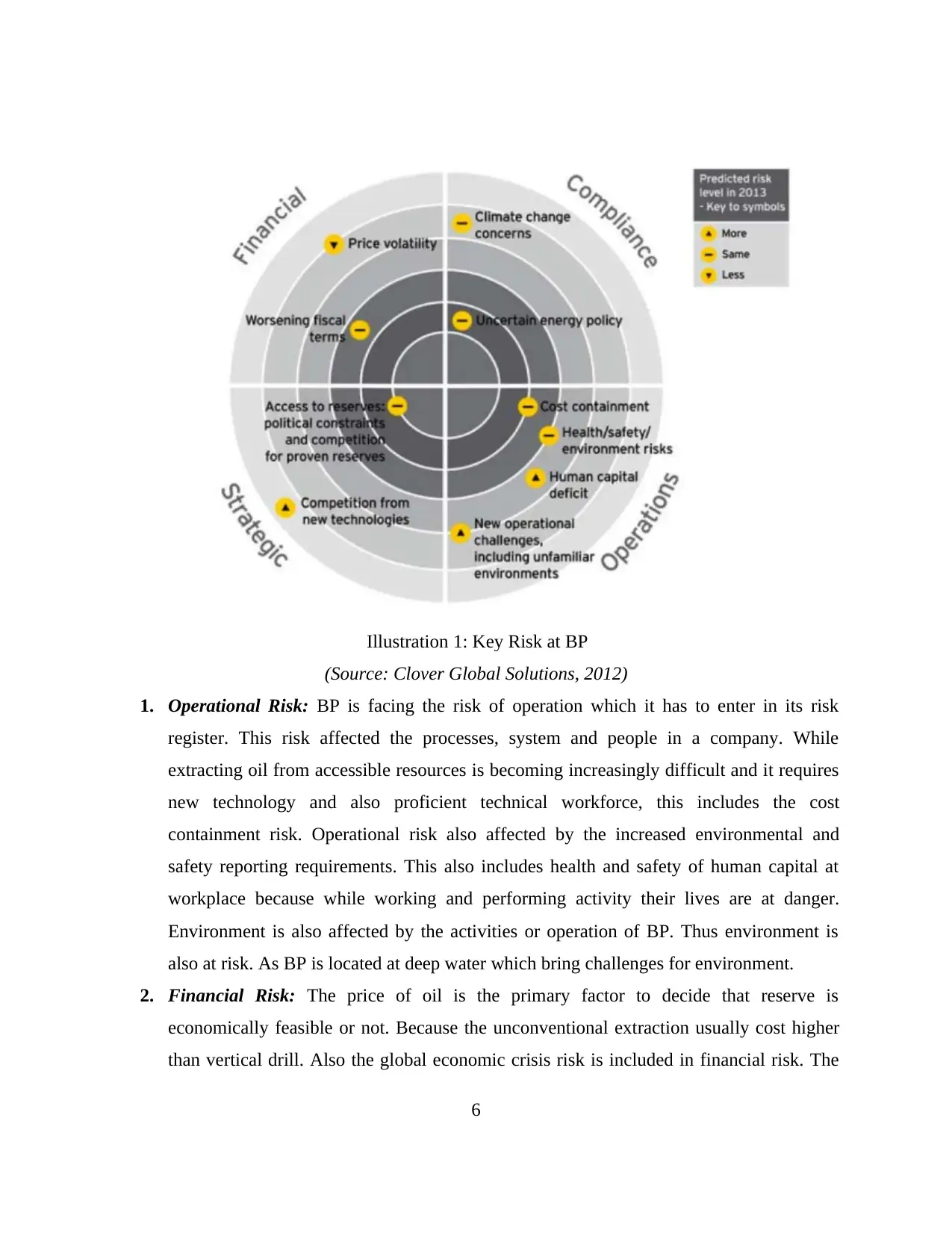
(Source: Clover Global Solutions, 2012)
1. Operational Risk: BP is facing the risk of operation which it has to enter in its risk
register. This risk affected the processes, system and people in a company. While
extracting oil from accessible resources is becoming increasingly difficult and it requires
new technology and also proficient technical workforce, this includes the cost
containment risk. Operational risk also affected by the increased environmental and
safety reporting requirements. This also includes health and safety of human capital at
workplace because while working and performing activity their lives are at danger.
Environment is also affected by the activities or operation of BP. Thus environment is
also at risk. As BP is located at deep water which bring challenges for environment.
2. Financial Risk: The price of oil is the primary factor to decide that reserve is
economically feasible or not. Because the unconventional extraction usually cost higher
than vertical drill. Also the global economic crisis risk is included in financial risk. The
6
Illustration 1: Key Risk at BP
1. Operational Risk: BP is facing the risk of operation which it has to enter in its risk
register. This risk affected the processes, system and people in a company. While
extracting oil from accessible resources is becoming increasingly difficult and it requires
new technology and also proficient technical workforce, this includes the cost
containment risk. Operational risk also affected by the increased environmental and
safety reporting requirements. This also includes health and safety of human capital at
workplace because while working and performing activity their lives are at danger.
Environment is also affected by the activities or operation of BP. Thus environment is
also at risk. As BP is located at deep water which bring challenges for environment.
2. Financial Risk: The price of oil is the primary factor to decide that reserve is
economically feasible or not. Because the unconventional extraction usually cost higher
than vertical drill. Also the global economic crisis risk is included in financial risk. The
6
Illustration 1: Key Risk at BP
⊘ This is a preview!⊘
Do you want full access?
Subscribe today to unlock all pages.
Trusted by 1+ million students worldwide
UK economy is going under recession and this causes the downfall of prices of the oil.
Due to which company are facing losses. Because extraction is done with a higher cost
and products is sold at lower price. This will cause the economic imbalance also.
3. Strategic Risk: It includes the risk of customers, competitors and investors. Uncertainties
lies that any time customer are switching to another brand and competitors are coming up
with innovative ideas. This imposes the challenges on BP and it is consider to be a main
risk for BP.
4. Compliance Risk: Political instability in UK economy and also in other countries leads to
a major risk for the BP because it is a global company. The international laws changes at
any point of time and due to which company faces losses in other countries due custom
and tariffs.
Thus, these key risk which BP is facing in current scenario are entered in risk register so
that risk can be managed in proper and accurate manner. After the BP oil spill incident the
company is taking due care in managing the risk as that incident had a major impact on the
organization, their employees and other stakeholders. It had a very dangerous impact on
environment as well. BP is highly experienced so it cannot take a chance of risking anything else
(Phippen and Ashby, 2014).
HEAT MAP OF THE KEY RISK
Heat map is basically a table or it is a graphical representation of the data in which
individual values which is contained in a matrix are represented as colors. Data is represented
using colors so that it can indicate the level of risk. Heat map is very easy to make, firstly
company has to collect the data of risk then separate those risk in terms of its affect that is high,
moderate, low. After that differentiate the zones of acceptable and unacceptable risk exposure on
the map and display risk reduction targets by inserting desired risk levels.
7
Due to which company are facing losses. Because extraction is done with a higher cost
and products is sold at lower price. This will cause the economic imbalance also.
3. Strategic Risk: It includes the risk of customers, competitors and investors. Uncertainties
lies that any time customer are switching to another brand and competitors are coming up
with innovative ideas. This imposes the challenges on BP and it is consider to be a main
risk for BP.
4. Compliance Risk: Political instability in UK economy and also in other countries leads to
a major risk for the BP because it is a global company. The international laws changes at
any point of time and due to which company faces losses in other countries due custom
and tariffs.
Thus, these key risk which BP is facing in current scenario are entered in risk register so
that risk can be managed in proper and accurate manner. After the BP oil spill incident the
company is taking due care in managing the risk as that incident had a major impact on the
organization, their employees and other stakeholders. It had a very dangerous impact on
environment as well. BP is highly experienced so it cannot take a chance of risking anything else
(Phippen and Ashby, 2014).
HEAT MAP OF THE KEY RISK
Heat map is basically a table or it is a graphical representation of the data in which
individual values which is contained in a matrix are represented as colors. Data is represented
using colors so that it can indicate the level of risk. Heat map is very easy to make, firstly
company has to collect the data of risk then separate those risk in terms of its affect that is high,
moderate, low. After that differentiate the zones of acceptable and unacceptable risk exposure on
the map and display risk reduction targets by inserting desired risk levels.
7
Paraphrase This Document
Need a fresh take? Get an instant paraphrase of this document with our AI Paraphraser
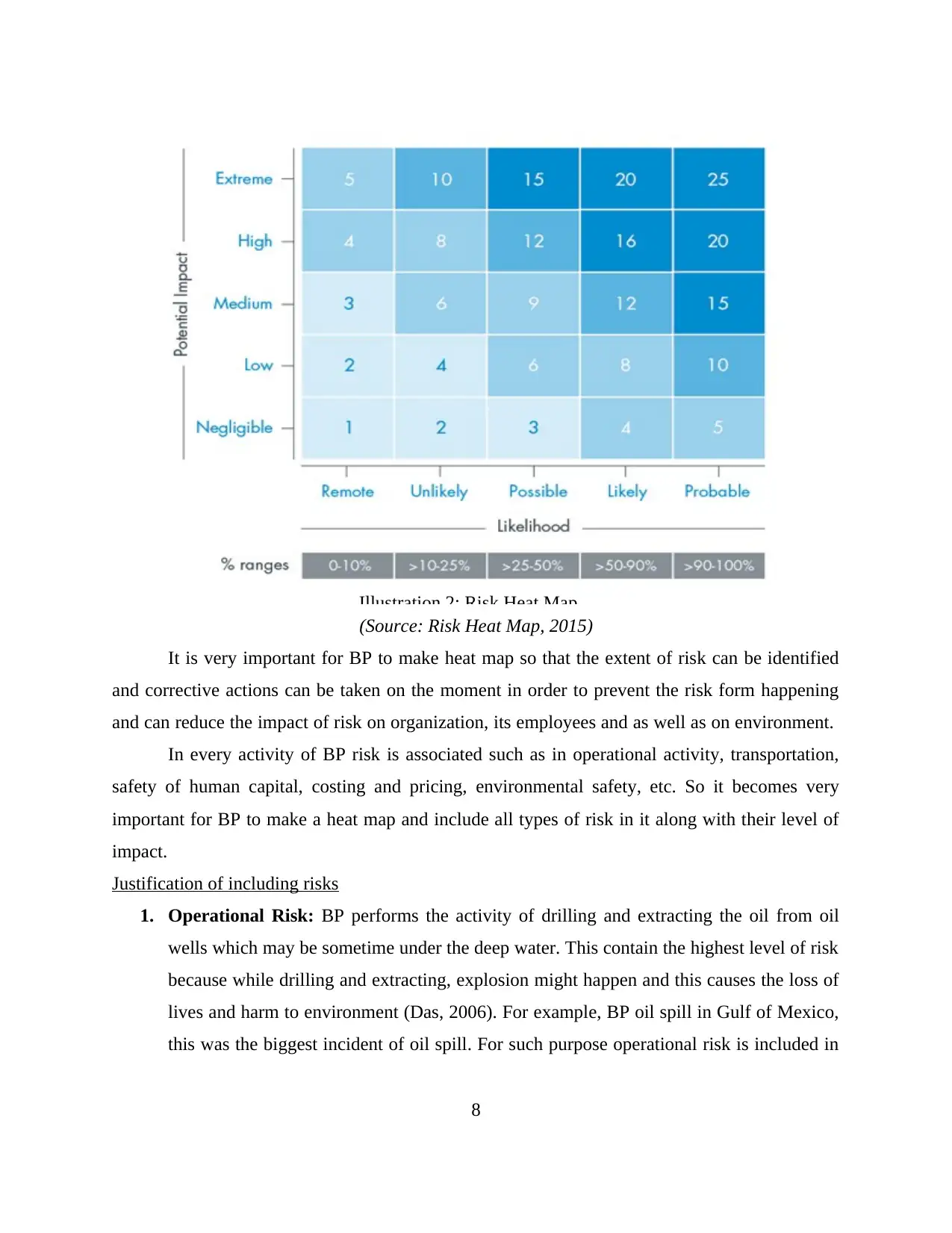
(Source: Risk Heat Map, 2015)
It is very important for BP to make heat map so that the extent of risk can be identified
and corrective actions can be taken on the moment in order to prevent the risk form happening
and can reduce the impact of risk on organization, its employees and as well as on environment.
In every activity of BP risk is associated such as in operational activity, transportation,
safety of human capital, costing and pricing, environmental safety, etc. So it becomes very
important for BP to make a heat map and include all types of risk in it along with their level of
impact.
Justification of including risks
1. Operational Risk: BP performs the activity of drilling and extracting the oil from oil
wells which may be sometime under the deep water. This contain the highest level of risk
because while drilling and extracting, explosion might happen and this causes the loss of
lives and harm to environment (Das, 2006). For example, BP oil spill in Gulf of Mexico,
this was the biggest incident of oil spill. For such purpose operational risk is included in
8
Illustration 2: Risk Heat Map
It is very important for BP to make heat map so that the extent of risk can be identified
and corrective actions can be taken on the moment in order to prevent the risk form happening
and can reduce the impact of risk on organization, its employees and as well as on environment.
In every activity of BP risk is associated such as in operational activity, transportation,
safety of human capital, costing and pricing, environmental safety, etc. So it becomes very
important for BP to make a heat map and include all types of risk in it along with their level of
impact.
Justification of including risks
1. Operational Risk: BP performs the activity of drilling and extracting the oil from oil
wells which may be sometime under the deep water. This contain the highest level of risk
because while drilling and extracting, explosion might happen and this causes the loss of
lives and harm to environment (Das, 2006). For example, BP oil spill in Gulf of Mexico,
this was the biggest incident of oil spill. For such purpose operational risk is included in
8
Illustration 2: Risk Heat Map
heat map so that its extent and possibility of occurring can be detected and measures can
be taken in order to avoid the impact of such incident.
2. Transportation Risk: Vehicle-related incident is the key risk company is facing so this
is a high priority for the company to identify the level of transportation risk
(Handlechner, 2008). Because such incident leads to the loss for company as most of
their material are getting waste and environmental degradation is also happening.
Because of these reason this risk is included in heat map.
3. Financial Risk: Due to recession and other economic downfall, the prices of oils get
affected in an adverse manner. This is a greater risk for the company. Investment risk is
also associated with this. Thus it may impact the company's profitability and its business.
To avoid or reduce the impact of financial risk on organization, this risk is included in
heat map (Davis and Jarvis, 2007).
4. Strategic Risk: It include the risk of customer, competitors, investor, etc. Company have
to attract and retain their customers so as to maximize their sales and profits. It is a very
risky matter for the company if customer loyalty get decreases and competitor get
increases. If competitor impact will increases than sales and profitability of a company
will go down (Borghesi and Gaudenzi, 2012). To mitigate the risk of strategy, this should
be included in heat map.
5. Health and Safety Risk: The company has to stay aware that the health and safety
standards are met out or not. This risk is to be included in heat map in order to detect its
level and accordingly prevention measure has to be taken. This risk is inclusive in BP oil
company because people working at this organization has highest risk of their life. BP
provides highest safety and healthy environment but during operational activities this is a
greatest risk for this purpose this is included in heat map.
6. Environmental Risk: There is a great environmental risk for this company because it is
unknown about the environmental change (Khan and Zsidisin, 2012). The plant are
located in deep water and any time storm may occur in oceans, thus it causes the
explosion of oil wells and accident of ships which are used for transporting oils. This lead
to the loss of materials, lives and also to the water bodies and marine life.
9
be taken in order to avoid the impact of such incident.
2. Transportation Risk: Vehicle-related incident is the key risk company is facing so this
is a high priority for the company to identify the level of transportation risk
(Handlechner, 2008). Because such incident leads to the loss for company as most of
their material are getting waste and environmental degradation is also happening.
Because of these reason this risk is included in heat map.
3. Financial Risk: Due to recession and other economic downfall, the prices of oils get
affected in an adverse manner. This is a greater risk for the company. Investment risk is
also associated with this. Thus it may impact the company's profitability and its business.
To avoid or reduce the impact of financial risk on organization, this risk is included in
heat map (Davis and Jarvis, 2007).
4. Strategic Risk: It include the risk of customer, competitors, investor, etc. Company have
to attract and retain their customers so as to maximize their sales and profits. It is a very
risky matter for the company if customer loyalty get decreases and competitor get
increases. If competitor impact will increases than sales and profitability of a company
will go down (Borghesi and Gaudenzi, 2012). To mitigate the risk of strategy, this should
be included in heat map.
5. Health and Safety Risk: The company has to stay aware that the health and safety
standards are met out or not. This risk is to be included in heat map in order to detect its
level and accordingly prevention measure has to be taken. This risk is inclusive in BP oil
company because people working at this organization has highest risk of their life. BP
provides highest safety and healthy environment but during operational activities this is a
greatest risk for this purpose this is included in heat map.
6. Environmental Risk: There is a great environmental risk for this company because it is
unknown about the environmental change (Khan and Zsidisin, 2012). The plant are
located in deep water and any time storm may occur in oceans, thus it causes the
explosion of oil wells and accident of ships which are used for transporting oils. This lead
to the loss of materials, lives and also to the water bodies and marine life.
9
⊘ This is a preview!⊘
Do you want full access?
Subscribe today to unlock all pages.
Trusted by 1+ million students worldwide
CONCLUSION
After preparing the project report on risk management of BP, it can be concluded that risk
management is necessary in oil company in order to measure the extent of risk and actions can
be planned in advance to reduce or prevent the impact of any incident. It is also concluded that
the risk management is properly done in BP by identifying several types of risk. Those risks are
managed by using tools of risk management such as risk register. The risk are identified and
according to their level they are separated by BP and heat map is also created so that impact can
be prevented or reduced. Company should focus on key risk factors and bring changes in their
risk management tool to mitigate the risk in their company. By taking lessons form past
experience the risk management can be done in a more improved manner.
10
After preparing the project report on risk management of BP, it can be concluded that risk
management is necessary in oil company in order to measure the extent of risk and actions can
be planned in advance to reduce or prevent the impact of any incident. It is also concluded that
the risk management is properly done in BP by identifying several types of risk. Those risks are
managed by using tools of risk management such as risk register. The risk are identified and
according to their level they are separated by BP and heat map is also created so that impact can
be prevented or reduced. Company should focus on key risk factors and bring changes in their
risk management tool to mitigate the risk in their company. By taking lessons form past
experience the risk management can be done in a more improved manner.
10
Paraphrase This Document
Need a fresh take? Get an instant paraphrase of this document with our AI Paraphraser
REFERENCES
Journals
Elena, B. A. and Richard, C., 2013. From initial risk assessments to system risk management.
Journal of Modelling in Management. 8(3). pp.262–289.
Kutsch, E., 2008. The effect of intervening conditions on the management of project risk.
International Journal of Managing Projects in Business. 1(4). pp.602–610.
Lemke, F. and Petersen, L. H., 2013. Teaching reputational risk management in the supply
chain. Supply Chain Management: An International Journal. 18(4). pp.413–429.
Olsson, R., 2008. Risk management in a multi‐project environment: An approach to manage
portfolio risks. International Journal of Quality & Reliability Management. 25(1).
pp.60–71.
Phippen, A. and Ashby, S., 2014. Digital Behaviors and People Risk: Challenges for Risk
Management, in Miguel R. Olivas-LujÁN , Tanya Bondarouk (ed.) Social Media in
Strategic Management (Advanced Series in Management, Volume 11) Emerald Group
Publishing Limited. pp.1-26.
Rasid, S., Rahman, A. and Ismail, W., 2011. Management accounting and risk management in
Malaysian financial institutions: An exploratory study. Managerial Auditing Journal.
26(7). pp.566–585.0
Schubert, R., 2006. Analyzing and managing risks – on the importance of gender differences in
risk attitudes. Managerial Finance. 32(9). pp.706-715.
Tummala, R. and Schoenherr, T., 2011. Assessing and managing risks using the Supply Chain
Risk Management Process (SCRMP). Supply Chain Management: An International
Journal. 16(6). pp.474–483.
Books
Borghesi, A. and Gaudenzi, B., 2012. Risk Management: How to Assess, Transfer and
Communicate Critical Risks. Springer Science & Business Media.
11
Journals
Elena, B. A. and Richard, C., 2013. From initial risk assessments to system risk management.
Journal of Modelling in Management. 8(3). pp.262–289.
Kutsch, E., 2008. The effect of intervening conditions on the management of project risk.
International Journal of Managing Projects in Business. 1(4). pp.602–610.
Lemke, F. and Petersen, L. H., 2013. Teaching reputational risk management in the supply
chain. Supply Chain Management: An International Journal. 18(4). pp.413–429.
Olsson, R., 2008. Risk management in a multi‐project environment: An approach to manage
portfolio risks. International Journal of Quality & Reliability Management. 25(1).
pp.60–71.
Phippen, A. and Ashby, S., 2014. Digital Behaviors and People Risk: Challenges for Risk
Management, in Miguel R. Olivas-LujÁN , Tanya Bondarouk (ed.) Social Media in
Strategic Management (Advanced Series in Management, Volume 11) Emerald Group
Publishing Limited. pp.1-26.
Rasid, S., Rahman, A. and Ismail, W., 2011. Management accounting and risk management in
Malaysian financial institutions: An exploratory study. Managerial Auditing Journal.
26(7). pp.566–585.0
Schubert, R., 2006. Analyzing and managing risks – on the importance of gender differences in
risk attitudes. Managerial Finance. 32(9). pp.706-715.
Tummala, R. and Schoenherr, T., 2011. Assessing and managing risks using the Supply Chain
Risk Management Process (SCRMP). Supply Chain Management: An International
Journal. 16(6). pp.474–483.
Books
Borghesi, A. and Gaudenzi, B., 2012. Risk Management: How to Assess, Transfer and
Communicate Critical Risks. Springer Science & Business Media.
11
Das, S., 2006. Risk Management. John Wiley & Sons.
Davis, E. A. and Jarvis, R. P., 2007. Risk Management: Survival Tools for Law Firms. American
Bar Association.
Handlechner, M., 2008. Risk Management. GRIN Verlag.
Khan, O. and Zsidisin, G. A., Handbook for Supply Chain Risk Management: Case Studies,
Effective Practices, and Emerging Trends. J. Ross Publishing.
Online
Clover Global Solutions. 2012. [Online]. Available through
<uhttps://c1wsolutions.wordpress.com/2012/03/26/risks-for-oil-and-gas/>. [Accessed
on 7 November 2015].
Risk Heat Map . 2012. [Online]. Available through
<http://www.cgma.org/Resources/Tools/essential-tools/Pages/risk-heat-maps.aspx>.
[Accessed on 7 November 2015].
12
Davis, E. A. and Jarvis, R. P., 2007. Risk Management: Survival Tools for Law Firms. American
Bar Association.
Handlechner, M., 2008. Risk Management. GRIN Verlag.
Khan, O. and Zsidisin, G. A., Handbook for Supply Chain Risk Management: Case Studies,
Effective Practices, and Emerging Trends. J. Ross Publishing.
Online
Clover Global Solutions. 2012. [Online]. Available through
<uhttps://c1wsolutions.wordpress.com/2012/03/26/risks-for-oil-and-gas/>. [Accessed
on 7 November 2015].
Risk Heat Map . 2012. [Online]. Available through
<http://www.cgma.org/Resources/Tools/essential-tools/Pages/risk-heat-maps.aspx>.
[Accessed on 7 November 2015].
12
⊘ This is a preview!⊘
Do you want full access?
Subscribe today to unlock all pages.
Trusted by 1+ million students worldwide

1 out of 12


Related Documents


Your All-in-One AI-Powered Toolkit for Academic Success.
+13062052269
info@desklib.com
Available 24*7 on WhatsApp / Email
![[object Object]](/_next/static/media/star-bottom.7253800d.svg)
Unlock your academic potential
Copyright © 2020–2026 A2Z Services. All Rights Reserved. Developed and managed by ZUCOL.