BAC 305 Research Report: Corporate Scandals, Auditing, and Regulation
VerifiedAdded on 2023/03/17
|16
|4187
|50
Report
AI Summary
This report provides an in-depth analysis of corporate scandals, focusing on three major cases: Satyam Computers, OneTel, and HIH Insurance. It meticulously examines how accounting irregularities were perpetrated within each company, exploring the underlying reasons for these fraudulent activities. The report also investigates why these irregularities were not detected by auditors, if applicable, and what measures auditors should have taken to prevent such occurrences. Furthermore, it delves into the actions taken by regulators to address these problems and prevent future instances of corporate malfeasance. The analysis covers the Satyam scandal, detailing the inflation of profits, the lack of auditor detection, and subsequent regulatory responses. The report then examines OneTel's demise, highlighting management failures, accounting policy manipulations, and the lack of effective auditing. Finally, it analyzes HIH Insurance, exploring irregularities, auditor failures, and regulatory interventions. The report concludes with a summary of findings and recommendations for improved corporate governance and auditing practices, supported by references to academic journals and other sources.
BAC 305 research assignment
2019
2019

Paraphrase This Document
Need a fresh take? Get an instant paraphrase of this document with our AI Paraphraser
Audit
Executive Summary
There have been innumerable cases of the collapse due to greed, false business practices and
the lust to rise to the apex. The major element in the downfall comprises of the irregularities
in the accounting domain. The noteworthy example is that of Lehman brothers, OneTel, HIH
Insurance, Enron, Satyam Computers, etc. In all the cases there has been breach of corporate
governance and management practices. The report stresses the demise of three giant that is
Satyam Computers, OneTel and HIH Insurance. For all the three cases the report sheds light
from the irregularities observed to action taken by the auditors to avert the same. Finally, the
role of regulator is discussed.
2
Executive Summary
There have been innumerable cases of the collapse due to greed, false business practices and
the lust to rise to the apex. The major element in the downfall comprises of the irregularities
in the accounting domain. The noteworthy example is that of Lehman brothers, OneTel, HIH
Insurance, Enron, Satyam Computers, etc. In all the cases there has been breach of corporate
governance and management practices. The report stresses the demise of three giant that is
Satyam Computers, OneTel and HIH Insurance. For all the three cases the report sheds light
from the irregularities observed to action taken by the auditors to avert the same. Finally, the
role of regulator is discussed.
2
Audit
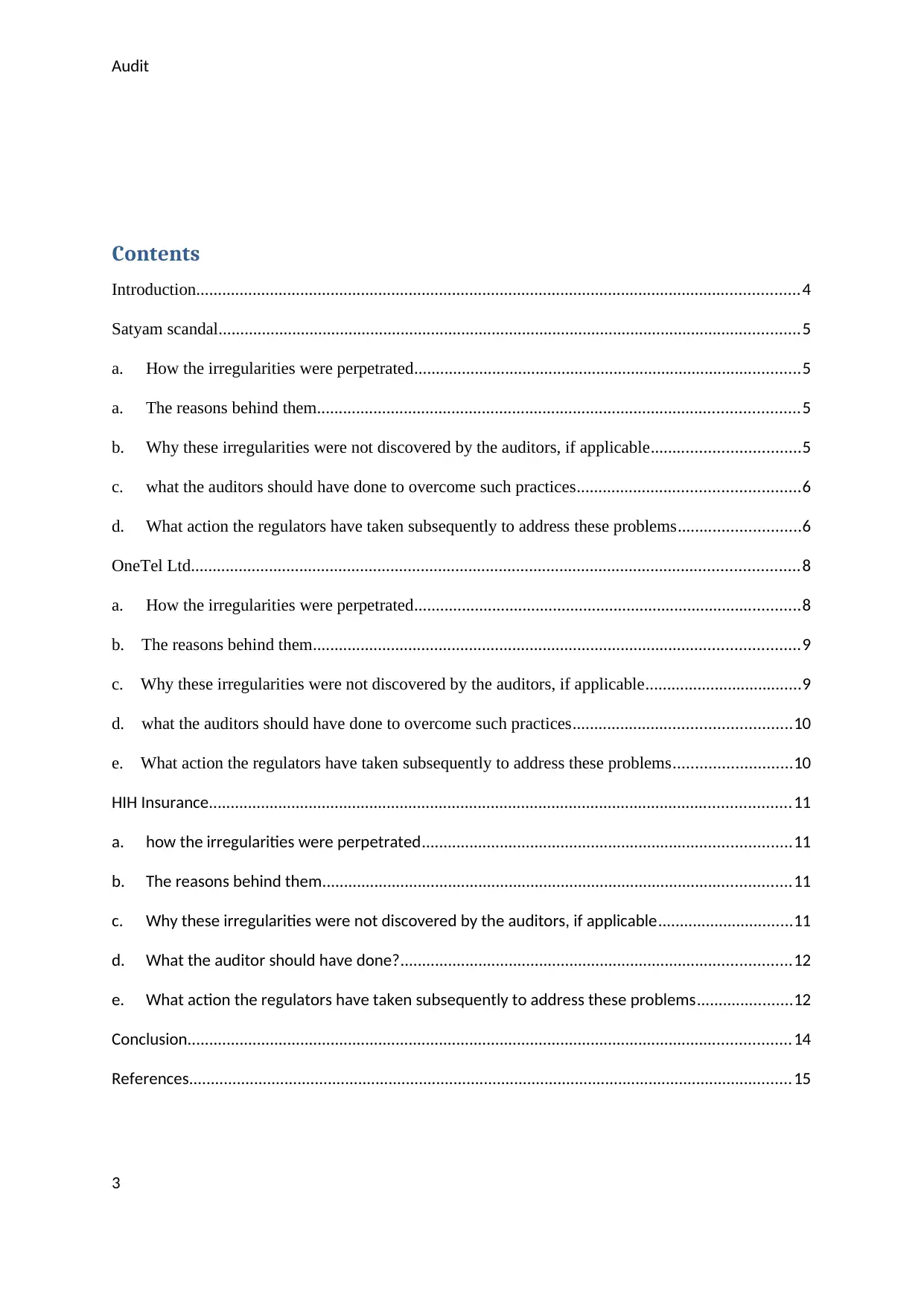
Contents
Introduction...........................................................................................................................................4
Satyam scandal......................................................................................................................................5
a. How the irregularities were perpetrated.........................................................................................5
a. The reasons behind them...............................................................................................................5
b. Why these irregularities were not discovered by the auditors, if applicable..................................5
c. what the auditors should have done to overcome such practices...................................................6
d. What action the regulators have taken subsequently to address these problems............................6
OneTel Ltd............................................................................................................................................8
a. How the irregularities were perpetrated.........................................................................................8
b. The reasons behind them................................................................................................................9
c. Why these irregularities were not discovered by the auditors, if applicable....................................9
d. what the auditors should have done to overcome such practices..................................................10
e. What action the regulators have taken subsequently to address these problems...........................10
HIH Insurance......................................................................................................................................11
a. how the irregularities were perpetrated.....................................................................................11
b. The reasons behind them............................................................................................................11
c. Why these irregularities were not discovered by the auditors, if applicable...............................11
d. What the auditor should have done?..........................................................................................12
e. What action the regulators have taken subsequently to address these problems......................12
Conclusion...........................................................................................................................................14
References...........................................................................................................................................15
3
Contents
Introduction...........................................................................................................................................4
Satyam scandal......................................................................................................................................5
a. How the irregularities were perpetrated.........................................................................................5
a. The reasons behind them...............................................................................................................5
b. Why these irregularities were not discovered by the auditors, if applicable..................................5
c. what the auditors should have done to overcome such practices...................................................6
d. What action the regulators have taken subsequently to address these problems............................6
OneTel Ltd............................................................................................................................................8
a. How the irregularities were perpetrated.........................................................................................8
b. The reasons behind them................................................................................................................9
c. Why these irregularities were not discovered by the auditors, if applicable....................................9
d. what the auditors should have done to overcome such practices..................................................10
e. What action the regulators have taken subsequently to address these problems...........................10
HIH Insurance......................................................................................................................................11
a. how the irregularities were perpetrated.....................................................................................11
b. The reasons behind them............................................................................................................11
c. Why these irregularities were not discovered by the auditors, if applicable...............................11
d. What the auditor should have done?..........................................................................................12
e. What action the regulators have taken subsequently to address these problems......................12
Conclusion...........................................................................................................................................14
References...........................................................................................................................................15
3
⊘ This is a preview!⊘
Do you want full access?
Subscribe today to unlock all pages.

Trusted by 1+ million students worldwide
Audit
Introduction
The report revolves around the scandal of Satyam, demise of OneTel and HIH insurance. In
all the following cases, a detailed analysis is done that helps in projecting the major reason
for the downfall. In all the following cases, a vivid description is provided in the form of
irregularities in the system, reason for the downfall, auditor role in overcoming the issue, and
the action taken by the regulator. The management of the company refrained from adopting
policies that was the major reason in the downfall of the giants.
4
Introduction
The report revolves around the scandal of Satyam, demise of OneTel and HIH insurance. In
all the following cases, a detailed analysis is done that helps in projecting the major reason
for the downfall. In all the following cases, a vivid description is provided in the form of
irregularities in the system, reason for the downfall, auditor role in overcoming the issue, and
the action taken by the regulator. The management of the company refrained from adopting
policies that was the major reason in the downfall of the giants.
4
Paraphrase This Document
Need a fresh take? Get an instant paraphrase of this document with our AI Paraphraser
Audit
Satyam scandal
a. How the irregularities were perpetrated
It was seen that a rapid uphill chart was going to be created because of the need of hour in the
section of IT services desperately. The best chart section was from the year 2003-2008 where
it increased rapidly. The company seemed to flourish in all direction because it made a
whooping profit of about $470m and all this was not enough and it continued its reign and
increased the profit supplies to about 2.2 billion USD in the year 2008. The company had
been very smooth throughout those years and the horizon expansion for the company were
calculated to be 35% at that time (Winkler, 2010). 21% was the calculated amount part for
the profits reaped by the company and this is why the share price of the company rose from
$0.13 to $0.64 with an increase net chart of about 42%. as explained earlier that the share
price also increased rapidly during this phase and it can be demonstrated by the fact that the
price increased by 300% and rose from INR 138.08 in January 2003 to 562.25. This wide and
huge success came up in this phase for Satyam Computers and also due to this figures it was
seen that the shareholder values also have a great impact in the market (Winkler, 2010). IT
can be said that the management and the execution board did something extra to make the
company such a success and they were of first priority to the company. But it was seen that
the data and the information provided from the surface did not tally to the depths of the
company statistics and so it can be said that the Satyam fraud is known as “India’s Enron”.
a. The reasons behind them
Wrecking of all the policies and the legislatures by Mr. Raju was the fact of the hunger for
power, money and success of which the investors were unaware and also of the misleading
functions of the company.
b. Why these irregularities were not discovered by the auditors, if applicable
The misstatements were very well hidden by the company upfront and the deceiving
properties and the investor has no clue about the real frame. PriceWaterHouseCoppers
(PWC) was the company that was supposed to deal with all this as it was the auditing group
of the company until it found out the case in 2009. During this time there were many deals
5
Satyam scandal
a. How the irregularities were perpetrated
It was seen that a rapid uphill chart was going to be created because of the need of hour in the
section of IT services desperately. The best chart section was from the year 2003-2008 where
it increased rapidly. The company seemed to flourish in all direction because it made a
whooping profit of about $470m and all this was not enough and it continued its reign and
increased the profit supplies to about 2.2 billion USD in the year 2008. The company had
been very smooth throughout those years and the horizon expansion for the company were
calculated to be 35% at that time (Winkler, 2010). 21% was the calculated amount part for
the profits reaped by the company and this is why the share price of the company rose from
$0.13 to $0.64 with an increase net chart of about 42%. as explained earlier that the share
price also increased rapidly during this phase and it can be demonstrated by the fact that the
price increased by 300% and rose from INR 138.08 in January 2003 to 562.25. This wide and
huge success came up in this phase for Satyam Computers and also due to this figures it was
seen that the shareholder values also have a great impact in the market (Winkler, 2010). IT
can be said that the management and the execution board did something extra to make the
company such a success and they were of first priority to the company. But it was seen that
the data and the information provided from the surface did not tally to the depths of the
company statistics and so it can be said that the Satyam fraud is known as “India’s Enron”.
a. The reasons behind them
Wrecking of all the policies and the legislatures by Mr. Raju was the fact of the hunger for
power, money and success of which the investors were unaware and also of the misleading
functions of the company.
b. Why these irregularities were not discovered by the auditors, if applicable
The misstatements were very well hidden by the company upfront and the deceiving
properties and the investor has no clue about the real frame. PriceWaterHouseCoppers
(PWC) was the company that was supposed to deal with all this as it was the auditing group
of the company until it found out the case in 2009. During this time there were many deals
5
Audit
and transactions which were approved by the auditing team and this was criticized by all
along with its non-capability to find out the fraud. To make the situation worse it was the
Satyam company that claimed $1.05billion as and from its balance sheet which was totally
vague in nature.
The loop holes were not only in the income statements but also prevailed in the balance sheet
courtesy of the fact that as per the requirement, Satyam kept on creating some vague and non-
existing sources whenever there was a demand to increase the profits which was clearly
undetected by the auditors. This was how the fraud process went on without any hindrance
for so long. Though the auditors thought that the data provided to them was not at ll
appealing but then also they did not have the proof and also the independent directors, SEBI
and the other investors were given staged information which were void in nature (Goergen,
2012). Account creation and its changed nature are never a case of doubt and so this was the
raising factor the complications for Satyam. Once the company got hold of the nature of
changing the statements more often, then it became a daily dose for it.
c. what the auditors should have done to overcome such practices
Manipulation Detection - it was calculated that the fraud amount that Satyam took
over to was about $270million. Beginning of all these tampering were short and
temporary in nature so it would have been best that they were detected in the aery
stage and action were taken so as to suppress them. Detection of errors and loop holes
is a daily check and is must for all the stages and this also gives and idea to the other
that if any account in the company seems off the chart then it should be handled and
actions should be taken to scan it (Caraballo, Cheerla & Jafari, 2010). Not a single
person abut a team should be appointed to do the same so as to bring in light all the
misstatements which would have been missed by the later.
d. What action the regulators have taken subsequently to address these
problems
The need of the hour for the corporate governance was understood after the fraud of the
Satyam happened. The ethics and the legislature of the corporate governance were at the top
6
and transactions which were approved by the auditing team and this was criticized by all
along with its non-capability to find out the fraud. To make the situation worse it was the
Satyam company that claimed $1.05billion as and from its balance sheet which was totally
vague in nature.
The loop holes were not only in the income statements but also prevailed in the balance sheet
courtesy of the fact that as per the requirement, Satyam kept on creating some vague and non-
existing sources whenever there was a demand to increase the profits which was clearly
undetected by the auditors. This was how the fraud process went on without any hindrance
for so long. Though the auditors thought that the data provided to them was not at ll
appealing but then also they did not have the proof and also the independent directors, SEBI
and the other investors were given staged information which were void in nature (Goergen,
2012). Account creation and its changed nature are never a case of doubt and so this was the
raising factor the complications for Satyam. Once the company got hold of the nature of
changing the statements more often, then it became a daily dose for it.
c. what the auditors should have done to overcome such practices
Manipulation Detection - it was calculated that the fraud amount that Satyam took
over to was about $270million. Beginning of all these tampering were short and
temporary in nature so it would have been best that they were detected in the aery
stage and action were taken so as to suppress them. Detection of errors and loop holes
is a daily check and is must for all the stages and this also gives and idea to the other
that if any account in the company seems off the chart then it should be handled and
actions should be taken to scan it (Caraballo, Cheerla & Jafari, 2010). Not a single
person abut a team should be appointed to do the same so as to bring in light all the
misstatements which would have been missed by the later.
d. What action the regulators have taken subsequently to address these
problems
The need of the hour for the corporate governance was understood after the fraud of the
Satyam happened. The ethics and the legislature of the corporate governance were at the top
6
⊘ This is a preview!⊘
Do you want full access?
Subscribe today to unlock all pages.
Trusted by 1+ million students worldwide
Audit
priority now. The fraud also showed a different side of the human thinking which was cursed
with hunger of money and manipulative outlaws. Corporate governance should be followed
in all cases so as to avoid the fraudulent cases to all extent. Though the damage and the shock
on the willing nature of the people were large, then also the government tried its best to instil
some faith (Caraballo, Cheerla & Jafari, 2010). It is necessary to take actions for the same in
all the situations so no manipulation may ever occur. Also it can be seen that because of such
actions, the reputation and the score of the nation also decreases and so the investors are
driven away from the country and their willingness to invest in the same is totally lost. So it
is again and- again said that all the rules and the proper and legal accounting policies are to
be followed so that no fraudulent cases are now raised.
7
priority now. The fraud also showed a different side of the human thinking which was cursed
with hunger of money and manipulative outlaws. Corporate governance should be followed
in all cases so as to avoid the fraudulent cases to all extent. Though the damage and the shock
on the willing nature of the people were large, then also the government tried its best to instil
some faith (Caraballo, Cheerla & Jafari, 2010). It is necessary to take actions for the same in
all the situations so no manipulation may ever occur. Also it can be seen that because of such
actions, the reputation and the score of the nation also decreases and so the investors are
driven away from the country and their willingness to invest in the same is totally lost. So it
is again and- again said that all the rules and the proper and legal accounting policies are to
be followed so that no fraudulent cases are now raised.
7
Paraphrase This Document
Need a fresh take? Get an instant paraphrase of this document with our AI Paraphraser
Audit
OneTel Ltd
In case of OneTel it can be seen that though the company had genuine resources and client
but then also due to the non-following nature of the company in part of the corporate
governance led to the company’s downfall. Also the management was weak and inefficient in
nature.
a. How the irregularities were perpetrated
An organization can achieve all its goals if it has a sound infrastructure. OneTel lacked a
profound infrastructure and this is why the same faced issues in the facilitation of an effective
communication system. The company had a system of high centralization where the
managers performed as per the instructions are given by Jody. Jody left no stones unturned in
making the managers of the company feel inferior in front of him. Having a superiority
complex he took undue advantage of being at a higher position. Jody couldn’t bear the word
‘no’ coming from the managers and therefore, he took up every opportunity to humiliate
them (Avison & Wilson, 2003). This was why OneTel faced high staff turnover. Jody
operated the company as per his will and did not encourage any opinions coming from his
subordinates. A lot of emphasis on the advertisement has done so as to cater to new
consumers. The employees could not engage much in resolving an issue due to the autocratic
nature of Jody. Also, the jobs and responsibilities of the employees engaged in the company
were not at all clear which indicates the presence of low complexity. The relationship
between the staff too lacked clarity and the determination of the same was actually difficult.
The company also frequently faced high staff turnover which is also why the queries of the
consumers were left unattended. This is also why the sales of the company dropped
rigorously. One Tel lacked proper operational activities which can be proved from the fact
that the company paid almost negligible attention to the complaints and queries of the
consumers. The company could not even manage its division’s functions appropriately. The
company hired young inexperienced candidates and also there was no appropriate procedure
for training employees (Connelley, 2012). The financial system and billing accounts were
also improperly managed. The technology of the company was also not utilized properly as
there was a lack of planning with respect to advertising, product availability, and employee
training.
8
OneTel Ltd
In case of OneTel it can be seen that though the company had genuine resources and client
but then also due to the non-following nature of the company in part of the corporate
governance led to the company’s downfall. Also the management was weak and inefficient in
nature.
a. How the irregularities were perpetrated
An organization can achieve all its goals if it has a sound infrastructure. OneTel lacked a
profound infrastructure and this is why the same faced issues in the facilitation of an effective
communication system. The company had a system of high centralization where the
managers performed as per the instructions are given by Jody. Jody left no stones unturned in
making the managers of the company feel inferior in front of him. Having a superiority
complex he took undue advantage of being at a higher position. Jody couldn’t bear the word
‘no’ coming from the managers and therefore, he took up every opportunity to humiliate
them (Avison & Wilson, 2003). This was why OneTel faced high staff turnover. Jody
operated the company as per his will and did not encourage any opinions coming from his
subordinates. A lot of emphasis on the advertisement has done so as to cater to new
consumers. The employees could not engage much in resolving an issue due to the autocratic
nature of Jody. Also, the jobs and responsibilities of the employees engaged in the company
were not at all clear which indicates the presence of low complexity. The relationship
between the staff too lacked clarity and the determination of the same was actually difficult.
The company also frequently faced high staff turnover which is also why the queries of the
consumers were left unattended. This is also why the sales of the company dropped
rigorously. One Tel lacked proper operational activities which can be proved from the fact
that the company paid almost negligible attention to the complaints and queries of the
consumers. The company could not even manage its division’s functions appropriately. The
company hired young inexperienced candidates and also there was no appropriate procedure
for training employees (Connelley, 2012). The financial system and billing accounts were
also improperly managed. The technology of the company was also not utilized properly as
there was a lack of planning with respect to advertising, product availability, and employee
training.
8
Audit
The company lacked a proper accounting system as well. There was also a lack of
information pertaining to total debtors, aging debtors and risk profile of debtors. There were
numerous differences in the data description, monthly trial balances, collection and the
outstanding balance of accounts receivable, and reporting of earnings before interest, tax,
depreciation, and amortization. The company had an inefficient internal control system. Also,
the senior management of the company didn’t show any interest in preserving the accuracy
and integrity in the financials of the same.
b. The reasons behind them
In a time span of 2 years, the company made two significant alterations in its accounting
policy. The annual report of the company for 1998 stated that unlike other telecommunication
companies, the balance sheet of the same will not represent intangibles. Things took a u-turn
in the following year when the company made alterations in its accounting policies regarding
the treatment of deferred expenditures. It was also seen that the costs incurred earlier in the
incorporation of the company were not only capitalized but also amortized at the same time
for a period, not more than 3 years. The reported operating profit for the year 1998-99 would
have dropped by A$32.4 million while reported EPS of 0.52 cent would have bought about
loss per share of 2 cents if these costs were written off in a single year (Tepalagul & Lin,
2015).
c. Why these irregularities were not discovered by the auditors, if applicable
The management of OneTel insisted on EBITDA rather than focussing on the earnings
reported under generally accepted accounting principles while analyzing the annual reports of
the company in the managerial discussion. Thus, focussing completely only on accounting
expenses such as interest expense, taxes, depreciation and amortization and not on other
significant factors.
The earnings reported by the company mismatched the real numbers and there was a lot of
evidence so as to support this statement. The earning quality, as well as the financial
reporting quality of the company, was poor. The audit processes conducted in the company
was undoubtedly a failure in itself. Low audit quality and low financial reporting are enough
to support the fact that the financial well being of the company was wrongly presented on
purpose so as to portray a better and a favorable picture of the company in the eyes of the
9
The company lacked a proper accounting system as well. There was also a lack of
information pertaining to total debtors, aging debtors and risk profile of debtors. There were
numerous differences in the data description, monthly trial balances, collection and the
outstanding balance of accounts receivable, and reporting of earnings before interest, tax,
depreciation, and amortization. The company had an inefficient internal control system. Also,
the senior management of the company didn’t show any interest in preserving the accuracy
and integrity in the financials of the same.
b. The reasons behind them
In a time span of 2 years, the company made two significant alterations in its accounting
policy. The annual report of the company for 1998 stated that unlike other telecommunication
companies, the balance sheet of the same will not represent intangibles. Things took a u-turn
in the following year when the company made alterations in its accounting policies regarding
the treatment of deferred expenditures. It was also seen that the costs incurred earlier in the
incorporation of the company were not only capitalized but also amortized at the same time
for a period, not more than 3 years. The reported operating profit for the year 1998-99 would
have dropped by A$32.4 million while reported EPS of 0.52 cent would have bought about
loss per share of 2 cents if these costs were written off in a single year (Tepalagul & Lin,
2015).
c. Why these irregularities were not discovered by the auditors, if applicable
The management of OneTel insisted on EBITDA rather than focussing on the earnings
reported under generally accepted accounting principles while analyzing the annual reports of
the company in the managerial discussion. Thus, focussing completely only on accounting
expenses such as interest expense, taxes, depreciation and amortization and not on other
significant factors.
The earnings reported by the company mismatched the real numbers and there was a lot of
evidence so as to support this statement. The earning quality, as well as the financial
reporting quality of the company, was poor. The audit processes conducted in the company
was undoubtedly a failure in itself. Low audit quality and low financial reporting are enough
to support the fact that the financial well being of the company was wrongly presented on
purpose so as to portray a better and a favorable picture of the company in the eyes of the
9
⊘ This is a preview!⊘
Do you want full access?
Subscribe today to unlock all pages.
Trusted by 1+ million students worldwide
Audit
investors (Duckworth & Moore, 2010). All this in return couldn’t save OneTel from dealing
with the consequences of its actions in the future and therefore, this resulted in the company’s
untimely demise.
d. what the auditors should have done to overcome such practices
The auditors should have ascertained the Trial balance, balance sheet; debtors aging
statements and others are some of the areas that could have been ascertained the auditors. The
performance was also on a low for the company as its faith and responsibility for the
production results were not seen. If the financial structure is considered then the auditors
should have undertaken serious steps and spotted the cause of the failure. A rigorous check
could have spotted that the deferred cost techniques were made to change for every two years
and the other one bring that the intangibles of the company were not put separately in the
account (Edward & Moutchnik, 2013). Such actions and manipulation could only happen in
case if the management was involved and also it was clear that the auditor also had no idea
about the manipulations and was unable to detect it which sees that the auditors were
involved in the fraudulent case also which caused the company to suffer a huge loss (Sikka,
2009).
e. What action the regulators have taken subsequently to address these problems
To address the problems the regulators came up with the provision of strong internal control,
audit quality and management scrutiny of effective nature. Further, it became imperative to
disclose all the facts that will lead to a strong link between the executive pay and the
performance of the firm. Secondly, the regulators ensured that the board is set up in a manner
that will spot the issues in the firm. Further, the non-executive members were provided access
to middle and lower management so that transparency can be obtained (Manoharan, 2011).
10
investors (Duckworth & Moore, 2010). All this in return couldn’t save OneTel from dealing
with the consequences of its actions in the future and therefore, this resulted in the company’s
untimely demise.
d. what the auditors should have done to overcome such practices
The auditors should have ascertained the Trial balance, balance sheet; debtors aging
statements and others are some of the areas that could have been ascertained the auditors. The
performance was also on a low for the company as its faith and responsibility for the
production results were not seen. If the financial structure is considered then the auditors
should have undertaken serious steps and spotted the cause of the failure. A rigorous check
could have spotted that the deferred cost techniques were made to change for every two years
and the other one bring that the intangibles of the company were not put separately in the
account (Edward & Moutchnik, 2013). Such actions and manipulation could only happen in
case if the management was involved and also it was clear that the auditor also had no idea
about the manipulations and was unable to detect it which sees that the auditors were
involved in the fraudulent case also which caused the company to suffer a huge loss (Sikka,
2009).
e. What action the regulators have taken subsequently to address these problems
To address the problems the regulators came up with the provision of strong internal control,
audit quality and management scrutiny of effective nature. Further, it became imperative to
disclose all the facts that will lead to a strong link between the executive pay and the
performance of the firm. Secondly, the regulators ensured that the board is set up in a manner
that will spot the issues in the firm. Further, the non-executive members were provided access
to middle and lower management so that transparency can be obtained (Manoharan, 2011).
10
Paraphrase This Document
Need a fresh take? Get an instant paraphrase of this document with our AI Paraphraser
Audit
HIH Insurance
a. how the irregularities were perpetrated
The sudden demise of HIH insurance came as a shock to the entire industry. It was one of the
biggest collapses that one could ever recall. The Liberal Federal Government formed a Royal
Commission so as to have a detailed investigation in order to locate the reasons that
accounted to the untimely demise of such a well-doing company. It was seen that there were
numerous alterations in the corporate regulatory of the company owing to various
recommendations. Most of the systems and policies of the company also failed. Mr. Justice
Owen concluded that the untimely demise of the company was highly on account of poor
monitoring and inefficient systems (Leisyte & Westerheijden, 2014). Most of the directors of
the company were banned from engaging themselves in the managerial activities of the
company as they were earlier found breaching their duties under the Corporations Act, 2001.
b. The reasons behind them
There were other factors too that aided in the failure of the company such as a narrow
corporate culture and other discrepancies. Also, the dominating nature of the company’s CEO
was also one of the possible reasons that may not have directly but too an extent indirectly
aided in the disintegration of the same. The CEO opted for such decisions that were riskier to
take in such a market where serious competition prevailed. The company’s board lacked
independent directors (Saville, 2003). Few of the directors even claimed that they lacked
information pertaining to the actual financial position of the company. The company also
faced a lot of consequences owing to its obsession for unnecessary acquisitions. The
company resisted from presenting the actual financial status and well being of the same
which ultimately called for its untimely disintegration (Manoharan, 2011).
c. Why these irregularities were not discovered by the auditors, if
applicable
The auditor of HIH that is Arthur Andersen depended entirely upon the internal business
audit process. As it relied entirely upon the internal processes there was no conduct of any
assessment or testing of the working. The policies and procedures were not followed in
11
HIH Insurance
a. how the irregularities were perpetrated
The sudden demise of HIH insurance came as a shock to the entire industry. It was one of the
biggest collapses that one could ever recall. The Liberal Federal Government formed a Royal
Commission so as to have a detailed investigation in order to locate the reasons that
accounted to the untimely demise of such a well-doing company. It was seen that there were
numerous alterations in the corporate regulatory of the company owing to various
recommendations. Most of the systems and policies of the company also failed. Mr. Justice
Owen concluded that the untimely demise of the company was highly on account of poor
monitoring and inefficient systems (Leisyte & Westerheijden, 2014). Most of the directors of
the company were banned from engaging themselves in the managerial activities of the
company as they were earlier found breaching their duties under the Corporations Act, 2001.
b. The reasons behind them
There were other factors too that aided in the failure of the company such as a narrow
corporate culture and other discrepancies. Also, the dominating nature of the company’s CEO
was also one of the possible reasons that may not have directly but too an extent indirectly
aided in the disintegration of the same. The CEO opted for such decisions that were riskier to
take in such a market where serious competition prevailed. The company’s board lacked
independent directors (Saville, 2003). Few of the directors even claimed that they lacked
information pertaining to the actual financial position of the company. The company also
faced a lot of consequences owing to its obsession for unnecessary acquisitions. The
company resisted from presenting the actual financial status and well being of the same
which ultimately called for its untimely disintegration (Manoharan, 2011).
c. Why these irregularities were not discovered by the auditors, if
applicable
The auditor of HIH that is Arthur Andersen depended entirely upon the internal business
audit process. As it relied entirely upon the internal processes there was no conduct of any
assessment or testing of the working. The policies and procedures were not followed in
11
Audit
completeness. Moreover, the auditor failed to obtain reliable evidence under ASA 502 but
provided an unqualified opinion leading to the downfall (Mansell, 2013).
The disintegration of the company was also due to the dominance of the CEO of the same.
Ray Williams who happens to be the CEO of HIH treated the company as his personal
belonging. The Board of directors had no choice other than submitting into his dominance as
the limits and authority of the CEO were undefined (Saville, 2003). The corporate
governance model of the company was getting impacted highly due to the dominance of Ray
Williams and therefore, the investors started losing their interest in the same (Manoharan,
2011).
d. What the auditor should have done?
There was a tremendous rise in the liabilities of the company. The company was keen on
more and more acquisitions and therefore, this accounted for a significant rise in its liabilities.
The auditor should have acknowledged market fluctuations (Kruger, 2009). Hence, auditors
should have implemented strategies so as to allow the company to sail through such
fluctuations and provide the same in the financial statements so that the stakeholders could
have been beware. The auditors should have highlighted that the fact that its takeover to
liabilities was interconnected and also the lack of proper management and strategies allowed
the same to disintegrate (Elder, Beasley & Arens, 2010).
e. What action the regulators have taken subsequently to address
these problems
The never-ending dispute between the proprietors, managers, and debtors of the company
resulted in the cost problem for the same. This is also why HIH faced bankruptcy issues and
failed to continue its existence. There is a link that exists between the debtors and the
stakeholders as determined in the theory of the mainstream. As per the downfall of HIH, the
regulators came up with strict provision (Hoffelder, 2012). The main problem of HIH was the
failure to disclose the position that was deteriorating. The material information was not
projected and after the demise of HIH, stern measures were undertaken and policies were
upgraded. It was stated that the listed should reflect the material information to the public that
has an impact on the price (Fraser, 2011). The regulatory bodies insisted on a higher version
12
completeness. Moreover, the auditor failed to obtain reliable evidence under ASA 502 but
provided an unqualified opinion leading to the downfall (Mansell, 2013).
The disintegration of the company was also due to the dominance of the CEO of the same.
Ray Williams who happens to be the CEO of HIH treated the company as his personal
belonging. The Board of directors had no choice other than submitting into his dominance as
the limits and authority of the CEO were undefined (Saville, 2003). The corporate
governance model of the company was getting impacted highly due to the dominance of Ray
Williams and therefore, the investors started losing their interest in the same (Manoharan,
2011).
d. What the auditor should have done?
There was a tremendous rise in the liabilities of the company. The company was keen on
more and more acquisitions and therefore, this accounted for a significant rise in its liabilities.
The auditor should have acknowledged market fluctuations (Kruger, 2009). Hence, auditors
should have implemented strategies so as to allow the company to sail through such
fluctuations and provide the same in the financial statements so that the stakeholders could
have been beware. The auditors should have highlighted that the fact that its takeover to
liabilities was interconnected and also the lack of proper management and strategies allowed
the same to disintegrate (Elder, Beasley & Arens, 2010).
e. What action the regulators have taken subsequently to address
these problems
The never-ending dispute between the proprietors, managers, and debtors of the company
resulted in the cost problem for the same. This is also why HIH faced bankruptcy issues and
failed to continue its existence. There is a link that exists between the debtors and the
stakeholders as determined in the theory of the mainstream. As per the downfall of HIH, the
regulators came up with strict provision (Hoffelder, 2012). The main problem of HIH was the
failure to disclose the position that was deteriorating. The material information was not
projected and after the demise of HIH, stern measures were undertaken and policies were
upgraded. It was stated that the listed should reflect the material information to the public that
has an impact on the price (Fraser, 2011). The regulatory bodies insisted on a higher version
12
⊘ This is a preview!⊘
Do you want full access?
Subscribe today to unlock all pages.
Trusted by 1+ million students worldwide

1 out of 16


Your All-in-One AI-Powered Toolkit for Academic Success.
+13062052269
info@desklib.com
Available 24*7 on WhatsApp / Email
![[object Object]](/_next/static/media/star-bottom.7253800d.svg)
Unlock your academic potential
Copyright © 2020–2026 A2Z Services. All Rights Reserved. Developed and managed by ZUCOL.