Business Law Assignment 1: CSR, DuPont Case, Expert Responsibility

Verified

Added on  2021/05/31

|4
|794
|106
Homework Assignment
AI Summary
This MBA Business Law assignment solution addresses two key areas: Corporate Social Responsibility (CSR) and the ethical implications of the DuPont case. Assignment 1 explores CSR, defining it as a company's obligation to act in the best interests of its stakeholders and society. It discusses how CSR activities, such as waste management disclosure and benefit events, can enhance a company's reliability and consumer trust. The analysis emphasizes the importance of identifying and eliminating political CSR. Assignment 2 delves into the DuPont case, examining the company's handling of Perfluorooctanoic acid (PFOA) and its detrimental effects. The solution discusses the ethical obligations of experts who were aware of the risks, arguing they had a duty to inform authorities about the company's actions. The analysis concludes that the experts failed to fulfill their ethical responsibilities to protect the environment and express their concerns.
Document Page
Running head: MBA- BUSINESS LAW
MBA- BUSINESS LAW
Name of the Student
Name of the University
Author Note
tabler-icon-diamond-filled.svg

Paraphrase This Document

Need a fresh take? Get an instant paraphrase of this document with our AI Paraphraser
Document Page
1MBA- BUSINESS LAW
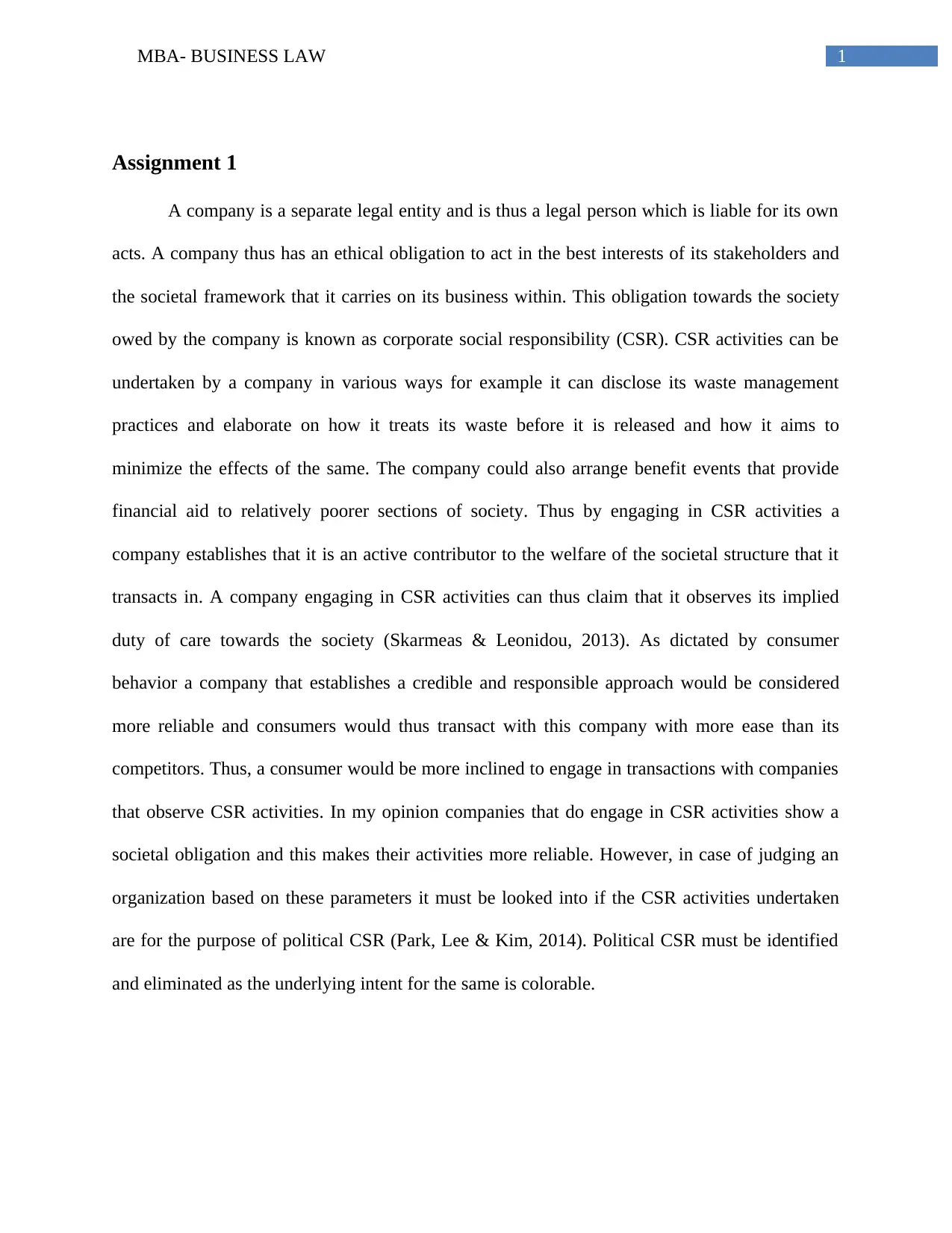
Assignment 1
A company is a separate legal entity and is thus a legal person which is liable for its own
acts. A company thus has an ethical obligation to act in the best interests of its stakeholders and
the societal framework that it carries on its business within. This obligation towards the society
owed by the company is known as corporate social responsibility (CSR). CSR activities can be
undertaken by a company in various ways for example it can disclose its waste management
practices and elaborate on how it treats its waste before it is released and how it aims to
minimize the effects of the same. The company could also arrange benefit events that provide
financial aid to relatively poorer sections of society. Thus by engaging in CSR activities a
company establishes that it is an active contributor to the welfare of the societal structure that it
transacts in. A company engaging in CSR activities can thus claim that it observes its implied
duty of care towards the society (Skarmeas & Leonidou, 2013). As dictated by consumer
behavior a company that establishes a credible and responsible approach would be considered
more reliable and consumers would thus transact with this company with more ease than its
competitors. Thus, a consumer would be more inclined to engage in transactions with companies
that observe CSR activities. In my opinion companies that do engage in CSR activities show a
societal obligation and this makes their activities more reliable. However, in case of judging an
organization based on these parameters it must be looked into if the CSR activities undertaken
are for the purpose of political CSR (Park, Lee & Kim, 2014). Political CSR must be identified
and eliminated as the underlying intent for the same is colorable.
Document Page
2MBA- BUSINESS LAW
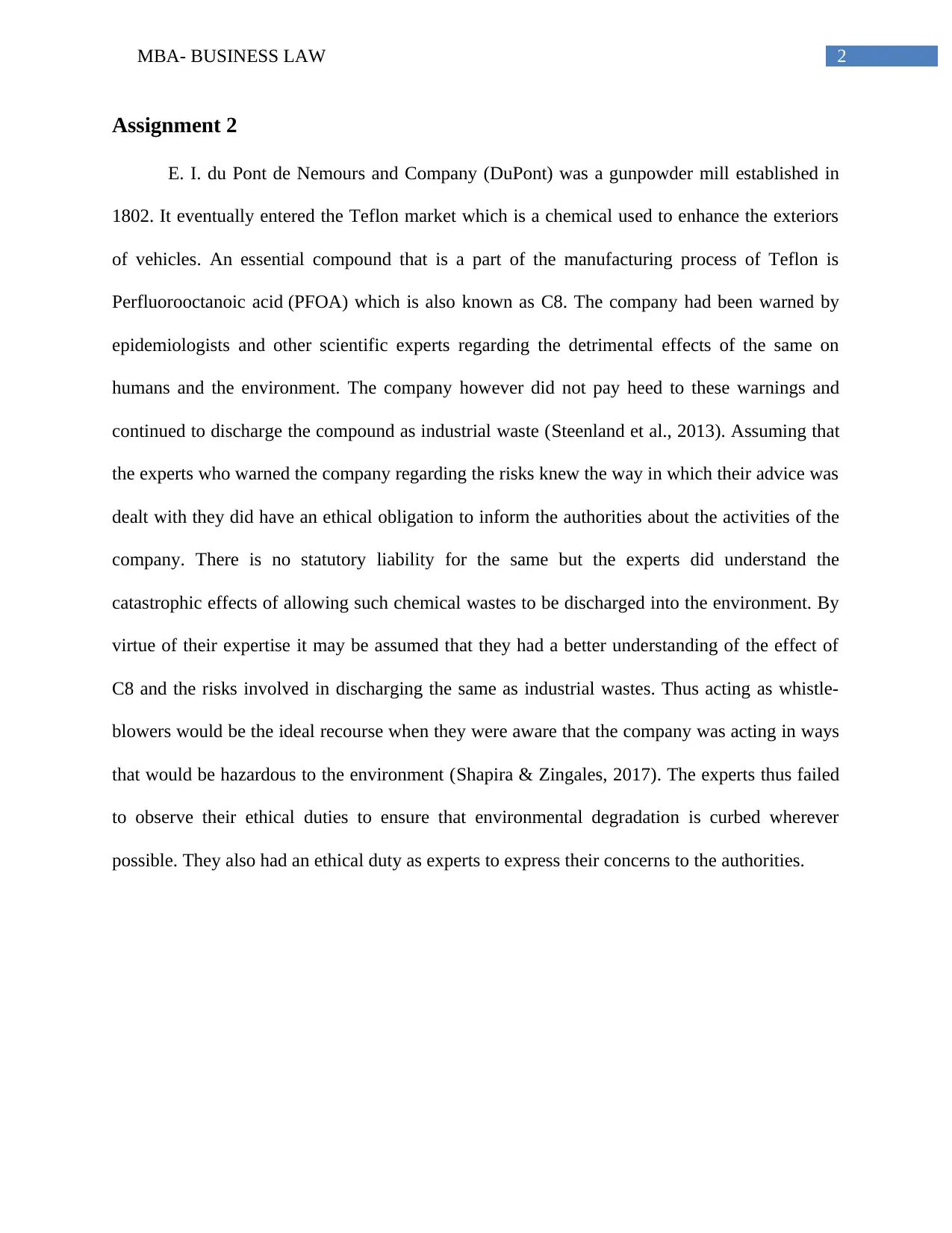
Assignment 2
E. I. du Pont de Nemours and Company (DuPont) was a gunpowder mill established in
1802. It eventually entered the Teflon market which is a chemical used to enhance the exteriors
of vehicles. An essential compound that is a part of the manufacturing process of Teflon is
Perfluorooctanoic acid (PFOA) which is also known as C8. The company had been warned by
epidemiologists and other scientific experts regarding the detrimental effects of the same on
humans and the environment. The company however did not pay heed to these warnings and
continued to discharge the compound as industrial waste (Steenland et al., 2013). Assuming that
the experts who warned the company regarding the risks knew the way in which their advice was
dealt with they did have an ethical obligation to inform the authorities about the activities of the
company. There is no statutory liability for the same but the experts did understand the
catastrophic effects of allowing such chemical wastes to be discharged into the environment. By
virtue of their expertise it may be assumed that they had a better understanding of the effect of
C8 and the risks involved in discharging the same as industrial wastes. Thus acting as whistle-
blowers would be the ideal recourse when they were aware that the company was acting in ways
that would be hazardous to the environment (Shapira & Zingales, 2017). The experts thus failed
to observe their ethical duties to ensure that environmental degradation is curbed wherever
possible. They also had an ethical duty as experts to express their concerns to the authorities.
Document Page
3MBA- BUSINESS LAW
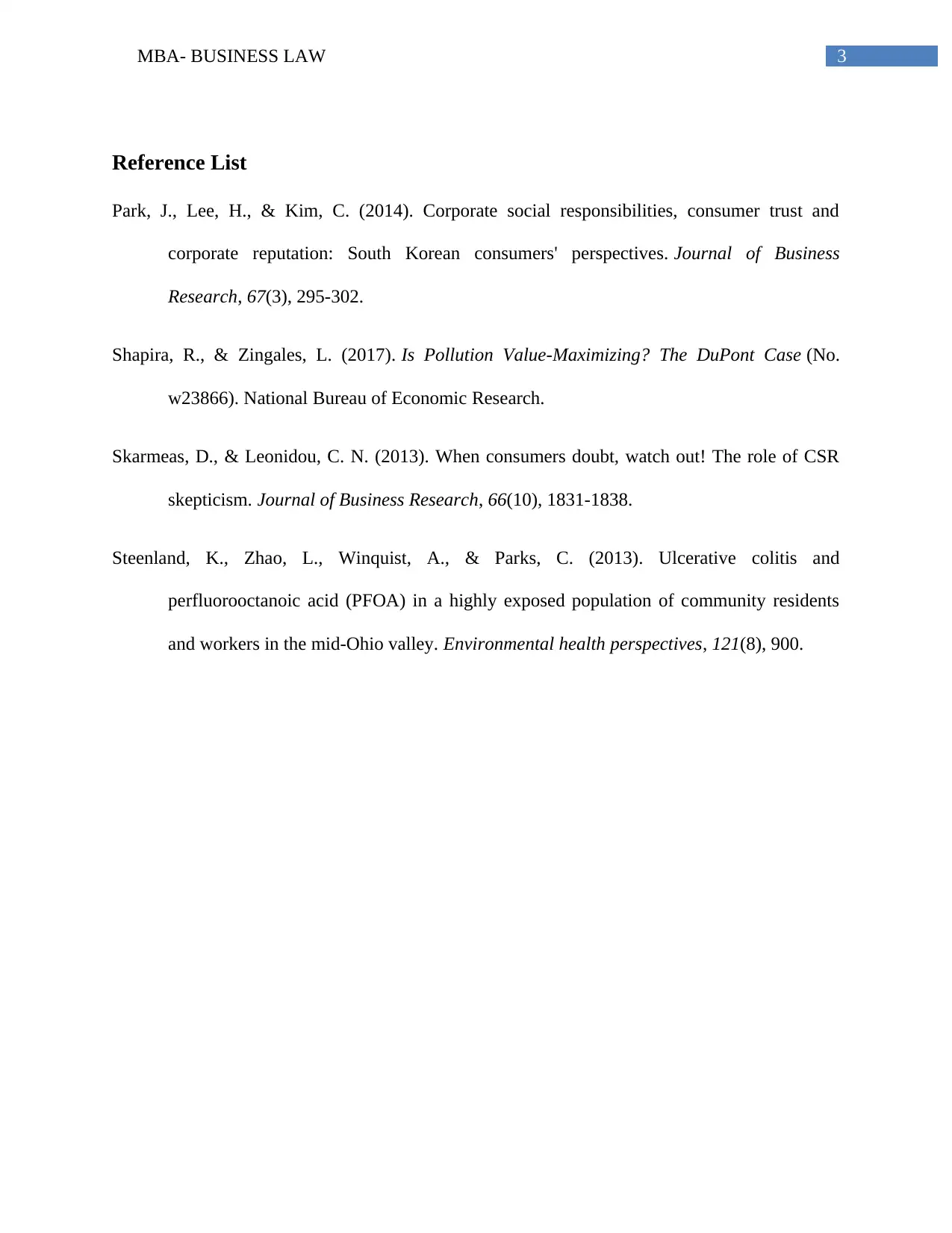
Reference List
Park, J., Lee, H., & Kim, C. (2014). Corporate social responsibilities, consumer trust and
corporate reputation: South Korean consumers' perspectives. Journal of Business
Research, 67(3), 295-302.
Shapira, R., & Zingales, L. (2017). Is Pollution Value-Maximizing? The DuPont Case (No.
w23866). National Bureau of Economic Research.
Skarmeas, D., & Leonidou, C. N. (2013). When consumers doubt, watch out! The role of CSR
skepticism. Journal of Business Research, 66(10), 1831-1838.
Steenland, K., Zhao, L., Winquist, A., & Parks, C. (2013). Ulcerative colitis and
perfluorooctanoic acid (PFOA) in a highly exposed population of community residents
and workers in the mid-Ohio valley. Environmental health perspectives, 121(8), 900.
chevron_up_icon
1 out of 4
circle_padding
hide_on_mobile
zoom_out_icon
[object Object]